The goal of this blog is to create a long list of facts that are important, not trivia, and that are known to be true yet are either disputed by large segments of the public or highly surprising or misunderstood by many.
Author: thomasstigwikman
My name is Thomas Wikman. I am a software/robotics engineer with a background in physics. I am currently retired. I took early retirement. I am a dog lover, and especially a Leonberger lover, a home brewer, craft beer enthusiast, I’m learning French, and I am an avid reader. I live in Dallas, Texas, but I am originally from Sweden. I am married to Claudia, and we have three children. I have two blogs. The first feature the crazy adventures of our Leonberger Le Bronco von der Löwenhöhle as well as information on Leonbergers. The second blog, superfactful, feature information and facts I think are very interesting. With this blog I would like to create a list of facts that are accepted as true among the experts of the field and yet disputed amongst the public or highly surprising. These facts are special and in lieu of a better word I call them super-facts.
Super fact 56 : The Bermuda Triangle mystery is a myth. There is not a higher risk of disappearances in the Bermuda Triangle. To be specific, disappearances do not occur in the so-called Bermuda Triangle, or Devils Triangle, with any higher frequency than in other comparable regions of the ocean. The “mystery” of the Bermuda Triangle is largely a manufactured one, perpetuated by sensationalized accounts that often misrepresent the facts and downplay the role of natural hazards like storms.
The number of ships and aircraft reported missing in the Bermuda Triangle is not significantly greater, proportionally speaking, than in any other part of the ocean. The U.S. Coast Guard, along with NOAA, the U.S. Navy, Lloyds of London who pays out insurance for ships and aircraft lost/missing at sea, and other organizations do not recognize the Bermuda Triangle as a unique or mysterious geographic hazard. They emphasize that this is a highly traveled area where the losses are consistent with natural phenomena such as strong storms, the Gulf Stream, human error, and poor navigation, rather than any mysterious forces.
Considering all this, the number of disappearances and accidents is what you’d expect. The Bermuda Triangle isn’t any more mysterious than the Greenland square, the New Zeeland circle, or the Azores Octagon, that I just made up. I consider this a super fact because it is very likely true, and yet surprising to many people who are convinced that there really is a mystery. Furthermore, it is important because it is such a well-known myth.
The Bermuda Triangle: It is approximately defined as a triangle Florida, Bermuda, and Puerto Rico. There is no exact definition. Alphaiosderivative work: -Majestic-, Public domain, via Wikimedia Commons.
Bermuda Triangle Mysteries
Just because the risk of disappearances of planes and ships is not higher in the Bermuda Triangle, does not mean that there aren’t mysterious disappearances and mysterious phenomenon occurring in the Bermuda Triangle. Some notable disappearances are USS Cyclops (1918), Flight 19 (1945), Star Tiger and Star Ariel (1948–1949), and the Witchcraft (1967). However, there are mysteries and mysterious phenomena occurring all around the world.
One of the mysterious phenomena occurring in the Bermuda Triangle is ocean swirls, and rogue waves, and methane burps might be another problem, but it is far from unique to the Bermuda triangle, and there are no magnetic anomalies in the Bermuda triangle as often alleged.
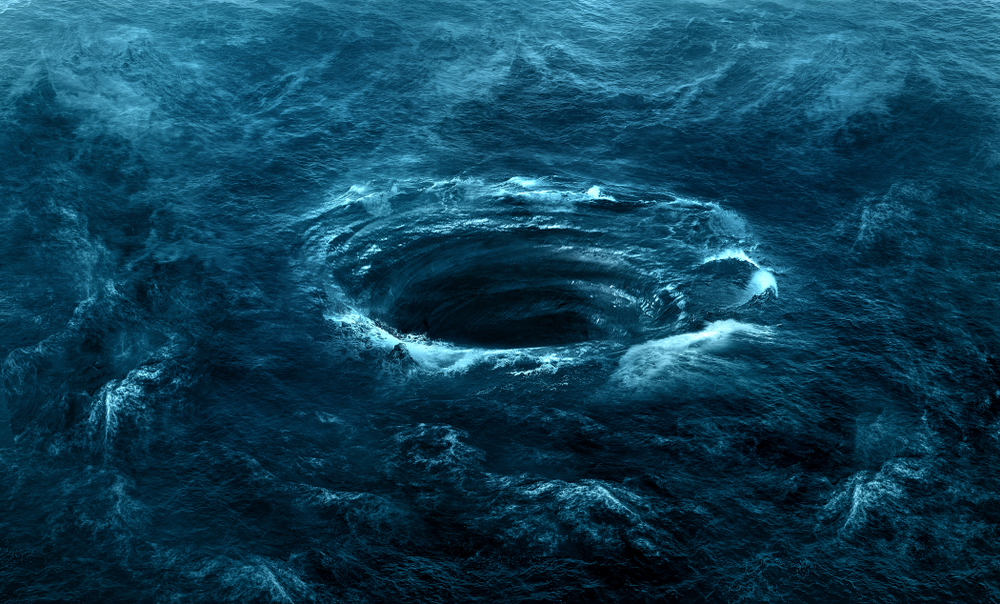
Ocean swirls frequently occur all over the world with some famous hotspots for ocean swirls by the coasts of Japan, Norway, Italy, Scotland, and Maine, USA. The ocean swirls in the Bermuda triangle might be due to movement of water between landmasses and/or the Gulf stream, but this is under investigation. There are no known giant or permanent ocean swirls in the Bermuda triangle.
Ocean swirl allegedly in the Bermuda Triangle Asset id: 1158148882 by PHOTO JUNCTION
As mentioned, another mysterious phenomenon is methane bubbling to the surface of the ocean. However, as can be seen in the maps in this National Geographic blog post the source of these methane burps of death aren’t typical to the Bermuda triangle. The methane hydrate field in the first map of the National Geographic blog post is mostly outside of the Bermuda triangle stretching from Cuba and up along the Florida coast. The second map, the world map, shows that these methane hydrate fields exist all around the world.
Our Honeymoon in Bermuda
Below are some old photos from our honeymoon in Bermuda in August of 1991.
A lot of people have died on the silver screen from being trapped in quicksand. In the 1960s, almost 3% of films featured someone sinking in clay, mud or sand. However, this is extremely rare, if it has ever happened, and it is very difficult to find any documented cases of people drowning in quicksand even when they struggle. The reason is that you can never completely become submerged in quicksand because quicksand is much denser than water so you’ll easily float. If you relax you will float and sink no more than up your waist or lower chest. In addition, quicksand pits are rarely more than a few feet deep. Another misconception spread by the silver screen is that quicksand appear in the desert. However, quicksand usually appears near water.
Quicksand is thick and heavy, and it is extremely difficult to get out once you are stuck. The best way to get out of quicksand on your own is to slowly lean back so that the weight of your body is distributed over a wider area and then do back and forth movements as if you are swimming. It will take a long time though, so expect to take it very slowly and gently.
That does not mean that getting stuck in quicksand is not dangerous. There are documented cases where people have gotten stuck in quicksand and there was no one around to help them and they couldn’t get out on their own and eventually died from thirst, exposure, or attacking animals. Another dangerous situation is when the quicksand is located on a beach near the shore. There are cases where a person was stuck in quicksand, and the tide came in resulting in a drowning.
There are situations in which the dangers associated with being submerged in quicksand are real, and that is what is called “grain entrapment” or “grain engulfment”. Several people are killed each year when they become submerged in grain and cannot escape. This happens in grain elevators and silos. So don’t jump into grain silos.
I should say that I do not consider this a super fact because it is not very important information, sort of trivia, and I also don’t think there is enough reliable information out there about this. However, I think it is interesting information that relates to me a little bit (see next section). To remind you, this is what I consider a super fact.
A super fact is:
An important fact that can be simply stated.
It is very surprising, shocking, widely disputed, misunderstood, or mind-blowing.
Yet it is true with a very high degree of certainty.
Woman sinking in quicksand Shutterstock Asset id: 2576940253 by Shutterstock AI
My Quicksand Experience
When I was about 6-7 years old, I had my own experience with quicksand or at least a mudpuddle that acted very much like quicksand. I should say that back then neighbors were friends, and your lawn was everyone’s lawn, and the kids in the neighborhood played with each other. The kids roamed the neighborhood and the forest. We threw stones at imaginary witches, screamed at moose, broke into barns to jump in the hay, ate dirt and cheerfully watched the schoolhouse burn down. There were no cellphones, doomscrolling, political keyboard warriors, online predators or overprotective parents. Kids were happy back then, but life was less safe.
I was with a group of kids, including a couple of kids a bit older than I was. We came upon a funny-looking mudpuddle, about two feet wide, and I decided to step in to check it out. I don’t remember why. Maybe I wanted to impress. Maybe I was curious. It only took a few seconds for me to sink in to right above my knees and then it was impossible to get out. The mud/quicksand held my legs in an iron grip. The fact that I stopped sinking around my knees might have been because my feet had hit solid ground. My friends tried to pull me up but could not get me up.
The older kids told me not to struggle and one of them ran to get my parents. They came running as fast as they could. My dad gripped me around the waist and slowly, bit by bit, he was able to pull me up. The rubber boots I was wearing stayed in the mud/quicksand. They might still be there like a fossil to be found by future inhabitants of our planet. Was it some sort of strange mud, or quicksand? I don’t know, but I remember being afraid. It taught me one lesson. Don’t step in funny looking mud puddles. In fact, maybe you shouldn’t step in mud at all unless you have to.
The Kuiper Belt is a vast torus/donut shaped region of space beyond Neptune, filled with icy, rocky bodies, including dwarf planets like Pluto. It shares a lot of similarities with the Asteroid belt, but it is much larger, and further out. The Kuiper belt is 20 times wider than the Asteroid belt, 1,000 larger by volume, and 20 to 200 times more massive than the Asteroid belt. It extends from roughly 30 to 50 astronomical units (AU) from the Sun.
I can add that one Astronomical Unit (AU) is the distance from the sun to Earth.
I drew this illustration of the solar system and the Kuiper belt. It is not entirely to scale, and in reality, Mercury and Venus are not attached to the sun.
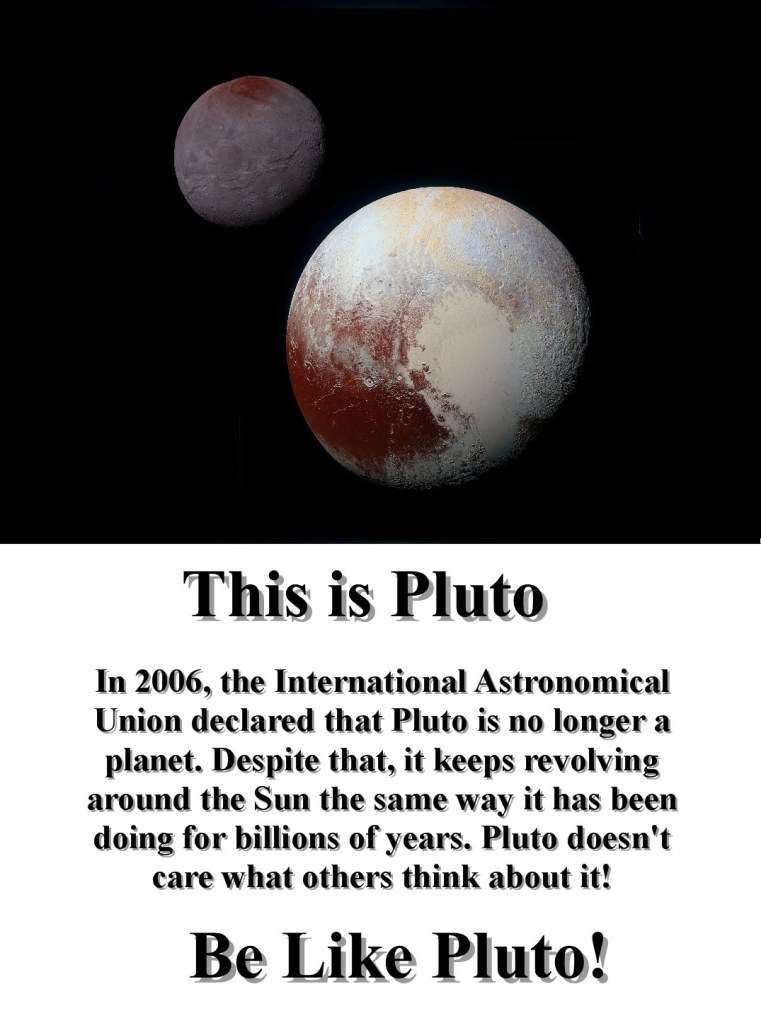
The Kuiper belt is like a giant Asteroid belt located further out, beyond Neptune. The Kuiper Object Pluto, formerly known as the Planet Pluto, is the most admired, the cutest and most beloved of all planets, and it was the first Kuiper object discovered in 1930. However, we did not know of the existence of the Kuiper belt at the time. The Kuiper belt was discovered in 1992 and predicted to possibly exist by Astronomer Gerard Kuiper in 1951. The discovery of the Kuiper belt was one of the reasons Pluto was demoted from its planet status in 2006. There are other dwarf planets in the Kuiper belt similar Pluto, including Makemake, Haumea, and Eris. However, there could be hundreds. Ceres is a dwarf planet located in the Asteroid belt. To read more about the Kuiper belt and verify the facts above, click here, or here, or here.
Pluto and its moon Charon from NASA/JHUAPL/SwRI. NASA / Johns Hopkins University Applied Physics Laboratory / Southwest Research Institute, Public domain, via Wikimedia Commons. NASA’s New Horizons spacecraft captured this high-resolution enhanced color view of Pluto in 2015.
I selected this to be a super fact because the existence of the Kuiper belt drastically changed our view of our Solar system, so it is important, we know it exists, so it is a true fact, and despite its enormous size the Kuiper belt is much less known than the Asteroid belt, and its existence often comes as a surprise to people.
The Kuiper Belt Resides in Darkness
You may wonder why the Kuiper belt was discovered so late whilst the Asteroid belt has been known since the beginning of the 19th century (Ceres 1801, Pallas 1802, Vesta 1807, etc.) The reason is that the Kuiper belt resides in darkness. The Asteroid belt is 2.2AU to 3.2AU from the sun whereas the Kuiper belt is between 30 to 50AU from the sun.
Let’s say you take an object that is 2.5AU from the sun and place it at a distance that is 40AU from the sun. Due to the spreading of the light the object will now receive 16 X 16 = 256 times less sunlight. This is called Geometric dilution. In addition, this light needs to be reflected back to earth for us to see the object, and once again the light will spread resulting in 256 X 256 = 65,536 times less light reaching our telescopes. The Kuiper belt is huge, but it resides in darkness. Despite this fact, we have now discovered and catalogued more than 2,000 Kuiper belt objects. However, it is estimated that there are hundreds of thousands of Kuiper belt objects wider than 100 kilometers.
What is a Dwarf Planet?
A planet as well as dwarf planet is a celestial body that orbits the Sun and is nearly round due to its own gravity. Basically, it must be large enough to have compressed itself to a near spherical shape. To be classified as a planet and not a dwarf planet it must also have cleared its orbit of debris. So, a dwarf planet is therefore a celestial body that orbits the Sun, is nearly round due to its own gravity, but has not cleared the neighborhood around its orbit. Obviously, a planet in the Asteroid belt or the Kuiper belt is a dwarf planet. Just to make this complicated Astronomers have found giant exoplanets that have not cleared their orbit of debris . I wonder, are these exo-planets giant dwarf planets?
Oort Cloud
Astronomer and Author David Lee Summers (blog here) reminded me of the Oort cloud, which could be interesting to bring up in this context. The Oort Cloud is a vast spherical cloud of icy bodies, which is hypothesized to surround the solar system, extending from about 2,000 to 200,000 AU. It is thus thousands of times further out and wide than the Kuiper belt. I say hypothesized because the objects are so small, there’s really no direct observation of them and there’s some variation in numbers for its distance and extent, meaning it’s still not well defined yet. Still, its outer edge is believed to be the boundary between where the sun’s gravity dominates and the galaxy’s gravity dominates.
The Oort cloud is generally considered to be the outer edge of the solar system and believed to be the origin of most long period comets. The Oort cloud is thought to encompass two regions: a disc-shaped inner Oort cloud aligned with the solar ecliptic (also called its Hills cloud) and a spherical outer Oort cloud enclosing the entire Solar System.
NASA This SVG image was created by Medium69.Cette image SVG a été créée par Medium69.Please credit this : William Crochot, Public domain, via Wikimedia Commons.
I have two blogs, Leonberger Life and this one called Superfactful.
Leonberger Life feature amusing and heartwarming stories about our late Leonberger dog Bronco, as well as other Leonbergers. It also has a lot of information about the Leonberger breed, the history, care, training, Leonberger organizations, etc. I also wrote a Leonberger book, which I am featuring in the sidebar. With my Leonberger Life blog I want to spread information about the Leonberger breed, a rare, large, furry, friendly and fun dog breed and also bring attention to my book The Life and Times of Le Bronco von der Löwenhöhle, stories and tips from thirteen years with a Leonberger.
The goal of Superfactful, which is this blog, is to create a long list of facts that are important, not trivia, and that are known to be true and yet are either disputed by large segments of the public or highly surprising or misunderstood by many. I call these kinds of facts Super facts because they could potentially be very impactful on how we view the world.
Humans have accumulated an enormous amount of knowledge. Science does not know everything, but it knows a lot. The same cannot be said for us as individuals. We know next to nothing and harbor a lot of false beliefs. I think that is pretty much true for all of us, including me, but we may not know it. With this blog I am trying to correct some of that, at least regarding important facts. In addition, along the way, I am hoping to learn a lot myself and have some of my own false beliefs corrected.
In short, the change I would like to make in the world with my blog is to correct as many false beliefs as possible and educate my readers, and myself, about facts that are both important and mind blowing.
Smash your old beliefs with new surprising facts, super facts. Expand your mind. Shutterstock ID: 1685660680 by MattL_Images
What is a Super fact?
A super fact is:
An important fact but it can be simply stated.
Very surprising, shocking, widely disputed, misunderstood, or mind-blowing.
Yet it is true with a very high degree of certainty.
The first two criteria are subjective. The last criteria can be determined from longstanding scientific consensus, my own expertise and education (valid for just a few topics), agreement between multiple reliable online or offline sources such as agreement among research papers, reputable scientific organizations, NASA, NOAA, Pew Research Center, Our World in Data, etc. I should say I also link to less academic sources such as Wikipedia, but I do not solely rely on them.
You can read more about how I choose super facts here. Also, I am open to challenges based on good data (not opinions), as well as questions. With that I don’t mean that you cannot give your opinion in a comment. I just won’t update or remove a super fact based on an opinion. In addition, I am happy to receive suggestions for super facts. I am trying to collect a few hundred super facts and need all the help I can get. In the end I want to pick the 100 best ones. I might use a poll for that.
Sometimes a super fact involves doing myth busting of a popular myth and sometimes a super fact is stating something that is well known but disputed by many. In these cases, the evidence is likely to be conclusive, but the fact is still disputed by those who don’t know much about the evidence, or don’t want it to be true. In this case, I will include a substantial amount of evidence, and it might be lengthy. People get bamboozled all the time, and that includes me. It is not easy to admit that you have been bamboozled. You can read about my own experiences with that here.
Fact or myth. Shutterstock Asset id: 2327968607
Examples of Super Facts
At the time of posting this I have made plans for 150 super facts and so far, I have posted 54. I will post a lot more. Below I am listing a few of my first 54 super facts.
Superfact 5 : Two events may be simultaneous for some but not for others. Click to visit post.
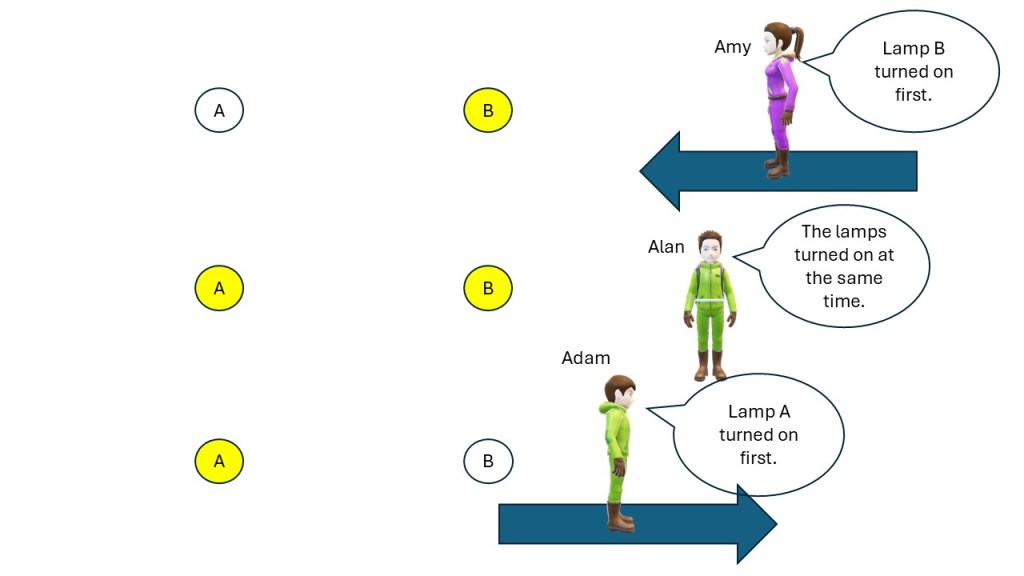
Two events may be simultaneous for some but not for others. This means that two events that are simultaneous to an observer may happen at different times to other observers. If two lamps A and B turn on at the same time according to observer #1, lamp A may turn on first for observer #2, and lamp B may turn on first for observer #3. All three observers are correct because time is relative.
Amy is traveling at a high speed to the left compared to two lamps A and B. Alan is standing still compared to the lamps. Adam is traveling at a high speed to the right compared to two lamps A and B. Alan turns on the lamps at the same time. After considering the travel time of the light she sees, Amy concludes that lamp B turned on first. After considering the travel time of the light he sees, Adam concludes that lamp A turned on first. I should add this non-simultaneity can only happen if the lamps are separated by a distance.
Superfact 7 : Poverty and child mortality has been sharply reduced worldwide. Click to visit post.
Extreme poverty as well as child mortality has been sharply reduced the world over. The countries that are the worst-off today are still better off than the countries that were doing the best at the beginning of the 19th century. Over the last 20 years extreme poverty and child mortality have continued to decline sharply.
Child mortality in in the world since 1950. The spike you see around the end of 1950 to 1960 is the great leap forward famine in China. In 1950 the child mortality rate was 22.7% and in 2023 the child mortality rate was 3.6%.
Superfact 25: Global Warming is Happening and is Caused by us – click to visit post.
Global warming is happening. Or if you call it Climate Change or Climate Disruption is indeed happening. And it is happening very fast. We also know that it is caused by us primarily as a result of our burning of fossil fuels. There is a long-standing scientific consensus on these two facts because the evidence is conclusive. Check the evidence in the post.
Superfact 28: That Earth is round was well known long before Columbus – click to visit post.
That Earth is round, or spherical (or closely spherical) had been known for at least a couple of thousand years by the time Columbus set sail. Columbus did not set sail to prove that earth was round, and he knew it was round.
Illustration of the measurement of the Earth circumference by Eratosthenes (2,300 years ago). On June 21st there is no shadow in Syene/Aswan but there is one in Alexandria. Asset id: 2319651251 by Javier Jaime
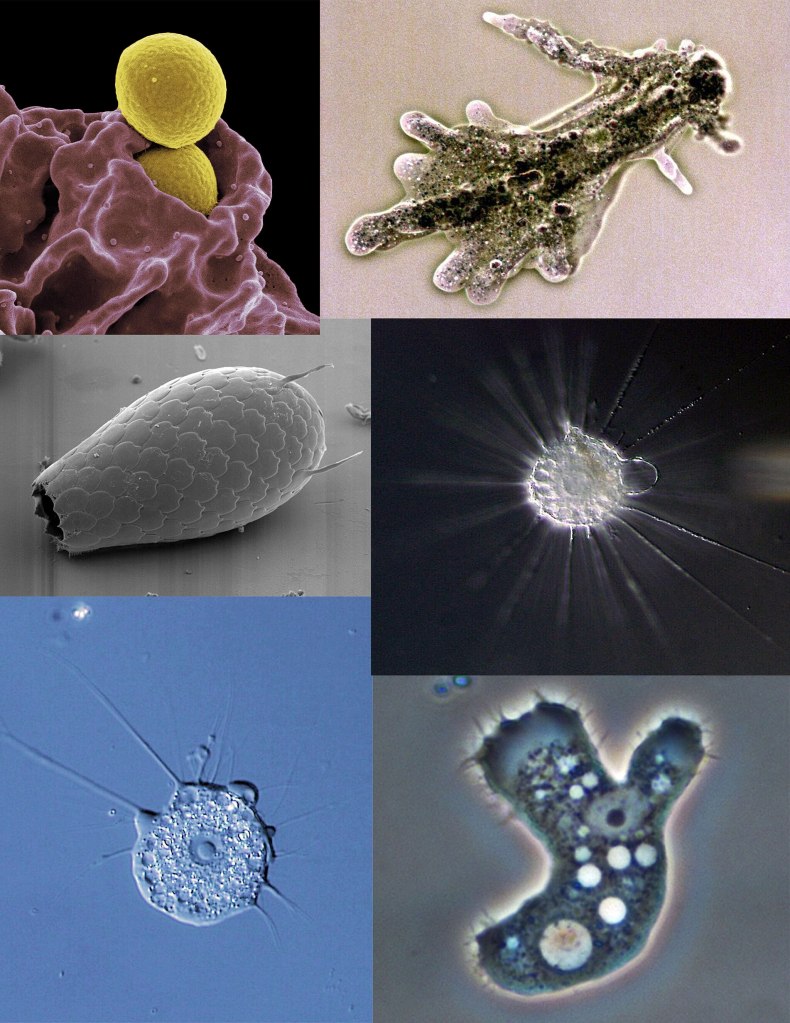
Fire ants are small. They average 1/8 inch to 1/4 inch in length, or 3 to 6 millimeters. Mites are very small arachnids that are less than 1 millimeters. They are so small that they are difficult to see with the naked eye unless they are on a white sheet. However, amoebas are typically even smaller than mites. Most amoebas range from 10 to 500 micrometers in diameter. 500 micrometers is the same as half a millimeter. You typically need a microscope to see an amoeba. I should say that there are some large amoebas that are 2 millimeters.
Amoebas from Wikimedia commons. Attribution Respectively: NIAID, Cymothoa exigua, ja:User:NEON / User:NEON_ja, Jacob Lorenzo-Morales, Naveed A. Khan and Julia Walochnik, ja:User:NEON / User:NEON_ja, ja:User:NEON / User:NEON_ja, CC BY-SA 4.0 <https://creativecommons.org/licenses/by-sa/4.0>, via Wikimedia Commons
Microscopic Things
If you want to go even smaller, much smaller, we can enter the microscopic world. Bacteria are microscopic, single-celled organisms with sizes typically ranging from 0.5 to 5 micrometers in length and 0.2 to 1 micrometer in width. That means that bacteria are around 100 times smaller than amoebas. Well, if you consider length. If you consider the volume that is a million times smaller. Comparing an amoeba to a bacterium is like comparing a horse to a small cicada. You certainly need a microscope to see bacteria.
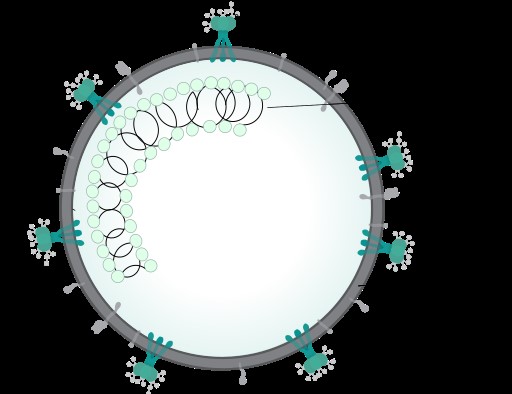
If you think bacteria are small, I can tell you that viruses are even smaller. Viruses typically range in size from 20 to 300 nanometers in diameter. 1000 nanometers is 1 micrometer. A small corona virus (SARS-CoV-2) is 50 nanometers, which is 20 times smaller (in diameter) than a bacterium that is 1 micrometer in size and 100 times smaller (in diameter) than a bacterium that is 5 micrometers. Again, a horse to a medium size insect.
Atoms are much smaller than viruses. This reddit user calculated that there are roughly 52 million atoms in a normal sized covid virus (100 nanometers). Also keep in mind that there is a lot of space between atoms. The size of a hydrogen atom is 0.1 nanometer or 100 picometer. Comparing a hydrogen atom to a normal sized covid virus is like comparing a flea to a horse. If you consider volume, you could fill a normal sized covid virus with 1 billion hydrogen atoms.
You cannot see an atom using a regular microscope. You must use specialized microscopes that don’t rely on visible light to see atoms, such as scanning tunneling microscopes and electron microscopes. So, in summary, a hydrogen atom is to a normal sized covid virus like a flea is to a horse, and a normal sized covid virus is to a 100 micrometers amoeba (small sized amoeba) like a flea is to a horse.
Below is an illustration of a Helium atom, which is the next element after Hydrogen. A Hydrogen atom has one electron and one proton and possibly one or two neutrons. A stable Helium atom has two electrons and two protons and one or two neutrons.
Illustration of a Helium atom. It has two electrons and a nucleus with two protons and two neutrons in the middle. The two electrons are depicted as clouds because they don’t have an exact position. Attribution : User:Yzmo, CC BY-SA 3.0 <http://creativecommons.org/licenses/by-sa/3.0/>, via Wikimedia Commons
Subatomic Things
But let’s go smaller, much smaller. A hydrogen atom is gigantic in comparison to subatomic particles. Most of the mass in an atom is concentrated in the nucleus, which consists of protons, neutrons, quarks and gluons, and quark pairs called mesons. The size of an atomic nucleus varies, but it typically ranges from 1.6 femtometers (1.6 x 10⁻¹⁵ meters) for a proton to about 15 femtometers for the heaviest atoms.
I should say this is difficult to estimate so take this with a grain of salt. In any case that makes the hydrogen atom about 100,000 times wider than the nucleus in its middle. If the hydrogen atom was 100-meter giant ball the nucleus in the middle would be just 1 millimeter (half the size of a flea). That is despite the fact that the vast majority (+99.95%) of the mass of the atom is in the nucleus. In this case, we are not comparing a flea to a horse, but a flea to a mountain. A mountain of mostly empty space with a super massive flea at its center. The YouTube video below explains the details.
Strings Are Extremely Small
However, the smallest things there are, might be strings. Strings, in the context of physics, are one-dimensional, extended objects that are thought to be the fundamental building blocks of the universe. These strings vibrate at different frequencies giving rise to elementary subatomic particles. Strings are thought to be about 10^-35 meters, which is 100,000,000,000,000,000,000 times smaller than the atomic nucleus described above. Comparing a string to a nucleus would be like comparing the hydrogen atom to a ball, or a giant star, containing one billion planet earths. I should mention that string theory has not been experimentally confirmed.
That is small, very small, extremely small, as small as it can get.
This post is not a super fact since it features a lot of facts and not all of them confirmed or exact.










 Super Facts