The goal of this blog is to create a list of super facts. Important facts that are true with very high certainty and yet surprising, misunderstood, or disputed by many. This blog aims to be challenging, educational, and fun, without it being clickbait. I determine veracity using evidence, data from reputable sources and longstanding scientific consensus. Prepare to be challenged (I am). Intentionally seek the truth not confirmation of your belief.
Super fact 54 : Satellites currently handle a very small percentage of global internet traffic, estimated at about 1%. The vast majority of internet traffic is carried by undersea cables.
I consider this a super fact because it is surprising, true and not trivia. It is an important fact since most of us use internet every day. It is a very common belief that satellites handle most of the global internet traffic, or at least a very large portion of it. I should say that a few years ago I thought so myself.
Stock Illustration ID: 1372134458 by Boris RabtsevichSubmarine underwater communication fiber optic cable on deep seabed. Asset id: 2175977719 by Dragon Claws
How Much Internet Traffic is Handled by Satellites
I should say that I did not find a lot of sites that answered this question, but all of the sites that I found gave similar answers such as, less than 1%, 1.5%, 1-2%, very little, etc.
I started out by asking ChatGPT this question “How much of internet communication does Satellites handle?” The answer I got was that Satellites handle a relatively small percentage of global internet traffic — typically less than 1–2% — with most of the world’s internet communication carried through undersea fiber optic cables and terrestrial infrastructure (like cell towers and wired broadband). Wikipedia states that satellites handle less than 5% – to an estimate of even 0.5%. I should add I do not rely on ChatGPT, SGE or Gemini, or Wikipedia for this blog but I take hints from them.
The reason satellite internet is used less is because satellite internet is significantly more expensive to use than traditional wired connections. In addition, satellites have higher latency (delay) compared to fiber optic cables, and less bandwidth (data capacity). Satellite internet is primarily used in remote areas where other forms of internet access are unavailable. Satellite internet is also used for military and government operations, as well as maritime and aviation connectivity. However, satellite internet is improving so this may change in the future. This is a comparison between satellite internet and optical fiber.
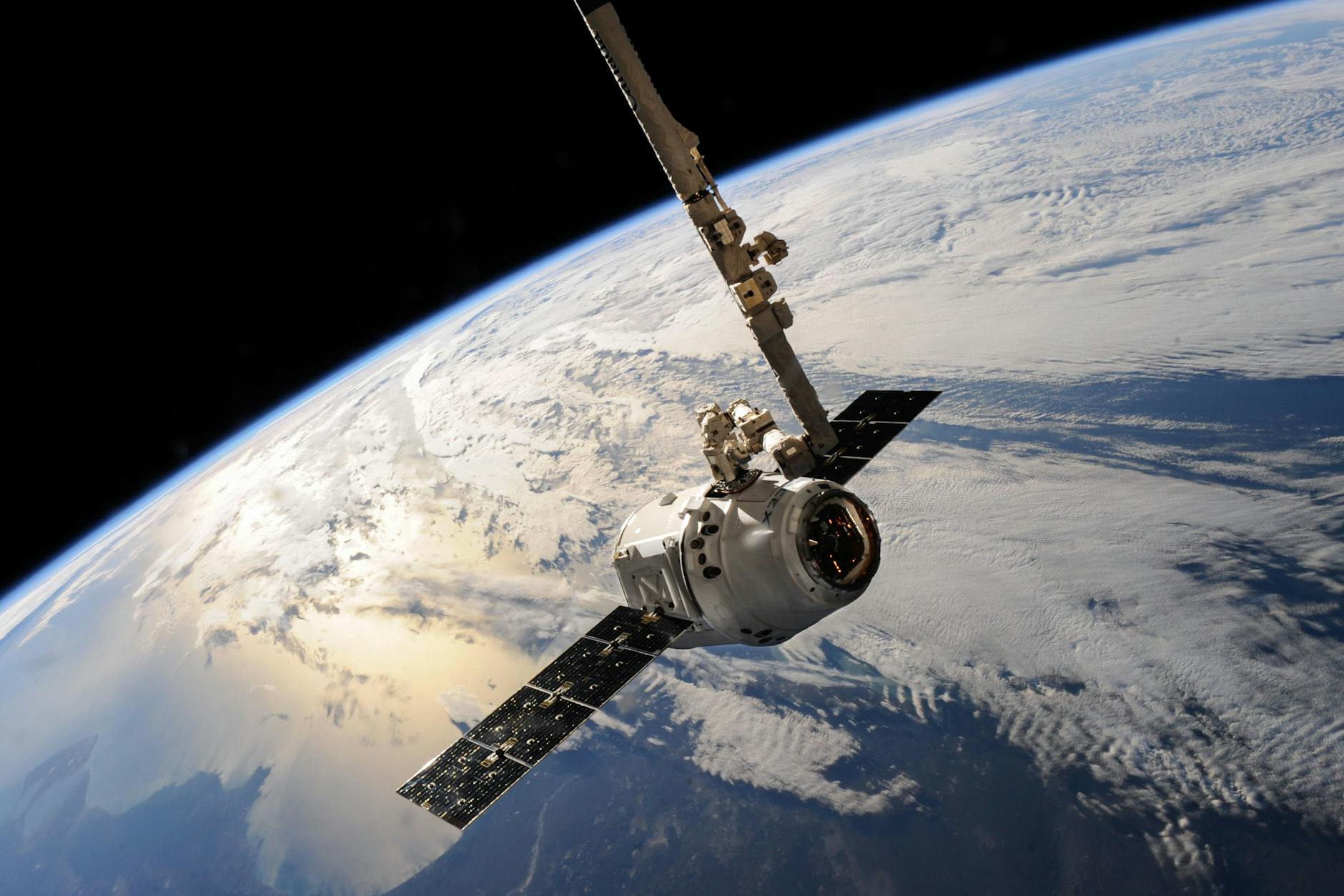
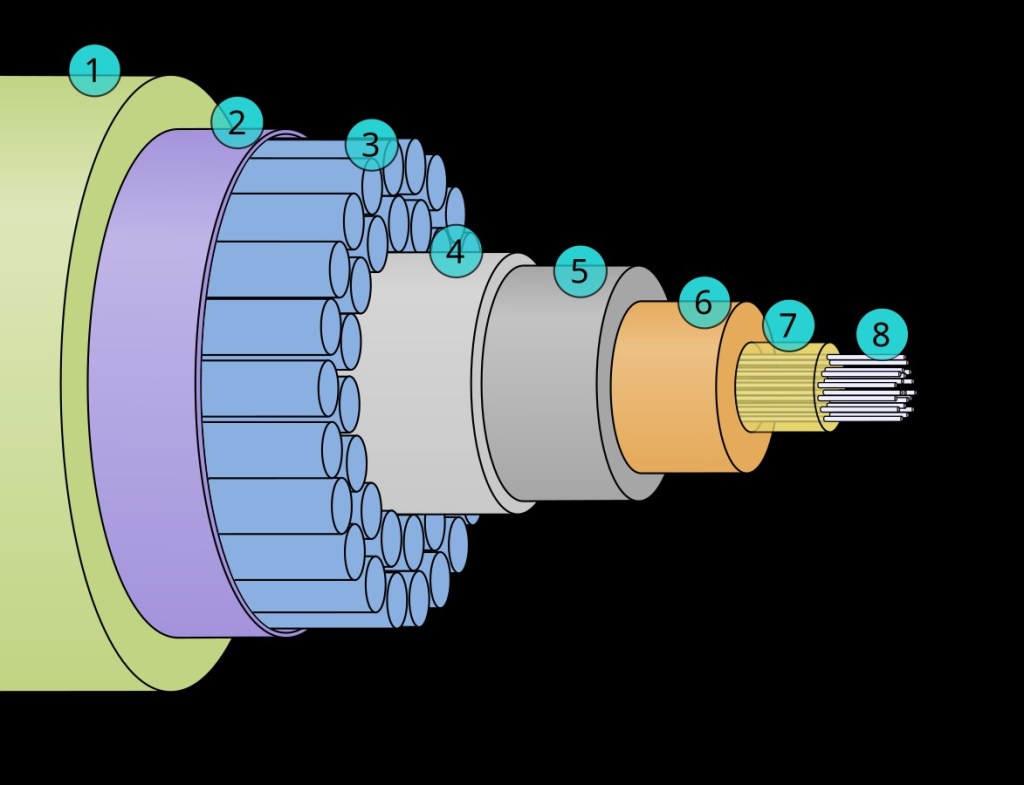
Photo by SpaceX on Pexels.comThis is a cross section of submarine fiber optic cable. Picture by Oona Räisänen (User:Mysid), Public domain, via Wikimedia Commons.
The layers in the picture of the submarine communications cable above are (from outside to inside): (1) Polyethylene (2) Mylar tape (3) Stranded steel wires (4) Aluminum water barrier (5) Polycarbonate (6) Copper or aluminum tube (7) Petroleum jelly (8) Optical fibers.
So, on what subject(s) am I an authority? My understanding on what being an authority on a subject means is that it is being an expert with recognized credibility on that subject. However, the word “authority” has so many other meanings and it brings to mind the “appeal to authority fallacy”. The “appeal to authority fallacy” refers to appealing to influential people or organizations who may not necessarily be experts, and regardless of the evidence.
In science you don’t really have such authorities, you have experts who often disagree with each other. In the event almost all experts agree on a certain fact that has been thoroughly vetted you can trust that fact with nearly 100% certainty, and that is not appeal to authority but a probability argument. Therefore, I don’t really like the use of the word authority in this context. It is confusing. I would have preferred the question to be “In what subject(s) do you have recognized expertise?”
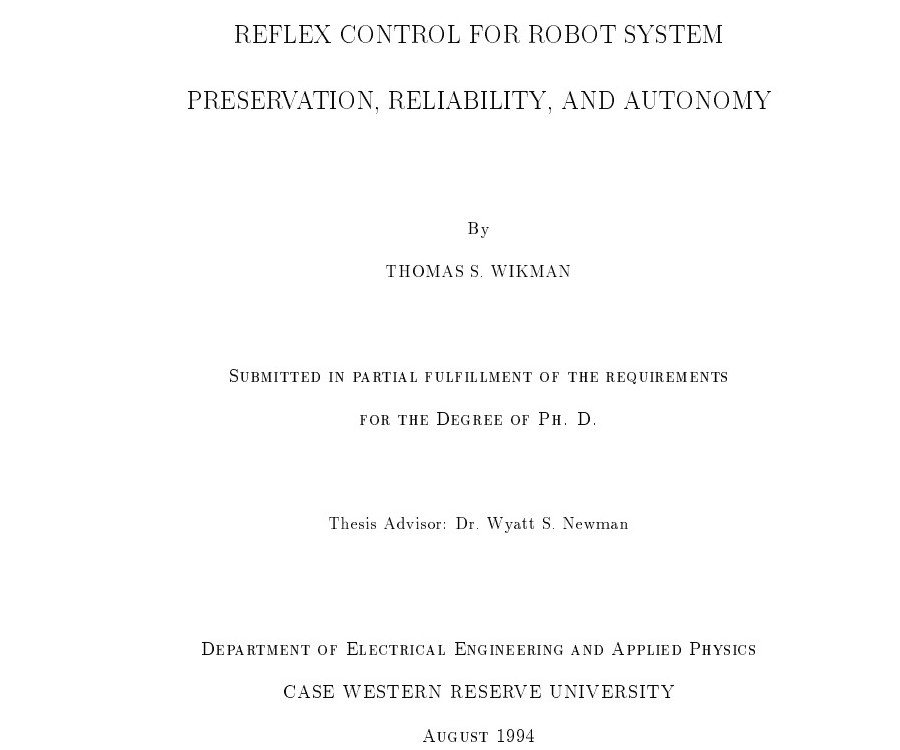
This is the front page of my PhD thesis “Reflex Control for Obstacle Avoidance and Self Preservation”.
Robotics
Reflex Control for Obstacle Avoidance and Self Preservation
My PhD thesis was in Robotics, specifically Reflex Control for Obstacle Avoidance and Self Preservation. Therefore, you can say that I am an expert on Reflex Control for Obstacle Avoidance and Self Preservation, Reflex Control (in Robotics) as well as Robotics. My expertise has been recognized through my published research papers, the citing of those papers, my PhD thesis, and my peers including Rodney Brooks.
Rodney Brooks is a former director of the MIT Computer Science and Artificial Intelligence Laboratory, founder of several robotics research companies, and he is arguably the most famous roboticist in the world. In the 1990’s he was featured on the front page in national magazines such as Time Magazine several times. During my internship at the Robotics Lab at Sandia National Laboratory in Albuquerque, New Mexico in 1993, I spoke to Rodney Brooks about my research, and he congratulated me on my research, which he liked.
Briefly, reflex control in Robotics refers to functionally simple, quick, and reliable behaviors that override whatever more complex algorithms or humans (joystick / telerobotics) are commanding in case those algorithms or humans execute dangerous motion. Take for example, a robot moving quickly among multiple objects and the path planning algorithm generates a faulty command that would result in a collision when executed. The reflex control layer would detect the problem (assuming it knows about the objects) and halt the robot before it collided with the object. This would need to happen quickly, in milliseconds, and always in a failsafe way. After the collision has been avoided the system or the human can figure out what went wrong and figure out a new path.
To do this the Reflex controller needs to be embedded with the motion controller, and know the characteristics of the motors, the robot configuration, and mechanical characteristics, such as mass, friction model, inertia, etc., exactly. The result is that when you drive a robot around among multiple objects such as boxes hanging from the ceiling, coat racks, and sombreros, and other robots it will avoid colliding with these objects regardless of input from people or high-level path planning algorithms. It looked like the objects were protected by an invisible force field.
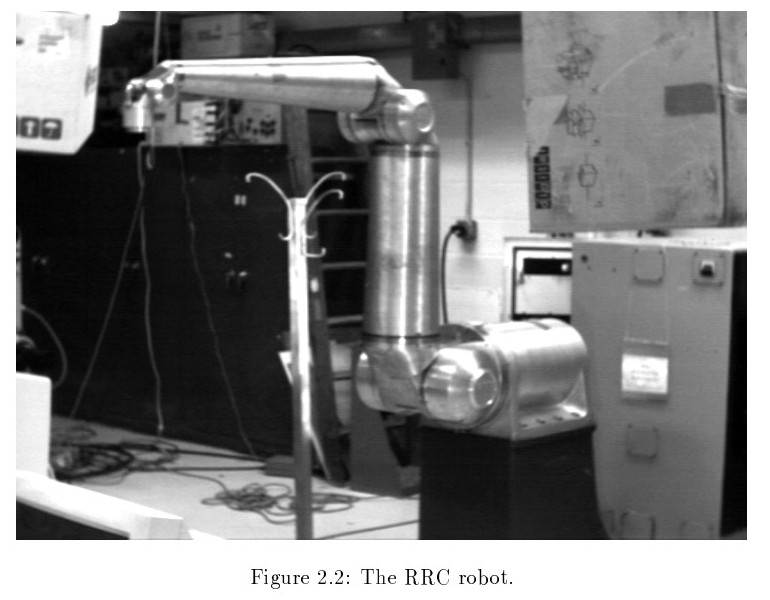
This is an old black and white photo of the Robotics Research Corporation Robot surrounded by objects including boxes hanging in the ceiling, a coat rack, and a control cabinet. I took the photo, and I created the software for the robot and placed the objects in its workspace.
Robot Kinematics
In addition, to “Reflex Control for Obstacle Avoidance and Self Preservation” or “Reflex Control for Robots”, which is very narrow field, I gained expertise in fields of robotics that are a bit wider. One such field is robot kinematics. That includes, for example, calculating the position, speed and acceleration of the tool tip (the end tip) of the robot from the position and motion of the joints of the robot. Or it could be calculating the possible joint angles from the position of the tool tip. The RRC robot was a seven-jointed robot so this could get complicated. I should say that when I worked for ABB Robotics (after my Ph.D) I created the kinematic models for 30+ of ABB Robotics robots. Therefore, I have expertise and recognized credibility in Robot Kinematics as well.
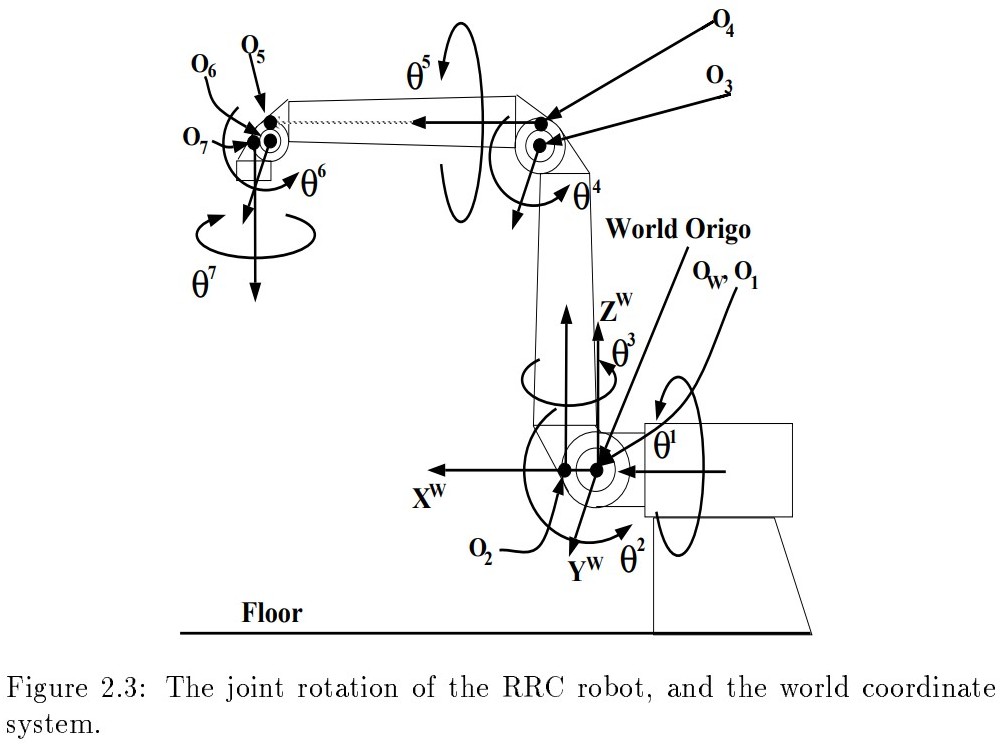
The drawing shows the seven joints, the seven possible rotations around those joints, the seven joint angles (the thetas), and the seven coordinate systems and their origos (the O’s) at each joint.
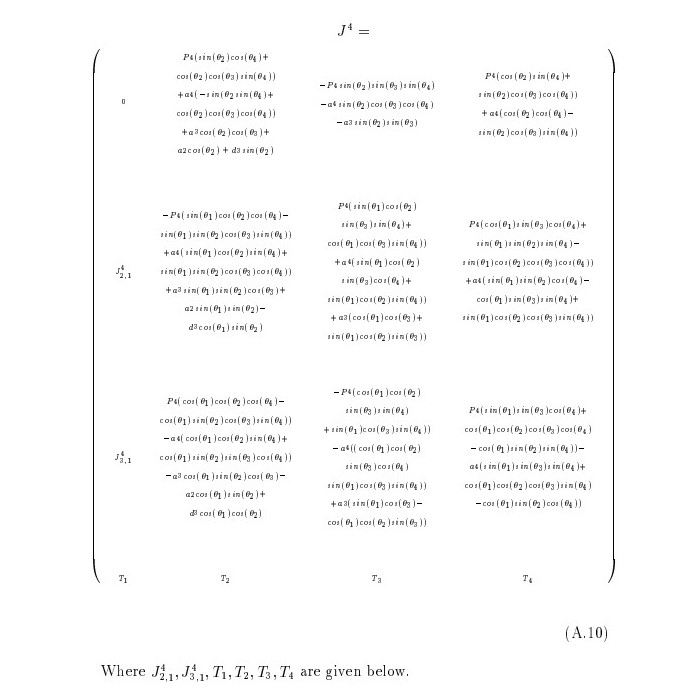
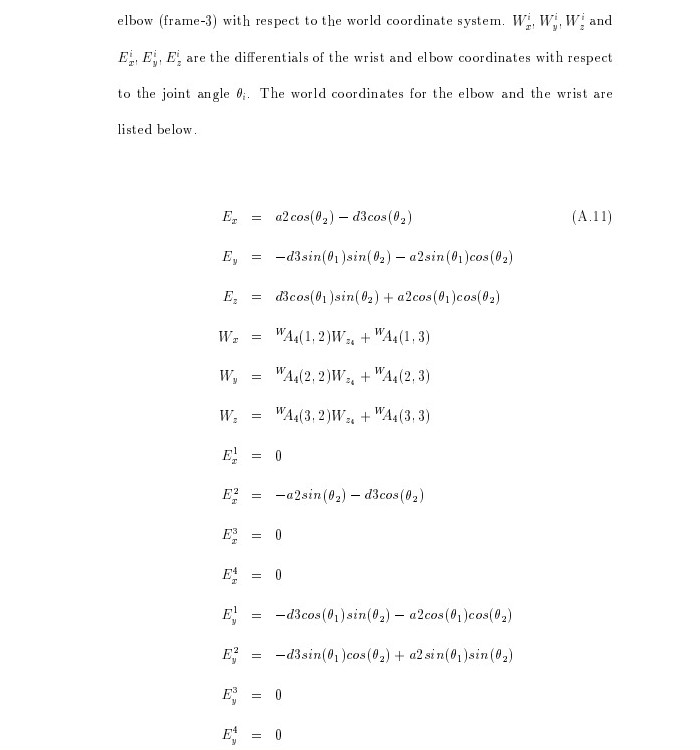
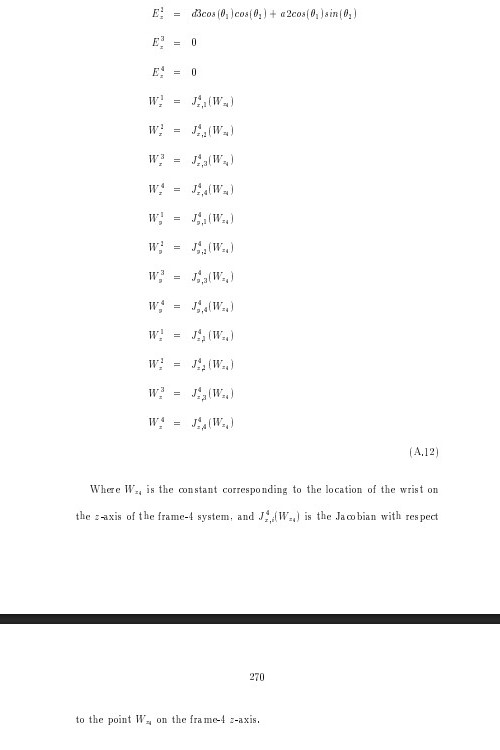
Robot kinematics can get complicated, at least for a seven-jointed robot like the RRC Robot. An example is the Jacobian, which is a matrix that relates joint velocities to end-effector / tool-tip velocities. The Jacobian is crucial for understanding and controlling robot motion, particularly for inverse kinematics and trajectory planning. Below is the Jacobian for the first four joints of the RRC robot. I spent an entire day deriving it. Depending on your eyesight it is difficult to read the scribbles, but it is a bunch of very long, mostly trigonometric equations. Don’t worry about understanding the matrix, it is just to show how complicated robot kinematics can get.
First part of the 4-dimensional (first four joints) Jacobian for the RRC Robot.Second part of the 4-dimensional (first four joints) Jacobian for the RRC Robot.Third part of the 4-dimensional (first four joints) Jacobian for the RRC Robot.Fourth part of the 4-dimensional (first four joints) Jacobian for the RRC Robot.
Configuration Space in Robotics
Another subject I gained a lot of expertise in is configuration space or so-called C-space. It is related to robot kinematics. C-space is a mathematical representation of all possible configurations a robot can take. In C-space for a robot arm (like the RRC Robot) the coordinates are the joint angles instead of X, Y and Z. For the seven-jointed RRC robot you have seven joint angles and C-space is thus seven dimensions. C-space is very useful if you succeed in representing obstacles in it. A point might become a curve, or multi-dimensional membrane in C-space, and a ball might become a multi-dimensional banana. I had a lot of fun creating algorithms for creating C-space with obstacles in it.
My Other Expertise
I also have a degree a master’s degree in engineering physics (Teknisk Fysik) from Uppsala University in Sweden. I should say that engineering physics in Uppsala was focused a lot on theoretical physics and modern physics as well as practical applications for physics. Case Western Reserve University later converted this degree to a master’s in electrical engineering. I loved physics and was a good student, but my special interest was the theory of relativity. Even though I had and still have a hard time with the General Theory of relativity and I studied the special theory of relativity way beyond what was required at school, and I read dozens of technical books on the subject. So, this is also sort of an area expertise for me.
Below are some links to topics related to the special theory of relativity on this website:
I spent at least 30 years working with software as a software engineer / robotics engineer and gained a lot of experience in software development. It was mostly embedded software but also graphical user interfaces, things you can see on a screen, and Networking Software Development. I worked a lot with Visual Studio, a powerful, expandable, and popular integrated development environment (IDE) from Microsoft.
I developed a lot of code using C++ and C#, .Net, WPF, but also other languages and libraries. I started with Visual Studio 97 (in 1997), then Visual Studio 6, Visual Studio .NET 2002, Visual Studio .NET 2003, Visual Studio 2005, Visual Studio 2008, Visual Studio 2010, Visual Studio 2012, Visual Studio 2015, Visual Studio 2017, but I never got around to Visual Studio 2019 and Visual Studio 2022. So, you can say that I am an expert on Visual Studio with C++ and C# and .NET (I am less of an expert on the other languages typically used with Visual Studio).
Later in life I also came to learn a lot about climate change / climate disruption / global warming / the greenhouse effect whatever you call it. I used to be skeptical about climate change, and I thought it might be politicized by the scientific community, but after some interesting red flags I took a deep dive into the subject, and I learned that climate change is very real and caused by us. I was politicized not the scientific community. There is a scientific consensus on the subject for very good reasons. I continued by reading dozens of climate science papers and several dozens of technical and non-technical books on the topic. Therefore, at this point I know more about it than a lot of people. Maybe expert is a strong word, but almost expert.
Least but not last
Being a Leonberger Dog Expert
I know a lot about Leonbergers because my family was lucky enough to live with one for thirteen years. His name was Le Bronco von der Löwenhöhle—but we called him “Bronco” for short. Bronco wasn’t our only dog, but our world wouldn’t have been the same without him. For instance, he once saved the life of our pug by fending off an attack from another dog. He probably saved our Labrador’s life, too, by sniffing out an impending insulin shock before it happened. Then there was the time he scared off a trespasser who’d been terrorizing my wife and other women in the neighborhood.
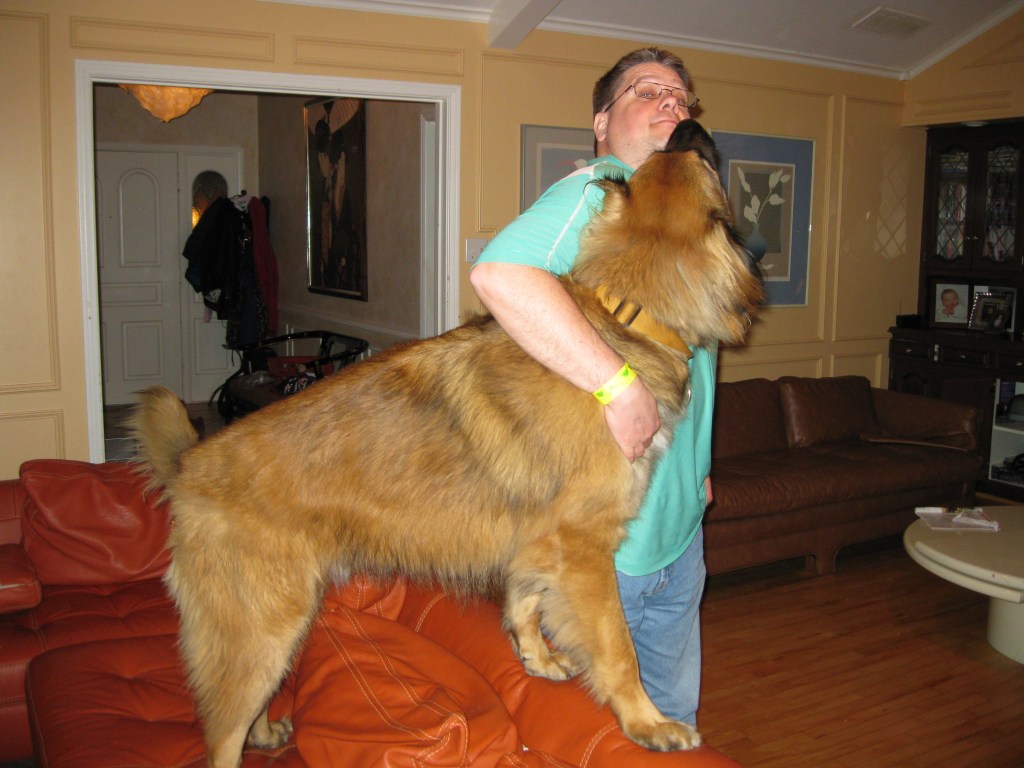
Bronco loved to dance and hug. Here he is giving me a hug (not yet fully grown).
Bronco is no longer with us, but even in his passing he was distinctive. Leonbergers tend to live less than nine years—but Bronco came very close to reaching his thirteenth birthday. In fact, he received an award for longevity called the “Grey Muzzle Award.” We already knew he was a special dog, but we sent his DNA to two labs for research anyway. I wrote a book about our amazing Bronco and his many amusing adventures and included helpful information on Leonbergers for new owners and interested dog lovers. I also have a Leonberger website.
In the process of writing my book about Bronco and Leonbergers I came to learn a lot about Leonberger dogs, the Leonberger breed standard, their history, health issues, Leonberger organizations, health and care, etc. I became a bit of a Leonberger expert. If you are interested in the book, check it out here or here. You can also get it from Amazon in many other countries, Barnes & Noble, Chapters Indigo and many other bookstores. For more information check here.
This post is not a super fact post but it contains some other important information. 23AndMe, the large personal genomics and biotechnology company just went into bankruptcy. This has implications for its 15 million customers including me and my wife. In fact, it is advised that you delete your data from their website, and I will tell you how to do that.
About 23AndMe
23AndMe, founded in 2006 provides a direct-to-consumer genetic testing service in which customers provide a saliva sample that is analyzed to generate reports relating to the customer’s ancestry, genetic predispositions, inherited health conditions and other health related topics. Who doesn’t want to know something about their ancestry going back possibly thousands of years? Who doesn’t want to know about genetic timebombs in their DNA?
I took the test, and my wife took the test, our daughter took the test, other family members took the test, and it was fun and very interesting, and a good conversation starter. For example, I found out that I am practically a Neanderthal, well maybe not exactly.
Geneticist sequencing human genome Asset id: 2479929725 by FOTOGRIN
What we did not think about is that 23AndMe represented a significant privacy risk. This is data that can be misused in various ways. You can be discriminated against based on this data, you can be denied employment, insurance companies can use it to deny you health insurance, you can be subject to surreptitious testing without your consent. Not to mention familial complications, such as infidelity, and people finding out who their real parents are, and relatives were. In the wrong hands this data is dangerous.
In October 2023 hackers stole 7 million people’s data. Stolen information included people’s names, addresses and genetic data and was sold online. This made the economic difficulties the company was in even worse. Yesterday the company filed for Chapter 11 bankruptcy and their founder and CEO resigned. Now people are rightfully worried about their data.
Ancestry from 23AndMe
However, the information we got from our genetic tests was interesting and fun. I found out that my ancestry was 99.8% Northwestern European, 85.3% Scandinavian/Sweden/Norway, 14.4% Finnish, 0.1% other Northwestern European, and 0.2% Siberian.
Not surprising since my family have lived in northern Sweden and northern Finland since at least 1628 according to the ancestry records. Other people in my family were a lot more mixed than that. I can add that I also thought it was fun to on occasion find second cousins or third cousins whose existence I was unaware of.
I also found out that I had strong Neanderthal ancestry. The report says I have more Neanderthal variants than 99% of customers. On the 23AndMe website there was a forum, or club for people with strong Neanderthal ancestry, so I joined. However, some people were taking it a bit too seriously and after I while I did feel comfortable in the Neanderthal club, so I left.
I was happy to find that I did not seem to have any hereditary predisposition for any illnesses among the ones they listed. Well, I have the typical predisposition for type II diabetes. I was happy to see that I am not predisposed to get Alzheimer’s, which I was worried about, since I have a couple of relatives with that condition.
The most fun and perhaps least important aspect of the genetic testing was the non-health related predispositions. For example, regarding “ice cream flavor preference” my genes says that I am “more likely to prefer vanilla over chocolate ice cream”. My wife got the opposite, and this is correct. I love vanilla, she loves chocolate. I am less likely than average to be afraid of heights and less likely to be motion sick.
Our eye colors, finger and toe lengths, propensity for dandruff, cheek dimples, hair texture and thickness, earwax type, freckles, bunions, the DNA analysis got it all right. By the way I am good at smelling asparagus, just like my DNA test says. The one thing that my DNA test got wrong was that the most likely time for me to wake up in the morning is 6:53AM. The DNA test got my wife’s wake up time correct, but I am not waking up at 6:53AM.
Deleting your data from 23AndMe
OK this is a lot of fun and maybe useful, but the big question is do we want this information in the wrong hands. I’ve mentioned a few ways in which this data can be misused but there may be many more ways this data can be misused that I have not thought about, that no one has yet thought about. Therefore, I deleted all our data from 23AndMe today. If you are a member of 23AndMe I suggest you do the same. Below I am giving you the instructions for how to delete your data from 23AndMe.
Log into your 23andMe account. You may need to reset your password.
Go to your profile and locate the little menu up on the far top right. Select Settings.
Scroll to the “23andMe Data” section at the bottom of the page and click View (button). If you want to download your data, select what you want to download. I downloaded the “reports summary”, which is a pdf file. I also downloaded ancestry composition raw data, which is a large CSV file compressed into a zip file. Finally, I downloaded family tree data, which is in json format.
Scroll to the “Delete Data” section and click Permanently Delete Data. This is a Red button at the bottom.
Confirm your request: You’ll receive an email from 23andM. Click the link/button in the email to confirm.
Important Note : I am back from my ski vacation, and I once again respond to comments posting and visiting other people’s blogs.
Super fact 29: EV Cars emit less pollution than Internal Combustion Engine Cars, even considering manufacturing, disposal and EV Cars being charged by dirty grids.
EV Cars emitting less carbon pollution is a Super Fact
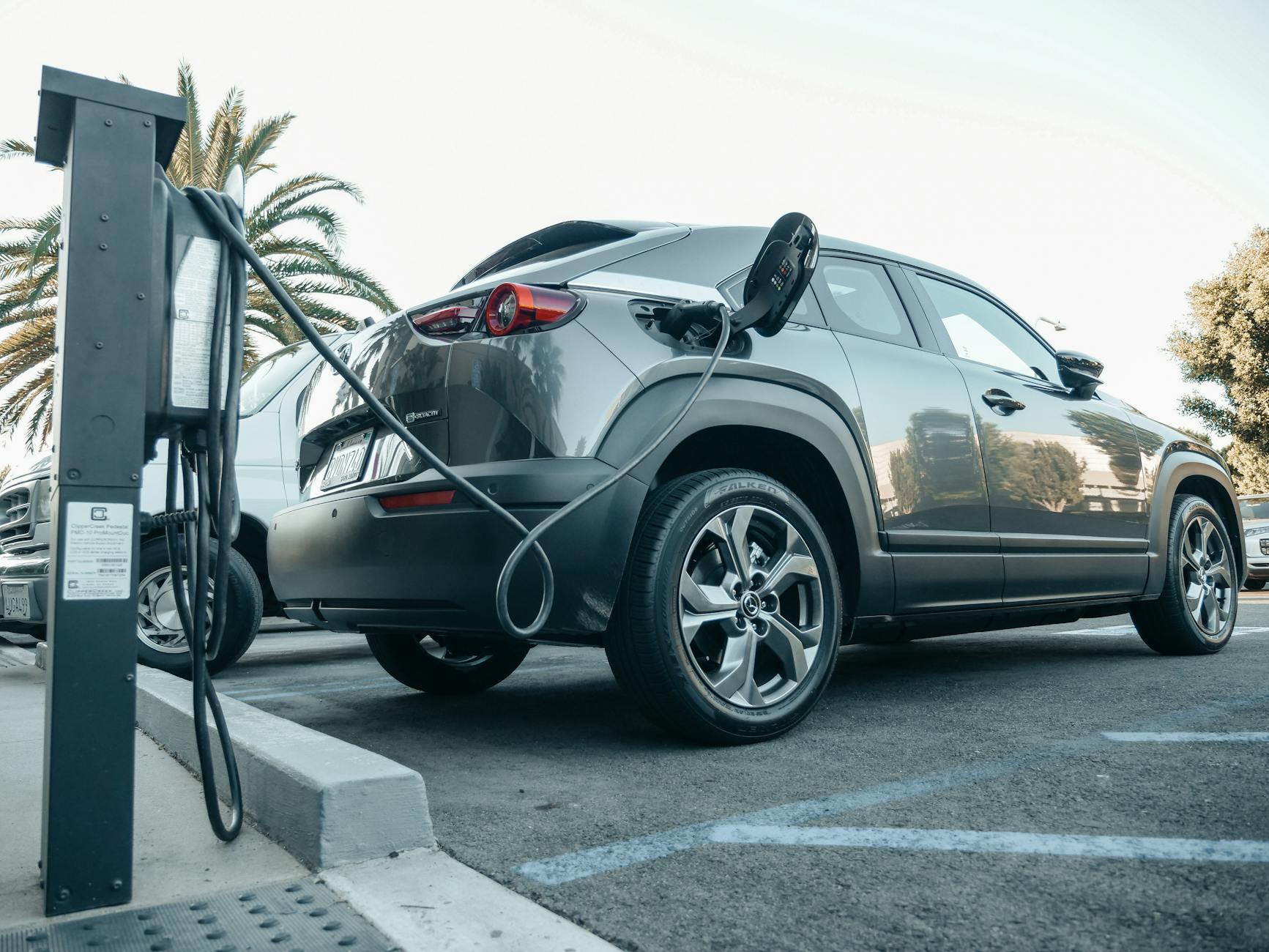
At least here in Texas it is quite common to hear people say that EV cars do not reduce emissions. After all EV cars use electricity from the dirty grid. It is also frequently implied that environmentalists and people who care about fossil fuel emissions do not understand that the electricity for EV cars typically comes from the dirty grid. However, the environmentalists I know do know that. In fact, they typically know more and have sometimes done the math. This is why I consider it a super fact. We know that it is true that EV Cars emit less carbon pollution. This is a fact that matters, it is not trivia, and yet this fact is frequently disputed, argued over, or surprising to people.
EV Cars are more efficient than Internal Combustion Engines
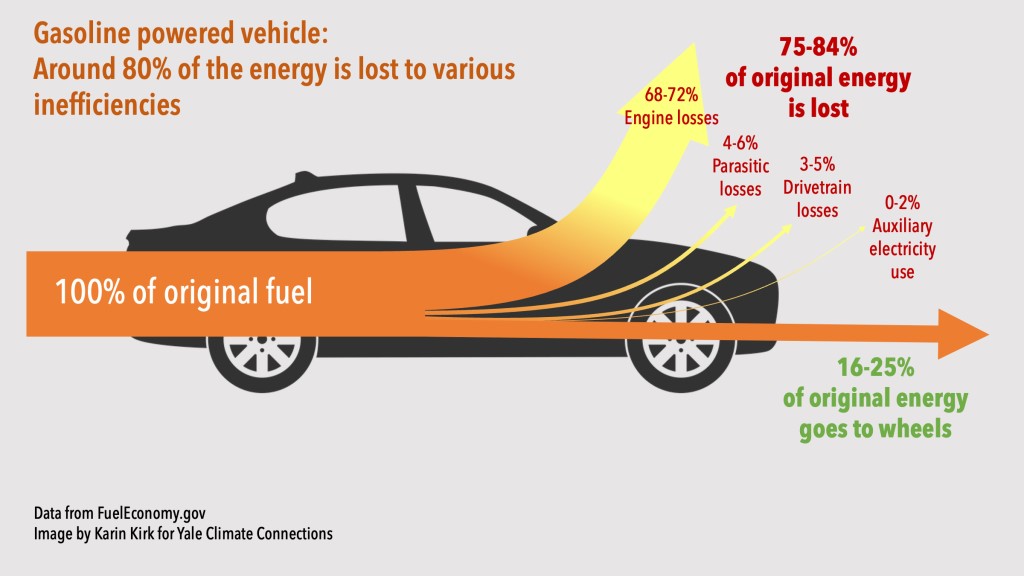
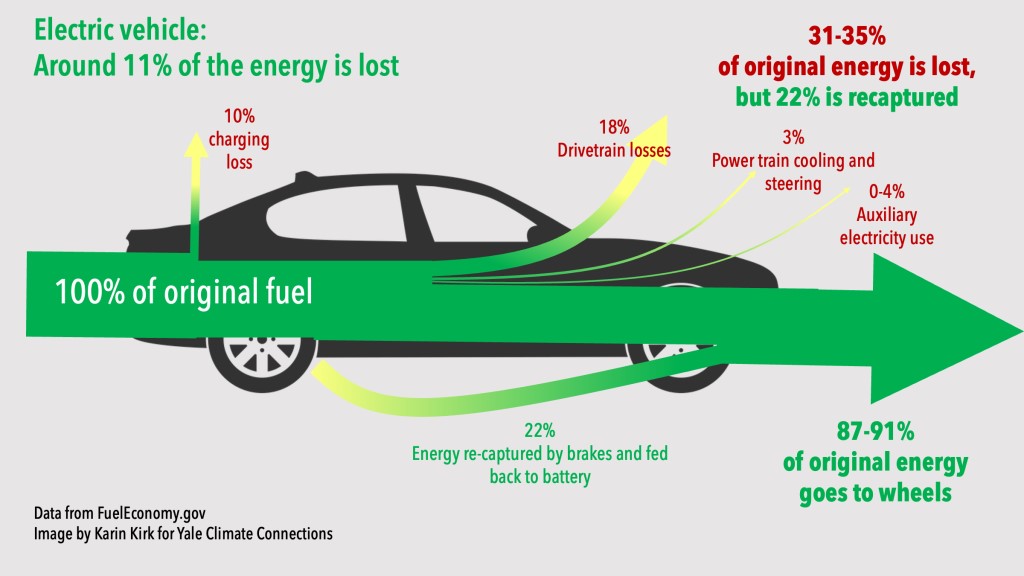
For starters, EV cars are much more efficient than Internal Combustion Engine cars, or ICE, and even a coal-fired power plant is less wasteful than a car engine. The net result is that the emissions caused by EVs via the electrical grid are significantly less per mile. The miles per gallon equivalent (MPGe) for electric vehicles (EVs) varies by state/grid and depends on the model of the car but in general it is much better than for an ICE . Replacing gasoline-powered cars with EVs saves energy, regardless of the energy source used to recharge the EVs. For an ICE 16-25% of the original energy goes to the wheels whereas for an EV 87-91% of the original energy goes to the wheels.
16-25% of original energy goes to the wheels. Data from FuelEconomy.gov, Image by Karin Kirk for Yale Connections.87-91% of original energy goes to the wheels. Data from FuelEconomy.gov, Image by Karin Kirk for Yale Connections.
The Manufacture and Disposal of EV Cars
It takes more energy to manufacture an EV battery for an EV car than it does to produce a combustion engine. So, the production of an electric vehicle does emit more carbon than a petrol car. However, the lower emissions resulting from driving an EV means that an electric car quickly pays back that debt, so to speak. It is typically paid back within two years, according to Hannah Richie, the research director at Our World in Data. The statistics show that switching from an average ICE to an equally sized EV will save 1.2 tons of carbon emissions per person and year. That is a lot considering that the average carbon footprint per year is 4 tons worldwide and 14.4 tons per year for an American.
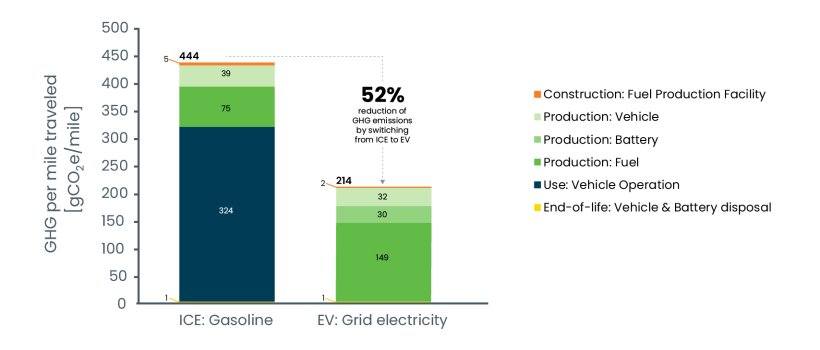
So, are electric vehicles definitely better for the climate than gas-powered cars? This article from MIT answers the question in the affirmative. The graph below includes construction of facilities, manufacturing of vehicle and battery, production of fuel, vehicle operation as well as disposal. It is taken from this government website and this article also answers the question above in the affirmative. This is an article from the Department of Energy is stating the same thing.
Lifecycle greenhouse gas emissions comparison of average gasoline car and average EV.
Hannah Richie at Our World in Data also states that other environmental damages related to EVs such as mining for minerals are less than the damage from mining and extraction for fossil fuel cars, and she claims that the price of lithium-ion batteries has fallen by 98% over the last three decades. It should be noted that EVs are becoming increasingly common. According to Our World in Data in 2022, 88% of all cars sold in Norway were EVs and 54% of all cars in Sweden were EVs.
There are other EV myths that you may want to have debunked, such as Electric vehicle batteries are unreliable and need to be replaced every few years. In 2011 battery failures were common, 7.5%, but in 2023 battery failures were 0.1%. See this article for details and other myth debunking. A related post is my post on electrification.
I should add that there are some drawbacks with EVs such as the easy with which you can charge them, depending on your location. This post is not a promotion of EVs, and I do not drive an EV for various reasons. This post, like most posts in this blog, is about correcting misinformation and getting the facts correct.
Superfact 23: GPS uses relativity for accuracy. Global Positioning Systems or GPS uses Special Relativity and General Relativity to guide you to your destination. In fact, GPS systems would be rendered useless without the Theories of Relativity.
Stock Photo ID: 2502019165 by mayam_studio
Did you use Einstein’s Theories of Relativity to get to the grocery store today?
Therefore, it is a bit surprising that without the theories of relativity the GPS app on your phone would not be able to guide you to the grocery store. That’s why I call it a super fact that GPS uses relativity for accuracy.
Stock Illustration ID: 1372134458 by Boris Rabtsevich
GPS and Time Dilation
GPS is a satellite-based radio navigation system that provides location information and time anywhere on Earth. It is amazingly accurate. The basic GPS service provides users with approximately 7.0-meter accuracy, 95% of the time, anywhere on or near the surface of the earth.
The fact that the information is provided by satellites that orbit earth at high speeds and high above earth’s surface makes General Relativity and Special Relativity necessary. The GPS system needs to calculate precisely the time it takes for signals to travel from the satellites to a receiver on Earth for it to work. GPS satellites travel at high speeds causing a large enough time dilation that must be accounted for. In addition, they orbit earth high above earth’s surface where earth’s gravitational field is weaker than on earth’s surface. Clocks run faster in weaker gravitational fields due to gravitational time dilation, so you must correct that as well.
If you ignore relativity, you will accumulate a discrepancy of six miles in one day. You are not going to find the grocery store that way, unless you use the old-fashioned method of reading a map. In a sense, if your GPS device finds the grocery store for you, you have proven Einstein right.
Below is a YouTube video animation visualizing the GPS system.
The GPS satellites were sent up by the United States Air Force (and not NASA).
The first NAVSTAR satellite, later called GPS, was launched in 1978.
There are 31 GPS satellites currently in orbit.
The system requires 24 GPS satellites.
The 24-satellite system became fully operational in 1993.
The Global Positioning System cost (the US government) $1.8 billion annually to operate and maintain.
The Global Positioning System is free to use for the public worldwide.
Making GPS free to civilians worldwide was a decision by President Ronald Reagan in 1983 after a Korean airliner was shot down for straying off course.
GPS satellites carry extremely accurate atomic clocks. As explained, GPS must account for relativity, special relativity as well as General Relativity.
Other satellite systems help improve GPS, including WAAS (in the U.S.), EGNOS (in Europe), and MSAS (in Japan).
GPS is not the only satellite navigation system. Other countries have their own satellite navigation systems. GLONASS (Russia), Galileo (EU), and BeiDou (China).
Ukraine is helped by both GPS and Galileo.
Russian forces have been actively jamming GPS signals in Ukraine.
Uses of GPS
Examples of consumer electronics that use GPS are smart phones, tablets, Smartwatches, Car navigation systems, Cameras (DSLR with GPS), some models of laptops, fitness trackers (Fitbit), and drones.
Examples of vehicles using GPS are cars, delivery vans, trucks, aircraft, trains, ships and boats.
Military uses of GPS include guided missiles, guided munitions, tactical radios, communication systems, soldier-worn devices for location tracking, military vehicles and military aircraft.
Additional examples of GPS use include construction equipment for site positioning and machine guidance, tractors for precision farming and other agricultural machinery, surveying equipment, pipeline inspection drones, other inspection drones and rovers, emergency locator beacons, pet trackers, smart collars, livestock monitoring, personal trackers, and geocaching devices.
As you can see, GPS is extremely useful, and there are a lot of interesting facts about GPS.