Neanderthals and Humans Interbred

Superfact 114: Early humans (early Homo sapiens) lived at the same time as many other homo species including Neanderthals (Homo Neanderthalensis) and Humans and Neanderthals Interbred.

Two skulls facing each other. Art Study - Old Textured Paper Vintage Antique Poster style (Vintage Version). | Neanderthals and Humans Interbred
Neanderthals Archaic Extinct Human Skull Vs Modern Human Skull Comparison. Shutterstock Asset id: 2238778267 by Winters860

It’s been known for more than a decade that ancient members of our species, Homo sapiens, met and mated with our evolutionary cousins, Neanderthals. If you have read the Savage Land trilogy by Jacqui Murray, or you have taken a DNA test from, for example, 23AndMe, then you already knew that. Today, up to 2% of the genomes of people outside sub-Saharan Africa originated from Neanderthals. The Neanderthal genome was successfully sequenced in 2010. You can read more about it here. More recently, an analysis of Neanderthal X chromosomes found that most cross-species couplings involved Neanderthal males and modern human females.

Photo of a reconstruction of a Neanderthal man
Reconstruction of a Neanderthal by Natural History Museum. Werner Ustorf, CC BY-SA 2.0 https://creativecommons.org/licenses/by-sa/2.0, via Wikimedia Commons

My wife and I took a DNA test with 23AndMe to find out about inherited diseases as well as our ancestry. I found out that my ancestry was 99.8% Northwestern European, 85.3% Scandinavian/Sweden/Norway, 14.4% Finnish, 0.1% other Northwestern European, and 0.2% Siberian. I also found out that I had strong Neanderthal ancestry. The report said that I have more Neanderthal variants than 99% of customers. Even though this kind of information is fun, it is risky to have some of this information exposed, so I deleted it.

Man geneticist. Doctor sits at table in genetic laboratory. Chains of DNA or RNA. Sequencing human genome. Doctor studies DNA. Geneticist conducts scientific experiments Geneticist looks at test tubes
Geneticist sequencing human genome Asset id: 2479929725 by FOTOGRIN

Anyway, I consider this a super fact because it comes as a surprise to many that humans and Neanderthals interbred, and that many of us therefore have traces of neanderthal DNA. It is also an important fact that we know is true.
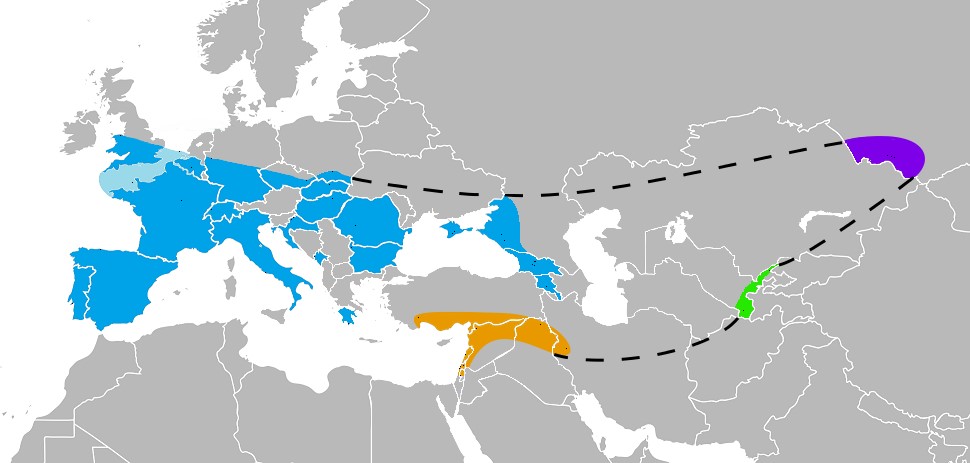
This map of Europe and West Asia shows the region where Neanderthals have been found. | Neanderthals and Humans Interbred
Known Neanderthal range in Europe (blue), Southwest Asia (orange), Uzbekistan (green), and the Altai mountains (violet), as inferred by their skeletal remains (not stone tools). There were 165 such places by 2017. Nilenbert, N. Perrault, auteur du guide complet du canotageI, CC BY-SA 3.0 <http://creativecommons.org/licenses/by-sa/3.0/&gt;, via Wikimedia Commons

Early Homo Sapiens lived at the same time as many other human species

Early humans, early homo sapiens, lived at the same time as many other human species, not just Neanderthals. Early Homo sapiens lived at the same time as Denisovans, Homo floresiensis, Homo naledi, Homo luzonensis. Homo heidelbergensis, Homo erectus, and maybe other species as well.  Neanderthals interbred with homo sapiens and died out around 40,000 years ago. The Denisovans also interbred with homo sapiens and died out around 30,000 to 50,000 years ago. Moreover, Homo Neanderthalensis interbred with Homo Denisova. You can read more here and here.
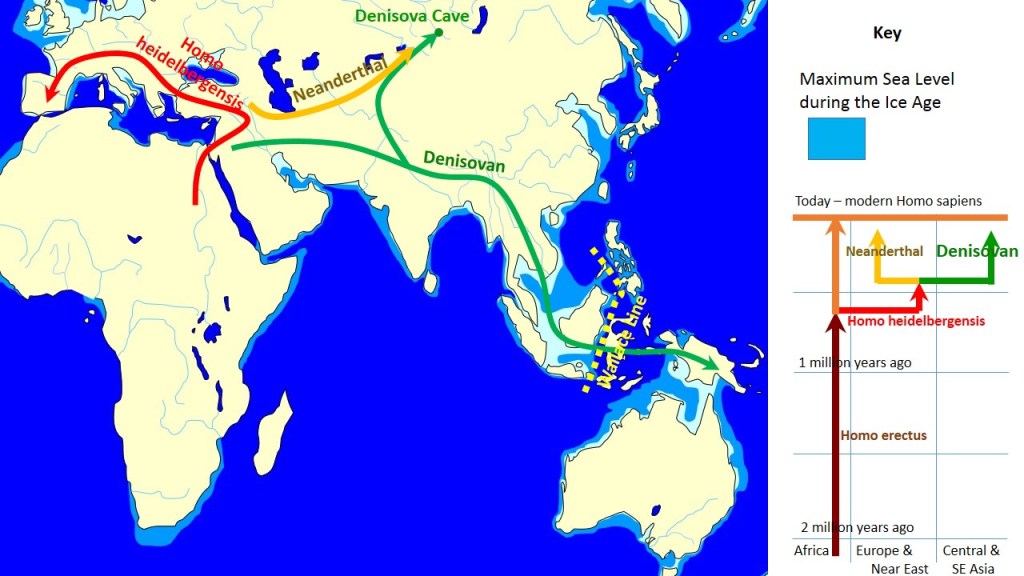
The map shows the movement of Homo heidelbergensis originating in Africa and moving into Europe and Asia with Neanderthals (in yellow) emerging in Europe and moving into Asia. The Denisovans emerged in Asia and spread further east.
The evolution and geographic spread of Denisovans as compared with Neanderthals, Homo heidelbergensis and Homo erectus. John D. Croft at English Wikipedia, CC BY-SA 3.0 https://creativecommons.org/licenses/by-sa/3.0, via Wikimedia Commons.

Speciation is considered relative

Homo Neanderthalensis and Homo Sapiens were different species, so it may seem strange that they could interbreed. However, species is a complex non-static concept, and it is considered relative.

It is often said that two animals belong to the same species if they can interbreed in nature and produce viable, fertile offspring. However, it is not that simple. An animal A may be able to successfully interbreed with an animal B, and that animal B may be able to successfully interbreed with an animal C, but animal A and C cannot interbreed. Animal A could be said to be a different species relative to animal C, but animal B could be said to be the same species as both animal A & C using the definition above. A great geography related example of this is ring species. In a ring species, gene flow occurs between neighboring populations of a species, but at the ends of the ring the populations don’t interbreed.
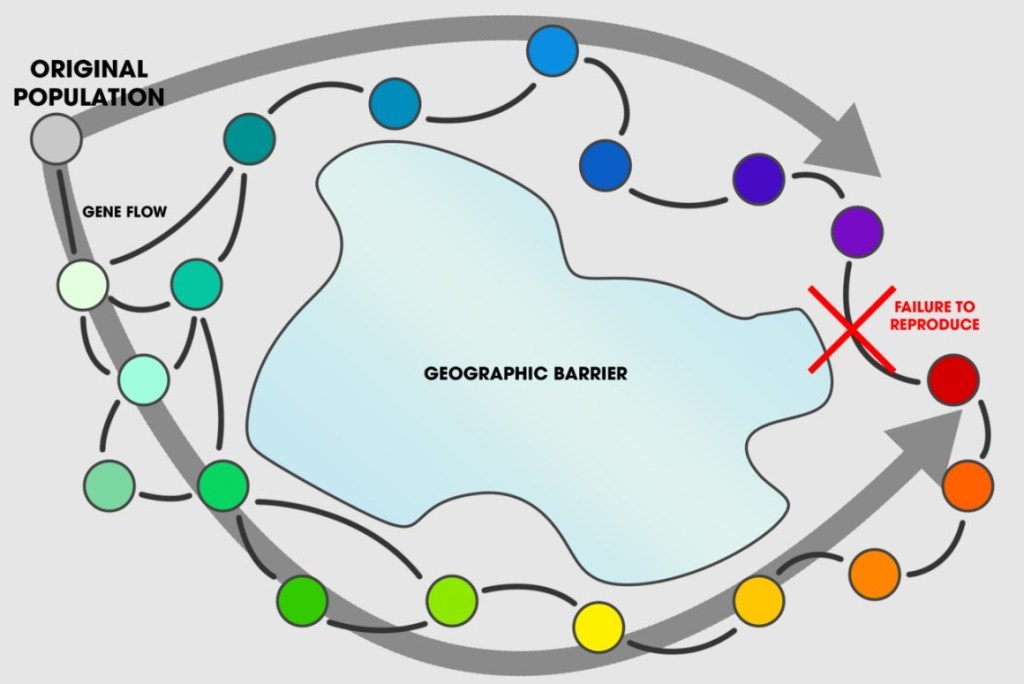
The picture depicts different subspecies as little colored circles centered around a big lake. The color changes a little bit at the time. All the circles next to each other can interbreed. | Neanderthals and Humans Interbred
Illustration of ring species, an example of how speciation can be relative. All the circles next to each other can interbreed but at the end it no longer works. Andrew Z. Colvin, CC BY-SA 4.0 <https://creativecommons.org/licenses/by-sa/4.0&gt;, via Wikimedia Commons

For the case of Neanderthals and Homo sapiens (and Denisovans); at certain points in history, you could consider Homo Neanderthalensis and Homo Sapiens to be different subspecies rather than different species. That is why you sometimes hear the terms Homo Sapiens Neanderthalensis and Homo Sapiens Sapiens. I can add that Homo sapiens certainly got around, as you can see on the map below.
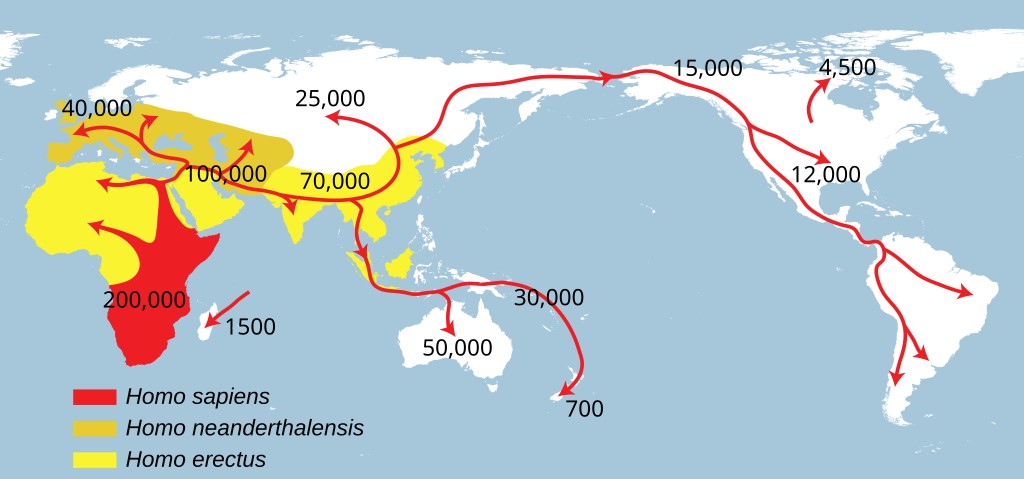
A world map showing portions of Africa being yellow and red, and portions of Asia being yellow and dark yellow with red arrows representing migrating Homo Sapiens. The map features several time markers representing the arrival of Homo Sapiens. | Neanderthals and Humans Interbred
The spread of Homo Erectus (yellow), Homo Sapiens (red) and Homo Neanderthalensis (dark yellow). NordNordWest, Public domain, via Wikimedia Commons

Super fact posts related to this one


To see the Other Super Facts click here

Satellites handle a very small amount of global internet traffic

Super fact 54 : Satellites currently handle a very small percentage of global internet traffic, estimated at about 1%. The vast majority of internet traffic is carried by undersea cables.

I consider this a super fact because it is surprising, true and not trivia. It is an important fact since most of us use internet every day. It is a very common belief that satellites handle most of the global internet traffic, or at least a very large portion of it. I should say that a few years ago I thought so myself.

Space satellite orbiting the Earth. 3D rendering | Satellites handle a very small amount of global internet traffic
Stock Illustration ID: 1372134458 by Boris Rabtsevich
Multiple layers inside a black cable. Optical fibers emerge from the cut end, and they shine.
Submarine underwater communication fiber optic cable on deep seabed. Asset id: 2175977719 by Dragon Claws

How Much Internet Traffic is Handled by Satellites

I should say that I did not find a lot of sites that answered this question, but all of the sites that I found gave similar answers such as, less than 1%, 1.5%, 1-2%, very little, etc.

I started out by asking ChatGPT this question “How much of internet communication does Satellites handle?” The answer I got was that Satellites handle a relatively small percentage of global internet traffic — typically less than 1–2% — with most of the world’s internet communication carried through undersea fiber optic cables and terrestrial infrastructure (like cell towers and wired broadband). Wikipedia states that satellites handle less than 5% – to an estimate of even 0.5%. I should add I do not rely on ChatGPT, SGE or Gemini, or Wikipedia for this blog but I take hints from them.

According to NOAA, over 95 percent of international data and voice transfers are currently routed through the many fiber optic cables that crisscross the world’s seafloors, whilst satellites currently carry just about 1% of global internet traffic according to Research Outreach. Operations Forces Report, Space Voyage Ventures, Neterra, and Newsweek made similar claims .

The reason satellite internet is used less is because satellite internet is significantly more expensive to use than traditional wired connections. In addition, satellites have higher latency (delay) compared to fiber optic cables, and less bandwidth (data capacity). Satellite internet is primarily used in remote areas where other forms of internet access are unavailable. Satellite internet is also used for military and government operations, as well as maritime and aviation connectivity. However, satellite internet is improving so this may change in the future. This is a comparison between satellite internet and optical fiber.

Satellites handle a very small amount of global internet traffic
Photo by SpaceX on Pexels.com
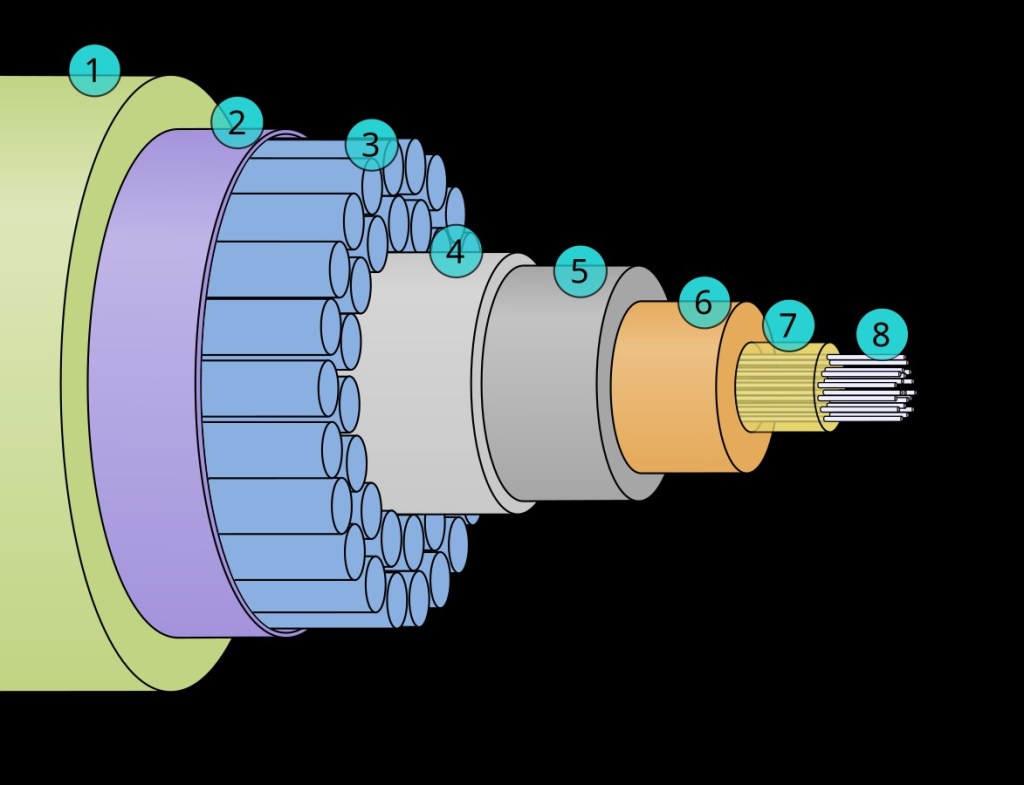
Eight layers in various colors are shown. See below for indicators.
This is a cross section of submarine fiber optic cable. Picture by Oona Räisänen (User:Mysid), Public domain, via Wikimedia Commons.

The layers in the picture of the submarine communications cable above are (from outside to inside): (1) Polyethylene (2) Mylar tape (3) Stranded steel wires (4) Aluminum water barrier (5) Polycarbonate (6) Copper or aluminum tube (7) Petroleum jelly (8) Optical fibers.

Related Post

A related post and super fact is: GPS uses relativity for accuracy


To see the other Super Facts click here