Peace Is Boring News

Do you remember the Oklahoma Brouhaha? The thirty-year war between Episcopalians and Baptists in Oklahoma. It began in 1970, and thousands of people were killed. The Baptist Republican Army committed terrorist attacks that killed thousands of Episcopalians.

The US Army was called in to establish peace, but it was seen as an occupation and only made things worse. People were dying in Oklahoma but also in Texas, Arkansas and Louisiana. The Governor of Texas was complaining about all the Oklahoma terrorism and wanted to close the border with Oklahoma.

Oh, you don’t remember? Were you asleep during history class? No don’t worry, it is not a super fact you didn’t know about. The Oklahoma Brouhaha never happened. I made that up.

Yesterday I started talking to my daughter about The Troubles, the war between Catholics and Protestants in Northern Ireland that started in 1968 and lasted for more than 30 years. I don’t remember how the discussion started.

My daughter knows history well, much better than most adults I know, but she had still not heard about The Troubles. Her face looked like yours would if you thought I was serious about the Oklahoma Brouhaha. How could this have happened so recently in a peaceful, prosperous and beautiful European country known for its friendly and happy people, great pubs, cute gnomes, and fairy tales?

I can add that an acquaintance of mine survived a bombing of a hotel by the Irish Republican Army (IRA) in 1984. He frequently talked about it. Another acquaintance of mine used to be a member of the IRA. Therefore, I have a small personal connection to it.

Black and white photo showing a young girl crossing the street as an armed soldier is hunkered down behind her. There is big wall with text written on it saying, “Dangerous Wall keep Clear.”
West Belfast, Northern Ireland,UK; February, 1994; Girl running with plate of chips past wall where two IRA Volunteers were killed by British soldiers Shutterstock Asset id: 1951602385, Editorial credit: RORY NUGENT.com

I on the other hand was flabbergasted that she did not know about The Troubles. But it makes sense. Half my life I was watching the news every day about the war between Catholics and Protestants in Northern Ireland (on Swedish TV), but once peace was achieved, and Gerry Adams and Ian Paisley shook hands, I didn’t hear a peep about it ever again. How could someone in their 20s know about it?

Peace is Boring News

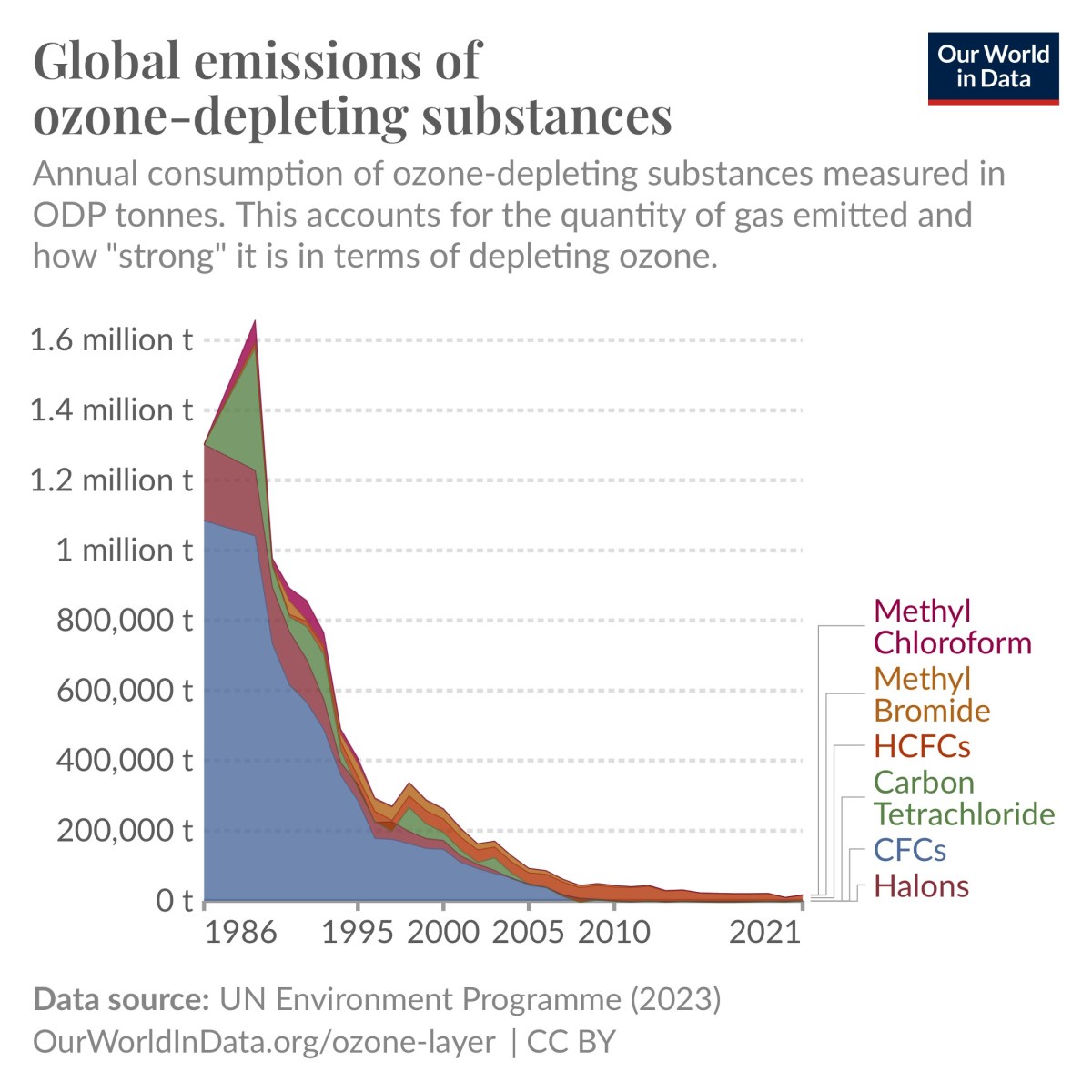
Peace is boring News. Peace is not even news. No news is good news. The same goes for other topics, such as the environment. Environmental disasters and environmental threats are news, and it should be, but an environmental problem that has been solved is no longer news and will be forgotten. One example of that is the super fact post I made yesterday “By 2018 the emissions of ozone-depleting gases had fallen by 99.7 percent”. What else have we forgotten about?
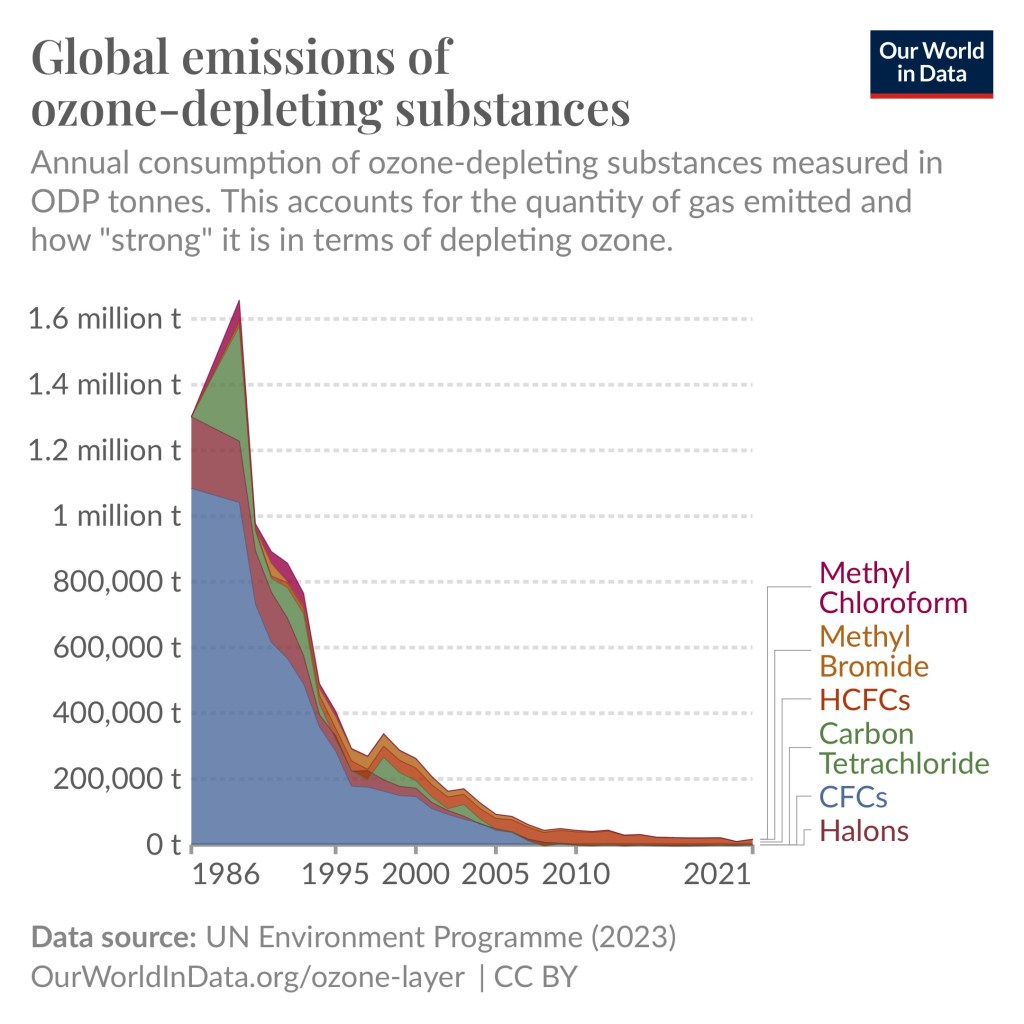
Gases visualized in the diagram are CFCs, Halons, HCFCs, Carbon Tetrachloride, Methyl Bromide, Methyl Chloroform. The diagram shows a peak around the end of 1980’s | Peace Is Boring News
The phase out of six ozone depleting gases. Data source UN Environment Program (2023).

I guess my point is first of all, we forget, and secondly, that it is important to remember that bad news gets attention because it is interesting. Therefore, it is important to remember that there’s a lot of good out there that we forget about.

Below is a youTube video showing Irish comedian David Tynan O’Mahony (born in Dublin), stage name Dave Allen, making fun of Reverend Ian Paisley. Reverend Ian Paisley was a hell and brimstone preacher who agitated against Catholics (it was hate speech), not just in Northern Ireland, but against all Catholics.

For example, he called the pope the anti-Christ. I should add that Ian Paisley and Gerry Adams the leader of the political wing of the Irish Republican Army (Sinn Féin) eventually shook hands in 2007 and came to an agreement. The tone was much different then, but that was long after this YouTube video was made.

The video below is not inflammatory, just very funny. I should mention that as Dave Allen is imitating Ian Paisley it sounds like he is saying “naatching of teeth”. That is “gnashing of teeth” in a north Irish accent. The ending is priceless with perfect comedic timing and effect. The video is 2 minutes and 42 seconds long.

I have one more video if you are interested. It is the Cranberries singing “Zombie” a famous song about the war in Northern Ireland. My daughter knew this song. She just didn’t realize that the song was about the war in Northern Ireland.
To see the Super Facts click here

Emissions of ozone-depleting gases have fallen by 99 Percent

Super fact 41 : Largely thanks to the Montreal Protocol in 1987 the emissions of ozone-depleting gases have fallen by more than 99%, 99.7% to be exact, according to Our World in Data. This has resulted in halting the expansion of the ozone holes and the reduction in emissions of  ozone-depleting gases is saving millions of lives every year.

This is my good news for Earth Day, and it is a super fact. It is a super fact because a lot of people believe that the issue with ozone depleting gases and Montreal protocol is bunk. They take the fact that we are not talking about it much nowadays as evidence that there was nothing to it in the first place. However, they are wrong. We typically don’t talk much about environmental problems that have been addressed successfully. The Antarctic ozone hole that we used to worry about is still there, but its worrisome expansion has been halted.

The Reduction of Ozone-Depleting Gases

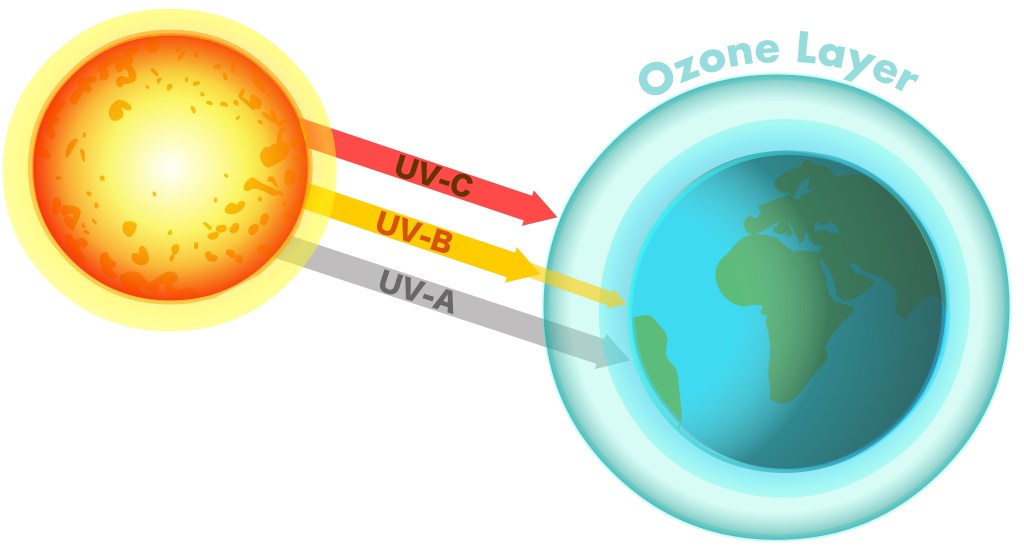
The ozone layer, located in the stratosphere, protects Earth from harmful UV radiation. Ozone (O3) is naturally created and destroyed in a balance, but ozone-depleting substances damage the ozone layer by releasing chlorine atoms that catalyze the destruction of ozone molecules.

This problem was discovered by Mario Molina and F. Sherwood Rowland in 1974. They were awarded the 1995 Nobel Prize in Chemistry, along with Paul Crutzen, for their work in atmospheric chemistry. Examples of ozone depleting gases are chlorofluorocarbons (CFCs), hydrochlorofluorocarbons (HCFCs), halons, methyl chloroform ,methyl bromide, carbon tetrachloride, hydrobromofluorocarbons, and chlorobromomethane.

The picture shows the sun radiating UV radiation to earth, which is protected by a blanket of ozone | By 2018 the emissions of ozone-depleting gases had fallen by 99.7 percent
Ozone layer depletion diagram. Earth’s sunscreen, shielding us from the sun’s harmful ultraviolet rays. UV A, B, C. UVA, UVB, UVC.

Ozone depletion causes a breakdown of the ozone layer around the world, including the famous Arctic and Antarctic ozone holes. This allows more UV radiation to reach Earth surface, increasing the exposure to harmful ultraviolet (UV) radiation, which can cause skin cancer, cataracts, and immune system damage.

It also harms plants and marine life, as well as climate. It should be noted that this is a different problem from climate change or if you call it global warming, even though ozone depletion to some degree influence climate change. You can read about climate change related super facts here, here and here.

The Reduction of Ozone-Depleting Gases

The good news is that we have been very successful in reducing ozone depleting gases. The Montreal protocol, a landmark international agreement signed in 1987 to protect the Earth’s ozone layer by phasing out ozone depleting gases, has been very successful.

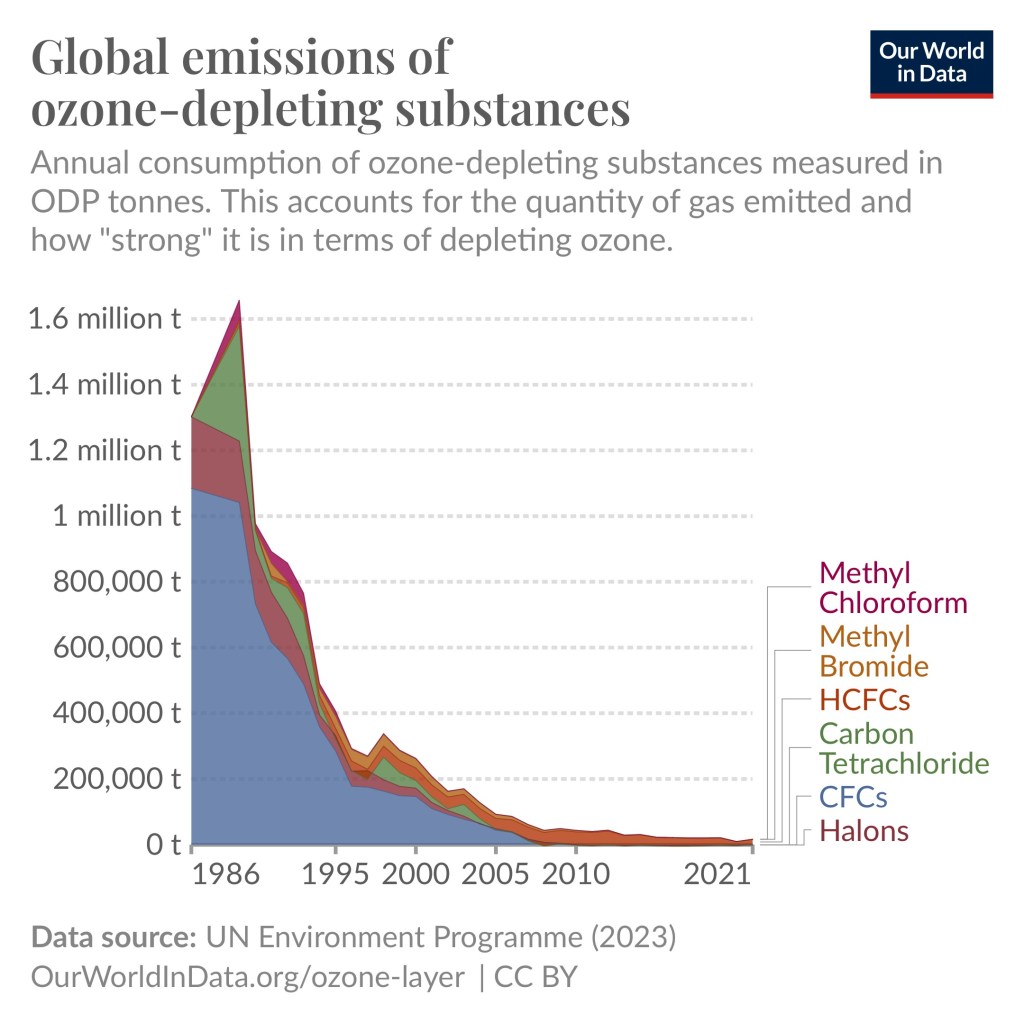
As you can see in the diagram below from Our World in Data. We have had at least a 99% reduction in ozone depleting gases according to the NASA, the World Economic Forum and the UN Environment Program. More specifically, the reduction is 99.7% by 2018 according to Our World in Data.

Gases visualized in the diagram are CFCs, Halons, HCFCs, Carbon Tetrachloride, Methyl Bromide, Methyl Chloroform. The diagram shows a peak around the end of 1980’s | By 2018 the emissions of ozone-depleting gases had fallen by 99.7 percent
The phase out of six ozone depleting gases. Data source UN Environment Program (2023).

443 million Cases of Skin Cancer Prevented

The NIH estimate that the Montreal Protocol has prevented 443 million cases of skin cancer, 2.3 million skin cancer deaths, and 63 million cases of cataracts in the United States alone. Globally, it is estimated that the Protocol has saved an estimated 2 million people from dying from skin cancer each year.

Yes, you can read that again :

Worldwide the Montreal Protocol has saved an estimated 2 million people from dying from skin cancer each year.

To read more about the Montreal Protocol and the ultimate repair job click here.

The Antarctic Ozone Hole

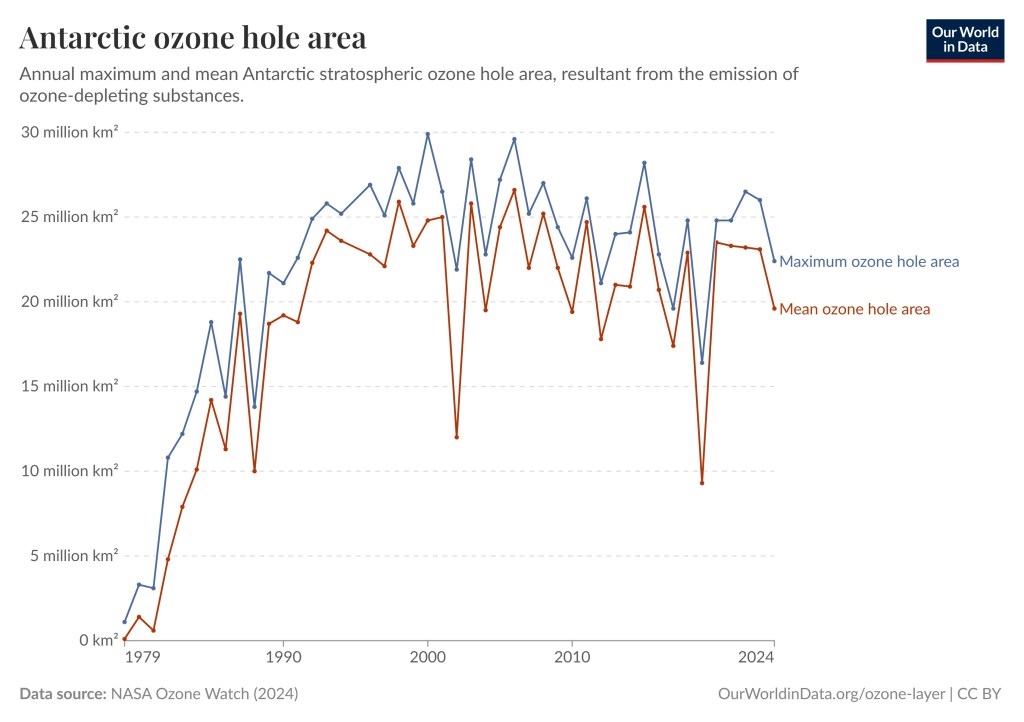
What about the Arctic and Antarctic ozone holes? Well, they are not gone but they are retreating. When there is an environmental problem, it does not entirely disappear right away even if you remove the root cause. The same is true for global warming. If we succeeded to stop all carbon emissions tomorrow it would take decades for average temperatures to stop rising and hundreds of years for them to come down to “normal”. But remember it would have been much worse without the Montreal Protocol.

There are two graphs. The graph representing the annual mean Antarctic ozone hole is blue.  The graph representing the annual maximum Antarctic ozone hole is red. Both graphs are rising initially but after the year 2000 the graphs flatten and even go down a bit.
The graph is from Our World in Data and data comes from NASA Ozone watch 2024.
To see the other Super Facts click here

The Surprising Butterfly Effect

Super fact 40 : In chaotic systems the so-called butterfly effect means that a small change in initial conditions, such as a butterfly flapping its wing in Brazil, can lead to large, unpredictable changes in a system’s future, such as the appearance of a tornado in North Texas. However, that does not mean that the butterfly directly caused the tornado. It should also be noted that chaotic systems can contain predictable patterns and external forcings can certainly make aspects of a chaotic system behave in a predictable manner.

The first part of Super Fact 40 describes a well-established phenomenon that is often surprising to people who have not heard about it before. The second part (following the word “However”) address a few common misconceptions about the butterfly effect. The butterfly effect is a surprising and widely misunderstood phenomenon and therefore I consider the information in bold above to be a super fact.

The Surprising Butterfly Effect
Photo by Cindy Gustafson on Pexels.com

The Butterfly Effect and Unpredictability

The butterfly effect is the sensitive dependence on initial conditions in which a small change in one aspect of the system can result in large differences later. A butterfly flapping its wing in Brazil, leading to the appearance of a tornado in North Texas, is one example. The butterfly effect is an aspect of chaos theory.

However, it is important to understand that the butterfly is not directly causing the tornado. It is the wing flaps of trillions of butterflies, the wing flaps of 50 billion birds, the barks of 900 million dogs, all the waterdrops in the world, and all the bushes and trees, etc., which together provide the initial conditions for the world’s weather system.

Remove one butterfly, anyone of them, or the bark of a dog, and you may or may not have a tornado in north Texas on a certain date. It isn’t the butterfly causing the tornado. Any tiny change in the initial conditions will eventually lead to a large difference in the system later. This is how the Butterfly Effect provides unpredictability.

A large well-formed tornado over the plains.
Did a butterfly do this? Stock Photo ID: 2369175167 by g images.com.

The Butterfly Effect and Predictability

Because of the butterfly effect you may not be able to predict whether it is going to rain at 1:00PM next Thursday, but you can still safely predict that Dallas, Texas, will on average be cooler in January than in July. That’s largely because the sun will heat Dallas, Texas more in July than in January. We know that if you add carbon dioxide, or other heat trapping gases, to the atmosphere it will on average get warmer. External forcings make aspects of chaotic systems predictable. You sometime hear the argument that “climate is chaotic and cannot be predicted”. This is a myth that is debunked here.

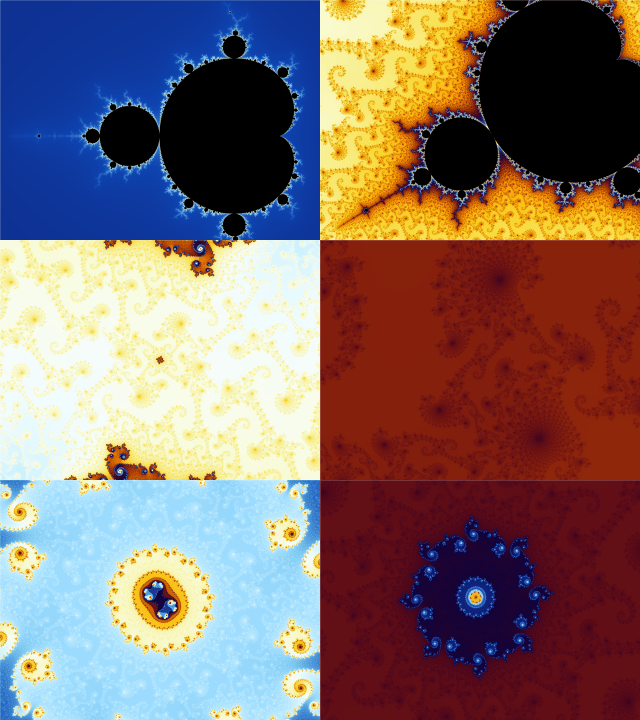
In addition, chaotic systems can feature predictable patterns, even though chaotic systems are considered unpredictable. Chaos theory demonstrates that within the apparent randomness of chaotic systems, there are underlying statistical patterns, self-similarity, fractals, and interconnection.

I once created a robot control system for which the robot was shaking a little bit. The tool tip was moving in a little circle and did not get to where it was supposed to be. The reason was that the presence of static friction made the control system I was using a chaotic system.

However, the robot didn’t randomly go all over the place. It was moving quickly in a small circle. It was chaotic, and its exact motion was unpredictable, but there was an underlying statistical pattern. Another example is, fractals, which are geometric patterns that emerge from chaotic processes described by chaos theory. Fractals feature self-similar patterns repeating at different scales. They can visually represent the complex behavior of these systems. See an example below.

A 450 layer fractal | The Surprising Butterfly Effect
This is a file from the Wikimedia Commons Wikipedia. Simpsons contributor at English Wikipedia, Public domain, via Wikimedia Commons.

Edward Norton Lorenz

In 1961, Edward Norton Lorenz was using a computer to simulate weather patterns by modeling 12 variables (heat, wind, etc.). After finishing one simulation he wanted to see it again but to save time he started it in the middle using the saved variables at the point. To his surprise his simulation ended up with completely different weather. He realized that the computer the saved data had tiny errors from the computer rounding off the numbers. For example, 3.145787 instead of 3.1457872. That small difference was enough to eventually result in completely different weather.

Lorenz was not the first person to realize that, so called, non-linear systems can be extremely  sensitive initial data. This realization goes all the way back to the mathematician Henri Poincaré in the 19th century. However, he was the founder of modern chaos theory and coined the term the Butterfly Effect.

To see the other Super Facts click here

What do you think about the Fractal above?

Relativity Visualized by Lewis Carroll Epstein

The goal of this blog is to create a list of what I call super facts. Super facts are important and true facts that are nevertheless highly surprising to many or disputed or misunderstood by many. In a sense this is a myth busting blog regarding important information. However, I also make posts that are not super facts but feature other interesting information, such as this book review and book recommendation.

Relativity Visualized by Lewis Carroll Epstein

Lewis Carroll Epstein <<Link-1>> is a physicist, teacher and author who has written a number of physics books for layman. He is somewhat famous for coming up with ingenious ways of using diagrams, pictures and puzzles to explain complex matters without using mathematics. His approach is unorthodox but, in my opinion, quite successful. You still have to invest time in reading this 200-page long book and solving most of the puzzles to understand what is going on. The book features some math, notably regarding the derivation of the formula for energy-mass equivalency E = mc2. However, it is in a special section for “teachers only”.

It is an old book and the only version currently available on Amazon is the paperback version. The publisher of the paperback is Insight Press; First Edition (January 1, 1985), ASIN : 093521805X, ISBN-13 : 978-0935218053, 206 pages, item weight : 12.8 ounces, dimensions : 6.25 x 0.75 x 9 inches. It costs $48.99 on US Amazon. Click here to order it from Amazon.com.

The front cover features the title “Relativity Visualized” and the author’s name and in the background is the night sky with the milky way. At the bottom of the front cover is a train with a head lamp and a light beam | Relativity Visualized by Lewis Carroll Epstein
Front cover of the paperback version of Relativity Visualized by Lewis Carroll Epstein. Click on the image to go to the Amazon page for the paperback version of the book.

Amazon’s Description of the Relativity Visualized By Lewis Carroll Epstein

Perfect for those interested in physics but who are not physicists or mathematicians, this book makes relativity so simple that a child can understand it. By replacing equations with diagrams, the book allows non-specialist readers to fully understand the concepts in relativity without the slow, painful progress so often associated with a complicated scientific subject. It allows readers not only to know how relativity works, but also to intuitively understand it.

This is my five-star review for Relativity Visualized

Note, I wrote this review in 2016, so it is relatively old, pun intended. In my original Amazon review I used very large paragraphs. I have changed that by breaking up the paragraphs a bit but without changing the content in any way.

Relatively Intuitive

In my opinion the theories of relativity are among the most interesting intellectual achievements in human history. They revolutionized physics and changed the way we think about physics, space, time, mass, energy, electromagnetism and essentially everything in nature. Despite that fact, the theories of relativity are deterministic and possible to visualize, and unlike Quantum Physics they are not statistical in nature and they don’t have a big issue with interpretation.

I’ve been interested in this topic ever since I came across it as a high school student. Therefore, I did not learn a lot about relativity from this book. I was more interested in the approach to explaining it, and I think his approach is a very good one.

I’ve found that an explanation for relativity that lacks rigor and quantitative reasoning creates misconceptions. The reader may end up thinking he understands it when he doesn’t. I’ve also found that books that focus on deriving complex equations were not only unattainable to the layman but sometimes left the mathematically inclined student with a poor understanding of relativity as well.

Lewis Carroll Epstein’s book “Relativity Visualized” seems to succeed in making relativity accessible to both the layman and those who are mathematically inclined. He explains the special theory of relativity and the general theory of relativity using graphs, visual constructs, and logical puzzles that the reader solves for himself. In a sense he allows the reader to develop the theories of relativity on his own. He avoids equations and formulas, but the reader will still discover more exactly what is going on.

One thing that really impressed me with this book is its special focus on the difference between what you see/experience and what you measure. As an example, take two lights that flash at the same time (in your reference frame). They could appear to flash at different times if the distance between them is large. So, you will see them flash at different times. However, if you time the light flashes and take the distance into account you can measure that they flashed at the same time (non-relativistic situation).

In relativity the differences you measure between frames do not only arise from the distance the light travels or from Doppler Effects but also from the relativity of time and space as well, and Epstein explains the details without confusing the reader. He focuses a lot on simultaneity/non-simultaneity right from the very beginning, and in my opinion understanding relativistic non-simultaneity is crucial to understanding what is going on.

The book also discusses the General Theory of Relativity. The General Theory of Relativity is often seen as completely off limits to the layman. It is typically explained using complex tensor calculus, differential geometry, and topology, or alternatively in a non-technical vague way that leaves the reader clueless. General Relativity was born out of an enigma. Special relativity had shown that energy and mass are the same things, so light has mass. A light beam traveling through a gravitational field must thus bend.

However, that means that the side of the light closer to the mass will travel a shorter distance. From known properties of light (always a transverse/orthogonal wave) this means that the side of the light beam closer to the mass moves slower than the outer rim which would violate the constancy of the speed of light in vacuum.

To solve this enigma Einstein had to introduce a time warp in gravitational fields. Later he discovered that this time warp would cause objects to fall towards the masses that caused the time warp and the practical effect of this turned out to be essentially identical to Newton’s theory of gravity and thus the mysterious force of gravity could be removed. Einstein also discovered that there is a warp effect on space which is negligible unless the speed of the objects is large (like magnetism for electric forces). The book helps you visualize all of this without using complex math.

Lewis Carroll Epstein’s book contains unique pedagogic approaches, novel geometric representations of relativity, as well as engaging questions and answers. For this reason, the book is fiercely protected by copyright law. On the negative side, his writing style is somewhat rigid and old fashioned, the drawings and the graphics are sometimes of low quality, and the book might be quite a bit of work for the layman reader, so it requires that you are really interested. However, overall, this is a very rigorous, detailed, correct, and yet entertaining book that I highly recommend.

Good Myths

I also would like to mention another tool that Lewis Carroll Epstein use in his book, and that is the concept of a Good Myth. A Good Myth is a description that isn’t technical and maybe not exact but that isn’t wrong either. In a loose way it captures the truth of what is going on.

An example of one of these myths is that everything, including all of us, is always traveling through time and space at exactly the speed of light in vacuum. In other words, we are all traveling at the speed of c = 299,792,458 meters per second. If we are sitting still, then we are traveling through time at the speed of light. If we are traveling through space at the speed of light then we are not traveling through time at all, like photons, for which time does not exist.

If we are traveling through space at a high speed, then if we add, in a vector way (Pythagoras theorem), our speed in space to our speed in time, they together will add up to the speed of light in vacuum. But that means that we are traveling through time at a speed that is less than the speed of light. So, our clocks will run slower.

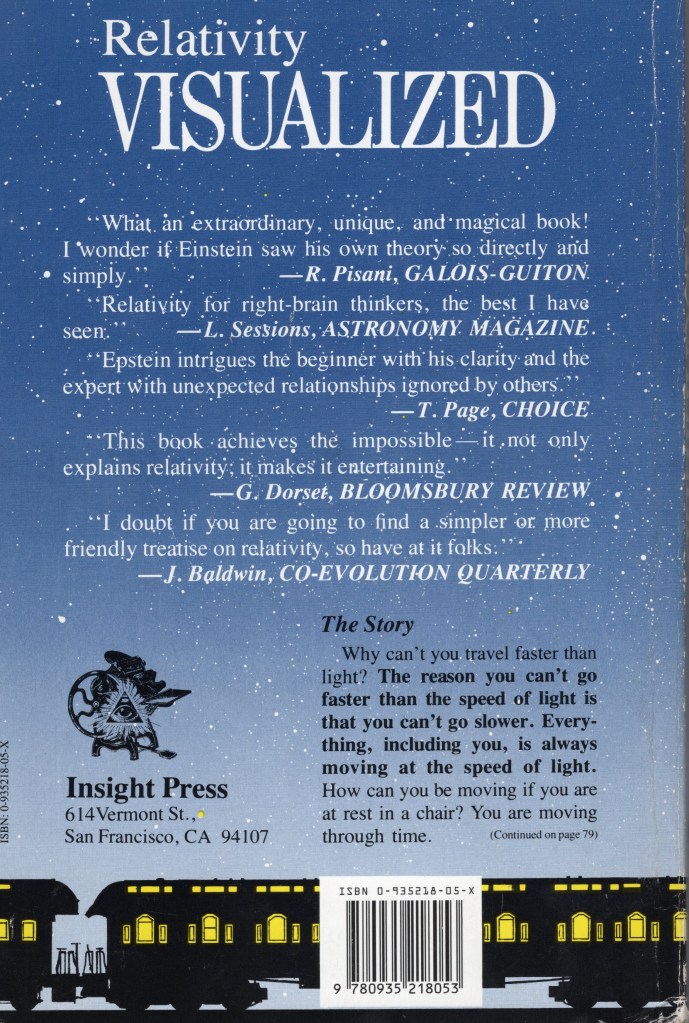
The back cover features the title of the book, praise for the book and very brief description | Relativity Visualized by Lewis Carroll Epstein
Back cover of the paperback version of Relativity Visualized by Lewis Carroll Epstein.

Other Posts on Relativity

Below is a list of other posts I made on Relativity

  • The Speed of Light In Vacuum Is a Universal Constant : to see post click here
  • Two events may be simultaneous for some but not for others : to see post click here
  • Time Dilation Goes Both Ways : to see post click here
  • The Pole-Barn Paradox and Solution : to see post click here
  • Book-Review : The Special Theory of Relativity by David Bohm : to see post click here

Do you feel that you are traveling through time at the speed of light?

To see the Super Facts click here

The Sunshine Blogger Award Is Rising Again

I’ve been nominated for the Sunshine Blogger Award a second time, this time by Pooja, from Lifesfinewhine. Thank you for the nomination, Pooja! It was a nice surprise.

The Sunshine Blogger Award Official Image
The Sunshine Blogger Award

Check out her blog for lots of great posts featuring blogging advice and expertise, beautiful poetry, short stories, thought provoking quotes and much more!

Without further ado, here are the rules which I’ve copied from Pooja’s blog:

  • Display the award’s official logo somewhere on your blog.
  • Thank the person who nominated you.
  • Provide a link to your nominator’s blog.
  • Answer your nominators’ questions.
  • Nominate up to 11 bloggers.
  • Ask your nominees 11 questions.
  • Notify your nominees by commenting on at least one of their blog posts.

Eleven Questions for Me

Below are my answers to Pooja’s eleven questions.

Question 1 : What’s your favorite animal?

Dogs, especially Leonberger dogs. I love dogs that are big or small. We’ve had a Labrador, a German Shepherd, a Leonberger, a Japanese Shin, a Pug and a mini-Australian Shepherd. I did not grow up with dogs. I learned to love them as an adult. Dogs are intelligent, they can understand hundreds of words, they are emotional, they are great communicators, they are loyal and loving. Dogs are the only animals capable of loving you more than they love themselves. Our Leonberger Bronco, or Le Bronco von der Löwenhöhle, was a very large dog. He was brave, confident, strong, and a great family dog.

A photo of our three months old Leonberger wearing a red scarf
Our Leonberger Bronco at the age of three months. He would grow to be 140lbs, and 167lbs when he was a bit overweight.

Bronco rescued hamsters and he saved our Pug’s life by stepping in between her and an attacking dog. He likely saved our Labrador’s life too by sniffing out an oncoming insulin shock. He chased off a trespasser and peeping Tom who was harassing my wife and other women in the neighborhood thereby saving the women in the neighborhood when police couldn’t.  He was very funny and an amazing swimmer as well as a skilled counter surfer. I wrote a book about Bronco that you can find here.

The cover is light brown and featuring an old Leonberger dog. The title is The Life and Times of Le Bronco von der Löwenhöhle: Stories and Tips from Thirteen Years with a Leonberger. Author is Thomas Wikman.
The front cover of The Life and Times of Le Bronco von der Löwenhöhle: Stories and Tips from Thirteen Years with a Leonberger. Click on the picture to visit the Amazon page the book.

Question 2 : What TV show or movie do you wish you could watch for the first time again?

I think that might be Ex Machina. This was a movie about Artificial Intelligence embedded in a female robot. She displayed human feelings in many ways, but she was imprisoned, and she wanted to get out. She was a disaster in the making. The movie was very thought-provoking, scary on many levels, as well as full of social commentary. Because it featured several surprises it is the kind of movie that is difficult to watch too many times.

Question 3 : What’s one thing you love unironically?

My wife, my children, my dog, well, that’s many things.

Question 4 : What is your favorite dish to cook?

I don’t have a favorite dish to cook but I love to grill or barbecue chicken, meat, sausage, and drink a beer while I am doing it.

Question 5 : Share the one joke that always makes you laugh no matter how many times you hear it?

There are some jokes that have a thought-provoking aspect to them and those I can laugh at even if I’ve heard them before. An example, “How will Descartes feel when he finds out that people who don’t think exist too?”.

A picture of Descartes with the caption How will Descartes feel when he finds out that people who don’t think exist too? | The Sunshine Blogger Award

I also love dog jokes, even the silly simple ones. An example featuring our Pug Daisy and our mini-Australian Shepherd is shown below.

Daisy tells Rollo “Rollo do you want to hear a joke?”. Rollo says “OK”, Daisy says “Knock! Knock!”, and they both stars barking.

Question 6 : What was your favorite cartoon growing up?

I read a lot of French Belgian Bande Dessinée (in Swedish) when I was a kid. My favorite was Tintin and maybe Asterix. That goes for both the comic books as well as the animated movies.

Question 7 : You get to bring three items to a desert island. What are they?

  • A knife. A gun needs ammunition and cannot be used for a lot of practical things. However, you can use a knife for a very long time. In addition, you can turn it into a spear and use it as a tool and use it to prepare a fire.
  • A hard bottle, or another sort of vessel, for carrying water or digging.
  • A reverse osmosis filter for removing salt from sea water.

Question 8 : What’s your go-to karaoke song?

I’ve only sang Karaoke a few times and I don’t remember what songs I picked, so I don’t have a go-to karaoke song. However, if I ever do Karaoke again, I think I will sing “Nothing Else Matters” by Metallica.

Question 9 : Are you more of a “stay in and binge-watch” person or “go out and explore” person?

I love nature and I love the outside world. However, Dallas, where I live, does not offer a lot of opportunities for that so I might stay inside and watch TV. When I am in the countryside, or where there is a forest, mountains, or beeches, or in a beautiful city like Paris, Stockholm, or Copenhagen, I go out and explore.

Question 10 : What’s your useless superpower?

My most useless superpower is pointing out to people when they are getting their facts wrong. You would think they would appreciate the learning opportunity, but no, they often get annoyed.

Question 11 : What’s the weirdest compliment you’ve ever received?

My dog gives me an implicit compliment when he sits outside the bathroom door and waits for me. He shows that he wants to be with me, but it is a little weird.

Our dog Rollo’s dark brown hair is visible under the white bathroom door | The Sunshine Blogger Award
Rollo’s fur sticking out underneath the bathroom door. He is waiting for me to come back out.

Here are my questions for my nominees:

Question 1 : What’s your favorite book?

Question 2 : What’s your ultimate comfort food?

Question 3 : What’s your favorite season and why?

Question 4 : Do you recharge better alone or with others?

Question 5 : What’s one adventure or trip that changed you?

Question 6 : What’s something you used to believe that you’ve changed your mind about?

Question 7 : What’s something you’ve learned about yourself in the past year?

Question 8 : What’s the weirdest or most random fact you know?

Question 9 : What’s a risk you’re glad you took?

Question 10 : What’s the best piece of advice you’ve ever received?

Question 11 : What kind of legacy do you want to leave behind?

Eleven New Victims

Below are my nominees. Naturally, whether you participate or not is entirely up to you. I do not have any expectations, and I fully understand if you are not up to it.

Susana Cabaço, Spiritual Insights & Personal Empowerment

John Howell, Fiction Favorites

Pete Springer, teacher and author

Violet Lentz from Thru Violet’s Lentz

Jan Sikes, Award winning Texas author

Laura Stamps from Dog Dazed

Ada Jenkins from The Introverted Bookworm

Joanne Macco, Anything is Possible with Love, Hope, and Perseverance

Darlene Foster from Darlene Foster’s Blog

Carol Ann Taylor from Carol Cooks2

The Mindful Mystic from the Wild Pomegranate Tree

To see the Super Facts click here