The goal of this blog is to create a long list of facts that are important, not trivia, and that are known to be true yet are either disputed by large segments of the public or highly surprising or misunderstood by many.
This is not a super fact but a collection of interesting facts regarding money.
US 100 dollar bills falling through the air Shutterstock Asset id: 2555911235 by Caito
Money is a Shared Fiction, a Myth
Money is a fiction that depends on the trust that we collectively put in it. In his book Sapiens, History Professor Yuval Noah Harari argues that money is a “myth”, or a “shared fiction” because its value is not an objective, physical reality but a collective belief. This imagined order allows for mass cooperation by creating a universally accepted, albeit artificial, medium of exchange that can bridge the gap between strangers who don’t know or trust each other personally. When people cease to believe in the value of money it ceases to have value.
Money is Not the Root of All Evil
The “root of all evil is money” is a common phrase that is a misquote of the biblical verse in 1 Timothy 6:10. According to the King James Version of the Bible it says, “For the love of money is the root of all evil: “. However, this is also not correct because it is a mistranslation. According to the New American Standard Bible – NASB 1995 (NASB1995), the New Century Version (NCV), the American Standard Version (ASV), the New King James Version (NKJV), the correct translation is “For the love of money is a root of all kinds of evil”. The latter makes a whole lot more sense. Not all evil is because of the love of money, but a lot of it.
The Wealth of the World is 500 Trillion Dollars
The world’s total net wealth in 2025 is estimated to be around 500 trillion, but there are other estimates. More than half of this, $260 trillion, is in stocks and bonds.
The Wealth of the United States is 160 Trillion Dollars
The United States has an estimated total wealth of approximately $160 trillion. The top 50% of the US population own 98% of that wealth. The bottom 50% of the US population owns 2% of that wealth. In Q3 2024, the top 1.3 million had a wealth of 49.2 trillion (31%), the next 65.2 million had a wealth of 106.8 trillion (67%), and the next 66.6 million had a wealth of 3.9 trillion (2%).
The Second Most Important Currency is the Euro
The Euro is the second most important currency after the US Dollar, which is the most important currency for borrowing, lending, and reserves.
US paper money is not paper
US paper mone is not made of paper; it’s a blend of 75% cotton and 25% linen to make it more durable.
Cacao Was Once a Currency
The ancient Aztecs used cacao beans as a form of money. Some Aztec taxes were paid in Cacao, and it was even used to pay workers. A single bean could buy you a tamale, while a few dozen might get you a rabbit.
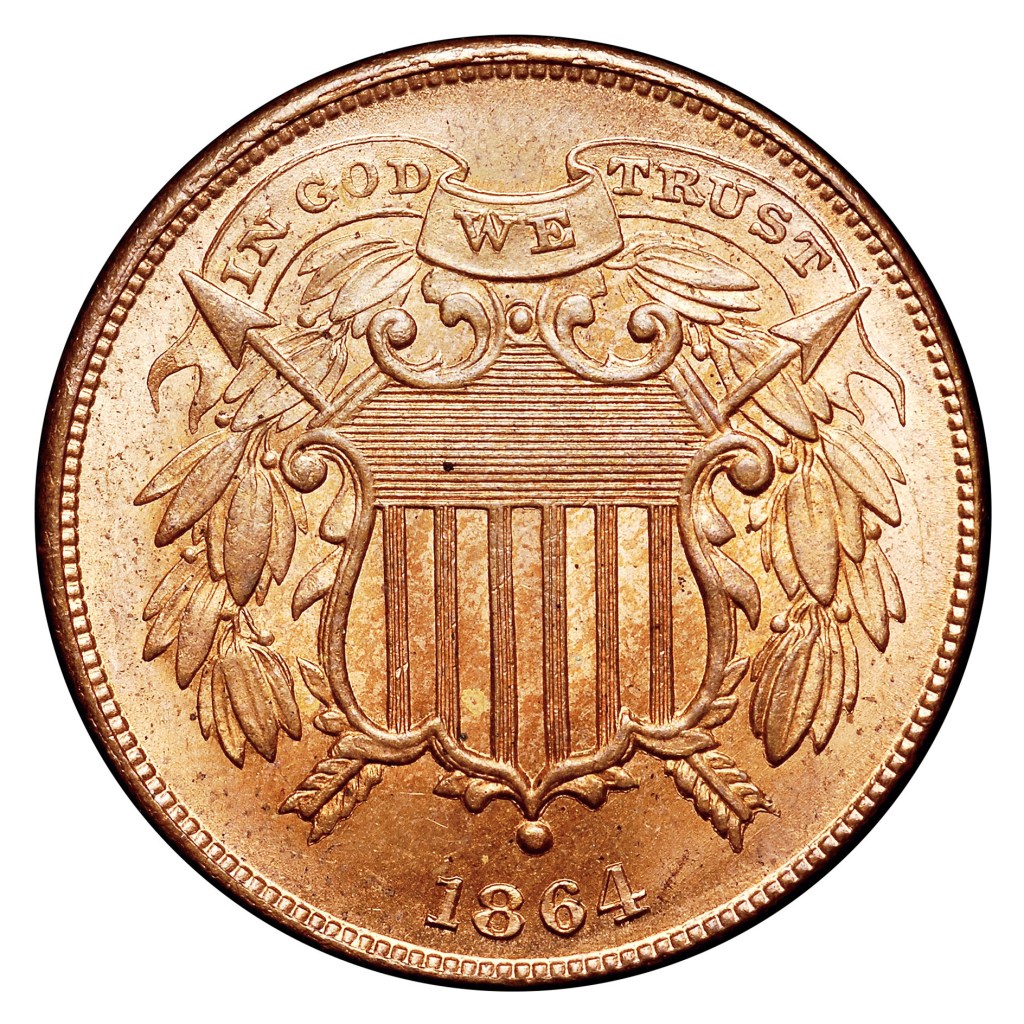
“In God We Trust” is the official motto of the United States. It was adopted by the U.S. Congress in 1956, replacing E pluribus unum (“Out of many, one”). The first paper money to feature the motto was the one-dollar silver certificate, which entered circulation on October 1, 1957.
However, that was not the first time “In God We Trust” appeared on American money. “IN GOD WE TRUST” first appeared on the obverse side of the Two-cent piece in 1864.
Image courtesy of Heritage Auctions, Public domain, via Wikimedia Commons
US Banknotes Have Multiple Security Features
US banknotes / “paper currency” (along with other currencies) contain security features that can be used to authenticate the banknotes and thereby avoiding accepting counterfeit currency. If you feel the paper (well it is not paper) it should feel slightly rough. All denominations higher than $10 have color shifting ink in the numeral on the lower right corner of the note. On current notes it should change from copper to green. The current style of $100 notes also includes two new security features that you can check by tilting the note: the color shifting in the inkwell and the 3D security ribbon (in the middle across the note). The images of the bells and the text of “100s” should shift as you tilt the note.
In addition, hold the note to light and check the watermark and the security thread that are included on denominations $5 and higher. When held to light the security thread should be visible when held to light. The watermark on a bill should match the portrait of the banknote. The two watermarks on five dollar bills should match the numeral five. The security thread is in a different location for each denomination and glows in a unique color when exposed to UV light. To watch a video explaining how you can check if a bank note is authentic click here or on the YouTube Video below.
If you sort the banknotes or use a machine to check for counterfeiting, there are additional features. The different denominations have a unique magnetic ink signature, as well as a serial number that is unique to each banknote. However, that is for machines and complex systems to discover. The serial number helps in identifying and tracking individual bills.
Me Being a Money Printing Engineer
At one point in my life (2013, 2014, beginning of 2015), I was working for a British company, which at the time was called DeLaRue Cash Systems, now DeLaRue Currency Solutions. DeLaRue Currency Solutions provide more than half of the world’s currencies for a lot of countries around the world. I was working there as a senior software engineer (and electrical engineer) and I was handling and developing the machines that printed banknotes or sorted banknotes. Both of these machines needed to be able to detect the security features described above and therefore they featured various detectors such as cameras, UV lights, magnetic detectors, etc. In the first case to make sure the banknotes were printed correctly and in the second case to check for counterfeit banknotes.
Through my work at DeLaRue I got the opportunity to travel to Great Britain and India. In Great Britain (Gateshead) I visited a banknote printing facility, which when I visited contained huge stacks of banknotes to the value of several billion dollars. Security was pretty tight, and you were not allowed to bring in or out any money. In Bangalore in India, I was introduced to an actress at the Bangalore Palace. My guide told me she was the Jennifer Aniston of India. I looked it up and she was not. Anyway, below is a picture.
Me and allegedly Jennifer Aniston of India, at the Bangalore Palace. They were making a movie at the palace. It was very nice of her to agree to a photo, but my guide’s claim that she was Jennifer Aniston of India was perhaps a slight exaggeration.
On April 8, 2024, a narrow sliver of the United States, including Dallas, where we live, experienced a total solar eclipse whilst most of the United States experienced a partial solar eclipse. We also had a three hour long partial solar eclipse and the total solar eclipse lasted four minutes. To explain, first there was a one and a half hour partial solar eclipse, then the total solar eclipse lasting four minutes, and then a one and a half hour long partial solar eclipse again. A partial solar eclipse is interesting, but a total solar eclipse is something else entirely. A total solar eclipse is the ultimate moon shade and an unforgettable lifetime experience.
We were all sitting outside in our backyard having a little party, drinking beer and eating snacks, as the partial solar eclipse began. During the partial solar eclipse, it was still daylight, and you could not look at the sun unless you had ISO certified solar eclipse glasses, which we did. When you put on the solar eclipse glasses you could see that the sun looked like a crescent. This was not possible to see without the solar eclipse glasses, and you certainly should not look at the sun during a partial solar eclipse.
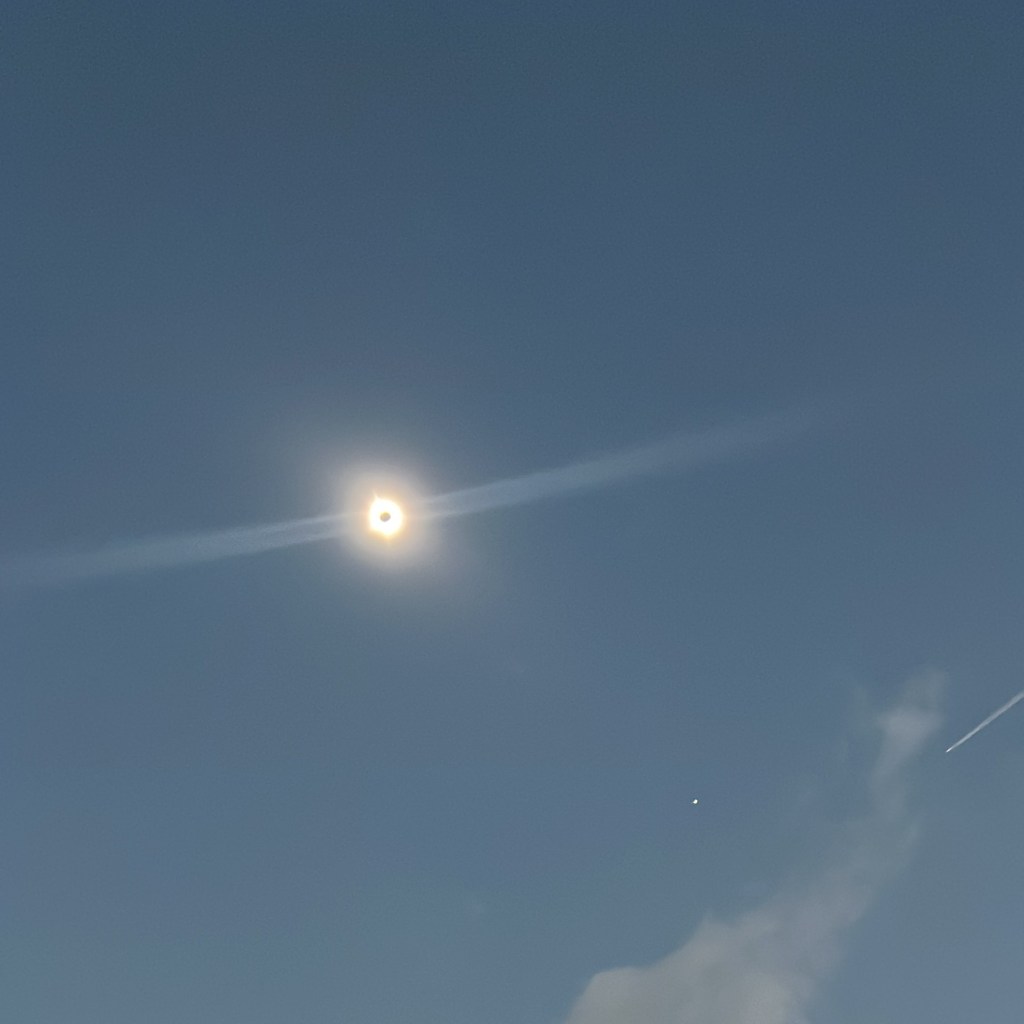
Suddenly, it got dark, not entirely dark, but more like as if it was well into twilight. The sun turned into a black circle surrounded by a faint wispy light. That was the sun’s corona, which normally is invisible due to the sun’s powerful light. The sun’s transformation only took a few seconds. The darkness fell extremely fast as if someone turned off the lights. Now you could look straight at the sun without the ISO certified solar eclipse glasses. Looking straight at the sun during a total eclipse is perfectly safe since all you see is a black circle in the sky. What you see is the black moon. The sun is hidden behind the moon. However, you need to be ready to put on your glasses, or turn your head, when it is time for the sun to come back.
As the sun suddenly vanished, the birds and the insects became quiet. The stars came out. Venus appeared above our heads, not far from the sun. It shone brightly in a location where you normally never see Venus. Venus typically appears above the western horizon after sunset (the evening star) or above the eastern horizon before sunrise (the morning star), not right above you. It was quiet, dark, the sky was beautiful and filled with stars, and there was a black circle in the sky surrounded by the magical faintly shining corona.
I knew what was coming next as the four minutes came to a close, so I put my ISO certified solar eclipse glasses back on. At first, I saw nothing. Then I saw something that looked like a big star that was quickly expanding like a super nova and turning into a thin bright thin crescent. The lights came on, the stars and Venus disappeared, the birds and insects began making noise again. Daylight and the whole world returned in just a few seconds. Now we had another one and a half hour of a partial solar eclipse to enjoy (using our solar eclipse glasses).
Path of totality (total solar eclipse). I am allowed to use this image as long as I link back to the National Eclipse. Click on the image to visit the National Eclipse.
What is a Total Solar Eclipse?
Solar eclipse occurs when the Moon passes between the Sun and Earth, blocking the Sun’s light and casting a shadow on Earth’s surface. This is illustrated in the picture below. As you can see there’s a weaker but larger shadow covering a portion of earth. This corresponds to the moon not blocking all of the sun, which results in a bright sun crescent. The darker smaller region/circle on earth corresponds to the moon blocking all of the sun resulting in near total darkness. This is the region on earth that has a total solar eclipse.
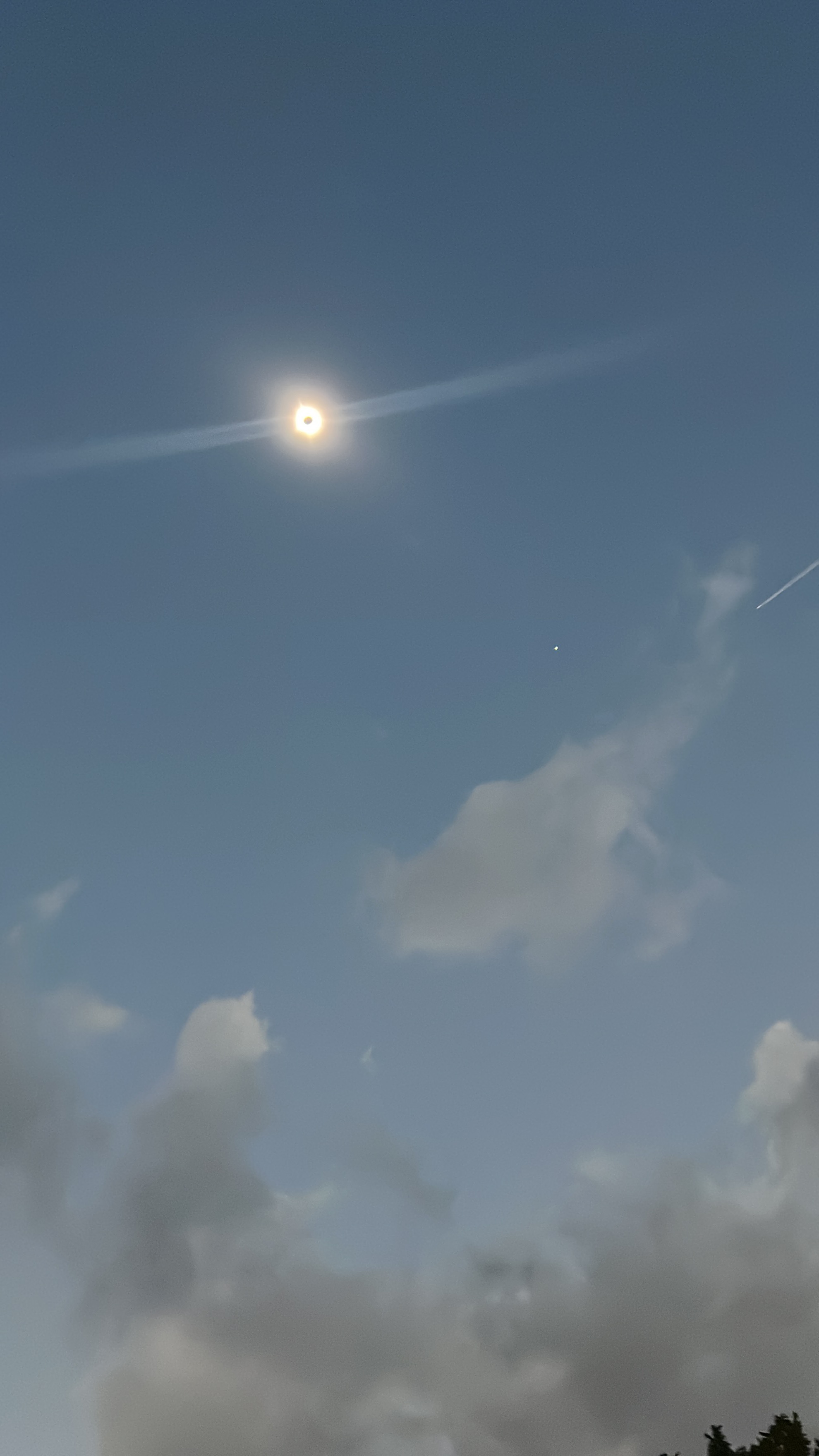
Solar Eclipse with Sun Moon and Earth Orbit. Shutterstock Asset id: 2292547031 by Nandalal SarkarGif animation illustrating totality and extent of partial solar eclipse. Official work for NASA.Solar Eclipse. The moon moving in front of the sun. The wispy light is the sun’s corona. It is typically invisible due to the sun’s strong light. It is fine to look at the sun’s corona with the naked eye. It is not very bright, more like the moon’s light. I can add that this photo corresponds the closest to what we saw with our naked eyes. Asset id: 2441654015 by GagliardiPhotographySolar Eclipse photo taken with a photo filter solar Stock Photo ID: 2344355767 by aeonWAVETotal solar eclipse photo that my daughter took with her iPhone. The sun, I mean the moon, looks small in the picture, but they were the normal size. Can you find Venus?My solar eclipse glasses that I bought on Amazon.
Partial Solar Eclipse
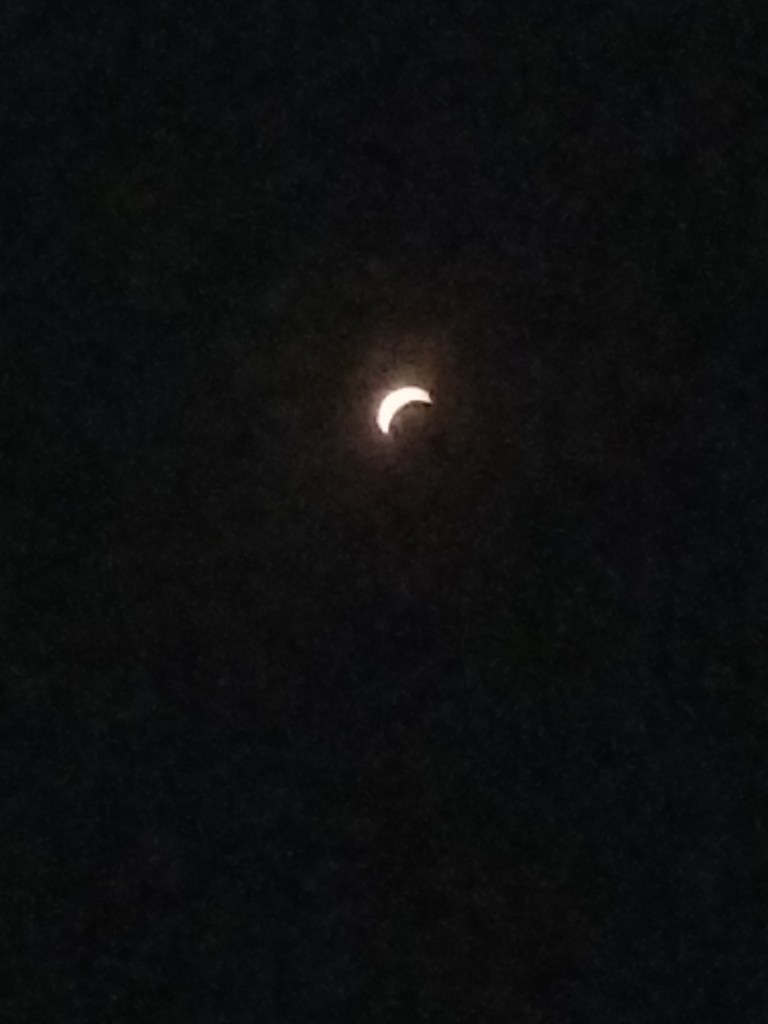
As I said, most of the country had a partial solar eclipse and we had a partial solar eclipse as well as a total solar eclipse. During a partial solar eclipse, it does not get dark, no stars come out (the sun is too bright), the birds don’t stop singing, and you cannot see the partial solar eclipse with the naked eye. You need ISO certified solar eclipse glasses. However, there are other cool effects such as the shadows of the trees turn into thousands of little crescents.
Partial eclipse photo taken with my old Samsung Galaxy phone and a photo filter.Illustration / enhanced photo of partial solar eclipse. Shutterstock Asset id: 2237042889 by Kolonko
Annular Solar Eclipse
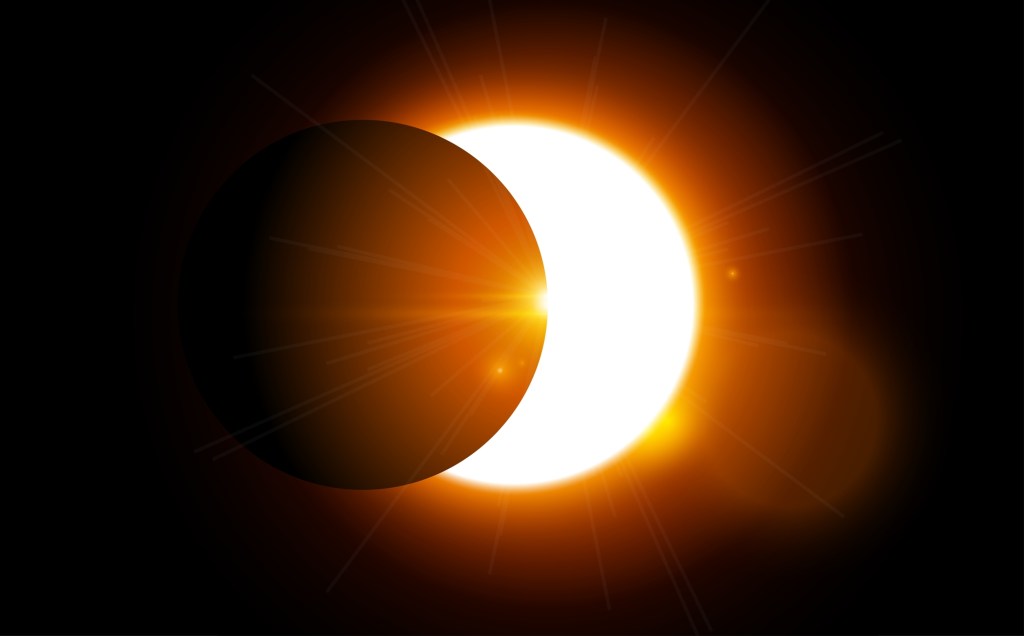
Lastly there are also annular solar eclipses. That is almost a total solar eclipse, but the moon is not covering all of the sun’s disc resulting in circle of the sun being visible. It is similar to a partial solar eclipse in the sense that it is still daylight, the stars won’t come out, etc. I can add that even though the light is dimmed a bit during an annular solar eclipse it does not get dark as during a total solar eclipse. The picture below is a bit misleading in that sense (probably a photo filter).
Annular solar eclipse in desert. Liwa desert, Abu Dhabi, United Arab Emirates. Shutterstock Asset id: 1598991664 by Kertu
Miscellaneous Solar Eclipse Photos taken with Cell Phones
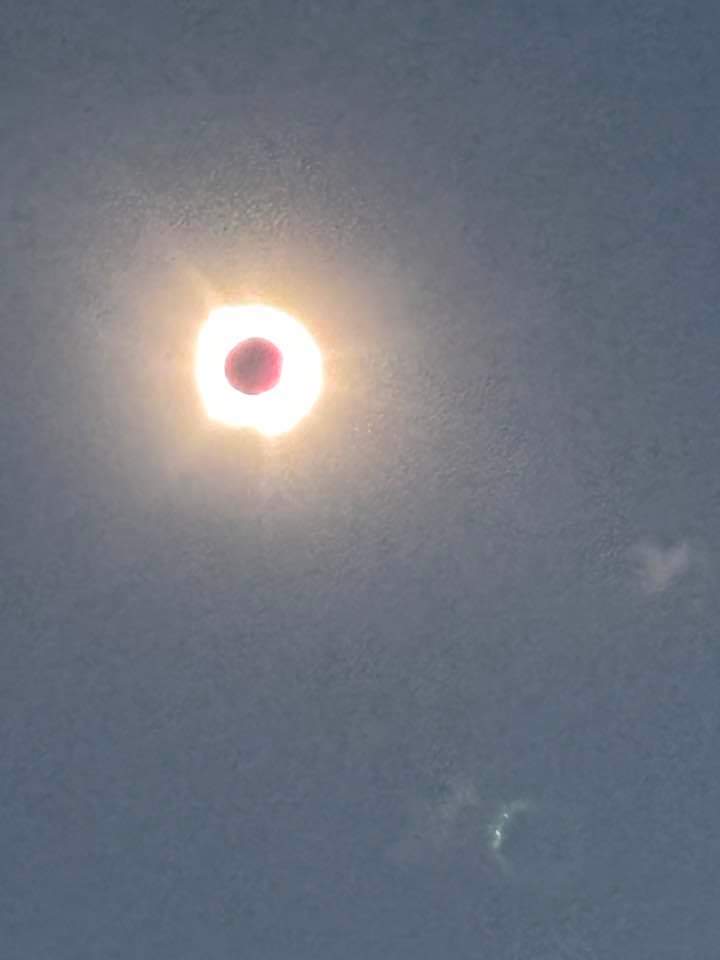
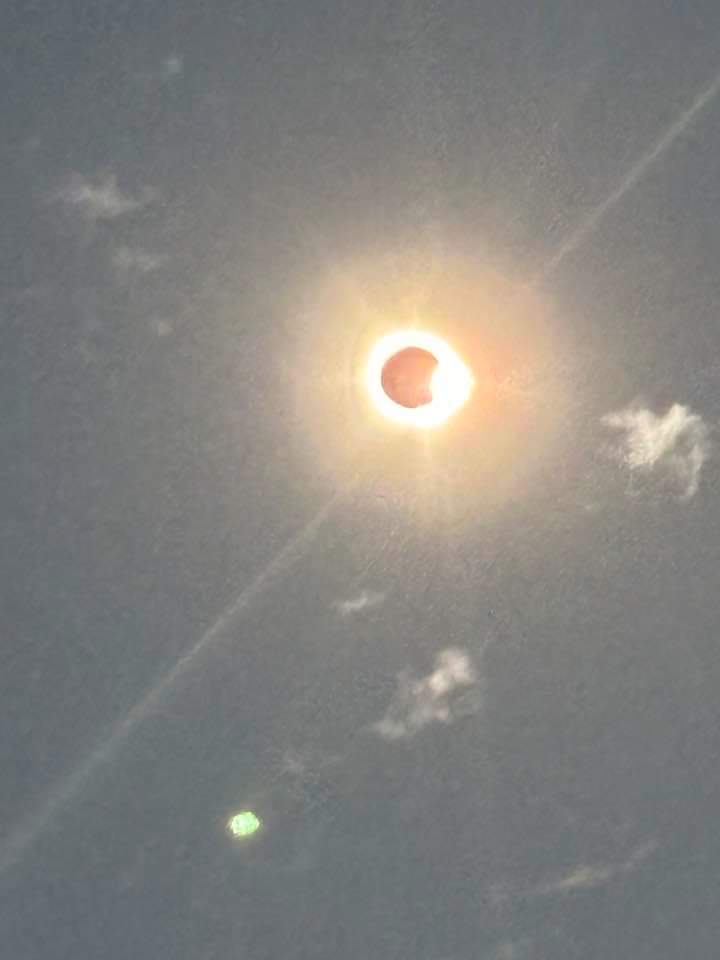
These eight pictures above were taken with cell phones by my daughter Rachel, and friends Denise Mosier-Wanken, and Margaret Weiss Bloebaum.
If you want to read more about this experience you can click here or here.
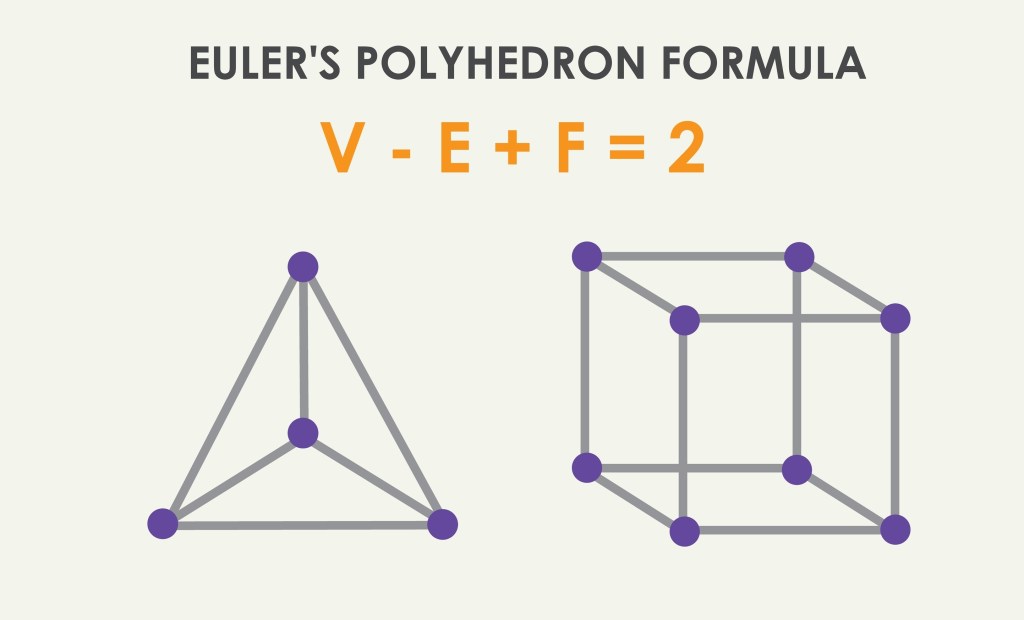
Super fact 64 : V – E + F = 2 is true for all convex polyhedra, where V is the number of vertices (corners), E is the number of edges, and F is the number of faces of a convex polyhedron. This is called Euler’s formula for polyhedra.
Polyhedron Euler’s formula. The cube has 6 faces, 8 corners (blue dots), and 12 edges (grey lines) and 8 – 12 + 6 = 2. Popular shapes Asset id: 2362684465 by ramonparaiba.
Convex polyhedra are polyhedra without holes, or it has no internal angles larger than 180 degrees. To express that exactly; A convex polyhedron is a three-dimensional solid with flat polygonal faces where a line segment connecting any two points on its surface or interior remains entirely within the solid. I can add that convex polyhedra consists of convex polygons as their faces. All its faces are convex polygons.
The difference between convex and concave polygons. Notice that the concave polygons on the right have “holes” in them, or inner angles larger than 180 degrees, and that you can draw a line starting and ending inside the polygon that goes outside the polygon.
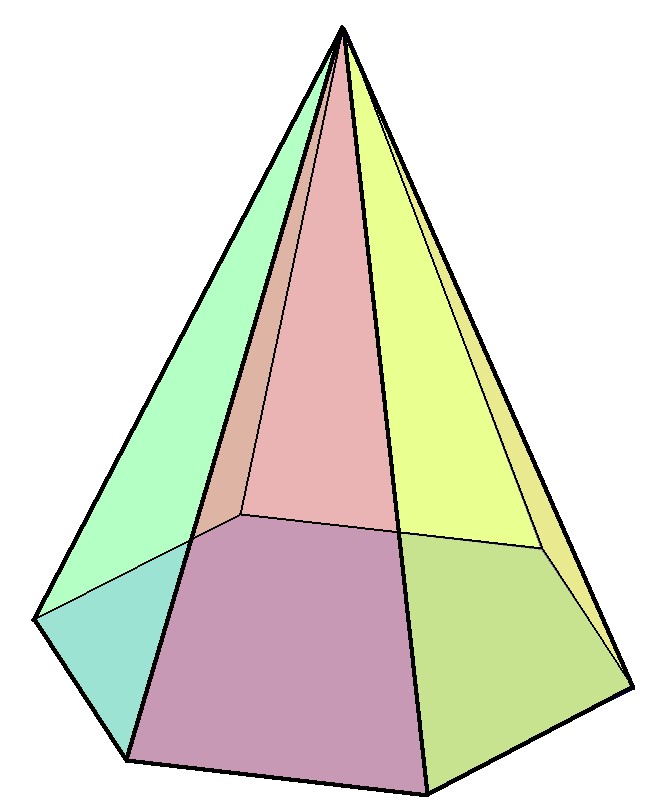
It is easy to understand that there are an infinite number of convex polyhedra. All pyramids (with convex polygons for bottoms) are convex polyhedra whether the bottom is a square/rectangle, or a convex pentagon, hexagon, heptagon, octagon, or any kind of convex polygon, even with trillions.
A hexagonal pyramid (it is convex). Tomruen at en.wikipedia, Public domain, via Wikimedia Commons.
Examples of convex polyhedra are cubes, boxes, a tetrahedron, pyramids of various sorts, an octahedron, dodecahedron, icosahedron, but there are infinitely many.
As an example, take a cube (like a dice). It has six faces (F = 6), eight vertices (corners V = 8), and 12 edges (V – E + F = 2 or 8 – 12 + 6 = 2). A tetrahedron has four faces (F = 4), four vertices (V =4), and six edges (E = 6) (V – E + F = 2 or 4 – 6 + 4 = 2). A pyramid (with a square bottom) has five faces (F = 5), five vertices (V = 5) and eight edges (E = 8) (V – E + F = 2 or 5 – 8 + 5 = 2). An octahedron has eight faces (F = 8), and six vertices (V = 6), and twelve edges (E = 12) (V – E + F = 2 or 6 – 12 + 8 = 2). A dodecahedron has twelve faces (F = 12), and twenty vertices (V = 20), and thirty edges (E = 30) (V – E + F = 2 or 20 – 30 + 12 = 2). An icosahedron has twenty faces (F = 20), and twelve vertices (V = 20), and thirty edges (E = 30) (V – E + F = 2 or 12 – 30 + 20 = 2). Euler’s Polyhedral Formula works for all of them and for all the infinite number of convex polyhedra that exists.
Tetrahedron, cube, octahedron, dodecahedron and icosahedron, Shutterstock Asset id: 2138211027 by Dotted Yeti
I consider this a super fact because it is quite amazing and surprising that the number of faces, vertices, and edges follow the same formula for all convex polyhedra. At least it is surprising if you haven’t seen it before. I should say that Leonhard Euler’s most celebrated discovery is probably his discovery of the Euler Number and the associated Euler’s Formula.
More Polyhedra Examples
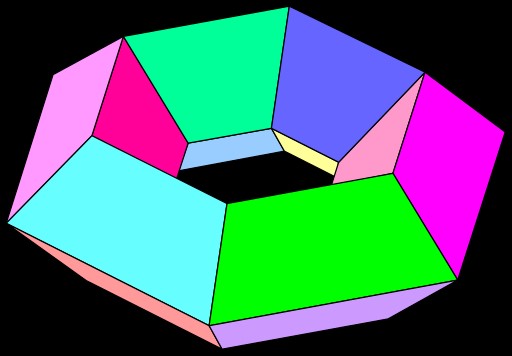
The three first examples below are convex polyhedra so Euler’s Polyhedral Formula apply. The last two examples are not so Euler’s Polyhedral Formula does not apply.
This is a truncated icosahedron, which is a convex polyhedra, so Euler’s Polyhedral Formula apply. Shutterstock Asset id: 2309812551 by Mima Subota.This Rhombicuboctahedron is an example of convex polyhedron, so Euler’s Polyhedral Formula applies. Cyp, CC BY 4.0 <https://creativecommons.org/licenses/by/4.0>, via Wikimedia Commons.This Icosidodecahedron is another example of a convex polyhedron, so Euler’s Polyhedral Formula applies. Attribution must be given to Robert Webb’s Stella software as the creator of this image along with a link to the website: http://www.software3d.com/Stella.php. A complimentary copy of any book or poster using images from the Software would also be appreciated where feasible., Attribution, via Wikimedia CommonsThis hexagonal torus / toroidal polyhedron is not a convex polyhedra, so Euler’s Polyhedral Formula does not apply in this case. Tom Ruen, SVG version from de:User:Antonsusi, Public domain, via Wikimedia CommonsThis Merkaba Polyhedron is not a convex polyhedra, so Euler’s Polyhedral Formula does not apply in this case. Shutterstock Asset id: 1296063079 by Panimoni
Super fact 63 : Evolution is both a fact and a scientific theory. It is a fact that life has changed over time. This is supported by overwhelming evidence, while the theory of evolution provides a comprehensive scientific explanation for these changes, using processes like natural selection.
This is very confusing to people who do not know what a scientific fact is or what a scientific theory is. First of all, a scientific fact (they exist) is not the same as the scientific theory associated with that fact. Secondly, theory in science does not mean a guess, or a hypothesis, as is often the case in common parlance. In science, a theory is far more than a guess — it is a well-tested, comprehensive explanation of natural phenomena, supported by an extensive body of evidence. I think a good example of this confusion is the following dialogue that I found on Facebook.
I follow “The Credible Hulk”, a Facebook page managed by a group of anonymous scientists dedicated to correcting misinformation around vaccines, global warming, evolution and GMOs. I did not save the post, but it went something like this: The Credible Hulk posted a meme that looked like this.
One of the commentors said : “Calling evolution a “fact” defeats your argument. The Theory of Evolution is by definition a theory not a fact. It’s the currently agreed upon hypothesis but not a fact.” He did not know that he did not know what he was talking about. Since the Credible Hulk page is administered by scientists and a lot of its followers are also scientists, or people with a science education, he got schooled. You can read more about this confusion in my post “There Are Scientific Facts”, or here.
The evidence for evolution is both vast and compelling. Evolution is not just a process of the distant past — it can be observed in real time. Bacteria developing antibiotic resistance, viruses adapting to immune systems, and insects evolving resistance to pesticides are clear, measurable examples of evolution in action. The extensive fossil record, transitional fossils, comparative anatomy, sub-optimality, evidence from biogeography, etc., provide a very large body of conclusive evidence for evolution. Modern genetics provides perhaps the strongest proof of evolution.
Far from being a matter of belief, evolution is a scientifically established reality that shapes life continuously. Its understanding is vital, not only for biology but also for medicine, ecology, and environmental science. It allows us to track disease outbreaks, design new treatments, and appreciate the delicate balance of ecosystems. Evolution is not speculation — it is the foundation of modern biology and a dynamic process still unfolding around us. Evolution is a fact.
According to the pew research center around a third of all Americans reject the idea of evolution. Since this is an important fact that is widely disputed amongst the public, and yet we know it is true, I consider it a super fact. I also would like to reiterate that none of my super facts are scientific theories, but some of them are scientific facts, which again, is not the same thing.
Evidence for Evolution
The evidence for evolution as a phenomenon (fact) is conclusive as we can directly observe it (see below). That is all I need for my statement above that evolution is a fact. However, most people want to know how strong the evidence is for large-scale evolutionary changes that have occurred over geologic time, and what evidence there is for evolution being as the origin of species. In other words, how strong is the evidence for the theory of evolution. It turns out the evidence for that is also very strong. That is not the same as my super fact, but it is related and a quite interesting discussion.
Fossil records preserved in rock layers reveal a chronological history of life on Earth, documenting gradual changes in species over millions of years. Transitional fossils, such as Archaeopteryx linking dinosaurs to birds, demonstrate how one group of organisms evolved into another. Comparative anatomy adds to the case, showing homologous structures across species that point to shared ancestry.
Biogeography shows patterns of species distribution explained by common descent and migration. Modern genetics provides perhaps the strongest proof. DNA — the universal code of life — shows striking similarities across organisms. Humans, for example, share a large percentage of their genome with chimpanzees, and remarkably, the same genetic code underlies all living things, from bacteria to mammals, confirming a common evolutionary origin.
Making a list of all the evidence with brief explanations is far beyond the scope of this blog post and reading a 1,000,000+ word essay about evidence is not everyone’s cup of tea. Therefore, I am just providing a very small sample with very brief explanations (this post is long enough as it is).
This website offers a more extensive overview including 29+ evidences for so called macroevolution. Macroevolution describes large-scale evolutionary changes that occur over geologic time. Scientist tend to avoid the word Macroevolution because it is so misunderstood. First of all, Macroevolution is just the combination of a large number of smaller scale changes. New species do not randomly pop up because of some amazing mutation.
Speciation is considered relative. It is often said that two animals belong to the same species if they can interbreed in nature and produce viable, fertile offspring. However, it is not that simple. An animal A may be able to successfully interbreed with an animal B, and that animal B may be able to successfully interbreed with an animal C, but animal A and C cannot interbreed. Animal A could be said to be a different species relative to animal C but animal B could be said to be the same species as both animal A & C.
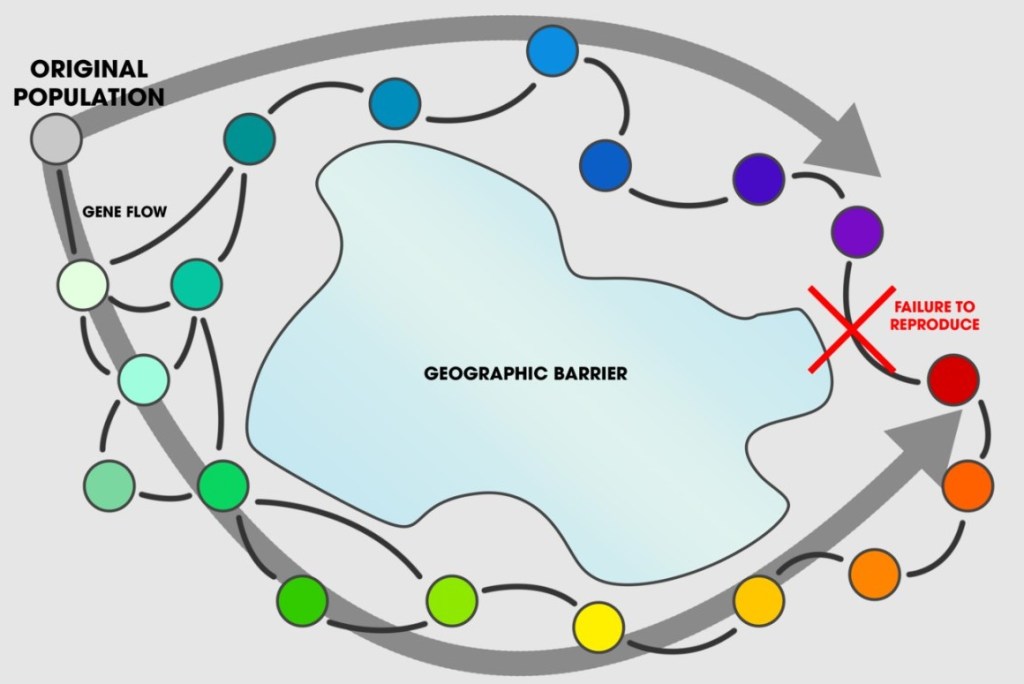
A great geography related example of this is ring species. In a ring species, gene flow occurs between neighboring populations of a species, but at the ends of the ring the populations don’t interbreed. Macroevolution is the result of repeated microevolution, so you cannot claim that microevolution is possible but not macroevolution.
Illustration of ring species, an example of how speciation can be relative. All the circles next to each other can interbreed but at the end it no longer works. Andrew Z. Colvin, CC BY-SA 4.0 <https://creativecommons.org/licenses/by-sa/4.0>, via Wikimedia Commons
Direct Observation
Evolution in viruses and bacteria has been observed and is well-documented, providing a direct window into evolutionary processes. Examples include the development of antibiotic-resistant bacteria, the annual evolution of influenza viruses and researchers can also directly observe rapid adaptation through experiments, such as the ongoing “arms race” between bacteria and viruses in lab settings. Direct observation supports my claim that “evolution is a fact”, because we’ve seen it. However, the evidence for so called macroevolution over longer periods of time is more indirect but still extremely strong.
Evidence from Biogeography
Biogeography provides evolutionary evidence by revealing patterns in the geographic distribution of species that can only be explained by common descent and evolutionary processes. For example, oceanic islands, which are islands that are formed from the sea bottom typically through volcanic activity, feature very narrow sets of native species (flora + fauna) that do not exist elsewhere.
One example is the Hawaiian Islands, which make up only 0.004 percent of the earth’s land and yet they contain nearly half of the world’s two thousand species of Drosophila. Darwin’s finches is another example. Another example is that oceanic islands do not have any native freshwater fish, or amphibians and rarely any native reptiles or mammals. These kinds of examples match the narrative that certain species (birds, insects, etc.) travelled to these islands and then evolved resulting in a unique set of species. BTW non-native freshwater fish, amphibians, and mammals do just fine, so it is not the environment. The book Why Evolution Is True by Jerry A. Coyne gives an extensive overview of biogeographic evidence for evolution.
Fossil Record
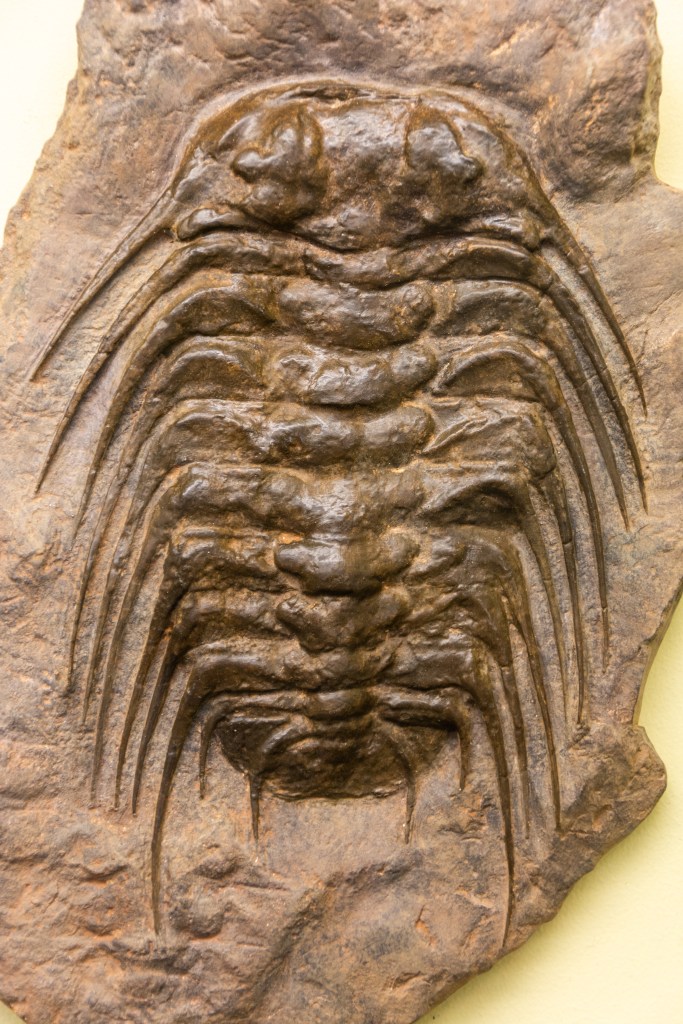
There are millions of found fossils representing 250,000 different species (there are likely trillions of not yet found fossils). The fossil record shows that early life was simple with complex life appearing later, with the youngest fossils being most similar to currently living species. It documents the orderly succession of life forms through geologic time. This is predicted by the theory of evolution. In addition, the various so called gaps in the fossil record keep being filled out. Opponents to evolution often criticize the dating methods used to date fossils. However, these criticisms do not hold water. You can read about that in my post We Know That the Earth is Billions of Years Old.
The fossil record is a lot more solid and much less problematic than the creationist books I have read claimed. Shutter Stock Photo ID: 1323000239 by Alizada Studios
Evidence of Evolution from DNA
DNA provides strong evidence for evolution. It is perhaps the strongest evidence for evolution. For example, related species share genes for fundamental traits, and the more similar the DNA sequences of two organisms, the more recently they shared a common ancestor. As time goes by DNA mutations accumulate acting like a “genetic clock,” allowing scientists to estimate how long ago different lineages split from each other. That’s how we know that Chimpanzees and Hominins / Humans share a common ancestor about 6-8 million years ago without having a fossil.
I can add that this was just a sample with a very brief summary for each case. Other types of evidence is the development of embryos. For example, whale and dolphin embryos have limbs that disappear, fetuses look like fish early on, human fetuses go through a hairy (primate) stage. There is evidence in the anatomy of our bodies, sub-optimality, curious anatomical imperfections due to our evolutionary history, so called atavisms, and vestiges. But that is enough for now.
Objections to Evolution
If you pay attention to this topic, you will come across a lot of flawed objections to evolution. When I was a teenager, I was a young earth creationist myself. Since I did not know a lot about the subject at the time I accepted many of these flawed objections and I even believed in a young earth. It doesn’t matter how many flawed objections you have to a theory (or a fact), if they are flawed, they don’t matter. I was very interested in science and went to science high school in northern Sweden. As I learned more about science, I came to realize that I had been bamboozled. You can read more about that in my post “Bamboozlement Misunderstandings, Big Surprises and My Journey”.
Since then, I have tried to argue with creationists about evolution, and I have come to realize that a lot of people are very emotionally invested in their opposition to evolution. For example, back in high school my wife was asked whether she believed in evolution and when she said yes, another girl threatened to beat her up in the bathroom. Once I was arguing online with a couple of strict fundamentalists who took a very aggressive and self-assured attitude to the topic despite not knowing much about the related science or evidence. It seemed to be impossible for them to understand normal scientific or logical arguments and yet they were totally sure, and they used mockery a lot. One of them found out that I “believed/accepted” that global warming is real and caused by us and started mocking me for that, a totally unrelated issue. Then the other one told me that if you believe in evolution, then you and your children will burn in hell forever. Well, if that is really what you believe, no wonder you can’t be rational about it. Anyway, at this point I pressed the block button. Talk about a hot discussion.
In my youth I read dozens of creationist books of various kinds, so I’ve have come across a lot of creationist objections. In the end I came to realize that none of them worked. I can add that the book “The Counter-Creationism Handbook” address over 400 of the most prevalent claims made by creationists. Below I am just very briefly addressing a few.
If humans descended from monkeys how come there are still monkeys?
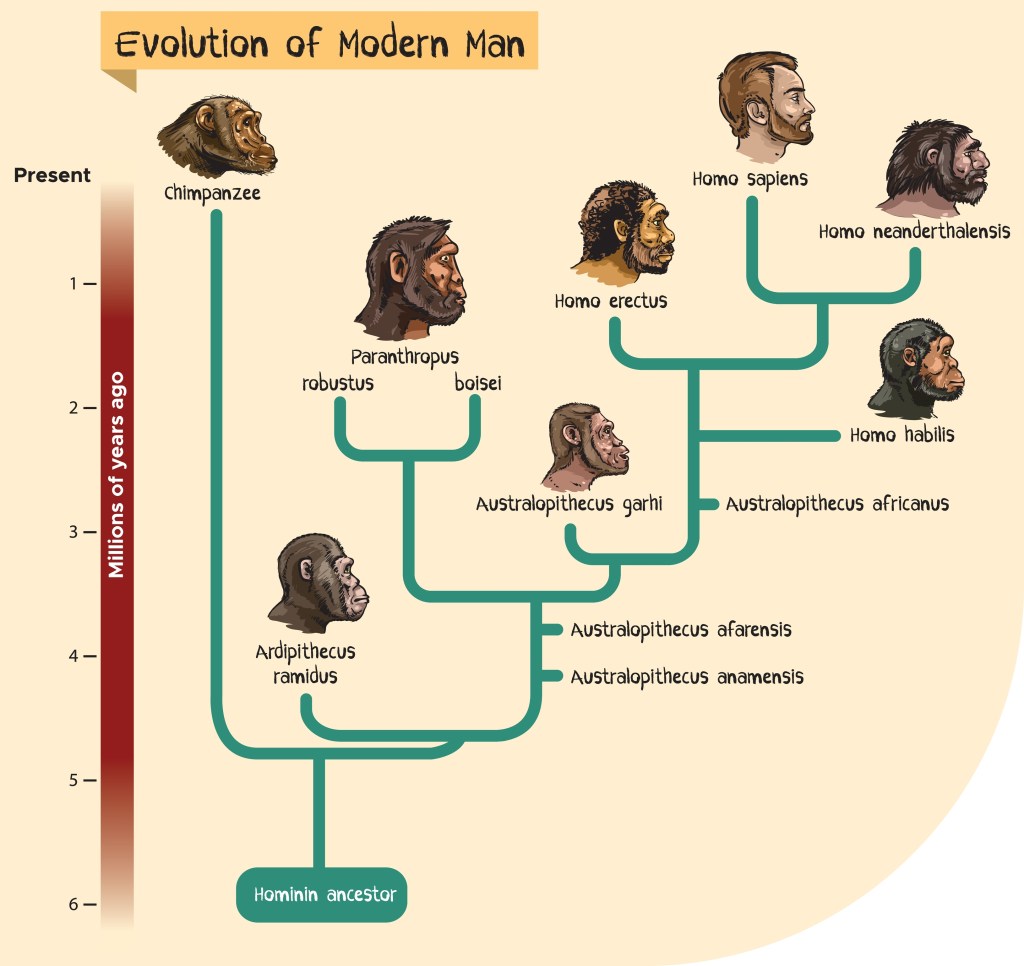
This is perhaps one of the more simplistic objections, but it is still worth mentioning. Even if it would have been true that monkeys evolved from monkeys, there’s no reason monkeys would stop existing just because humans evolved from some monkeys. However, that is not what happened. Genetics provides overwhelming evidence that hominins (including humans) and chimpanzees share a common ancestor. We have not found a fossil for this ancestor, but human and chimpanzee DNA tells us that such an ancestor lived about 6 to 8 million years ago. The simplified cladogram for hominins below demonstrates this. I can add that there are around 6000 hominin fossils, and up to 31 hominin species.
Simple cladogram showing evolution of modern man from Hominid Ancestor Shutterstock Asset id: 2093535535 by CLOUD-WALKER
Evolution is not Falsifiable
A theory is scientific only if it can be proven false. It must be falsifiable. Opponents to evolution often claim that evolution is not falsifiable because it deals with unobservable, unrepeatable events. However, the theory of evolution is falsifiable. There are no Precambrian rabbits or Mesozoic human fossils, but if there were that would have proven the theory of evolution false. Note evolution would still have been directly observable (viruses and bacteria), so evolution is a fact that would still be true, but the theory of evolution would have been proven wrong.
Second law of Thermodynamics contradicts Evolution
The second law of thermodynamics states that entropy (typically denoted ‘S’ in physics), which could be said to represent disorder, always increases or stays the same in a closed system. Creationists believe evolution creates complexity and order, which would seem to be a decrease in entropy. One weakness of this argument is that entropy representing disorder only loosely relates to order and disorder as used in common language. More correctly, entropy is defined as; for a given set of macroscopic variables, the entropy measures the degree to which the probability of the system is spread out over different possible microstates. Much more importantly, the creationist argument fails because the second law of thermodynamics requires a closed system, and evolution does not operate in a closed system. For example, the sun is shining and providing earth with energy.
Second law of thermodynamics Shutter Stock Vector ID: 2342031619 by Sasha701
Evolution is Random and Improbable
Another creationist argument is that evolution is random, and randomness cannot create an elephant or an airplane. No matter how many times you randomly throw pieces of junk around you won’t get an airplane. The error in this argument is that evolution is not random. It is guided by natural selection (theory of evolution), and natural selection can be very powerful over time. For example, several computer simulations have been created to model the evolution of the eye, demonstrating that a complex camera-type eye can evolve gradually from a simple light-sensitive patch through a series of small, advantageous steps.
I can add that I have some personal experience with genetic algorithms myself. At work I created an algorithm that interpreted data from a camera for the purpose of sorting mail effectively. I started out with a chromosome that was very bad. Then my program applied random mutations and few other genetic features and allowed the best chromosomes to survive. Eventually a very complex but effective algorithm/chromosome resulted. I did not create this powerful algorithm; randomness combined with natural selection did. Randomly throw lots of junk around but also add some natural selection and you may very well get an airplane.
Microevolution is possible but not Macroevolution
Creationists like to say this because they must accept the reality of observable microevolution. It is a scientific fact. However, so called macroevolution is just repeated microevolution. There is no reason that macroevolution wouldn’t be possible. In addition, as you saw in the paragraphs before the ring species image above, the evidence for macroevolution is very strong. Again, microevolution and macroevolution are concepts that creationists like to use more than scientists.
Anyway, this became very long, almost 3,000 words.
Super fact 62 : Facts exist in science; a scientific “fact” is an observation of a natural phenomenon that has been repeatedly confirmed by independent observers and is accepted as true for all practical purposes.
Outside of mathematics and logic nothing is ever the final truth, not in science, and not anywhere else. However, there are facts that have been so well confirmed and are so basic that there is no reason to doubt them. Earth is not flat like a pancake, and the sun is a star, are two examples of astronomical facts. Most dogs have four legs is another fact. The speed of light in vacuum is the same for all observers is a fact in physics that is surprising if you didn’t know it before. Scientific facts are verified by repeatable careful observation or measurement by experiments or other means. It is possible that we are all living in a virtual reality, like in the movie The Matrix, and that Earth is really flat like a pancake after all, because all of reality is a dream. However, for all practical purposes, it is not the case.
This blog, super facts, deal with facts that are surprising, strange, or disputed by non-experts, and yet true because they have been verified, for example, in the case of scientific facts, by repeatable careful observation. Anyone is free to object if you think I am wrong about a fact.
My next super fact is going to be “Evolution is a fact”. Evolution is also a scientific theory, but it means something different from when you say evolution is a fact. Moreover, a Scientific Theory is not a guess, as commonly but incorrectly assumed. I am bringing this up because many people who are typically unaware of the evidence behind a fact will use arguments such as “science does not know everything”, “it is just a theory”, etc., in efforts to dismiss a well-supported claim.
I should say that this post is inspired by a Facebook post by “The Credible Hulk”, a Facebook page managed by a group of anonymous scientists opposing misinformation around vaccines, global warming, evolution and GMOs. I did not save the post, but it went something like this:
One of the commentors said : “Calling evolution a “fact” defeats your argument. The Theory of Evolution is by definition a theory not a fact. It’s the currently agreed upon hypothesis but not a fact”
What the commentor did not realize is that “Theory” in the context of science does not mean what he thought it did. I am using past tense because he got “schooled”. To his credit he did not respond with insults and neither did the Credible Hulk, which does not seem to be standard on Facebook. However, his comment illustrates something that drives scientists like those who created “The Credible Hulk” nuts, and that is the widespread lack of understanding of the difference between a guess, a hypothesis, a scientific fact, theory as used in common language and used when talking about a scientific theory.
Rather than having this discussion over at my upcoming “Evolution is a fact” post, I am making a separate post about it. I consider “There are Scientific Facts” a super fact because it is true, and yet the confusion around it and what a Scientific Theory pertains is massive, and it is an important topic.
What is Science?
Science is the process of learning about the world through systematic observation and experimentation to gain knowledge about how things work. It involves observing phenomena, forming testable ideas (hypotheses), systematic studies, conducting experiments, and collecting evidence and facts that support or refute those ideas, ultimately leading to a deeper understanding of general truths and natural laws. If an idea/hypothesis correctly predicts and explains facts, it becomes a theory, which is something that is very different from a guess.
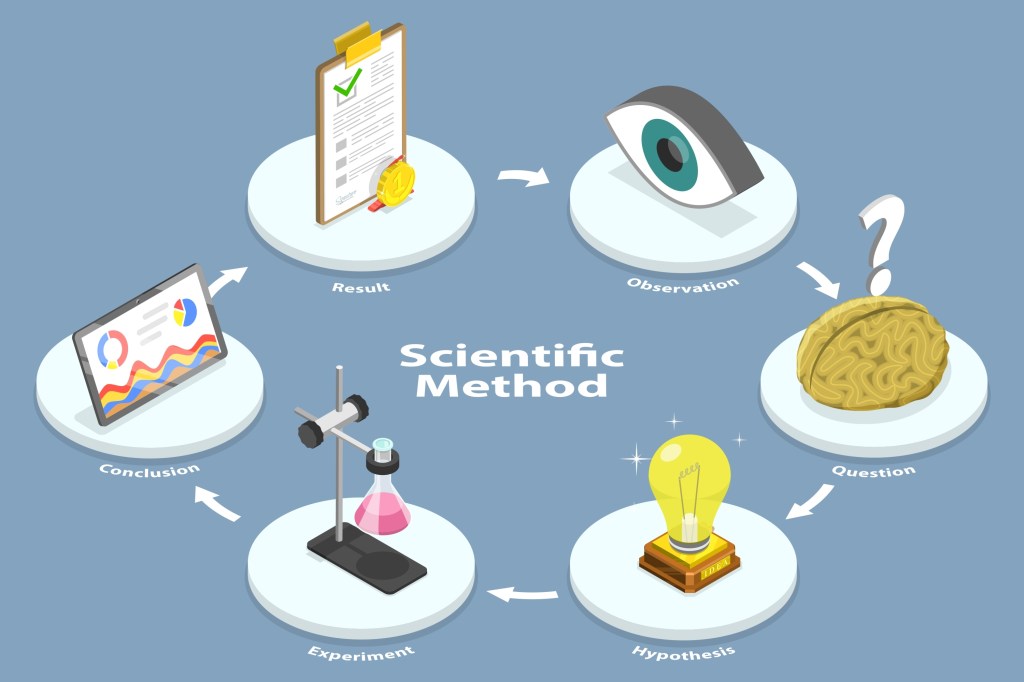
The process of making observations, formulating testable hypotheses, conducting experiments, analyzing data, and drawing conclusions to understand phenomena and solve problems is referred to as the scientific method, and there are different types of scientific methods. Some involve experiments, other involve analysis historical artifacts or existing data. Objectivity, reproducibility, falsifiability, and predictive power or problem solving are essential.
Aspects of scientific research include analysis, data collection, sometimes surveys, development, establishing facts, creating knowledge, and data entry so that others can repeat it and verify results. Shutterstock Asset id: 1100776715 by Trueffelpix
What is a Scientific Theory?
When people hear the phrase “evolution is a theory,” many mistakenly assume it means evolution is just a guess or speculation. In science, however, a theory is far more than a guess. A scientific theory is an explanation of an aspect of the natural world that can be or that has been repeatedly tested and has corroborating evidence in accordance with the scientific method, using accepted protocols of observation, measurement, and evaluation of results. In other words, it is a well-tested, comprehensive explanation of natural phenomena, supported by an extensive body of evidence.
Conceptual Illustration of Scientific Method and Knowledge Acquiring. Notice, not all scientific methods necessarily include experiments. Some include surveys, or testing of ancient artifacts, etc. Shutterstock Asset id: 2139402875 by TarikVision
The evidence for evolution is both vast and compelling. It is not just the massive fossil record, it is in DNA, anatomy, there’s geographic evidence, and evidence from dozens of other scientific fields, not to mention that evolution is directly observable. There is a Theory of Evolution, that is the well supported explanation for evolution, or evolution by natural selection. There is also “Evolution is a fact” referring to, for example, the fact that we can directly observe it. It is true for all practical purposes, and that does not mean that evolution stops being a scientific theory as well as a fact.
Afterword
Even though science is constantly evolving and our knowledge is evolving and sometimes our understanding and scientific theories on a topic needs to be updated, scientific facts exist. Some scientific facts are extremely unlikely to change. For example, Jupiter has multiple moons, galaxies exist, global warming is real and is caused by us, and evolution is a fact. Before you decide to dismiss such a fact make sure you know what “theory” means in science, and most importantly educate yourself on the relevant evidence. There might be a whole lot more than you imagined, and you may discover that the evidence you thought was contrary is not evidence.
You often hear “science does not know everything”. That’s true. If science knew everything it would stop. However, the collective knowledge created by science is enormous and as individuals we know next to nothing. So be humble and learn from scientific evidence presented by reliable sources.




















 Super Facts