Relativity by Albert Einstein

This is not a super fact post but another kind of fact-oriented post. It is a book review for a book that I find interesting, Relativity: The Special and the General Theory by Albert Einstein. Yes, the book was written by Albert Einstein in 1916 and translated into English in 1920. It is written for laymen, average readers, and despite being more than 100 years old (well this reprint is from 1995) it does not feel outdated.

I should say that I wrote my review decades ago and Amazon has hidden about 900 of the oldest reviews including mine. So, you can no longer find it. Luckily, I still had it, but I cannot provide a link to it. The book comes in formats, hardcover (2024), paperback (1995), Kindle (2014), Audio (2009). I bought the paperback version.

  • Publisher : Independently published (July 29, 2024), ASIN : B0DBQVVJVQ, ISBN-13 : 979-8334454118, 109 pages, item weight : 7.8 ounces, dimensions : ‎ 6 x 0.47 x 9 inches, Translator : Robert W. Lawson, it costs $12.33 on US Amazon. Click here to order it from Amazon.com.
  • Paperback –  Publisher : Crown (June 6, 1995), ASIN : 0517884410, ISBN-13 :  978-0517884416, 208 pages, item weight : 8 ounces, dimensions : ‎ 5.2 x 0.5 x 8 inches, it costs $7.89 on US Amazon. Click here to order it from Amazon.com.
  • Kindle –  Publisher : Amazon Kindle Direct Publishing (February 23, 2014), ASIN : B004M8S53U, 126 pages, it costs $0.99 on US Amazon. Click here to order it from Amazon.com.
  • Audiobook –  Publisher : HighBridge, a division of Recorded Books (November 14, 2009), ASIN : B002XGLDAA, Listening Length : 2 hours and 14 minutes, it costs $12.09 on US Amazon. Click here to order it from Amazon.com.
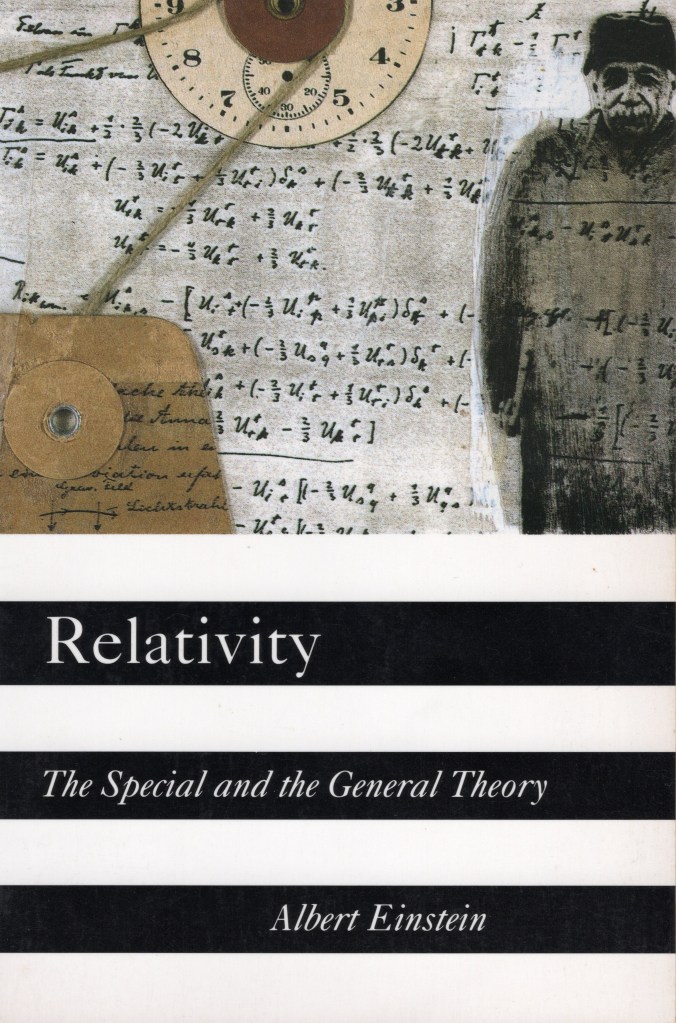
The front cover of the paperback version feature Albert Einstein in front of a black board full of equations, title “Relativity: The Special and the General Theory” and author – Albert Einstein | Relativity by Albert Einstein
Front cover of Relativity: The Special and the General Theory by Albert Einstein. Click on the image to go to the Amazon page for the paperback version of the book.

Amazon’s Description of Relativity by Albert Einstein

This book was originally written in German by Albert Einstein in 1916 and later translated to English by Robert W. Lawson in 1920. In Einstein’s own words, “The present book is intended, as far as possible, to give an exact insight into the theory of Relativity to those readers who, from a general scientific and philosophical point of view, are interested in the theory, but who are not conversant with the mathematical apparatus of theoretical physics. It is an easy-to-understand collection of the ideas of one of the greatest scientists of the twentieth century including the idea he is most known for, the theory of relativity.

Redesigned inside and out to have a fresh, appealing look, this new edition of a classic Crown Trade Paperback is a collection of Einstein’s own popular writings on his work and describes the meaning of his main theories in a way virtually everyone can understand.

Below is my review for Relativity: The Special and the General Theory by Albert Einstein. First, I should mention that the book is divided into two sections, one for the Special Theory of Relativity and another for the General Theory of Relativity. In addition, there are five short appendices. The five appendices are not written for layman and require at least high school mathematics.

Relativity Explained by Einstein himself

I found it very interesting to read an explanation of the theories of relativity by the developer of those theories. However, it is important to remember that the inventors of science theories aren’t always the best ones to explain them. Isaac Newton is a prime example.

Another thing to remember is that today there are a lot of books and online graphics that use clever pedagogic techniques and visualizations to assist you in understanding these theories, and naturally this book does not contain any of that.

This book was originally written in 1916 and updated in 1920 and since then it has been reprinted/edited several times (as this book is an example of). I should say that the General Theory of Relativity had just been published so there weren’t much else out there for laymen at the time.

I’ve already read many good books on relativity, and I believe I understand special relativity pretty well, but my understanding of general relativity is partial. I did not buy this book to understand relativity. The reason I bought this book was to gain another perspective on the subject. If you just want to learn and understand relativity, I recommend Relativity Visualized by Lewis Carroll Epstein instead.

“Relativity: The Special and the General Theory” features no derivations of the formulas in relativity (except in the appendix) and no visualizations demonstrating relativistic effects and phenomena. The book is focused on the conceptual foundations of relativity and physics.

For example, what are Geometrical propositions, what does it mean to measure the length of a rod, or the time of an event, what do we mean by speed, what is simultaneity, what is the difference between what we observe and what we measure, etc? Einstein spends one and a half page explaining addition of velocities in classical-pre-relativistic kinematics (w = v + u) and what assumptions that are inherent with the approach. In that sense the book is quite philosophical, which is what I meant by “another perspective”. The book covers both the Special Theory of Relativity and the General Theory of Relativity. However, the sections on the General Theory of Relativity are quite short and very introductory.

There are some issues with the book. In appendix 1 Einstein (I presume) derives the Lorentz transforms. However, it is not, in my opinion, the best derivation from a pedagogical standpoint and it also had typos in it. As far as I can tell the formula on page 50 is wrong unless what Einstein means with the “m” is “additional relative mass” and not actual “mass” as stated.

The book features an addition written in 1920 where he is discussing an ad hoc modification to his theory that he had previously made but it turned out to be unnecessary (related to cosmology). The language is also very old fashioned. On the other hand, this kind of stuff makes you feel as if you travel back in time to when the theories of relativity were being churned out.

I don’t recommend the book for learning the theories of relativity but overall I liked the book. It focuses very much on basic concepts and near philosophical aspects of time, space and relativity. The book presents a valuable perspective if you already understand what the theories of relativity are about.

The back cover of the paperback features an overview of the background to relativity and to this book as well as ISBN number and publisher | Relativity by Albert Einstein
Back cover of Relativity: The Special and the General Theory by Albert Einstein. Click on the image to go to the Amazon page for the hardback version of the book.

Other Relativity Related Posts


To see the Super Facts click here

Time Dilation Goes Both Ways

Super fact 38 : If two observers are moving compared to each other both will observe the other’s time as being slower. In other words, both observers will observe the other’s clocks as ticking slower. Time slowing down is referred to as Time Dilation. And this post is about how time dilation goes both ways.

A lot of people know that if someone moves very fast his clocks will run slower. That’s relativity. If someone speeds through space in a rocket ship, close to the speed of light his time will slow down. When one hour passes on earth only half an hour may pass in the rocket. What comes as a shock to many people is when they find out that the converse is also true. When one hour passes in the rocket only half an hour will pass on earth.

Clearly that looks like a contradiction, but there is an explanation. I consider this a super fact because it is so strange and almost impossible for people to believe, and yet it is true.

The image shows two clocks side by side. On the left is a wall clock and on the right a wristwatch | Time Dilation Goes Both Ways
The guy on earth says my clock (left) is ticking double as fast as the rocket man’s clock (right). The rocket man say’s my clock (right) is ticking double as fast as the clock on earth (left). Who is right? Surprisingly both of them.

Postulates of Special Relativity

The two postulates of special relativity are:

  • The laws of physics are the same in all inertial frames of reference. An inertial frame is a system that moves at a constant velocity.
  • The speed of light in a vacuum is constant for all observers, regardless of the motion of the light source.

The first postulate is called the principle of relativity and goes all the way back to Galileo Galilei. It means that no experiment can determine whether you are at rest or moving at a constant velocity. The reciprocity of time dilation follows from this postulate. If the time for the rocket man in the example above was ticking at half the speed compared to the time for the guy on earth and they both agreed, then you could tell who was standing still and who was moving from that fact.

The first postulate demands that they disagree. The guy on earth thinks the rocket man’s clock is ticking at half the speed of his own clock, whilst the rocket man think it is earth man’s clock that is going slow. Therefore, you can’t tell who is standing still, which is what the first postulate requires.

The second postulate is the more shocking one and is special to relativity. It was discovered experimentally at the end of the 19th century but was too difficult for scientists to accept at first so various ad hoc explanations were put forth to explain it away, until the theories of relativity were created. I designated this postulate as my super fact #4 and you can read about it here.

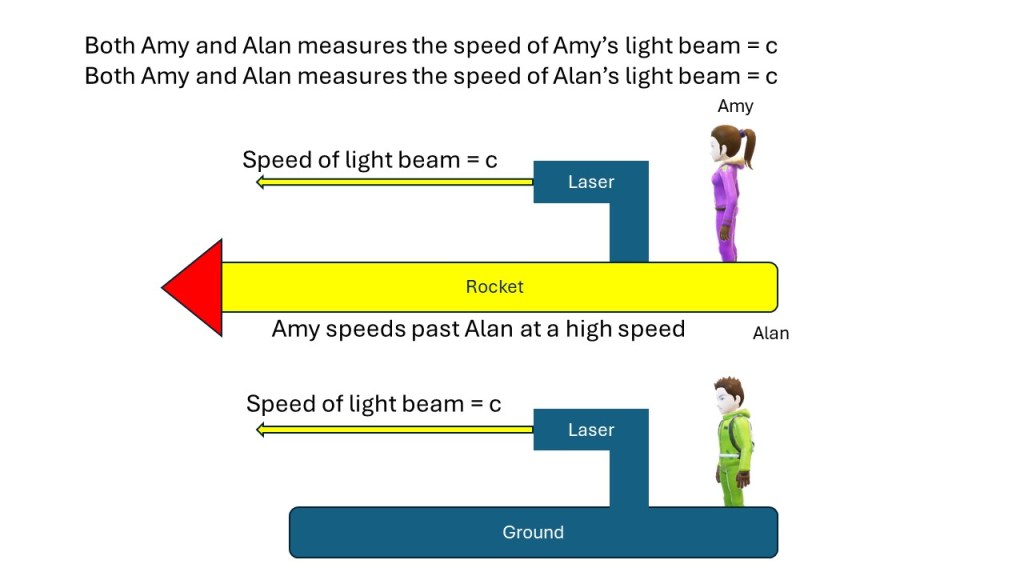
The picture shows two people Alan and Amy. Alan is on the ground. Amy is flying by Alan in a rocket speeding left. Both Alan and Amy are pointing lasers to the left | Time Dilation Goes Both Ways
In this picture Amy is traveling past Alan in a rocket. Both have a laser. Both measure the speed of both laser beams to be c = 299,792,458 meters per second. The speed of light is a universal constant.

Time Dilation

In the pictures below I am showing two rocket systems in space, Amy’s rocket and Alan’s rocket. They are travelling at a high speed compared to each other. Each rocket has a light clock that consists of a light beam bouncing up and down between a mirror in the ceiling and a mirror on the floor. The two light clocks are identical, and each bounce corresponds to a microsecond.

Amy is passing Alan at a high speed, and therefore Alan will see Amy’s light clock running slower than his because Amy’s light beam must travel further. Remember, the speed of light is identical for both light clocks (light speed is a universal constant). For those interested I am also deriving the formula for time dilation.

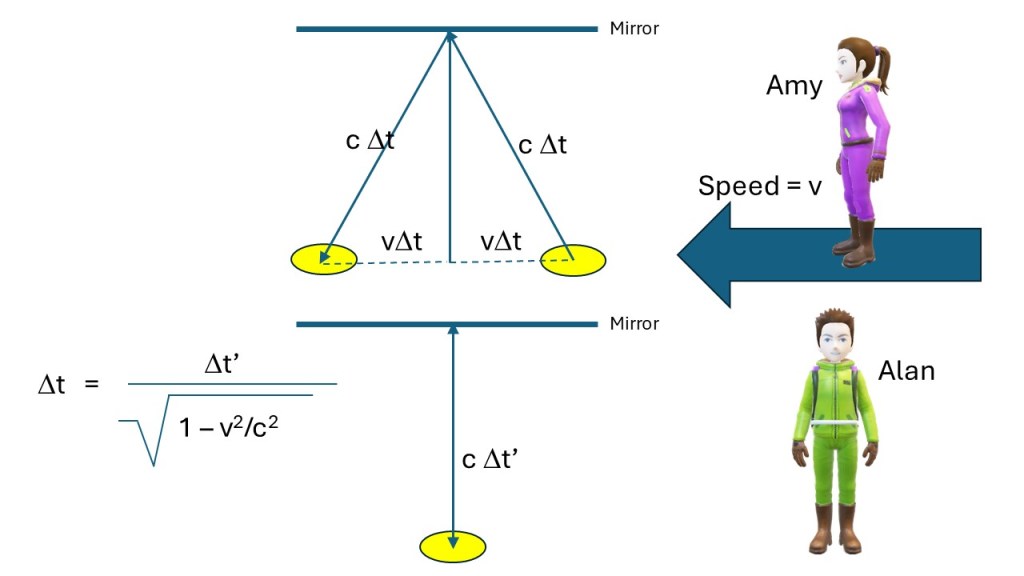
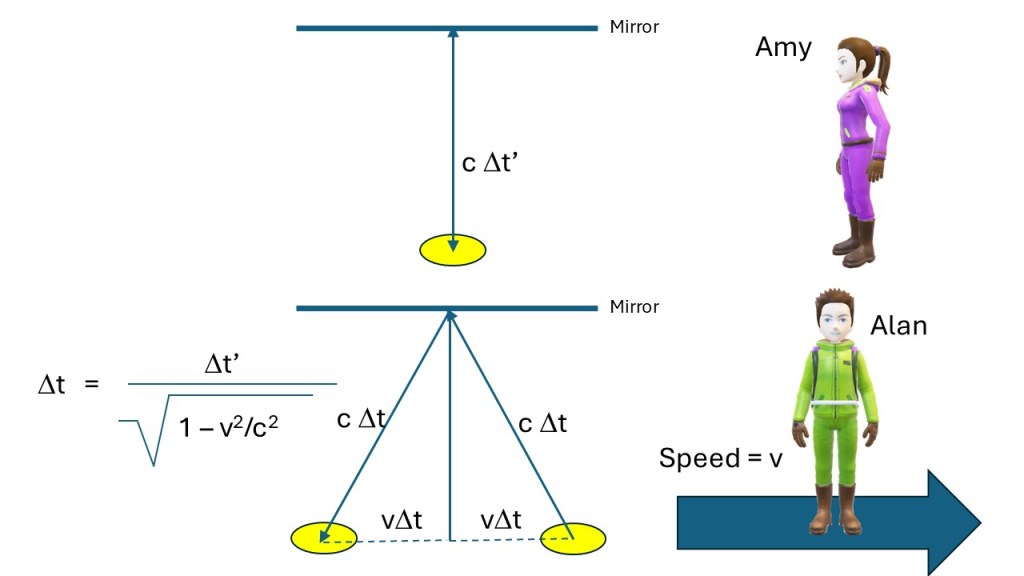
The picture shows two systems, each with a clock consisting of light beams bouncing between mirrors. In this set up Alan is stationary compared to us and therefore his light beam only moves vertically.
Alan and Amy have identical light clocks. We call the time it takes for the light beam to go from the floor to the ceiling (one clock tick) Dt in Amy’s case and Dt’ (reference frame) for Alan. Amy is speeding past Alan towards the left. From Alan’s perspective Amy’s clock is running slower. Using Pythagoras theorem, it is possible to derive the formula for time dilation shown in the lower left corner.

Since Amy moving left is the same as Amy standing still and Alan moving right you can say that Alan is the one moving fast. In this case it is Alan’s light clock that is ticking slower because from this viewpoint it is his light beam that has to travel further. From Amy’s perspective it is Alan’s clock that is going slower.

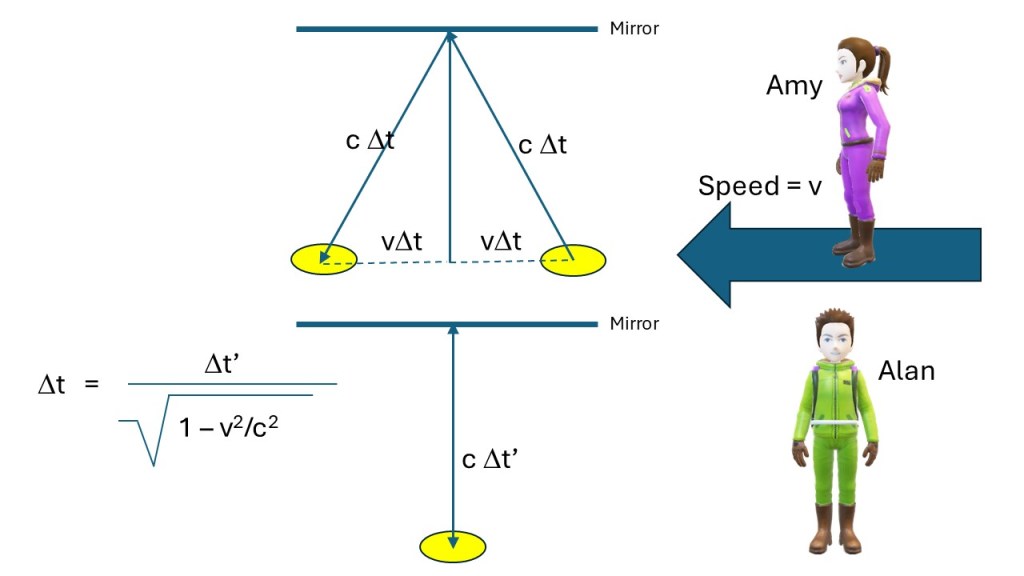
The picture shows two systems, each with a clock consisting of light beams bouncing between mirrors. In this set up Amy is stationary compared to us and therefore her light beam only moves vertically | Time Dilation Goes Both Ways
It is equally correct to say that Amy is standing still and that it is Alan that is moving fast to the right. This time (pun not intended) it is Alan’s clock that is ticking slower. Dt corresponds to Alan’s clock ticks and Amy’s clock ticks are Dt’.

This seemingly contradictory situation is resolved by the fact that Amy’s and Alan’s perspectives will drift apart as they continue their journey. They will increasingly disagree on whether events are simultaneous or not, and they will disagree in which order events occur. This is another shocking fact, or as I refer to it, super fact. It is strange but it resolves the apparent contradiction of reciprocal time dilation. I am explaining this in greater detail in this post.

The Twin Paradox

But what happens if one of Amy or Alan decides to turn around so that they meet up again. If Amy’s clock runs slower from Alan’s perspective and Alan’s clock runs slower from Amy’s perspective, how can you reconcile that when they meet up again? It turns out that whoever is turning around or accelerating or decelerating to turn back is the one who will have the least time pass. If Amy is the one turning back, then she will age less than Alan. During her acceleration she will see Alan’s clock starting to run faster and faster until he is older her.

Let say Alan’s clock is running half the speed of Amy’s clock from Amy’s perspective and Amy’s clock is running half the speed of Alan’s clock from Alan’s perspective. Let’s also say that Amy traveled to the left for 10 years before turning around.

From Alan’s perspective she would have traveled 20 years before turning around. However, from Amy’s perspective 5 years would have passed on Alan’s clock. As she turns around Alan’s clock will run faster and catch up so that when they meet up again Amy will be aged 20 years, while Alan will be aged 40 years. That is 35 years of catching up for Alan’s clock from Amy’s perspective. Alan’s clock advanced 35 years from Amy’s perspective after Amy turned around. In the end Amy will be the younger one.

The picture shows Amy on the left turning around and Alan on the right. Text explains what happens | Time Dilation Goes Both Ways
Observe that the fast-forward advancement of Alan’s clock from Amy’s perspective happens only while Amy is in the process of turning around (accelerating / decelerating). Further, how fast the fast forward happens depends on the distance as well. Once Amy is traveling at a constant speed again (inertial frame) Alan’s clock will run slower again from Amy’s perspective.

A somewhat halting but OK analogy for the 35 years of catching up that happens on Alan’s clock from Amy’s perspective is when you turn a boat around on a wavy sea. As you are moving in the direction of the waves the waves will hit you much less often (if at all) but after you turn around and move against them the waves will hit your boat very frequently. Alan’s clock will run faster for Amy whilst she is turning around.

Book Recommendations on Relativity

To see the other Super Facts click here

Two events may be simultaneous for some but not for others

Superfact 5 : Two events may be simultaneous for some but not for others

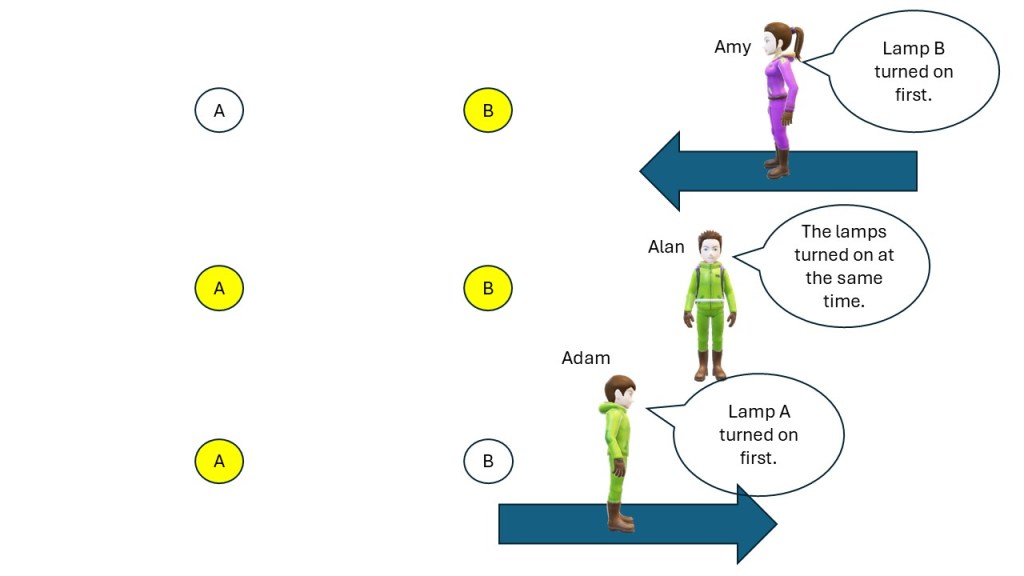
Two events may be simultaneous for some but not for others. This means that two events that are simultaneous to an observer may happen at different times to other observers. If two lamps A and B turn on at the same time according to observer #1, lamp A may turn on first for observer #2, and lamp B may turn on first for observer #3. All three observers are correct because time is relative.

Previous Fact:

My previous blog post “The Speed of Light In Vacuum Is a Universal Constant” explained that the speed of light in vacuum compared to yourself is the same regardless of your motion or the origin of the light beam. A beam from a flashlight you are holding is traveling at a specific speed c = 299,792,458 meters per second as compared to you. If your friend is traveling at half the speed of light compared to you, he will still agree that the light beam from your flashlight is traveling at the specific speed c = 299,792,458 meters per second as compared to him, just like his own light beam by the way.

No matter how everyone is traveling everyone agrees that all light beams everywhere, emanating from everyone’s flashlights, all travel at exactly the same speed c = 299,792,458 meters per second. Like I said, the speed of light in vacuum is a universal constant. This is made possible by accepting that space and time are relative, but what does that mean? As mentioned in the other post this leads to the special theory of relativity.

I can add that since we are talking about relativity, or rather special relativity, relativistic effects have been very well tested by thousands of experiments and are not in doubt by the scientific community. Don’t be fooled by the word “theory” in special theory of relativity. “Theory” is not used the same way in science as in everyday language.

Two people Alan and Amy. Alan is on the ground. Amy is flying by Alan in a rocket speeding left. Both Alan and Amy are pointing lasers to the left.
In this picture Amy is traveling past Alan in a rocket. Both have a laser. Both measure the speed of both laser beams to be c = 299,792,458 meters per second.

Relativity of simultaneity

Time is relative not only means that clocks are running slower in moving systems or that distances are contracted. It means that observers will disagree on how fast clocks are running and even disagree on whether events are simultaneous or not and in which order events occur.

If you are traveling through space at a very high speed and your wife/husband is back on earth, you can’t really ask yourself, “I wonder what my wife/husband is doing now?”, because what time it is back on earth depends on how it is calculated and by which observer. There is no universal now. Time is not absolute. Time is relative. The speed of light in vacuum is what is absolute.

I should add that if you combine space and time into spacetime you get an entity that is the same for all observers, the spacetime interval. You can say that in four dimensions the relativity disappears, but that is beyond the scope of this blog post.

Three pairs of lamps and three people. The setup is used to show three situations | Two events may be simultaneous for some but not for others
Amy is traveling at a high speed to the left compared to two lamps A and B. Alan is standing still compared to the lamps. Adam is traveling at a high speed to the right compared to two lamps A and B. Alan turns on the lamps at the same time. After considering the travel time of the light she sees, Amy concludes that lamp B turned on first. After considering the travel time of the light he sees, Adam concludes that lamp A turned on first. I should add this non-simultaneity can only happen if the lamps are separated by a distance.

Below I am going to explain what is going on in more detail. If you don’t want to get into the details you can stop reading here. I am not going to explain the theory of special relativity, but I will explain some of the background and it gets a little bit complicated. Explaining scientific theories is not the goal of this blog. The goal of this blog is to list scientifically/expert accepted facts that are still disputed amongst the public or are highly surprising facts. Let’s look at time dilation first.

Time dilation

That clocks run at different speeds as a result of the constancy of speed of light in vacuum is pretty much well accepted. This is called time dilation. If Amy is passing Alan at a high speed, Alan will see Amy’s clocks running slower than his. This can be illustrated by the light clocks depicted below. The light clocks consist of light beams that are bouncing up and down between the floor and a mirror in the ceiling. Since light in vacuum is a universal constant, this is a very precise and reliable clock.

However, from Alan’s perspective the light beam in Amy’s system/spaceship must go farther than in Alan’s system (but note, from Amy’s perspective it is the opposite). Since the speed of all light beams in vacuum is a universal constant Amy’s clock is slower from Alan’s perspective.

Two systems, each with a clock consisting of light beams bouncing between mirrors. In this set up Alan is stationary compared to us and therefore his light beam only moves vertically.
Alan and Amy have identical light clocks. We call the time it takes for the light beam to go from the floor to the ceiling (one clock tick) Dt in Amy’s case and Dt’ (reference frame) for Alan. Amy is speeding past Alan towards the left. From Alan’s perspective Amy’s clock is running slower. Using Pythagoras theorem, it is possible to derive the formula for time dilation shown in the lower left corner.

When you realize that speeds and velocities are relative, a difficulty arises, perhaps even an apparent paradox. Let’s assume that you are flying in a rocket in space, and you meet another rocket, and your relative speed is 10 million miles per hour.

Is the other rocket standing still and you are moving at 10 million miles per hour? Is the other rocket moving towards you at 10 million miles per hour and you are one standing still? Or are both moving at the speed of 5 million per hour towards each other? Who gets to decide? Do we decide what is “standing-still” by tying it to a point on the surface of planet Earth, the center of planet Earth, the center of our solar system, or the center of our galaxy, or maybe another galaxy or an ether that no one can find?

The point is velocities are always compared to something and can be assigned arbitrary numbers. That means that if an observer, Amy, is speeding past another observer, Alan, at a high speed, then Alan thinks that Amy’s clock runs slower, but note, speed is relative, so we can reverse the situation. In fact, Amy thinks that it is Alan’s clock that runs slower.

Two systems, each with a clock consisting of light beams bouncing between mirrors. In this set up Amy is stationary compared to us and therefore her light beam only moves vertically.
It is equally correct to say that Amy is standing still and that it is Alan that is moving fast to the right. This time (pun not intended) the clock ticks Dt correspond to Alan’s clock ticks and Amy’s clock ticks are Dt’.

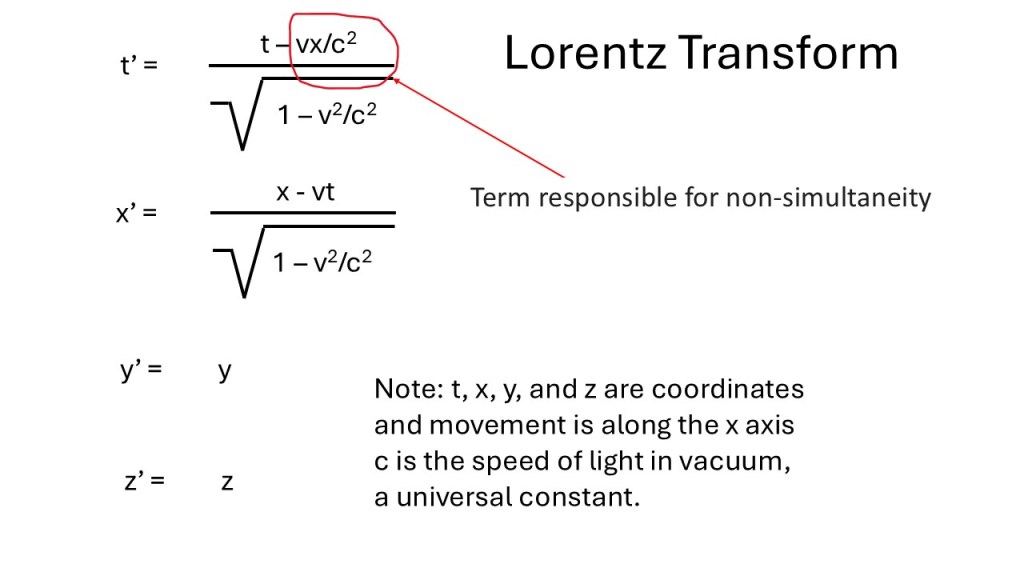
To understand how this works and why this is not a contradiction you need the Lorentz transform. The Lorentz transform is a so-called coordinate transform that incorporates time and space (as variable x), and it determines the specific time and space coordinate for one system based on the time and space coordinate for another and the relative velocity between the two. The Lorentz transform is a way of keeping account of time and space coordinates and using it correctly resolves any apparent paradoxes.

It is a bit more complicated to derive the Lorentz transform, and it is beyond the scope of this blog post. Suffice it to say that it is the vx/c2 term in the equation that both explains how it is possible for both Amy and Alan to consider the other’s clock slower and introduces the non-simultaneity aspect of special relativity. You have to look at both space and time to get the full picture.

Lorents transform formula | Two events may be simultaneous for some but not for others
The Lorentz transform is a so-called coordinate transform that incorporates time and space (as variable x), and it determines the specific time and space coordinate for one system based on the time and space coordinate for another and the relative velocity between the two.

The Twin Paradox

There is one obvious paradox that I need to address. Let’s say that Amy and Alan are of the same age. Then Amy leaves earth and travels at high speeds toward the star Sirius. From Alan’s perspective Amy’s clocks are running slower and from Amy’s perspective Alan’s clocks are running slower.

What will happen if Amy turns around and returns to earth after visiting Sirius and they meet up again? Will Amy be younger than Alan or will Alan be younger than Amy. Will they both be younger than each other? Well, the latter is not possible. You have to keep count of the time and what happens is that during the decelerations/accelerations necessary for Amy to turn around as well as the speed-up/slow-down around earth, Amy will catch up on the time that she lost with Alan.

In other words, her acceleration will make it so Alan’s clocks will run faster. When she comes back and meets up with Alan back on earth, Alan will be much older than her.

Recommended Reading

Below is some recommended reading on the Special Theory of Relativity.

Note after copying all the text from my word document to WordPress I realized that wordpress cannot handle symblic characters. Thus all my delta-t were turned into Dt. I am sorry about that.


To see the other Super Facts click here