
I haven’t posted or read blog posts for almost a week because I was busy with something else. I am a member of a non-partisan volunteer organization called the Citizens Climate Lobby which seeks to create political will for a livable future. As the name suggests we do a lot of lobbying. It is not the kind of paid lobbying that is done by professionals and that is often associated with money. We are average constituents, average voters, with no money, who are visiting our legislators to give them information and opinions on legislation we support or don’t support.
Since we are non-partisan, we visit both Democrats and Republican offices. We just had a CCL conference in Washington DC on Sunday, Monday and Tuesday. We were 800+ volunteers who visited 400+ Congressional offices in Washington DC on Tuesday July 22nd.
I visited four Texas Congressmen, including Senator Ted Cruz (R), Congresswoman Beth Van Duyne (R), and Congressman Marc Veasey (D). We also had a zoom call with Congressman John Carter’s (R) office. I am the CCL liaison for Senator Cruz’ office and I was the one who organized our visit, from our side, with Senator Cruz and a couple of his staff. Ted Cruz does not always agree with us, or perhaps more correctly, he seldom agrees with us, but we had a friendly and interesting meeting, and he and his staff were very appreciative of us being there.

Ted Cruz is standing in the back between the flags. I am in the front row, second from the right wearing a blue suit. We are twelve people.
Right after our meeting with Senator Cruz I posted the following on Facebook “I am in Washington DC meeting with congressmen. We had an in person meeting with Ted Cruz and we took pictures with him.” along with a photo of the capitol building (not the group photo). Most people left interesting or nice comments but then a far-left Facebook friend of mine left a very hostile comment. He started out saying “so you are finally revealing your true colors Thomas…” and that was followed by an angry outburst in two separate comments filled with F-bombs and how he was ending his friendship with me. I deleted his comments and blocked him. Basically, a centrist on-line friend visiting with a Republican politician for a friendly exchange of opinions enraged him. Naturally I have seen a lot of this on both sides.
Division has become so severe in this country that we are losing our ability to talk to each other. Families are divided against each other, and the rhetoric is overheated. This is dangerous and it is what Amanda Ripley, the keynote speaker at our CCL conference in Washington DC calls High Conflict. High Conflict is a natural psychological phenomenon that sucks us deep into conflict that eventually gets out of hand. She compares it to the La Brea Tar Pits in Los Angeles. We form kinships and tribes, echo chambers, and dislikes for those with different opinions, we belittle and insult each other, which grows resentment, and we create an us-versus them scenario, which evolves into a good (us) versus evil (them).
Amanda Ripley is the author of the book High Conflict: Why We Get Trapped and How We Get Out. I think her message and her book are very important, and I have a lot of good things to say about the book. However, the book featured one false and defamatory statement and generalization about environmentalists, which prevents me from giving the book five stars. That claim pretty much ruined it for me , so I am giving the book three stars. I still recommend the book, and perhaps whether I like this book or not is not as important as the topic.
High Conflict the Book Formats
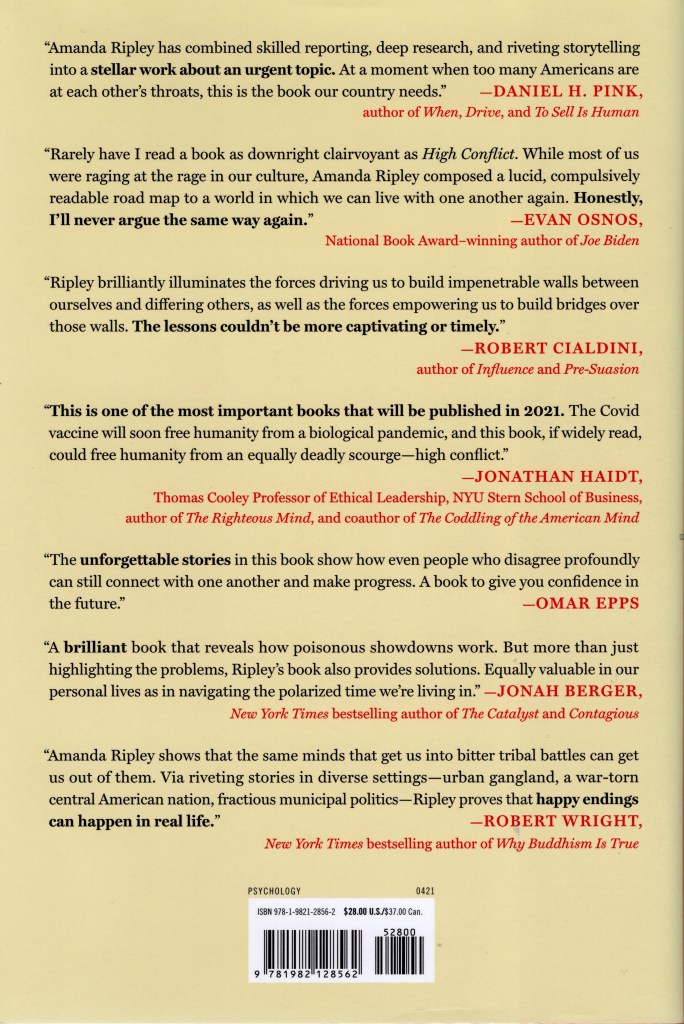
High Conflict: Why We Get Trapped and How We Get Out by Amanda Ripley. I bought the hardback format.
- Hardcover – Publisher : Simon & Schuster (April 6, 2021), ISBN-10 : 1982128569, ISBN-13 : 978-1982128562, 368 pages, item weight : 1.26 pounds, dimensions : 6 x 1.2 x 9 inches, it costs $24.98 on US Amazon. Click here to order it from Amazon.com.
- Paperback – Publisher : Simon & Schuster (April 5, 2022), ISBN-10 : 1982128577, ISBN-13 : 978-1982128579, 368 pages, item weight : 2.31 pounds, dimensions : 5.5 x 0.92 x 8.38 inches, it costs $13.95 on US Amazon. Click here to order it from Amazon.com.
- Kindle – Publisher : Simon & Schuster (April 6, 2021), ASIN : B08LDW7M7J, ISBN-13 : 978-1982128586, 363 pages, it costs $ 15.99 on US Amazon. Click here to order it from Amazon.com.
- Audio– Publisher : Simon & Schuster Audio (April 6, 2021), Listening Length : 9 hours and 50 minutes, ASIN : B0DCCWRMJS, it costs $0.00 with membership on US Amazon. Click here to order it from Amazon.com.

Amazon’s Description of High Conflict
When we are baffled by the insanity of the “other side”—in our politics, at work, or at home—it’s because we aren’t seeing how the conflict itself has taken over.
That’s what “high conflict” does. It’s the invisible hand of our time. And it’s different from the useful friction of healthy conflict. That’s good conflict, and it’s a necessary force that pushes us to be better people.
High conflict is what happens when discord distills into a good-versus-evil kind of feud, the kind with an us and a them. In this state, the brain behaves differently. We feel increasingly certain of our own superiority, and everything we do to try to end the conflict, usually makes it worse. Eventually, we can start to mimic the behavior of our adversaries, harming what we hold most dear.
In this “compulsively readable” (Evan Osnos, National Book Award-winning author) book, New York Times bestselling author and award-winning journalist Amanda Ripley investigates how good people get captured by high conflict—and how they break free.
Our journey begins in California, where a world-renowned conflict expert struggles to extract himself from a political feud. Then we meet a Chicago gang leader who dedicates his life to a vendetta—only to realize, years later, that the story he’d told himself about the conflict was not quite true. Next, we travel to Colombia, to find out whether thousands of people can be nudged out of high conflict at scale. Finally, we return to America to see what happens when a group of liberal Manhattan Jews and conservative Michigan corrections officers choose to stay in each other’s homes in order to understand one another better, even as they continue to disagree.
All these people, in dramatically different situations, were drawn into high conflict by similar forces, including conflict entrepreneurs, humiliation, and false binaries. But ultimately, all of them found ways to transform high conflict into good conflict, the kind that made them better people. They rehumanized and recategorized their opponents, and they revived curiosity and wonder, even as they continued to fight for what they knew was right.
People do escape high conflict. Individuals—even entire communities—can short-circuit the feedback loops of outrage and blame, if they want to. This is an “insightful and enthralling” (The New York Times Book Review) book—and a mind-opening new way to think about conflict that will transform how we move through the world.
My three-star review of High Conflict
Interesting discussion on conflict but with a lot of interpretation and opinion
“Good conflict” is healthy conflict in which questions get asked, in which there is curiosity and movement in opinions. “High conflict” on the other hand is what happens when conflict devolves into a good versus evil kind of feud. The conflict takes on its own life and draws us in like a tar pit.
The book gives many examples of high conflict and explains how they came to be; the Hatfield’s and the McCoy, John Adams and Thomas Jefferson, our current political division, couples getting divorced, gang warfare, guerilla warfare, civil war, etc. The book focuses much attention on Gary, a friendly lawyer who rather solves conflict than benefit from it, as is typically a lawyer’s job. Gary runs for a local office and wins but because he is thinking a little bit too highly about himself and his abilities, he by mistake excludes some really knowledgeable, willing and helpful people from what he refers to as “the old guard”, which leads to a high conflict that he himself created. However, in the end he becomes part of the solution. It is a good story.
The author makes a lot of interesting observations such as; we have group belongings, we form factions, we need belonging, giving people two choices is dangerous, a proportional representation system might be better than the current American system, people have biases that inflame conflict such as confirmation bias, and there’s a conflict industrial complex. There are fire starters, group identities, conflict entrepreneurs, and humiliation. Media and social networking can function as conflict entrepreneurs. The areas in Rwanda where the radio reception was better there were more killings.
To escape high conflict, we need to recognize the conflict entrepreneurs around us, avoid excluding and humiliating people, and recognize that people want to be heard. Getting out of high conflict includes recognizing a saturation point where people had enough, building new broader identities, reframing the situation, and clearing the path for combatants. Welcome former combatants home rather than shaming them. Avoiding conflict involves complicating the narrative from the beginning. Simplifications do damage. I felt all that was pretty good advice.
Then on page 183 a strange claim is made, implying that very few people concerned about climate change would want a “carbon fairy” to solve climate change (that carbon fairy could be nuclear power) because they want to use “climate change” as vehicle for something else. I am volunteering in a climate change organization, and I have never met anyone who isn’t part of it primarily to solve carbon emissions. Half are pro nuclear power the other half skeptical about it being a “climate fairy” (I am pro nuclear). Some are pro-capitalists, others more left leaning, a substantial minority are Republicans, and world views are all over the spectrum. So obviously page 183 makes a false claim probably for sensationalistic reasons.
That’s just one dubious claim, but it alerted me to read the book more critically and I realized that the author is far from objective. She definitely wants to promote her ideas and make her book look more interesting. She is doing that by carefully selecting examples and stories, interpreting those cherry-picked situations, and there’s a lot of opinions, and who knows what she may get wrong or misreporting? It seems at first to be an authoritative work, but it is not a scientific book. That doesn’t mean that it’s wrong. I believe a lot of what the book claims to be true, but I do not know. It is a journalist’s opinion and interpretation of conflict, and it is therefore less than I expected.
 Super Facts