The Unfolding Solar Energy Revolution

The goal of this blog is to create a list of what I call super facts. Super facts are important true facts that nevertheless are surprising to many, misunderstood, or disputed among the non-experts. They are special facts that we all can learn something important from. However, I also make posts that are not super facts but feature other interesting information, such as this book review and book recommendation. I should say that this book is not written by a scientist but an environmentalist, and he did not provide references for his hundreds of factual claims. However, I fact checked at least 20 claims and found only one that was not entirely correct, so I think his facts are for the part correct. The book is:

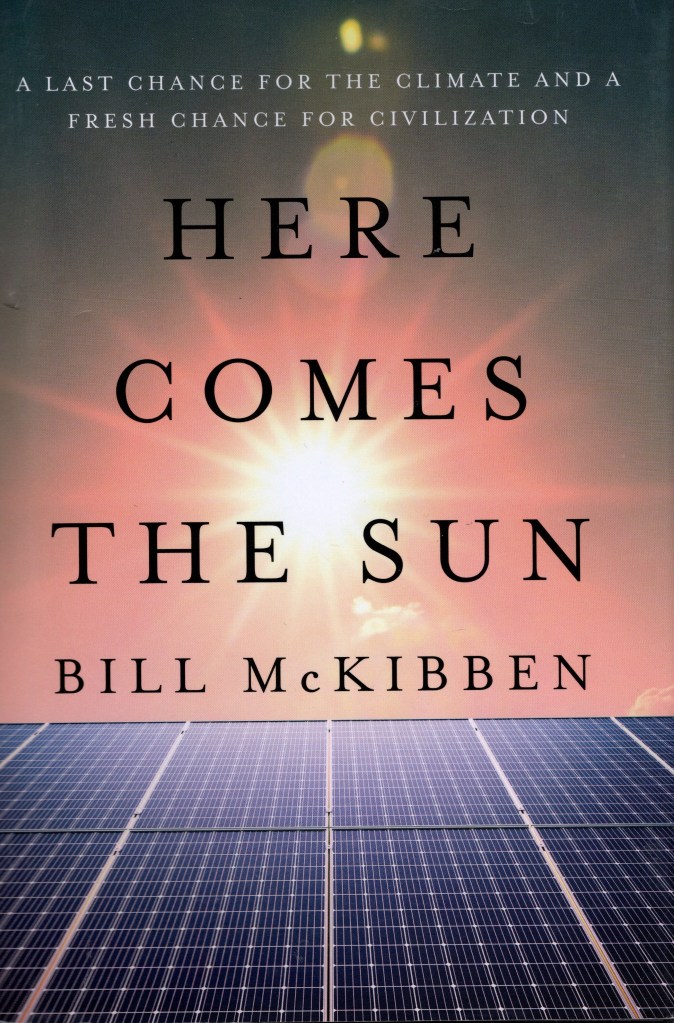
Here Comes the Sun: A Last Chance for the Climate and a Fresh Chance for Civilization by Bill McKibben

Below I am listing the four versions of this book. I bought the hardback version.

  • Hardback –  Publisher : W. W. Norton & Company (August 19, 2025), ISBN-10 : 1324106239, ISBN-13 : 978-1324106234, 224 pages, item weight : 12 ounces, dimensions : 5.8 x 0.9 x 8.6 inches. It costs $15.91on US Amazon. Click here to order it from Amazon.com.
  • Paperback –  Publisher : W. W. Norton & Company (August 11, 2026), ISBN-10 : 1324130628, ISBN-13 : 978-1324130628, 240 pages, item weight : 13 ounces, dimensions : 1 x 5.5 x 8.25 inches. It costs $19.99 on US Amazon. Click here to order it from Amazon.com.
  • Kindle –  Publisher : W. W. Norton & Company (August 19, 2025), ASIN : B0DXQGBM4Z, 220 pages, it costs $9.40 on US Amazon. Click here to order it from Amazon.com.
  • Audiobook – Publisher : Highbridge Audio (August 19, 2025), ASIN : B0F95QL1C2, Listening length : 7 hours and 36 minutes. $0.00 with membership. Click here to order it from Amazon.com.
The front cover of Here Comes the Sun: A Last Chance for the Climate and a Fresh Chance for Civilization by Bill McKibben. | The Unfolding Solar Energy Revolution
The front cover of Here Comes the Sun: A Last Chance for the Climate and a Fresh Chance for Civilization by Bill McKibben. Click on the image to go to the Amazon page for the hardback version of the book.

Amazon’s Description of the Book

From the acclaimed environmentalist, a call to harness the power of the sun and rewrite our scientific, economic, and political future.

Our climate, and our democracy, are melting down. But Bill McKibben, one of the first to sound the alarm about the climate crisis, insists the moment is also full of possibility. Energy from the sun and wind is suddenly the cheapest power on the planet and growing faster than any energy source in history―if we can keep accelerating the pace, we have a chance.

Here Comes the Sun tells the story of the sudden spike in power from the sun and wind―and the desperate fight of the fossil fuel industry and their politicians to hold this new power at bay. From the everyday citizens who installed solar panels equal to a third of Pakistan’s electric grid in a year to the world’s sixth-largest economy―California―nearly halving its use of natural gas in the last two years, Bill McKibben traces the arrival of plentiful, inexpensive solar energy. And he shows how solar power is more than just a path out of the climate crisis: it is a chance to reorder the world on saner and more humane grounds. You can’t hoard solar energy or hold it in reserves―it’s available to all.

There’s no guarantee we can make this change in time, but there is a hope―in McKibben’s eyes, our best hope for a new civilization: one that looks up to the sun, every day, as the star that fuels our world.

This is my five-star review for Here Comes the Sun

The Spectacular Success of Renewables

Here comes the sun tells the story of the spectacular success of renewables around the world, especially the success of solar power and wind power, with a special emphasis on solar power. The success of renewables was one reason that the IPCC will likely retire the RCP8.5 emissions scenario. The RCP8.5 emissions scenario, which was the extremely bad emissions scenario, was never very likely to begin with, but the fact that the world, including China, is turning away from coal and fossil fuels made this scenario implausible as they stated. I am not sure whether Bill McKibben could have predicted this when he wrote this book, but I think this recent event makes this book very relevant now in 2026.

The book describes a very interesting situation for our world and contains interesting personal anecdotes and is written in a positive and optimistic way. However, I was delighted that the book was full of interesting facts, for example, in 2024 92.5% of all new electricity bought online around the world came from renewables. Other facts are, Chinese emissions are dropping. He tells us that forty percent of the world’s ship traffic consists of moving coal and gas back and forth across the ocean to be burned. He states that the entire continent of Africa has barely produced 3% of the greenhouse gases warming the atmosphere, whilst they are likely to bear the brunt of the effects of global warming.

Other interesting facts are; Chinese citizens can expect to live on average 2.2 years longer than they would have a decade ago, due to the sharp drop in pollution (thanks to renewables and EVs). Dealing with cleantech waste is a small problem compared to fossil fuels, and we have enough minerals, especially considering recycling. He tells us about various physics facts related to the sun, how our health is effected by the sun, the history of the day “Sunday”, sun worship in the ancient world, and other sun related facts.

He reviews the history of fossil fuels and renewables, particularly solar power, and the how the fossil fuel industry and certain politicians are fighting against renewables with disinformation and bad faith arguments. He explains the problems with fossil fuels and the dangers they pose, which is not just limited to climate change. He also explains a little bit about why we know that fossil fuels are causing global warming / climate change, why we need to keep pushing for renewables despite their success. He states that because fossil fuels themselves are easy to concentrate, they often yield authoritarian outcomes.

In the past renewables were an expensive alternative and fossil fuels cheap, but that situation has been reversed. He explains why EVs are in general cleaner and better for the environment than cars with internal combustion engines. He explains how we get around the intermittence issue with wind and solar and that batteries are getting much cheaper and environmentally friendlier, and why a lot of negative information you hear about batteries is not true anymore. Salt batteries is an example of an emerging technology.

My only concern with the book is that Bill McKibben is not a scientist. He is an activist. Because of that it is extra important that he provides references to reputable sources for all his claims. Typically, scientists provide references to their claims even though you in general can trust scientists more than activists. However, Bill McKibben provided no references to any of his several hundred facts and claims, except for some general and vague information in the back about where he got his information from.

I should say that I fact checked about two dozen of his claims and found only one that was not entirely accurate, so overall I trust this book. The book is easy, lighthearted and positive reading. It is not a heavy science book, the book was well organized, and he is a good author. Therefore, I highly recommend this book.

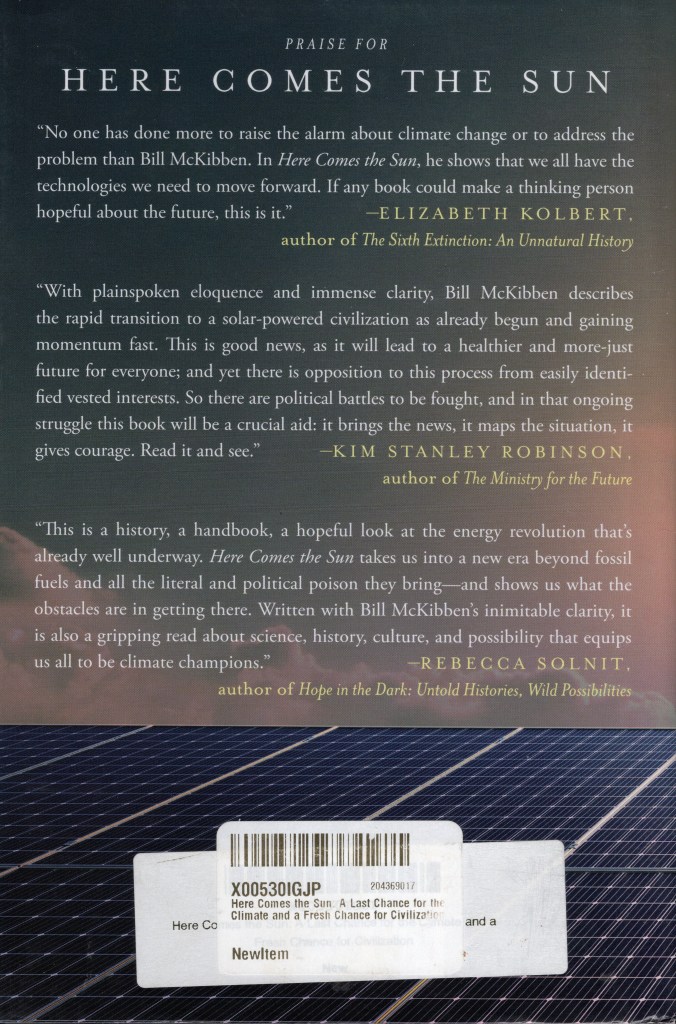
The back cover of Here Comes the Sun: A Last Chance for the Climate and a Fresh Chance for Civilization by Bill McKibben.
The back cover of Here Comes the Sun: A Last Chance for the Climate and a Fresh Chance for Civilization by Bill McKibben. Click on the image to go to the Amazon page for the paperback version of the book.

A related super fact is “The Unfolding Clean Energy Revolution


To see the Super Facts click here

Is Plant Intelligence Real?

The goal of this blog is to create a list of what I call super facts. Super facts are important and true facts that nevertheless are very surprising to many, misunderstood, or disputed among the public. They are special facts that we all can learn something important from. However, I also make posts that are not super facts but feature other interesting information, such as this book review and book recommendation.

The Light Eaters: How the Unseen World of Plant Intelligence Offers a New Understanding of Life on Earth by Zoë Schlanger – May 7, 2024

Below I am listing the four versions of this book. I bought the hardback version.

  • Hardback –  Publisher : Harper (May 7, 2024), ISBN-10 : 0063073854, ISBN-13 : 978-0063073852, 304 pages, item weight : 2.31 pounds, dimensions : 6 x 0.92 x 9 inches. It costs $ 19.90 on US Amazon. Click here to order it from Amazon.com.
  • Paperback –  Publisher : Harper Perennial (May 13, 2025), ISBN-10 : 0063073862, ISBN-13 : 978-0063073869, 304 pages, item weight : 11.2 ounces, dimensions : 5.5 x 0.75 x 8 inches. It costs $15.99 on US Amazon. Click here to order it from Amazon.com.
  • Kindle –  Publisher : Harper (May 7, 2024), ASIN : B0CFM4SMPF, 298 pages, it costs $ 14.99on US Amazon. Click here to order it from Amazon.com.
  • • Audiobook – Publisher : Harper (May 7, 2024), ASIN : B0CJWQ6X99, Listening length : 10 hours and 56 minutes. Click here to order it from Amazon.com.
The front cover features a plant on a black background, the title and author of the book and the phrase “How the Unseen World of Plant Intelligence Offers a New Understanding of Life on Earth”. | The front cover of The Light Eaters: How the Unseen World of Plant Intelligence Offers a New Understanding of Life on Earth by Zoë Schlanger.
The front cover of The Light Eaters: How the Unseen World of Plant Intelligence Offers a New Understanding of Life on Earth by Zoë Schlanger. Click on the image to go to the Amazon page for the hardback version of the book.

Amazon’s Description of the Book

NEW YORK TIMES BESTSELLER

The New Yorker’s Best Books of 2024 • TIME’s 10 Best Nonfiction Books of 2024 • New York Magazine’s 10 Best Books of the Year • Washington Post’s 50 Notable Works of Nonfiction of 2024 • Smithsonian’s 10 Best Science Books of the Year •  A Best Book of the Year: Boston Globe, Scientific American,New York Public Library, Christian Science Monitor, Library Journal, and Publishers Weekly • An Amazon Best Nonfiction Book of the Year

Longlisted for the National Book Critics Circle Nonfiction Prize • Finalist for the Chautauqua Prize • Finalist for the Los Angeles Times Book Prize • Winner of the National Outdoor Book Award for Natural History

“A masterpiece of science writing.” ―Robin Wall Kimmerer, author of Braiding Sweetgrass

“Mesmerizing, world-expanding, and achingly beautiful.” ―Ed Yong, author of An Immense World

“Rich, vital, and full of surprises. Read it!” ―Elizabeth Kolbert, author of Under a White Sky and The Sixth Extinction

Award-winning Atlantic staff writer Zoë Schlanger delivers a groundbreaking work of natural history and popular science that probes the hidden world of the plant kingdom, “destabilizing not just how we see the green things of the world but also our place in the hierarchy of beings, and maybe the notion of that hierarchy itself.” (The New Yorker)

It takes tremendous biological creativity to be a plant. To survive and thrive while rooted in a single spot, plants have adapted ingenious methods of survival. In recent years, scientists have learned about their ability to communicate, recognize their kin and behave socially, hear sounds, morph their bodies to blend into their surroundings, store useful memories that inform their life cycle, and trick animals into behaving to their benefit―a fascinating display of plant behavior and sensory abilities, to name just a few remarkable talents.

The Light Eaters is a deep immersion into the drama of green life and the complexity of this wild and awe-inspiring world that challenges our very understanding of agency, consciousness, and intelligence. In this captivating exploration of plant intelligence, we see that plants, rather than imitate human intelligence, have perhaps formed a parallel system. What is intelligent life if not a vine that grows leaves to blend into the shrub on which it climbs, a flower that shapes its bloom to fit exactly the beak of its pollinator, a pea seedling that can hear water flowing and make its way toward it? Zoë Schlanger takes us across the globe, digging into her own memories and into the soil with the scientists who have spent their waking days studying these amazing entities up close.

What can we learn about life on Earth from the living things that thrive, adapt, consume, and accommodate simultaneously? More important, what do we owe these life forms once we come to understand their rich and varied abilities? Examining the latest epiphanies in botanical research, Schlanger spotlights the intellectual struggles among the researchers conceiving a wholly new view of their subject, offering a glimpse of a field in turmoil as plant scientists debate the tenets of ongoing discoveries and how insights into plant communication influence our understanding of what a plant is.

We need plants to survive. But what do they need us for―if at all? An eye-opening and informative look at the ecosystem we live in, this book challenges us to rethink the role of plants―and our own place―in the natural world, tackling the enthralling question of plant consciousness along the way.

This is my five-star review for The Light Eaters

It is a truly great and fact filled book

Plant Behavior and Communication is Real. What about Plant Intelligence?

This is a very interesting book that describes the ways plants behave and communicate via chemicals, fungus, sound, electric signals and light. Many plants even exhibit memory functions and are able mimic the look of other plants from a distance. A leaf is the only thing in our known world that can manufacture sugar out of materials, light and air, that have never been alive. They can produce complex chemicals, like caffeine, that humans and animals can’t produce. If weighed, plants would amount to 80% of Earth’s living matter.

Plants can regrow virtually any amputated part. Some plants inject poisons into the ground around their roots to prevent anything else from growing nearby. Plants can recognize and protect their kin. Many plants will rearrange their leaves to avoid shading siblings. One of the points of the book is that we may have underestimated plants.

The book also discusses the possibility that plants may have a type of intelligence, perhaps even consciousness, depending on how you define it. This is a philosophical discussion. It should be noted that there was a very popular book in the 1970’s that made outlandish and pseudoscientific claims about plants. In the long run this book created a lot of skepticism towards claims within botany that seemed far-fetched despite collaborating evidence. The author laments this conservatism at the same time as she understands it.

There is a problem with getting unconventional work published in botany, at the same time the arduous peer-review process is an essential safeguard against false paths.

However, it has been established that plants do a lot of amazing things, and we are just beginning to realize the extent of plant behavior and communication. Some examples are, plants can communicate with each other even when they are too far apart to be passing information through their roots (perhaps pheromonal substances).

Plants produce electrical impulses and seem to have nodes at the tips of their roots that serve as local command centers. Plants can react to an attack of munching insects by summoning those insects’ specific predators to come and pick them up. They can perceive gravity, but we don’t know how. Primrose increases the sweetness of its nectar within three minutes if you play an audio recording of honeybee flight to it. Pea plants and many other plants grow their roots toward the sound of running water.

Other examples are, Tomatoes make thirty-five sounds per hour when drought stressed. Goldenrod can sense the volatile signals of nearby gall-forming flies and jump-start its immune system before the flies even make contact. Researchers who played tones at different frequencies to alfalfa sprouts for two hours saw that they increased the plants’ content of vitamin C. Plants can hear the caterpillars or pick up the vibrations they cause. Trichomes allow plants to sense the footsteps of moths and caterpillars.

Nasa poissoniana can store and recall information. It can remember the time intervals between bumble bee visits and anticipate the next time their pollinator was likely to arrive. Bittersweet nightshade recruit ants as bodyguards. Cornish mallow, a pink-flowered plant, will turn its leaves hours before sunrise to face the horizon in exactly the direction its expects the sun to rise. A common vine in this rainforest was capable of spontaneously morph into the shape of almost any plant it grew beside.

Plant mimicry is not that unusual. Scientists have long observed that virtually all plants are highly sensitive to touch of any kind and will change their growth accordingly. The book features several dozen more amazing examples of plant behavior, communication, sensing, and forms of memory including generational memory.

The book also delves into some other topics such as the importance of microbes for both plants and animals, including humans. Microbes influence our immune systems, our smells, and our attractiveness to mosquitos. Emerging research suggests that they may play a role in autism, depression, anxiety, and possible even who we are attracted to. The author also notes that pollution steadily filling the air appears to sabotage plants ability to send and interpret each other’s signals.

This is a book that is filled with interesting and perhaps even shocking information, and it certainly made me more interested in plants and botany. I think the book made the outlandish ideas about plant intelligence and conscience appear almost plausible. Plants are all around us and they are more interesting than I thought. The book is also well written and well organized. I should say that I did not think the first three chapters were very interesting, but it got better the further I read. I highly recommend this book.

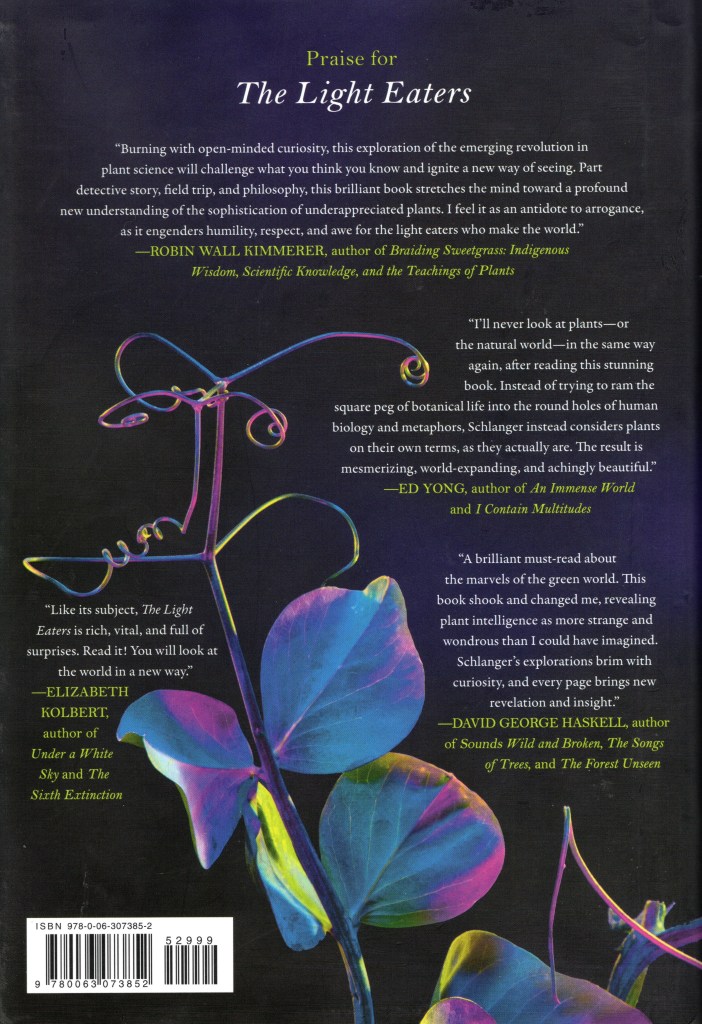
The back cover features a picture of a plant on a black background and praise for the book. | The back cover of The Light Eaters: How the Unseen World of Plant Intelligence Offers a New Understanding of Life on Earth by Zoë Schlanger.
The back cover of The Light Eaters: How the Unseen World of Plant Intelligence Offers a New Understanding of Life on Earth by Zoë Schlanger. Click on the image to go to the Amazon page for the hardback version of the book.


To see the Super Facts click here

How Our Planet Came to Life

I recently read a very interesting book on the history of our Planet Earth, Becoming Earth: How Our Planet Came to Life by Ferris Jabr. Life of various forms, microbes, fungi, plants, animals, etc., has had a large impact on climate, earth’s crust, the composition of the atmosphere, the oceans, and still do. This fact filled book is about this four and half billion history. Below is my review of the but first something about the book formats.

Becoming Earth Book Formats

Becoming Earth: How Our Planet Came to Life by Ferris Jabr comes in four formats. I bought the hardback format.

  • Hardcover –  Publisher : Random House (June 25, 2024), ISBN-10 : 0593133978, ISBN-13 : 978-0593133972, 304 pages, item weight : 2.31 pounds: ‎ 6.3 x 1.1 x 9.55 inches, it costs $16.68 on US Amazon. Click here to order it from Amazon.com.
  • Paperback –  Publisher : Random House Trade Paperbacks (April 1, 2025), ISBN-10 : 0593133994, ISBN-13 : 978-0593133996, 320 pages, item weight : 4.8 ounces, dimensions : ‎ 5.15 x 0.75 x 7.97 inches, it costs $ 13.57 on US Amazon. Click here to order it from Amazon.com.
  • Kindle –  Publisher : Random House (June 25, 2024), ASIN : B0CJTLBCDX, ISBN-13 : 978-0593133989, 423 pages, it costs $5.99 on US Amazon. Click here to order it from Amazon.com.
  • Audio–  Publisher : Random House Audio (June 25, 2024), Listening Length : 9 hours and 27 minutes, ASIN : B0CKM3P33F, it costs $0.99 on US Amazon with membership. Click here to order it from Amazon.com.
Front cover of Becoming Earth: How Our Planet Came to Life by Ferris Jabr.
Front cover of Becoming Earth: How Our Planet Came to Life by Ferris Jabr. Click on the image to go to the Amazon page for the hardcover version of the book.

Amazon’s Description of Becoming Earth

NEW YORK TIMES BESTSELLER • A vivid account of a major shift in how we understand Earth, from an exceptionally talented new voice. Earth is not simply an inanimate planet on which life evolved, but rather a planet that came to life.

“Glorious . . . full of achingly beautiful passages, mind-bending conceptual twists, and wonderful characters. Jabr reveals how Earth has been profoundly, miraculously shaped by life.”—Ed Yong, Pulitzer Prize winner and bestselling author of An Immense World

FINALIST FOR THE LOS ANGELES TIMES BOOK PRIZE • FINALIST FOR THE OREGON BOOK AWARD • AN AMERICAN LIBRARY ASSOCIATION NOTABLE BOOK OF THE YEAR

A BEST BOOK OF THE YEAR: Smithsonian, Chicago Public Library, Booklist, Scientific American, Nature

A BEST BOOK OF THE SUMMER: The Atlantic and NPR’s Science Friday

One of humanity’s oldest beliefs is that our world is alive. Though once ridiculed by some scientists, the idea of Earth as a vast interconnected living system has gained acceptance in recent decades. We, and all living things, are more than inhabitants of Earth—we are Earth, an outgrowth of its structure and an engine of its evolution. Life and its environment have coevolved for billions of years, transforming a lump of orbiting rock into a cosmic oasis—a planet that breathes, metabolizes, and regulates its climate.

Acclaimed science writer Ferris Jabr reveals a radical new vision of Earth where lush forests spew water, pollen, and bacteria to summon rain; giant animals engineer the very landscapes they roam; microbes chew rock to shape continents; and microscopic plankton, some as glittering as carved jewels, remake the air and sea.

Humans are one of the most extreme examples of life transforming Earth. Through fossil fuel consumption, agriculture, and pollution, we have altered more layers of the planet in less time than any other species, pushing Earth into a crisis. But we are also uniquely able to understand and protect the planet’s wondrous ecology and self-stabilizing processes. Jabr introduces us to a diverse cast of fascinating people who have devoted themselves to this vital work.

Becoming Earth is an exhilarating journey through the hidden workings of our planetary symphony—its players, its instruments, and the music of life that emerges—and an invitation to reexamine our place in it. How well we play our part will determine what kind of Earth our descendants inherit for millennia to come.

My five-star review for Becoming Earth

A Page Turner for People with a Curious Mind

This book gives us a brief overview of the natural history of Earth, emphasizing that not only is life impacted by geological forces, but life is influencing and even creating the composition of the atmosphere, impacting climate and even affecting geological forces. The author explains how microbes, plants, and animals transformed the planet. He is explaining how humans are transforming planet Earth and its climate through fossil fuel consumption, agriculture, and pollution. He is noting that we have altered more layers of the planet in less time than any other species, pushing Earth into a crisis. The author promotes the idea that Earth itself is a living organism (Gaia hypothesis). I am not sure if I entirely buy that idea, but he makes a good case for it.

The book covers a lot of history. Earth is four and half billion years old and a lot has happened. As a result, there are no deep dives into topics. However, the book is filled with hundreds of interesting facts and information, which makes the book a page turner to anyone with a curious mind. One major example of this is that about three billion years ago Cyanobacteria evolved a new type of photosynthesis that used sunlight, water, and carbon dioxide to create energy, while releasing oxygen as a waste product. This transformed the atmosphere and enabled complex life by allowing aerobic respiration to evolve. This invention turned the sky blue, gave us the protective ozone layer, but also caused climate change (snowball Earth) resulting in massive extinctions.

However, there is much more. Another example is that microbes helped transform Earth’s crust. During the first half billion years of Earth’s history, Earth was a water world save for volcanic islands. Trees communicate and assist each other via fungi (Mycorrhizas). Phytoplankton produces 50% of all oxygen, the invention of the Haber-Bosch process more than doubled the world’s crop harvest, there once was 30-60 million Bison roaming the plains, humans now emit 60 to 120 times more carbon dioxide each year than all the world’s volcanoes.

As I mentioned there are hundreds more interesting facts. He also presents a lot of facts and information regarding the destruction of the environment, which may not sit well with everyone. However, I think it is important information. The book includes a large number of references for further reading.

The book is well written and well organized and included fun personal anecdotes. It was easy and entertaining reading and like I said, it is a page turner to people with a curious mind. I loved this book and I highly recommend it.

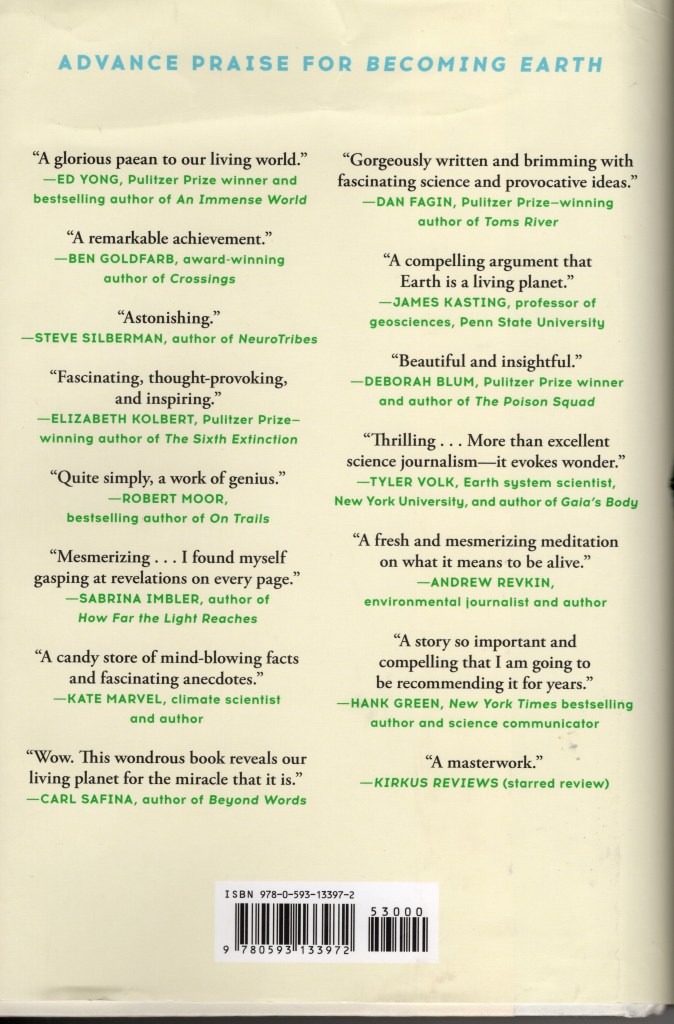
Back cover of Becoming Earth: How Our Planet Came to Life by Ferris Jabr.
Back cover of Becoming Earth: How Our Planet Came to Life by Ferris Jabr. Click on the image to go to the Amazon page for the paperback version of the book.


To see the Super Facts click here

Destroying Ourselves with High Conflict

I haven’t posted or read blog posts for almost a week because I was busy with something else. I am a member of a non-partisan volunteer organization called the Citizens Climate Lobby which seeks to create political will for a livable future. As the name suggests we do a lot of lobbying. It is not the kind of paid lobbying that is done by professionals and that is often associated with money. We are average constituents, average voters, with no money, who are visiting our legislators to give them information and opinions on legislation we support or don’t support.

Since we are non-partisan, we visit both Democrats and Republican offices. We just had a CCL conference in Washington DC on Sunday, Monday and Tuesday. We were 800+ volunteers who visited 400+ Congressional offices in Washington DC on Tuesday July 22nd.

I visited four Texas Congressmen, including Senator Ted Cruz (R), Congresswoman Beth Van Duyne (R), and Congressman Marc Veasey (D). We also had a zoom call with Congressman John Carter’s (R) office. I am the CCL liaison for Senator Cruz’ office and I was the one who organized our visit, from our side, with Senator Cruz and a couple of his staff. Ted Cruz does not always agree with us, or perhaps more correctly, he seldom agrees with us, but we had a friendly and interesting meeting, and he and his staff were very appreciative of us being there.

12 people from CCL plus Senator Ted Cruz in a blue suit | Destroying Ourselves with High Conflict
Senator Cruz hosts a Texas Tuesday Coffee for Constituents in Washington, DC on July 22, 2025. (Official U.S. Senate photo by Rebecca Hammel)
Ted Cruz is standing in the back between the flags. I am in the front row, second from the right wearing a blue suit. We are twelve people.

Right after our meeting with Senator Cruz I posted the following on Facebook “I am in Washington DC meeting with congressmen. We had an in person meeting with Ted Cruz and we took pictures with him.” along with a photo of the capitol building (not the group photo). Most people left interesting or nice comments but then a far-left Facebook friend of mine left a very hostile comment. He started out saying “so you are finally revealing your true colors Thomas…” and that was followed by an angry outburst in two separate comments filled with F-bombs and how he was ending his friendship with me. I deleted his comments and blocked him. Basically, a centrist on-line friend visiting with a Republican politician for a friendly exchange of opinions enraged him. Naturally I have seen a lot of this on both sides.

Division has become so severe in this country that we are losing our ability to talk to each other. Families are divided against each other, and the rhetoric is overheated. This is dangerous and it is what Amanda Ripley, the keynote speaker at our CCL conference in Washington DC calls High Conflict. High Conflict is a natural psychological phenomenon that sucks us deep into conflict that eventually gets out of hand. She compares it to the La Brea Tar Pits in Los Angeles. We form kinships and tribes, echo chambers, and dislikes for those with different opinions, we belittle and insult each other, which grows resentment, and we create an us-versus them scenario, which evolves into a good (us) versus evil (them).

Amanda Ripley is the author of the book High Conflict: Why We Get Trapped and How We Get Out. I think her message and her book are very important, and I have a lot of good things to say about the book. However, the book featured one false and defamatory statement and generalization about environmentalists, which prevents me from giving the book five stars. That claim pretty much ruined it for me , so I am giving the book three stars. I still recommend the book, and perhaps whether I like this book or not is not as important as the topic.

High Conflict the Book Formats

High Conflict: Why We Get Trapped and How We Get Out by Amanda Ripley. I bought the hardback format.

  • Hardcover –  Publisher : Simon & Schuster (April 6, 2021), ISBN-10 : 1982128569, ISBN-13 : 978-1982128562, 368 pages, item weight : 1.26 pounds, dimensions : ‎ 6 x 1.2 x 9 inches, it costs $24.98 on US Amazon. Click here to order it from Amazon.com.
  • Paperback –  Publisher : Simon & Schuster (April 5, 2022), ISBN-10 : 1982128577, ISBN-13 : 978-1982128579, 368 pages, item weight : 2.31 pounds, dimensions : ‎ 5.5 x 0.92 x 8.38 inches, it costs $13.95 on US Amazon. Click here to order it from Amazon.com.
  • Kindle –  Publisher : Simon & Schuster (April 6, 2021), ASIN : B08LDW7M7J, ISBN-13 : 978-1982128586, 363 pages, it costs $ 15.99 on US Amazon. Click here to order it from Amazon.com.
  • Audio–  Publisher : Simon & Schuster Audio (April 6, 2021), Listening Length : 9 hours and 50 minutes, ASIN : B0DCCWRMJS, it costs $0.00 with membership on US Amazon. Click here to order it from Amazon.com.
Front cover of the hardback format of the book High Conflict: Why We Get Trapped and How We Get Out by Amanda Ripley.
Front cover of the hardback format of the book High Conflict: Why We Get Trapped and How We Get Out by Amanda Ripley. Click on the image to go to the Amazon page for the hardcover version of the book.

Amazon’s Description of High Conflict

When we are baffled by the insanity of the “other side”—in our politics, at work, or at home—it’s because we aren’t seeing how the conflict itself has taken over.

That’s what “high conflict” does. It’s the invisible hand of our time. And it’s different from the useful friction of healthy conflict. That’s good conflict, and it’s a necessary force that pushes us to be better people.

High conflict is what happens when discord distills into a good-versus-evil kind of feud, the kind with an us and a them. In this state, the brain behaves differently. We feel increasingly certain of our own superiority, and everything we do to try to end the conflict, usually makes it worse. Eventually, we can start to mimic the behavior of our adversaries, harming what we hold most dear.

In this “compulsively readable” (Evan Osnos, National Book Award-winning author) book, New York Times bestselling author and award-winning journalist Amanda Ripley investigates how good people get captured by high conflict—and how they break free.

Our journey begins in California, where a world-renowned conflict expert struggles to extract himself from a political feud. Then we meet a Chicago gang leader who dedicates his life to a vendetta—only to realize, years later, that the story he’d told himself about the conflict was not quite true. Next, we travel to Colombia, to find out whether thousands of people can be nudged out of high conflict at scale. Finally, we return to America to see what happens when a group of liberal Manhattan Jews and conservative Michigan corrections officers choose to stay in each other’s homes in order to understand one another better, even as they continue to disagree.

All these people, in dramatically different situations, were drawn into high conflict by similar forces, including conflict entrepreneurs, humiliation, and false binaries. But ultimately, all of them found ways to transform high conflict into good conflict, the kind that made them better people. They rehumanized and recatego­rized their opponents, and they revived curiosity and wonder, even as they continued to fight for what they knew was right.

People do escape high conflict. Individuals—even entire communities—can short-circuit the feedback loops of outrage and blame, if they want to. This is an “insightful and enthralling” (The New York Times Book Review) book—and a mind-opening new way to think about conflict that will transform how we move through the world.

My three-star review of High Conflict

Interesting discussion on conflict but with a lot of interpretation and opinion

“Good conflict” is healthy conflict in which questions get asked, in which there is curiosity and movement in opinions. “High conflict” on the other hand is what happens when conflict devolves into a good versus evil kind of feud. The conflict takes on its own life and draws us in like a tar pit.

The book gives many examples of high conflict and explains how they came to be; the Hatfield’s and the McCoy, John Adams and Thomas Jefferson, our current political division, couples getting divorced, gang warfare, guerilla warfare, civil war, etc. The book focuses much attention on Gary, a friendly lawyer who rather solves conflict than benefit from it, as is typically a lawyer’s job. Gary runs for a local office and wins but because he is thinking a little bit too highly about himself and his abilities, he by mistake excludes some really knowledgeable, willing and helpful people from what he refers to as “the old guard”, which leads to a high conflict that he himself created. However, in the end he becomes part of the solution. It is a good story.

The author makes a lot of interesting observations such as; we have group belongings, we form factions, we need belonging, giving people two choices is dangerous, a proportional representation system might be better than the current American system, people have biases that inflame conflict such as confirmation bias, and there’s a conflict industrial complex. There are fire starters, group identities, conflict entrepreneurs, and humiliation. Media and social networking can function as conflict entrepreneurs. The areas in Rwanda where the radio reception was better there were more killings.

To escape high conflict, we need to recognize the conflict entrepreneurs around us, avoid excluding and humiliating people, and recognize that people want to be heard. Getting out of high conflict includes recognizing a saturation point where people had enough, building new broader identities, reframing the situation, and clearing the path for combatants. Welcome former combatants home rather than shaming them. Avoiding conflict involves complicating the narrative from the beginning. Simplifications do damage. I felt all that was pretty good advice.

Then on page 183 a strange claim is made, implying that very few people concerned about climate change would want a “carbon fairy” to solve climate change (that carbon fairy could be nuclear power) because they want to use “climate change” as vehicle for something else. I am volunteering in a climate change organization, and I have never met anyone who isn’t part of it primarily to solve carbon emissions. Half are pro nuclear power the other half skeptical about it being a “climate fairy” (I am pro nuclear). Some are pro-capitalists, others more left leaning, a substantial minority are Republicans, and world views are all over the spectrum. So obviously page 183 makes a false claim probably for sensationalistic reasons.

That’s just one dubious claim, but it alerted me to read the book more critically and I realized that the author is far from objective. She definitely wants to promote her ideas and make her book look more interesting. She is doing that by carefully selecting examples and stories, interpreting those cherry-picked situations, and there’s a lot of opinions, and who knows what she may get wrong or misreporting? It seems at first to be an authoritative work, but it is not a scientific book. That doesn’t mean that it’s wrong. I believe a lot of what the book claims to be true, but I do not know. It is a journalist’s opinion and interpretation of conflict, and it is therefore less than I expected.

Advance Praise for High Conflict: Why We Get Trapped and How We Get Out by Amanda Ripley. The text is black and red on a beige background. Back cover of hardback format of the book High Conflict: Why We Get Trapped and How We Get Out by Amanda Ripley.
Back cover of hardback format of the book High Conflict: Why We Get Trapped and How We Get Out by Amanda Ripley. Click on the image to go to the Amazon page for the paperback version of the book.

To see the Super Facts click here

Review of Glacial by Chelsea Henderson

I recently read a very interesting book on the history of climate change politics; Glacial: The Inside Story of Climate Politics by Chelsea Henderson. Chelsea Henderson is a leader in the EcoRight movement, basically Republicans who care about the environment and climate change. She is a former senior advisor to Senator John Warner (Republican) and have held other positions in the US Congress. Her book is non-partisan. However, naturally she is accepting the reality of human caused global warming.

I should mention that the second last sentence of the seventh paragraph of my rather long review says this “As of very recently, a few days ago, those Tax Credits have been reversed.” Those few days ago have not yet happened. I thought Amazon would take longer to publish my review and I was predicting that the vote today/tomorrow on the Senate version of the Budget Reconciliation Bill (the Big Beautiful Bill) would allow it to pass. So those few days ago have not yet happened because Amazon was faster than I thought. Basically, the Budget Reconciliation Bill will roll back or phase out the clean energy tax credits enacted in 2022. For those who don’t know what a Budget Reconciliation Bill is, it is a bill that allows you to bypass the filibuster, and it is therefore typically a highly partisan bill.

Glacial The Book Formats

Glacial: The Inside Story of Climate Politics by Chelsea Henderson comes in four formats. I bought the hardback format.

  • Hardcover –  Publisher : Turner (August 6, 2024), ISBN-10 : 1684429579, ISBN-13 : 978-1684429578, 432 pages, item weight : 1.45 pounds, dimensions : ‎ 6.25 x 1.25 x 9.25 inches, it costs $ 23.11 on US Amazon. Click here to order it from Amazon.com.
  • Paperback –  Publisher : Turner (August 6, 2024), ISBN-10 : 1684429587, ISBN-13 : 978-1684429585, 432 pages, item weight : 1.34 pounds, dimensions : ‎ 6 x 0.96 x 9 inches, it costs $13.10 on US Amazon. Click here to order it from Amazon.com.
  • Kindle –  Publisher : Turner (August 6, 2024), ASIN : B0CBQKTM46, ISBN-13 : 978-1684429592, 460 pages, it costs $12.44 on US Amazon. Click here to order it from Amazon.com.
  • Audio–  Publisher : Tantor Audio (August 13, 2024), Listening Length : 9 hours and 50 minutes, ASIN : B0DCCWRMJS, it costs $0.00 with membership on US Amazon. Click here to order it from Amazon.com.
Front cover of hardback format of the book Glacial: The Inside Story of Climate Politics by Chelsea Henderson | Review of Glacial
Front cover of hardback format of the book Glacial: The Inside Story of Climate Politics by Chelsea Henderson. Click on the image to go to the Amazon page for the hardcover version of the book.

Amazon’s Description of Glacial

It took nearly sixty years for a meaningful climate change bill to run the political gauntlet from Capitol Hill to the Oval Office. Why?

From mavericks to party standard-bearers, U.S. Senators, members of the House of Representatives, and presidential candidates have campaigned for four decades espousing their intentions to address the impacts of climate change.

Glacial: The Inside Story of Climate Politics is the first Inside-the-Beltway account to lay bare the machinations of what went wrong in Washington—how and why our leaders failed to act on climate change as mounting scientific evidence underscored the urgency to do so. Glacial tells a story of behind-the-scenes infighting and power struggles that blocked or derailed federal legislative progress on climate change, even in times of bipartisanship and with polls showing most Americans favored action.

The good news today is that public opinion is at its highest level of support for climate action, from corporate boardrooms embracing sustainability for business reasons to movements led by passionate younger generations who can’t afford to stand mute because it is they who will inherit the worst environmental catastrophes. If the missed opportunities in Washington are instructive, the path to doing so is clear. Our elected officials must use their offices not solely for the power and prestige it bestows upon them personally, but for the public good—and they must do so while there is still time.

My five-star review for Glacial

The Glacial Pace of Climate Policy

This book recounts the history of the politics around climate change starting with the LBJ administration and ending with the Biden administration. LBJ was the first commander in chief to warn his fellow Americans of a steady increase in carbon dioxide from the burning of fossil fuels.

The author, Chelsea Henderson is a leader in the Eco-Right movement, basically Republicans for the Environment. Some well-known names in this movement are former secretary of state James Baker (under H.W. Bush), and the former secretary of state under Ronald Reagan, the late George Shultz, Bob Ingliss former Republican Congressman from South Carolina, the founders of RepublicEN, the Republican congressman Carlos Curbelo who founded the Climate Solutions Caucus in Congress together with Ted Deutch, Republican Utah Senator John Curtis, and George Mankiw a notable conservative economist.

It may come as a surprise to some that once upon a time the environment was not a divisive left versus right issue. Nixon signed into law the Clean Air Act, the Clean Water Act of 1972, the Endangered Species Act, and founded the Environmental Protection Agency. Ronald Reagan and Margaret Thatcher led the ratification of the Montreal Protocol in 1987 – 1989 to phase out the global use of CFCs due to their detrimental effect on the ozone layer. As a result, emissions of ozone-depleting gases have fallen by 99 percent, and it saves an estimated 2 million lives from skin cancer every year. This was one of Ronald Reagans greatest successes and yet it has been mocked by some subsequent Republican Presidents.

The book also talks about the history of acid rain and our fight against that. Margaret Thatcher, a chemist, was very concerned about the greenhouse effect, or global warming, and so was George H.W. Bush and Reagan to some degree. Unfortunately, the words climate change has grown to be deeply polarizing due to decades long disinformation campaigns funded by fossil fuel companies and far right think tanks and talk show hosts.

Another factoid that might surprise readers is that in 1957, scientists working for Humble Oil, later known as ExxonMobil, sounded the alarm on the greenhouse effect / global warming caused by burning fossil fuels. However, the executive leadership decided to deride the type of work its own scientists had done. The same thing happened on later occasions and Exxon funneled a lot of money into anti-climate change think tanks.

As the evidence that carbon dioxide was causing the greenhouse effect (or global warming or climate change) became increasingly indisputable in the 1990’s the fossil fuel industry and far right think tanks, and conservative talk show hosts, started to push back on the science very hard, by spreading misinformation, insulting and attacking scientists, environmentalists, and politicians taking a stand they did not like. Koch industries, the American Petroleum Institute and the Global Climate Coalition (GCC), which contrary to what the name seems to imply, opposed climate action, teamed up to fight climate action.

However, it was not only people on the right doing this. Democrat politicians from coal districts also opposed measures on global warming. Clinton and Gore tried make progress on the issue, but it became politically unworkable. The book explains what happened during the Contract with America episode, the Kyoto protocol, etc.

However, the issue of climate change was not purely a right versus left. Some Republican leaders such as Senator John McCain and Mitt Romney championed climate action (perhaps on and off and on again) and the George W. Bush administration contained both pro-fossil advocates such as Dick Cheney and those favoring action on climate change such as Treasury Secretary Paul O’Neill, Condoleezza Rice, Christine Todd Whitman, and Colin Powell.

Later during the Obama administration there was a climate change bill that was very close to passing, the Waxman-Markey bill. The bill passed the house but when it was going to be voted on in the Senate, Barbara Boxer (democrat) used her role as a committee chairman to change it and take it so far left that it became unpassable. She wasn’t against climate action, on the contrary, but she thought it would work.

I can add that the Tea Party, which had started out to oppose the national debt, but later focused on the culture war and opposed climate action made climate action more difficult. Well, it did not help that the oil and gas industry spent 175 million dollars lobbying against the bill in less than a year whilst environmental advocates spent only 22.4 million dollars lobbying for it, despite that being a record effort for environmental advocates.

The end of the book focuses on the Biden administration and the Clean Energy Tax Credits in the Inflation Reduction Act. This part of the book reads like a thriller because it was held up by one man, Joe Manchin, the Democrat Senator from West Virginia, who was pressured from all sides and kept changing his mind, until he finally decided to support it. As of very recently, a few days ago, those Tax Credits have been reversed. The history of action on climate change marches on.

By reading this book you will learn about a lot of people and their stories, politicians and scientists, who became embroiled in the climate change issue, for or against, George E. Brown, Dr. Roger Revelle, Dr. James Hansen, Katherine Hayhoe, Al Gore, Joe Lieberman, Rafe Pomerance, Speth, Shimberg, Senator John Chafee, John McCain, Mathew Stembridge, Rick Boucher, John Warner, Alex Bozmoski, Bob Ingliss, Lindsey Graham, John Sununu, Rahm Emmanuel, Congressman Joe Barton, Dick Cheney, Tom DeLay, Scott Pruitt, Lee Iacocca, Senator Inhofe, Rush Limbaugh, Harry Reid, Mitch McConnell, Myron Ebell, and many others. You will also learn about terms that relates to the American form of Democracy, the filibuster, budget reconciliation, appropriation, the parliamentarian, the various senate and house committees and caucuses, how bills are created and passed, an Omnibus bill, etc.

If you are interested in political history, the history of climate change politics, and the stories of the people involved, then this book is for you. The author explains all the terms used and it is not a complicated book. The book reads like a journey through political history, and you will learn thousands of facts and anecdotes. If you are a somewhat older reader, like me, you will be reminded of the events from the past and you will recognize people, and what they said, and the chaos, and the complexities, and all the hoopla, and you will think to yourself, what a crazy world politics is.

I also think that the book gives you a perspective of where the politics have been and where it might be going. Despite the many setbacks in the past, this book will give you reason for optimism. The younger generation both on the left and the right are more willing to accept the science and are more willing to embrace action on climate. Well, I guess it is their future. The world is moving forward, and it is decarbonizing, no matter what we do. Overall, I think the book is entertaining and fascinating and I highly recommend it.

Advance Praise for Glacial: The Inside Story of Climate Politics by Chelsea Henderson on a blue and red background. The praise for the book is by former South Carolina Congressman Bob Ingliss and environmentalist and author C.K. Westbrook.
Back cover of hardback format of the book Glacial: The Inside Story of Climate Politics by Chelsea Henderson. Click on the image to go to the Amazon page for the paperback version of the book.

Other Posts Related to Climate Change, Environment or Clean Energy


An update : The Senate version of the Budget Reconciliation Bill passed today (7/1 – 2025). The phase out of the clean energy tax credits stayed, as I predicted, but the excise tax on renewables that the Senate previously added to the bill was removed in the last minute, which is good news for those who care about the environment.


To see the Super Facts click here