
Robbie Cheadle posted the second part of my guest post on Scandinavian Folklore on LatinosUSA. LatinosUSA is an amazing and very interesting online magazine/blog featuring poetry, stories and all kinds of interesting content from around the world. She also included a kind review of my Leonberger book Le Life and Times of Le Bronco von der Löwenhöhle, and I am very grateful for that.
Tag: Blogging
All Life Have a Common Ancestor
Super fact 82 : All known cellular life descends from a single Last Universal Common Ancestor (LUCA). All animals, all plants, fungi, algae, green and red algae, kelp, phytoplankton, cyanobacteria, amoebas, amoebozoa, diatoms, stramenopiles, rhizaria, hacrobia, all eukaryote, all archaea, all bacteria, all the millions of species on Earth come from one single ancestor known as the Last Universal Common Ancestor – LUCA. Viruses are an exception, but viruses are not considered life.
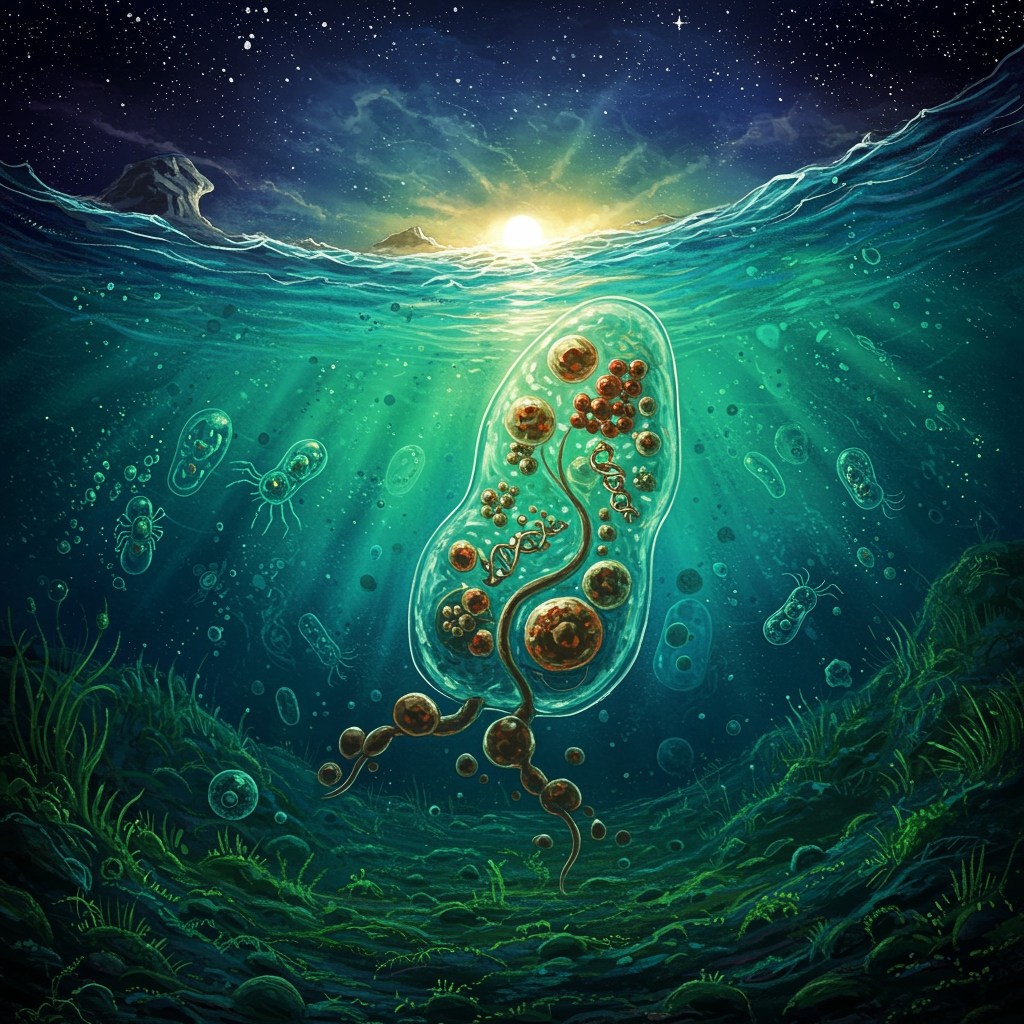
LUCA, the Last Universal Common Ancestor, was not the first life form. It was preceded by earlier, simpler life forms that did not survive. LUCA was a single-celled, bacteria-like microorganism that existed roughly 4.2 billion years ago, or about 400 million years after planet Earth first formed. It was the final common ancestor for all currently living organisms. It thrived near hydrothermal vents as part of a larger microbial community before the three domains of life bacteria, archaea, and Eukarya diverged. This is a super fact because it is true, or at least highly probable, it is surprising and amazing and kind of important.
How Do We Know All Life Has a Common Ancestor ?
The answer is genome mining. By surveying nearly 2000 genomes of modern microbes we not only know that all life has a common ancestor (LUCA), that lived roughly 4.2 billion years ago, but we also know that it thrived near hydrothermal vents as part of a larger microbial community. This is analogous to another of my posts “Humans and Chimpanzees Have a Common Ancestor”. By sequencing human DNA and chimpanzee and bonobo DNA we know that humans and chimpanzees have a common ancestor. No fossils, or other information from the past is needed. DNA is a great tool for determining relationships between species and for finding information about past life, without the need of fossils.
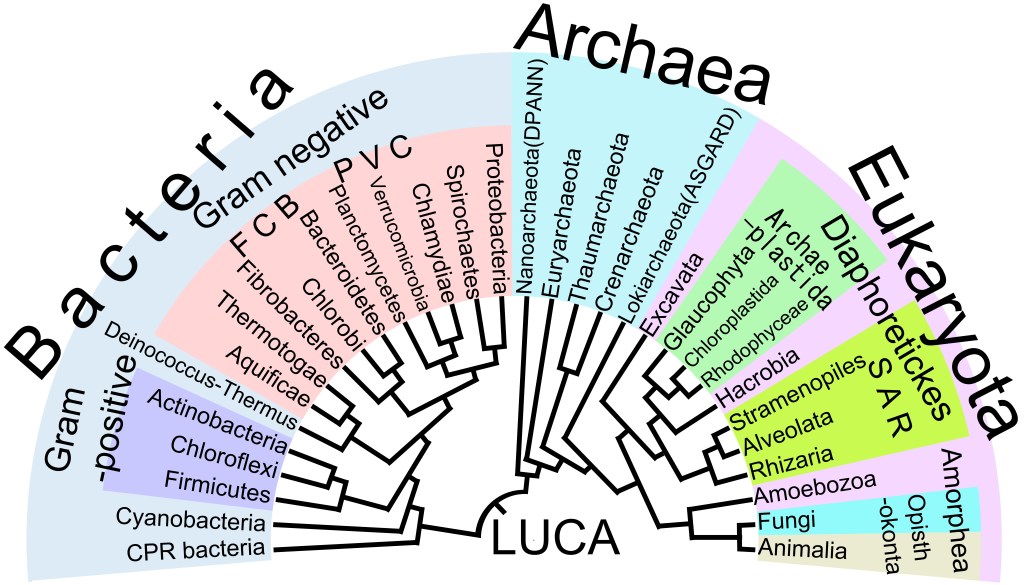
To be more specific, the detailed biochemical similarity of all current life makes the existence of LUCA widely accepted by biochemists. There is a Universal Genetic Code, which means that nearly all living things use the same DNA/RNA-based genetic code to translate genetic information into proteins. There is a shared molecular machinery, for example, all life relies on ribosomes for protein synthesis, similar energy carriers like ATP, and the same 20 amino acids. All life uses the same mirror-image form of molecules, a signature of a single, common ancestry. In addition, there is a “core” set of 355 gene families present in both modern bacteria and archaea, which were likely inherited from LUCA. Finally, we have phylogenetic mapping, protein-sequence-based phylogenetic trees converge on a single root, indicating a common ancestry for all life. See the phylogenetic tree of life below.
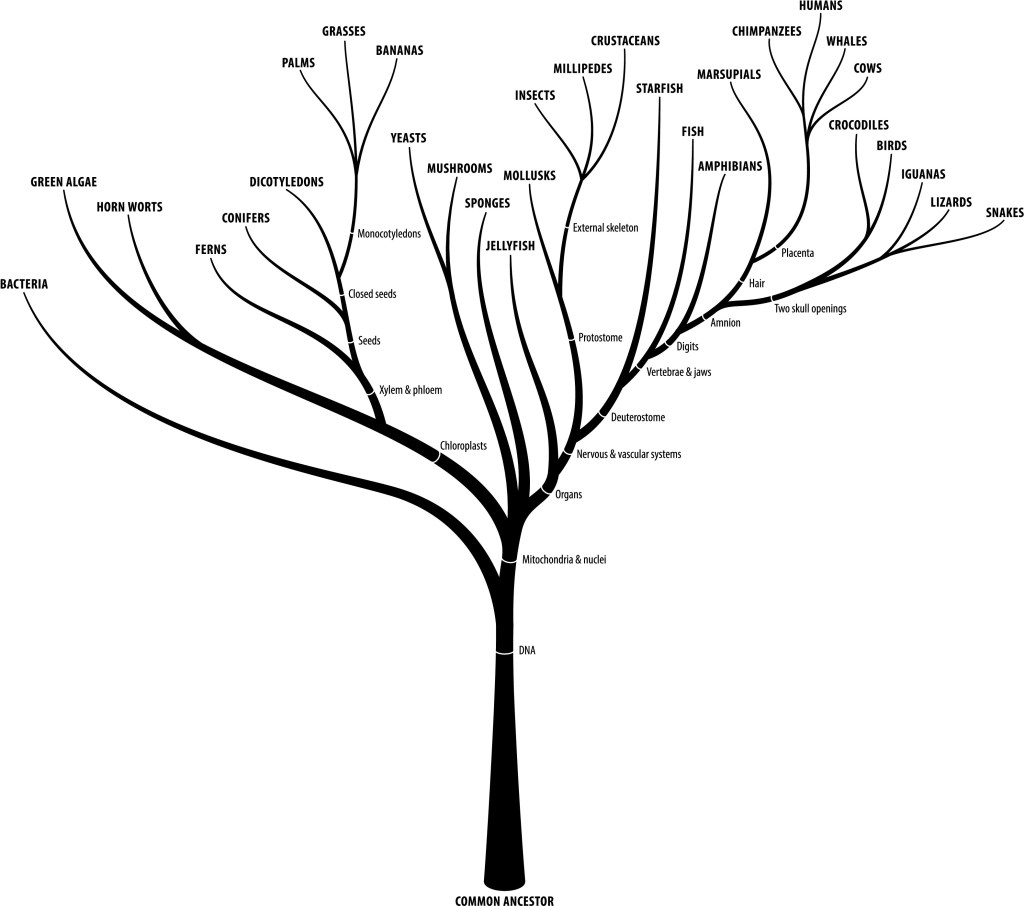
Below is another view of the diversification of life that focuses on the inventions made by life.
It should be noted that in addition to viruses there were likely other forms of life that existed alongside LUCA or before it. There was likely non-cellular life as well as cellular life that died out, RNA-based life, self-replicating nucleic acids, etc. It should also be noted that if some of the large viruses were to be reclassified as life, or a life form not based on LUCA were to be discovered then our “current LUCA” would no longer be LUCA, but just the ancestor of “almost all life”. That would still be amazing, just slightly less so.
The existence of LUCA brings up an interesting question. What would happen if we found DNA based life on another planet and its DNA showed that it also originated from LUCA ?
Other Evolution Related Super Facts
- Neanderthals Never Lived in Africa
- Evolution is a Fact
- The Second Law of Thermodynamics Does Not Contradict Evolution
- Humans and Chimpanzees Have a Common Ancestor
To see the other Super Facts click here
Humans and Chimpanzees Have a Common Ancestor
Super fact 81 : Humans are not descended from chimpanzees, or monkeys, or any other primate living today. However, humans and chimpanzees share a common ancestor that lived roughly 5 to 7 million years ago. The two species evolved separately to become modern humans and chimpanzees. Humans and chimpanzees are closely related and share approximately 98.8% of their DNA. Studying the DNA, it is possible to determine how long ago this ancestor lived despite not having any fossils from this ancestor.
Chimpanzee genome sequencing and the sequencing of human DNA has led to the realization that human and chimpanzee DNA is very similar and that humans and chimpanzees share an ancestor. The fact that the great apes have 48 (24 pairs) chromosomes while humans have 46 (23 pairs) is not an issue. What happened was that the ancestral chromosomes corresponding to modern chimpanzee chromosomes 2A and 2B fused to create human chromosome 2. We can see that the genes in 2A and 2B line up with chromosome 2 and we can also see where the 2A and 2B merge in the human chromosome 2 (see picture below).
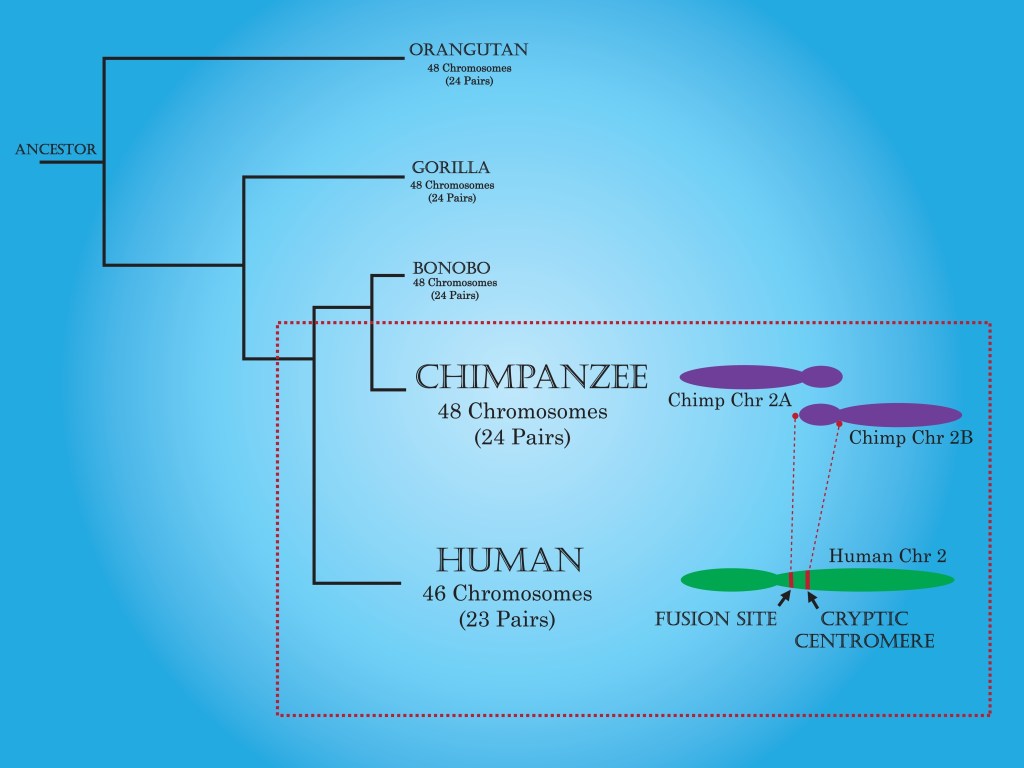
The graph above shows that gorillas, chimpanzees and humans share a common ancestor with orangutans. At the next level bonobos, chimpanzees and humans share a common ancestor with gorillas and finally chimpanzees and bonobos share a common ancestor with humans. We can deduct these things from DNA without needing fossils. We have found millions of fossils corresponding to more than 250,000 species. However, the best evidence for so called “macro evolution” and the best tool for determining relationships between species may not be the fossil record but DNA.
It should be noted that the terms “macro-evolution” and “micro-evolution” are terms that creationists like to use but that scientists do not like to use. Creationists like to say that microevolution is possible (it is observed) but not macroevolution. However, macroevolution is the result of repeated microevolution, so you cannot claim that microevolution is possible but not macroevolution. In addition, speciation is relative. An animal A may be able to successfully interbreed with an animal B, and that animal B may be able to successfully interbreed with an animal C, but animal A and C cannot interbreed. The border between microevolution and macroevolution is fuzzy.
The fact that we can determine evolutionary ancestry by sequencing DNA of living creatures may come as a surprise to many people. In addition, we can also determine how long ago a common ancestor lived. It may also come as an additional surprise to many that we are not descended from the great apes but share a common ancestor. Super fact 81 is a super fact because we know it is true, it is surprising to many, and important to know.
Identifying a common ancestor using DNA Sequencing
Below is a very high-level image of human and chimpanzee chromosomes referred to as a Karyotype. A karyotype is a laboratory-produced image or visual profile of an individual’s complete set of chromosomes, arranged in pairs by size, shape, and number.
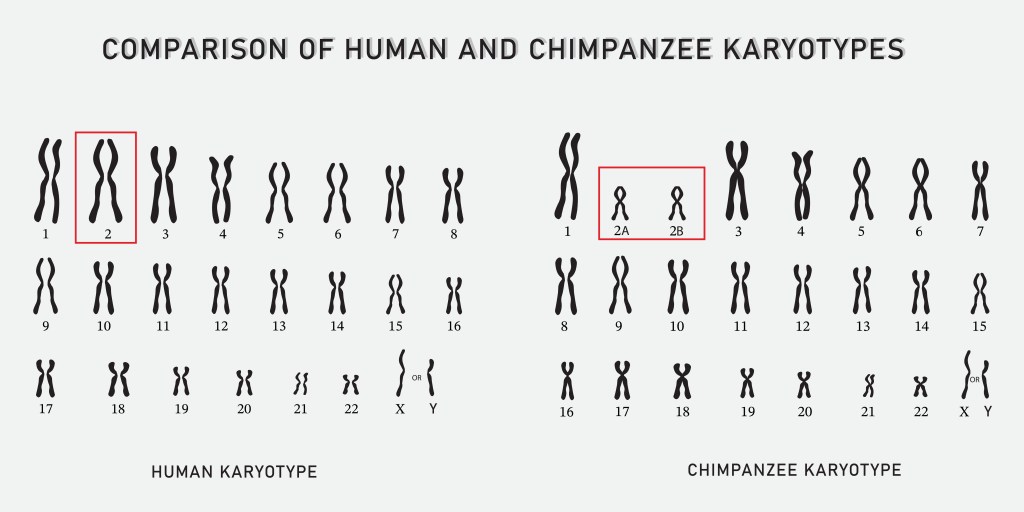
Based on the similarity in transposons, or jumping genes, pseudo genes, and genes in general (all of the genome) we know that the closest related living animals to humans are chimpanzees and bonobos. You can read more about this in the book Relics of Eden by Daniel Fairbanks, a book I highly recommend. According to the author the latest and perhaps best evidence for evolution as well as the fact that humans and chimpanzees have a common ancestor comes from so called junk-DNA. DNA that is not currently used but contains scientifically informative remnants of our evolutionary ancestry trapped in our DNA. The author refers to these remnants as relics.
Hominini species
Another interesting fact derived from DNA research is that chimpanzees and humans are more closely related than chimpanzees than to the other great apes. Based on the genetic record chimpanzees are no longer classified as great apes but as Hominini together with humans. The fact that there are three Hominini species (homo sapies – us humans, chimpanzees and bonobos) could maybe be another super fact.
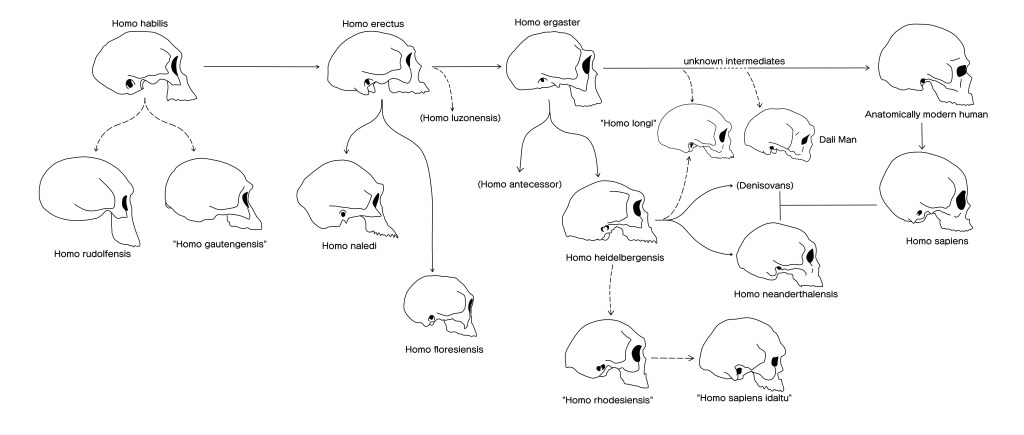
Speaking about hominini species, we have found more than 6,000 hominin fossils corresponding to dozens of species including Australopithecus, Paranthropus, Homo Habilis, Homo Erectus, Homo Heidelbergensis, Homo Neanderthalis, and Homo Sapiens. This link features a cool phylogenetic tree that includes Homo Sapiens (us), Neanderthals, as well as chimpanzees and bonobos.
Other Evolution Related Super Facts
- Neanderthals Never Lived in Africa
- Evolution is a Fact
- The Second Law of Thermodynamics Does Not Contradict Evolution
To see the other Super Facts click here
Conic Sections are the Shapes that Shape Our World
Super fact 80 : A conic section is a shape formed by slicing a cone with a plane. There are four such shapes, circle, ellipse, parabola, and hyperbola. The conic sections universally describe motion under gravity. The orbits of planets around their stars are circles or ellipses, comets fly around space in elliptical orbits, or parabolic or hyperbolic paths. Objects thrown up in the air follow parabolic paths. They are the basis for a huge amount of engineering applications.
Esther’s writing prompt: January 21 : Shapes
Click here or here to join in.
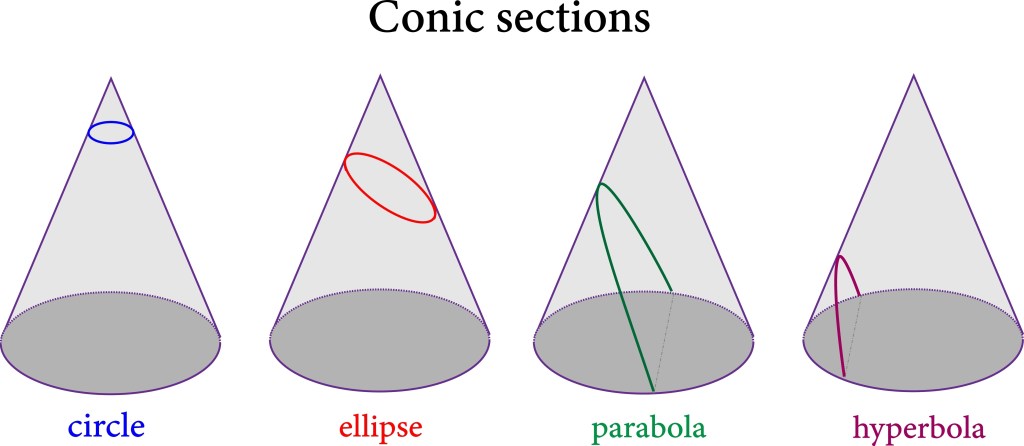
The four conic sections, circle, ellipse, parabola and hyperbola are fundamental and very useful shapes in mathematics, physics and engineering. Well, a circle is a special case of an ellipse, so it is really only three conic sections. The motion of the planets and other stellar objects are described by the conic shapes. Isaac Newton derived his law of gravitation from Kepler’s laws, which describe planetary orbits as ellipses.
The conic sections are all described by second degree equations (quadratic equations) and are in that sense the simplest shapes aside from points and lines. It is important to understand that there is an infinite amount of shapes that are almost conic sections and look like conic sections, but it is the exact mathematical properties of the four conic sections that make them so common in physics, mathematics, nature and engineering.
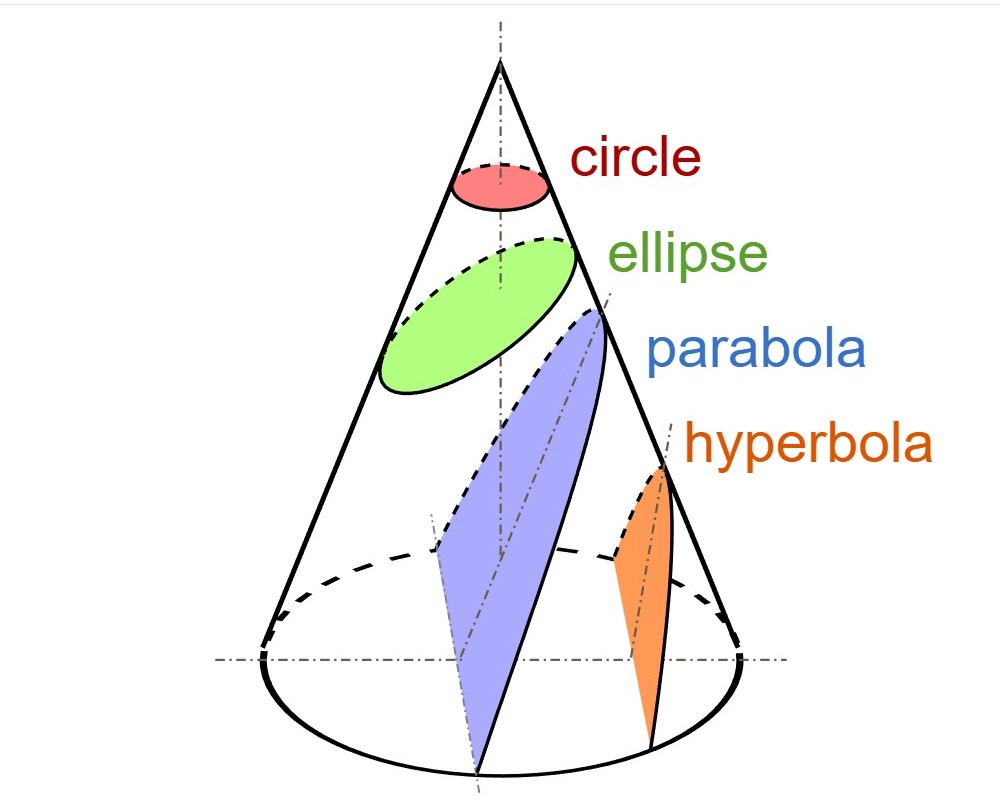
It may not come as a surprise that the circle is a fundamental and important shape, but I believe that the fact that the other conic sections are also fundamental in mathematics, physics and engineering come as a surprise to people outside of the STEM fields. It is a true and an important fact regarding how our world works.
Conic Sections
As mentioned, the conic sections are fundamental shapes that appear in a lot of places in STEM. Below are a few examples.
Parabola
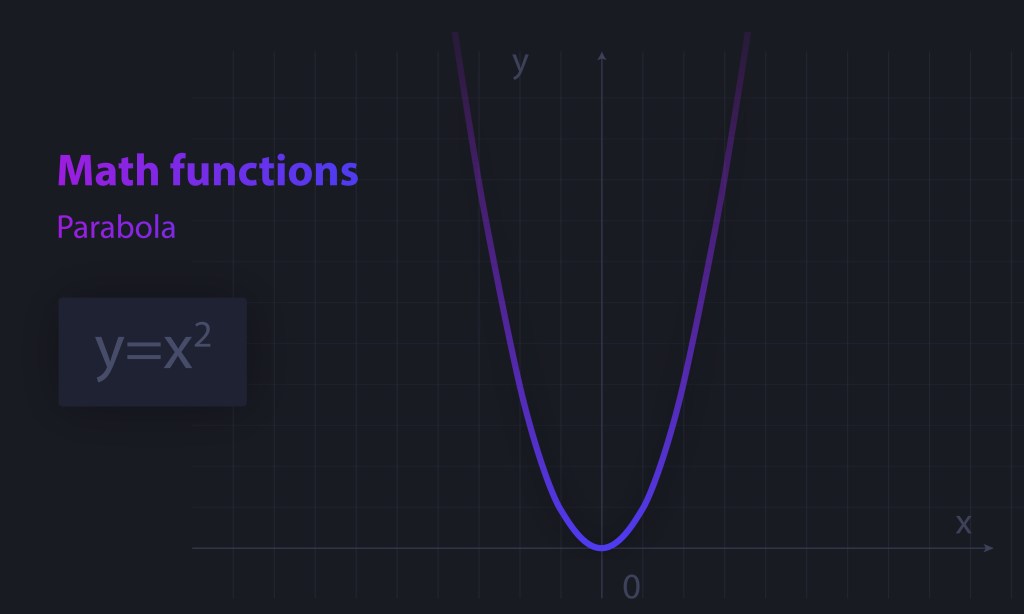
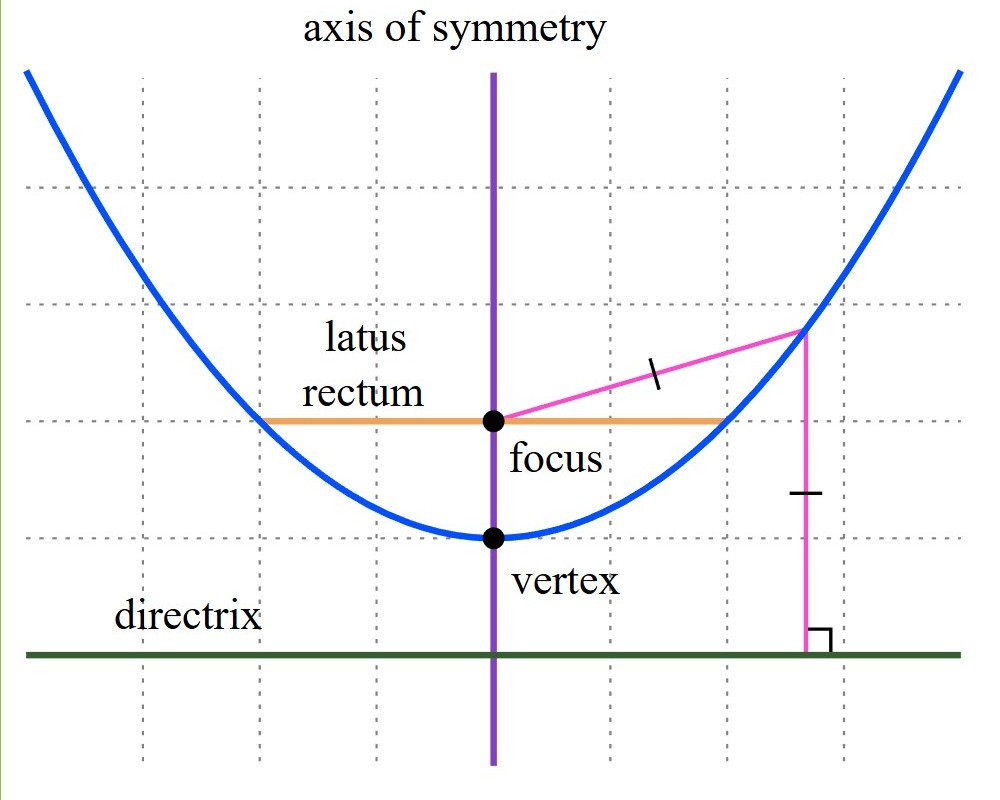
A parabola is formed when a plane cuts a cone, so the plane is parallel to a side of the cone. Parabolas are shapes that are roughly U-shaped and described by the equation y = x^2 or more generally by y = ax^2 + bx + c. Parabolas have a so called focus point. See the picture below. If you throw a ball, or any object, up in the air its trajectory will be a parabola (ignoring distortions caused by friction and wind). I should say the parabola you get in this case is upside down. The parabola is important when you design any kind of projectile.
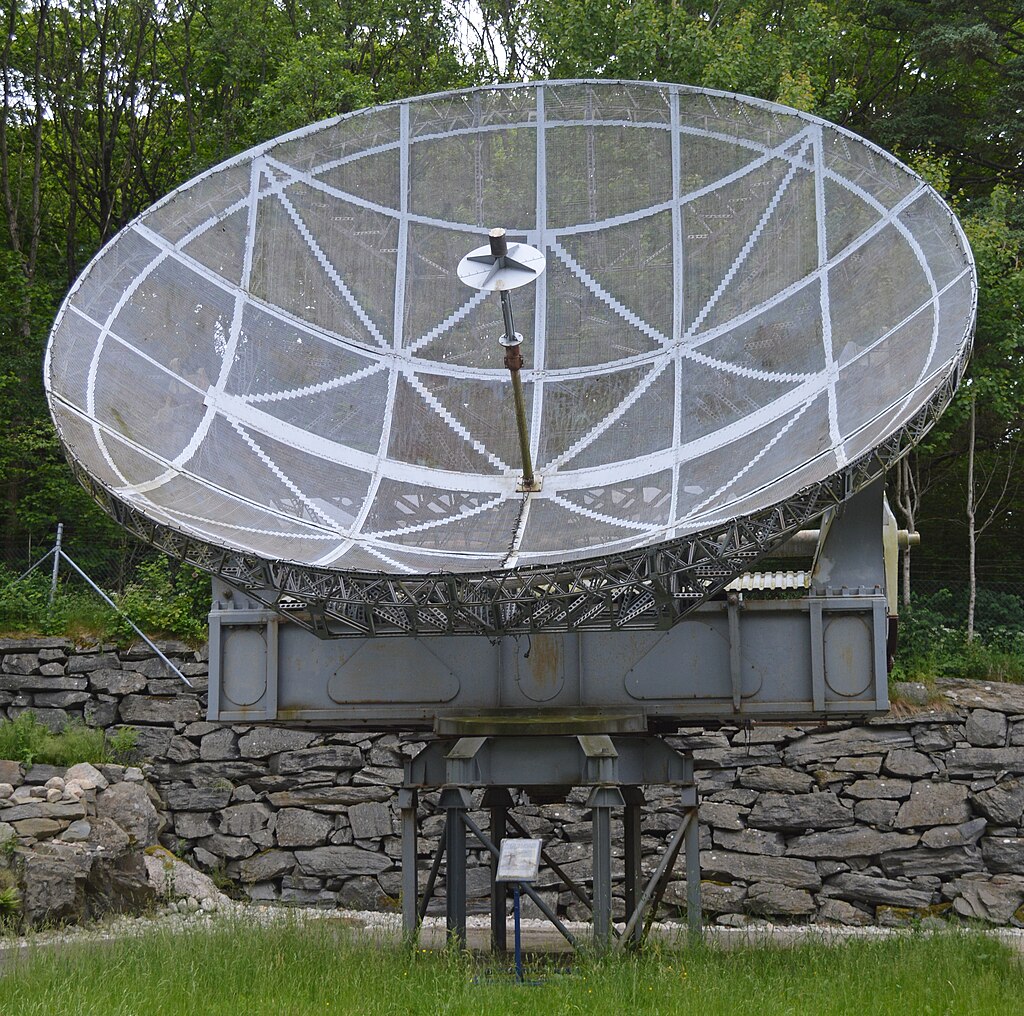
Antennas shaped like parabolas (in 3D) will direct incoming radiation and waves towards their focus point. If the surface is reflective a light located at the focus point will reflect to create a straight beam. Parabolas are used for radio telescopes, satellite dishes, car headlights, flashlights, solar cookers, solar power plants, water fountains, suspension bridges, business modelling and thousands of engineering applications. Parabolas like circles and the other conic sections shape our modern world (pun intended).
Ellipse and circle
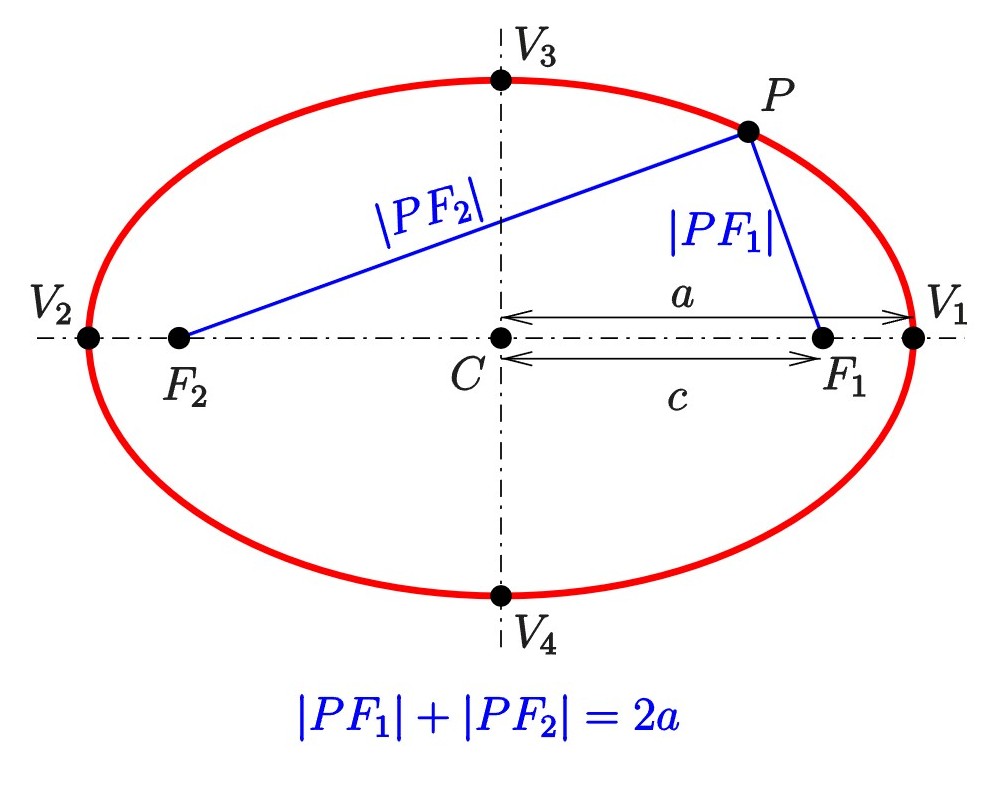
As mentioned, a circle and an ellipse are conic sections formed by intersecting a plane with a cone. You get a circle when the cuts perpendicular to the cone’s axis (see pictures above) and an ellipse form when the plane intersects the cone at a slant but not slanted so much that it becomes a parabola or a hyperbola. An alternative for an ellipse is that the sum of the distances from any point on the curve to two fixed points (called the foci) is a constant. See the picture below. The two definitions are identical. For a circle the two foci are merged into one point at the center.
There are a lot of real world examples of ellipses. Planets orbit the Sun in elliptical paths. The sun is in one of the foci points. The orbits of other stellar objects and satellites are also elliptical. Charged particles follow elliptical paths within magnetic fields. Elliptical patterns are observed in the rotation of ocean currents, elliptical models and algorithms are used in medical imaging, computer science and encryption. Also whispering galleries.
Hyperbola
Comets and spacecraft that are not orbiting another body, in other words, they have enough speed to escape the gravitational pull and continue into deep space, will travel along a hyperbola. The boundary of a shockwave from a supersonic jet (a sonic boom) creates a hyperbolic curve on the ground as it moves. The intersection of two sets of concentric ripples in water makes a hyperbola. The light beam from a lamp or flashlight makes an ellipse or an hyperbola on a plane depending on the angle.
Newton’s Law of Gravitation
Johannes was an early 17th century German mathematician who derived three laws that describe how planetary bodies orbit the Sun using the observational data collected by the Danish astronomer Tycho Brahe. The three laws are the following:
- Planets move in elliptical orbits with the Sun as a focus.
- A planet covers the same area of space in the same amount of time no matter where it is in its orbit.
- A planet’s orbital period is proportional to the size of its orbit (its semi-major axis).
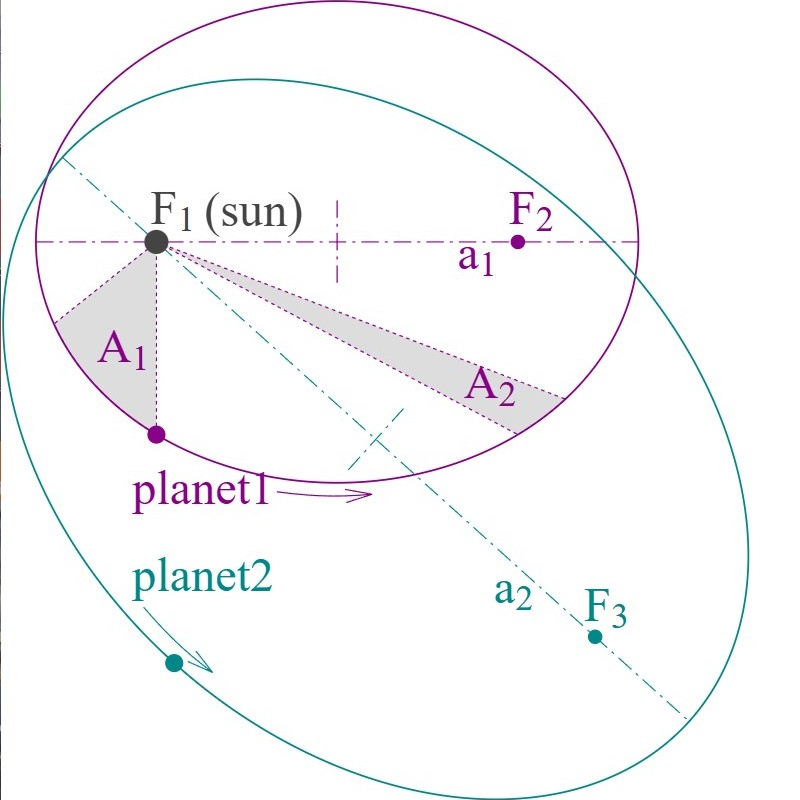
The orbits are ellipses, with foci F1 and F2 for Planet 1, and F1 and F3 for Planet 2. The Sun is at F1.
The shaded areas A1 and A2 are equal and are swept out in equal times by Planet 1’s orbit.
The ratio of Planet 1’s orbit time to Planet 2’s is (a1/a2)^3/2
Hankwang, CC BY-SA 3.0 <http://creativecommons.org/licenses/by-sa/3.0/>, via Wikimedia Commons
Later Isaac Netwon would use Kepler’s three laws to derive his law of gravity. Newton showed that an inverse-square force (gravity) directed toward the sun was necessary to explain the orbits.
My Other Responses to Esther’s Prompts
- Prompt : Small : Small Microscopic Subatomic and Strings
- Prompt : Kind : Leonbergers Are Kind Dogs
- Prompt : Charge : Electric Charge is not the only type of Fundamental Charge
- Prompt : Promises : Promises To My Dog
- Prompt : Shade : A Total Solar Eclipse the Ultimate Moon Shade
- Prompt : Money : Ten Money Facts
- Prompt : Edge : The Edge of the Observable Universe is 46.5 billion Light Years Away
- Prompt : Fish : Ten Amazing Fish Facts
- Prompt : Promise : I Promise Not to Post AI Generated Comments
- Prompt : Respect : Respect your Dog
- Prompt : Giving : Leonbergers Giving Gifts to Pugs
- Prompt : Family : Dogs Are Family
- Prompt : Snow : Snow and Ice in Norrland
- Prompt : Red : The Universe has a Redshift and its Increasing
To see the other Super Facts click here
The Universe has a Redshift and its Increasing
Super fact 79 : Distant galaxies appear redder (redshifted) because of the universe’s expansion. The farther away the galaxy, the redder it is. This cosmological redshift is also increasing because the Universe’s expansion is accelerating. Our Universe is getting more and more red every day.
Esther’s writing prompt: January 14 : Red
Click here or here to join in.
Many people are aware that the Universe is expanding but may not know that this results in a measurable redshift. The faster a galaxy is moving away from us the redder it appears. This is called the cosmological redshift. Measuring these redshifts was how we discovered that our Universe is expanding.
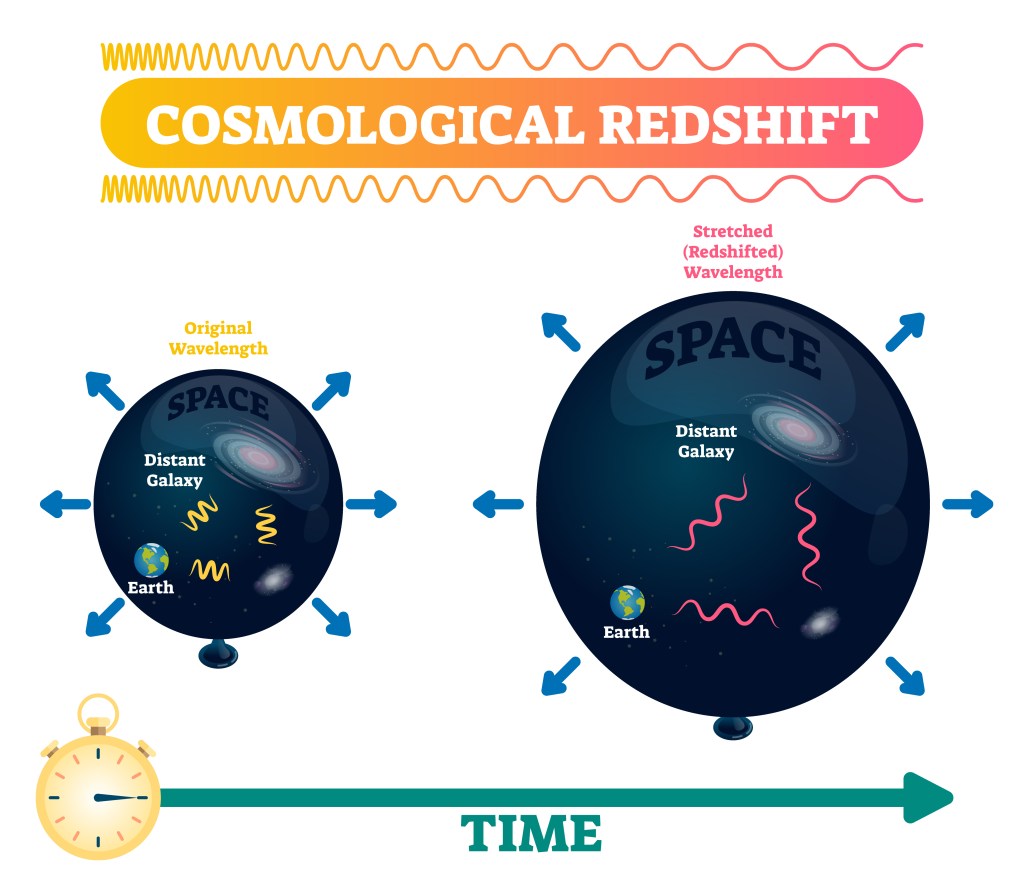
At the end of the 1990’s it was also discovered that the Universe’s expansion was accelerating. This discovery came from measuring the redshifts (and apparent dimness) of distant Type Ia supernovae. I should add that measuring the increase in the cosmological redshift directly is difficult. However, it is expected to be possible when the Extremely Large Telescope (ELT) starts gathering data in 2027. I can add that there are also other types of evidence showing that the Universe’s expansion is accelerating.
Another surprising aspect is, if the Big Bang was like an explosion, gravity would pull back the galaxies making the expansion slow down and perhaps eventually even reverse. However, the opposite is happening. A common explanation is that a repulsive force, a sort of anti-gravity, referred to as dark energy, is responsible for this acceleration.
I call this a super fact because this is an observed phenomenon, it is important knowledge for how we view the world, and it is surprising. Many people have heard bits and pieces of this but do not have the fuller picture.
The Doppler Effect
The cosmological redshift is an example of the so called doppler effect. The doppler effect is the change in the frequency or wavelength of a wave in relation to an observer if the origin of the wave and the observer are moving compared to each other. If an object is moving towards you, let say an ambulance, the frequency of its sound will be higher (wavelength shorter).
After it passes you and moves away from the frequency will be lower (wavelength longer). In other words, the sound changes when the ambulance passes you. The same is true for other kinds of waves, including waves on the water, and light. If a light is travelling towards you at a high speed, it will look bluer. If a light is travelling away from you at a high speed it will look redder. The latter is what is called a redshift, cosmological redshift in our case.
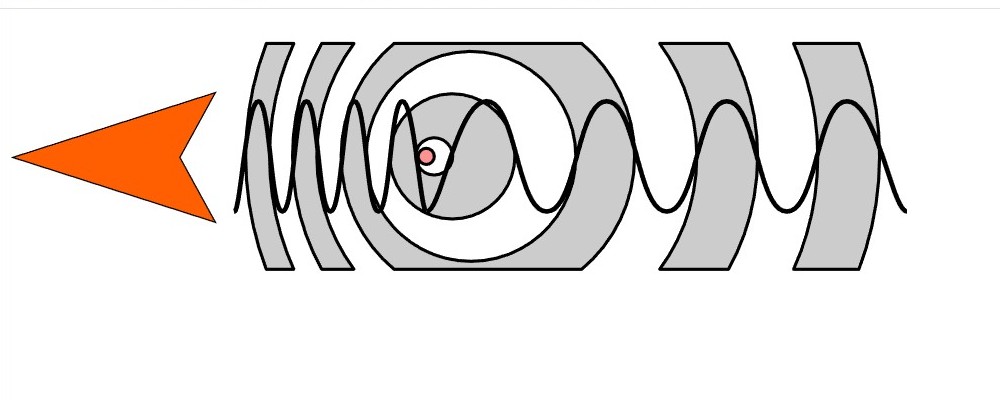

Below is a three minute video explaining the doppler effect and redshift.
I can add that the constancy of the speed of light in vacuum changes the exact size of the doppler effect. The doppler effect remains as is for the most part but the formulas for the classical doppler effect, which you would use for sound, and the relativistic doppler effect, which you would use for light in space, are different. It is just to pick the right formula.

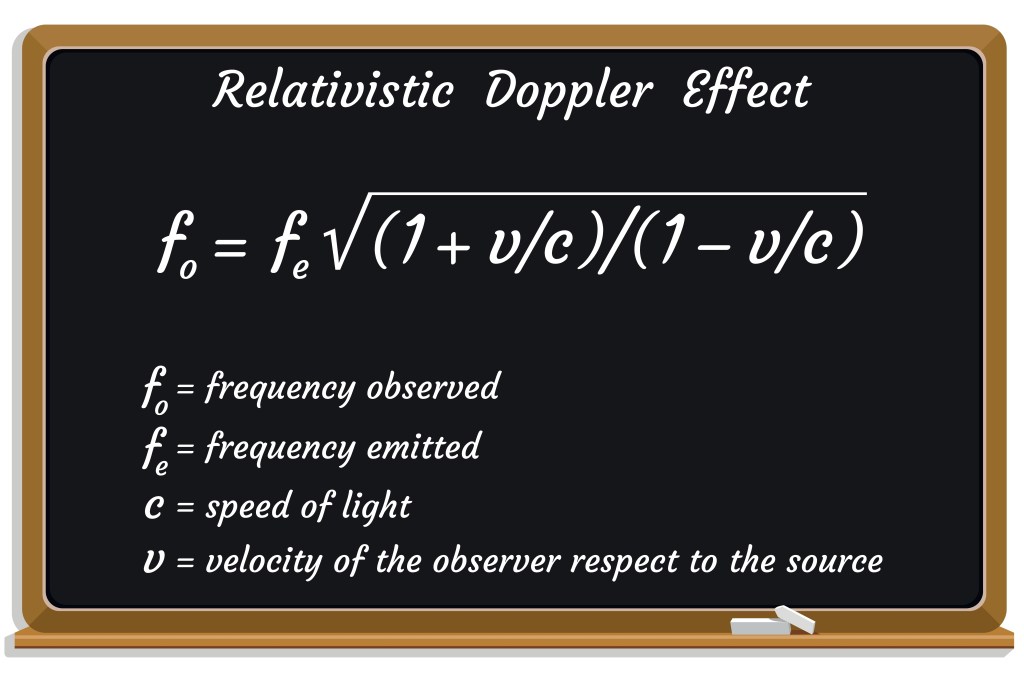
Measuring redshift
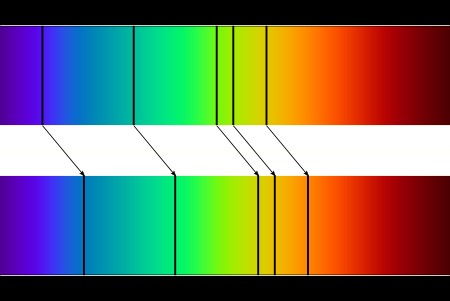
A common misconception is that astronomers take pictures of distant galaxies and somehow measure the “redness” of them, but that is not the case. When you take a spectrum of a heated element (such as hydrogen or helium in stars) it creates characteristic dark lines in the spectrum — like a fingerprint. Everything on the periodic table has its own characteristic fingerprint of lines at characteristic frequencies. In addition to measuring the cosmological redshift it makes it possible to identify the elements in a star and their proportions. See the picture below.
Expanding Universe Hazy IPA
Expanding Universe is a Hazy IPA, or a so called New England style IPA from First State Brewing, ABV 6.5%, IBU 25 (IBU = International Bitter Units). The fact that it is an IPA (India Pale Ale) means that it is Ale and therefore not a Lager. The fact that it is an IPA means that it is hop-forward and has an intense flavor and aroma. The fact that it is a Hazy / New England style IPA means that it is more fruity than bitter and looks cloudy, hazy, like juice. The flavor of Expanding Universe is mango, pineapple, and grapefruit. It has a low bitterness, it is fruity, juicy, and it is great if you like New England IPAs.

Related Posts
- The Speed of Light In Vacuum Is a Universal Constant
- Two events may be simultaneous for some but not for others
- We are Star Dust
- The vastness of space and the beginning of infinity
- GPS uses relativity for accuracy
- There is strong evidence for the Big Bang
- Time Dilation Goes Both Ways
- The Edge of the Observable Universe is 46.5 billion Light Years Away
 Super Facts