The Strong Nuclear Force Increases with Distance

Super fact 129 : Most fundamental forces of nature, gravity, electromagnetism, the weak nuclear force, become weaker as the distance between the objects with the charges increase, except for the strong nuclear force, which grows stronger, not weaker, when the distance between the quarks increases. The strong nuclear force is strange in other ways too. Unlike the electric force which has two forms of charges, positive and negative, the strong nuclear force has three forms of charge denoted red, blue, and green. It has actually six kinds of charges if you count anti-red, anti-blue, and anti-green. I can add that the strong nuclear force is the strongest fundamental force in nature.

As you may know, atoms consist of particles. Electrons surround the nucleus of the atom. The nucleus of the atom is in the middle of the atom, and it consists of protons and neutrons. Electrons have a negative charge. Protons have a positive charge. Neutrons do not have an electrical charge. Electrons are so called elementary particles. They are not composed of other particles. Protons and Neutrons, on the other hand, are not elementary particles. They are composite particles consisting of quarks, gluons and quark pairs called mesons.

Quarks have electric charges, just like an electron and a positron, which is why a proton has an electric charge, a positive electric charge. However, as mentioned, in addition quarks have something called color charge. Unlike electric charges, which come in two forms, negative and positive, they come in three forms red, green and blue. In addition, there are also anti-red, anti-green, and anti-blue charges, making it six forms of charges. I should say that the color charges, red, green and blue, are not real colors. They are just names. Just like electric charges are associated with electric forces; color charges are associated with the nuclear strong force.
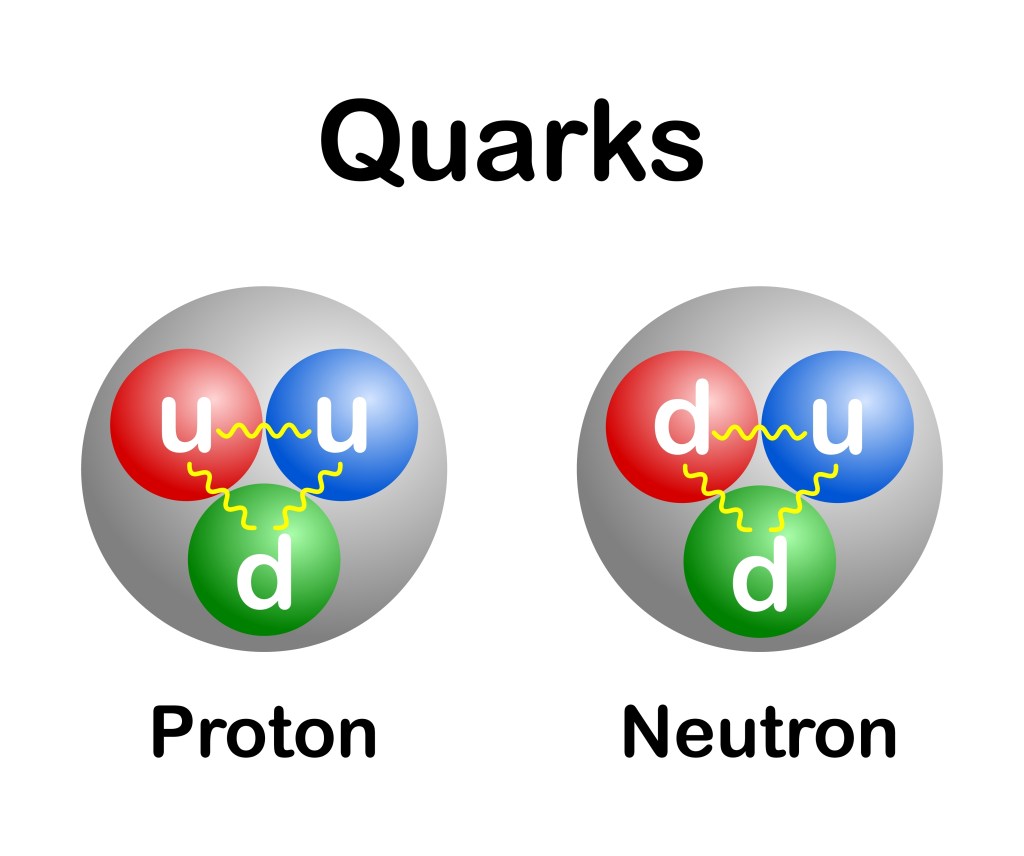
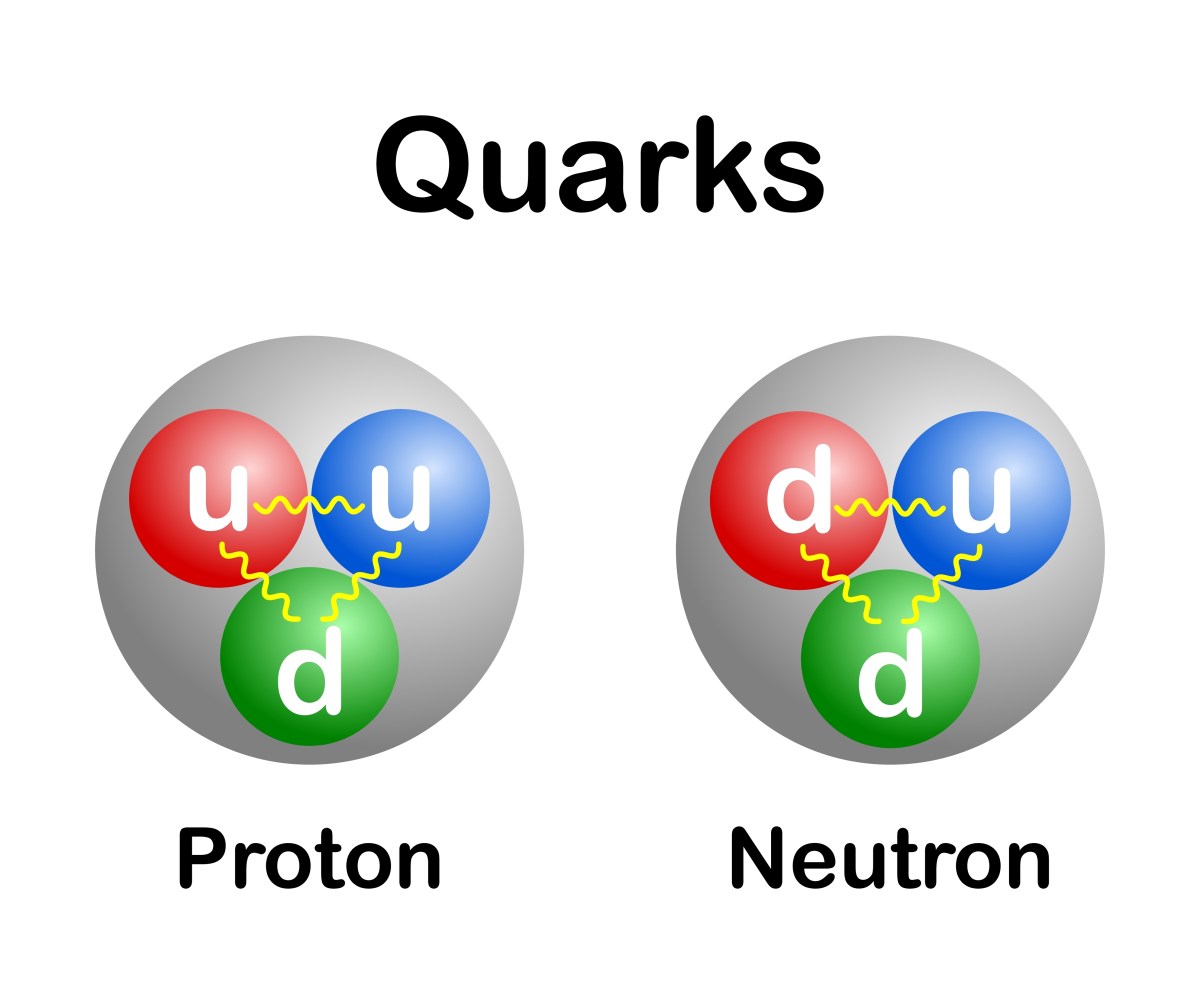
vector illustration of up and down quarks in proton and neutron on white background. The proton (left) is a red and blue up quark and a green down quark. The neutron is a red and green down quark and a blue up-quark. | The Strong Nuclear Force Increases with Distance
The proton and neutron each consist of three quarks. Protons consist of two up quarks and one down quark. Neutrons consist of two down quarks and one up quark. Both protons and neutrons have a net white charge. The yellow squiggly lines are gluons transporting color charge between the quarks. Asset id: 2333679305 by KRPD.

If you take an equal amount of positive and negative electric charges you get something that is electrically neutral. If you take an equal amount of red, green and blue you get what is called white, or neutral. If you take an equal amount of red and anti-red you also get white. Any other mix gives you a net color charge. As mentioned, unlike, for example, gravity or electromagnetism, which get weaker as objects move apart, the strong force grows stronger as quarks are pulled apart and weaker when they are squeezed together. This strange feature is referred to as Asymptotic Freedom.

As you separate a quark further and further from another the attractive strong force grows stronger and stronger until it becomes super strong, and at about 10,000 Newtons, which is more than one hundred billion times stronger than the force between an electron and a proton in a hydrogen atom it will finally quickly dimmish as if it was a rubber band that snapped. This event will create new particles and quarks, but not free quarks. 10,000 Newtons correspond to a weight of 2,200 pounds, like a small car. However, remember that we are talking about objects that are a trillion times smaller (in diameter) than one millimeter.

Not only is the nuclear strong force increasing with distance until it snaps, which is kind of strange, but by the time it snaps the force is shockingly gigantic for such a small particle. Therefore, this is a fact that is mind-blowing and kind of important to our understanding of the Universe and therefore I think it is a super-fact. With these kinds of forces inside the atomic nucleus no wonder we can blow up large cities using small amounts of the right matter.

The Other Fundamental Forces Become Weaker with Distance

As mentioned, the other fundamental forces gravity, electromagnetism, and the weak nuclear force get weaker as objects move apart. You may say what about friction, pressure, pulling a rope, and attraction between atoms in a molecule? Well, they are not fundamental forces and composed of electromagnetic forces at the bottom. Also, electric and magnetic forces are combined into electromagnetism because they are fundamentally the same thing.

Gravity gets Weaker as Masses Move Apart

The force of gravity gets weaker as masses such as planet Earth, the moon, and the sun are separated further. Newtons law of gravity states that every object in the universe attracts every other object with a force that is directly proportional to the product of their masses and inversely proportional to the square of the distance between their centers.
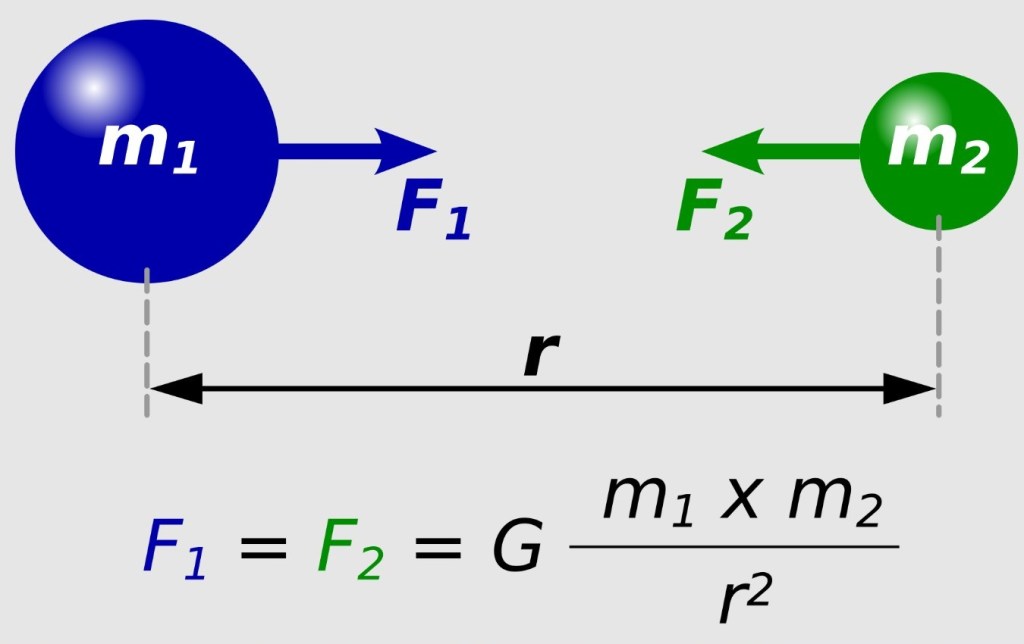
The picture shows the formula of Newtons law of gravity and an illustration of two objects being attracted to each other.
This diagram describes the mechanisms of Newton’s law of universal gravitation; A point mass m1 attracts another point mass m2 by a force F2 pointing along the line intersecting both points. The force is proportional to the product of the two masses and inversely proportional to the square of the distance (r) between the point masses. Dennis Nilsson, CC BY 3.0 https://creativecommons.org/licenses/by/3.0, via Wikimedia Commons
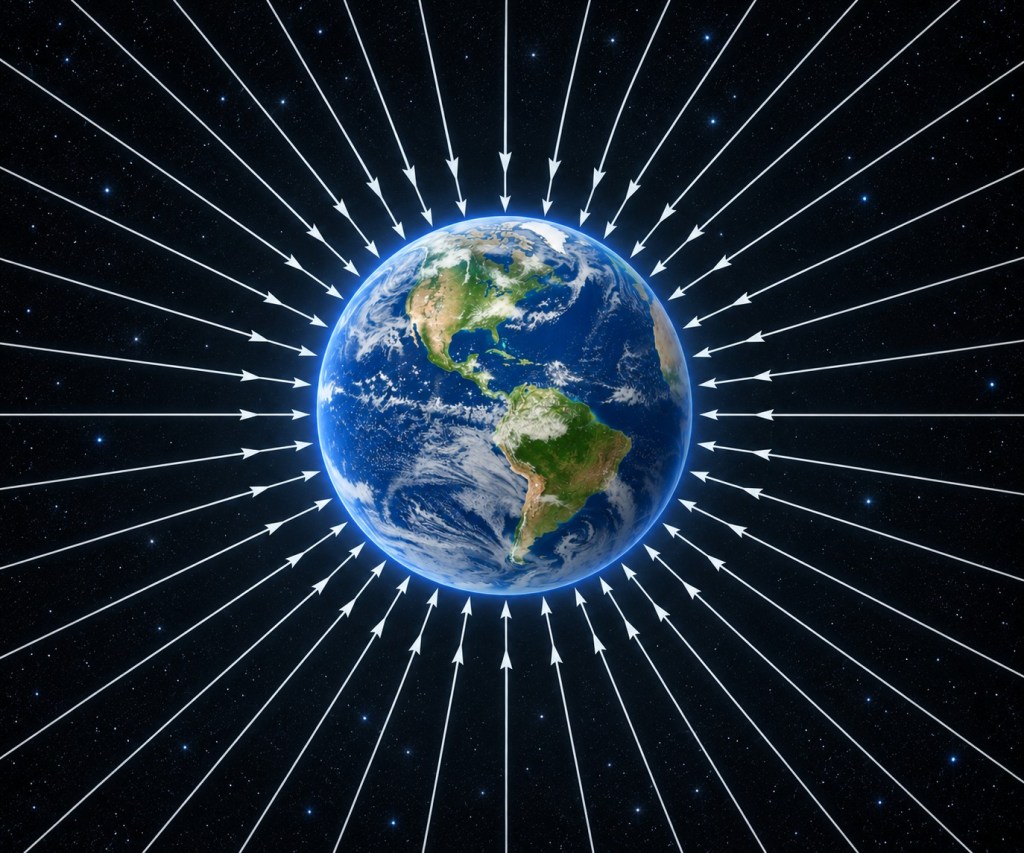
Gravity force field lines spreading out around Earth. | The Strong Nuclear Force Increases with Distance
The force field lines demonstrate how gravity gets weaker as the gravitational field spreads out in space. I generated this picture using ChatGPT.
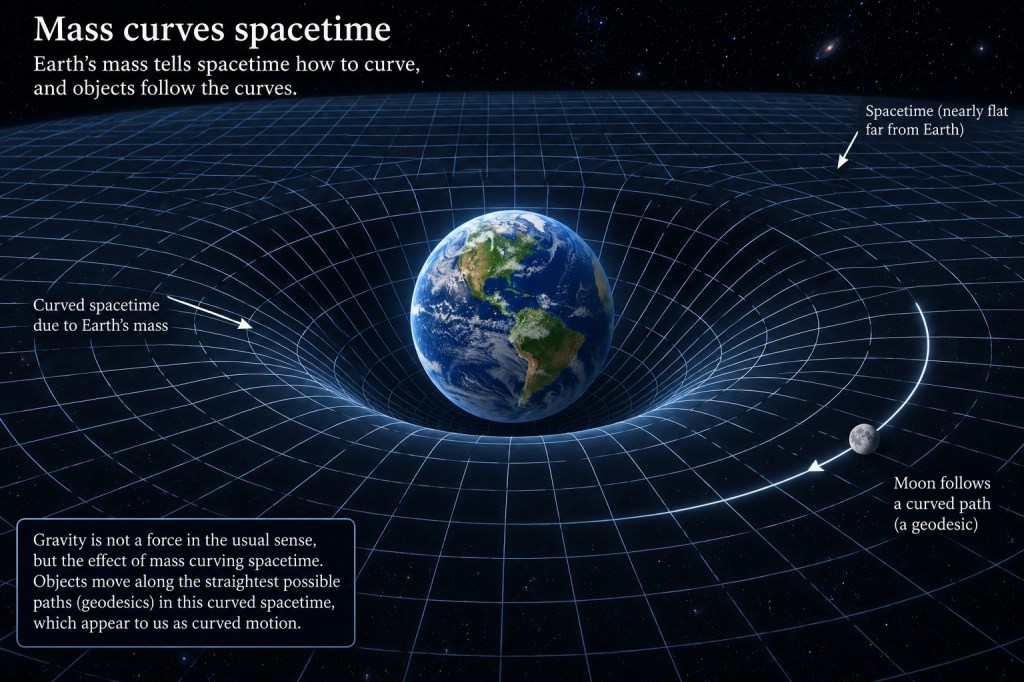
The picture depicts an Earth bending spacetime around it.
Even if you use the more modern model of gravity, Einstein’s General Theory of Relativity, you can see how the curvature of space becomes less further away from Earth. I generated this picture using ChatGPT.

This does not happen with the strong nuclear force.

The Electromagnetic Force gets Weaker as Objects Move Apart

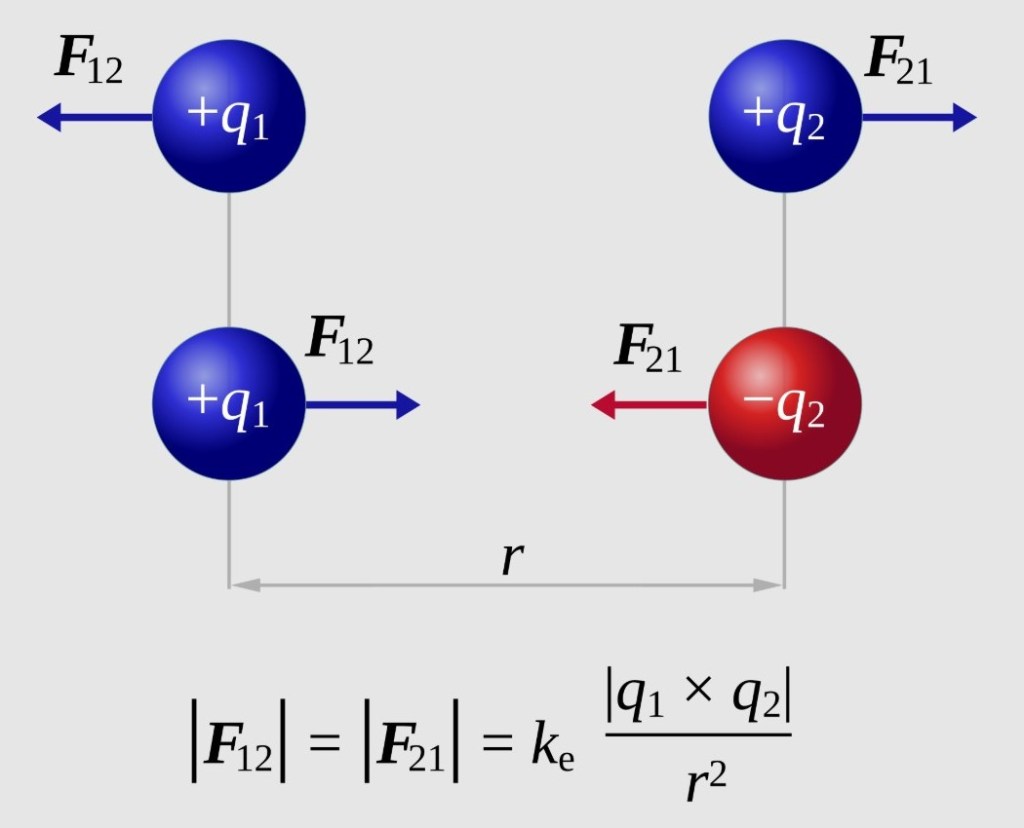
The electric force gets weaker as the charges are separated further. Coulombs law is similar to Newtons law of gravity. The force between them is inversely proportional to the square of the distance between their centers.
The picture shows the formula of Coulombs law which has the same form as Newton’s law of gravity plus an illustration of a positive and negative charge being attracted to each other and two positively charged particles repulsing each other.
The magnitude of the electrostatic force F between two point charges q1 and q2 is directly proportional to the product of the magnitudes of charges and inversely proportional to the square of the distance between them. Like charges repel each other, and unlike charges attract each other. File:CoulombsLaw.svg: User:Dna-Dennis / *derivative work RJB1, CC BY 3.0 https://creativecommons.org/licenses/by/3.0, via Wikimedia Commons.
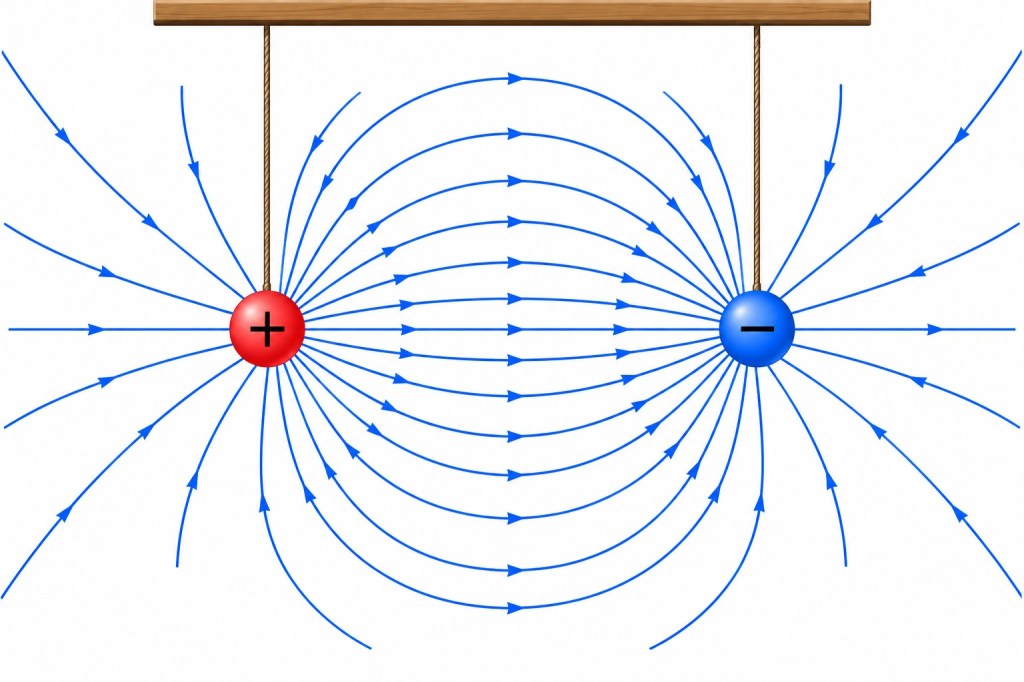
Electric force field lines spread out around a positively and negatively charged particle.
The force field lines demonstrate how the electric force gets weaker as the electric field spreads out in space. I generated this picture using ChatGPT.
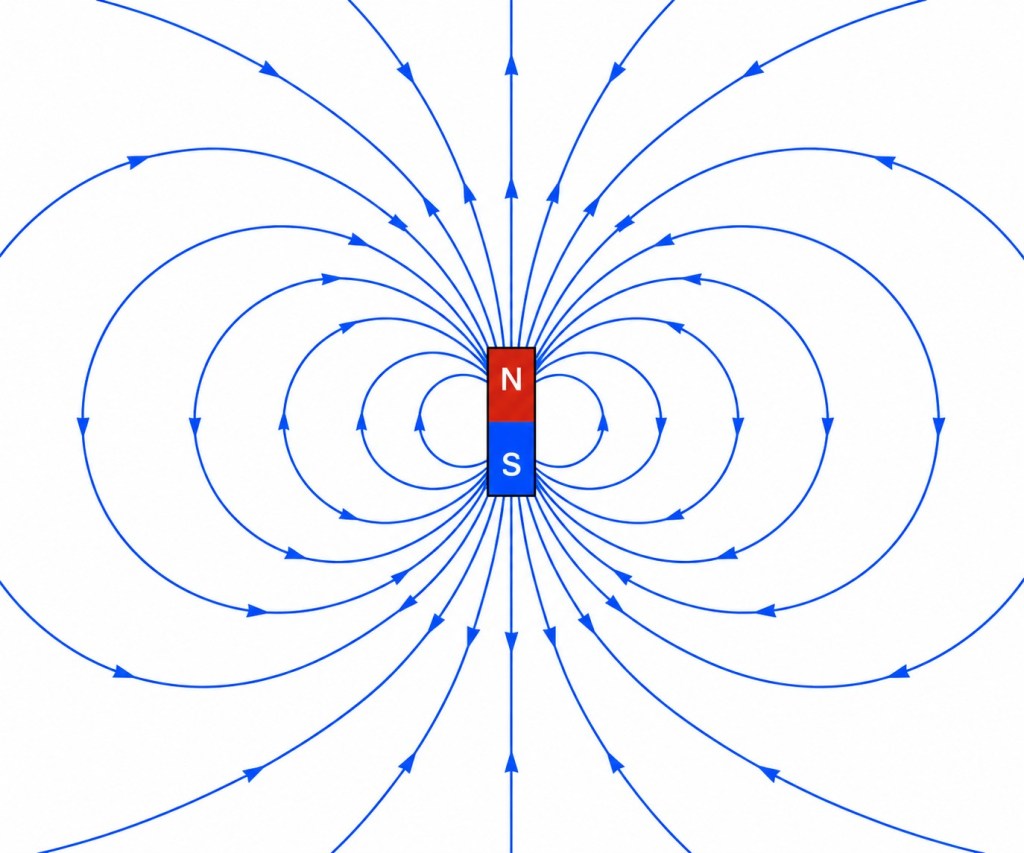
The picture shows magnetic force field lines spreading out around a magnetic dipole. They are spreading farther apart further away. | The Strong Nuclear Force Increases with Distance
Same thing with a magnetic dipole. The field lines are spreading out in space so the magnetic force (field) become weaker further away from the dipole. I generated this picture using ChatGPT.

Again, this does not happen with the strong nuclear force. It is different. The strong nuclear force is strange and very strong.

What is a Quark?

You can learn more about Quarks and the strong force by watching this 10 minute video below. The strong nuclear force is discussed towards the end of the video.

Other Physics Related Superfacts


To see the other Super Facts click here

Electric Charge is not the only type of Fundamental Charge

Super fact 59 : Most people have heard of electrical charges, positive and negative. However, in nature there are also color charges—red, green, and blue—which are analogous to electric charges. In addition, there are anti-red, anti-green, and anti-blue charges.

Esther’s writing prompt: 10th September : Charge

Click here or here  to join in.

As you may know, atoms consist of particles. Electrons surround the nucleus of the atom. The nucleus of the atom is in the middle of the atom and it consists of protons and neutrons. Electrons have a negative charge. Protons have a positive charge. Neutrons do not have an electrical charge. Electrons are so called elementary particles. They are not composed of other particles. Protons and Neutrons, on the other hand, are not elementary particles. They are composite particles consisting of quarks, gluons and quark pairs called mesons.

The picture shows a Hydrogen atom consisting of one proton and one electron, one Carbon atom with six electrons, six protons and six neutrons, an Oxygen atom with eight electrons, eight protons and eight neutrons, and a Nitrogen atom with seven electrons, seven protons and seven neutrons | Electric Charge is not the only type of Fundamental Charge
Four elements with a nucleus and electron shells. The number of electrons, protons, and neutrons is shown. The green particles circling the nucleus are electrons. The red particles in the nucleus (middle) are protons and the blue particles in the nucleus are neutrons. The colors of the particles in this picture have nothing to do with color charges. The four elements are Hydrogen, Carbon, Oxygen, and Nitrogen. There are 118 elements. These elements can combine into millions of different kinds of molecules that make up everything. Asset id: 1555863596 by OSweetNature.

Quarks have electric charges, just like an electron and a positron, which is why a proton has an electric charge, a positive electric charge. However, in addition quarks have something called color charge. Unlike electric charges, which come in two forms, negative and positive, they come in three forms red, green and blue and in anti-red, anti-green, and anti-blue (well six forms actually). I should say that the color charges, red, green and blue, are not real colors. They are just names. Just electric charges are associated with electric forces; color charges are associated with the nuclear strong force. The strong force is even stronger than the electrical force.

If you take an equal amount of positive and negative electric charges you get something that is electrically neutral. If you take an equal amount of red, green and blue you get what is called white, or neutral. If you take an equal amount of red and anti-red you also get white. Any other mix gives you a net color charge.

vector illustration of up and down quarks in proton and neutron on white background. The proton (left) is a red and blue up quark and a green down quark. The neutron is a red and green down quark and a blue up-quark.
The proton and neutron each consist of three quarks. Protons consist of two up quarks and one down quark. Neutrons consist of two down quarks and one up quark. Both protons and neutrons have a net white charge. The yellow squiggly lines are gluons transporting color charge between the quarks. Asset id: 2333679305 by KRPD.

I can add that gluons are elementary particles that in many respects are like photons. Light consists of photons. It is because of the photons that we can see. In addition, the photons transport electrical charge. Photons are massless elementary particles with the intrinsic spin of one, and they belong to a group of elementary particles called Bosons. Gluons transport color charge, and they are massless and have an intrinsic spin of one and belong to the same group of elementary particles called Bosons. Unlike photons, they are stuck inside the nucleus and unlike photons they never get to see the light of day. The pun was intended.

Matter, light, and electrical charges are all part of our daily life. We can touch matter, see light, and we come across electrical charge when we touch something that is charged or when we see lightning. However, we do not come across quarks, gluons, and color charges in our daily life because they are hidden at the center of the atoms. Yet they are fundamental to the existence of matter, of us. We know color charges exist, the existence of color charges is an important fact, and yet it is not a well-known fact and often a big surprise to people. Therefore, I think it is a super fact.

The 118 Elements and the 3,500 Isotopes

There are 118 known elements. Why not 500, or just 4 or 5, like the ancient Greeks believed? Each element is defined by it having a certain number of protons and the same number of electrons if it is to be electrically neutral. The problem with having more than one proton in the nucleus is that protons all carry a positive charge and therefore want to push each other away. Same charges repel and different charges attract. What saves the nucleus from blowing apart are the neutrons and the associated strong nuclear force (protons & neutrons) which is guided by the color charges. The quantum model for electricity is called Quantum electrodynamics or QED. The quantum model for color charges is called Quantum chromodynamics or QCD.

As you add more protons it becomes increasingly more difficult for the nuclear forces (strong and weak) to hold the nucleus together. The positive charge of the protons is pushing too hard. That’s why there are only 118 Elements. Another thing to note is that the number of neutrons does not have to be the same as the number of protons. This means that for each element there are several kinds of so-called isotopes. For example, carbon has six protons and six electrons (if the atom is electrically neutral) but the carbon atom / element can have six neutrons, seven neutrons, or eight neutrons. You call them carbon-12, carbon-13, and carbon-14, where the number represents the number of protons plus the number of neutrons.

The picture shows a Carbon-12 isotope, a Carbon-13 isotope, and a Carbon-14 isotope | Electric Charge is not the only type of Fundamental Charge
Three natural isotopes of Carbon Stock Vector ID: 2063998442 by zizou7
Bohr model representation of the uranium atom, number 92 and symbol U. Conceptual vector illustration of uranium-238 isotope atom, mass number 238 and electron configuration 2, 8, 18, 32, 21, 9, 2.
This is a simplified Bohr model of the Uranium atom. There are 92 little blue balls circling a nucleus in the middle of the atom. Those are electrons. In the nucleus there are 92 protons. Those are the red balls with plus signs. In addition, there is a yellowish smudge around the protons in the nucleus. Those are the neutrons. Depending on the isotope, there are 143 neutrons for U-235, 146 neutrons for U-238 and 142 neutrons for U-234. Shutterstock asset id: 1999370450 by Patricia F. Carvalho

It is the electrons that determine the chemical properties of an element, and therefore isotopes with a different amount of neutrons are chemically identical. However, they are different with respect to properties that relate to he nucleus, such as radioactivity/stability, and of course weight. Also, when atoms combine into molecules their chemical properties change drastically, but again that is due to the rearrangement of the electrons. There are around 3,500 known isotopes, most of them radioactive.

What is a Quark?

To learn more about Protons, Neutrons, Quarks, Gluons, Color Charges, and Quantum Chromodynamics you can watch this 10 minute video below.

Other Physics Related Superfacts


To see the other Super Facts click here