We Exploded Thousands of Nuclear Bombs

Super fact 48 : Since 1945 we have set off more than 2,000 Nuclear Bombs corresponding to a yield of an estimated 42,000 times that of the Hiroshima Bomb.

According to the Arms Control Association there’s been 2,056 nuclear bomb tests. According to the UN there’s been more than 2,000 nuclear bomb tests, and according to Wikipedia there’s been 2,121 nuclear bomb tests, totaling 635 Megaton. Using the typical yield estimate for the Hiroshima bomb of 15 Kiloton that corresponds to more than 42,000 Hiroshima bombs. I think most of us know about the Hiroshima and Nagasaki bombs and we know about nuclear testing. However, I think the number of tests and the large total yield will come as a surprise to many, at least it was a surprise to me. That is why I consider this a super fact.
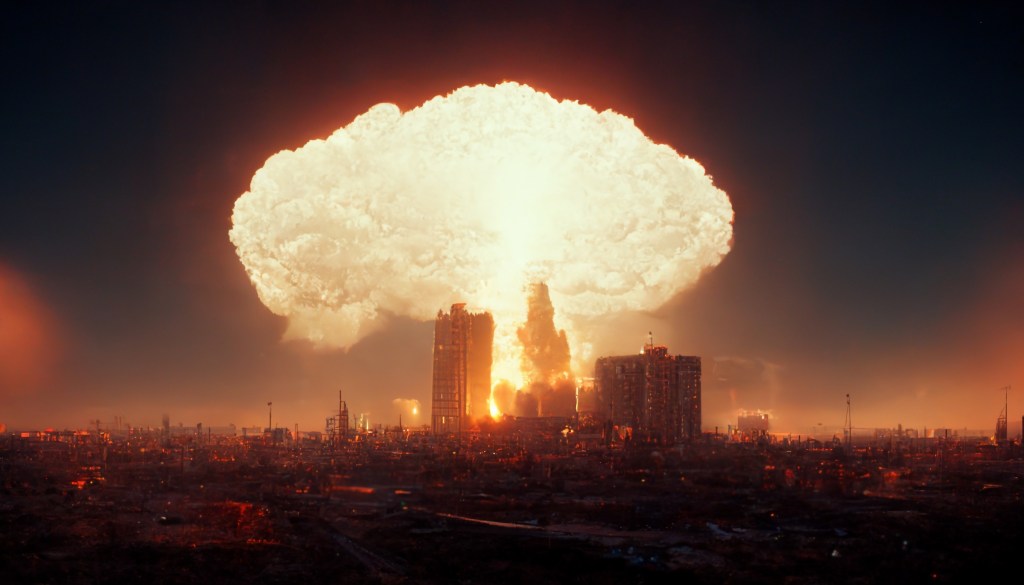
Atomic bomb explosion in a city - nuclear attack on a crowded city – 3D rendering of a mushroom cloud encompassing a city with skyscrapers | We Exploded Thousands of Nuclear Bombs
Nuclear bomb dropped on a big city. Shutterstock, asset id: 2188083835 by CI Photos.

Nuclear Landscaping

It may also come as a surprise that many of these tests were not for military purposes. Another usage for nuclear bombs is nuclear landscaping. Towards the end of the 1950’s the existing Panama Canal was thought to be insufficiently large and some people, including Edward Teller, the father of the Hydrogen bomb (Thermonuclear bomb), suggested that a new wider and deeper canal could be built simply by using nuclear bombs to blow multiple huge holes across Panama. The US was also interested in creating a new harbor in Alaska using nuclear bombs.

Thus, Project Plowshare was created to achieve this. As part of the Project Plowshare 35 nuclear warheads were detonated. The Soviet Union also had a similar program named “Nuclear Explosions for the National Economy” that included 124 nuclear bomb tests. Due to concerns over radioactive fallout the nuclear landscaping projects were eventually put to rest. The last Plowshare detonation was on May 17, 1973. The book Atomic Awakening by James Mahaffey recounts the history of nuclear testing and nuclear landscaping in greater detail.
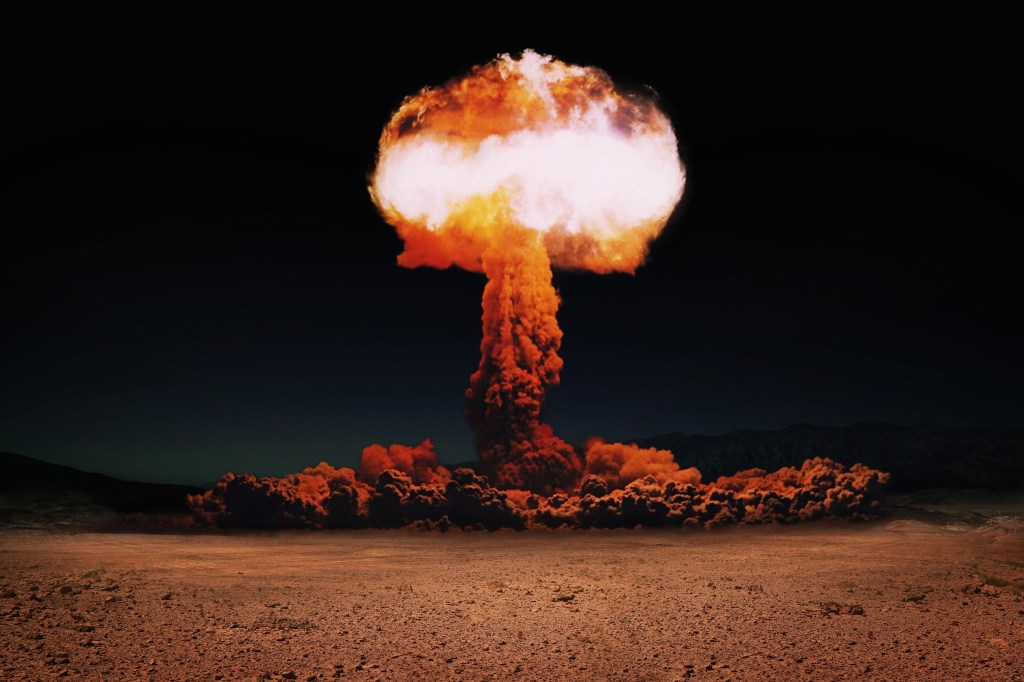
An enormous nuclear bomb explosion in the dessert featuring a huge mushroom cloud.
Hydrogen bomb test by Alones Shutterstock Asset id: 2194195335.

Project Orion

Another non-military use of nuclear bomb testing was Project Orion. Project Orion was a study conducted from 1956 to 1964 by the US Air Force, NASA, and DARPA into the viability of a nuclear pulse spaceship that would be directly propelled by a series of atomic explosions behind the craft. A thick steel pusher plate would catch the blast and accelerate the ship forward.

The “Pascal B” shot in Operation Plumb Bob in 1957 was the first nuclear weapons test of the pusher concept. The Limited Test Ban Treaty of 1963 made it difficult to continue with the project. According to the book Atomic Awakening, if the design had been successfully completed, we could have created an interstellar spaceship that could have taken a crew and a large load to other planets and stars.

I can add that According to Atomic Awakening, in addition to Nuclear Landscaping and Project Orion, Nuclear Blasts were a tourist attraction.

Number of Nuclear Tests by Country

Below is a list of countries and the number of nuclear tests that they’ve performed according to the Arms Control Association and Wikipedia.

  • The United States – 1,030 – According to Wikipedia – 1,032
  • The USSR/Russia – 715 – According to Wikipedia – 727
  • France – 210 – According to Wikipedia – 215
  • United Kingdom – 45 – According to Wikipedia – 88
  • China – 45 – According to Wikipedia – 47
  • North Korea – 6 – According to Wikipedia – 6
  • India – 3 – According to Wikipedia – 3
  • Pakistan – 2- According to Wikipedia – 2

However, it should be noted that partially due to nuclear arms control legislation such as; the Limited Test Ban Treaty (LTBT): Signed in 1963,  the Threshold Test Ban Treaty (TTBT): Signed in 1974, and the Comprehensive Nuclear-Test-Ban Treaty (CTBT) opened for signing in 1996, the number of nuclear tests have been significantly reduced. This is illustrated by the graph below from Our World in Data. The last nuclear test was done by North Korea in 2017.

The histogram graph shows how many nuclear tests took place each year since 1945. The different countries, the portion by each country, the US, USSR/Russia, France, United Kingdom, China, North Korean, India, and Pakistan are colored differently. The histogram shows the 1961 was the year when most nuclear tests took place. The vast majority of the tests took place between 1950 and 1990 | We Exploded Thousands of Nuclear Bombs
Data Source: Arms Control Association (2024). OurWorldInData.org/nuclear weapons.

Tsar Bomba

The biggest nuclear bomb ever exploded was RDS-220, or AN602, or Tsar Bomba. It was detonated by the Soviet Union on October 30th, 1961, on the arctic island of Novaya Zemlya, and yielded more than 50 Megaton. In other words, it was 3,300 times more powerful than the Hiroshima bomb. According to Atomic Awakening, windows in Finland 1,900 kilometers (1,180 miles) away shattered. There are no cities large enough to match the size of the explosion. This is the kind of bomb that could obliterate states or small countries.

Tsar Bomba was a so-called thermonuclear device, or a hydrogen bomb as they are typically called. Hydrogen bombs are much more powerful than fission bombs, such as Uranium bombs or Plutonium bombs. To read my related post called “Ukraine Gave up Thousands of Nuclear Warheads” click here.
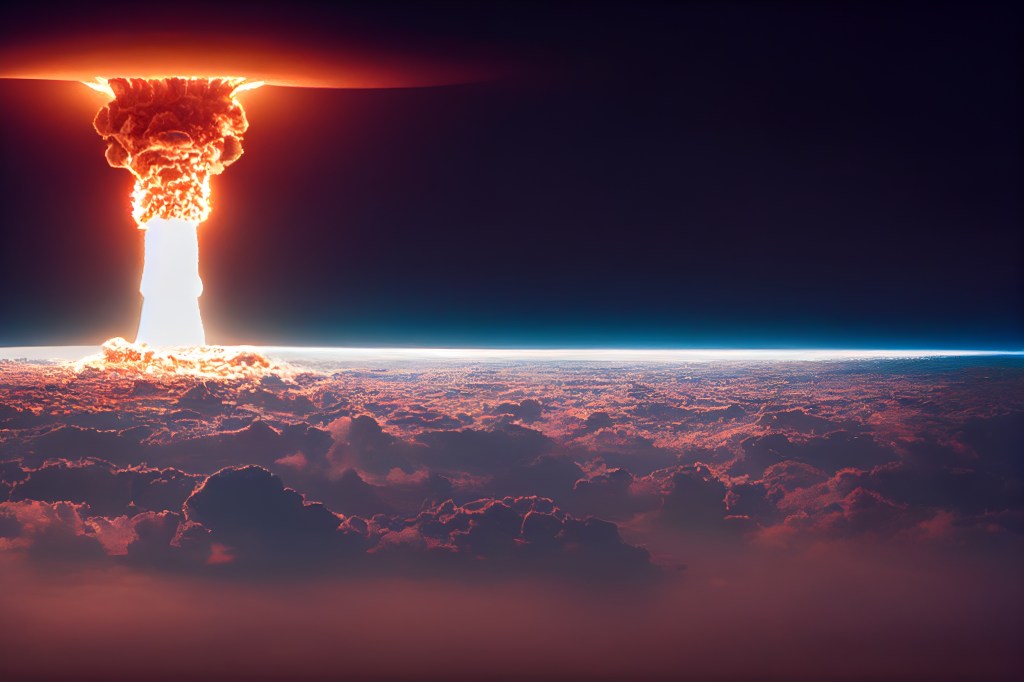
Russian Tsar Bomba mushroom cloud rising high above the clouds. High quality photo realist ( 3d make ) | We Exploded Thousands of Nuclear Bombs
This is an illustration of the Tsar Bomba explosion by by mbafai Shutterstock Asset id: 2208486661. To see a photo of the actual Tsar Bomba explosion click here (it is copyrighted).

Would you pay to watch a Nuclear Bomb Test? (Nuclear Bomb Test Tourism)


To see the other Super Facts click here

Ukraine Gave up Thousands of Nuclear Warheads

Super fact 47 : In 1991, after the dissolution of the Soviet Union, Ukraine became the third largest nuclear power in the world after Russia and the United States. Ukraine held about one third of the former Soviet nuclear weapons and delivery systems. Ukraine agreed to transfer these weapons to Russia for dismantlement in exchange for economic compensation and assurances to respect Ukrainian independence and borders.

After the dissolution of the Soviet Union in 1991, Ukraine inherited an estimated 1,700 to 1,900 strategic nuclear warheads, 130 UR-100N intercontinental ballistic missiles (ICBM) with six warheads each, 46 RT-23 Molodets ICBMs with ten warheads apiece, and an estimated 2,650-4,200 tactical nuclear weapons. It should be noted that these nuclear warheads were not under Ukrainian control.

In 1994, Ukraine agreed to transfer these weapons to Russia for dismantlement in exchange for economic compensation and assurances from Russia, the United States and the United Kingdom to respect Ukrainian independence and sovereignty within its existing borders. These political agreements are referred to as the Budapest Memorandum.

These events are relevant to what is happening in Ukraine today, and yet it is seldom discussed, and many people are unaware of or have forgotten about this history. It also comes as a surprise to many that there are nuclear states who have relinquished their nuclear weapons. This is why I call this fact a super fact.

Atomic bomb explosion in a city - nuclear attack on a crowded city – 3D rendering of a mushroom cloud encompassing a city with skyscrapers.
Nuclear bomb dropped on a big city. Shutterstock, asset id: 2188083835 by CI Photos.

Nine Nuclear States

There are nine nuclear states in the world as of 2025 according to the Federation of Atomic Scientists. There are 12,331 nuclear warheads including 9,600 in active military stockpiles.

  • Russia – 5,449 warheads
  • The United States – 5,277 warheads
  • China – 600 warheads
  • France – 290 warheads
  • United Kingdom – 225 warheads
  • India – 180 warheads
  • Pakistan – 170 warheads
  • Israel – 90 warheads
  • North Korea – 50 warheads

There are also countries that are hosting nuclear warheads owned by other countries.

  • Italy (the United States) – 35 warheads
  • Turkey (the United States) – 20 warheads
  • Belgium (the United States) – 15 warheads
  • Germany (the United States) – 15 warheads
  • Netherlands (the United States) – 15 warheads
  • Belarus (Russia) – ? warheads
Nuclear bomb, chemical weapons, missile defense, a system of salvo fire.
Four missiles aimed at the sky at sunset.  Shutterstock, asset id: 2131803989 by Hamara

Four nations that relinquished their nuclear weapons programs

The four nations that relinquished their nuclear weapons programs are Belarus, Kazakhstan, South Africa, and Ukraine. Belarus, Kazakhstan, and Ukraine returned their inherited nuclear weapons to Russia after the dissolution of the Soviet Union. However, it should be noted that in 2023 Russia began deploying tactical nuclear weapons to Belarus. However, Belarus does not currently possess its own nuclear weapons. South Africa voluntarily dismantled its nuclear weapons program in 1991.

In 2023 Russia began deploying tactical nuclear weapons to Belarus.
Russia and Ukraine as well as the borders of Russia and Ukraine are colored and look different from other countries.
Russia (green) and Ukraine (brown) map on a world map. Ukraine is about the size of Texas. Russia is about twice the area of the United States. Belarus is the country located immediately to the north of Ukraine and Kazakhstan is the big country immediately to the south of Russia and east of Ukraine. Shutterstock Asset id: 2121271067 by buraktumler

How to Build a Nuclear Bomb

This section is just some extra reading that is only somewhat related to the topic. However, since it is an interesting topic somewhat related to the topic I might as well explain how to build a nuclear bomb. Don’t worry I will not present any engineering details, only general principals, which is all I know, and which are already all over internet. Besides if I were to give detailed engineering instructions some peacenik hippie might have a hissing fit and swear in the comment section (that was a joke).

Anyway, the main idea behind a nuclear fission bomb is to achieve a runaway chain reaction. A fusion bomb, or a so-called hydrogen bomb is different. To create a fission bomb you are not looking for the most radioactive materials there are. You are looking for a fuel which you can use to create a runaway chain reaction, and which is also stable enough to make a bomb possible, in other words not too radioactive. Basically, the fuel must be just right. The primary fuels used in fission bombs are uranium-235 and plutonium-239. These isotopes undergo fission when struck by neutrons, releasing a massive amount of energy in a chain reaction.

The image shows a Uranium atom on the left arrows in the middle and an alpha particle, a gamma ray, a proton, a neutron, and an electron on the right | Ukraine Gave up Thousands Nuclear Warheads
Uranium-235 and Uranium-238 are both not very radioactive and can be used for radiometric dating that stretches millions and billions of years. Uranium-235 is also the “just-right” uranium isotope that can be used for bomb making. Shutterstock Vector ID: 2417370135 by grayjay

I should explain, isotopes are different forms of an element. For example, hydrogen comes in three different forms, a nucleus with just a proton, a nucleus with one proton and one neutron (deuterium), and a nucleus with one proton and two neutrons (tritium). Isotopes for the same element are chemically identical but have different atomic weight and they may or may not be radioactive.

The three isotopes of Uranium are uranium-234, uranium-235, and uranium-238. The one we need is uranium-235, which has 92 protons and 143 neutrons in the nucleus. The isotopes of Plutonium include Pu-238, Pu-239, Pu-240, Pu-241, and Pu-242 but there are others. The one we need is plutonium-239, which has 94 protons and 145 neutrons in the nucleus. There are more than 3,500 known isotopes of which 3,000 are radioactive.

During Uranium-235 fission, an average of 2.5 neutrons are released. Specifically, the fission of U-235 typically releases 2 or 3 neutrons, with the average being close to 2.5. During the fission of plutonium-239, an average of 2.9 neutrons are released (depending on the energy of the incident neutron). The important thing for bomb making is that one atom/nucleus releases enough neutrons so that the neutrons from one nucleus cause more than one fission. For example, a nucleus releases three neutrons and two of those neutrons cause two more fission events, which in turn cause four fission events, etc. 2, 4, 8, 16, 32, 64, a trillion…

From left to right : a neutron strikes a uranium nucleus, and it breaks apart into a Krypton and Barium isotope and release three neutrons, which strike three uranium nucleuses, causing three fission events and releasing nine neutrons in total, etc | Ukraine Gave up Thousands Nuclear Warheads
Illustration of nuclear chain reaction. Uranium-235 fission. Unfortunately, the picture has an error in it. It is 92 protons not 95 in a U-235 isotope. – Shutterstock asset id: 73714504 by Mpanchenko.

By putting together enough U-235 you can make it so that one fission event will result in more than one additional fission event. This is called the critical mass. The critical mass for U-235 is 47 kilograms (104 pounds). Theoretically, you can achieve this by taking a 24-kilogram half sphere of U-235 in your right hand and a 24-kilogram half sphere of U-235 in your left hand and bring them together. You will achieve a limited chain reaction for a nano second, but you will just blow the two halves apart and kill yourself, but your city will survive. This is called a fizzle. To make most of the 48-kilogram mass undergo fission you have to force them together long enough for the chain reaction to complete (or almost complete). This requires force and precise calculations. See the illustration below.

A piece of arrow shaped uranium-235 is shot from the left to the right to collide with a larger half-sphere-shaped uranium-235 core thus achieving critical mass forcefully and quickly | Ukraine Gave up Thousands Nuclear Warheads
Components Inside of Uranium Nuclear Fission Bomb illustration – Shutterstock asset id: 2271462995 by BlueRingMedia.

Another difficulty is obtaining nearly 100% U-235 from natural uranium. 99% of the Uranium you find in nature is U-238. U-235 and U-238 chemically identical so extracting U-235 from natural uranium is difficult. However, U-235 is slightly lighter than U-238 so you can use centrifugal separation as you do to separate cream from milk. What is typically done is using a uranium compound, uranium hexafluoride, heat it into gaseous form and then utilize centrifugal separation to extract the uranium hexafluoride with U-235 isotopes. After that you can chemically extract the uranium, which is now U-235.

To see the other Super Facts click here