The Little Book of Cosmology

Cosmology is the science of the origin and development of the universe, and this post is about a book on Cosmology, The Little Book of Cosmology by Lyman Page. This is a big and, in my opinion, interesting topic. A lot of cosmology is speculative, multiverses, what was before the big bang, has the universe always existed, has there been an infinite number of big bangs, what about conformal cyclic cosmology in which each cycle result in a new big bang (Roger Penrose), what is the future and end of the universe, is the Universe a hologram, is it self-aware, etc.

This book is not focused on scientific speculation but on what we know about the structure of the universe, the big bang and the expansion of the universe, the well understood basics. I think it is amazing how much we can learn from the Cosmic Microwave Background Radiation (CMB).

The goal of this blog is to create a list of what I call super facts. Important facts that we know to be true and yet they are surprising, shocking or disputed among non-experts. Super facts are special facts that a well-informed person may want to know. However, I sometimes create posts that are not super facts but just interesting information, such as this one. The Little Book of Cosmology is a relatively short and easy read. I bought the hardback version of it.

  • Hardcover –  Publisher : Princeton University Press; First Edition (April 7, 2020), ISBN-10 : 0691195781, ISBN-13 : 978-0691195780, 152 pages, item weight : 2.31 pounds, dimensions : 5.59 x 0.79 x 8.58 inches, it costs $15.39 on Amazon. Click here to order it from Amazon.com.
  • Kindle –  Publisher : Princeton University Press (April 7, 2020), ASIN : B07Z1DWB4P, 132 pages, it costs $9.99 on US Amazon. Click here to order it from Amazon.com.
The front cover features the title, the author, and geodesic lines forming a hyperbolic cone mesh | The Little Book of Cosmology by Lyman Page
Front cover of The Little Book of Cosmology. Click on the image to go to the Amazon page for the hardcover version of the book.

Amazon’s description of The Little Book of Cosmology by Lyman Page

The cutting-edge science that is taking the measure of the universe

The Little Book of Cosmology provides a breathtaking look at our universe on the grandest scales imaginable. Written by one of the world’s leading experimental cosmologists, this short but deeply insightful book describes what scientists are revealing through precise measurements of the faint thermal afterglow of the Big Bang—known as the cosmic microwave background, or CMB—and how their findings are transforming our view of the cosmos.

Blending the latest findings in cosmology with essential concepts from physics, Lyman Page first helps readers to grasp the sheer enormity of the universe, explaining how to understand the history of its formation and evolution in space and time. Then he sheds light on how spatial variations in the CMB formed, how they reveal the age, size, and geometry of the universe, and how they offer a blueprint for the formation of cosmic structure.

Not only does Page explain current observations and measurements, he describes how they can be woven together into a unified picture to form the Standard Model of Cosmology. Yet much remains unknown, and this incisive book also describes the search for ever deeper knowledge at the field’s frontiers—from quests to understand the nature of neutrinos and dark energy to investigations into the physics of the very early universe.

This is my five star review for The Little Book of Cosmology

What the Cosmic Microwave Background (CMB) can tell us

This is a short book describing the evolution of the Universe since the Big Bang and its composition. How do we know all this stuff? The Cosmic Microwave Background (CMB) can tell us a lot.

The CMB is a black body radiation remnant from the time (400,000 years after the Big Bang) when the Universe had cooled enough to allow the formation of hydrogen atoms and the decoupling of photons from electrons so that they could roam free.

CMB is in itself evidence for the Big Bang but in addition we get additional information from the minor anisotropy and polarization of the CMB, and add the composition of the elements (hydrogen, helium, lithium, and heavier elements), redshifts of galaxies, gravity lensing, and we can tell quite a bit about the evolution of the Universe and where it is heading.

It’s fascinating science detective work. This eventually leads to the Standard Model of Cosmology, which is something I’ve never heard of before, but it’s cool.

I found the facts about the size and age of the Universe, the early giant stars in the Universe, dark energy and dark matter, very interesting. The book is filled with basic and fascinating facts that I did not know. Because of the CMB (rather than particle accelerator experiments) we know roughly the mass (rest mass) of neutrinos.

We know why dark energy can’t be space dust, or rogue planetoids, or black holes or neutrinos, so what is it? The book explains why it can’t be any of those. There’s a lot we can know because of the CMB and other information, and some things we don’t know. Finding out what we do know was quite exciting and finding out what the mysterious “what we don’t know” was equally exciting. Again, the focus is on CMB and how it is measured, it tells us a lot.

The book is easy to read and require no degree in physics or mathematics. I admit I have a degree in Engineering Physics, and I am also interested in astronomy and cosmology, but I can tell it was light reading. It is a truly popular science book like those that Neil De Grasse Tyson writes, and it was short but very informative. There’s a lot of information you can extract from CMB. It was a fun short read for anyone interested in the mysteries of the Universe.
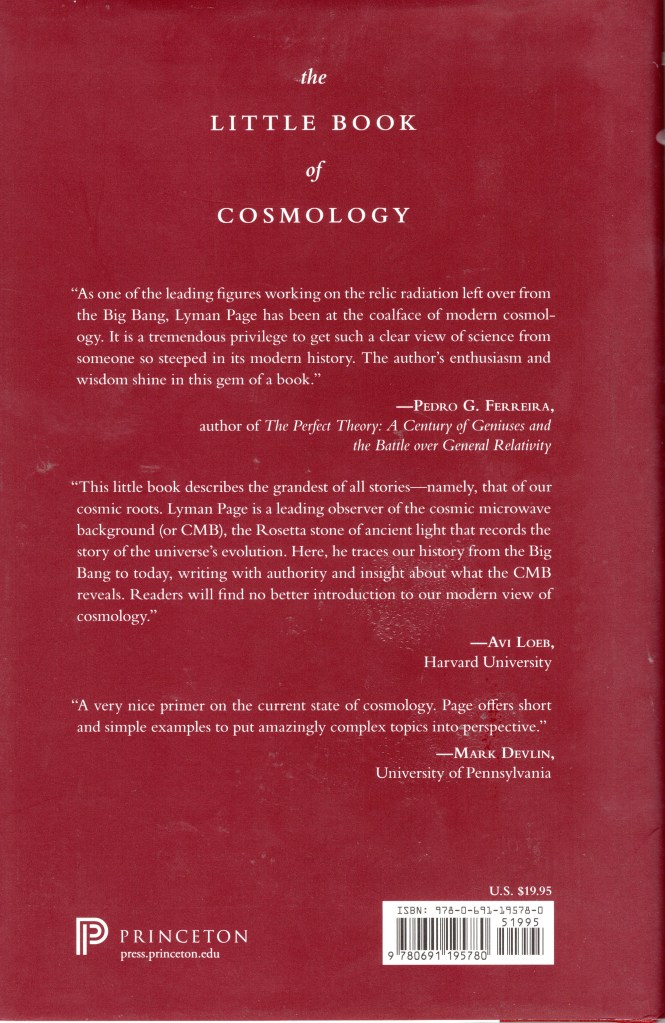
The back cover feature advanced praise for the book | The Little Book of Cosmology by Lyman Page
Back cover of The Little Book of Cosmology. Click on the image to go to the Amazon page for the kindle version of the book.

To see the Super Facts click here


Examples of the Dunning Kruger Effect

The goal of this blog is to create a list of what I call super facts, but this is not a super-fact post. I sometimes create posts that are not super fact posts but related to this goal as well as other factual posts, and this is one of those. This post is about the Dunning–Kruger effect. The Dunning–Kruger effect is a cognitive bias in which people with limited competence in a particular domain overestimate their abilities. Those who are incompetent in a given area tend to be ignorant of their incompetence. What is so interesting about this effect is how widespread it is and how extreme it can get.

Some extreme examples include people without much knowledge in a given field lecturing the experts in the field, people without experience or much knowledge in an area telling the professionals in the field how to do their job. It includes people insisting on absurd claims despite not understanding the topic. It includes people dismissing scientific consensus on a topic without having much knowledge about that topic. It includes managers lacking engineering experience refusing to listen to the engineers, etc.

We are all occasional victims of the Dunning–Kruger effect. The problem comes when the one with the lower ability is stubborn and unreasonable and does not attempt to understand what the better-informed person is saying. Sometimes the situation becomes absurd. Below I am listing a few interesting cases, starting with a time when I was the ignorant one.

Creationism Bamboozled Me

When I was a teenager, I read creationist books that claimed that evolution was a hoax, and that earth was likely 6,000 years old. This is still a very common belief here in the US. These books appeared to me to be very convincing, and I took it upon myself to spread the word and correct the misconceptions. I was good at science and math, but this was before I had studied biology and physics in depth. I was accepted into the “Natur / Natural Science” Highschool program (similar to taking all AP Science classes) and I later studied physics in college.

As a result of what I learned I came to realize that the creationism I had come to embrace was bunk. The young earth claims and the anti-evolution rhetoric was not tenable. I realized this not by reading counter creationist books; I was just learning about the science. Understanding some science made all the difference. I just never knew how much I was missing. It was a lot. To read more about this click here and here. One more thing I learned is that you should avoid science related books written by lawyers and theologians with agendas. It is not their field and they don’t know what they are misunderstanding.

A photo of a trilobite fossil.
The fossil record is a lot more solid and much less problematic than the creationist books I had read claimed. Shutter Stock Photo ID: 1323000239 by Alizada Studios

Entropy and Evolution

Related to this is the myth that entropy contradicts evolution. Entropy is the measure of a system’s thermal energy per unit temperature that is unavailable for doing useful work. It is also the measure of the number of possible microscopic arrangements or states of individual atoms and molecules of a system that comply with the macroscopic condition of the system. These two definitions are identical.

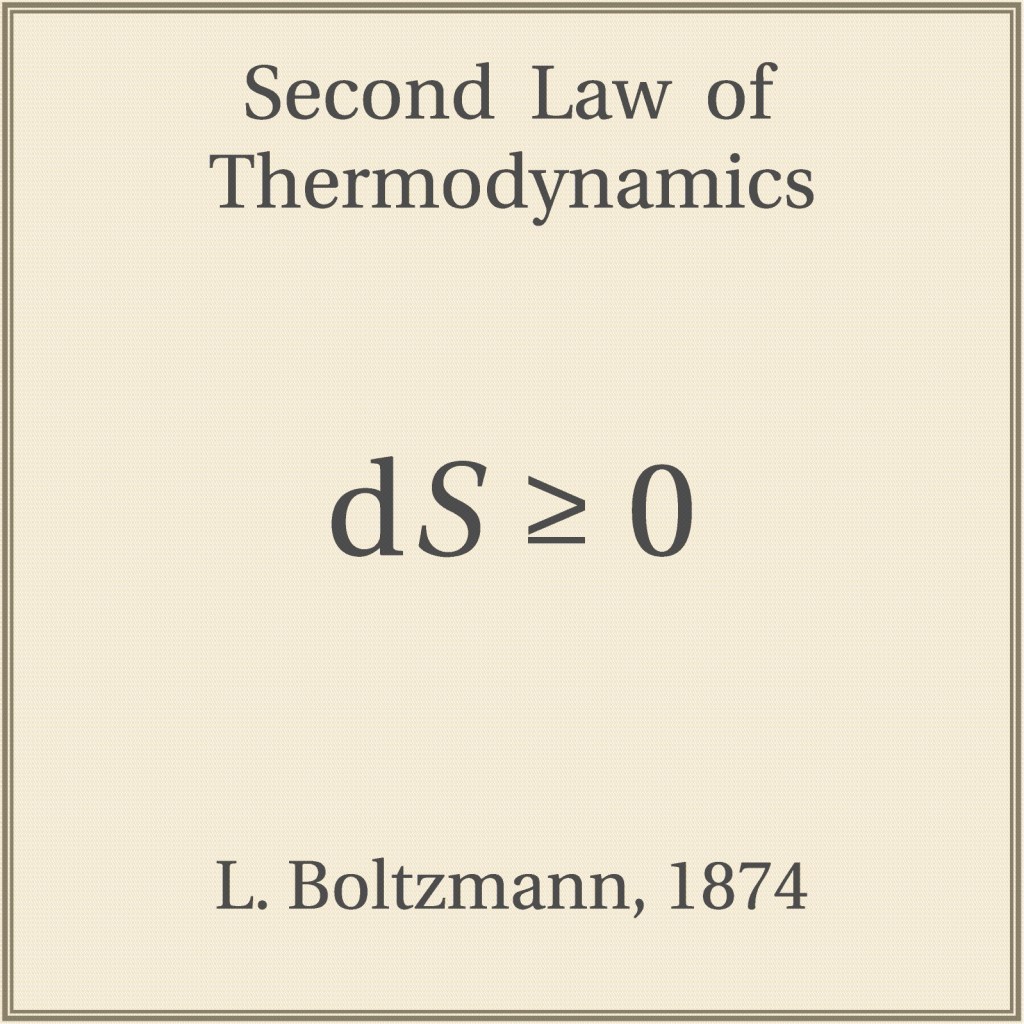
The formula is S = K * ln (W), where S is entropy, K is Boltzmann’s constant, and W is the number of microstates whose energy equals to the one of the system. Entropy is said to be the amount of disorder in a system, but in this context “disorder” may not correspond exactly to what people mean by disorder. Anyway, the issue is the second law of thermodynamics, which states that the entropy of an isolated system left to spontaneous evolution cannot decrease with time.

The creationists like to say that evolution decreases disorder in the biosphere and therefore contradicts the second law of thermodynamics.

Ludwig Boltzmann’s formula from 1874 | Examples of the Dunning Kruger Effect
Second law of thermodynamics Shutter Stock Vector ID: 2342031619 by Sasha701

If you take a college level class in thermodynamics you will realize within half an hour that this creationist / anti-evolution claim is false. The most important point being that evolution does not occur within an isolated system.

First of all, the earth, the biosphere, plants and animals receive energy from the outside, the sun for starters. Whether evolution decreases disorder in the biosphere or not, the claim fails instantly on the point that the system is not closed.

Despite decades and even centuries of conclusive debunking many people continue to make the false claim that the second law of thermodynamics and evolution are incompatible. There are people writing to prominent physicists and lecturing them and mocking them for “not knowing” that the second law of thermodynamics and evolution are incompatible. Typically, people who know almost nothing about the subject. They know too little to realize that their arguments are absurd.

The awkward algorithm

One day the engineering manager at my job at Siemens asked me and another guy to do research on how a certain process might improve our system. It was the CEO of the company (he was not an engineer) who was requesting this.

However, it was instantly obvious to me that this process was not compatible with what we were doing. Before, I had opened my mouth, the engineering manager told me “Thomas I know what you are going to say. This process is not applicable to what we are doing, but the CEO just learned about this process, and he is very excited about it. Just pretend to work on it for a few weeks and then write a report about why it did not work out. This is easier than explaining to the CEO why it wouldn’t work.”

Isotopes are real

On one occasion I was arguing on Facebook with an acquaintance regarding whether the current rapid Global Warming trend was natural or not. He said it was natural, and he insisted that he knew a lot about the science. I knew that he did not have a college level science degree, and it was obvious from what he said that he did not understand the science behind climate change.

One of the pieces of evidence I mentioned to him was that isotope studies showed that the carbon dioxide in the atmosphere originated from our burning of fossil fuels. That was when he said that the atoms of a certain element were all identical. There was no such thing as isotopes. He accused me of fabricating the existence of isotopes.

The picture shows a Carbon-12 isotope, a Carbon-13 isotope, and a Carbon-14 isotope
Three natural isotopes of carbon Stock Vector ID: 2063998442 by zizou7

I posted a research article of one isotope study (carbon-12/carbon-13/carbon-14) and an article from Wikipedia on isotopes. Wikipedia isn’t an academically acceptable source, but it featured a good introduction.

He focused on the fact that Wikipedia articles are not always entirely accurate and used it as a reason to dismiss everything I said about isotopes. I was surprised he had never heard of Carbon-14. Isotopes is well known high school science and there are thousands of articles about it on the internet. He just didn’t know anything about this basic fact. He started insulting and mocking me perhaps because he felt I was lecturing him, but how would I have handled this? He knew too little about the subject to realize how much he was missing.

The Current Global Warming is not natural

Nearly all climate scientists say the same thing, Global Warming / Climate Change is real, and it is us. Just because the climate has changed for natural reasons in the past does not mean that is the case now. The same people who told us about the natural variability of climate in the past are the ones telling us it is not natural now. We should listen.

It is not orbital cycles, not the sun, not volcanoes, not bacteria or other lifeforms, and not cosmic radiation, it is us, primarily because of emissions from fossil fuels. The paleoclimatologists and the climate scientists and atmospheric physicists are telling us that it is not natural because of the quite substantial and solid evidence. Yet a very substantial proportion of us insist that it is natural causes without knowing much about the evidence. Why? Because they know too little about the evidence to consider it. The Dunning-Kruger effect again. BTW I will make a more detailed post about this in the future.

Wind Power Myths

Wind power has been on the receiving end of false claims, nonsense, and strange rumors for a while. It is not the only energy source that is a victim of widespread falsehoods, but it is a considerable problem. One false claim is that wind power requires an additional power source to operate (such as a companion diesel engine).

Another false claim  is that wind power generates less power than it consumes, and yet another false claim is that wind power causes cancer. These claims are absurd and no one with basic insights in engineering and science would know they are false, yet many people fall for them. The people who fall for these claims think they know more than others, not less. Dunning-Kruger again. I am discussing nonsense and rumors about wind power here.

Examples of the Dunning Kruger Effect
Photo by Sam Forson on Pexels.com

Well, that is long enough, but I can certainly list many more examples. My own Dunning-Kruger moments as well as those of others.


To see the Super Facts click here


Astronomer

Daily writing prompt
What alternative career paths have you considered or are interested in?

So I am trying out the Daily writing prompt for the first time, answering the question “What alternative career paths have you considered or are interested in?”.

I’ve always been interested in astronomy and astrophysics, and I studied engineering physics, later electrical engineering. I did not think astronomer or astrophysicist was an easily attainable career and perhaps not very well paid either, but I think it would have been a fun job to have.

Astronomer
Photo by Lucas Pezeta on Pexels.com

Celestron Powerseeker 70EQ

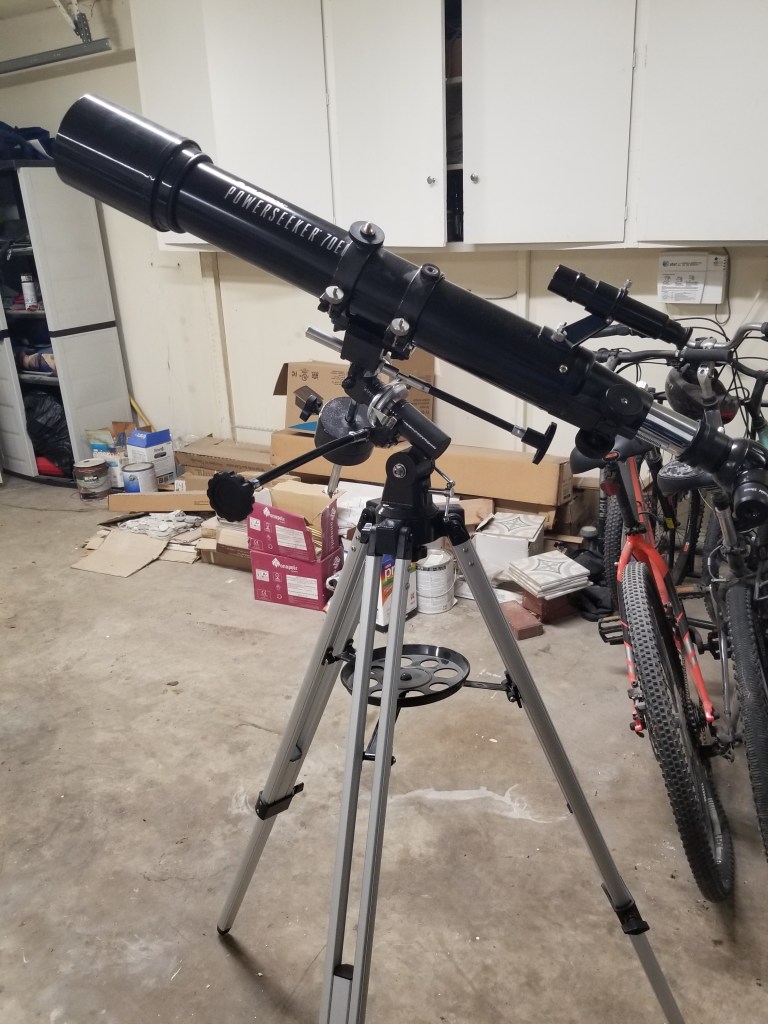
I am a bit of an amateur astronomer, and I own a basic telescope for amateurs, a Celestron Powerseeker 70EQ. It is not a great telescope, but it is good enough for observing objects such as Saturn and its rings, Jupiter and its four Galilean moons, Mars, Venus (the crescent), the moon and its craters. Those objects you can see from inside a big city like Dallas. Naturally you can do much better if you leave the city and especially if you visit a dark spot. I am a member of TAS, Texas Astronomical Society and they own a dark spot in Oklahoma. Below is a photo of my Celestron Powerseeker 70EQ standing in my garage.

Black Telescope standing in front of bicycles in a garage
Celestron Powerseeker 70EQ

What Does an Astronomer Do?

Astronomers study the universe, including galaxies, stars, planets, and other celestial objects, using telescopes and other instruments to observe and analyze them. They observe and analyze celestial objects. Depending on their specific area, astronomers have different duties.

  • They observe celestial objects using telescopes.
  • They conduct research, analyze data and test hypothesis.
  • They use and develop models including complex mathematical models and computer simulations to understand complex astrophysical phenomena.
  • They collaborate with peers, they teach, and they do mentoring and public outreach.

Types of Astronomers

  • Observational Astronomers use telescopes and other observational instruments to collect data from celestial objects.
  • Theoretical Astrophysicists use mathematical models and computer simulations to understand the physical processes in the universe. They may study stellar evolution, galaxy formation, cosmology, and black holes.
  • Planetary Scientists study planets, moons, and other objects within our solar system. They use data collected by space missions, telescopes, and remote sensing techniques.
  • Stellar Astronomers study stars, their properties, and their life cycles. They may study variable stars, binary star systems, massive stars, stellar remnants such as white dwarfs, neutron stars, or black holes.
  • Galaxies and Cosmology researchers study galaxies and the large-scale structures in the universe.
  • Radio Astronomers study celestial objects using radio waves instead of visible light. They may study radio galaxies, cosmic microwave background radiation, and the structure of the Milky Way.
  • Exoplanet Astronomers study and discover planets orbiting stars outside our solar system. They use techniques such as transit photometry and radial velocity measurements to detect and characterize exoplanets.

Famous Astronomers

  • Nicolaus Copernicus 1473–1543, discovered the heliocentric model putting the sun at the center of our solar system.
  • Johannes Kepler 1571–1630, revolutionized our understanding of how planets orbit the Sun. He used the Copernicus heliocentric model and very careful measurements to show that the planets moved in elliptical orbits around the sun and he came with additional laws to describe the speed of the planets in their orbits.
  • Galileo Galilei, 1564–1642, or Galileo di Vincenzo Bonaiuti de’ Galilei, was an Italian astronomer, physicist and engineer who greatly improved the optical telescope and discovered the four primary moons of Jupiter and the rings of Jupiter. He proved that all falling bodies fall at the same rate, regardless of mass, and developed the first pendulum clock. He got in trouble for defending Nikolai Copernicus idea.
  • Edmund Halley, 1656–1742,  investigated and discovered many things including the nature of comets’ orbits.
  • Edwin Powell Hubble, United States, 1889–1953. Hubble proved that many objects previously thought to be clouds of dust and gas and classified as “nebulae” were galaxies beyond the Milky Way. He showed that these galaxies were moving away from us and each other leading to the conclusion that the universe was expanding.
  • Vera Rubin, 1928–2016,  studied the rotation of galaxies and uncovered the discrepancy between the predicted and observed angular motion. This led to the discovery of dark matter.

What about you? What alternative career paths have you considered or are interested in?


To see the Super Facts click here