Electric Charge is not the only type of Fundamental Charge

Super fact 59 : Most people have heard of electrical charges, positive and negative. However, in nature there are also color charges—red, green, and blue—which are analogous to electric charges. In addition, there are anti-red, anti-green, and anti-blue charges.

Esther’s writing prompt: 10th September : Charge

Click here or here  to join in.

As you may know, atoms consist of particles. Electrons surround the nucleus of the atom. The nucleus of the atom is in the middle of the atom and it consists of protons and neutrons. Electrons have a negative charge. Protons have a positive charge. Neutrons do not have an electrical charge. Electrons are so called elementary particles. They are not composed of other particles. Protons and Neutrons, on the other hand, are not elementary particles. They are composite particles consisting of quarks, gluons and quark pairs called mesons.

The picture shows a Hydrogen atom consisting of one proton and one electron, one Carbon atom with six electrons, six protons and six neutrons, an Oxygen atom with eight electrons, eight protons and eight neutrons, and a Nitrogen atom with seven electrons, seven protons and seven neutrons | Electric Charge is not the only type of Fundamental Charge
Four elements with a nucleus and electron shells. The number of electrons, protons, and neutrons is shown. The green particles circling the nucleus are electrons. The red particles in the nucleus (middle) are protons and the blue particles in the nucleus are neutrons. The colors of the particles in this picture have nothing to do with color charges. The four elements are Hydrogen, Carbon, Oxygen, and Nitrogen. There are 118 elements. These elements can combine into millions of different kinds of molecules that make up everything. Asset id: 1555863596 by OSweetNature.

Quarks have electric charges, just like an electron and a positron, which is why a proton has an electric charge, a positive electric charge. However, in addition quarks have something called color charge. Unlike electric charges, which come in two forms, negative and positive, they come in three forms red, green and blue and in anti-red, anti-green, and anti-blue (well six forms actually). I should say that the color charges, red, green and blue, are not real colors. They are just names. Just electric charges are associated with electric forces; color charges are associated with the nuclear strong force. The strong force is even stronger than the electrical force.

If you take an equal amount of positive and negative electric charges you get something that is electrically neutral. If you take an equal amount of red, green and blue you get what is called white, or neutral. If you take an equal amount of red and anti-red you also get white. Any other mix gives you a net color charge.

vector illustration of up and down quarks in proton and neutron on white background. The proton (left) is a red and blue up quark and a green down quark. The neutron is a red and green down quark and a blue up-quark.
The proton and neutron each consist of three quarks. Protons consist of two up quarks and one down quark. Neutrons consist of two down quarks and one up quark. Both protons and neutrons have a net white charge. The yellow squiggly lines are gluons transporting color charge between the quarks. Asset id: 2333679305 by KRPD.

I can add that gluons are elementary particles that in many respects are like photons. Light consists of photons. It is because of the photons that we can see. In addition, the photons transport electrical charge. Photons are massless elementary particles with the intrinsic spin of one, and they belong to a group of elementary particles called Bosons. Gluons transport color charge, and they are massless and have an intrinsic spin of one and belong to the same group of elementary particles called Bosons. Unlike photons, they are stuck inside the nucleus and unlike photons they never get to see the light of day. The pun was intended.

Matter, light, and electrical charges are all part of our daily life. We can touch matter, see light, and we come across electrical charge when we touch something that is charged or when we see lightning. However, we do not come across quarks, gluons, and color charges in our daily life because they are hidden at the center of the atoms. Yet they are fundamental to the existence of matter, of us. We know color charges exist, the existence of color charges is an important fact, and yet it is not a well-known fact and often a big surprise to people. Therefore, I think it is a super fact.

The 118 Elements and the 3,500 Isotopes

There are 118 known elements. Why not 500, or just 4 or 5, like the ancient Greeks believed? Each element is defined by it having a certain number of protons and the same number of electrons if it is to be electrically neutral. The problem with having more than one proton in the nucleus is that protons all carry a positive charge and therefore want to push each other away. Same charges repel and different charges attract. What saves the nucleus from blowing apart are the neutrons and the associated strong nuclear force (protons & neutrons) which is guided by the color charges. The quantum model for electricity is called Quantum electrodynamics or QED. The quantum model for color charges is called Quantum chromodynamics or QCD.

As you add more protons it becomes increasingly more difficult for the nuclear forces (strong and weak) to hold the nucleus together. The positive charge of the protons is pushing too hard. That’s why there are only 118 Elements. Another thing to note is that the number of neutrons does not have to be the same as the number of protons. This means that for each element there are several kinds of so-called isotopes. For example, carbon has six protons and six electrons (if the atom is electrically neutral) but the carbon atom / element can have six neutrons, seven neutrons, or eight neutrons. You call them carbon-12, carbon-13, and carbon-14, where the number represents the number of protons plus the number of neutrons.

The picture shows a Carbon-12 isotope, a Carbon-13 isotope, and a Carbon-14 isotope | Electric Charge is not the only type of Fundamental Charge
Three natural isotopes of Carbon Stock Vector ID: 2063998442 by zizou7
Bohr model representation of the uranium atom, number 92 and symbol U. Conceptual vector illustration of uranium-238 isotope atom, mass number 238 and electron configuration 2, 8, 18, 32, 21, 9, 2.
This is a simplified Bohr model of the Uranium atom. There are 92 little blue balls circling a nucleus in the middle of the atom. Those are electrons. In the nucleus there are 92 protons. Those are the red balls with plus signs. In addition, there is a yellowish smudge around the protons in the nucleus. Those are the neutrons. Depending on the isotope, there are 143 neutrons for U-235, 146 neutrons for U-238 and 142 neutrons for U-234. Shutterstock asset id: 1999370450 by Patricia F. Carvalho

It is the electrons that determine the chemical properties of an element, and therefore isotopes with a different amount of neutrons are chemically identical. However, they are different with respect to properties that relate to he nucleus, such as radioactivity/stability, and of course weight. Also, when atoms combine into molecules their chemical properties change drastically, but again that is due to the rearrangement of the electrons. There are around 3,500 known isotopes, most of them radioactive.

What is a Quark?

To learn more about Protons, Neutrons, Quarks, Gluons, Color Charges, and Quantum Chromodynamics you can watch this 10 minute video below.

Other Physics Related Superfacts


To see the other Super Facts click here

Science Books for Babies

I think that one of the most interesting series science books for beginners that I’ve come across is the Baby University series. I bought it for our soon to be born first grandchild Jack, but I couldn’t help but go through them myself. It is a great series for those who hope to put their one-year-old toddlers in a PhD program. But seriously, these books explain science concepts as simply as it is possible to do. The books may still be a little bit tough for babies, but I think 2–3-year-olds might get something out of them. The point of the books is not to make young children understand complex scientific concepts but to introduce the vocabulary and build curiosity.

Below I am presenting five books in the series, General Relativity for Babies, Electromagnetism for Babies, Artificial Intelligence for Babies, Quantum Physics for Babies, and Organic Chemistry for Babies. I am providing my review for the book and a link to my review as well as the book and a photo of the front cover.

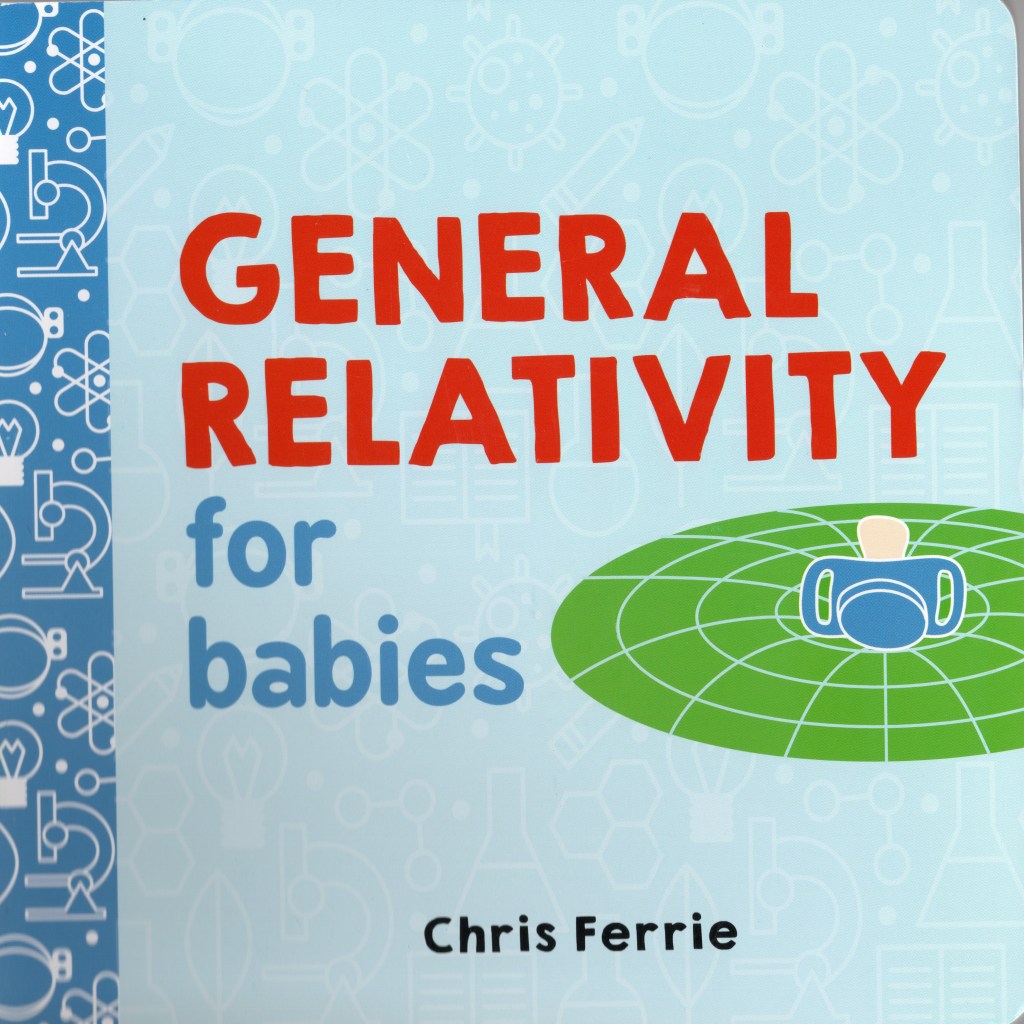
General Relativity for Babies

The front cover of General Relativity for Babies is light blue and features the title, author (Chris Ferrie) and a green illustration of warped space | Science Books for Babies
Front cover of General relativity for Babies.

This is the Amazon link for General Relativity for Babies.

My Review for General Relativity for Babies

General Relativity as Simplified as Possible

We bought this board book for our not yet born grandson. This book simplifies the General Theory of Relativity as far as you possibly can. It uses simple language and colorful illustrations to give the reader an idea of what is going on. Different sized masses are different sized balls, space-time curvature is illustrated using a distorted grid, and objects orbiting larger masses, such as a star, are shown as small balls having their paths curved by a warped grid. There are simple explanations for what a black hole is and what gravity waves are.

A baby would not understand this book but maybe someone who is 3-4 years old would. But your expectations need to be realistic. It should also be noted that even if you understand the book, the explanations are too simplistic for you to really understand General Relativity, but the explanations are not so simple that they are wrong. The book will just give you an idea of what is going on. However, I was impressed by the fact that the author and illustrator were able to present such an abstract theory in a way that makes it possible for a child to at least have a clue. I think that the most important aspect of the book is not whether the child understands General Relativity but the interest in science that it may evoke.

Electromagnetism for Babies

The front cover of Electromagnetism for Babies is light green and features the title, author (Chris Ferrie) and a light blue illustration of a binky surrounded by a field.
Front cover of Electromagnetism for Babies.

This is the Amazon link for Electromagnetism for Babies.

My Review for Electromagnetism for Babies

Electromagnetism Simplified for Young Children

We bought this short and colorfully illustrated board book for our not yet born grandson. I don’t think a baby will understand it but maybe when he is 2-3 years old. The book explains in simple terms and with colorful simple illustrations the basic concepts of charges, and attraction between negative and positive charges, and repulsion between two positive balls/charges and two negative balls. It explains about electrical and magnetic fields, and the fact that charges rotate around magnets. I believe this book can spur a child’s interest in science and engineering.

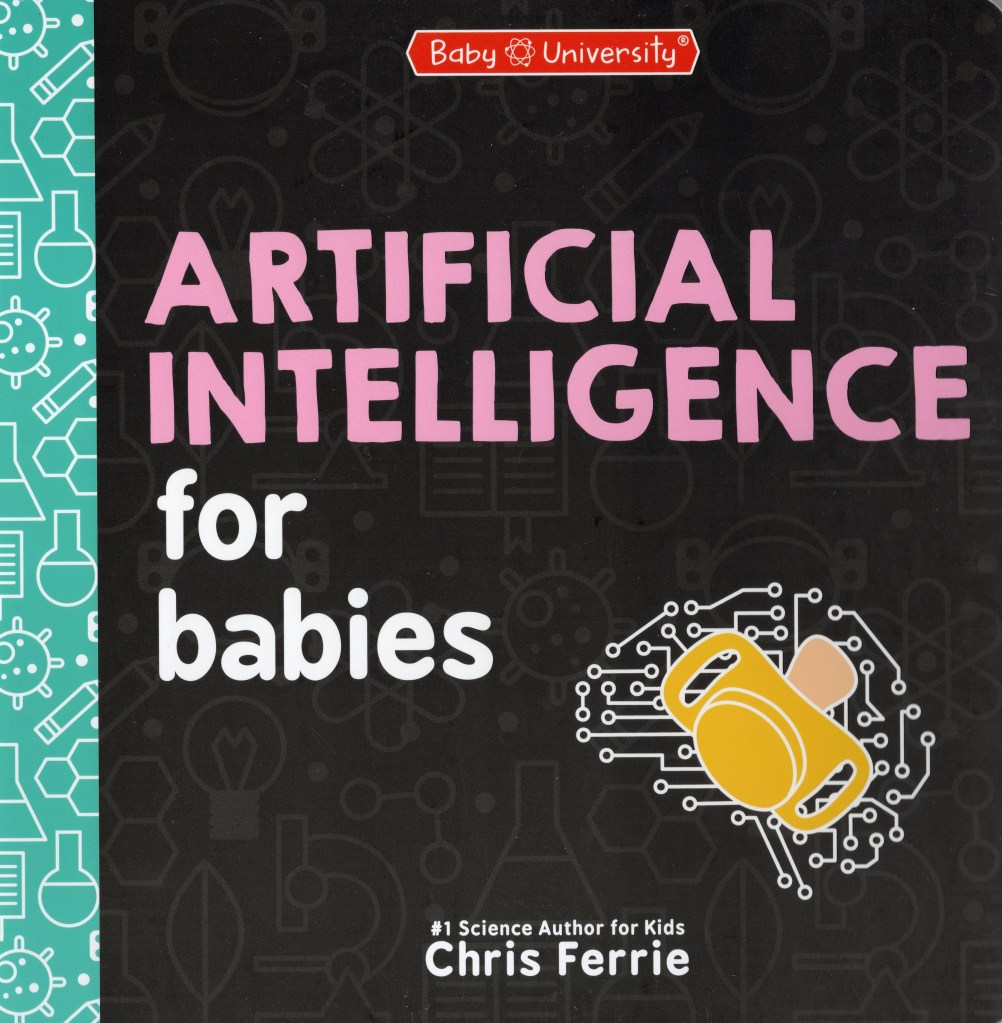
Artificial Intelligence for babies

The front cover of Artificial Intelligence for babies is black and features the title, author (Chris Ferrie) and an illustration of a binky surrounded by an electronic network | Science Books for Babies
Front cover of Artificial Intelligence for babies.

This is the Amazon link for Artificial Intelligence for babies.

My Review for Artificial Intelligence for babies

Artificial Intelligence for Small Children

We bought this board book for our not yet born grandson. He will not be able to understand it until he is at least one years old, but that is OK. The book explains the difference between a dog, a live thing, and a computer. It does this in very simple terms that I believe a young child could understand. According to the book, a computer can do some things that are impressive, such as complex calculations, and you can teach it certain skills, but it is not adaptable like a dog. I think that is about what you can make a very young child understand. Naturally, there are no neural networks or AI algorithms in the book. However, I think it sells artificial intelligence short, since artificial intelligence is becoming increasingly adaptable.

Quantum Physics for babies

The front cover of Quantum Physics for babies is yellow and features the title, author (Chris Ferrie) and an illustration of a simplified Bohr Model of the Atom with a binky as a nucleus.
Front cover of Quantum Physics for babies.

This is the Amazon link for Quantum Physics for babies.

My Review for Quantum Physics for babies

Quantum Physics for Young Children and Adults who Detested Physics Class

We bought this board book for our not yet born grandson. We may need to wait until he is 2-3 years old before it makes sense to read it to him. In the meantime, it is also a good book for adults without a solid science education. The book talks about colorful balls with energy and presents a simplified version of the Bohr model of the atom. There are blue balls called electrons and red balls called protons in the middle (the nucleus). The electrons travel in circular orbits around the middle. Light can change the energy of electrons causing them to jump between the orbits.

My daughter made the comment that a baby is only going to understand that an electron is a blue ball and a proton is a red ball, which isn’t a correct description of electrons and protons. Protons and electrons don’t have specific colors, not to mention that a simplified Bohr model for the atom is quite different from the more realistic Schrödinger’s model of the atom with quantum waves and probabilistic electron clouds. However, I am still very impressed by how simple the author and the illustrator succeeded in making this abstract topic. It is a good start for budding physicists.

Organic Chemistry for babies

The front cover of Organic Chemistry for babies is red and features the title, author (Chris Ferrie and Cara Florance) and an illustration of a benzene ring made from binkies | Science Books for Babies
Front cover of Organic Chemistry for babies.

This is the Amazon link for Organic Chemistry for babies.

My Review for Organic Chemistry for babies

Your First Book on Organic Chemistry

We bought this board book for our not yet born grandson. We will read it to him when he is 1-3 years old. Right now, we can read it. This book simplifies Organic as far as you possibly can. It uses simple language and colorful illustrations to give the reader an idea of what organic chemistry is. Basically, atoms are balls of different kinds. Atoms make up everything. Atoms can stick to each other, and they can make different shapes. The balls we call carbon (in black) can stick to small white balls called hydrogen and other balls called oxygen. We call those organic molecules, and they make up plants, food, and medicines. I think this is simple enough for a 1–3-year-old to understand, but not a baby. In my opinion, a better name for this series would have been “for Big Boys or Girls” rather than babies, because young children don’t like being called babies.


To watch a woman read Quantum Physics for Babies. Click on the YouTube video below.


To see the Super Facts click here