More Science Books for Babies

This is my second and last post covering books from the Baby University series. There are 44 of them. I think the Baby University series books are quite interesting for children. They may not really be for babies, but they appear to me to be great for young children. The point of the books is not to make young children understand complex scientific concepts but to introduce them to scientific vocabulary and build their curiosity. We bought 10 of these books for our soon to be born first grandchild (due date September 17). We also bought other books for him. If you want to see my post for the five first books, click here.

Below I am presenting five books in the series, Evolution for Babies, Nuclear Physics for Babies, Astrophysics for Babies, Quantum Entanglement for Babies, and Newtonian Physics for Babies. For each of the books I am providing my review for the book and a link to my review as well as a link to the book on Amazon and a photo of the front cover.

Evolution for Babies
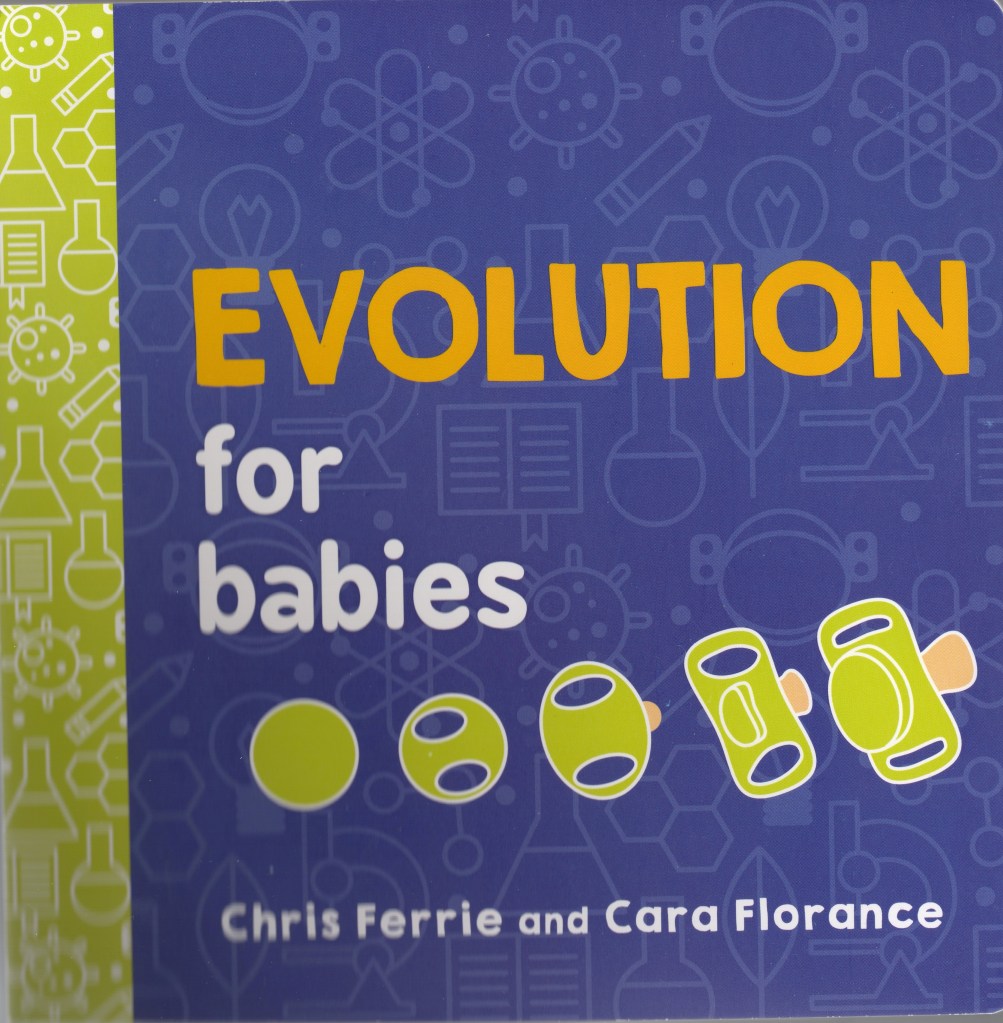
The front cover of Evolution for Babies is blue and features the title, author (Chris Ferrie) and a green illustration of evolving binkies | More Science Books for Babies
Front cover of Evolution for Babies.

This is the Amazon link for Evolution for Babies.

My Review for Evolution for Babies

Natural Selection as Simple as Possible

This simple board book just shows different kinds of balls falling through a hole until one ball doesn’t. It’s too big for the hole. That’s the surviving ball. Balls like that ball will be the survivors. That is Natural selection. It is very simple, but I guess it is to the point. I guess anyone can understand that. Even a baby.

Nuclear Physics for Babies

The front cover of Nuclear Physics for Babies is light blue and features the title, author (Chris Ferrie and Clara Florance) and a blue and red illustration showing protons and neutrons and a binky.
Front cover of Nuclear Physics for Babies.

This is the Amazon link for Nuclear Physics for Babies.

My Review for Nuclear Physics for Babies

The Blue Balls Keep the Red Balls Together

This book is about red balls called protons. They have a positive charge, and they repel each other. There are also blue balls called neutrons. If you put a blue ball between two red balls, the two red balls will not repel and will not fly apart. The more red balls there are, the more blue balls we need. The red and blue balls are at the center of the atom. If the number of red balls and blue balls is not right the nucleus becomes unstable, and it releases energy. That is radioactive decay. The book explains half-life. So that’s the story. It is simple and fun, and your baby can start working on his PhD in nuclear physics when he turns one years old.

Note: I would like to add one thing that I did not note in my review. The neutrons would not be able to hold together two protons just by being neutral. What the baby book is not mentioning is that neutrons (and protons) have a force that acts like glue, called the strong nuclear force. The strong force, color charges, quarks and gluons is what my previous post is about.

Astrophysics for Babies

The front cover of Astrophysics for babies is dark blue and features the title, author (Chris Ferrie and Julia Kregenow), and there is an illustration of the sun and a binky orbiting the sun | More Science Books for Babies
Front cover of Astrophysics for Babies.

This is the Amazon link for Astrophysics for Babies.

My Review for Astrophysics for Babies

Stars and Planets are Balls. The Sun is a Star

Earth is like a ball, and the sun is like a ball, and the earth orbits the sun. The sun is a star that looks big because it is close. Other stars look tiny because they are far away. Stars are heavy balls of hot gas. Inside stars atoms squeeze together. Smaller atoms squeeze together making bigger atoms and releasing energy in the process. The exploding stars spread bigger atoms across the Universe. The book is colorful and simple reading, but it features the Periodic table, which is not for babies, but ignoring that, this is a simple and fun book for young children.

Quantum Entanglement for Babies

The front cover of Quantum Entanglement for babies is red and features the title, author (Chris Ferrie) and an illustration of a two binkies supposedly entangled.
Front cover of Quantum Entanglement for Babies.

This is the Amazon link for Quantum Entanglement for babies.

My Review for Quantum Entanglement for Babies

Quantum Entanglement Using Balls

We bought this book for our future grandchild who will soon be born. It is a very short board book which takes one minute to read. It is about balls, like most of the “for babies” books. There are two red balls and two blue balls. Hide them in boxes. We know the colors, but Alice and Bob do not. However, in quantum physics the balls have a special bond. We put the tangled balls in two boxes. When the boxes are opened, both balls are blue or both balls red. What’s the point?

I am an adult who knows a little bit about Quantum Entanglement, and I did not understand what they meant. How is a baby going to understand it? It is a nice colorful board book but I wish they’ve taken a different approach.

Newtonian Physics for Babies
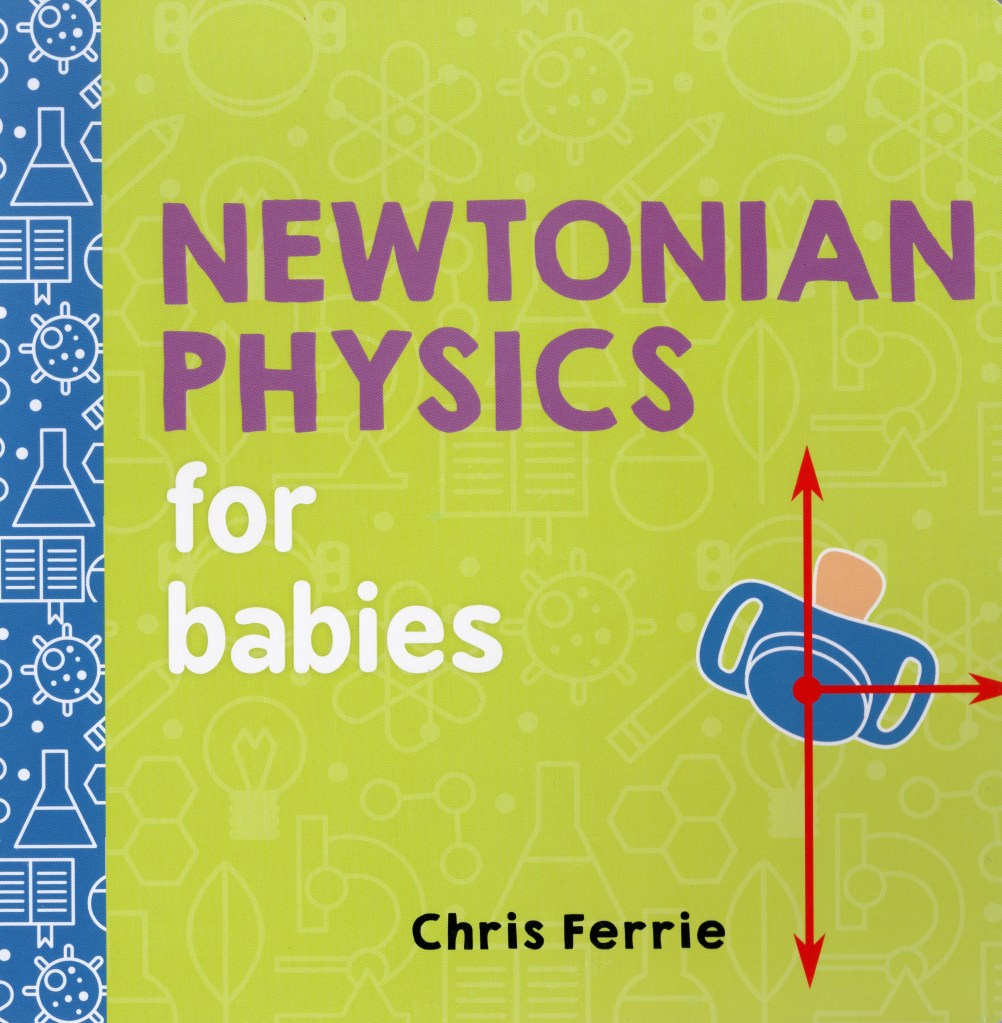
The front cover of Newtonian Physics for babies is green and features the title, author (Chris Ferrie) and an illustration of a binky with three red arrows representing forces | More Science Books for Babies
Front cover of Newtonian Physics for Babies.

This is the Amazon link for Newtonian Physics for Babies.

My Review for Newtonian Physics for Babies

Newtons Laws and a Ball Explained to the Very Young

We bought this book for our future grandchild who will soon be born. It is a very short board book which takes one minute to read. The book is about a ball. A ball feels the force of gravity, and it is pulling it down. When the ball is on the ground the ball still feels the force of gravity but the ground pushes back with an equal force and the ball is at rest. If there is a net force the ball moves.

At the end the book lists the three laws of motion. 1. If an object has zero net force, it does not change its motion. 2. The net force is equal to mass times acceleration. 3. For every force, there is an equal force in the opposite direction. It is very simply expressed, and the illustrations are fun, but I still think this book requires the child to be a bit older for him to understand, maybe 3-4 years old rather than a baby. However, I think the book can evoke an interest in science and physics at an earlier age. Despite it being one of the tougher books in the series, I think it seems to be a pretty good book.


To watch a woman read Astrohysics for Babies. Click on the YouTube video below.


To see the Super Facts click here

Science Books for Babies

I think that one of the most interesting series science books for beginners that I’ve come across is the Baby University series. I bought it for our soon to be born first grandchild Jack, but I couldn’t help but go through them myself. It is a great series for those who hope to put their one-year-old toddlers in a PhD program. But seriously, these books explain science concepts as simply as it is possible to do. The books may still be a little bit tough for babies, but I think 2–3-year-olds might get something out of them. The point of the books is not to make young children understand complex scientific concepts but to introduce the vocabulary and build curiosity.

Below I am presenting five books in the series, General Relativity for Babies, Electromagnetism for Babies, Artificial Intelligence for Babies, Quantum Physics for Babies, and Organic Chemistry for Babies. I am providing my review for the book and a link to my review as well as the book and a photo of the front cover.

General Relativity for Babies

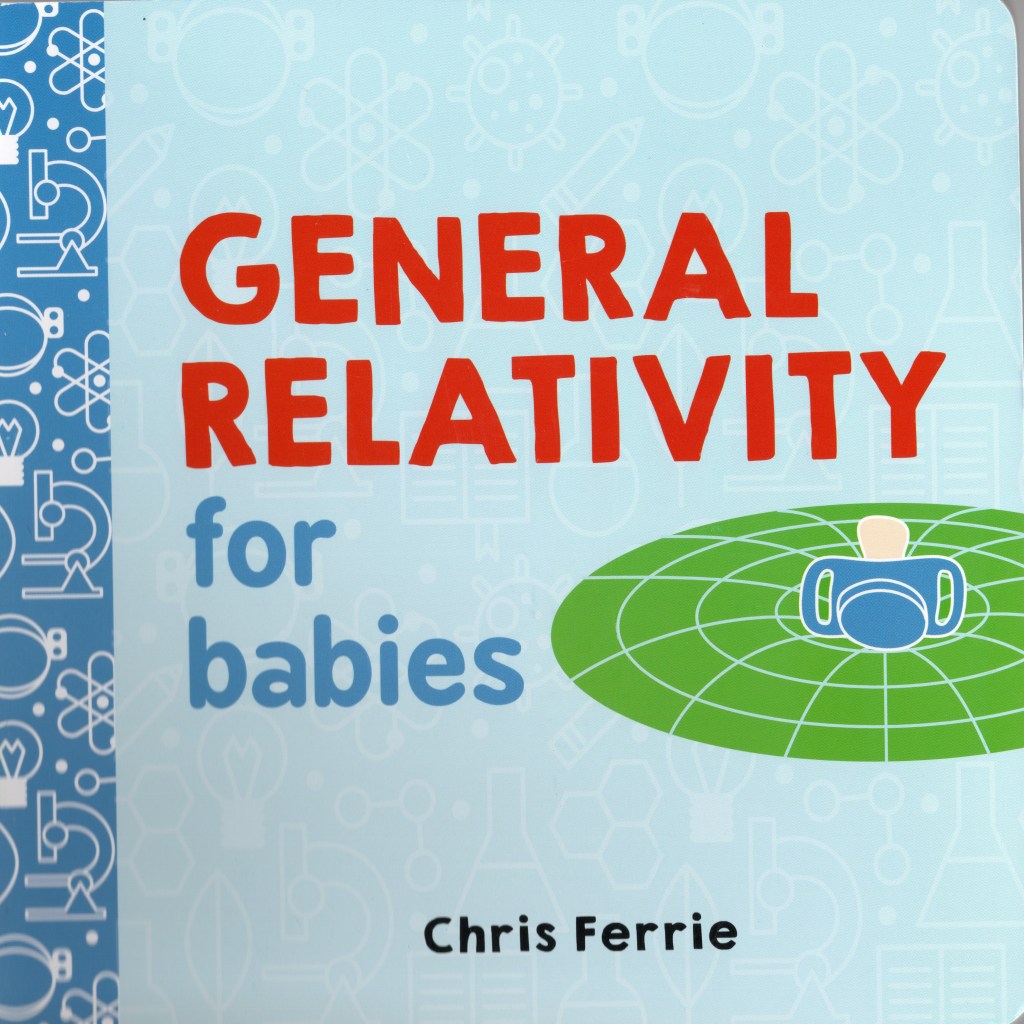
The front cover of General Relativity for Babies is light blue and features the title, author (Chris Ferrie) and a green illustration of warped space | Science Books for Babies
Front cover of General relativity for Babies.

This is the Amazon link for General Relativity for Babies.

My Review for General Relativity for Babies

General Relativity as Simplified as Possible

We bought this board book for our not yet born grandson. This book simplifies the General Theory of Relativity as far as you possibly can. It uses simple language and colorful illustrations to give the reader an idea of what is going on. Different sized masses are different sized balls, space-time curvature is illustrated using a distorted grid, and objects orbiting larger masses, such as a star, are shown as small balls having their paths curved by a warped grid. There are simple explanations for what a black hole is and what gravity waves are.

A baby would not understand this book but maybe someone who is 3-4 years old would. But your expectations need to be realistic. It should also be noted that even if you understand the book, the explanations are too simplistic for you to really understand General Relativity, but the explanations are not so simple that they are wrong. The book will just give you an idea of what is going on. However, I was impressed by the fact that the author and illustrator were able to present such an abstract theory in a way that makes it possible for a child to at least have a clue. I think that the most important aspect of the book is not whether the child understands General Relativity but the interest in science that it may evoke.

Electromagnetism for Babies

The front cover of Electromagnetism for Babies is light green and features the title, author (Chris Ferrie) and a light blue illustration of a binky surrounded by a field.
Front cover of Electromagnetism for Babies.

This is the Amazon link for Electromagnetism for Babies.

My Review for Electromagnetism for Babies

Electromagnetism Simplified for Young Children

We bought this short and colorfully illustrated board book for our not yet born grandson. I don’t think a baby will understand it but maybe when he is 2-3 years old. The book explains in simple terms and with colorful simple illustrations the basic concepts of charges, and attraction between negative and positive charges, and repulsion between two positive balls/charges and two negative balls. It explains about electrical and magnetic fields, and the fact that charges rotate around magnets. I believe this book can spur a child’s interest in science and engineering.

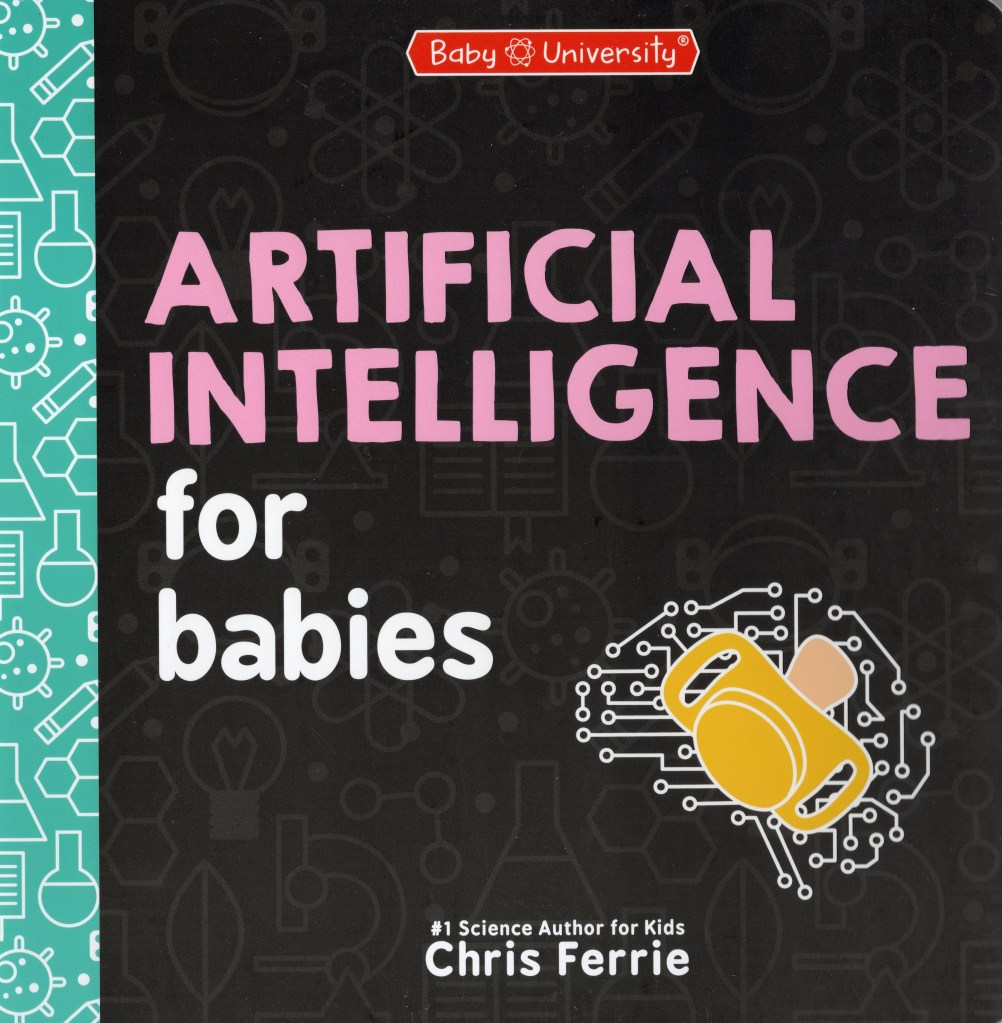
Artificial Intelligence for babies

The front cover of Artificial Intelligence for babies is black and features the title, author (Chris Ferrie) and an illustration of a binky surrounded by an electronic network | Science Books for Babies
Front cover of Artificial Intelligence for babies.

This is the Amazon link for Artificial Intelligence for babies.

My Review for Artificial Intelligence for babies

Artificial Intelligence for Small Children

We bought this board book for our not yet born grandson. He will not be able to understand it until he is at least one years old, but that is OK. The book explains the difference between a dog, a live thing, and a computer. It does this in very simple terms that I believe a young child could understand. According to the book, a computer can do some things that are impressive, such as complex calculations, and you can teach it certain skills, but it is not adaptable like a dog. I think that is about what you can make a very young child understand. Naturally, there are no neural networks or AI algorithms in the book. However, I think it sells artificial intelligence short, since artificial intelligence is becoming increasingly adaptable.

Quantum Physics for babies

The front cover of Quantum Physics for babies is yellow and features the title, author (Chris Ferrie) and an illustration of a simplified Bohr Model of the Atom with a binky as a nucleus.
Front cover of Quantum Physics for babies.

This is the Amazon link for Quantum Physics for babies.

My Review for Quantum Physics for babies

Quantum Physics for Young Children and Adults who Detested Physics Class

We bought this board book for our not yet born grandson. We may need to wait until he is 2-3 years old before it makes sense to read it to him. In the meantime, it is also a good book for adults without a solid science education. The book talks about colorful balls with energy and presents a simplified version of the Bohr model of the atom. There are blue balls called electrons and red balls called protons in the middle (the nucleus). The electrons travel in circular orbits around the middle. Light can change the energy of electrons causing them to jump between the orbits.

My daughter made the comment that a baby is only going to understand that an electron is a blue ball and a proton is a red ball, which isn’t a correct description of electrons and protons. Protons and electrons don’t have specific colors, not to mention that a simplified Bohr model for the atom is quite different from the more realistic Schrödinger’s model of the atom with quantum waves and probabilistic electron clouds. However, I am still very impressed by how simple the author and the illustrator succeeded in making this abstract topic. It is a good start for budding physicists.

Organic Chemistry for babies

The front cover of Organic Chemistry for babies is red and features the title, author (Chris Ferrie and Cara Florance) and an illustration of a benzene ring made from binkies | Science Books for Babies
Front cover of Organic Chemistry for babies.

This is the Amazon link for Organic Chemistry for babies.

My Review for Organic Chemistry for babies

Your First Book on Organic Chemistry

We bought this board book for our not yet born grandson. We will read it to him when he is 1-3 years old. Right now, we can read it. This book simplifies Organic as far as you possibly can. It uses simple language and colorful illustrations to give the reader an idea of what organic chemistry is. Basically, atoms are balls of different kinds. Atoms make up everything. Atoms can stick to each other, and they can make different shapes. The balls we call carbon (in black) can stick to small white balls called hydrogen and other balls called oxygen. We call those organic molecules, and they make up plants, food, and medicines. I think this is simple enough for a 1–3-year-old to understand, but not a baby. In my opinion, a better name for this series would have been “for Big Boys or Girls” rather than babies, because young children don’t like being called babies.


To watch a woman read Quantum Physics for Babies. Click on the YouTube video below.


To see the Super Facts click here