The speed of light is the speed of causality

Superfact 123: The speed of light is the speed of causality, which is the speed corresponding to how fast anything in the Universe can influence anything else in the Universe. That is because the universe, or space-time has a strict maximum speed limit for any action, signal, or information to travel from one place to another. Light just happens to travel at this maximum limit because photons have no mass.
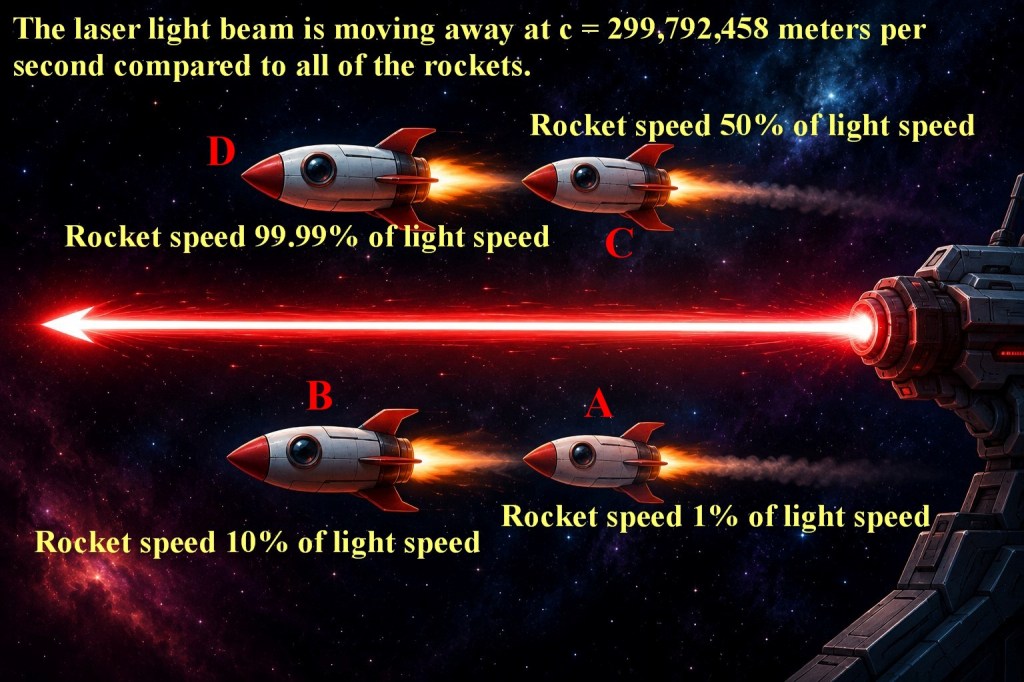
A spaceship on the right is shooting out a laser beam towards the left. Alongside the laser beam are four rockets trying to catch up with the light beam.
Four rockets, A, B, C, and D, are traveling along a light (laser) beam. No matter how fast they travel along the light beam, the light beam will always travel c = 299,792,458 meters per second faster than they do. I generated this picture with the help of ChatGPT.

I am posting about the speed of light again because there are so many aspects of it that are mind blowing. For starters, “The Speed of (Light in Vacuum) Is a Universal Constant”. It is always c = 299,792,458 meters per second for everyone no matter at what speed they are travelling. If you try to catch up to a light beam by going faster and faster the light beam will still keep moving at c = 299,792,458 meters per second faster than you. No matter how much you accelerate you can never catch up. The beam will keep moving away from you at c = 299,792,458 meters per second. This is possible because time and space are relative, at least if viewed separately, like we do.
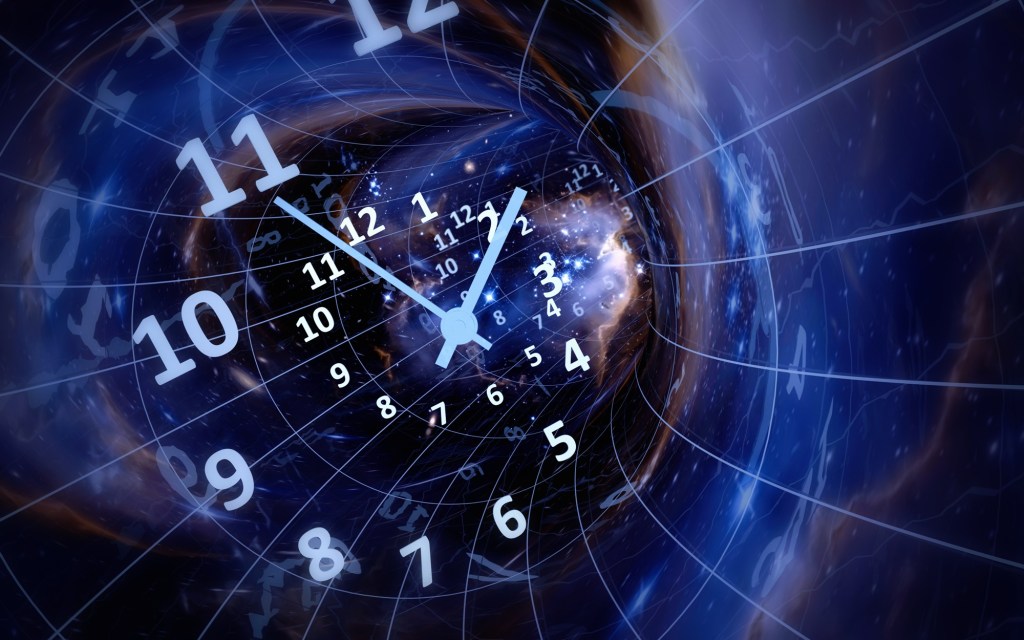
Clocks being sucked into a hole or possibly sped up into space.
Time is going to be different for me than for you. From shutterstock Illustration ID: 1055076638 by andrey_l

Photons and other massless particles will always move exactly at the speed of light c = 299,792,458 meters per second, whilst anything with mass could never travel at the speed of light. It will always move slower. In fact, when something with mass is approaching the speed of light, its mass will grow towards infinity, and it will require infinite energy to accelerate it to the speed of light. Basically, something with mass can never accelerate to reach the speed of light.
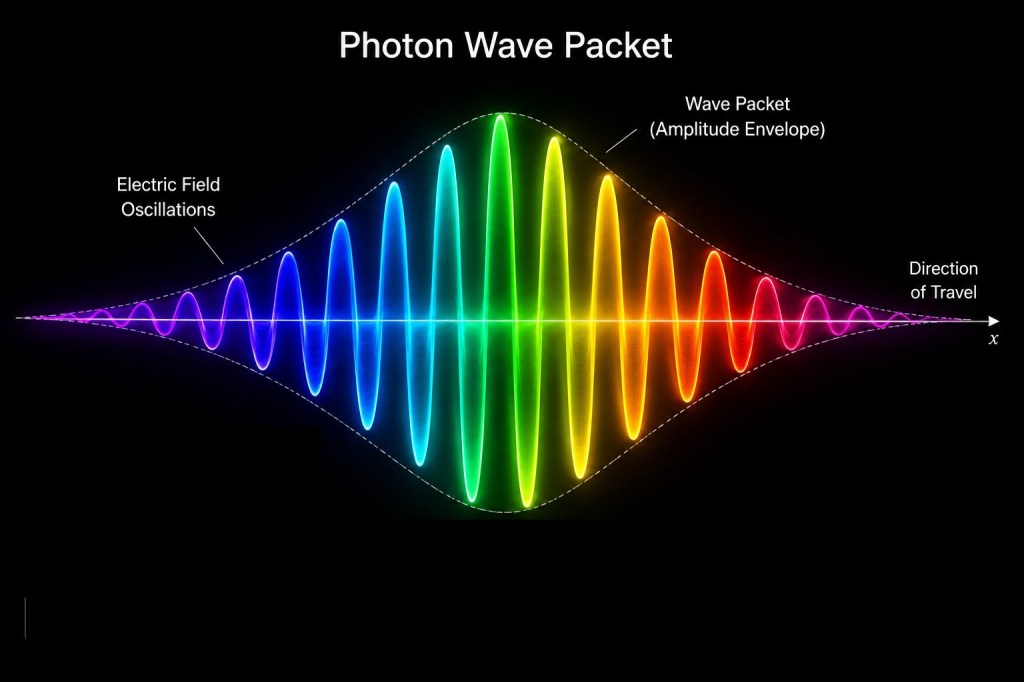
A colorful photon wave packet showing small amplitudes on the left, larger amplitudes in the middle and then small amplitudes on the right.
A photon wave packet. It has no mass, travel at the maximum speed, the speed of causality, and time does not exist for the photon.

Note: In my first paragraph I wrote (Light in Vacuum) in parenthesis because light always travels at c = 299,792,458 meters per second, but it appears to be going slower in transparent matter. When light moves through matter it is being absorbed and emitted as it “travels” between the atoms in the material, and this absorption and emittance process takes time.
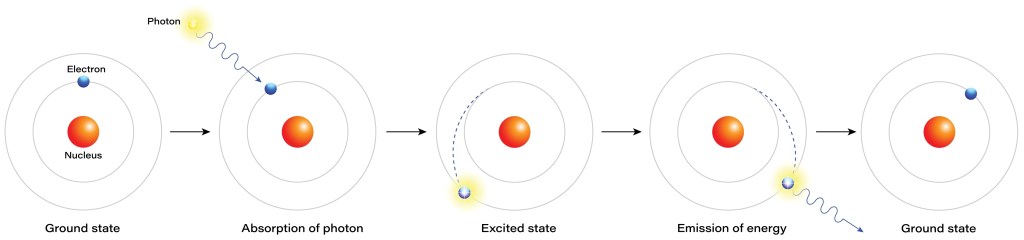
From left to right, an atom absorbs a photon, which excites an electron that jumps into a higher orbit. Then it emits a photon and the electron falls back to the ground state again.
From ground state to excited state, absorption and emission of a photon in an atom. Shutterstock asset id: 2180385419 by rktz.

As mentioned, the speed of light is a maximum speed limit for any action, signal, or information to travel from one place to another. Einstein’s theory of relativity shows that space and time are linked. The c = 299,792,458 meters per second acts as a conversion factor that binds space and time together. So, in a sense the speed of light is not even a speed in a regular sense, it is a property of time and space.
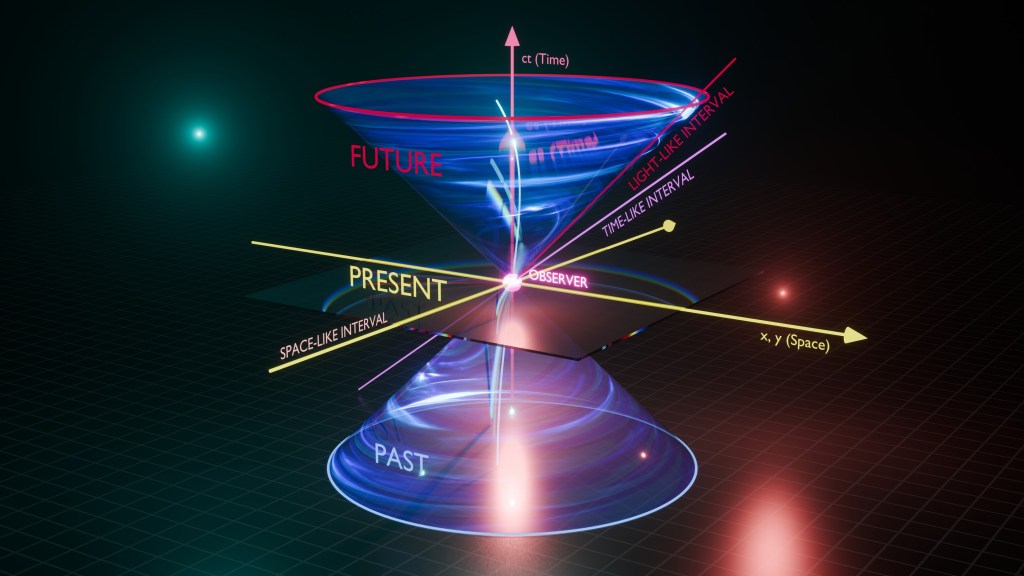
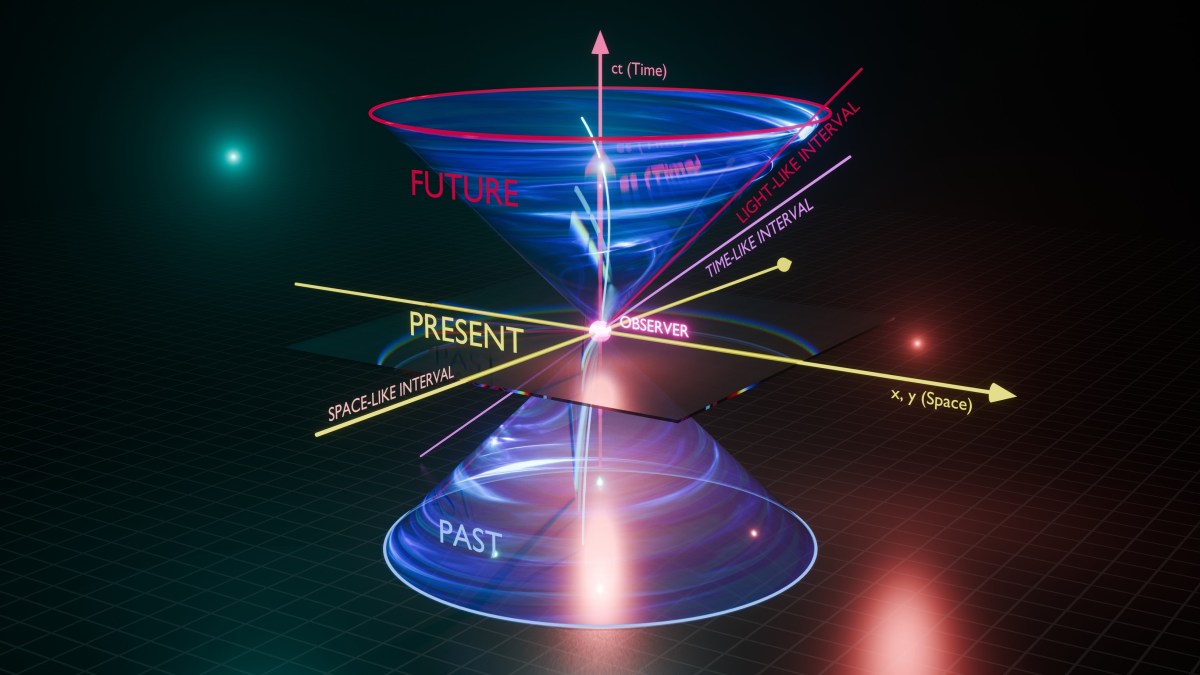
Scientific visualization of Minkowski light cone diagram demonstrating physics of special relativity theory and spacetime intervals, 3D rendering. 3D Illustration.
In the light cone diagram above, an observer can only affect what is confined within the future cone above it. Shutterstock asset id: 2728984295 by atdigit

The cone diagram above is a coordinate system with time being the pink arrow going from the bottom and up. The yellow arrows represent the x and y axis representing space. The center is the observer (you).  The past cone below the center represents all the past events that could have affected you (the center). The future cone represents everything that you could possibly affect in the future. All light beams travel on the surface of the future cone. What is outside these cones are parts of the Universe you cannot affect and that cannot affect you. This is the non-observable part of the Universe.

That the speed of light is also the speed of causality, or the maximum speed of cause and effect is an important fact that is mind blowing, and therefore a super fact in my opinion.

Light is Beyond the Reach of Time

Since the speed of light is a conversion factor between time and space and not a speed in a real sense there is more to say about the speed of light that may come as a surprise, for example, that time does not exist for photons. This means that from the photon’s perspective there will be no time at all. A photon, or a light beam, will travel from Earth to a distant galaxy a billion light years away in an instant. It will not take a billion years. It will not take one year. It will not take one second. It will not take one microsecond. It will not take a nanosecond, or a picosecond, or a trillionth of a picosecond. It will take zero seconds. The Big Bang and the end of the Universe (if there is one) happen at the same exact moment from the perspective of a photon. Time does not exist for a photon (or a gluon, or any other mass-less particle). This is explained in greater detail in my post “Light is Beyond the Reach of Time”.


What About Quantum Entanglement?

What about quantum entanglement? You may have heard about instantaneous action across vast distances due to quantum entanglement. Quantum entanglement is when pairs or groups of particles interact in ways such that the quantum state of each particle cannot be described independently of the others, even when the particles are separated by a vast distance. Therefore, measuring the state of one particle instantly determines the state of the other. Does that not violate the speed of light being the speed of causality? It turns out that it doesn’t.
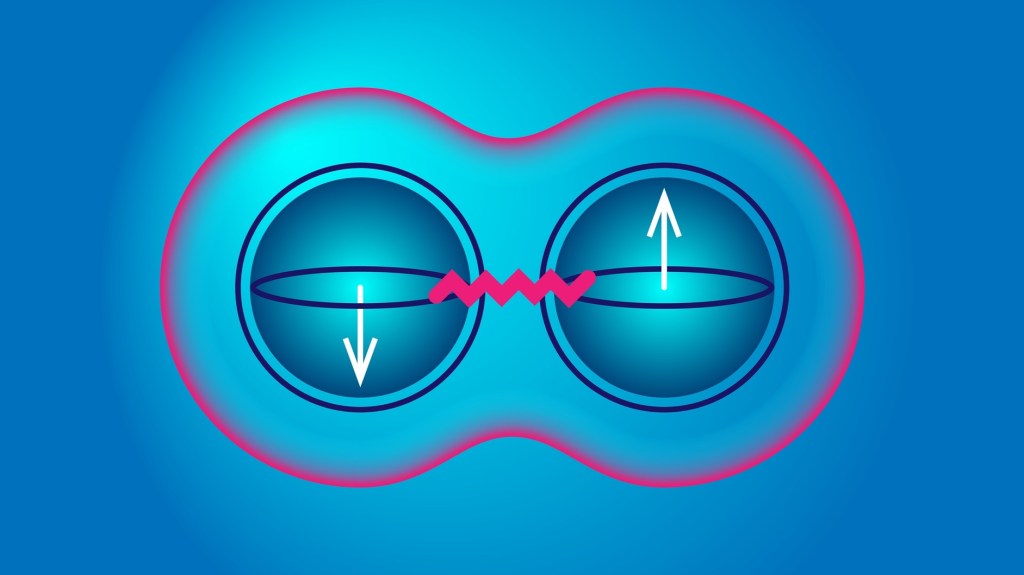
Entanglement of quantum qubits in superposition, schematic block spheres representation, two particles, one with spin up and one with spin down, measured state, visualization of concepts of quantum computing, vector illustration.
Two entangled particles, one with spin up and one with spin down. If you measure one the other one will manifest the opposite spin across any distance.

It can be understood the following way. Imagine two identical looking shoe boxes, one containing a left white shoe and the other containing a black right shoe. If you were to randomly scramble the two boxes so that you did not know in which box respective shoe was. Then you send one of the boxes to Mars. If you open the shoe box still on earth, you will instantly know the content of the box on Mars. The Martians don’t need to send a message to Earth.

The analogy is not perfect because unlike the shoe boxes the quantum case involves pure randomness. The content of the shoe boxes has been predetermined, and the randomness stem from the fact that we don’t know which box is which. But the shoes are there the whole time before you open any box. This corresponds to what you would call a hidden variable in physics. In the quantum case, the quantum state is not hidden or predetermined, there is no hidden variable, it does not even exist until you measure. It is true randomness. However, it is still similar in the sense that no signal, no message, and no information is being sent, and no message or information need to be sent.

Two red boxes with a white left shoe and a black right shoe. I used ChatGPT to generate image.

What about Warp Drives ?

So, nothing with mass can travel at the speed of light, and nothing can exceed it. What about the warp drive in Star Trek? As I said, the speed of light is not really a speed but the conversion factor between time and space. It is a geometric fact of space-time. That is a pretty difficult reality to get around, just like it is pretty difficult to push Earth out of its orbit by pushing on the floor. However, there is a way to cheat and that is to stretch space-time itself. This is theoretically possible, but it requires colossal amounts of mass-energy and enormous amounts of negative energy. We don’t even know if negative energy exists on a macroscopic scale.

So, no one knows if a warp drive is possible, and if it isn’t, then we are stuck moving slower than the speed of light, which would make interstellar travel very difficult and inconvenient.

Other Super Facts Related to the Speed of Light


To see the Other Super Facts click here

More Science Books for Babies

This is my second and last post covering books from the Baby University series. There are 44 of them. I think the Baby University series books are quite interesting for children. They may not really be for babies, but they appear to me to be great for young children. The point of the books is not to make young children understand complex scientific concepts but to introduce them to scientific vocabulary and build their curiosity. We bought 10 of these books for our soon to be born first grandchild (due date September 17). We also bought other books for him. If you want to see my post for the five first books, click here.

Below I am presenting five books in the series, Evolution for Babies, Nuclear Physics for Babies, Astrophysics for Babies, Quantum Entanglement for Babies, and Newtonian Physics for Babies. For each of the books I am providing my review for the book and a link to my review as well as a link to the book on Amazon and a photo of the front cover.

Evolution for Babies

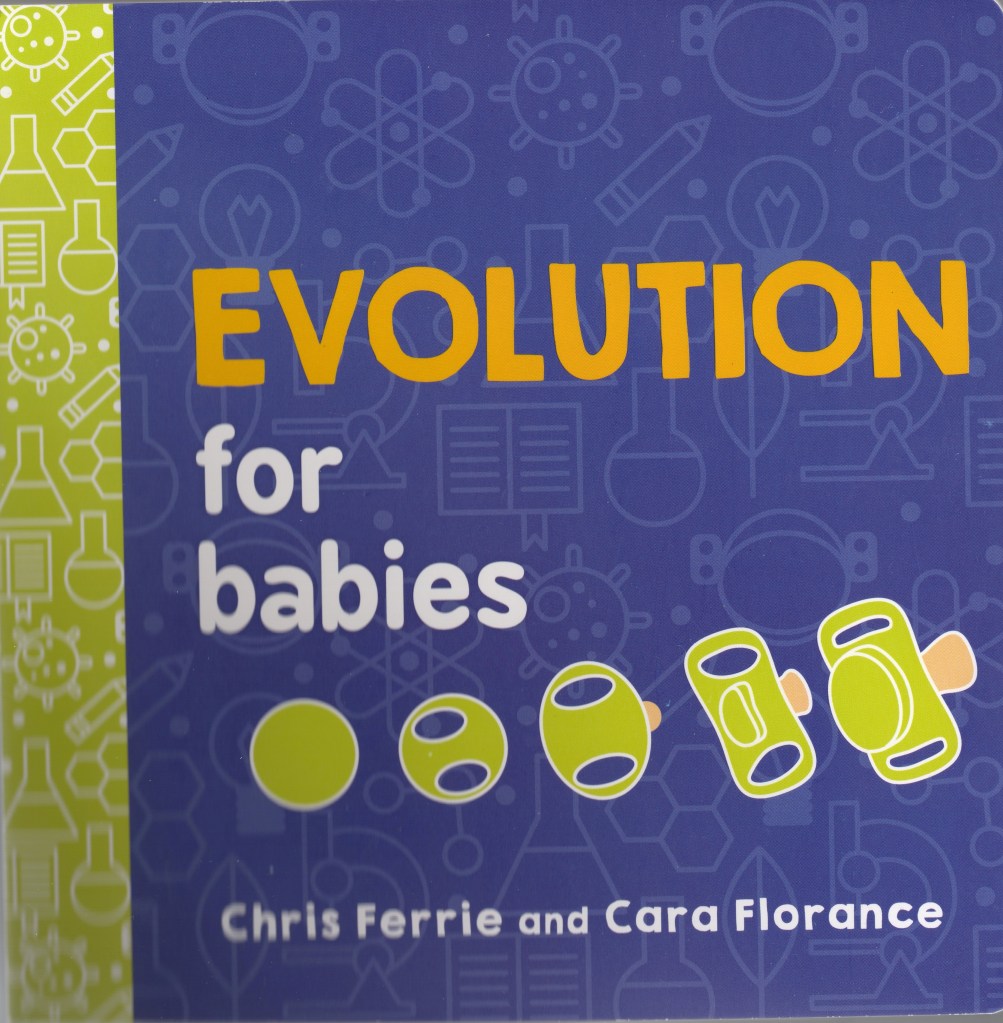
The front cover of Evolution for Babies is blue and features the title, author (Chris Ferrie) and a green illustration of evolving binkies | More Science Books for Babies
Front cover of Evolution for Babies.

This is the Amazon link for Evolution for Babies.

My Review for Evolution for Babies

Natural Selection as Simple as Possible

This simple board book just shows different kinds of balls falling through a hole until one ball doesn’t. It’s too big for the hole. That’s the surviving ball. Balls like that ball will be the survivors. That is Natural selection. It is very simple, but I guess it is to the point. I guess anyone can understand that. Even a baby.

Nuclear Physics for Babies

The front cover of Nuclear Physics for Babies is light blue and features the title, author (Chris Ferrie and Clara Florance) and a blue and red illustration showing protons and neutrons and a binky.
Front cover of Nuclear Physics for Babies.

This is the Amazon link for Nuclear Physics for Babies.

My Review for Nuclear Physics for Babies

The Blue Balls Keep the Red Balls Together

This book is about red balls called protons. They have a positive charge, and they repel each other. There are also blue balls called neutrons. If you put a blue ball between two red balls, the two red balls will not repel and will not fly apart. The more red balls there are, the more blue balls we need. The red and blue balls are at the center of the atom. If the number of red balls and blue balls is not right the nucleus becomes unstable, and it releases energy. That is radioactive decay. The book explains half-life. So that’s the story. It is simple and fun, and your baby can start working on his PhD in nuclear physics when he turns one years old.

Note: I would like to add one thing that I did not note in my review. The neutrons would not be able to hold together two protons just by being neutral. What the baby book is not mentioning is that neutrons (and protons) have a force that acts like glue, called the strong nuclear force. The strong force, color charges, quarks and gluons is what my previous post is about.

Astrophysics for Babies

The front cover of Astrophysics for babies is dark blue and features the title, author (Chris Ferrie and Julia Kregenow), and there is an illustration of the sun and a binky orbiting the sun | More Science Books for Babies
Front cover of Astrophysics for Babies.

This is the Amazon link for Astrophysics for Babies.

My Review for Astrophysics for Babies

Stars and Planets are Balls. The Sun is a Star

Earth is like a ball, and the sun is like a ball, and the earth orbits the sun. The sun is a star that looks big because it is close. Other stars look tiny because they are far away. Stars are heavy balls of hot gas. Inside stars atoms squeeze together. Smaller atoms squeeze together making bigger atoms and releasing energy in the process. The exploding stars spread bigger atoms across the Universe. The book is colorful and simple reading, but it features the Periodic table, which is not for babies, but ignoring that, this is a simple and fun book for young children.

Quantum Entanglement for Babies

The front cover of Quantum Entanglement for babies is red and features the title, author (Chris Ferrie) and an illustration of a two binkies supposedly entangled.
Front cover of Quantum Entanglement for Babies.

This is the Amazon link for Quantum Entanglement for babies.

My Review for Quantum Entanglement for Babies

Quantum Entanglement Using Balls

We bought this book for our future grandchild who will soon be born. It is a very short board book which takes one minute to read. It is about balls, like most of the “for babies” books. There are two red balls and two blue balls. Hide them in boxes. We know the colors, but Alice and Bob do not. However, in quantum physics the balls have a special bond. We put the tangled balls in two boxes. When the boxes are opened, both balls are blue or both balls red. What’s the point?

I am an adult who knows a little bit about Quantum Entanglement, and I did not understand what they meant. How is a baby going to understand it? It is a nice colorful board book but I wish they’ve taken a different approach.

Newtonian Physics for Babies

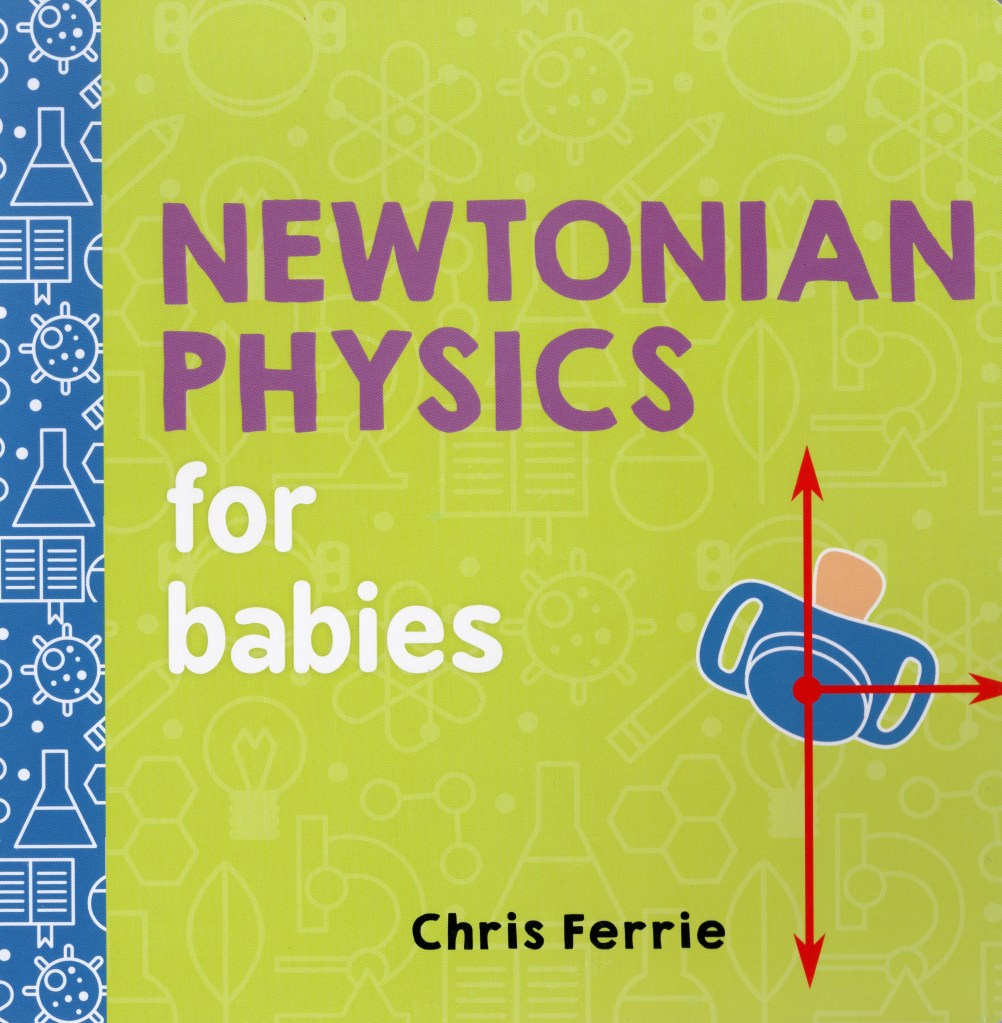
The front cover of Newtonian Physics for babies is green and features the title, author (Chris Ferrie) and an illustration of a binky with three red arrows representing forces | More Science Books for Babies
Front cover of Newtonian Physics for Babies.

This is the Amazon link for Newtonian Physics for Babies.

My Review for Newtonian Physics for Babies

Newtons Laws and a Ball Explained to the Very Young

We bought this book for our future grandchild who will soon be born. It is a very short board book which takes one minute to read. The book is about a ball. A ball feels the force of gravity, and it is pulling it down. When the ball is on the ground the ball still feels the force of gravity but the ground pushes back with an equal force and the ball is at rest. If there is a net force the ball moves.

At the end the book lists the three laws of motion. 1. If an object has zero net force, it does not change its motion. 2. The net force is equal to mass times acceleration. 3. For every force, there is an equal force in the opposite direction. It is very simply expressed, and the illustrations are fun, but I still think this book requires the child to be a bit older for him to understand, maybe 3-4 years old rather than a baby. However, I think the book can evoke an interest in science and physics at an earlier age. Despite it being one of the tougher books in the series, I think it seems to be a pretty good book.


To watch a woman read Astrohysics for Babies. Click on the YouTube video below.


To see the Super Facts click here