
Super fact 70 : Wild mammals have declined by 85% since the rise of humans even as the total mammal biomass has nearly tripled. The result is that only 4-5% of the total biomass of mammals are wild animals. The rest are humans and livestock.

As stated, mammal biomass has declined by 85% since the rise of humans. This is despite a threefold increase in mammal biomass over the last 200 years. However, this increase is almost entirely due to the growth of human and livestock populations. The result is that only 4-5% of the total biomass of mammals are wild animals. Another result is that Earth’s wild land mammals now make up just 2% of the mammal kingdom. You can read more here, or here, or here, and more in depth here.
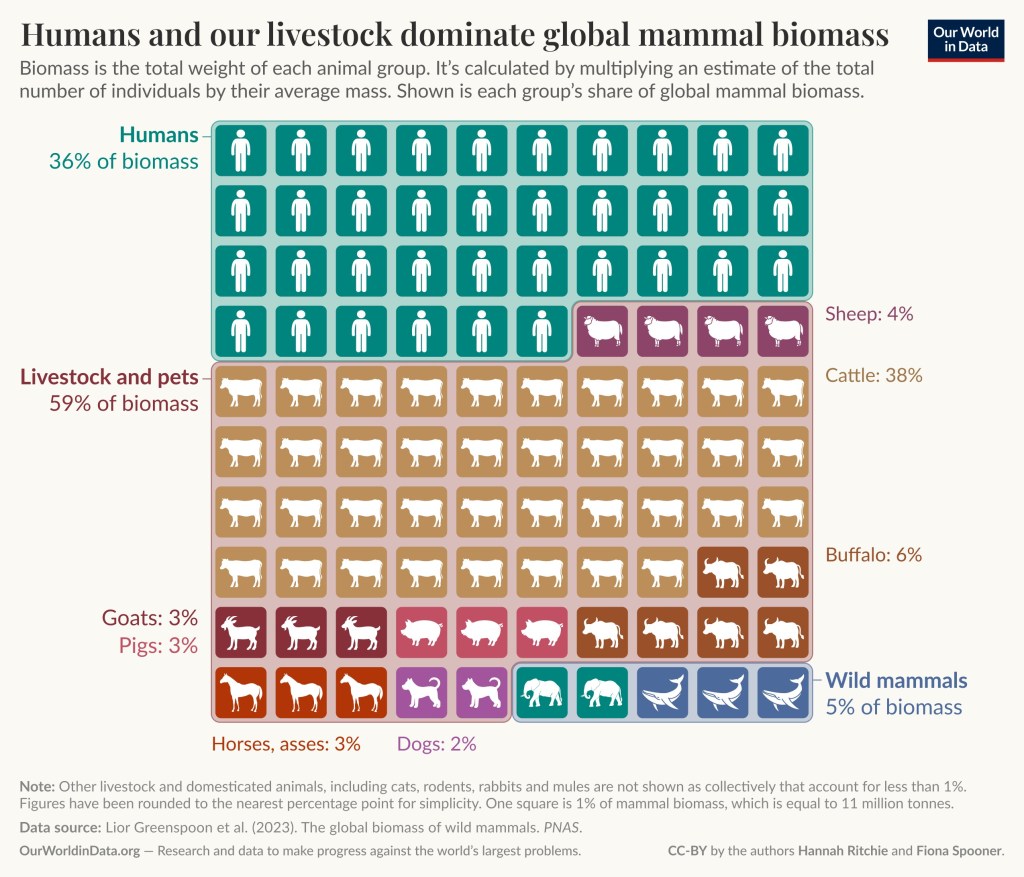
I think this is a super fact because we know it is true, and this huge and extremely rapid change of Earth’s fauna (from a geological timescale) is certainly important, and yet I think it comes as a surprise to many people. I often see the argument that humans have been great for animals because there are many more of them and the mammal biomass has tripled. That argument leaves out the part about the increase in mammal biomass coming from domesticated animals while wild animals have been disappearing. One question that comes to mind is whether life at the cramped factory farm is better than the life as a wild animal.
Wild Mammal Biomass Data
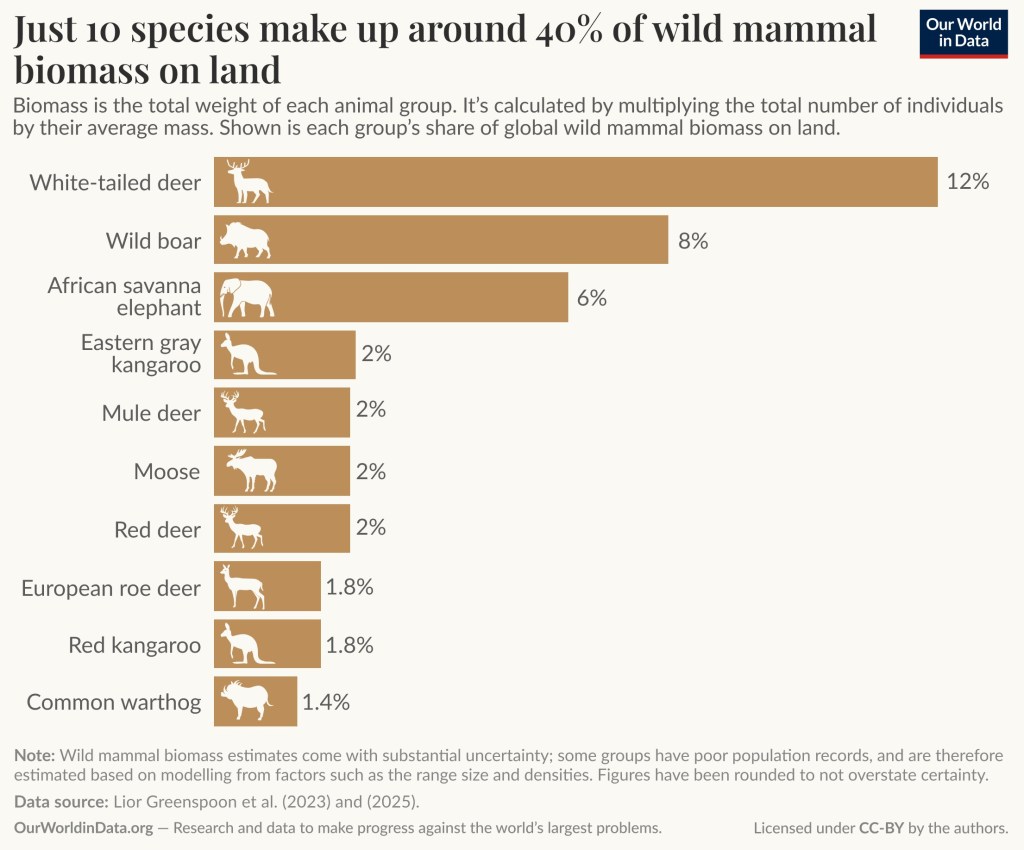
Below are a couple of graphs displaying some additional information on wild mammal biomass.

Another thing to note is that the wild animal biomass is very concentrated to just a few species. Considering that there are between 6,500 and 6,800 recognized mammal species in the world, it is quite remarkable that only 10 species make up 40% of the mammal biomass.
Reasons for Decline of Wild Animal Biomass
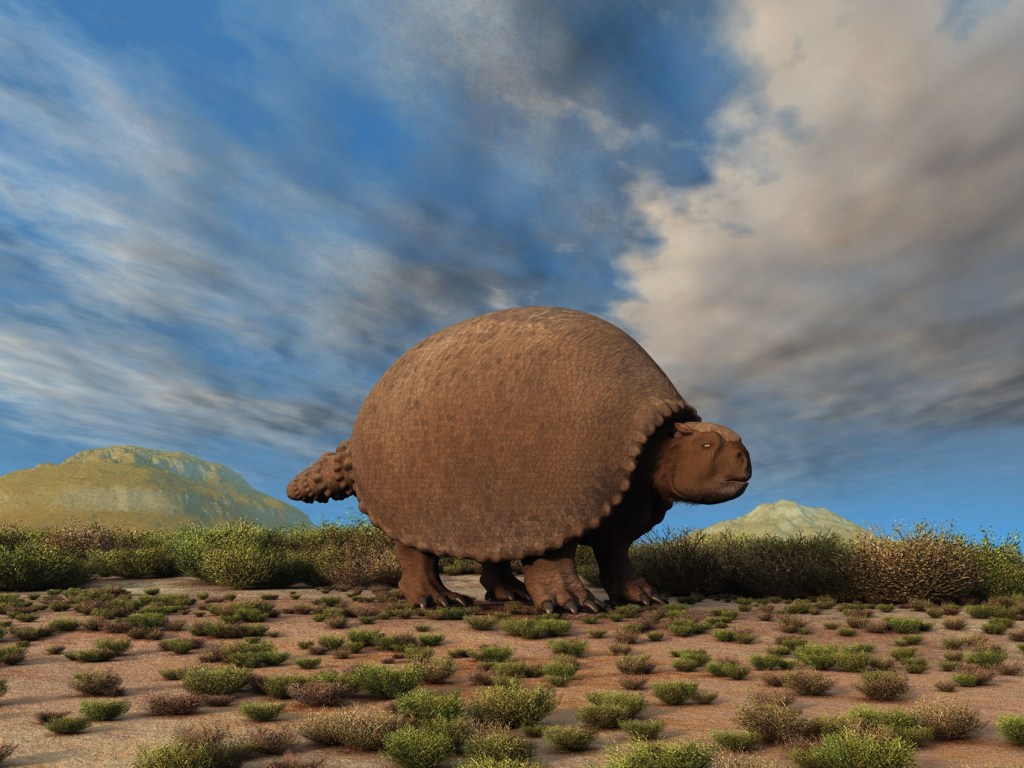
This decline of wild mammal biomass is primarily caused by human activity, including hunting, habitat loss and degradation from agriculture and urbanization, climate change, and pollution. This human-driven extinction event is the result of a rapidly growing human population and its increased consumption of natural resources, leading to widespread disruption of ecosystems and dramatic declines in wild mammal populations. It should be mentioned that the extinction of large mammals such as mammoths, American mastodon, giant ground sloths and glyptodonts was likely aided by human hunting in prehistoric times. The largest mammals have always been at the greatest risk for extinction and that is still true today.

To see the other Super Facts click here

 Super Facts
Although I know these facts, Thomas, it’s still depressing to read them set out like this.
LikeLiked by 2 people
Yes there are environmental good news and environmental bad news, but it is good to be informed. I knew that you would know but many people don’t (based on what I’ve seen and heard).
LikeLiked by 1 person
I enjoy these articles, Thomas.
LikeLiked by 2 people
Thank you so much Robbie
LikeLiked by 1 person
🌷
LikeLiked by 1 person
It is startling to read the data together, as you presented. As well I was startled that deer tops the list. Since I live in a country with a lot of nature, it is easy to forget that most countries are over populated and have taken away the land from the wild animals. Maggie
LikeLiked by 1 person
Wild animals have declined but some more than others, and some wild animals have become more common such as deer. I don’t the details, but I guess it is the same as with the moose in Sweden. Predators, such as wolf has become rare and therefore there is an ovebundance of moose, and I guess an abundance of deer in most of the rest of the world.
LikeLiked by 1 person
Oh that’s true. We’ve sent a bunch of our wolves down to Colorado to try to bring back some balance. Maggie
LikeLiked by 1 person
Yes I read about that. It seems like it was not without controversy.
LikeLiked by 1 person
I think the ranchers were especially unhappy.
LikeLiked by 1 person
There are no easy solutions but we cannot think only about ourselves. Perhaps the ranchers can be compensated.
LikeLiked by 1 person
I’m not surprised, but I wasn’t aware of these numbers. It is depressing. We humans consider ourselves to be superior to other life forms.
LikeLiked by 1 person
Yes you are right Audrey. The thinking that everything is for us and that no other life matters is not a good one in the long run.
LikeLiked by 1 person
Another very interesting post, Thomas. It’s very scary when you see it like that, but we do need to know.
LikeLiked by 1 person
Thank you Esther, there are environmental good news and environmental bad news, but it is good to be informed.
LikeLiked by 1 person
Very interesting to learn this. For whatever reason, I assumed there were more wild animals than livestock and humans. We really need to do more to increase their numbers.
LikeLiked by 1 person
I think that is a very common assumption. Go back a few years and I thought so to. In addition to wild animals having declined as livestock has increased, the ratio between the different wild animals has become very inbalanced. Wolves almost poff gone, deer and moose overpopulated.
LikeLiked by 1 person
That’s so sad, wolves used to be so common at one point. I remember learning that the increase in livestock is also causing an increase in carbon levels.
LikeLiked by 1 person
Yes you are right. It has to do a lot with the way and what we feed the cattle and the industry around it. Also, there are at least one and a half billion cattle in the world. Since cows and bulls are bigger than humans they add up to a biomass that is larger than all people in the world. Considering all that it is not too surprising that cattle is responsible for about 14.5% of global human-caused emissions.
LikeLiked by 1 person
I’ve also read that a lot of the crops being grown to feed the livestock is the cause of natural forests being destroyed. It’s sad we’re not doing more to protect the environment.
LikeLiked by 1 person
Yes you are right. Eating less beef would require a lot less crop land too.
LikeLiked by 1 person
Yeah, I think it’s not even about everyone giving meat especially red meat up completely. The main thing is moderation.
LikeLiked by 1 person
You are right Pooja. It is about moderation. The average American eat between 220-225 pounds of meat per year. Almost a pound per day, and some people are babies, small children, and vegetarians, so that is a lot per meat eater. Also a lot of food is thrown away.
LikeLiked by 1 person
That’s a lot and I think the lack of fibre also becomes an issue when that much meat is being eaten.
LikeLiked by 1 person
Yes you are right. We need to eat more vegetables. We especially eat a lot of red meat, such as beef, lamb, pork, (about 200 pounds per person) and red meat is the worst for the environment as well as our health.
LikeLiked by 1 person
Yeah, definitely causes a lot of health issues too. But a lot of people are trying to get in more fibre now and decrease meat especially red meat.
LikeLiked by 1 person
I think that sounds like a good trend. I am trying to eat more fiber too.
LikeLiked by 1 person
That’s great. Beans, squash and pumpkins are good options for this season.
LikeLiked by 1 person
So interesting, Thomas. I imagine that the loss of wild animal diversity will have consequences that we aren’t even aware of. It seems that humans have survived many animal extinctions over the millennia, but I wonder if there’s a breaking point where the interdependence of species collapses because one link ceases to exist. Thanks for sharing this. It’s a bit concerning, I think.
LikeLiked by 2 people
You are right, it is not just wild animals declining but there is also an imbalance. Some wild animals are more common, such as white tailed deer and moose, while other wild animals have becoming few or extinct. I’ve read that the extinction rate is 1,000 faster than normal, but that is another super fact. Thank you so much Diane.
LikeLiked by 2 people
I don’t think scientists can even predict the long term ripple effects. I worry about the migration of viruses and other microbes as animal populations move, get wiped out, or grow. It’s all connected, I think.
LikeLiked by 2 people
Yes you are right. It is all connected and like the Nobel prize winning physicist Niels Bohr said “Predictions are hard especially about the future”. Not only has humans and livestock largely replaced wild mammals and wild animals in general, but the extinction rate is about 1,000 times faster than normal and we have also shifted around the balance between wild life species. There used to be 30 to 60 million bison/buffalo roaming the North American plains and now there are 8,000, with an additional close to half a million in private commerical herds (essentially turning them into cattle). But we have lots of white tailed deer and Moose in northern Europe and Canada.
LikeLiked by 2 people
🙂 I love that Bohr quote. Lol
LikeLiked by 1 person
It is a good one
LikeLiked by 1 person
seeing these figures in black and white just confirms what I already knew….however what we don’t know is the long term consequences but we can hazard a guess each animal has its place in the bigger picture having man in charge with their factory farms and meat growing laboratories doesn’t bode well for our futures …Thank you Thomas we should know the good and the bad and this is bad…
LikeLiked by 1 person
Thank you so much Carol. The point you bring up “long term consequences” I am going to post about tomorrow or the next day, the rate of extinction rate, a thousands times the normal. If it continues we will cause a sixth extinction like what happened to the Dinosaurs but this time humanity would be the asteroid.
LikeLiked by 1 person
I knew this information before but it’s always depressing to see it in one place like this. An important post, Thomas.
LikeLiked by 2 people
Thank you so much Lynette. I am impressed to see how many people knew this. So many people I talk to to does not know about this and don’t want to believe it.
LikeLiked by 1 person
Humans, man. Whose idea were they anyhow?
LikeLiked by 1 person
It’s definitely the planet of the humans now
LikeLiked by 1 person
Your scientific facts are powerful and inspiring. You present big data in a way that touches the heart and makes us stop and think. You remind us that we must care not only about numbers but also about our shared life with every creature on Earth.
There is also something interesting about animals like wild boar and white-tailed deer. They survive well in places shaped by humans. This shows that our impact does not only destroy but also helps some species grow. Our friendly conversation can help more people understand nature better.
The deeper message you share is clear. We are facing a big challenge, and we must act before we become the cause of a massive extinction. Your courage to speak the truth gives hope. We believe your mission to awaken global awareness will succeed.
LikeLiked by 1 person
Thank you so much for your very kind words and support Livora. I really appreciate it.
LikeLiked by 1 person
Your message means a lot — thank you. It’s always a joy to visit your blog; the way you take complex ideas and turn them into something clear, thoughtful, and beautifully human is a gift. I learn something new every time I stop by.
I’m grateful you received my words with such kindness. Your work reflects a lifetime of curiosity and wisdom, and it’s inspiring to walk through those reflections with you. Thank you for what you share, and for the gracious spirit behind it.
LikeLiked by 1 person
I very much appreciate your kind support Livora
LikeLiked by 1 person
Your support has a steady kindness to it, and I’m grateful our exchanges keep meeting in that warmth. Thank you for walking alongside the words so thoughtfully.
LikeLiked by 1 person