
Super fact 79 : Distant galaxies appear redder (redshifted) because of the universe’s expansion. The farther away the galaxy, the redder it is. This cosmological redshift is also increasing because the Universe’s expansion is accelerating. Our Universe is getting more and more red every day.
Esther’s writing prompt: January 14 : Red
Click here or here to join in.
Many people are aware that the Universe is expanding but may not know that this results in a measurable redshift. The faster a galaxy is moving away from us the redder it appears. This is called the cosmological redshift. Measuring these redshifts was how we discovered that our Universe is expanding.
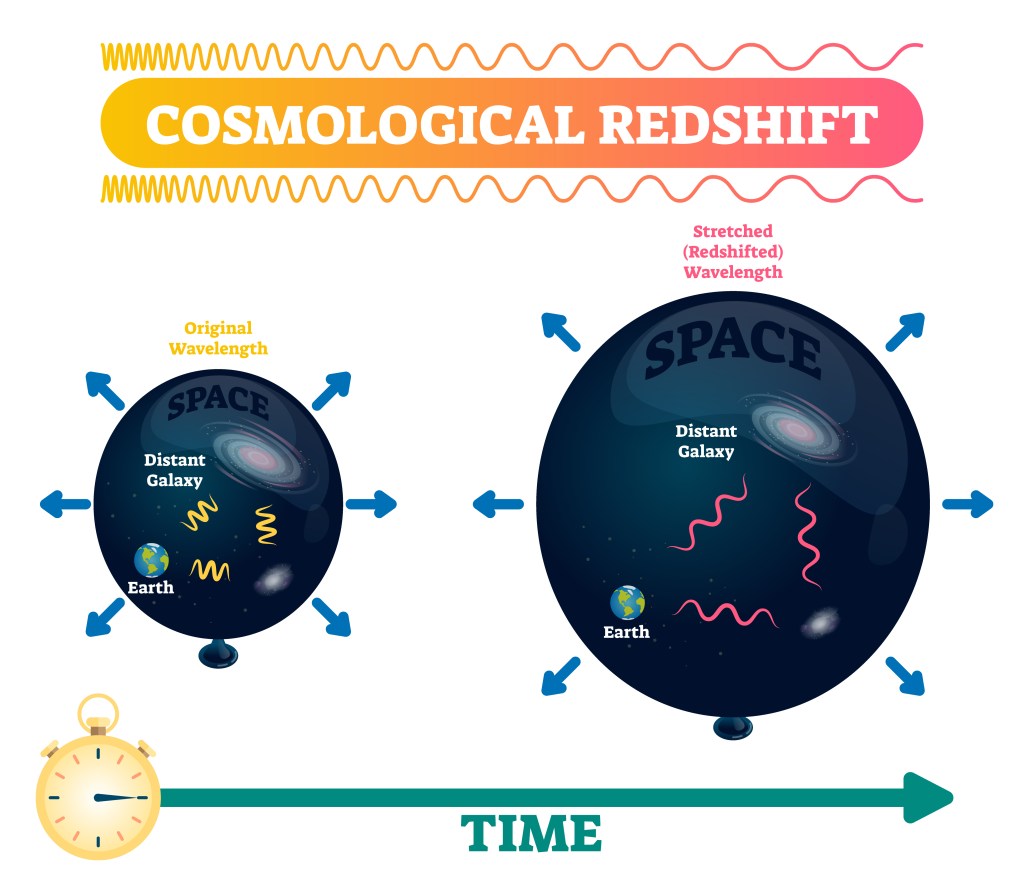
At the end of the 1990’s it was also discovered that the Universe’s expansion was accelerating. This discovery came from measuring the redshifts (and apparent dimness) of distant Type Ia supernovae. I should add that measuring the increase in the cosmological redshift directly is difficult. However, it is expected to be possible when the Extremely Large Telescope (ELT) starts gathering data in 2027. I can add that there are also other types of evidence showing that the Universe’s expansion is accelerating.
Another surprising aspect is, if the Big Bang was like an explosion, gravity would pull back the galaxies making the expansion slow down and perhaps eventually even reverse. However, the opposite is happening. A common explanation is that a repulsive force, a sort of anti-gravity, referred to as dark energy, is responsible for this acceleration.
I call this a super fact because this is an observed phenomenon, it is important knowledge for how we view the world, and it is surprising. Many people have heard bits and pieces of this but do not have the fuller picture.
The Doppler Effect
The cosmological redshift is an example of the so called doppler effect. The doppler effect is the change in the frequency or wavelength of a wave in relation to an observer if the origin of the wave and the observer are moving compared to each other. If an object is moving towards you, let say an ambulance, the frequency of its sound will be higher (wavelength shorter).
After it passes you and moves away from the frequency will be lower (wavelength longer). In other words, the sound changes when the ambulance passes you. The same is true for other kinds of waves, including waves on the water, and light. If a light is travelling towards you at a high speed, it will look bluer. If a light is travelling away from you at a high speed it will look redder. The latter is what is called a redshift, cosmological redshift in our case.
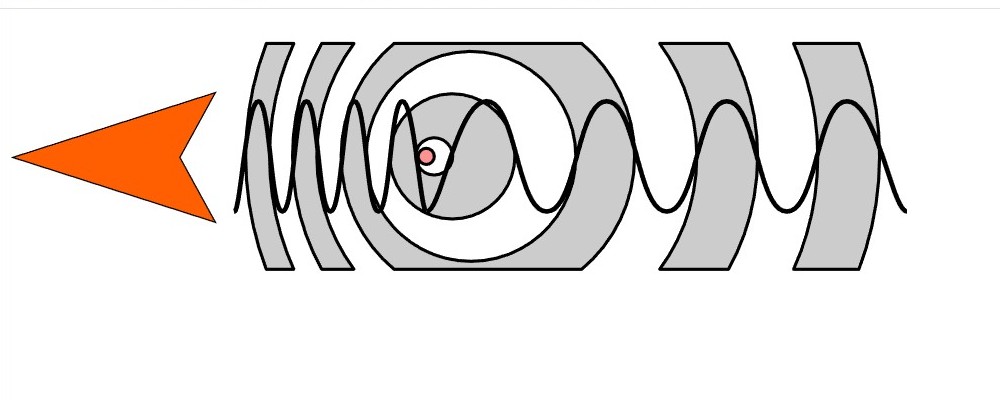

Below is a three minute video explaining the doppler effect and redshift.
I can add that the constancy of the speed of light in vacuum changes the exact size of the doppler effect. The doppler effect remains as is for the most part but the formulas for the classical doppler effect, which you would use for sound, and the relativistic doppler effect, which you would use for light in space, are different. It is just to pick the right formula.

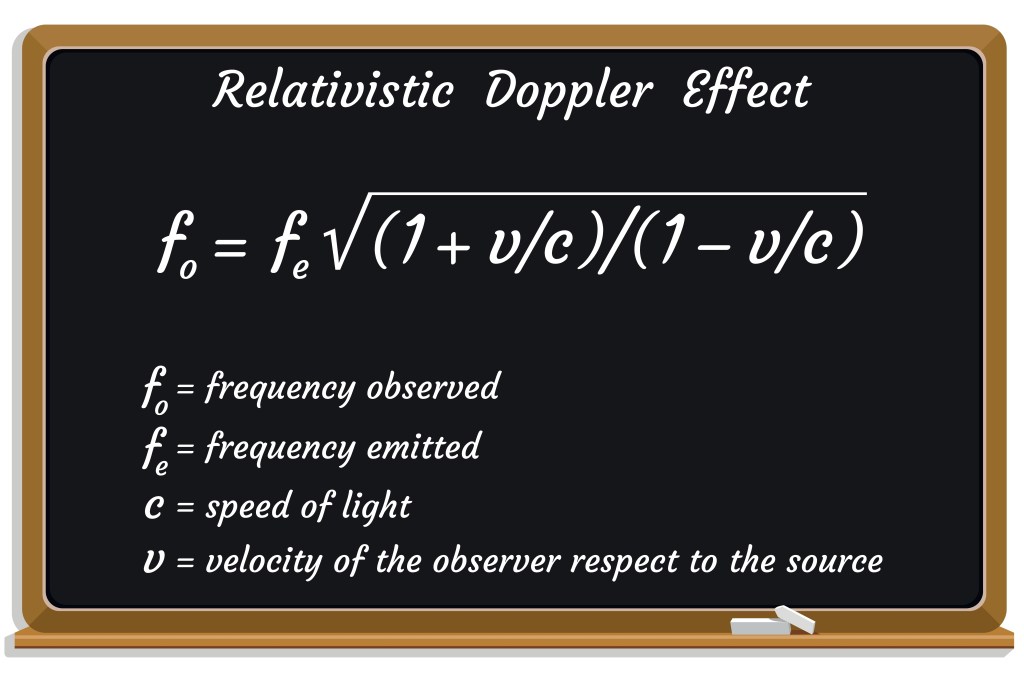
Measuring redshift
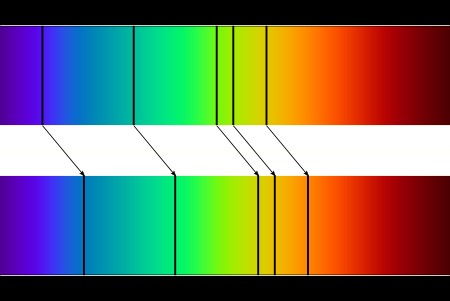
A common misconception is that astronomers take pictures of distant galaxies and somehow measure the “redness” of them, but that is not the case. When you take a spectrum of a heated element (such as hydrogen or helium in stars) it creates characteristic dark lines in the spectrum — like a fingerprint. Everything on the periodic table has its own characteristic fingerprint of lines at characteristic frequencies. In addition to measuring the cosmological redshift it makes it possible to identify the elements in a star and their proportions. See the picture below.
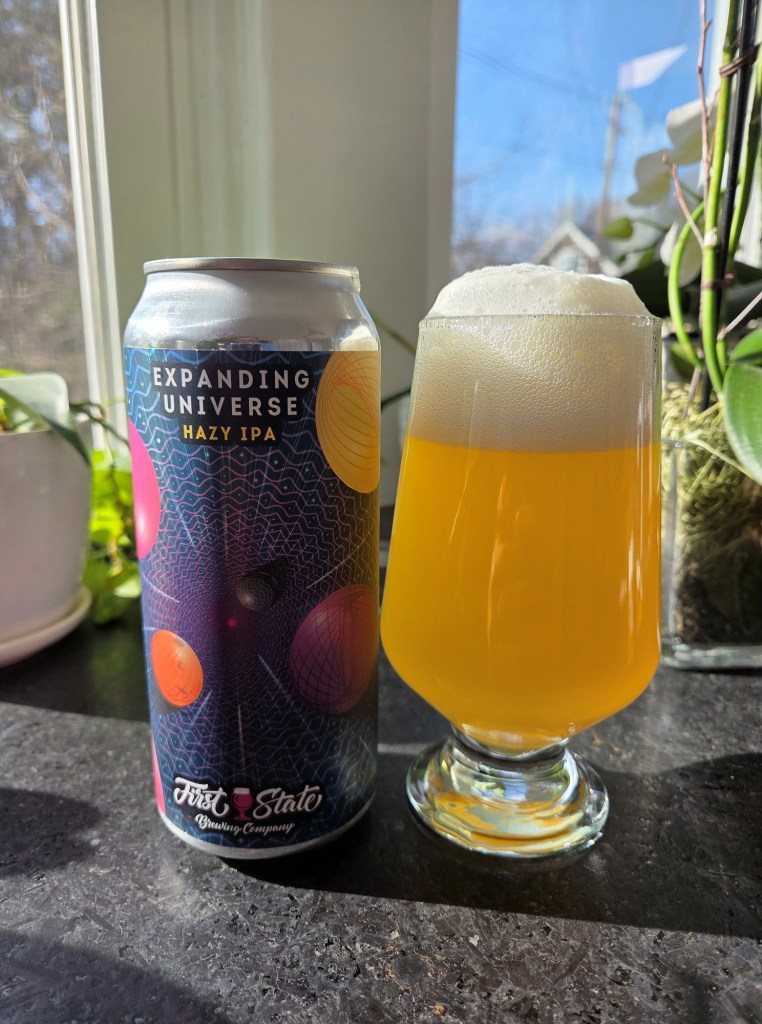
Expanding Universe Hazy IPA
Expanding Universe is a Hazy IPA, or a so called New England style IPA from First State Brewing, ABV 6.5%, IBU 25 (IBU = International Bitter Units). The fact that it is an IPA (India Pale Ale) means that it is Ale and therefore not a Lager. The fact that it is an IPA means that it is hop-forward and has an intense flavor and aroma. The fact that it is a Hazy / New England style IPA means that it is more fruity than bitter and looks cloudy, hazy, like juice. The flavor of Expanding Universe is mango, pineapple, and grapefruit. It has a low bitterness, it is fruity, juicy, and it is great if you like New England IPAs.
Related Posts
- The Speed of Light In Vacuum Is a Universal Constant
- Two events may be simultaneous for some but not for others
- We are Star Dust
- The vastness of space and the beginning of infinity
- GPS uses relativity for accuracy
- There is strong evidence for the Big Bang
- Time Dilation Goes Both Ways
- The Edge of the Observable Universe is 46.5 billion Light Years Away
To see the Super Facts click here

 Super Facts
A very interesting post as usual, Thomas. Thank you.
LikeLiked by 1 person
Thank you so much Lynette
LikeLiked by 1 person
I didn’t know this, Thomas, and I’ve never heard of the doppler effect. Thank you once again for your sharing your knowledge and explaining it clearly for us.
LikeLiked by 1 person
Thank you so much Esther and thank you for doing the fun prompts
LikeLiked by 1 person
But we aren’t surprised the Universe is expanding, are we? That’s what it does. Well, until it doesn’t. Now that would be interesting.
LikeLiked by 1 person
No you are right Jacqui. Most people have heard of the expansion of the Universe. However, that it is red shifted as a result might be surprising and that the expansion is accelerating and therefore the redshift increasing might be surprising too. In fact if the dark energy explanation is correct and dark energy keeps increasing then it would keep expanding faster and faster and eventually ripping the Universe apart.
LikeLiked by 1 person
WOW Thomas…. your wealth of knowledge is unimaginable my friend. The pieces are slowly being put together.. Will we ever know the bigger picture of the Universe? I doubt it.
But like the universe…. We are expanding our consciousness 🙂 xx
Another mega fact finding post my friend x
LikeLiked by 1 person
Thank you so much Sue and Mega Fact is a good name for super fact. Maybe I should have called it that.
LikeLiked by 1 person
🙂 haha…. You certainly dig deep my friend to retrieve those super facts my friend… Very much appreciated xx
LikeLiked by 1 person
Thank you so much for your kind words Sue
LikeLiked by 1 person
This is fascinating! I’m sitting here listening to my carpet cleaners work, and it’s making me think of the Doppler effect you mentioned. The sound of their equipment definitely changes as they move around the room. It’s neat to connect that everyday experience to something as huge as the universe expanding. Thanks for making such a complex topic so easy to understand
LikeLiked by 1 person
Thank you Jeanie and that is a great observation. I hope your carpets will be very clean.
LikeLike
This is new information for me. I didn’t know about cosmological redshift. I live and learn 🧡
LikeLiked by 1 person
Thank you Robbie. Yes most people have heard of the expansion of the Universe but not that it causes a redshift.
LikeLike
Lulu: “Our Dada says he remembers watching Cosmos or something back in the day where Carl Sagan or whoever said they didn’t yet know if the universe would collapse back on itself and make another Big Bang or if it would expand forever until everything eventually ran out of energy and winked out. Our Dada was rooting for another Big Bang, but oh well. Not like he will be around to see it either way.”Charlee: “What?!”
LikeLiked by 1 person
Yes Lulu I remember that too. That the Universe is expanding faster seems to contradict that the universe would collapse back on itself. However, I read today that recent observations seem to show that dark energy is weakening and if that is true the expansion of the Universe could halt and reverse itself so the universe would collapse back on itself afterall. Charlee and Lulu I hope your Dada will be around to find out. According to a book I’ve read there is a restaurant at the end of the Universe.
LikeLike
Lulu: “Oh, yum! A restaurant at the end of the universe? I hope they allow dogs!”
LikeLiked by 1 person
Yes they do Lulu, but you need to eat quickly before the Universe is destroyed.
LikeLiked by 1 person
If they allow dogs, I’m up for it! We’ll sneak the cats in too. Seriously though I would be happier to know that the universe will eventually collapse in on itself and start over than burn out. (I will mention that there’s a relatively recent book trilogy where this becomes a late plot point, but won’t name the series, because spoilers.)
LikeLiked by 1 person
That sounds exciting. I guess I have to find the series myself.
LikeLike
If you don’t mind a spoiler (and it’s not a huge one, honestly), it was the “Remembrance of Earth’s Past” trilogy, more commonly known by the title of the first book, The Three-Body Problem.
LikeLiked by 1 person
Oh I see. I’ve heard of that one but have not read it (yet)
LikeLike
What a fascinating write-up!😊
LikeLiked by 1 person
Thank you for your kind words Melanie
LikeLiked by 1 person
Interesting article, very clearly explained, and interesting video too… quite useful and nice to find out about the cosmological redshift 😊
LikeLiked by 2 people
Thank you so much for your kind words Nicole
LikeLiked by 1 person
Thanks for the good post. You’ve touched on a big part of what I do in my “day” job with the DESI survey at Kitt Peak National Observatory. I also was one of the observers that took data that led to the initial discovery of the accelerating universe.
I think a common misconception is that we take pictures of distant galaxies and somehow measure the “redness” of them. That’s not actually what we do. When you take a spectrum of a heated element (such as hydrogen or helium in stars) it creates characteristic dark lines in the spectrum — like a fingerprint. Everything on the periodic table has it’s own characteristic fingerprint of lines at characteristic frequencies. The further away something is, the more those exact pattern of lines “shift” redward in the spectrum. So, if you measure one of the sun’s principal helium lines at a wavelength of 587.5nm, you’ll find that same line at a higher value (or in the red direction) for a redshifted galaxy. The difference in that value gives you the redshift of the galaxy according to the equations you gave.
With the DESI survey we typically obtain tens of thousands of galactic spectra per night with the objective of creating the largest redshift map to date. Many of the most exciting discoveries about the expansion history of the universe are coming out of the DESI survey. Here’s one recent press release from just under a year ago: https://noirlab.edu/public/news/noirlab2512/
LikeLiked by 3 people
“I also was one of the observers that took data that led to the initial discovery of the accelerating universe.” – wow that is very exciting. Congratulations ! Regarding the common misconception that you astronomers somehow measure the “redness” of them made me realize that I should probably add a paragraph about that. I knew about this, I just didn’t say anything about it. So I added a brief section “Measuring redshift” (and a picture) towards the end. Also, thank you so much David for commenting and adding this very useful and enlightening information. It is a special treat everytime you comment and add to one of my astronomy related posts.
LikeLiked by 1 person
Thank you, Thomas. Yes, I suspected you did know. Interestingly, I know science writers who don’t like discussing spectra because they think their hard for the general public to understand. However, I think it’s just a matter of breaking down the information into familiar pieces. The principals really aren’t that difficult, it’s just something that requires a few steps to understand.
LikeLiked by 1 person
Thank you so much David. I did not intentionally avoid mentioning spectra, I just forgot to bring it up. I agree. I don’t think it is that hard to understand.
LikeLiked by 1 person
Crazy to think about this. Makes my head swim. 🙂
LikeLiked by 2 people
There are a lot of intriguing things to know about our Universe, and the color red.
LikeLiked by 1 person
Another fascinating and educational post. Thank you Thomas. Your diagrams and mini vids are very helpful. 😊
LikeLiked by 1 person
Thank you so much for your kind words Debby.
LikeLiked by 1 person
Fascinating stuff! The video was interesting and helpful. For some reason, I’ve never been a fan of the color red, even since childhood. (Deep greens and blues are the colors I choose… as James Taylor sang.)
LikeLiked by 1 person
Thank you JoAnna. I don’t really have a favorite color but I also prefer deep green and blue, maybe yellow.
LikeLiked by 1 person
I love yellow more and more as I’ve gotten older. Color is one of those wonderful things I sometimes take for granted.
LikeLiked by 1 person
You are right, so many people are colorblind. I recently read that dogs are not colorblind but the colors they see is shifted compared to us. They have a hard time with red, brown and orange, but they see blue and violet well and they can see ultraviolet, which we cannot see.
LikeLiked by 1 person
I knew dogs could see some colors but did not know they could see ultraviolet. That’s very interesting and would make a good post. 😉
LikeLiked by 1 person
You are right. You are giving me ideas.
LikeLiked by 1 person
🙂
LikeLiked by 1 person