The goal of this blog is to create a list of super facts. Important facts that are true with very high certainty and yet surprising, misunderstood, or disputed by many. This blog aims to be challenging, educational, and fun, without it being clickbait. I determine veracity using evidence, data from reputable sources and longstanding scientific consensus. Prepare to be challenged (I am). Intentionally seek the truth not confirmation of your belief.
This is not a super fact but more of a fun fact. It is a piece of trivia that confuses a lot of people. What is the difference between a Moose and an Elk? Well that depends on where you live and you’d be surprised.
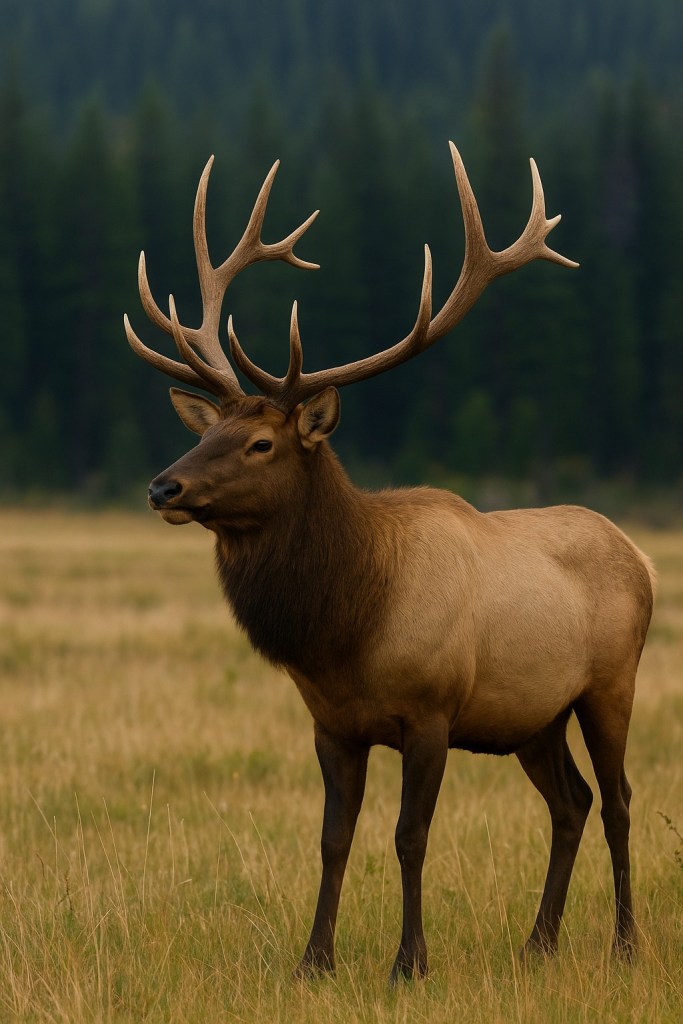
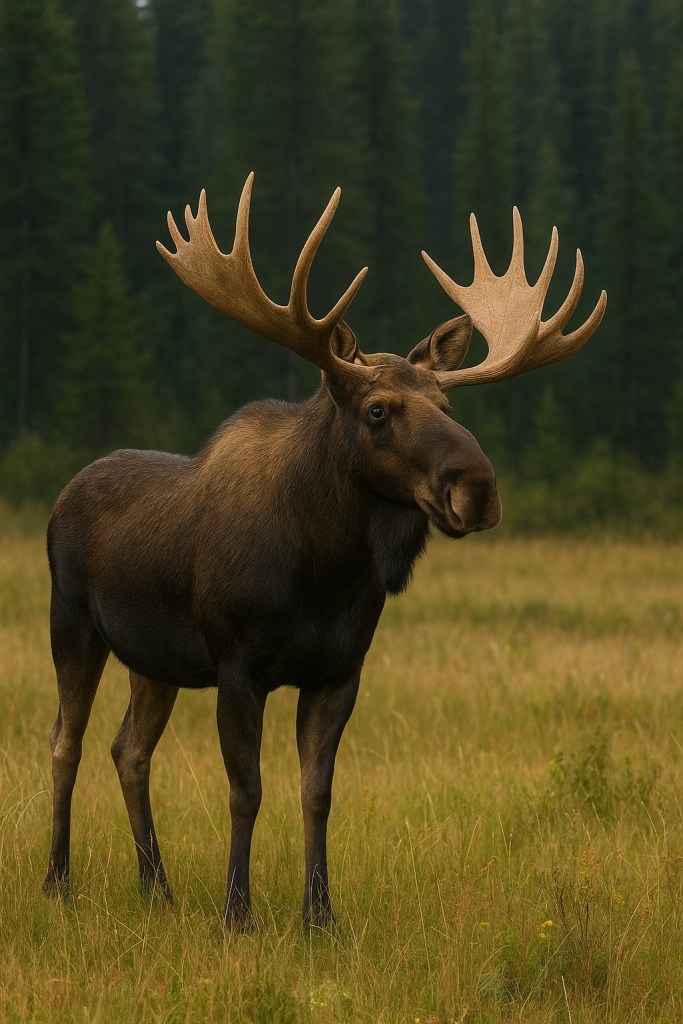
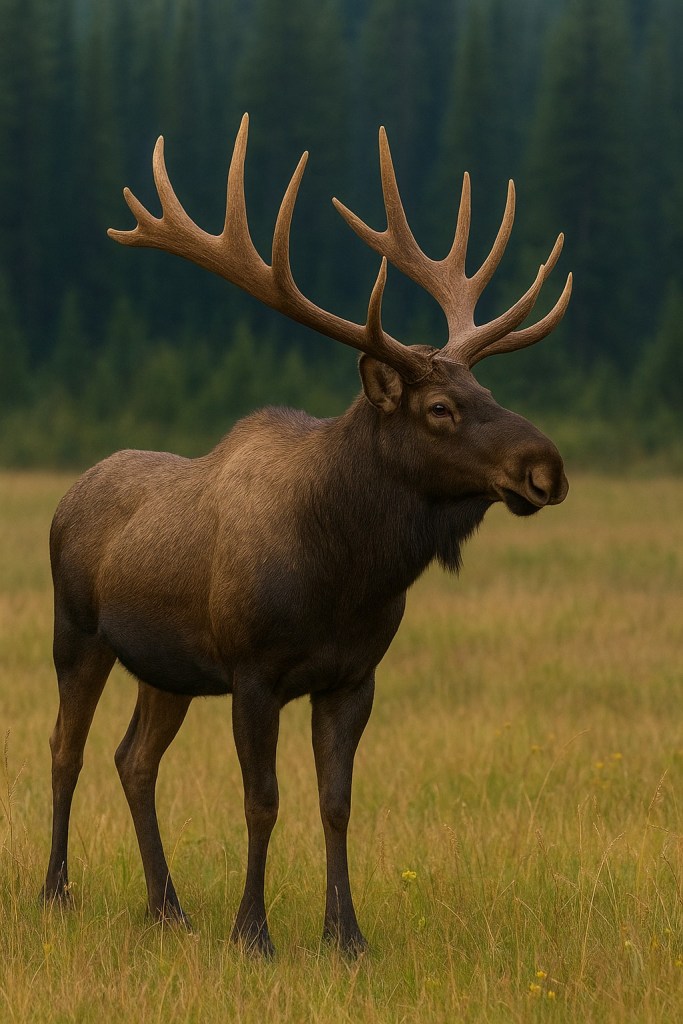
What people in North America refer to as a Moose is called an Elk in British English or in general when you speak English in Europe. It is called an “Älg” in Swedish, “Elg” in Norwegian and in Danish, “Elch“ in German, “Élan” in French, “Alce” in Spanish and Italian. If you use Google Translate “Elk” in English translates to “Älg” in Swedish and “Elch” in German, etc., but so does “Moose”. Using Google Translate Elk and Moose translate to the same animal in all other languages as well. However, if you ask ChatGPT to generate a picture of an Elk and then of a Moose you get two different animals. The same is true for Google AI. There is quite a bit of confusion.
ChatGPT generated picture of an Elk. Or is it a Moose?ChatGPT generated picture of a Moose. Or is it an Elk?ChatGPT generated picture of a Moose-Elk. Or is it an Elk-Moose.
The moose (Alces Alces) is called Elk in Eurasia. It belongs to the deer family and like all members of deer family the bull has antlers. It is the largest species within the deer family. After the mating season the males drop their antlers to conserve energy for the winter. A new set of antlers will then regrow in the spring. An interesting fact about moose is that not all bull moose have the same type of antlers. The moose in northern Europe and Alaska have palmate antlers, and they act as parabolic reflectors, amplifying sound at the moose’s ear. You may think that the plural of Moose is Meese, but it is not, and it is not Mooses either, it is just Moose. To read more about moose click here.
The Moose (or Elk in Eurasia) live in northern North America, Scandinavia, parts of eastern Europe, Russia and Siberia. Jürgen Gbruiker / User:Jrockley, CC BY-SA 3.0 <http://creativecommons.org/licenses/by-sa/3.0/>, via Wikimedia Commons.
Elk (Cervus Canadensis) is the second largest species within the deer family. It is also called Wapiti, and I have come across the name Canada Deer in Europe. Remember, when in Europe you can’t call an Elk and Elk because in Europe the name Elk is reserved for Moose. Like Moose Elk shed their antlers every year. You can read more about Elk here. Note that it says “This article is about the species called “elk” in North America. For the species called “elk” in Eurasia (Alces alces), see Moose.”.
Moose and Elk Photos
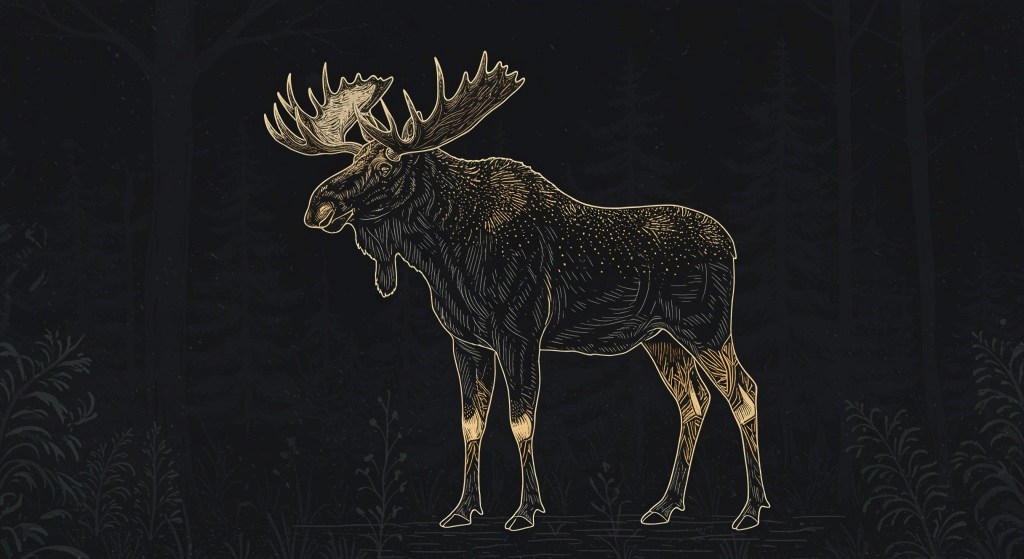
Vintage boho artistic image of älg (a bull moose) in Sweden in the forest Asset (Shutterstock AI) id: 2592983377A Moose in Jasper Canada Asset id: 2031585740 by Harry Collins PhotographyA bull elk in autumn during the rut Asset id: 190972129 by Harry Collins PhotographyPhoto of Elk taken by friend in Yellowstone National Park.Photo of a moose taken by friend in Grand Teton National Park.
My Moose and Elk Photos
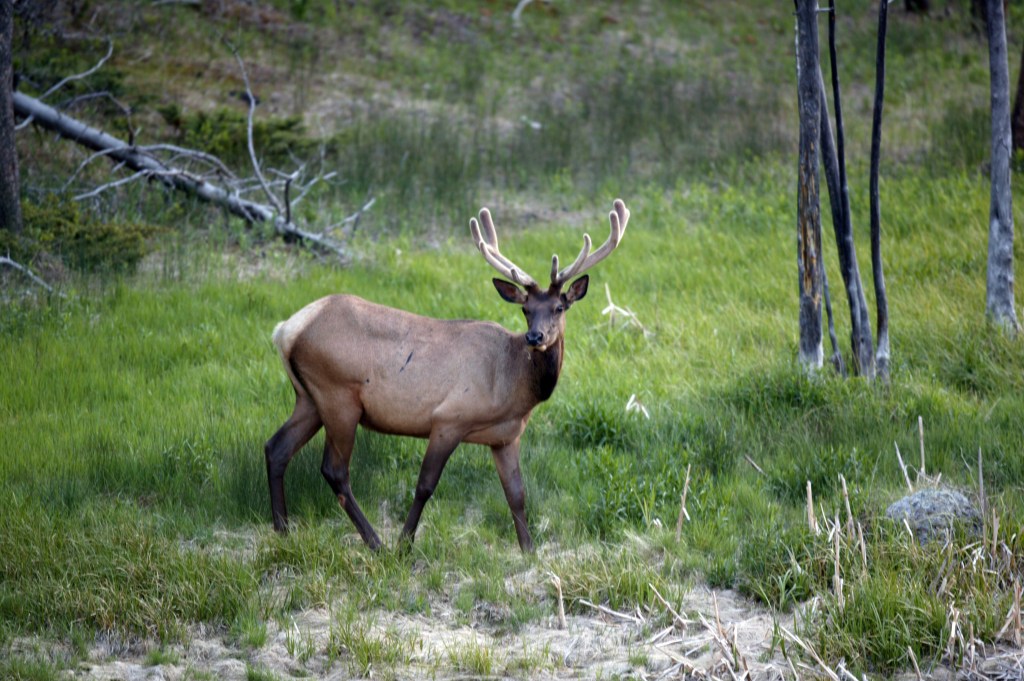
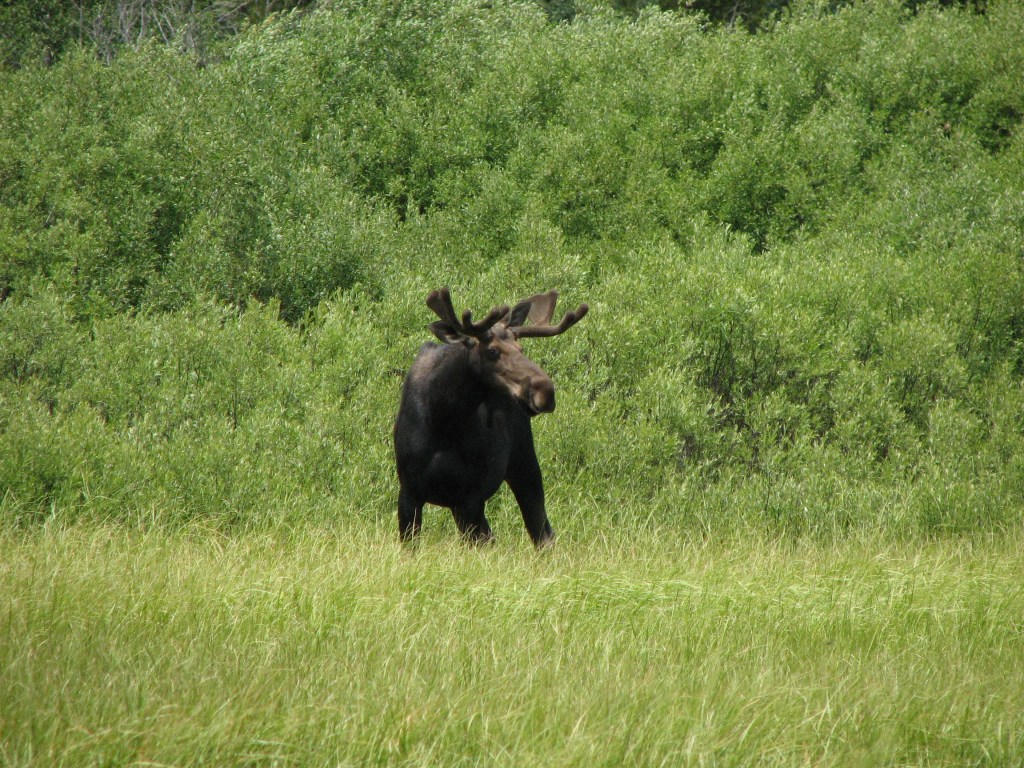
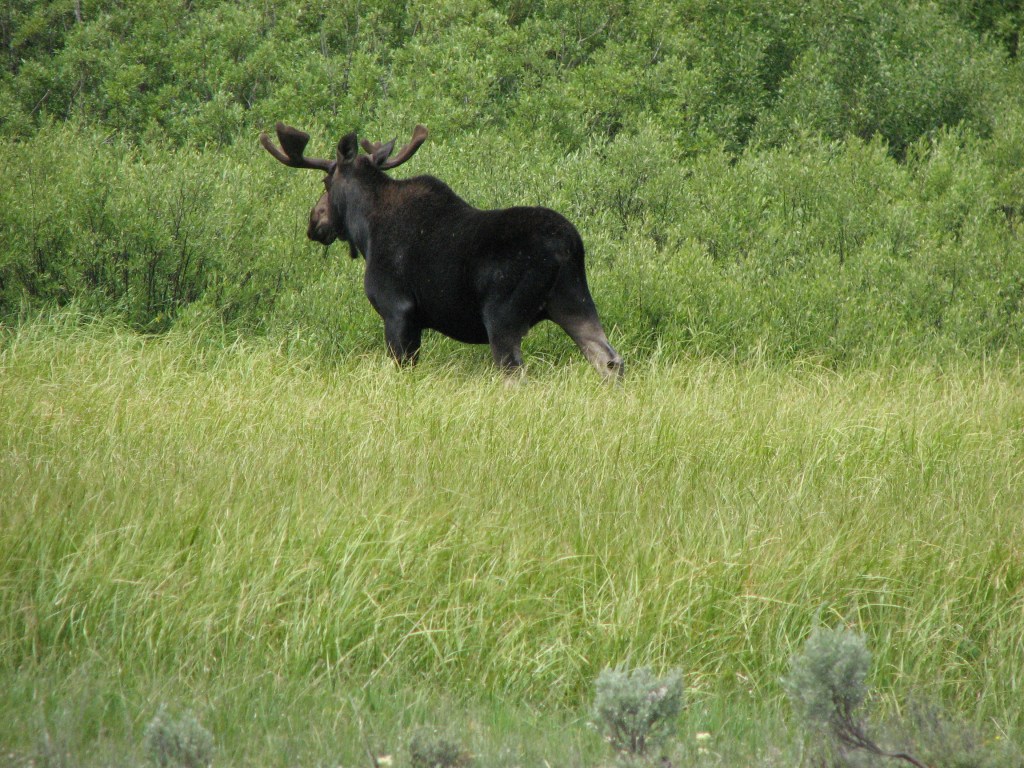
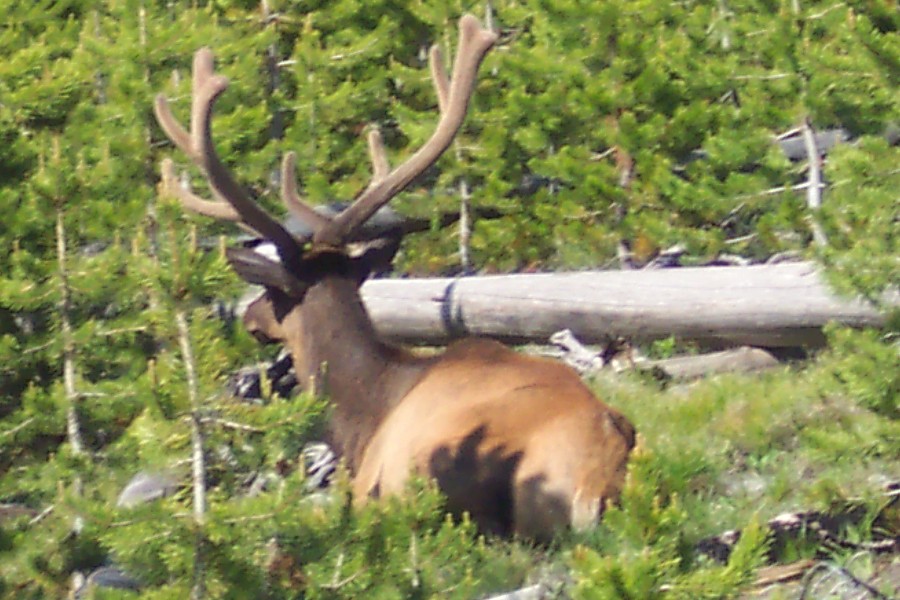
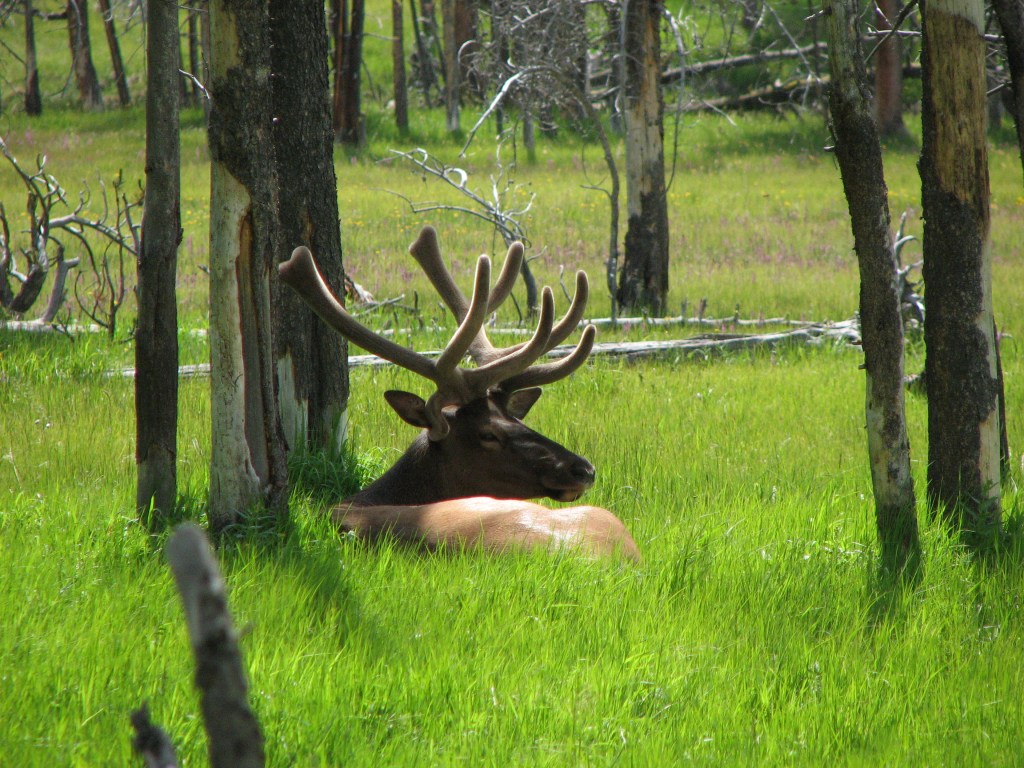
Photo of a Moose that I took on a visit to Yellowstone National ParkPhoto of a Moose that I took on a visit to Yellowstone National ParkPhoto of an Elk that I took on a visit to Yellowstone National ParkPhoto of another Elk that I took on a visit to Yellowstone National ParkPhoto of two Elk that I took on a visit to Yellowstone National Park.
The Murder Moose
The first story I ever wrote in my life I gave the title the “The Murder Moose” / “Mördar Älgen”. It was when I was in second grade in Swedish public school. Our teacher told us that we could write about anything, and I chose a horror story. The story was about a very big and dangerous moose that ran into to villages and killed people. At the end of the story a hunter shot the moose. I also drew a picture of a moose with big antlers and sharp teeth.
The murder moose in my second grade story. The picture was generated by ChatGPT.
The inspirations behind this story were two-fold. A neighbor’s girl and I had been walking in the forest together when we saw something big moving behind a thicket around 30 feet ahead of us. At first it looked like a horse and carriage to me, but it couldn’t be. A horse and carriage could not have gotten deep into the forest. Suddenly two big heads peered out of the thicket. It was a bull moose and female moose. We screamed on top of our lungs and ran home, and the two moose startled by our screams ran the opposite way.
The second inspiration for the story is that moose hunting is very common in Sweden especially in northern Sweden where I lived. Sweden has a very large moose population of approximately 300,000 to 400,000 moose, with a stable population of around 350,000. Sweden is the country with the highest concentration of moose in the world. Each fall about 80,000 to 90,000 moose are hunted and killed during the hunting season as part of wildlife management. Therefore, moose hunting was a practice that a lot of adults I knew participated in. We also ate a lot of moose meat.
So, on what subject(s) am I an authority? My understanding on what being an authority on a subject means is that it is being an expert with recognized credibility on that subject. However, the word “authority” has so many other meanings and it brings to mind the “appeal to authority fallacy”. The “appeal to authority fallacy” refers to appealing to influential people or organizations who may not necessarily be experts, and regardless of the evidence.
In science you don’t really have such authorities, you have experts who often disagree with each other. In the event almost all experts agree on a certain fact that has been thoroughly vetted you can trust that fact with nearly 100% certainty, and that is not appeal to authority but a probability argument. Therefore, I don’t really like the use of the word authority in this context. It is confusing. I would have preferred the question to be “In what subject(s) do you have recognized expertise?”
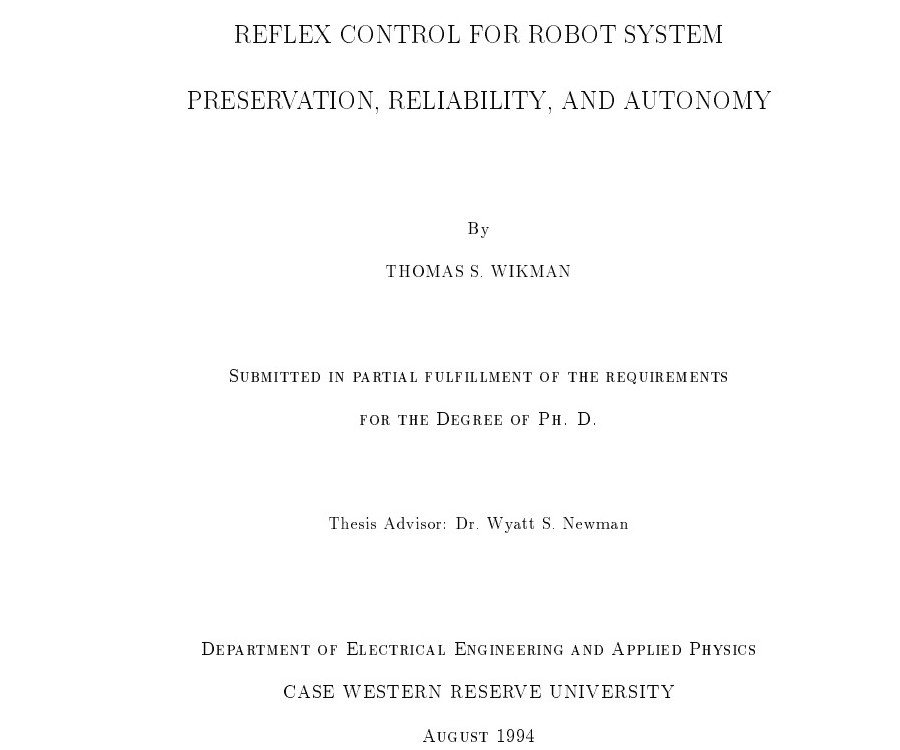
This is the front page of my PhD thesis “Reflex Control for Obstacle Avoidance and Self Preservation”.
Robotics
Reflex Control for Obstacle Avoidance and Self Preservation
My PhD thesis was in Robotics, specifically Reflex Control for Obstacle Avoidance and Self Preservation. Therefore, you can say that I am an expert on Reflex Control for Obstacle Avoidance and Self Preservation, Reflex Control (in Robotics) as well as Robotics. My expertise has been recognized through my published research papers, the citing of those papers, my PhD thesis, and my peers including Rodney Brooks.
Rodney Brooks is a former director of the MIT Computer Science and Artificial Intelligence Laboratory, founder of several robotics research companies, and he is arguably the most famous roboticist in the world. In the 1990’s he was featured on the front page in national magazines such as Time Magazine several times. During my internship at the Robotics Lab at Sandia National Laboratory in Albuquerque, New Mexico in 1993, I spoke to Rodney Brooks about my research, and he congratulated me on my research, which he liked.
Briefly, reflex control in Robotics refers to functionally simple, quick, and reliable behaviors that override whatever more complex algorithms or humans (joystick / telerobotics) are commanding in case those algorithms or humans execute dangerous motion. Take for example, a robot moving quickly among multiple objects and the path planning algorithm generates a faulty command that would result in a collision when executed. The reflex control layer would detect the problem (assuming it knows about the objects) and halt the robot before it collided with the object. This would need to happen quickly, in milliseconds, and always in a failsafe way. After the collision has been avoided the system or the human can figure out what went wrong and figure out a new path.
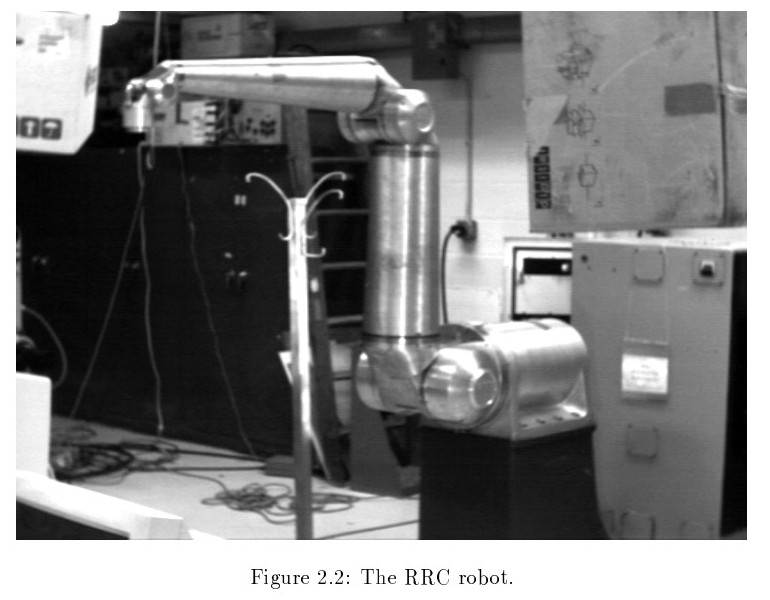
To do this the Reflex controller needs to be embedded with the motion controller, and know the characteristics of the motors, the robot configuration, and mechanical characteristics, such as mass, friction model, inertia, etc., exactly. The result is that when you drive a robot around among multiple objects such as boxes hanging from the ceiling, coat racks, and sombreros, and other robots it will avoid colliding with these objects regardless of input from people or high-level path planning algorithms. It looked like the objects were protected by an invisible force field.
This is an old black and white photo of the Robotics Research Corporation Robot surrounded by objects including boxes hanging in the ceiling, a coat rack, and a control cabinet. I took the photo, and I created the software for the robot and placed the objects in its workspace.
Robot Kinematics
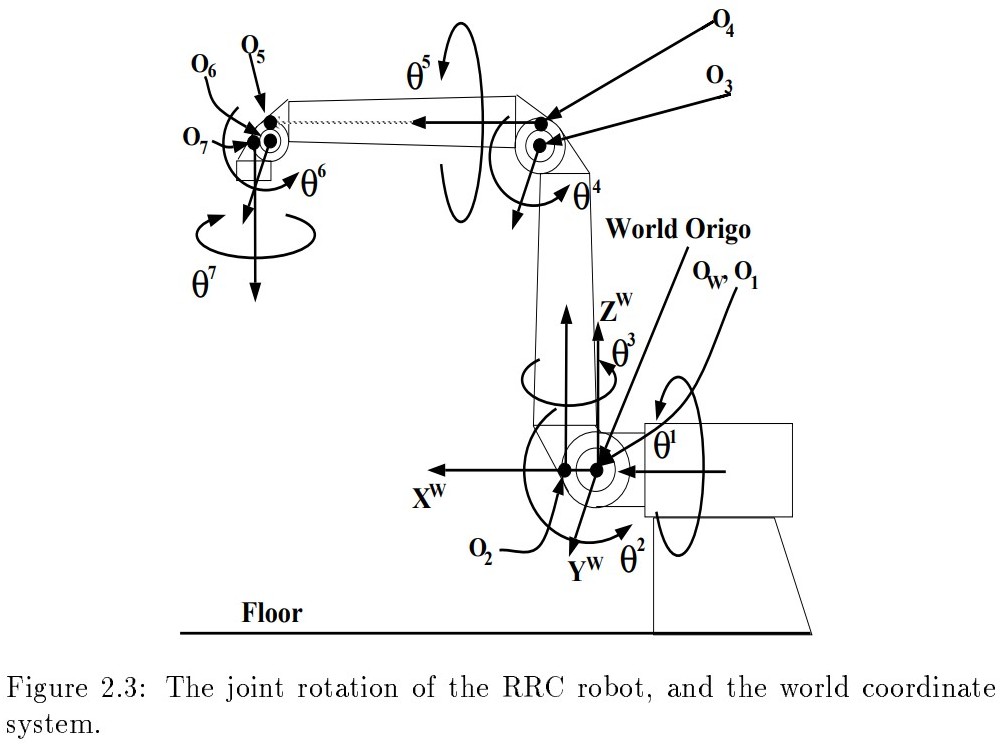
In addition, to “Reflex Control for Obstacle Avoidance and Self Preservation” or “Reflex Control for Robots”, which is very narrow field, I gained expertise in fields of robotics that are a bit wider. One such field is robot kinematics. That includes, for example, calculating the position, speed and acceleration of the tool tip (the end tip) of the robot from the position and motion of the joints of the robot. Or it could be calculating the possible joint angles from the position of the tool tip. The RRC robot was a seven-jointed robot so this could get complicated. I should say that when I worked for ABB Robotics (after my Ph.D) I created the kinematic models for 30+ of ABB Robotics robots. Therefore, I have expertise and recognized credibility in Robot Kinematics as well.
The drawing shows the seven joints, the seven possible rotations around those joints, the seven joint angles (the thetas), and the seven coordinate systems and their origos (the O’s) at each joint.
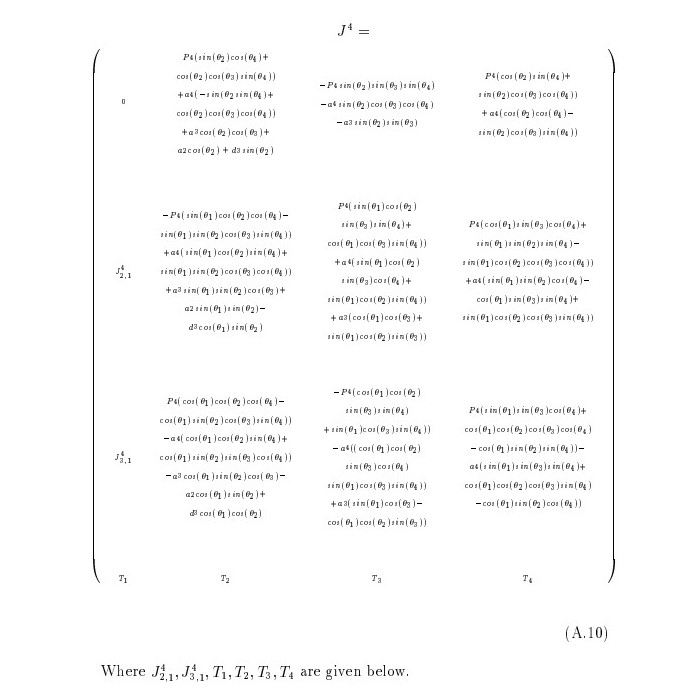
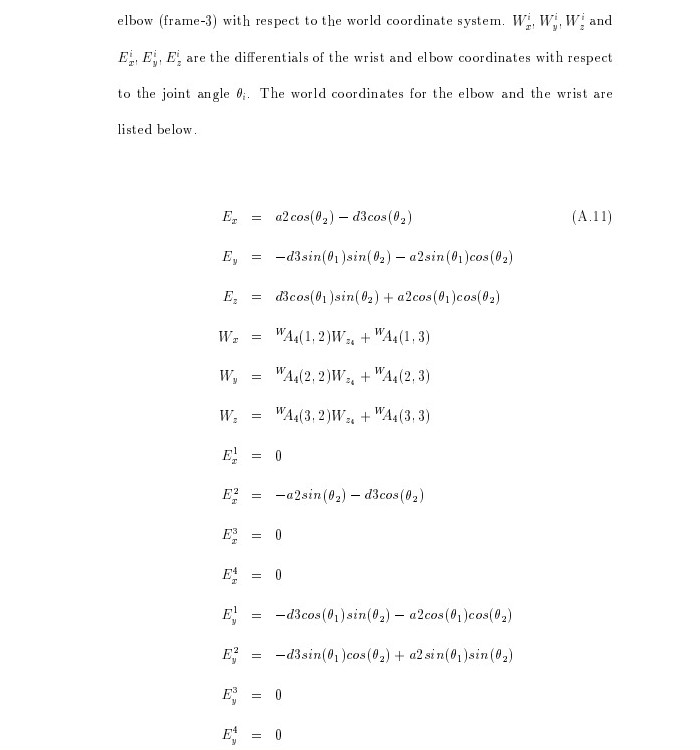
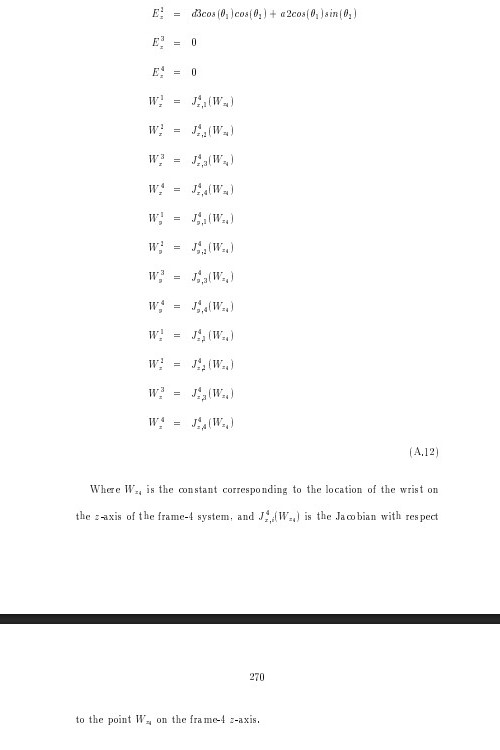
Robot kinematics can get complicated, at least for a seven-jointed robot like the RRC Robot. An example is the Jacobian, which is a matrix that relates joint velocities to end-effector / tool-tip velocities. The Jacobian is crucial for understanding and controlling robot motion, particularly for inverse kinematics and trajectory planning. Below is the Jacobian for the first four joints of the RRC robot. I spent an entire day deriving it. Depending on your eyesight it is difficult to read the scribbles, but it is a bunch of very long, mostly trigonometric equations. Don’t worry about understanding the matrix, it is just to show how complicated robot kinematics can get.
First part of the 4-dimensional (first four joints) Jacobian for the RRC Robot.Second part of the 4-dimensional (first four joints) Jacobian for the RRC Robot.Third part of the 4-dimensional (first four joints) Jacobian for the RRC Robot.Fourth part of the 4-dimensional (first four joints) Jacobian for the RRC Robot.
Configuration Space in Robotics
Another subject I gained a lot of expertise in is configuration space or so-called C-space. It is related to robot kinematics. C-space is a mathematical representation of all possible configurations a robot can take. In C-space for a robot arm (like the RRC Robot) the coordinates are the joint angles instead of X, Y and Z. For the seven-jointed RRC robot you have seven joint angles and C-space is thus seven dimensions. C-space is very useful if you succeed in representing obstacles in it. A point might become a curve, or multi-dimensional membrane in C-space, and a ball might become a multi-dimensional banana. I had a lot of fun creating algorithms for creating C-space with obstacles in it.
My Other Expertise
I also have a degree a master’s degree in engineering physics (Teknisk Fysik) from Uppsala University in Sweden. I should say that engineering physics in Uppsala was focused a lot on theoretical physics and modern physics as well as practical applications for physics. Case Western Reserve University later converted this degree to a master’s in electrical engineering. I loved physics and was a good student, but my special interest was the theory of relativity. Even though I had and still have a hard time with the General Theory of relativity and I studied the special theory of relativity way beyond what was required at school, and I read dozens of technical books on the subject. So, this is also sort of an area expertise for me.
Below are some links to topics related to the special theory of relativity on this website:
I spent at least 30 years working with software as a software engineer / robotics engineer and gained a lot of experience in software development. It was mostly embedded software but also graphical user interfaces, things you can see on a screen, and Networking Software Development. I worked a lot with Visual Studio, a powerful, expandable, and popular integrated development environment (IDE) from Microsoft.
I developed a lot of code using C++ and C#, .Net, WPF, but also other languages and libraries. I started with Visual Studio 97 (in 1997), then Visual Studio 6, Visual Studio .NET 2002, Visual Studio .NET 2003, Visual Studio 2005, Visual Studio 2008, Visual Studio 2010, Visual Studio 2012, Visual Studio 2015, Visual Studio 2017, but I never got around to Visual Studio 2019 and Visual Studio 2022. So, you can say that I am an expert on Visual Studio with C++ and C# and .NET (I am less of an expert on the other languages typically used with Visual Studio).
Later in life I also came to learn a lot about climate change / climate disruption / global warming / the greenhouse effect whatever you call it. I used to be skeptical about climate change, and I thought it might be politicized by the scientific community, but after some interesting red flags I took a deep dive into the subject, and I learned that climate change is very real and caused by us. I was politicized not the scientific community. There is a scientific consensus on the subject for very good reasons. I continued by reading dozens of climate science papers and several dozens of technical and non-technical books on the topic. Therefore, at this point I know more about it than a lot of people. Maybe expert is a strong word, but almost expert.
Least but not last
Being a Leonberger Dog Expert
I know a lot about Leonbergers because my family was lucky enough to live with one for thirteen years. His name was Le Bronco von der Löwenhöhle—but we called him “Bronco” for short. Bronco wasn’t our only dog, but our world wouldn’t have been the same without him. For instance, he once saved the life of our pug by fending off an attack from another dog. He probably saved our Labrador’s life, too, by sniffing out an impending insulin shock before it happened. Then there was the time he scared off a trespasser who’d been terrorizing my wife and other women in the neighborhood.
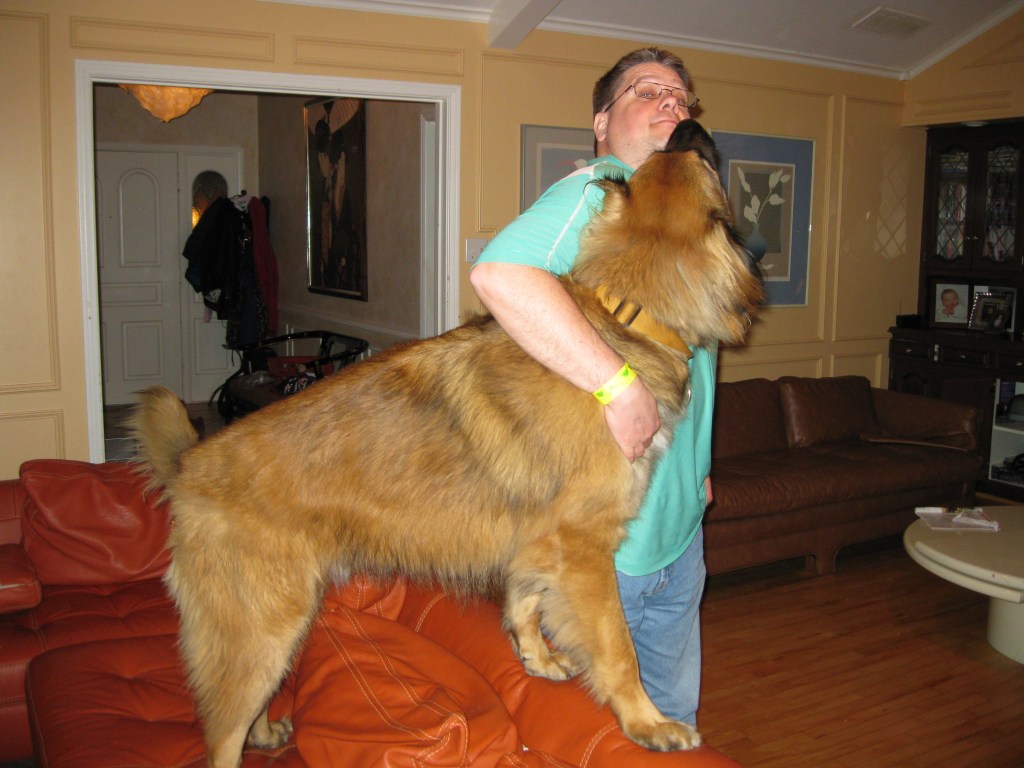
Bronco loved to dance and hug. Here he is giving me a hug (not yet fully grown).
Bronco is no longer with us, but even in his passing he was distinctive. Leonbergers tend to live less than nine years—but Bronco came very close to reaching his thirteenth birthday. In fact, he received an award for longevity called the “Grey Muzzle Award.” We already knew he was a special dog, but we sent his DNA to two labs for research anyway. I wrote a book about our amazing Bronco and his many amusing adventures and included helpful information on Leonbergers for new owners and interested dog lovers. I also have a Leonberger website.
In the process of writing my book about Bronco and Leonbergers I came to learn a lot about Leonberger dogs, the Leonberger breed standard, their history, health issues, Leonberger organizations, health and care, etc. I became a bit of a Leonberger expert. If you are interested in the book, check it out here or here. You can also get it from Amazon in many other countries, Barnes & Noble, Chapters Indigo and many other bookstores. For more information check here.
This picture reminded me of our trip to Australia and all the kangaroos and other marsupials we encountered. This is a submission for Kevin’s No Theme Thursday.
There Are Three Types of Mammals
Placentals, Monotremes, and Marsupials
All mammals are warm-blooded, have fur, and produce milk. However, there are three main types of mammals, placentals, monotremes, and marsupials, distinguished by how they give birth. Placentals give birth to well-developed young, and they nourish their young in the uterus through the placenta. Examples include gorillas, humans, whales, rodents, tigers, and bats. Monotremes lay soft-shelled eggs. Examples include the platypus and the echidna.
Then we have Marsupials, which give birth to small and underdeveloped young. Most female marsupials have pouches. Examples include kangaroos, wallabies, wombats, possum, opossum, Tasmanian devils, and koalas. Below is a kid friendly overview of the three types of mammals.
Marsupials on Three Continents
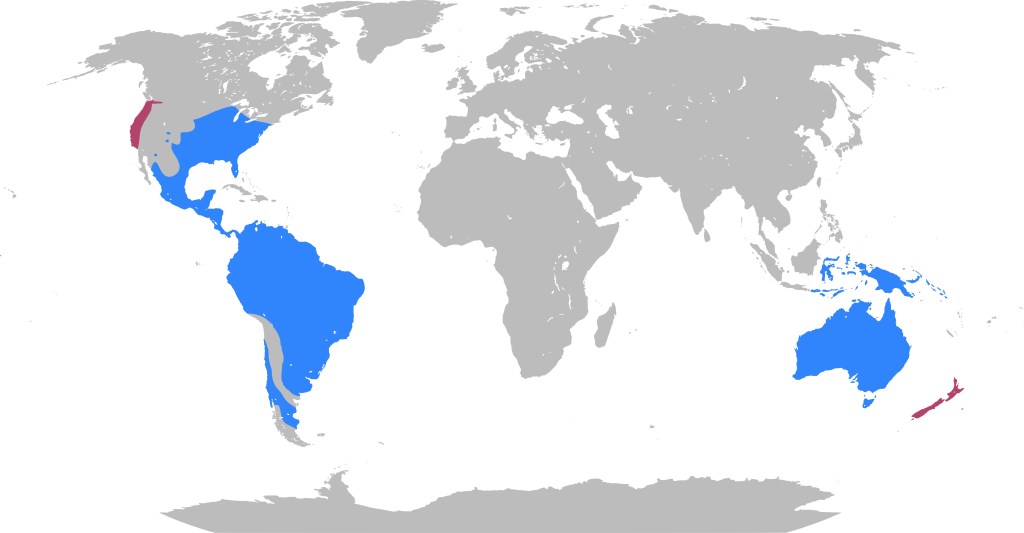
Close to 70% of the 334 extant marsupial species are concentrated on the Australian continent, including mainland Australia, Tasmania, New Guinea, and nearby islands. The remaining 30% are distributed across the Americas, primarily in South America. The Virginia opossum is the only marsupial native to the United States, but it is quite common. For example, we have lots of them in our neighborhood in Dallas. It should also be noted that there are a lot of marsupial fossils in Antarctica, which means that marsupials once lived there.
This map shows the distribution of marsupials. Blue indicates places in which marsupials are native and purple where they have been introduced. The image is from Wikipedia commons created by Michal Klajban under https://creativecommons.org/licenses/by/4.0/.
DNA evidence supports a South American origin for marsupials, with Australian marsupials arising from a single Gondwanan migration of marsupials from South America, across Antarctica, to Australia. These continents were connected and part of the supercontinent Gondwana back then. The ancestors of the marsupials, the metatherians split from placentals around 100 million to 120 million years ago during dinosaur times.
Bamboozled by an Opossum
We’ve found opossums in our house, behind our laundry machine. We’ve seen them along the street, on lawns in the neighborhood and we’ve seen them climb trees. They are pretty common in our neighborhood. It should be noted that they are not possums even though they are sometimes called that. Possums is an Australian relative to the Opossum.
One day when my wife and I were out walking the dogs we saw an opossum lying on the alleyway behind our house. He looked dead. However, when I checked, he was warm and appeared to be alive even though he was unconscious. We put him in a box containing a soft blanket and took him to the veterinary. We were willing to pay for any treatment or surgeries needed. At the veterinarian he woke up and they later placed him in a nature sanctuary. We did not need to pay anything.
Later on, we learned that when an opossum is threatened or harmed, they will “play possum“. They mimic the appearance and smell of a dead animal. This response is involuntary, like fainting, and not a conscious act. That might have been what was going on. So, I might have been bamboozled by an opossum. Bamboozlement seems to be the story of my life. Luckily, he was a male and the veterinary said it looked like he had been hit by a car, so us taking him to the veterinary probably did not do much harm. However, the “playing possum” thing is something to keep in mind with these animals.
Australia and our Photos of Marsupials
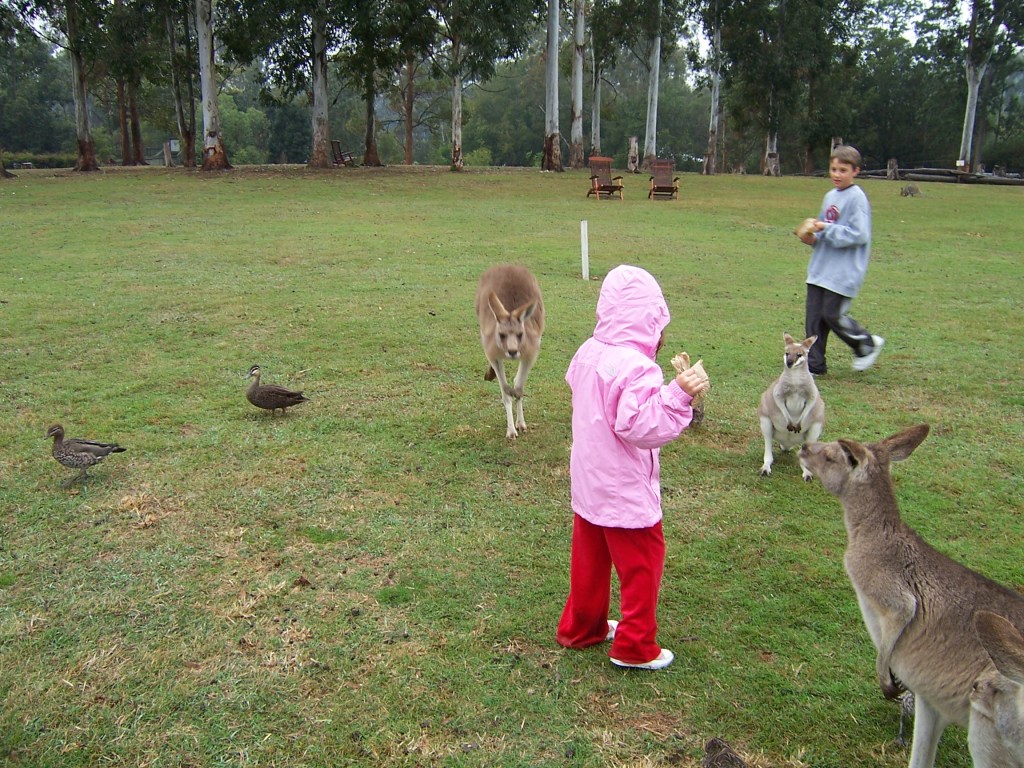
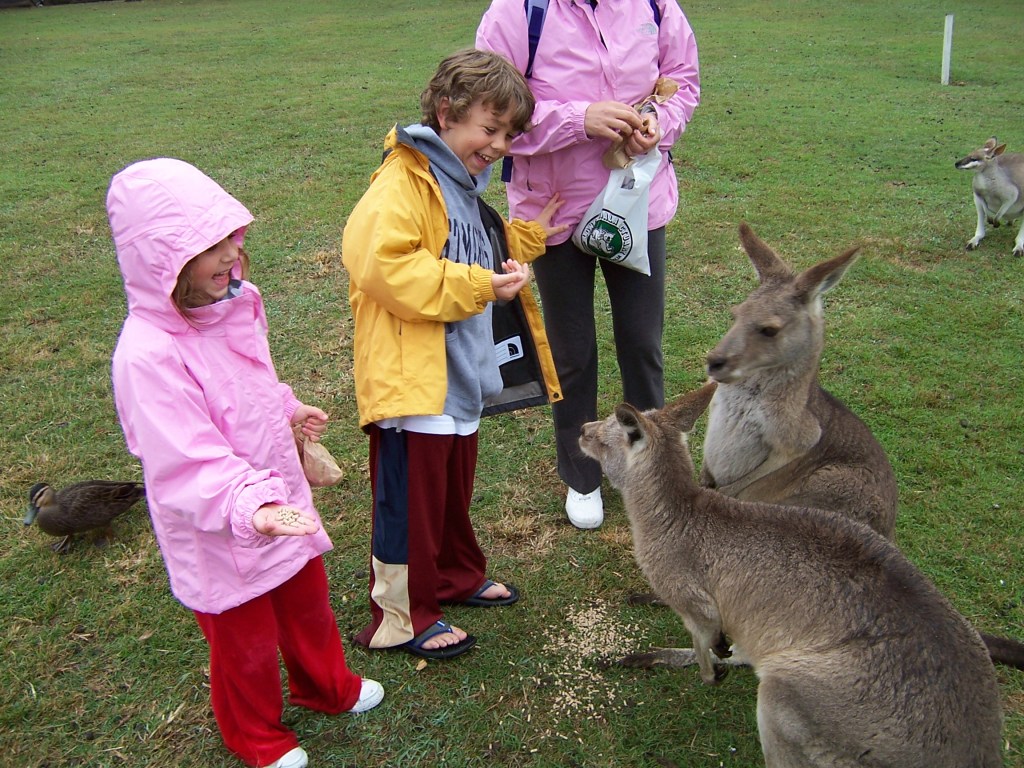
When our kids were young, we traveled to Australia where we encountered a lot of marsupials in the wild, in nature preserves and at zoos We encountered a lot of kangaroos but also wombats, koalas, and Tasmanian Devils. I can add that checking out kangaroos and other marsupials was not the only thing we did in Australia. We also spent a week in Great Barrier Reef where we did snorkel and scuba diving.
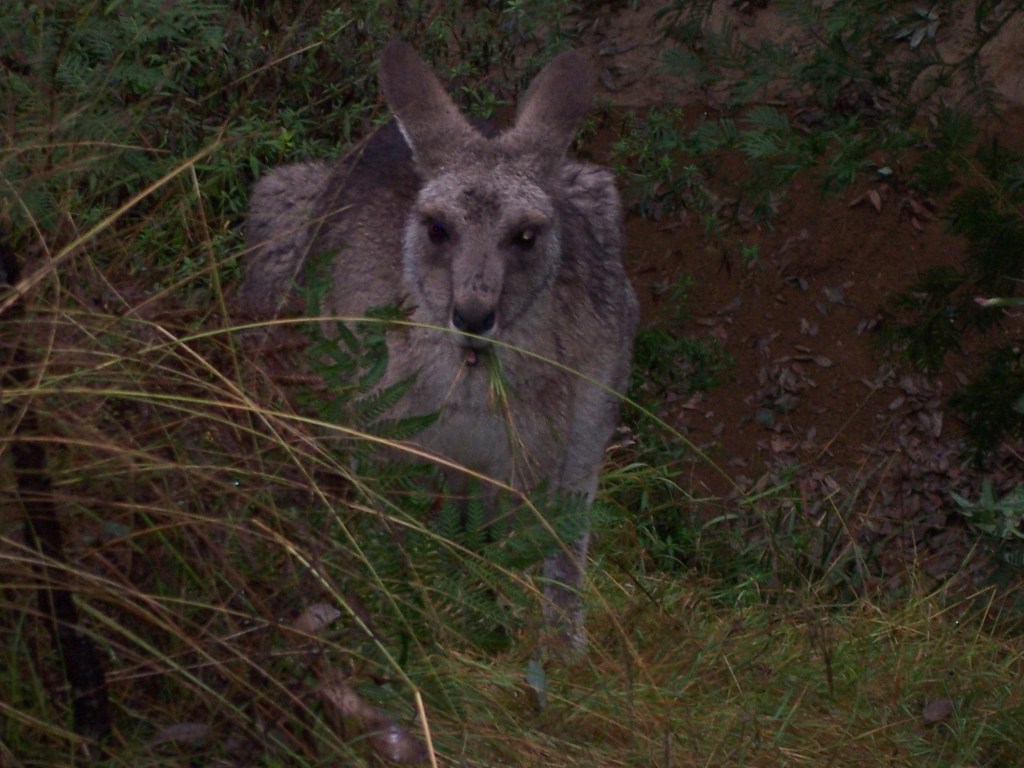
The first picture below was from our visit to the Blue Mountains. We stopped to have lunch, and I decided to go and take a leak. As I approached a bush, I heard some noise and when I looked behind the bush, I saw that there was a kangaroo behind it. What you see in the picture below is what I saw. The kangaroo was just two yards away. He seemed to be as startled as I was, and we stared at each other for a few seconds. I had my camera hanging around my neck, so I decided to take a photo. Then he hopped away. I am so glad I did not pee on his lunch.
A surprise encounter with a kangaroo in the wild. I am so glad I did not pee on his lunch.Our oldest son and daughter feeding small kangaroos (or wallabies) at a nature preserve outside Brisbane, Australia.Our younger son and daughter feeding small kangaroos at a nature preserve outside Brisbane, Australia. They are laughing because one of the kangaroos grabbed the entire bag of food and then spilled it.A small kangaroo/wallaby is sniffing my camera (at the same nature preserve).
Note : Koalas are often called Koala bears, but they are not bears.
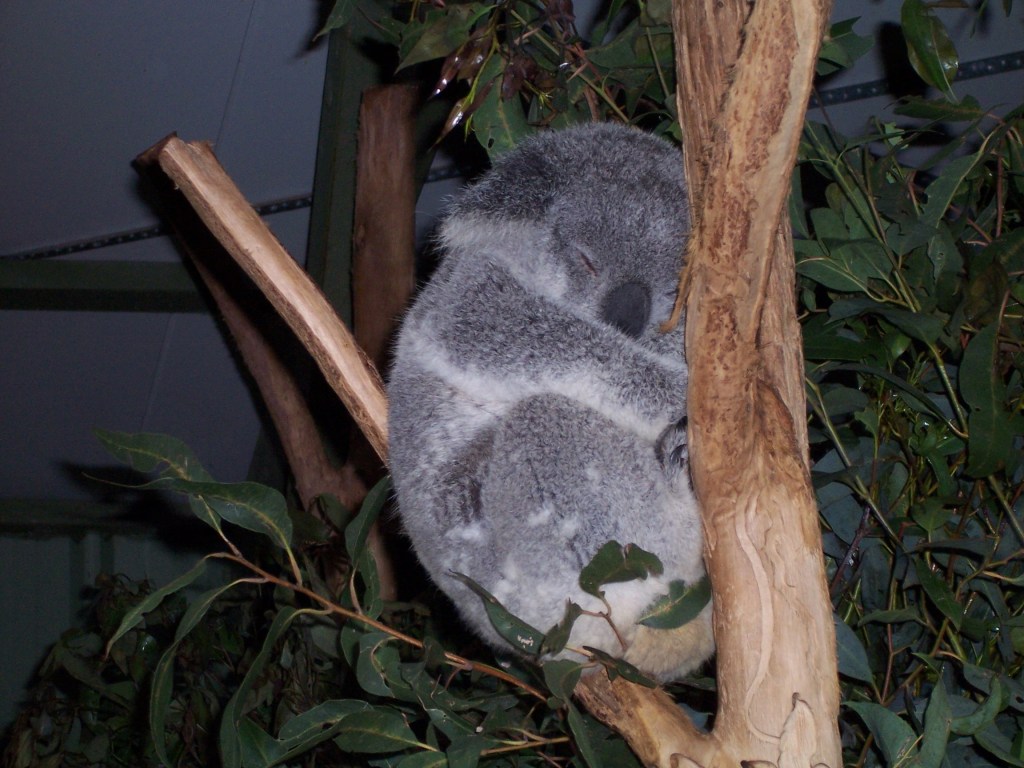
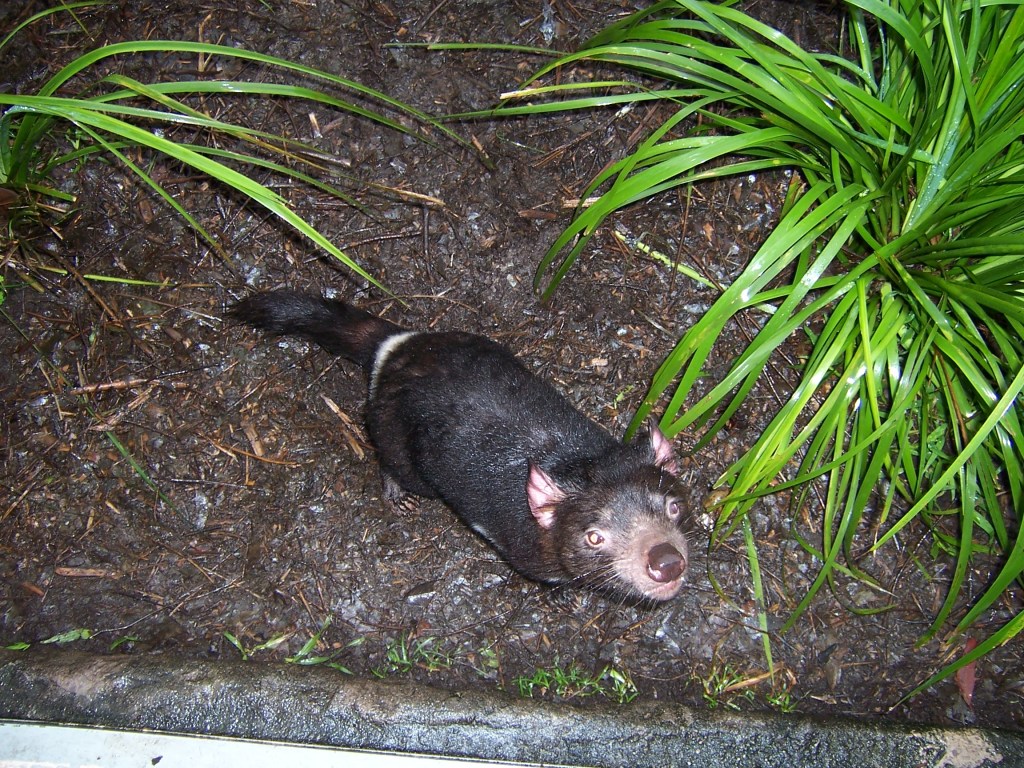
A Koala sleeping in a tree at Brisbane Zoo.Our daughter holding a Koala at Brisbane Zoo.A Tasmanian Devil at the Brisbane Zoo.Wombat at Brisbane Zoo
One interesting fact about Wombats is that they produce cubic shaped poop. This makes the poop stackable, and the wombats use it to mark their territory and attract mates.
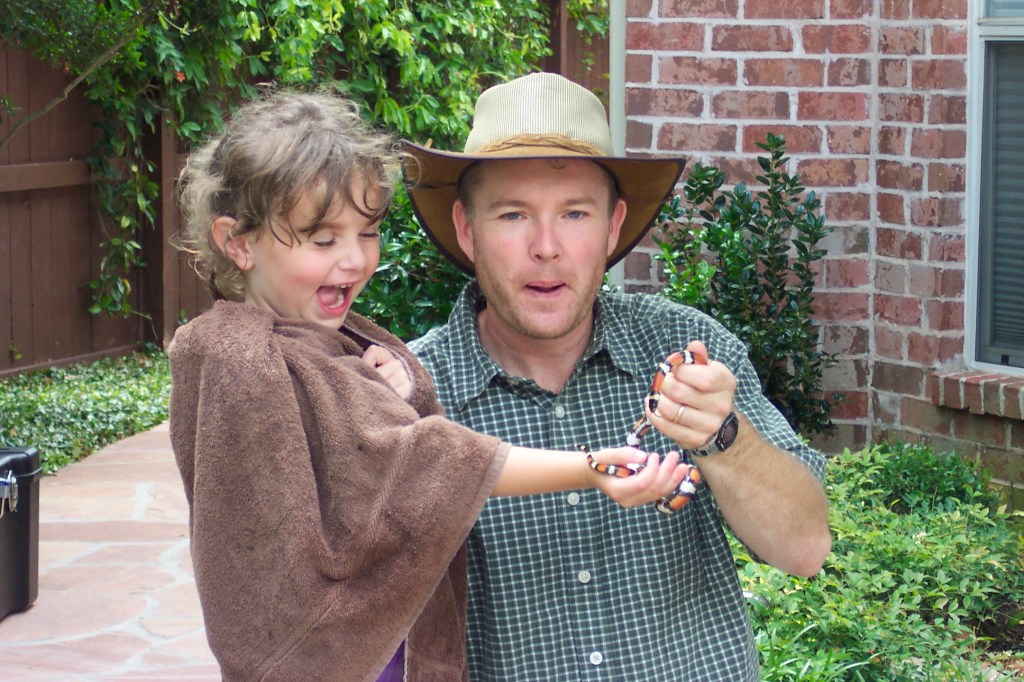
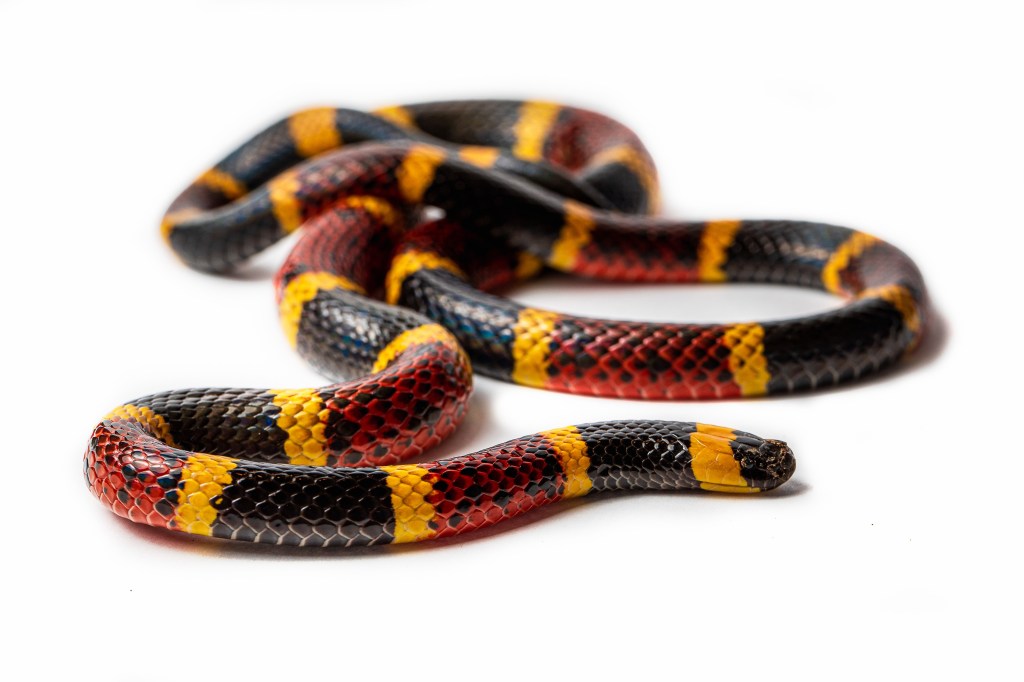
There at least 105 species of snake in Texas, the most of any U.S. state and 15 species are significantly venomous and four more are mildly venomous. The most venomous is the Texas coral snake, which has enough venom in one bite to kill six adult men. However, the milk snake and the king snake are harmless snakes that look very similar to the coral snake. The way to tell the difference is to use the rhyme “Red touches yellow, kill a fellow; red touches black, friend to Jack” or alternatively “Red touch black, safe for Jack. Red touches yellow, kills a fellow”.
Look at the two pictures below. One is my daughter with the critter man, and she is holding a milk snake. The other picture is of the deadly coral snake. Can you tell them apart by using the rhyme?
My daughter with a milk snake. We hired the critter man for her birthday.Photo of a Texas coral snake. Stock Photo ID: 2018440949 by Scott Delony
The Green Mamba
When our kids were young, we frequently visited Dinosaur State Park near Glen Rose, Texas. On one occasion I was carrying my four-year-old son on my shoulders. Suddenly he shouted, “Dad you almost stepped on that Green Mamba”. I looked down and between my feet crawled a green snake. It was a harmless green grass snake, but I did not even know there were green snakes in Texas.
On another occasion I was showing a whipsnake to my daughter. It was at a girl scout camp, and I had taken the snake out from its glass jar located in a room where they stored nonvenomous snakes. I was holding it in my hands. The whipsnake was pretty strong and decided to crawl under my shirt sleeve. I had to fight it to get it out from underneath my shirt sleeve and back into its glass jar. I probably looked like a clown juggling a snake. Whipsnakes are thin but very strong, long and stubborn.
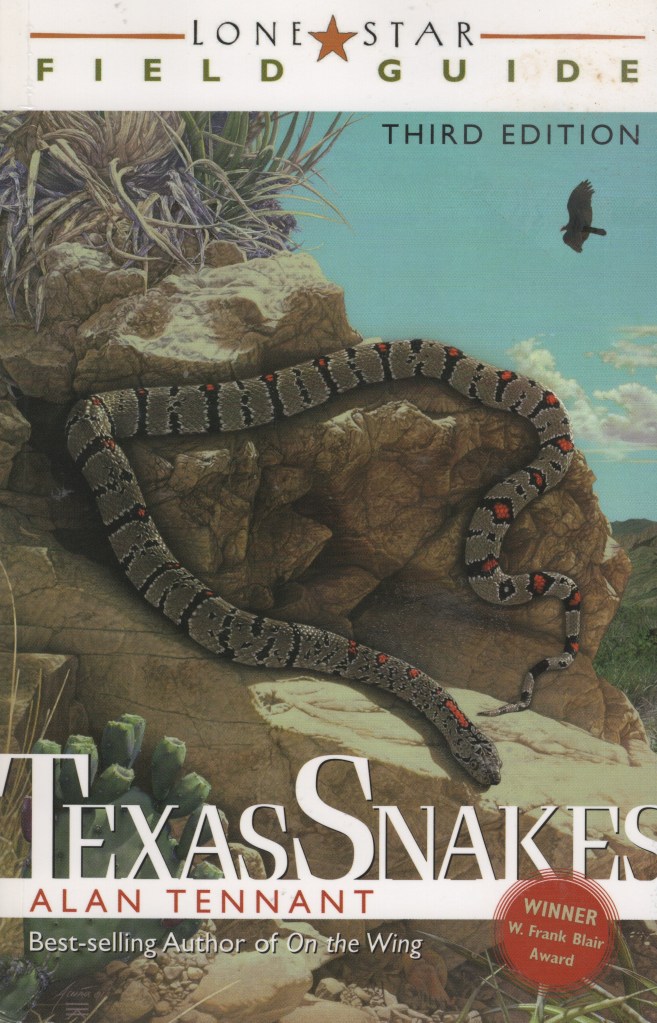
We’ve also seen all kinds of water snakes as well as the dangerous water moccasin or cottonmouth as it is also called. We’ve seen rat snakes and snakes in our yard. I’ve seen a lot of snakes in the wild here in Texas and I typically don’t know what kind they are. That’s why I needed The Lone Star Field Guide to Texas Snakes by Alan Tennant.
Lone Star Field Guide to Texas Snakes by Alan Tennant
The goal of this blog is to create a list of what I call super facts. Important facts that we know to be true and yet they are shocking or disputed among non-experts. Super facts are important facts that people get wrong.
However, I sometimes create posts that are not super facts but contain other interesting information, such as this book review and book recommendation of the Lone Star Field Guide to Texas Snakes. This book features 105 snakes and includes hundreds of photos, information on prey and reproduction, habitat information, geographical distribution, and more. I bought the paperback version of the book.
Paperback – Publisher : Taylor Trade Publishing; Third edition (December 28, 2005), ISBN-10 : 1589792092, ISBN-13 : 978-1589792098, 352 pages, item weight : 1.15 pounds, dimensions : 7.1 x 0.81 x 8.46 inches, it costs $43.46 new on Amazon, but you can buy used copies much cheaper. Click here to order it from Amazon.com.
Kindle – Published : Taylor Trade Publishing; 3rd edition (January 27, 2006), ASIN : B00IUFI1K8, 352 pages, it costs $10.99 on US Amazon. Click here to order it from Amazon.com.
Front cover of Lone Star Field Guide to Texas Snakes. Click on the image to go to the Amazon page for the paperback version of the book.
Amazon’s description of the book
The State of Texas not only boasts the largest snakes in North America, but also the largest number of species—105. This guide describes in detail each and every one of them, from the benign Texas long-nosed snake, to the venomous Western Cottonmouth. Facts on the biology and behavior are given, plus the latest findings on abundance, reproduction, prey, sizes, and habitat.
In addition, introductory chapters describe the physiology and diet of snakes, and an all-important section on “Venom and Evenomation” debunks the many myths surrounding what to do when bit by a venomous snake. 128 color plates of species and subspecies aid in identification.
The review I posted below is a copy from Amazon, but I’ve improved it a bit. For example, in my original review of 2008 I called snakes poisonous. Snakes are not poisonous, they are venomous.
You almost stepped on that green mamba
“Dad, you almost stepped on that Green Mamba”. That is what my 4-year old (sitting on my shoulders) told me when we were walking in Dinosaur Valley state park. Using the second edition of this book I was able to identify the snake as the “Rough Green Snake” when I got home.
I am glad there are no Green Mambas in Texas (in the wild), but there are still some very poisonous snakes to watch out for. Seven species of rattle snake, two species of Massasauga, and a pigmy rattle snake, cottonmouth (water moccasin), three species of copperhead, and the Texas Coral snake. The Texas Coral snake is the most venomous of the snakes in Texas (but it is not aggressive) and the poison from the Mojave Rattle Snake can kill six adults (lives only in West Texas). There are 105 species of snakes in Texas.
This edition (third edition) has essentially the same pictures and information as the second edition, but the third edition is organized better, is a little bit bigger, and more updated. What I really like about this book is that for each of the snakes it has a map of Texas showing the distribution of the snake.
The book is also well organized, and the photos are good. It is also an interesting book to read, it contains a lot of facts about the various snakes. Once you start reading about the various snakes, and looking at the pictures and the distribution maps, you just can’t put it down. The book tickles your curiosity. Compared to other Texas snake books that I have seen this one is the most interesting and the most well-organized of them all. If you quickly need to identify a snake this is the right book.
Back cover of Lone Star Field Guide to Texas Snakes. Click on the image to go to the Amazon page for the Kindle version of the book.
Western Diamondback Rattlesnake Crotalus Atrox
One of the most common venomous snakes in Texas is the Western Diamondback Rattlesnake. It is fairly big, 3 to 7 feet long. Nearly all of the most serious cases of snakebite treated in Texas hospitals are inflicted by Crotalus Atrox, the Western Diamond-back. Deaths are uncommon but the loss of limbs is more common. There are 10 species of rattlesnake in Texas.
Western Diamondback Rattlesnake, crotalus atrox. Stock Photo ID: 2494534895 by Clint H
Yes, I see wild animals every day despite living in a large city (Dallas). I see squirrels, rabbits, coyote, bats, birds of all kinds, crows, owls, hawks, pelicans, blue jays, mockingbirds, rats and mice, and I see snakes every now and then. Not too long ago we had a rat snake in the sink. I live in Texas and here we have 116 snake species.
I guess insects are animals too, and we have cicadas and crickets, wolf spiders, spider wasps of various kinds, including mud daubers and tarantula hawks, and sometimes I see them inside the house. We also have a lot of coyotes in the neighborhood. A few years ago, a coyote ran up to me as I was walking my two small dogs, a pug named Daisy and a Japanese Chin named Ryu. I was worried about my dogs, so I stared him down, and he ran off.
Every now and then we leave the city and there’s plenty of wild animals in the countryside. Two days ago, we visited a dark spot in Oklahoma. A dark spot is an exceptionally dark place intended for sky watching. I saw a skunk in the middle of the night. But we’ve seen foxes, coyotes, deer, antelope, wild turkeys, turkey vultures, wild pigs, bobcats, eagles, fish of all kinds, and many other types of animals. In the past we’ve also gone fishing and hunting and we’ve seen many wild animals that way.
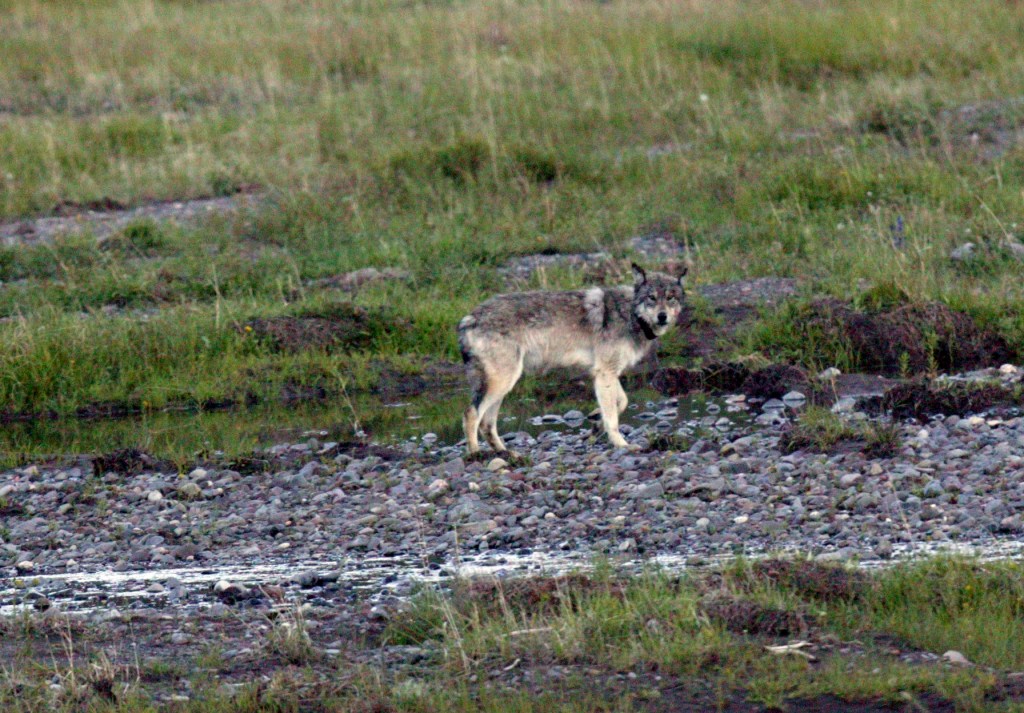
We’ve also visited national parks, for example, Yellow Stone and Grand Teton where we’ve seen grizzly bears, black bears, cinnamon bears, wolves, bison, elk, moose, prong horn, big horn sheep, marmots, whizzle pigs, and much more. I can add that sometimes we also visit other countries where we’ve seen more exotic wild animals, kangaroos, crocodiles, sharks, koalas, lynx, dolphins, etc.
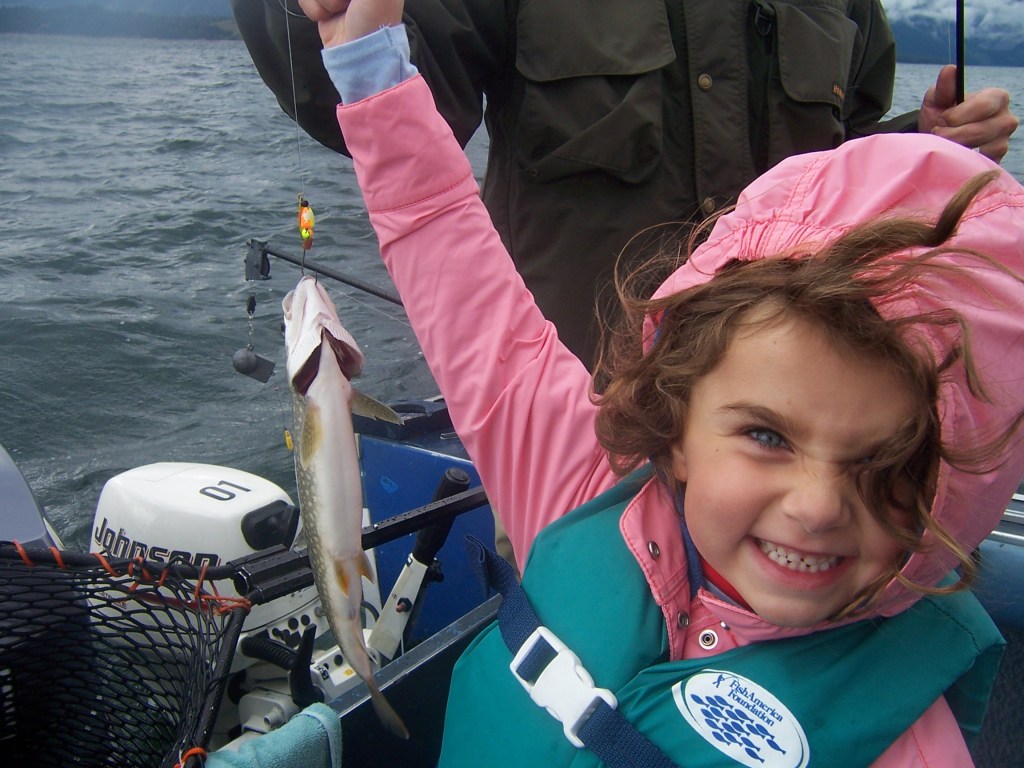
Bison in Yellowstone National ParkElk in in Yellowstone National Park, photo by meMy daughter caught a rainbow trout in Jackson Lake in Grand Teton National Park, photo by me.Grizzly bear in Grand Teton National Park, photo by Gabriel Goncalves, a fellow traveler.Grizzly bear cubs in Grand Teton National Park, photo by Gabriel Goncalves, a fellow traveler.A whistle pig in Yellowstone National Park. Photo by me.A marmot in Yellowstone National Park. Photo by me.A grey wolf in Yellowstone National Park.A moose in Yellowstone National Park.A tarantula hawk (wasp) is stinging a tarantula and then dragging it. This was in Oklahoma. Photo by either me or my friend Mark Segal.





















 Super Facts