Esther’s writing prompt: November 4th: Snake
Click here to join in
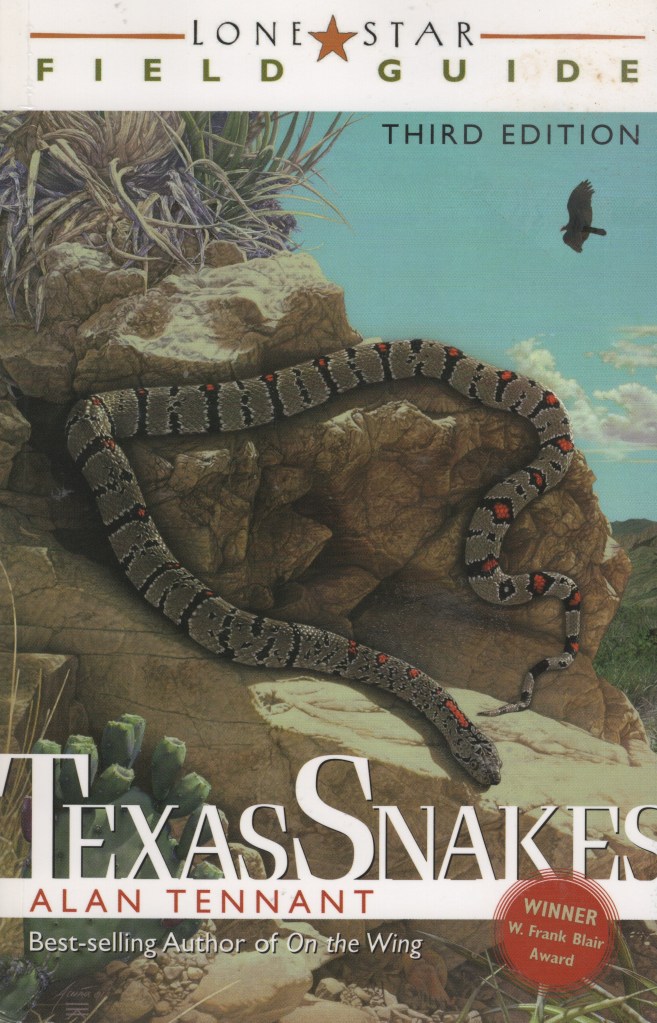
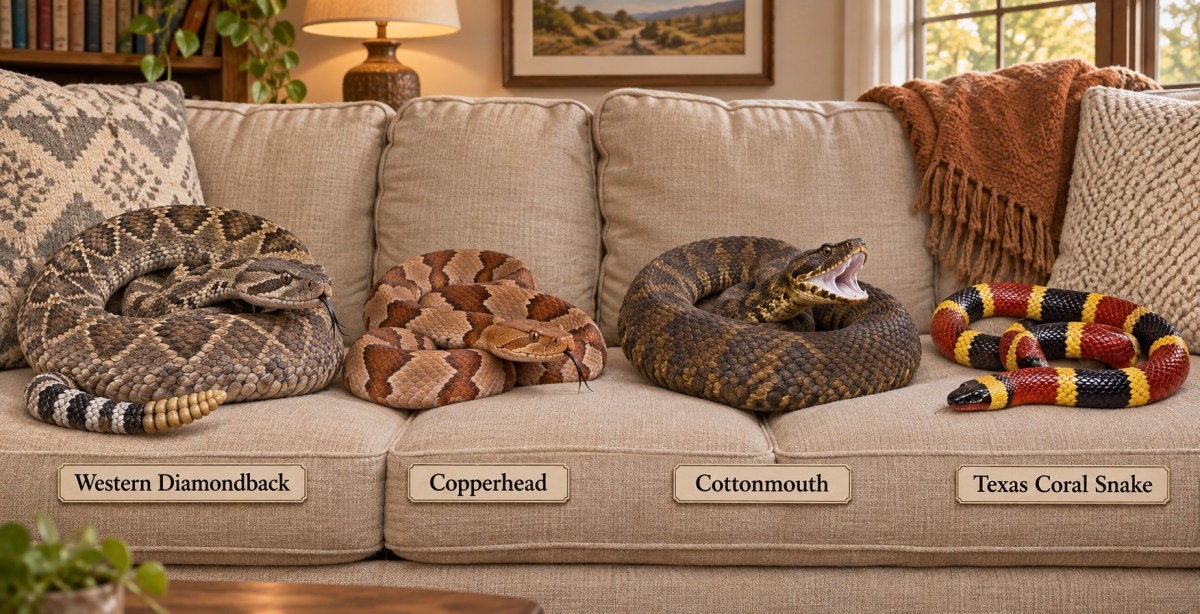
For Esther’s prompt today I am posting about a Texas Snake book that I like. I am also adding some additional Texas snake information. There are 105 species of snake in Texas. More than any other state. 16 of them are venomous. Below is a picture of four venomous Texas snakes.
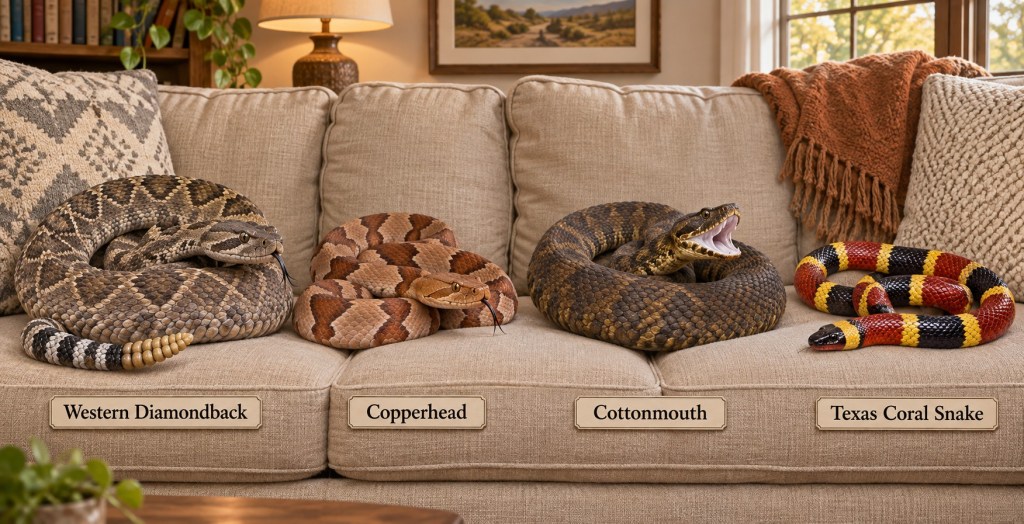
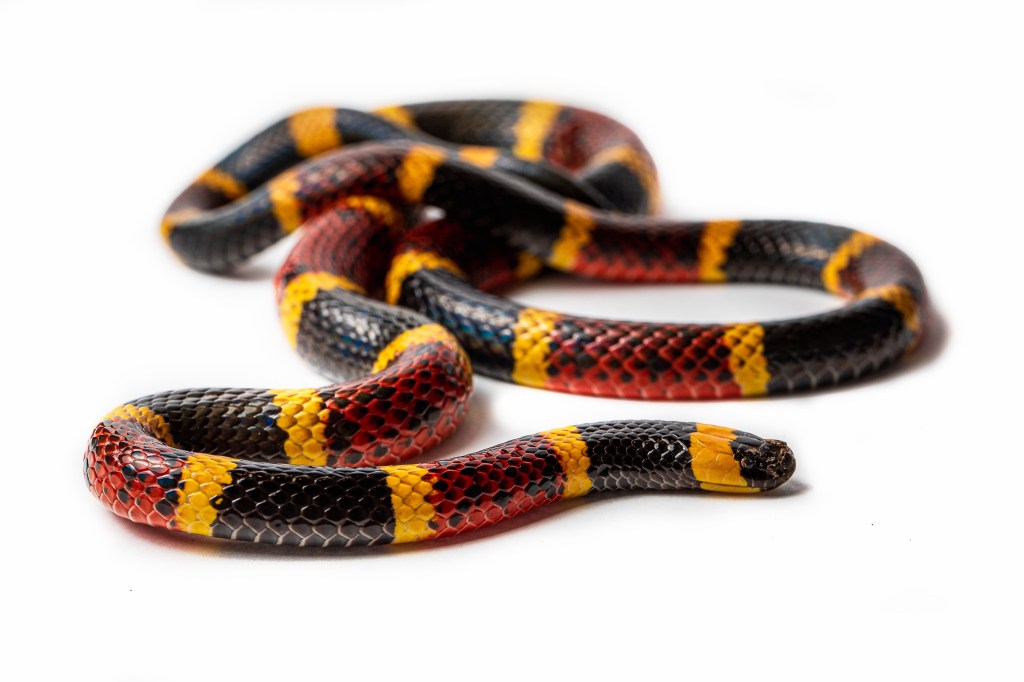
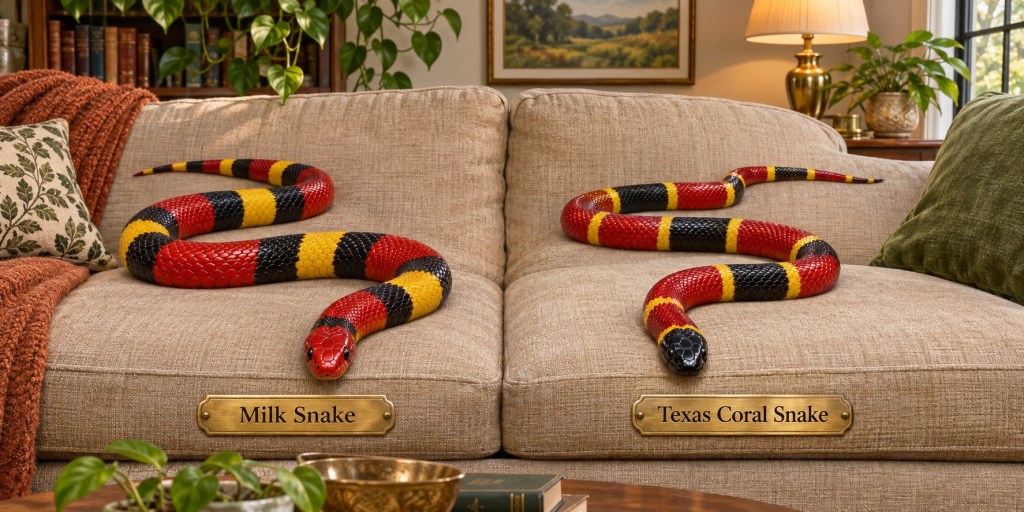
The Western Diamond Back Rattle Snake is a very common large Rattle Snake. The Copperhead is another common venomous snake. The Cottonmouth is a common venomous snake which is white inside its mouth. It is also called the Water Mockasin because it is a semi-aquatic snake that hunts fish and frogs. The colorful snake on the right, the Texas Coral Snake, is very venomous but luckily not very aggressive. A bite from the Texas Coral Snake has enough venom to kill seven adult men. There is a harmless snake, the Milk Snake, which has similar colors to the Texas Coral Snake. Since both Milk Snakes and the Texas Coral Snake have similar coloring, how do you tell them apart? This is the rule you follow:
Red touches yellow kill a fellow red touches black friend of jack
Can you see this in the picture below? The snake on the left you can hold and cuddle. The snake on the right can kill you.
The Green Mamba Between my Feet
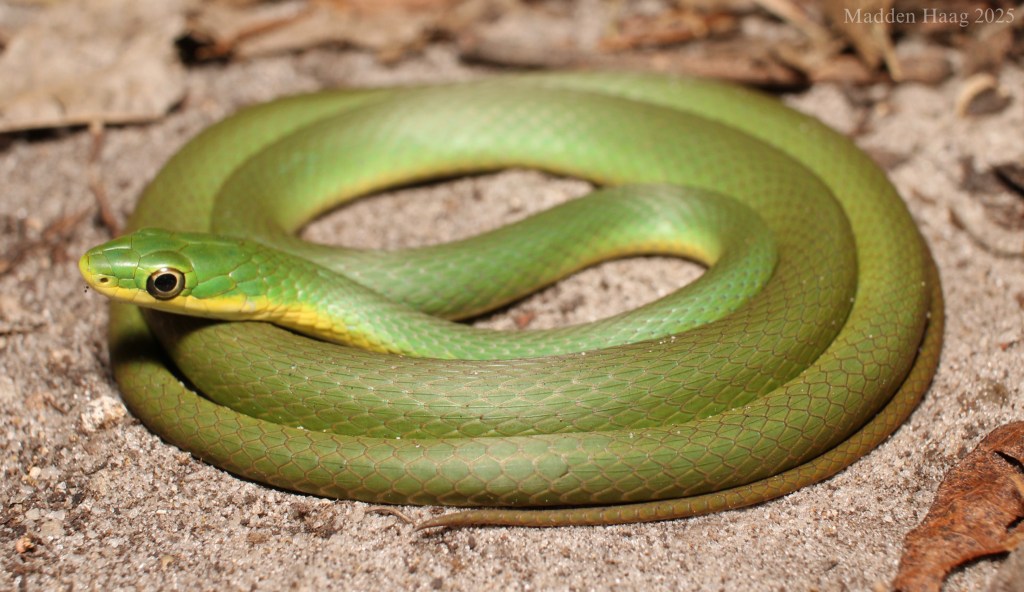
When our kids were young, we frequently visited Dinosaur Valley State Park south of Glen Rose Texas. It is famous for its fossilized dinosaur footprints. As I was walking around with my four year old son (our younger son) on my shoulders, he suddenly called out saying “Dad you almost stepped on that Green Mamba”. I looked down and between my feet there was a Green Grass Snake. It did not look like a Green Mamba, so we were safe. However, I am still glad I did not step on it.
The Whip Snake Inside my Shirt
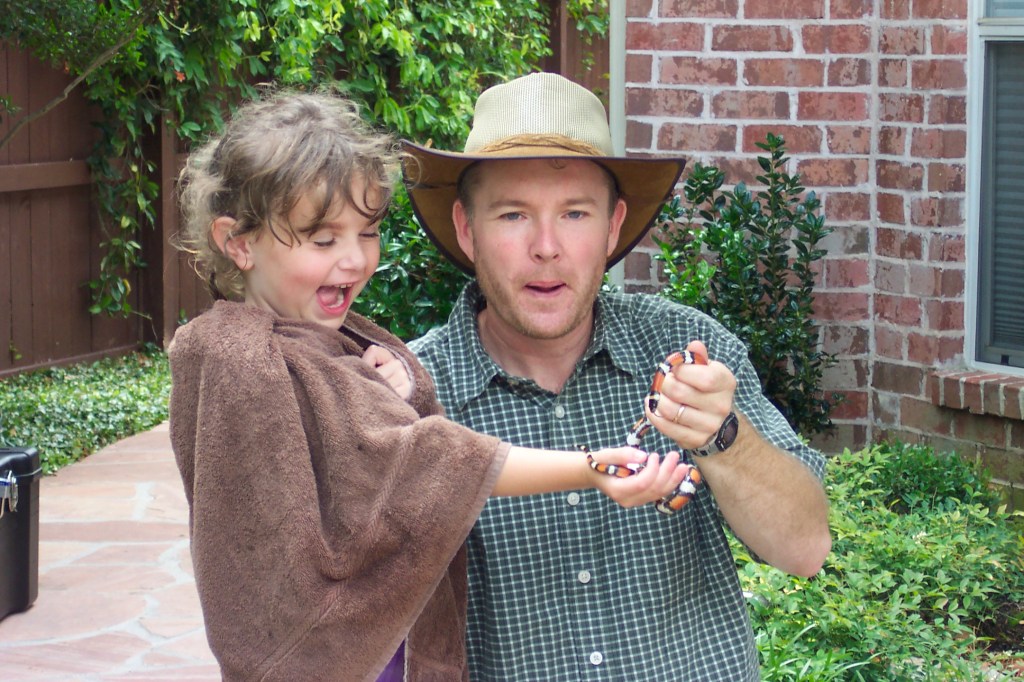
When our daughter was young, she was part of the scout like organization called Adventure Princesses. Sometimes the Adventure Princesses went camping with their dads. On one occasion we visited a state park that had a building featuring lots of different kinds of Texas snakes. None of the snakes were venomous and the dads were allowed to pick them up and show them to the girls.
My daughter and her friends were sitting on chairs in a classroom like setting. I made the mistake of picking up a coachwhip snake or a so called whip snake. These snakes are long and thin but very muscular. They can easily raise their head above half their body. The whip snake was wild, and it snuck itself under my long shirt sleeve and started crawling up my arm. It was much stronger than I anticipated so I struggled with the snake before I could pull it out of my shirt sleeve. The girls were very interested in the spectacle. However, nothing bad happened. The snake was just very good at slithering where I did not want it to.
The Rat Snake in the Sink
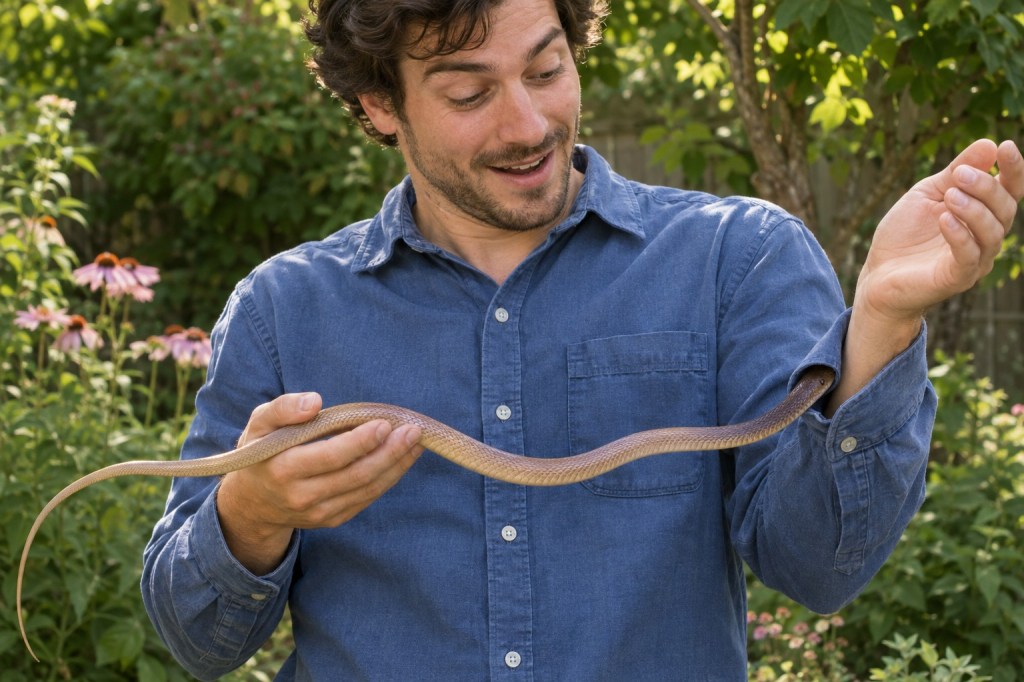
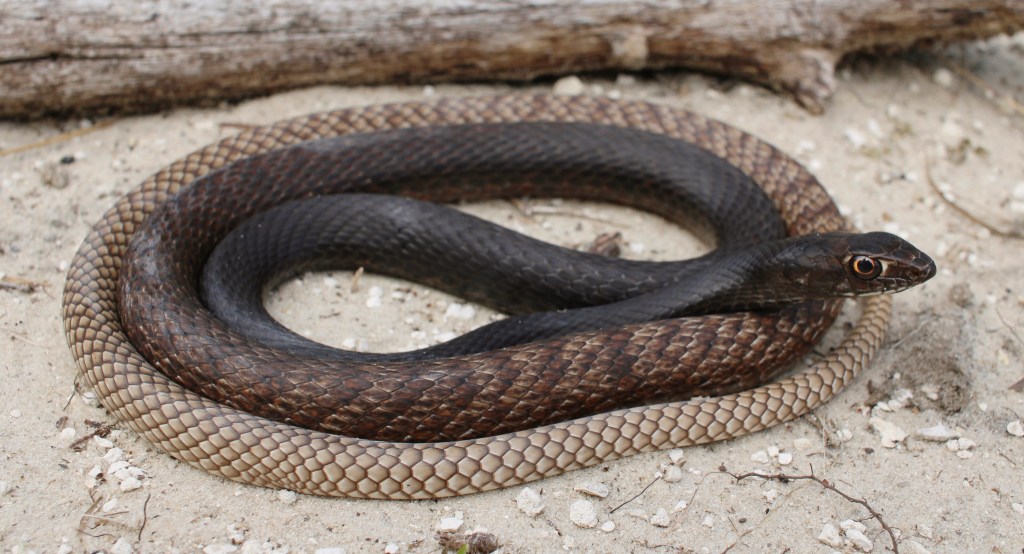
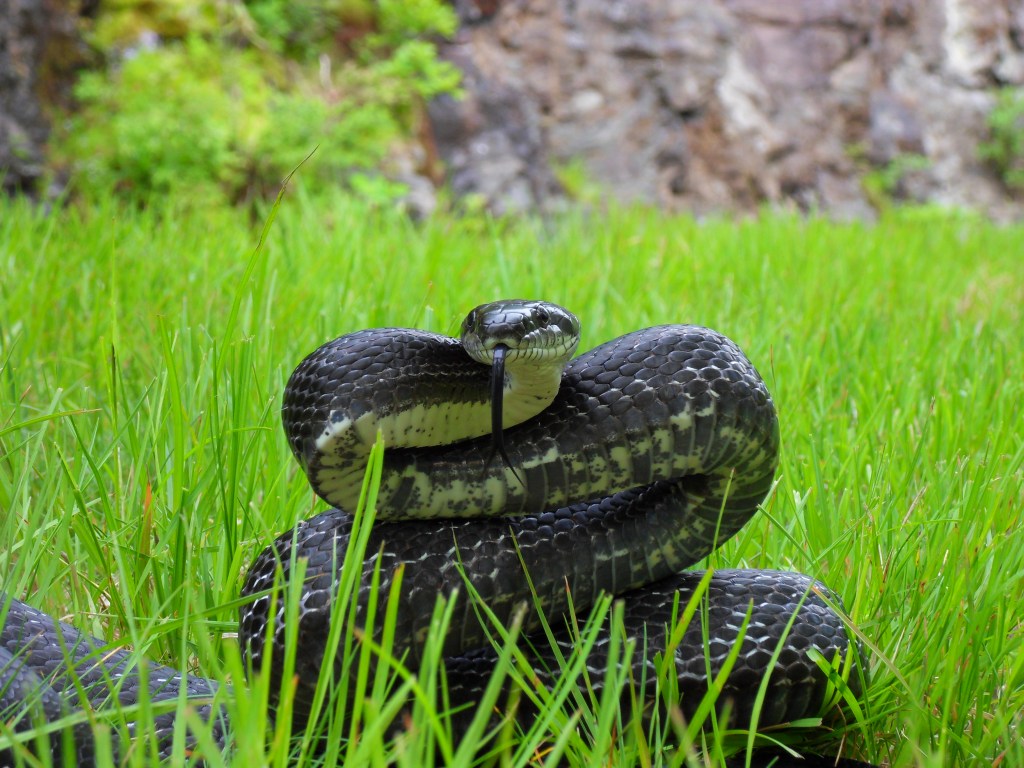
This happened more recently. We were visiting my wife’s parents when my wife went to the bathroom. As she was washing her hands, she noticed that a piece of what she thought was the faucet moved. She realized that there was a more than a yard long snake right behind the faucet. She had washed her hands just an inch away from the snake.
It turned out to be a harmless rat snake. However, since the Rat snake looks a bit like a Cottonmouth / Water Mockasin, we were afraid of handling it and we called animal control. I can add that we had also read that Water Mockasin Snakes could crawl through sewage pipes and come up through the toilet and bite your behind. As turned out, that is just a common myth.
Now finally, the review of the book.
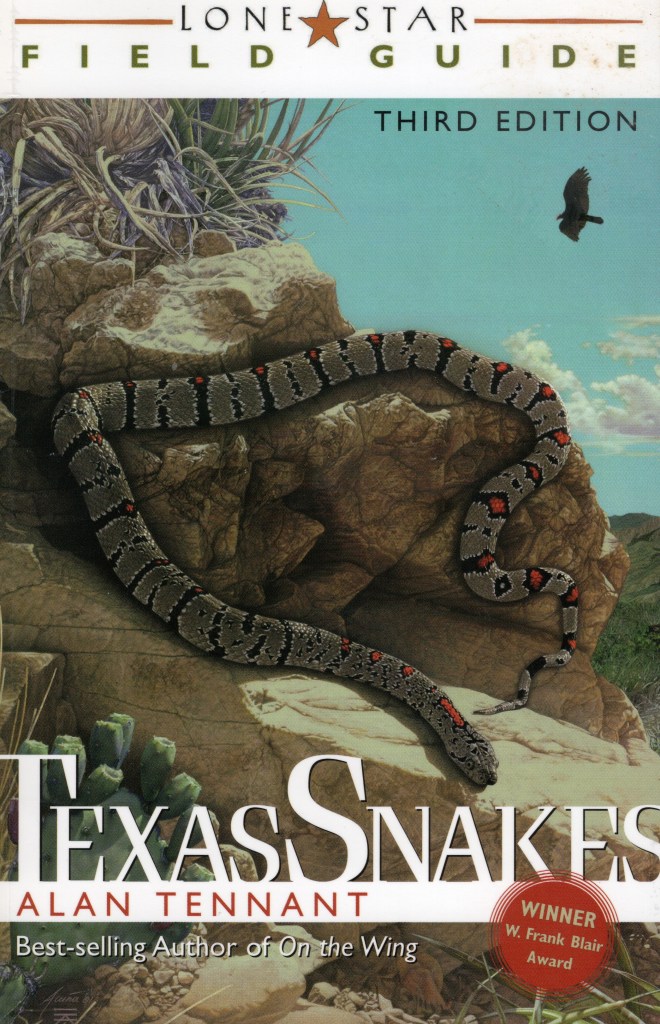
Lone Star Field Guide to Texas Snakes (Lone Star Guides) by Alan Tennant
Below I am listing the two editions of this book. I bought and read the paperback edition.
- Paperback – Publisher : Random House Large Print (November 13, 2018), ISBN-10 : 1984887262, ISBN-13 : 978-1984887269, 352 pages, item weight : 10 ounces, dimensions : 5.3 x 0.82 x 7.8 inches. It costs $27.00 on US Amazon. Click here to order it from Amazon.com.
- Kindle – Publisher : Taylor Trade Publishing (January 27, 2006), ASIN : B00IUFI1K8, ISBN-13 : 978-1461635642, 658 pages, it costs $10.99 on US Amazon. Click here to order it from Amazon.com.
Amazon’s Description of the Book
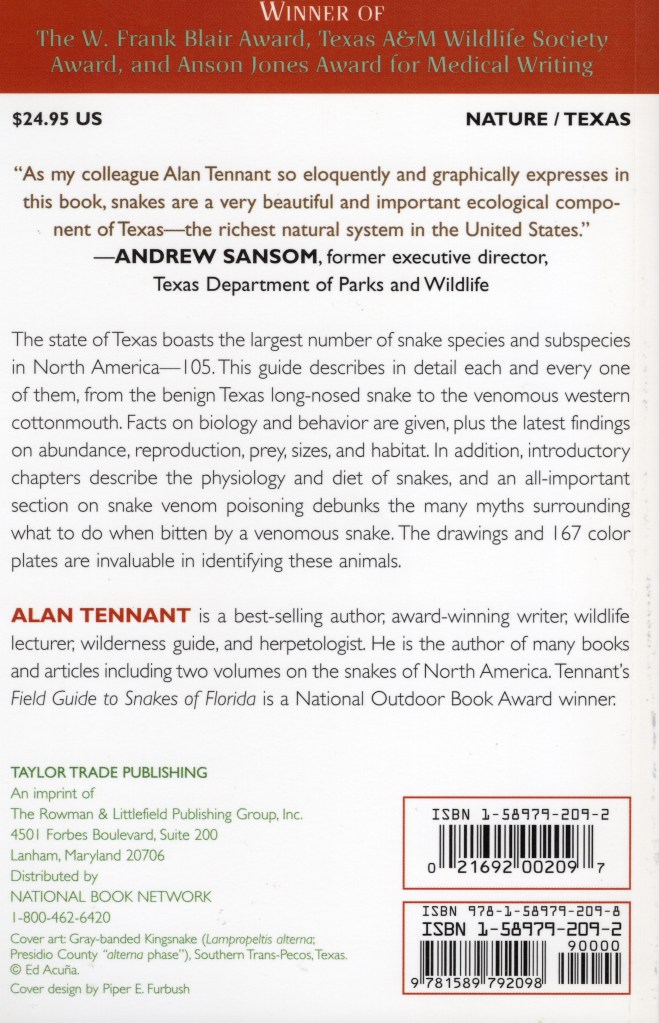
The State of Texas not only boasts the largest snakes in North America, but also the largest number of species—105. This guide describes in detail each and every one of them, from the benign Texas long-nosed snake, to the venomous Western Cottonmouth. Facts on the biology and behavior are given, plus the latest findings on abundance, reproduction, prey, sizes, and habitat. In addition, introductory chapters describe the physiology and diet of snakes, and an all-important section on “Venom and Evenomation” debunks the many myths surrounding what to do when bit by a venomous snake. 128 color plates of species and subspecies aid in identification.
This is my five star review for the book Lone Star Field Guide to Texas Snakes
You almost stepped on that green mamba
“Dad, you almost stepped on that Green Mamba”. That is what my 4-year old (sitting on my shoulders) told me when we were walking in Dinosaur Valley state park. Using the second edition of this book I was able to identify the snake as the “Rough Green Snake” when I got home. I am glad there are no Green Mambas in Texas (in the wild), but there are still some very poisonous snakes to watch out for. Seven species of rattle snake, two species of Massasauga, and a pigmy rattle snake, cottonmouth (water moccasin), three species of copperhead, and the Texas Coral snake. The Texas Coral snake is the most poisonous of the snakes in Texas (but it is not aggressive) and the poison from the Mojave Rattle Snake can kill six adults (lives only in West Texas). There are 105 species of snakes all in all in Texas.
This edition (third edition) has essentially the same pictures and information as the second edition, but the third edition is organized better, is a little bit bigger, and more updated. What I really like about this book is that for each of the snakes it has a map of Texas showing the distribution of the snake. The book is also well organized and the photos are good. It is also an interesting book to read, it contains a lot of facts about the various snakes. Once you start reading about the various snakes, and looking at the pictures and the distribution maps, you just can’t put it down. The book tickles your curiosity. Compared to other Texas snake books that I have seen this one is the most interesting and the most well organized of them all. If you quickly need to identify a snake this is the right book.
My Other Responses to Esther’s Prompts
- Prompt : Small : Small Microscopic Subatomic and Strings
- Prompt : Kind : Leonbergers Are Kind Dogs
- Prompt : Window : What Does Rollo See Out His Window
- Prompt : Charge : Electric Charge is not the only type of Fundamental Charge
- Prompt : Promises : Promises To My Dog
- Prompt : Shade : A Total Solar Eclipse the Ultimate Moon Shade
- Prompt : Money : Ten Money Facts
- Prompt : Edge : The Edge of the Observable Universe is 46.5 billion Light Years Away
- Prompt : Fish : Ten Amazing Fish Facts
- Prompt : Promise : I Promise Not to Post AI Generated Comments
- Prompt : Respect : Respect your Dog
- Prompt : Giving : Leonbergers Giving Gifts to Pugs
- Prompt : Family : Dogs Are Family
- Prompt : Snow : Snow and Ice in Norrland
- Prompt : Red : The Universe has a Redshift and its Increasing
- Prompt: Shapes : Conic Sections are the Shapes that Shape Our World
- Prompt: Flying : 10 Wind Blowing Facts About Birds
- Prompt: Drive : Letting Your Dog Drive the Car
- Prompt: Memories: False Memories Strange Memories Unpleasant Memories and Amnesia
- Prompt: Magic: Magic In New Orleans a Travel Overview
- Prompt: Vision: Human Vision Only Detects a Sliver of the EM Spectrum
- Prompt: Flower: Leonberger Dogs with Flowers
- Prompt: Capture: Carbon Capture and Storage an Unfulfilled Promise
- Prompt: Eyes: The Evolution of Eyes is Convergent
- Prompt: Pet: The Joy of Having a Pet
- Prompt: Cross: Why did the Dog Cross the Road
- Prompt: Close: Close Encounter with Grizzly Bear Number 399
- Prompt: Block: 60 million Lego Blocks
- Prompt: Bank: The Riverbank of Moälven
- Prompt: Rich: Super Rich
- Prompt: Test: When our Leonberger took a Car for a Test Drive
- Prompt: Fire: Climate change worsens wildfires Globally and Human land-Use Changes Reduces them
- Prompt: Exercise: Dogs Make you Exercise and you Live Longer
- Prompt: Play: Dog Play
- Prompt: Catch: Playing Catch with Dogs
- Prompt: Classic: Modern Physics is Fundamentally Different from Classical Physics