The Great Sun and Moon Spectacle

We are all in our places with sunshiny faces  ready to experience the astronomical event of the century, a spectacle that Mr. Sun, Sun, Golden Mr. Sun and the moon provided for us.

This is a submission for Kevin’s No Theme Thursday

The Great Sun and Moon Spectacle
Image by Kevin from The Beginning at Last

For us in Dallas, Texas, 2024 was the year when the sun and the moon put up an unforgettable spectacle for all of us to see. On April 8, 2024, the sun and the moon and earth lined up perfectly so that the moon fully covered the sun. We had a total solar eclipse, and we were lucky with the weather. I can add that experiencing a total solar eclipse is quite different from experiencing a partial or annular solar eclipse. I’ve experienced a partial solar eclipse as well and I can attest to the difference.

Unlike a partial eclipse, it gets dark during a total solar eclipse, the stars come out if the sky is clear like it was. The birds and the insects become quiet. It happens very suddenly, in just a few seconds. The total solar eclipse lasted four minutes.

The Motion of the Sun and the Moon

To understand what a solar eclipse is, the video below might help. What you see is the moon and the earth as seen from the sun’s viewpoint. We see earth all lit up by the sun, like a full moon, and we also see the moon lit up by the sun. 

In this situation, when the people on earth look up in the sky, they see the sun, but they don’t see the moon, even though it is there. It is a new moon, or a black moon if it happens twice in the same month. As the moon begins to partially cover the sun the shadows on the ground start looking different and if you use solar eclipse glasses you can see the sun disappearing and looking like a bright crescent, but it is still daylight and looking at the sun without eclipse glasses would just hurt your eyes.

Well, this is true until the sun is fully covered by the moon. When that happens, the light turns off and at that point it is safe to look at the sun without glasses. What you’ll see is a pitch-black circle in the sky surrounded by wispy faint lights. Those wispy faint lights are the sun’s corona.

Below is a youTube video showing an animation composed of actual satellite photos by NASA.


Solar Eclipse Preparation

I drank a very special beer for the occasion, a Trappist Belgian Strong Ale, or Quadruple, called Westvleteren 12 from Brouwerij Westvleteren (Sint-Sixtusabdij van Westvleteren).

A table set for five with a large parasol | The Great Sun and Moon Spectacle
Our patio table. The little brown packages contain AAS / ISO certified solar eclipse glasses.
My daughter holding a Westvleteren 12 glass with a bow. Grandpa and grandma sitting on chairs in the background | The Great Sun and Moon Spectacle
Our daughter holding a Westvleteren 12 glass with a bow. Grandpa and grandma in the background.
A mini-Australian Shepherd sitting on the patio floor | The Great Sun and Moon Spectacle
Rollo our mini-Australian Shepherd on the patio.

The Partial Eclipse Phase

It was partially cloudy during the partial eclipse, but we were able to get a good look at the eclipse as it progressed. As mentioned, to see the partial eclipse, you have to use good solar eclipse glasses. It is primarily for safety reasons, but it is also pointless to look at the sun during a partial eclipse. You won’t see the eclipse crescent because the powerful light from the sun overwhelms your view.

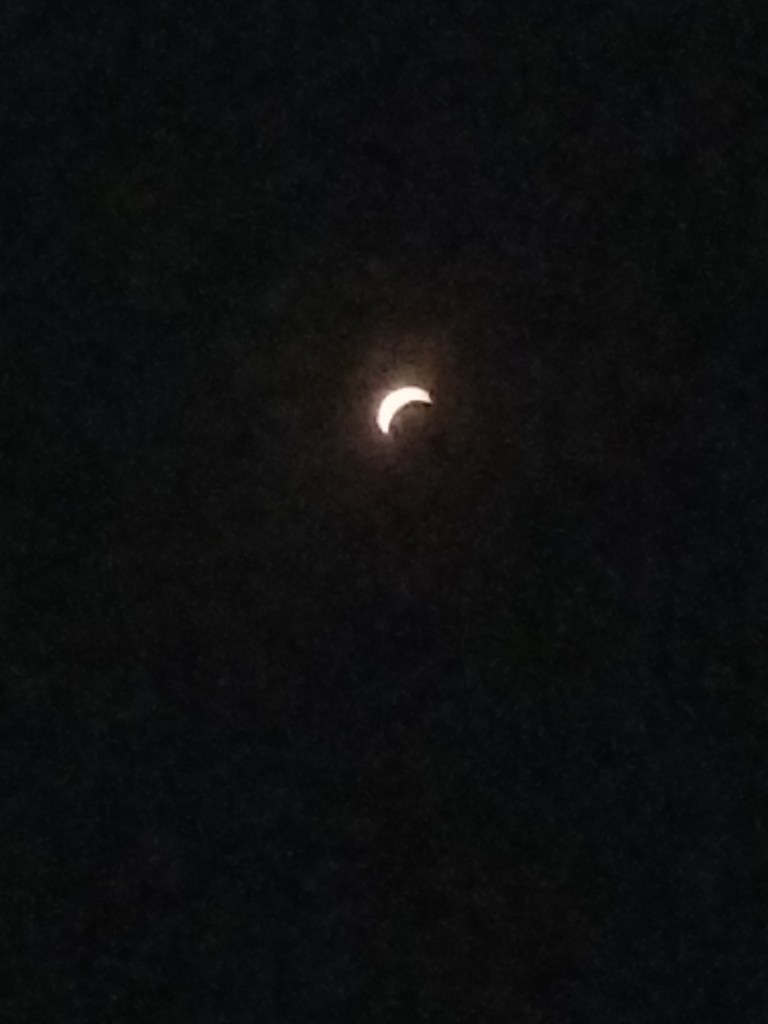
I had a little filter that was placed in front of my phone camera as I took a few pictures. Admittedly they were pretty bad. I have an old Samsung Galaxy S8+ but even using newer phones it is difficult to get decent photos of something like this.

The photo shows a shiny crescent on black background | The Great Sun and Moon Spectacle
Partial eclipse photo taken with my old Samsung Galaxy phone and a filter.

The Total Eclipse

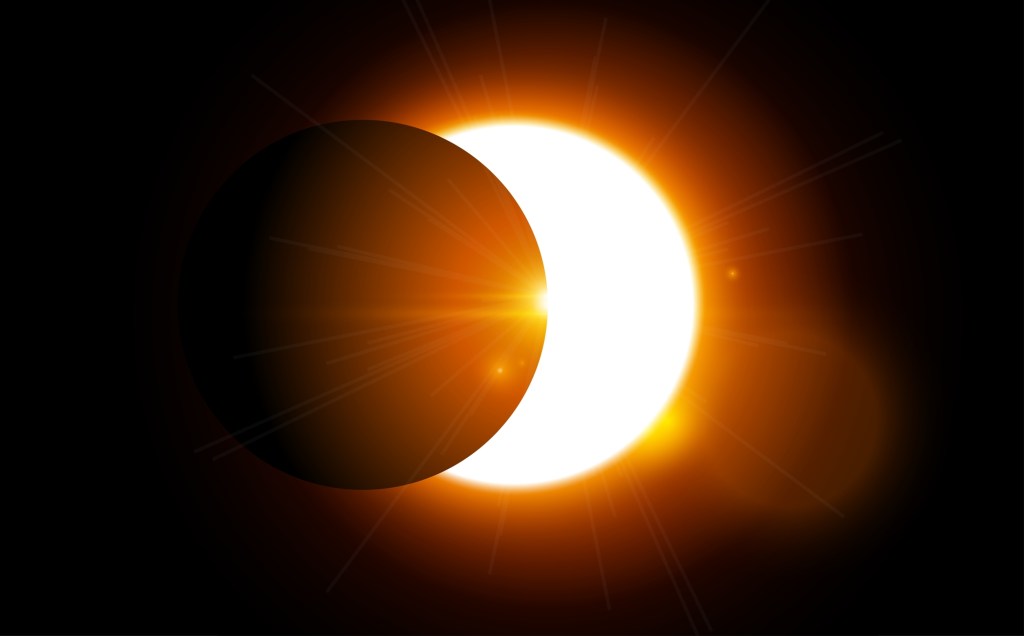
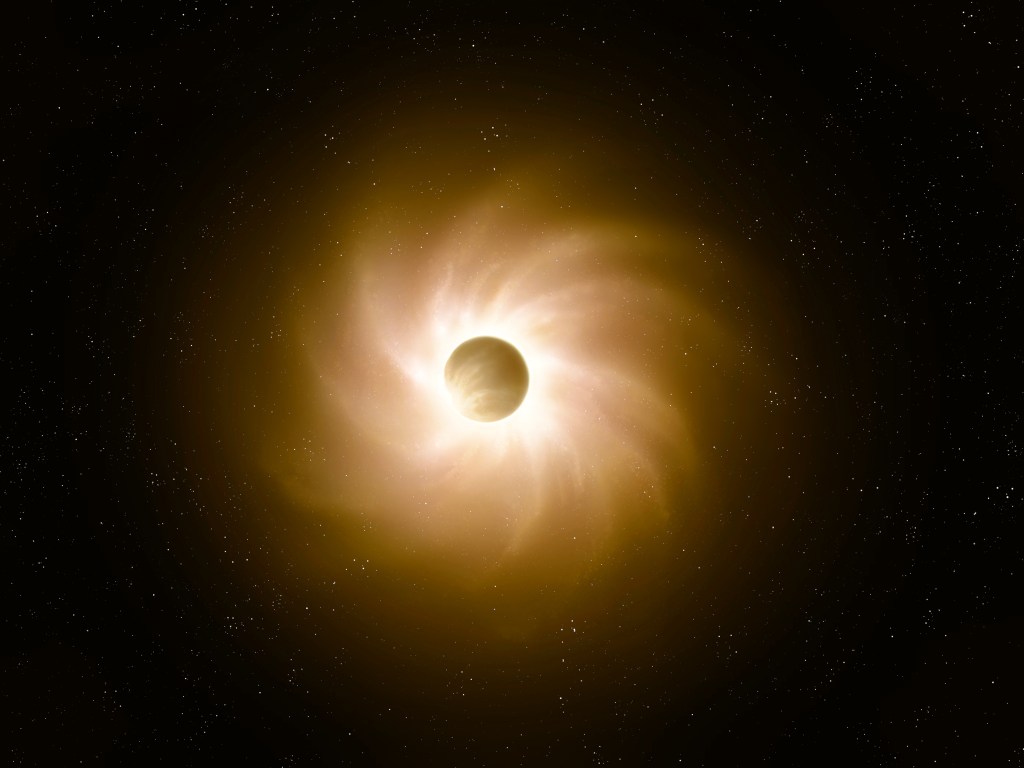
At 1:40PM Dallas time the total solar eclipse happened and luckily it was not covered by clouds. At this point it suddenly got dark and it was safe to look straight at the sun without using the eclipse glasses. The total eclipse lasted four minutes. I have included a shutter stock photo below which closely represents what we actually saw. We saw a black circle and around the black circle was a wispy white fog like light. This was the sun’s corona and it shone with about the same power as the full moon. It kind of looked like a black hole.

Black circle surrounded by a wispy white fog like light. That’s the sun’s corona | The Great Sun and Moon Spectacle
Except for the black background this looks like what we saw with our eyes. The sky we had was dark, like twilight, but not black. Solar Eclipse Stock Photo ID: 2344355767 by aeonWAVE

The Stars and the Planet Venus

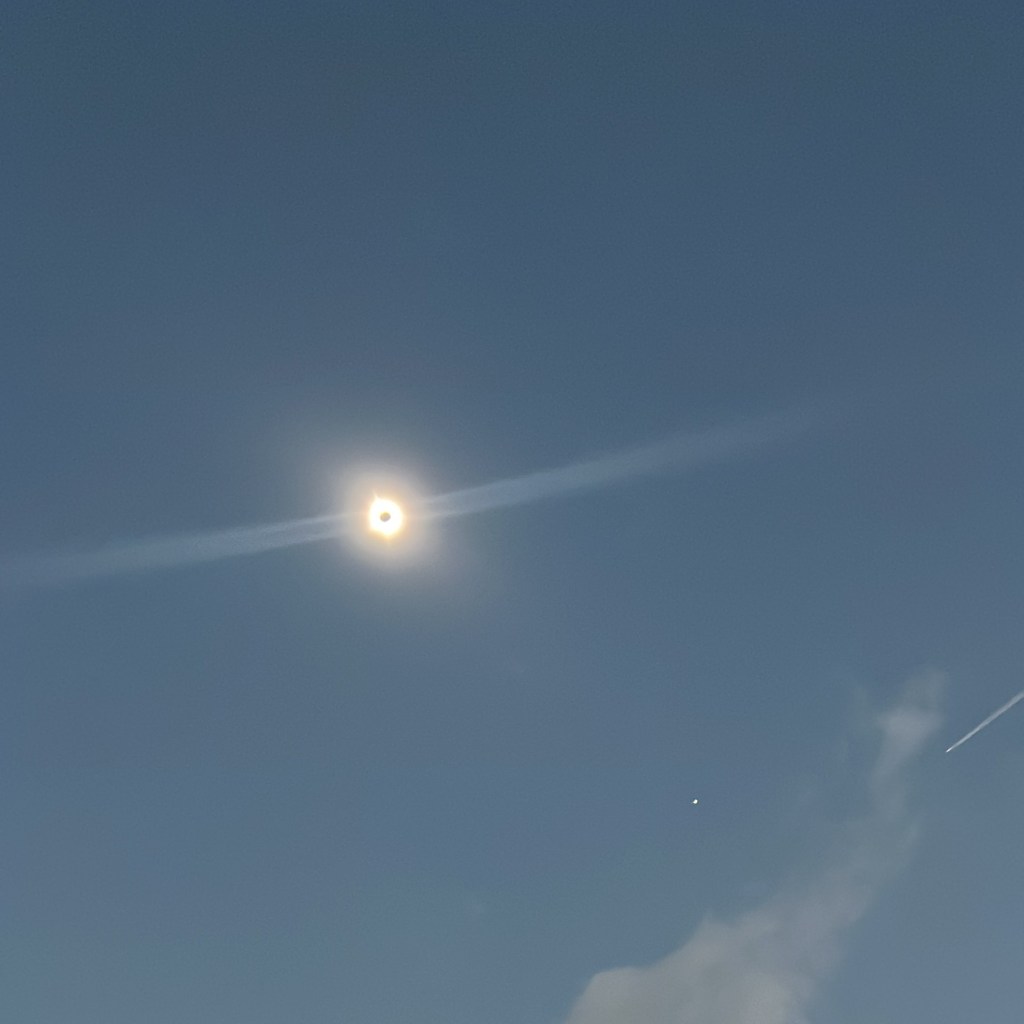
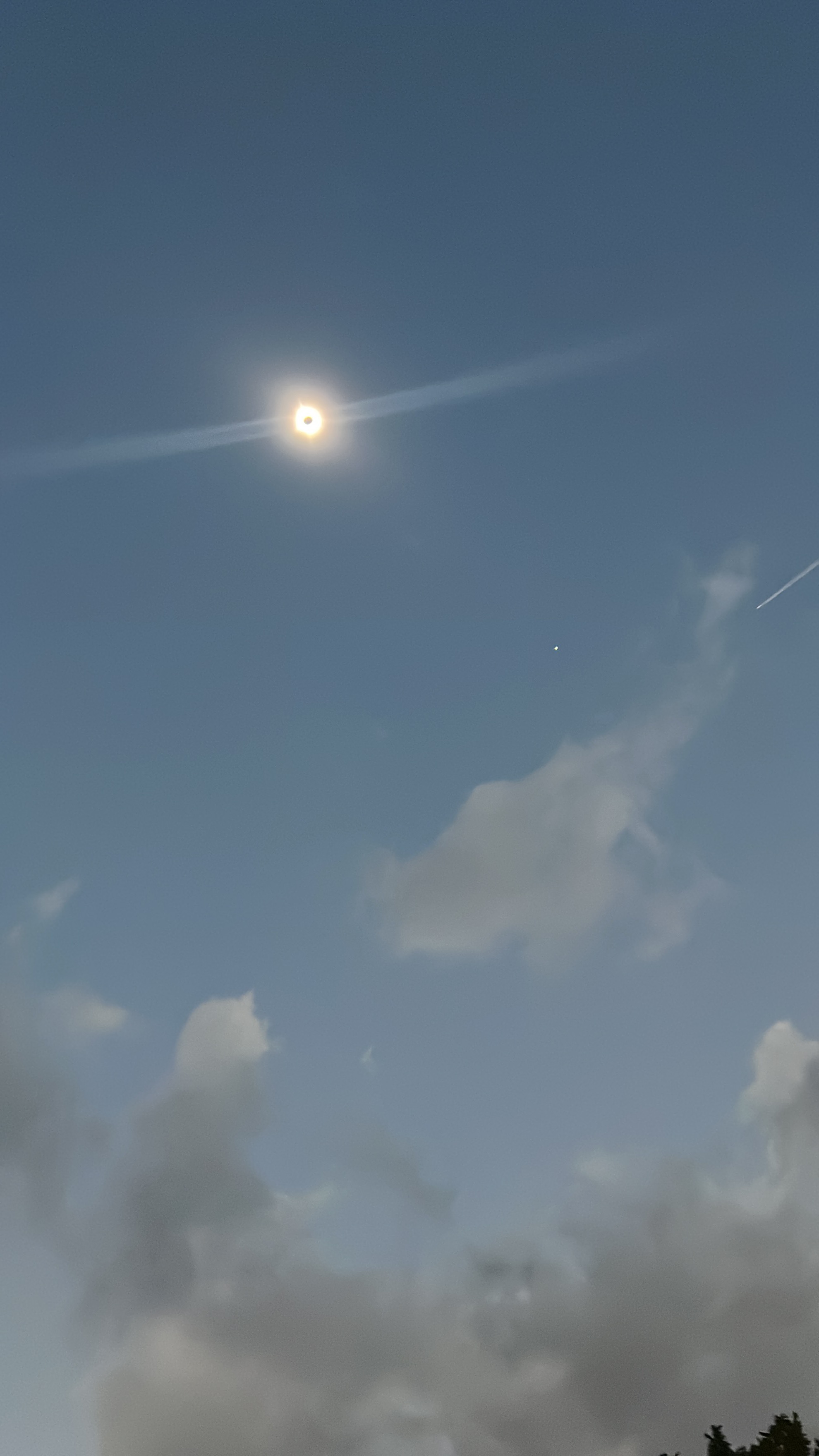
The photo shows the sun totally covered by the moon. It is very small in the photo. There is star like object, that’s Venus, a cloud and airplane contrail | The Great Sun and Moon Spectacle
Total solar eclipse photo that my daughter took. Can you find Venus?

Total Eclipse Photos

These eight pictures were taken with cell phones by my daughter Rachel, Denise Mosier-Wanken, and Margaret Weiss Bloebaum.

Did you see the total solar eclipse?


To see the Super Facts click here


Black Moon

Today, December 30, 2024, we are having what is called a Black Moon. In Europe it will be December 31.  This is not a super-fact post. Just some lighthearted information about the Black Moon phenomenon.

What is a Black Moon?

The most common definition is that it is the second new moon in a single calendar month. That’s what we are having now. During a new moon the moon is located between the sun and earth, which means that the night side of the moon is directed towards us. At night it is usually below the horizon and during the day you can’t see it.

However, there is one exception to that and that is when you are having a solar eclipse. In that case the moon is directly in front of the sun. It is an unusually well-placed new moon if you will. Here in Dallas, we had a total solar eclipse on April 8 this year. It was a remarkable experience. It turned daker, cooler, some stars and planets came out, including Venus, and the birds and insects stopped singing. I have included some photos from that event below. What you see is the dark side of the moon with the sun hiding behind it.

The sun is shaped like a moon crescent but bright.
I took this photo with my old Samsung 8+ phone before we had totality. Since the sun was still partially visible and bright I used a filter / a pair of glasses that I held in front of the phone.
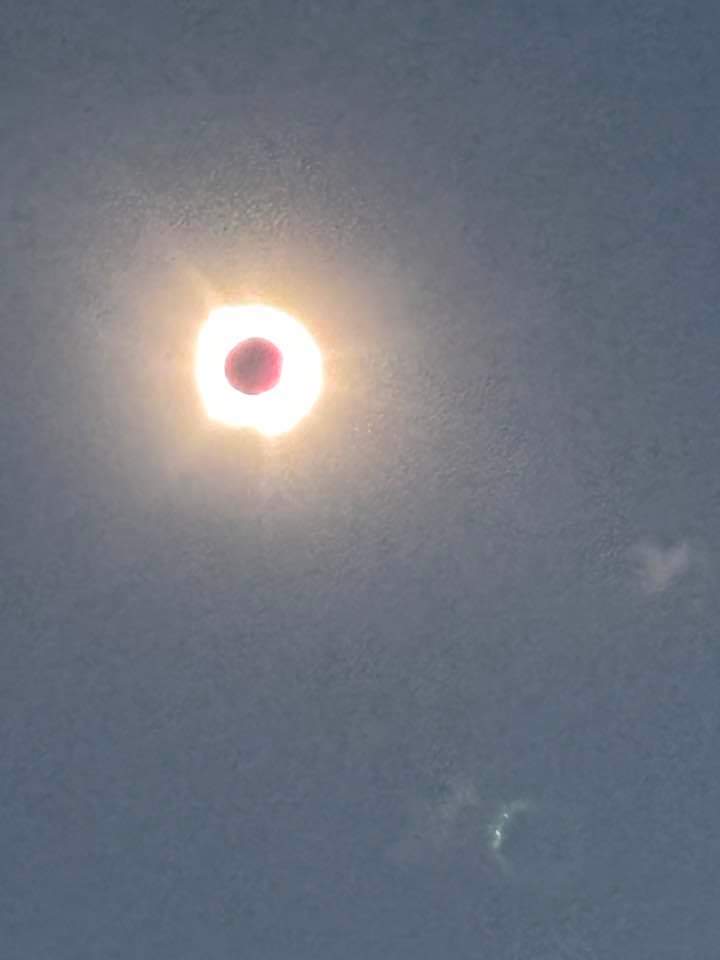
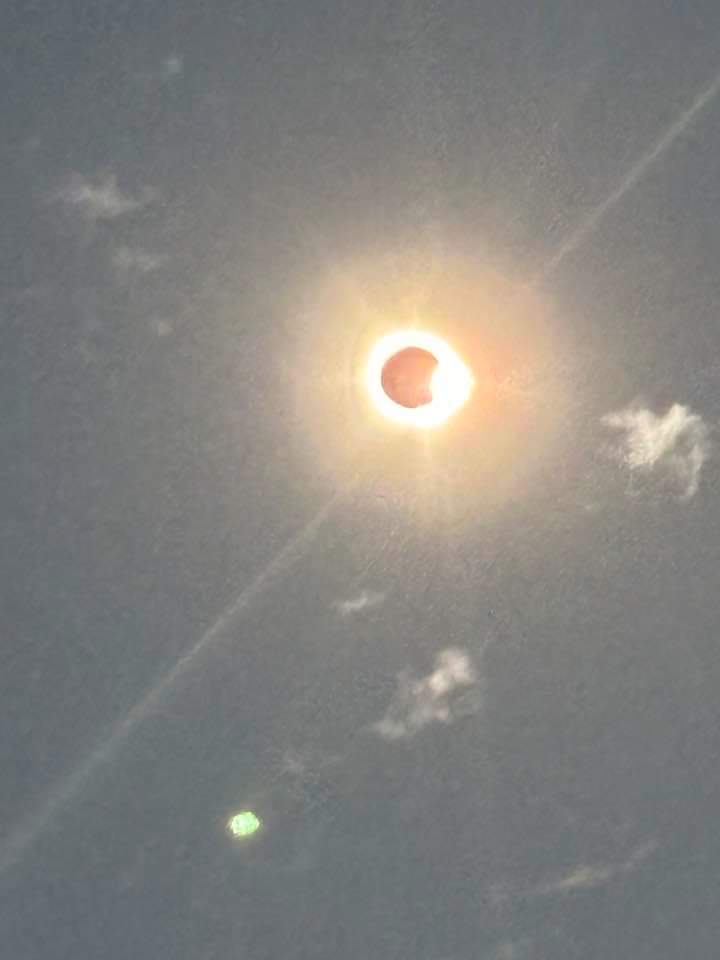
There’s a black circle in the middle with a light around it, and an especially bright light on the right side | Black Moon
A friend Denise Mosier-Wanken took this photo with her phone. The sun is almost gone. The fuzzy fog like light around the black circle is the sun’s corona.
There’s a black circle in the middle with a light around it.
My daughter Rachel took this photo with her iPhone.
A professional solar eclipse photo with filter. Black Moon.
A professional solar eclipse photo with filter. What we saw with our eyes was something in between this photo and the photos we took. The corona in our photos is too big. This one is too small. Stock Photo ID: 2344355767 by aeonWAVE.

Alternative Definitions of a Black Moon

As mentioned, the most common definition of a black moon is that it is the second new moon in a single calendar month. However, there are other definitions:

  • A month with no full moon
  • A month with no new moon
  • The third new moon in a season with four new moons. A season is defined as the period between a solstice and an equinox and is roughly three months.

A New Moon is a Star Gazing Opportunity

Since there is no moon in the sky the night is a little bit darker. This makes a significant difference in places that are very dark and very far away from city lights. There is so much light pollution here in Dallas, so it doesn’t matter here. However, I still took out my little telescope and observed easy objects, such as Venus, Mars, Jupiter and its four Galilean moons.

Jupiter in the middle. It is a greenish speck with lines. It is surrounded by three white dots.
The three little dots are three of the four Galilean Moons. I roughly saw this in my telescope a couple of hours ago, but it is not my photo. Photo by Raoni Aldrich Dorim on Pexels.com

The Near Side and the Far Side of the Moon

The moon is always showing us the same side, the so-called near side. The far side, or the back side, you can only see from spacecrafts. Look at the photo below. The near side is on the left whilst the far side is on the right. During a new moon the near side (left) is dark, and the far side (right) is lit up by the sun. But again, you cannot see the far side (right), which is turned away from us.

During a full moon the near side (left) is lit up by the sun, and the far side (right) is dark. One interesting fact about the moon is that the near side (left) and the far side (right) are very different. The far side (right) not only looks different, it has a crust that is much thicker compared to the near side, and it is also densely cratered compared to the near side.

On the left is the near side of the moon and on the right the far side of the moon | Black Moon
The near side of the Moon and the far side of the Moon. Comparison between the two hemispheres of the Moon. Elements of this image were furnished by NASA. Stock Photo ID: 2157518223 by Claudio Caridi.

Below is a youTube video showing an animation composed of actual satellite photos by NASA.

In this video the near side of the moon is dark. It is a new moon and the people on earth don’t see the moon. The sun is behind us and lights up both earth and the far side of the moon (the side people on earth do not see), so that is what the space craft see.

Happy New Year

Finally, a Happy New Year to all of you from Rollo and me. He may not look that happy but that is because I am leaving over the New Years. We have a dog sitter though. For the same reason I will not be on-line tomorrow.

Our mini-Australian Shepherd is looking into the camera. He is looking a tad sad.
Happy New Year from Rollo

To see the Super Facts click here


The End of Everything By Katie Mack

What will the end of everything be like? How will everything end? Will it be the Big Crunch as the Universe collapses back to a reverse Big Bang? Will it be the heat death, or what is better called the high-entropy death? Will it be the Big Rip as the Universe is ripped apart, or vacuum decay? Maybe it will be the Quantum Bubble of Death? Wouldn’t the Quantum Bubble of Death be a cool way to die?

The goal of this blog is to create a list of what I call super facts. Important facts that we know to be true and yet they are surprising, shocking or disputed among non-experts. Super facts are important facts that people get wrong. However, I sometimes create posts that are not super facts but other interesting information, such as this book review and book recommendation.

The End of Everything: (Astrophysically Speaking) by Katie Mack is a relatively easy book on cosmology. It features scientifically guided speculation on how the Universe will end. As in the previous book I reviewed the cosmic microwave background radiation (CMBR) is a major source for the information. It is amazing what it can tell you. I bought the hardback version of it. I can add that this book and my Amazon review was written in 2020, a good year for talking about the end of the world.

  • Hardcover –  Publisher : Scribner; Illustrated edition (August 4, 2020), ISBN-10 : 198210354X, ISBN-13 : 978-1982103545, 240 pages, item weight : 2.31 pounds, dimensions : ‎5.5 x 1 x 8.38 inches, it costs $19.14 on US Amazon. Click here to order it from Amazon.com.
  • Paperback –  Publisher : Scribner (May 4, 2021), ISBN-10 : 1982103558, ISBN-13 : 978-1982103552, 256 pages, item weight : 2.31 pounds, dimensions : ‎ ‏ : ‎5.5 x 0.6 x 8.38 inches, it costs $10.99 on Amazon. Click here to order it from Amazon.com.
  • Kindle –  Published : August 04, 2020, ASIN : B07Z41TTNK, 237 pages, it costs $14.89 on US Amazon. Click here to order it from Amazon.com.
  • Audiobook –  Publisher : Scribner (August 4, 2020), ASIN : B07Z8B5NZ8, it costs $13.12 on US Amazon. Click here to order it from Amazon.com.
Front cover of The End of Everything By Katie Mack | The End of Everything
Front cover of The End of Everything? Click on the image to go to the Amazon page for the hardcover version of the book.

Amazon’s description of The End of Everything By Katie Mack

A NEW YORK TIMES NOTABLE BOOK OF 2020

NAMED A BEST BOOK OF THE YEAR BY * THE WASHINGTON POST * THE ECONOMIST * NEW SCIENTIST * PUBLISHERS WEEKLY * THE GUARDIAN

From one of the most dynamic rising stars in astrophysics, an “engrossing, elegant” (The New York Times) look at five ways the universe could end, and the mind-blowing lessons each scenario reveals about the most important concepts in cosmology.

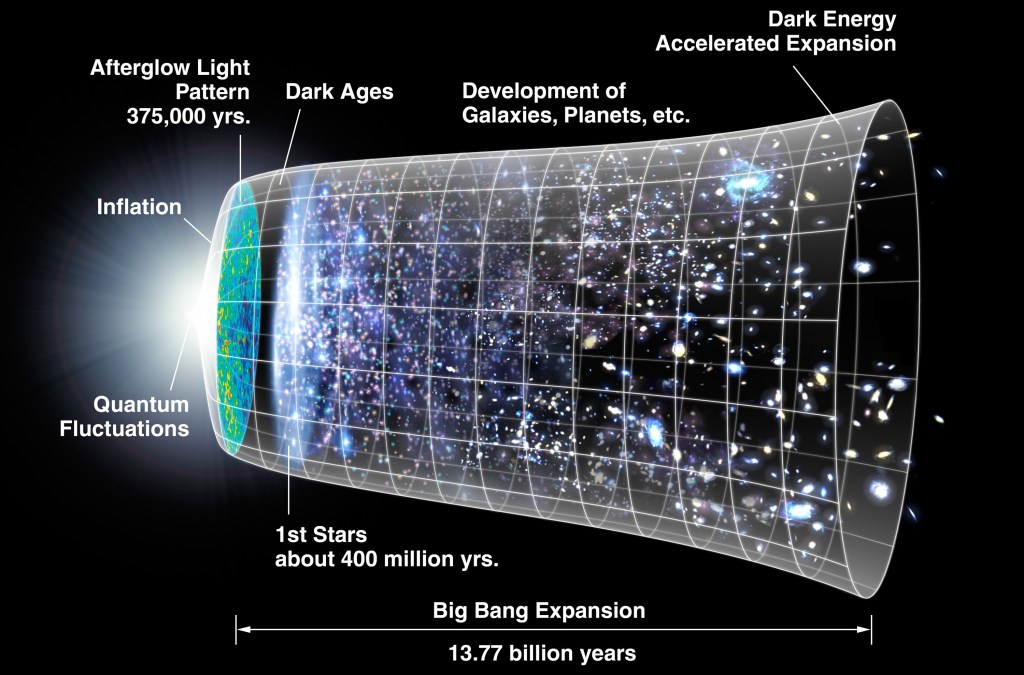
We know the universe had a beginning. With the Big Bang, it expanded from a state of unimaginable density to an all-encompassing cosmic fireball to a simmering fluid of matter and energy, laying down the seeds for everything from black holes to one rocky planet orbiting a star near the edge of a spiral galaxy that happened to develop life as we know it. But what happens to the universe at the end of the story? And what does it mean for us now?

Dr. Katie Mack has been contemplating these questions since she was a young student, when her astronomy professor informed her the universe could end at any moment, in an instant. This revelation set her on the path toward theoretical astrophysics.

Now, with lively wit and humor, she takes us on a mind-bending tour through five of the cosmos’s possible finales: the Big Crunch, Heat Death, the Big Rip, Vacuum Decay (the one that could happen at any moment!), and the Bounce. Guiding us through cutting-edge science and major concepts in quantum mechanics, cosmology, string theory, and much more, The End of Everything is a wildly fun, surprisingly upbeat ride to the farthest reaches of all that we know.

This is my five-star review for The End of Everything

The End of the Universe can be a lot of fun

Katie Mack’s timely (it’s 2020 after all) survey of the various ways the Universe might end, based on current physics, was a delightful read. It is an interesting and fun book. We learn about the Big Crunch (the Universe shrinking back), the Heat Death, or rather the high-entropy death, the Big Rip, Vacuum decay, or the “quantum bubble of death” if you want to call it that, and the “bounce”. 

To understand where the various ideas regarding the end of the Universe come from, you need to understand some of the physics and the cosmology. We learn something about CMB, or the Cosmic Microwave Background, Big Bang, cosmic inflation, Planck Time, GUTs, Nucleosynthesis, the standard model, de Sitter Space, black holes, electroweak symmetry breaking, the Higgs Boson and the Higgs field, multiverses, and much more.

Perhaps most importantly, we learn about dark matter and dark energy, which are important concepts that have greatly changed cosmology over the last few years. Chapter 2 on the Big Bang reminded me a lot about an old book by Stephen Weinberg, the first 3 minutes. However, Katie Mack puts a modern spin on it and goes much further beyond our Universe. I was intrigued to hear that it might be possible to communicate between different Universes in a multiverse using gravity, or gravity waves.

The book is written for laymen, and I found it to be between Neil De Grasse Tyson / Carl Sagan and Stephen Hawking in difficulty level. The book covers a lot of concepts and theories but does so concisely, simply and not in a mathematical way. Not so simply though that it is misleading.

I am an Engineer with an undergrad degree in physics so I may not be the best person to judge whether this is an easy read for laymen, but I believe it is. I am very interested in these kinds of topics, and I read all popularized books on cosmology, modern physics, the standard model, that I can find. This was one of the most fun books that I’ve ever read.

The back cover of The End of Everything by Katie Mack
Back cover of The End of Everything? Click on the image to go to the Amazon page for the hardcover version of the book.

Would you like to travel in time into the future to see the end of the Universe?


To see the Super Facts click here


The Giant Bubble of No Space

Cosmology is the science of the origin and development of the universe, and this post is about a book on Cosmology, “What’s Eating the Universe?: And Other Cosmic Questions” by Paul Davies.

What’s eating the Universe is one of the 30 questions answered in this book. It refers to the mysterious gigantic super-voids we’ve found. Could they be the result of collisions with other universes? Could they be the result of expanding giant bubbles with no space at all in them? That’s not just empty bubbles with empty space, but bubbles in which space itself is missing. Try to imagine that. Some of the 30 questions have answers, others just feature several guesses.

The goal of this blog is to create a list of what I call super facts. Important facts that we know to be true and yet they are surprising, shocking or disputed among non-experts. Super facts are special facts that a well-informed person may want to know.

However, I sometimes create posts that are not super facts but just interesting information, such as this one. What’s eating the Universe is a relatively short and easy read. I bought the hardback version of it.

  • Hardcover –  Publisher : University of Chicago Press; First Edition (September 22, 2021), ISBN-10 : 022681629X, ISBN-13 : 978-0226816296, 208 pages, item weight : 12.2 ounces, dimensions : ‎5.67 x 0.71 x 8.58 inches, it costs $19.84 on Amazon. Click here to order it from Amazon.com.
  • Paperback –  Publisher : University of Chicago Press; First Edition (September 30, 2022), ISBN-10 : 0226823873, ISBN-13 : 978-0226823874, 183 pages, item weight : 9.6 ounces, dimensions : ‎ ‏ : 5.5 x 0.46 x 8.5 inches, it costs $15.67 on Amazon. Click here to order it from Amazon.com.
  • eTextBook –  Publisher : University of Chicago Press; First edition (September 22, 2021), ASIN : B096L2WP51, 172 pages, it costs $14.89 on US Amazon. Click here to order it from Amazon.com.
Front cover of What's Eating the Universe | The Giant Bubble of No Space
Front cover of What’s Eating the Universe? Click on the image to go to the Amazon page for the hardcover version of the book.

Amazon’s description of the book

Combining the latest scientific advances with storytelling skills unmatched in the cosmos, an award-winning astrophysicist and popular writer leads us on a tour of some of the greatest mysteries of our universe.

In the constellation of Eridanus, there lurks a cosmic It’s as if something has taken a huge bite out of the universe. But what is the culprit? The hole in the universe is just one of many puzzles keeping cosmologists busy. Supermassive black holes, bubbles of nothingness gobbling up space, monster universes swallowing others—these and many other bizarre ideas are being pursued by scientists.

Due to breathtaking progress in astronomy, the history of our universe is now better understood than the history of our own planet. But these advances have uncovered some startling riddles. In this electrifying new book, renowned cosmologist and author Paul Davies lucidly explains what we know about the cosmos and its enigmas, exploring the tantalizing—and sometimes terrifying—possibilities that lie before us.

As Davies guides us through the audacious research offering mind-bending solutions to these and other mysteries, he leads us up to the greatest outstanding conundrum of Why does the universe even exist in the first place? And how did a system of mindless, purposeless particles manage to bring forth conscious, thinking beings? Filled with wit and wonder, What’s Eating the Universe? is a dazzling tour of cosmic questions, sure to entertain, enchant, and inspire us all.

This is my five-star review for What’s Eating the Universe?: And Other Cosmic Questions.

Cosmology explained the easy way

This book is organized into 30 cosmological questions that the author is answering or clarifying. His explanations are naturally not in depth but high level and easy to understand for anyone with an interest in the topic. He manages to keep the topic fascinating and the book is a real page turner. I read the book in a little bit more than one day.

The book discusses cosmology, relativity, the standard model, black holes, the big bang, the CMB, dark matter, dark energy, multiverses and the fate of our Universe, extraterrestrials, and much more, and he gives us insight into the very latest discoveries and views of cosmology.

I especially enjoyed reading chapter 20 & 21 “Can the Universe Come from Nothing” and “How Many Universes Are There”. He tells us that most cosmologists he knows believe there are infinitely many universes. One model is eternal inflation, a space/time mechanism beyond our universe that keeps causing new universes to bubble up and initially expand rapidly, but there are other models. I was surprised that he didn’t mention Roger Penrose’s model, cycles of time, with one Universe giving rise to another (after full expansion and heat death).

However, if there’s only one Universe and time came into existence with it (singularity) it doesn’t help those who want to insert a creation moment. If time didn’t exist before the big bang, the concept of a prior physical cause is meaningless. Asking what was before the big bang is like asking what lies north of the North Pole.

I also especially enjoyed reading chapter 30 “What’s New on the Cosmic Horizon” in which he lists mysteries and recent exciting discoveries, the cold patch in Eridanus (CMB), the mystery with the Hubble constant, what’s beyond the standard model, the prospect of top-down models, etc. Well, all the chapters were interesting.

This book is a quick and easy summary of what’s going on in cosmology. It’s accessible and engrossing writing and the straightforward organization make the book a great introduction to the topic. I highly recommend this book.

The back cover feature advanced praise for the book | Back cover of “What's Eating the Universe?”
Back cover of “What’s Eating the Universe?” Click on the image to go to the Amazon page for the paperback version of the book.

Finally, a list of the 30 questions

  • Journey from the Edge of Time
  • The search for the key to the Universe
  • Why is it dark at Night?
  • The Big Bang
  • Where is the Center of the Universe?
  • Why the Cosmos is Actually Fairly Simple?
  • What is the Speed of Space?
  • What is the Shape of Space?
  • Explaining the Cosmic Big Fix
  • Most of our Universe is Missing
  • What is Dark Energy
  • Where Does Matter Come From?
  • Gravity Conquers All
  • Warped Time and Black Holes
  • Is Time Travel Possible?
  • What is the Source of Time’s Puzzling Arrow?
  • The Black Hole Paradox
  • A Theory of Everything?
  • Fossils from the Cosmic Dawn
  • Can the Universe Come from Nothing?
  • How Many Universes Are There?
  • The Goldilocks Enigma
  • What’s Eating the Universe?
  • Is the Universe Actually a Botched Job?
  • Are We Alone?
  • Is ET in Our Backyard?
  • Why Am I Living Now?
  • The Fate of Our Universe
  • Is There a Meaning to It All?
  • What’s New on the Cosmic Horizon?

To see the Super Facts click here


The Betelgeuse Supernova

This is a submission for Kevin’s No Theme Thursday

The Betelgeuse Supernova
Image by Kevin from The Beginning at Last

Supernova

A supernova is an explosion of a star so violent that it can outshine an entire galaxy. It can occur when a super massive star’s core contracts (the death of the star) and as it reaches a critical point it triggers nuclear reactions that cause the star to explode. Alternatively, it can occur when a white dwarf star is triggered into runaway nuclear fusion by a collision with another star.

Depending on how far away the supernova is it can be as luminous as a bright new star, the moon, or a second sun. It occurs suddenly and lasts for several weeks or months before fading away. If a supernova shines bright enough, the other stars in the sky will vanish from view. We can’t see the stars during the day, not because of the blue sky, but because of the ambient light from the sun. 

This is also one major reason photos from space often lack stars in the black sky. If a supernova is close enough to earth it could destroy earth. Luckily there are no super massive stars close enough to earth to pose a risk.

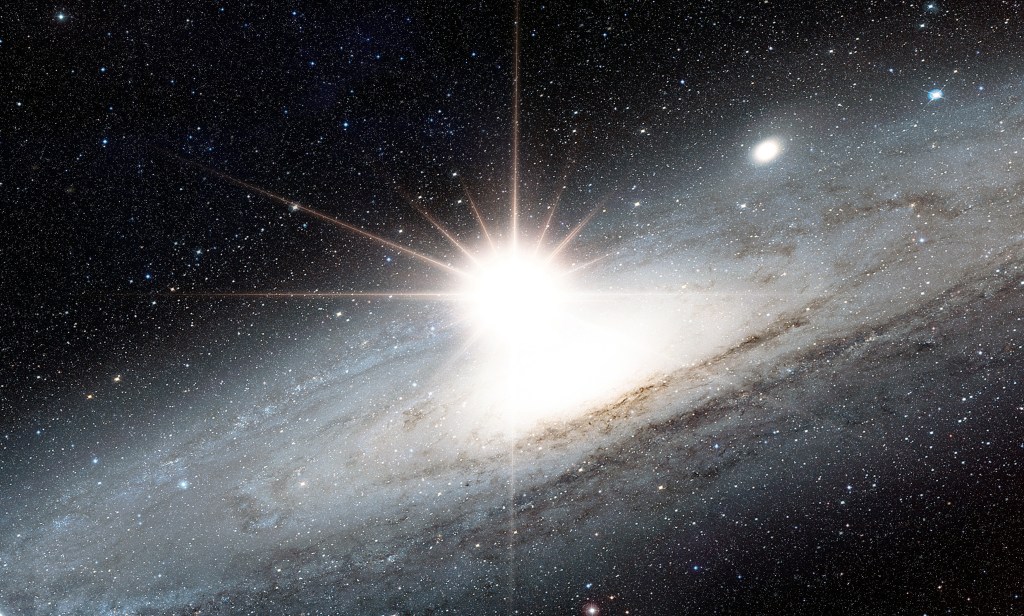
A picture of the Andromeda Galaxy with a bright white light near its center. The bright light is almost outshining the entire galaxy.
Supernova explosion in the center of the Andromeda galaxy “Elements of this image furnished by NASA” It is essentially an enhanced photo of a supernova explosion in a neighboring galaxy. Stock Photo ID: 2495486227 by muratart.

The Betelgeuse Supernova

Betelgeuse the bright red star in the constellation Orion is thought to be close to going supernova, and when it does it will be about as bright as half a full moon in our sky but concentrated in a point. What does “close” mean? Some astronomers say within decades, some say within a few thousand years. Could Kevin’s beautiful picture above depict this future event?

This is a map of the Orion constellation showing Orion’s belt in the middle. Betelgeuse is a red star or dot up to the left | The Betelgeuse Supernova
Illustration of the Orion constellation. To find Betelgeuse, first find Orion’s belt, then look up to the left. The reddish star is Betelgeuse. It is visible at this time of year (on a clear night). Stock Vector ID: 1631025025 by Tedgun.

We are stardust

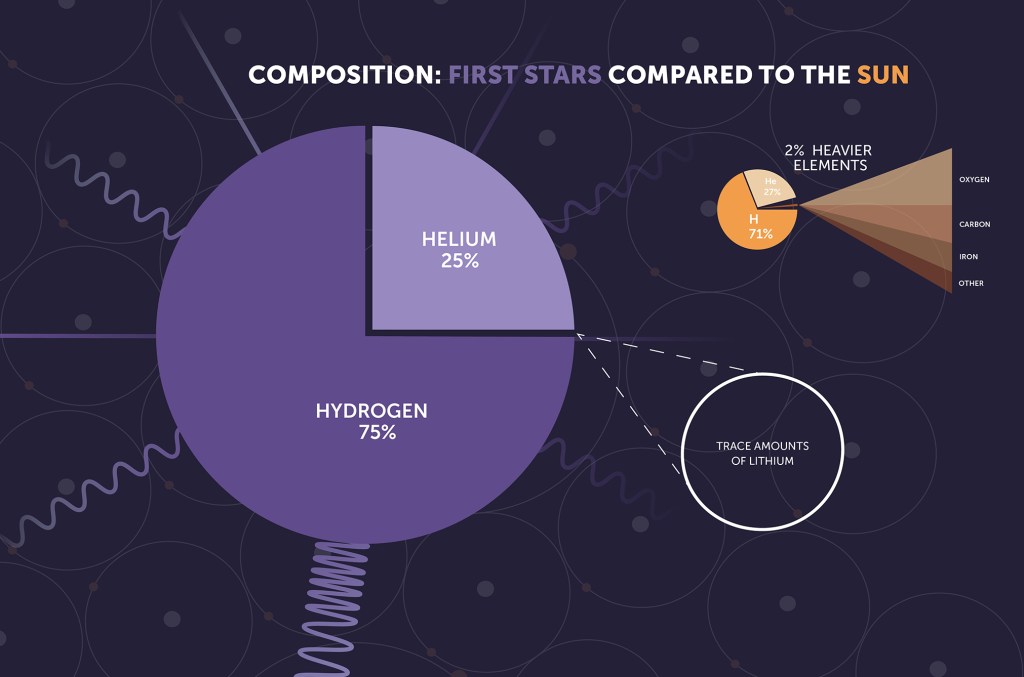
The first stars in the Universe were made of 75% hydrogen and 25% helium and trace amounts of Lithium, just like the entire Universe at the time. Heavier elements that could form rocky planets or other solid celestial bodies did not exist.

However, inside the cores of these stars, heavier elements such as carbon, oxygen, and iron were formed by fusion. These early stars are referred to as first generation stars. They tended to be large and ended their lives in massive supernova explosions. The dusty remains of these explosions became the building blocks of the second and third generation stars we see today as well as the planets, our bodies and all life. We are stardust.

The picture consists of two pie chart graphs representing stars. The left one is a first-generation star with one pie for the 75% hydrogen and one pie for the 25% helium.
The first-generation stars consisted of 75% hydrogen and 25% helium and trace amounts of Lithium. A second or third generation star like our sun is still mostly hydrogen and helium but also many other elements. The rocky planets circling the sun are mainly elements heavier than hydrogen and helium. Image credit NASA, ESA, CSA, STScI.

Finally, a 33 second YouTube video illustrating a Supernova (the creation of the Crab nebula)


Would you like to see Betelgeuse explode into a supernova in your lifetime?


To see the Super Facts click here