Infinities Come in Different Sizes

Super fact 68 : Infinities come in different sizes. Some infinities are larger than others. In fact, it is possible to create an infinite number of different-sized infinities. Some infinities are countable and others are uncountable.

How can infinity be of different sizes? Infinity is infinity after all. Infinity is an absolute, an absolute we cannot imagine. However, at the end of the 19th century a German mathematician by the name Georg Cantor demonstrated that there exists a variety of infinities, and some are larger than others. In fact, his theorem implies the existence of an infinity of infinities. For those who have not heard of this concept before it is surprising and yet it is true, and it is also kind of an important thing to know about mathematics. This is why I consider this a super fact.

Let me explain. Think about all natural numbers, 1, 2, 3, 4, 5, …, a billion, a quintillion, … You can keep counting forever. There are infinitely many natural numbers. Now take two natural numbers, the numbers 3 and 4. How many numbers are in between 3 and 4? Well, you have 3.5, 3.55555, 3.016893, and you have the number pi, 3.14159265358979323846, and infinitely many other numbers with infinitely many decimals. 3 and 4 are only two numbers but you have infinitely many decimal numbers, or so called real numbers, between 3 and 4. That is true for the two numbers 4 and 5 as well, and 5 and 6, and all natural numbers. Even though there are infinitely many natural numbers there are infinitely many more real numbers.

For the explanation of the mathematical proof see this article in Scientific American. This article explains why there are an infinite number of different-sized infinities.

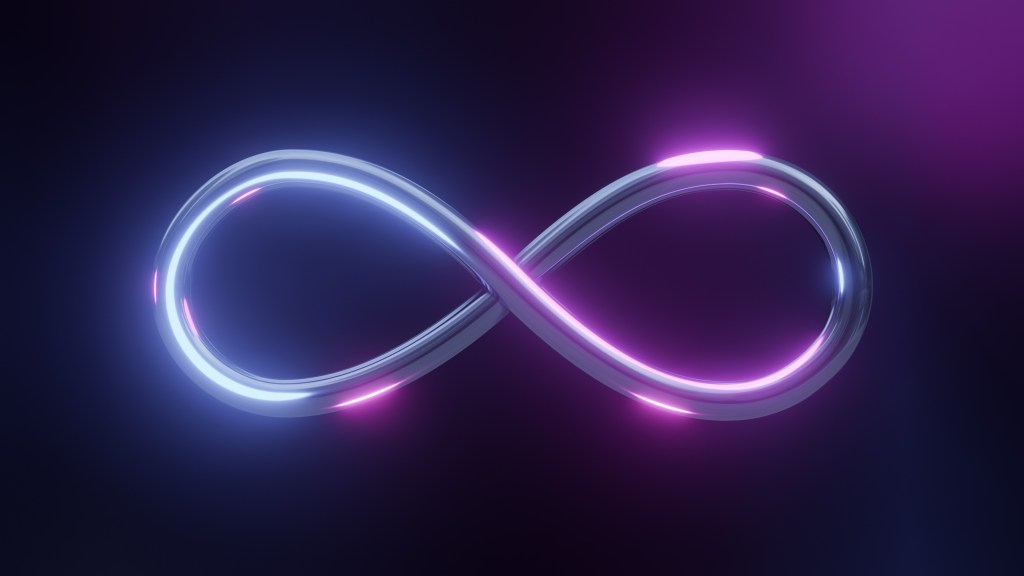
A neon infinity metaverse symbol. 3D illustration | Infinities Come in Different Sizes
Infinity Asset id: 2118543950 by Sahara Prince

I should say that today Saturday November 8, 2025, is National STEM Day, or STEAM Day. Stem stands for Science, Technology, Engineering, and Mathematics. The extra ‘A’ in STEAM stands for Art. Therefore, I thought that posting something related was appropriate for today, in this case it is Mathematics. I have to admit I am posting it a little bit late in the day though.

To infinity … and beyond!

Madrid, Spain; 05-14-2024: Large figure of the famous character Buzz Lightyear from the movie Toy Story in an exhibition called Pixar World about the studio's films.
Buzz Lightyear “To infinity … and beyond”.  Shutterstock Asset id: 2464838811 by MSCT Pics

As mentioned, infinites can have different sizes. How about, for example, the set of all natural numbers and the set of even numbers. After all, it seems like the set of all even numbers should be half as big. As it turns out they are the same size. That’s because for all natural numbers 1, 2, 3, 4, 5 you can always find a buddy, 2, 4, 6, 8, 10 among the even numbers. This is called a bijection. However, you cannot do this with natural numbers versus real numbers. You cannot pair up a natural number with the real numbers because there are infinitely many for each single natural number.

The set of all real numbers is really a larger infinity than natural numbers, which by the way is the smallest infinity. The sets of natural numbers and, for example, even numbers are called countable infinities, and the set of real numbers are called uncountable infinities. In addition, there are infinitely many different sizes of infinities that are larger than both natural numbers and real numbers.

Another interesting, related issue is that Cantor tried to prove that there are no infinities with sizes that lie in between the natural numbers and the real numbers. This was called the continuum hypothesis. As it turned out this hypothesis is not possible to prove (you can prove that it cannot be proved) at the same time as it is not possible to disprove. It is related to Gödels incompleteness theorem but is not the same. However, it is another absolute limit to human knowledge, things we know that we can never know.


If you want to have your mind blown, watch this 8 minute YouTube video about infinities of different sizes and the continuum hypothesis.

Other Mathematics Related Super Facts


To see the other Super Facts click here

Eulers Polyhedra Math Magic

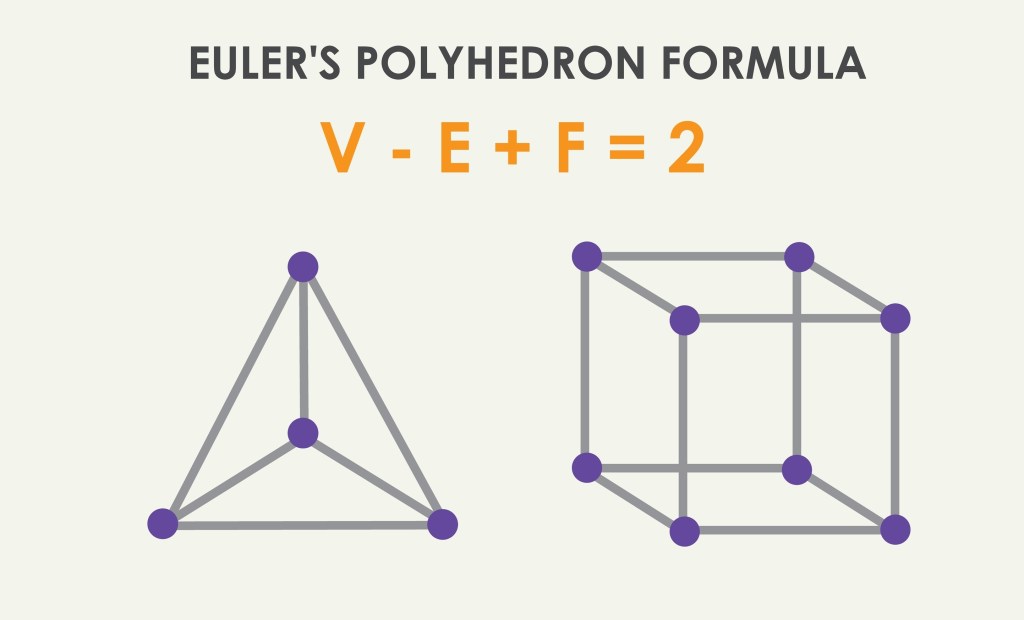
Super fact 64 : V – E + F = 2 is true for all convex polyhedra, where V is the number of vertices (corners), E is the number of edges, and F is the number of faces of a convex polyhedron. This is called Euler’s formula for polyhedra.

Stick drawings of a tetrahedron on the left and a cube on the right | Eulers Polyhedra Math Magic | Euler's Polyhedron Formula
Polyhedron Euler’s formula. The cube has 6 faces, 8 corners (blue dots), and 12 edges (grey lines) and 8 – 12 + 6 = 2. Popular shapes Asset id: 2362684465 by ramonparaiba.

Convex polyhedra are polyhedra without holes, or it has no internal angles larger than 180 degrees. To express that exactly; A convex polyhedron is a three-dimensional solid with flat polygonal faces where a line segment connecting any two points on its surface or interior remains entirely within the solid. I can add that convex polyhedra consists of convex polygons as their faces. All its faces are convex polygons.

On the left are three convex polygons and on the left are three concave polygons.
The difference between convex and concave polygons. Notice that the concave polygons on the right have “holes” in them, or inner angles larger than 180 degrees, and that you can draw a line starting and ending inside the polygon that goes outside the polygon.

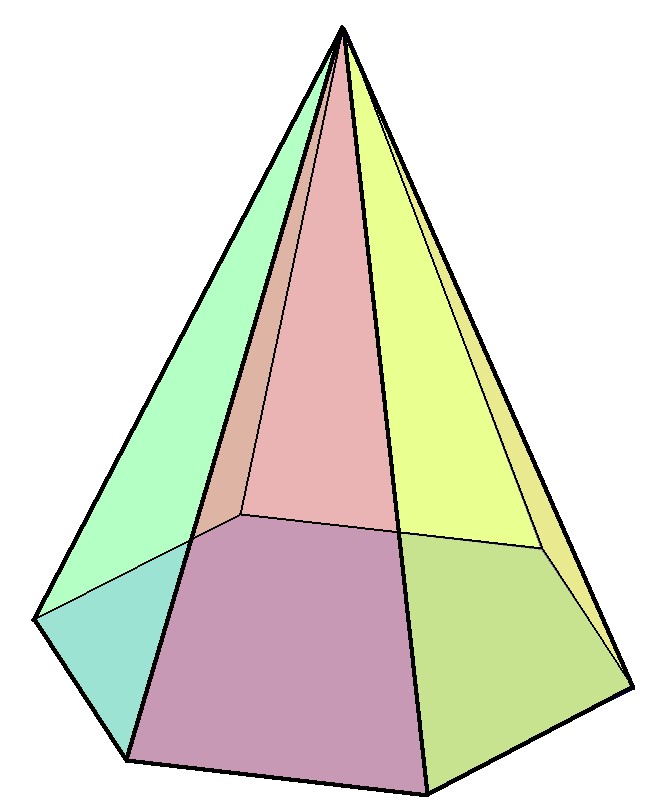
It is easy to understand that there are an infinite number of convex polyhedra. All pyramids (with convex polygons for bottoms) are convex polyhedra whether the bottom is a square/rectangle, or a convex pentagon, hexagon, heptagon, octagon, or any kind of convex polygon, even with trillions.

A hexagonal pyramid with differently colored faces | Eulers Polyhedra Math Magic | Euler's Polyhedron Formula
A hexagonal pyramid (it is convex). Tomruen at en.wikipedia, Public domain, via Wikimedia Commons.

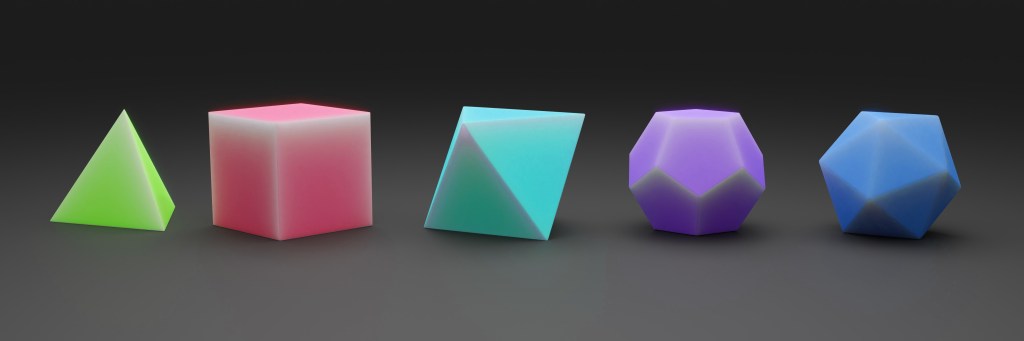
Examples of convex polyhedra are cubes, boxes, a tetrahedron, pyramids of various sorts, an octahedron, dodecahedron, icosahedron, but there are infinitely many.

As an example, take a cube (like a dice). It has six faces (F = 6), eight vertices (corners V = 8), and 12 edges (V – E + F = 2 or 8 – 12 + 6 = 2). A tetrahedron has four faces (F = 4), four vertices (V =4), and six edges (E = 6) (V – E + F = 2 or 4 – 6 + 4 = 2). A pyramid (with a square bottom) has five faces (F = 5), five vertices (V = 5) and eight edges (E = 8) (V – E + F = 2 or 5 – 8 + 5 = 2). An octahedron has eight faces (F = 8), and six vertices (V = 6), and twelve edges (E = 12) (V – E + F = 2 or 6 – 12 + 8 = 2). A dodecahedron has twelve faces (F = 12), and twenty vertices (V = 20), and thirty edges (E = 30) (V – E + F = 2 or 20 – 30 + 12 = 2). An icosahedron has twenty faces (F = 20), and twelve vertices (V = 20), and thirty edges (E = 30) (V – E + F = 2 or 12 – 30 + 20 = 2). Euler’s Polyhedral Formula works for all of them and for all the infinite number of convex polyhedra that exists.

Line of colorful Platonic solids on a grey surface (polyhedra - tetrahedron, cube, octahedron, dodecahedron and icosahedron, 3d render, banner.
Tetrahedron, cube, octahedron, dodecahedron and icosahedron, Shutterstock Asset id: 2138211027 by Dotted Yeti

I consider this a super fact because it is quite amazing and surprising that the number of faces, vertices, and edges follow the same formula for all convex polyhedra. At least it is surprising if you haven’t seen it before. I should say that Leonhard Euler’s most celebrated discovery is probably his discovery of the Euler Number and the associated Euler’s Formula.

More Polyhedra Examples

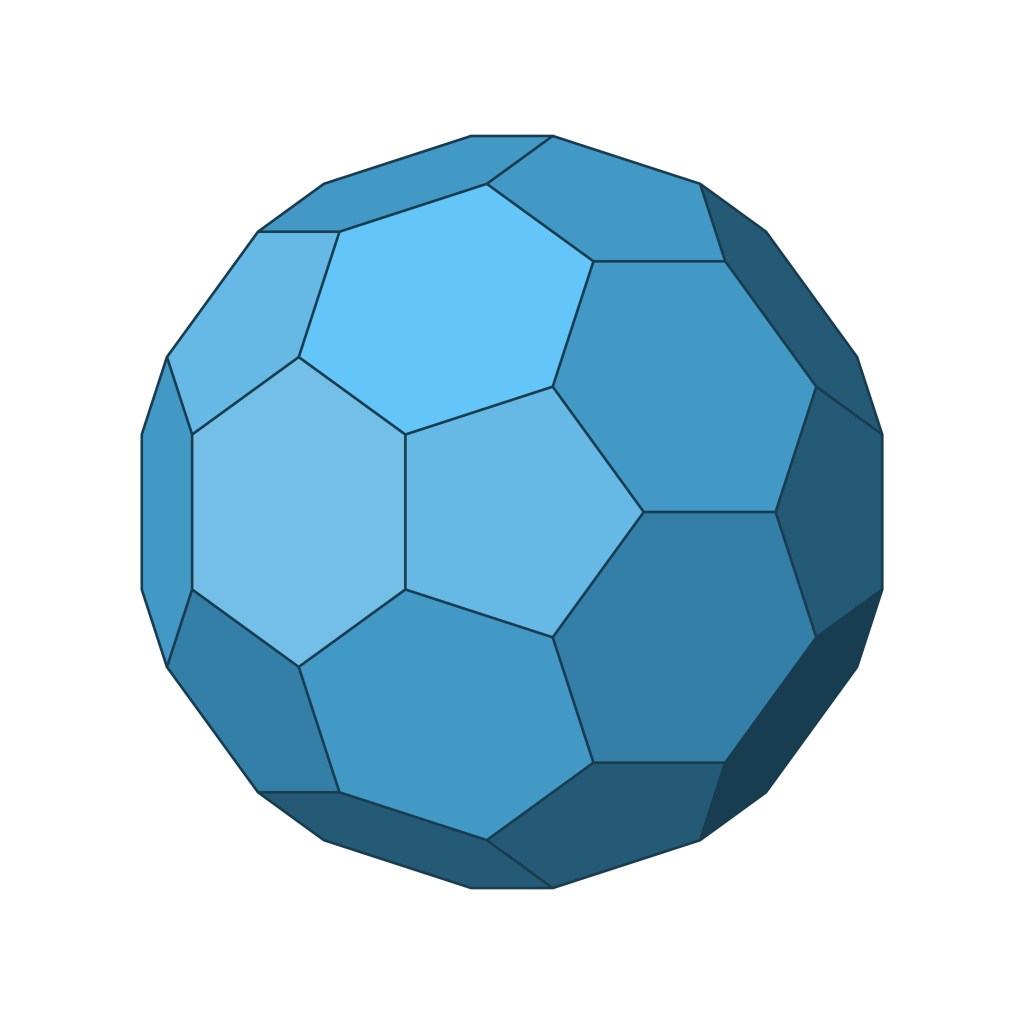
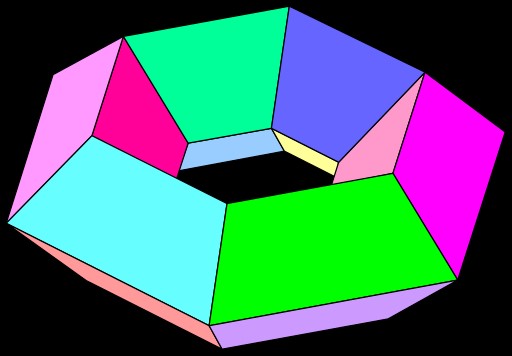
The three first examples below are convex polyhedra so Euler’s Polyhedral Formula apply. The last two examples are not so Euler’s Polyhedral Formula does not apply.

Blue truncated icosahedrons. Geometric soccer ball or football shape. Archimedean solid. Regular polygon outline with pentagonal and hexagonal faces. Blue gradient polygonal figure | Eulers Polyhedra Math Magic | Euler's Polyhedron Formula
This is a truncated icosahedron, which is a convex polyhedra, so Euler’s Polyhedral Formula apply. Shutterstock Asset id: 2309812551 by Mima Subota.
A green Rhombicuboctahedron with 8 triangles and 18 squares as faces.
This Rhombicuboctahedron is an example of convex polyhedron, so Euler’s Polyhedral Formula applies. Cyp, CC BY 4.0 <https://creativecommons.org/licenses/by/4.0&gt;, via Wikimedia Commons.
Icosidodecahedron with faces that are triangles and pentagons.
This Icosidodecahedron is another example of a convex polyhedron, so Euler’s Polyhedral Formula applies. Attribution must be given to Robert Webb’s Stella software as the creator of this image along with a link to the website: http://www.software3d.com/Stella.php. A complimentary copy of any book or poster using images from the Software would also be appreciated where feasible., Attribution, via Wikimedia Commons
This polyhedron is donut shaped | Eulers Polyhedra Math Magic | Euler's Polyhedron Formula
This hexagonal torus / toroidal polyhedron is not a convex polyhedra, so Euler’s Polyhedral Formula does not apply in this case. Tom Ruen, SVG version from de:User:Antonsusi, Public domain, via Wikimedia Commons
3d polyhedron Merkaba, esoteric bronze crystal, sacral geometry shape, volume david star, mesh form, abstract vector object
This Merkaba Polyhedron is not a convex polyhedra, so Euler’s Polyhedral Formula does not apply in this case. Shutterstock Asset id: 1296063079 by Panimoni


To see the other Super Facts click here

The Euler Number Math Magic

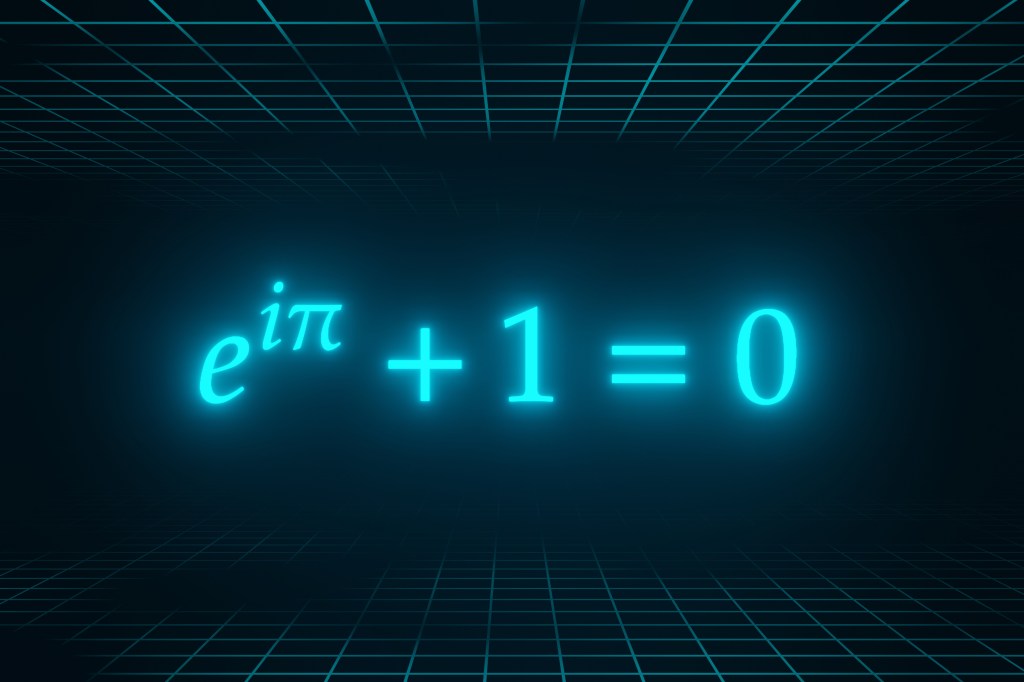
Super fact 53 : The Euler number denoted e, is an irrational number, which like the number pi is extremely important in mathematics. In addition, the relationship between the Euler number and pi; seemingly unrelated numbers, is quite amazing, especially if you throw the imaginary number: i = square root of -1 into the mix. Euler’s formula e^ix = cos(x) + isin(x), where x is degrees expressed in radians, is mind blowing to say the least. Radians means that 180 degrees is replaced by pi, and 90 degrees is replaced by pi/2, etc. A simpler special case, but equally amazing is Euler’s identity e^ix = -1, or e^ix + 1 =0. This is amazing math assuming you understand it.

As I said all this is amazing, mind blowing if you will, if you understand it, which is why I will try to explain it. Why I consider this a super fact is because when you first encounter the Euler number and the Euler formula, and you somewhat understand what it means, it is likely to be a mind-blowing experience. Those among you who have studied higher math, AP math classes in high school, or college level math are probably familiar with what I am about to describe, so your mind may not be blown. By the way you pronounce Euler like “Oiler”.

The formula e^ix + 1 =0 shown on a blue and black background | The Euler Number Math Magic
Euler’s formula in cyber space with grid 3d illustration, Asset id: 1636161301 by Giggle2000

Euler’s Number and Pi Two Irrational Numbers

Pi is the number you get when you divide the distance around a circle (the circumference) by the distance across the middle (the diameter). The Euler number is a bit more complicated to explain. I will do that next. Both pi and the Euler number are irrational numbers, which means that when written as a decimal, the number neither terminates nor repeats. As I mentioned, both pi and the Euler number are extremely important numbers in math. Perhaps the Euler should have its own day, just like pi has its own day (March 14). Maybe we should start celebrating Euler number day on February 7.

The picture shows a circle and a brief explanation of what pi is. The 20 first decimals of pi as well as the 20 first decimals of the Euler number are shown.
The first 20 decimals of pi and of the Euler number.

Exponents

Before I explain what, the Euler number is, I need to explain what an exponent is. If you multiply a number by itself x number of times, then x is the exponent. If you multiply two by itself four times 2*2*2*2, called 2 raised to 4, then 4 is the exponent. By the way the answer is 2^4 = 16 (called 2 raised to 4 is 16). I hope the illustration below will explain it.

This picture explains what an exponent is.
Overview of exponents.

And finally, before explaining what the Euler number is I should also mention what a factorial is. The factorial of a number is the product of all positive integers less than or equal to that number. The factorial of 5 is denoted 5! and is 1*2*3*4*5 = 120. Also, the factorial of 0 or 0! = 1 (per definition).

Definition of the Euler Number

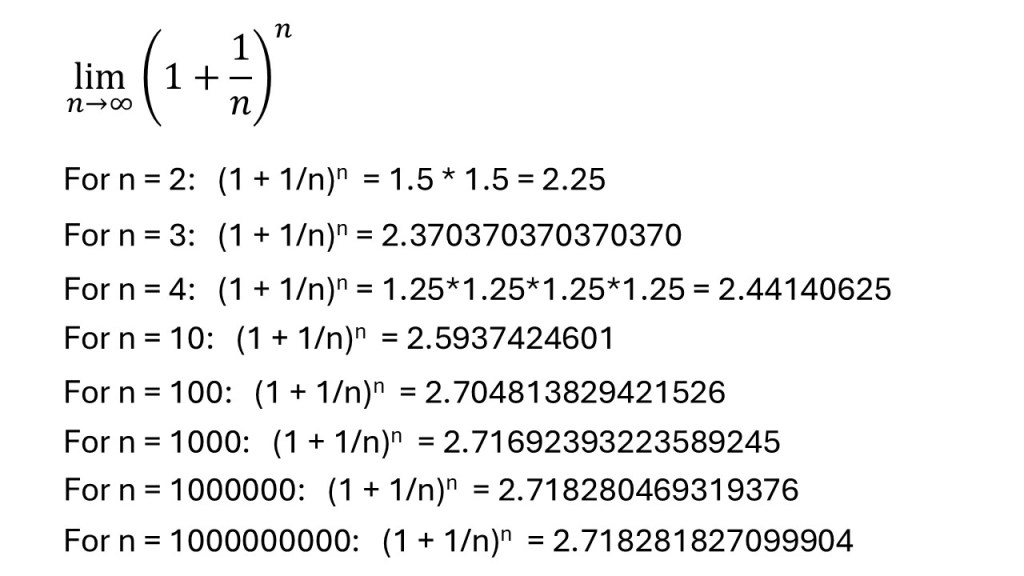
One more thing I need to explain before I go ahead with the definition for the Euler number is what is meant by allowing a number n in a formula to go towards infinity (limit –> infinity). Let’s say you have a formula that contains the number n. If the value of the formula does not change much as n becomes very large than it might be approaching a specific number as n approaches infinity. You say that it approaches a limit. I am trying to illustrate this in the picture below.

The formula (1 + 1/n)^n is given for a lot of different numbers n. You can see that a number, a limit, is reached as n approaches infinity | The Euler Number Math Magic
As the number n gets bigger the formula stops getting bigger and instead approaches a limit. When n approaches infinity that will be a very specific number. Which number do you think it is?
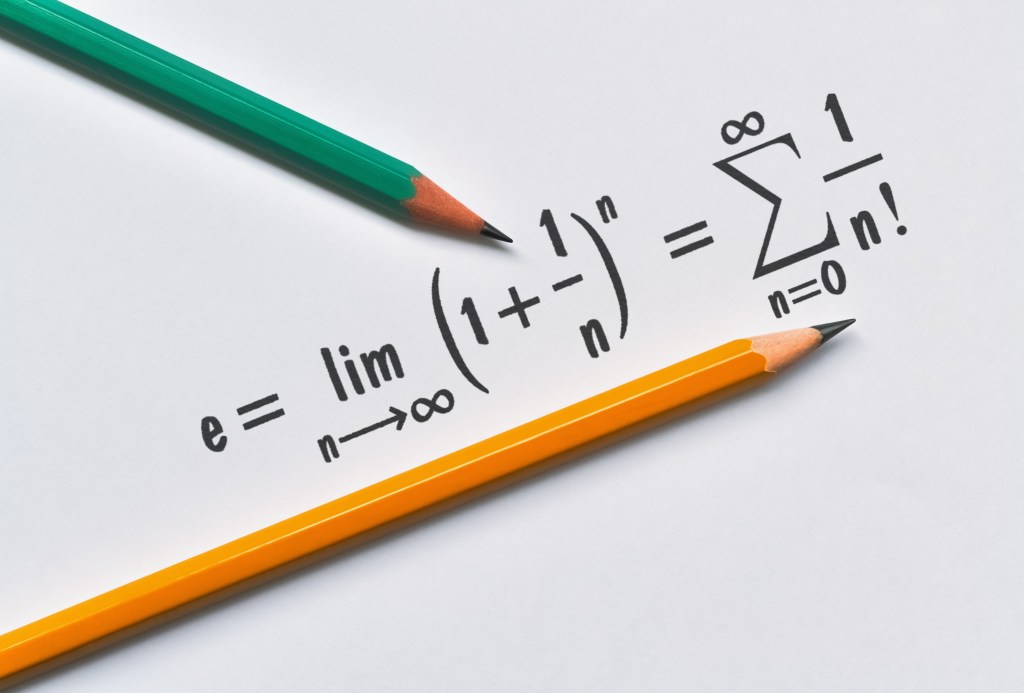
The picture features the definition of Euler’s Number as well as another formula consisting of an infinite sum that is also Euler’s number.
The definition of Euler’s number plus an infinite series sum that is also the same as Euler’s number.
Two formulas equal to Euler’s Number. One is an exponent approaching infinity and the other is a sum from 0 to infinity | The Euler Number Math Magic
Definition of the Euler’s constant in two different ways, Asset id: 1227561829, by benjaminec.

Euler’s Number in Calculus

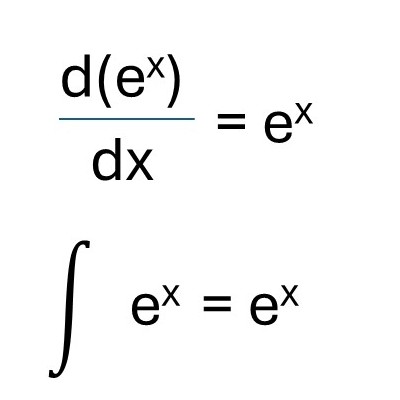
As I mentioned, Euler’s number shows up in mathematics in a lot of places. It is an extremely useful number with some amazing properties and that includes calculus. However, explaining functions and calculus may be going a bit too far, so I am just going to simply state that the derivate of e^x is just e^x and the indefinite integral, or the anti-derivative of e^x is e^x. In other words, differentiation / integration does not change this function. It also means that the slope of the curve is the same as the curve itself. Among all the infinite number of functions this is only true for e^x.

Differentiation and integration formulas for the exponential function.
Differentiation and integration does not change the function e^x.

Trigonometric Functions

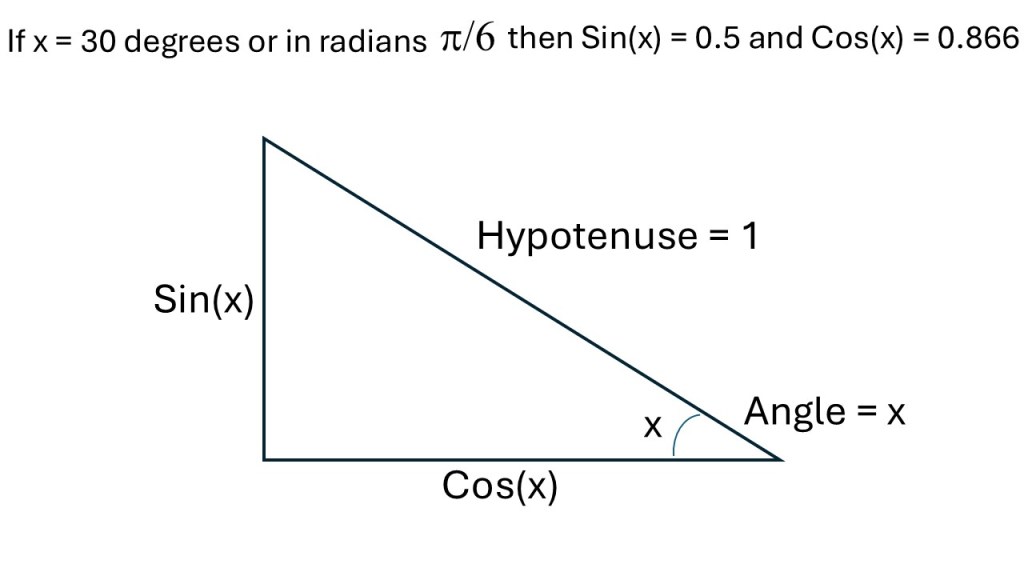
Next, I would like to launch into Euler’s formula. However, before I do that, I need to explain what trigonometric functions and imaginary numbers are. The trigonometric function sin(x) is the ratio of the length of the side opposite to a given angle to the length of the hypotenuse. In other words, if the hypotenuse is equal to 1, then sin(x) is the length of the opposite side to the given angle. The trigonometric function cos(x) is the ratio of the side of the triangle adjacent to the angle divided by the hypotenuse. In other words, if the hypotenuse is equal to 1, then cos(x) is the length of the adjacent side to the given angle.

Sin and cos are always between 1 and -1. ‘x’ is often expressed in degrees going from 0 to 360 (or 0 to 90 in a right-angled triangle). However, there is another way to express angles in triangles and that is radians. In this case the number pi corresponds to 180 degrees, pi/2 corresponds to 90 degrees, pi/4 corresponds to 45 degrees, etc. Euler’s formula uses trigonometric functions, but it only works if you use pi instead of degrees. Pi and Euler’s number have a special relationship. Sin and cos are illustrated in the picture below.

The picture shows a right-angled triangle with the sides being the hypotenuse set to 1 and the two other sides sin(x) and cos(x) respectively | The Euler Number Math Magic
Illustration of the trigonometric functions sin(x) and cos(x).

Imaginary Numbers

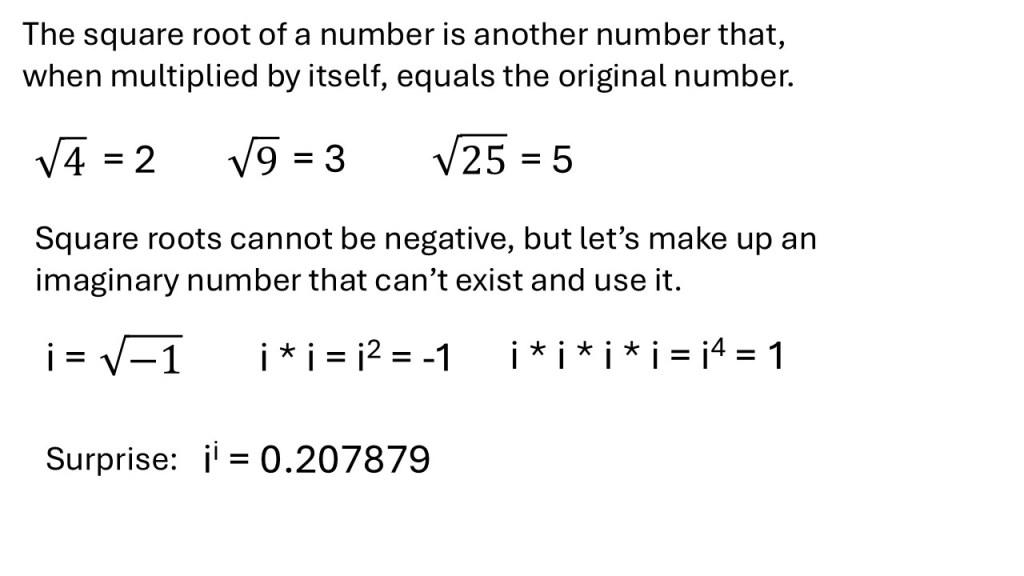
The last thing I need to explain before demonstrating Euler’s formula is imaginary numbers. The square root of a number is another number that, when multiplied by itself, equals the original number. For example, the square root of 4 is 2, because 2 * 2 = 4. The square root of 9 is 3, because 3 * 3 = 9. As long as you deal with real numbers, square roots must be positive numbers because you cannot multiply two numbers and get a negative number. -2 * -2 is 4, not -4.

However, that did not stop some mathematicians from making up a square root that was negative. This imaginary number is the square root of -1 and is referred to as i, yes just i, for imaginary. So, what’s the point of making up numbers that can’t exist? Well, it turned out to be quite useful and you can manipulate imaginary numbers to result in real numbers. For example, if you multiply the imaginary number i by itself i*i you get -1. If you multiply i by itself four times, in other words i^4, or i raised to 4, you get 1. Even more impressively, i raised to i, or i^i, is a real number. i^i = 0.207879… This is illustrated in the picture below.

The picture features the definition of the imaginary number and an explanation for what imaginary numbers are, as well as examples.
Imaginary numbers illustrated

Eulers Formula

Without giving the proof, or any detailed explanations, below is Euler’s identity and Euler’s Formula (e^ix = cos(x) + isin(x)). Notice the mix of Euler’s number, pi, the trigonometric functions using radians (based on pi), and the imaginary number. Well, likely mind-blown, if you have not seen it already and you understood this post up to here.

Euler’s identity and Euler’s formula | The Euler Number Math Magic
Euler’s identity and Euler’s formula.
The picture shows Euler’s formula illustrated in the complex plane.
Euler’s formula illustrated in the complex plane. Asset id: 2345669209 by Sasha701

If you want to see how you prove Euler’s Formula check out this youTube video.

If you want to learn more about the importance of Euler’s number in sommon and useful mathematics, check out this youTube video.


To see the other Super Facts click here

The Surprising Butterfly Effect

Super fact 40 : In chaotic systems the so-called butterfly effect means that a small change in initial conditions, such as a butterfly flapping its wing in Brazil, can lead to large, unpredictable changes in a system’s future, such as the appearance of a tornado in North Texas. However, that does not mean that the butterfly directly caused the tornado. It should also be noted that chaotic systems can contain predictable patterns and external forcings can certainly make aspects of a chaotic system behave in a predictable manner.

The first part of Super Fact 40 describes a well-established phenomenon that is often surprising to people who have not heard about it before. The second part (following the word “However”) address a few common misconceptions about the butterfly effect. The butterfly effect is a surprising and widely misunderstood phenomenon and therefore I consider the information in bold above to be a super fact.

The Surprising Butterfly Effect
Photo by Cindy Gustafson on Pexels.com

The Butterfly Effect and Unpredictability

The butterfly effect is the sensitive dependence on initial conditions in which a small change in one aspect of the system can result in large differences later. A butterfly flapping its wing in Brazil, leading to the appearance of a tornado in North Texas, is one example. The butterfly effect is an aspect of chaos theory.

However, it is important to understand that the butterfly is not directly causing the tornado. It is the wing flaps of trillions of butterflies, the wing flaps of 50 billion birds, the barks of 900 million dogs, all the waterdrops in the world, and all the bushes and trees, etc., which together provide the initial conditions for the world’s weather system.

Remove one butterfly, anyone of them, or the bark of a dog, and you may or may not have a tornado in north Texas on a certain date. It isn’t the butterfly causing the tornado. Any tiny change in the initial conditions will eventually lead to a large difference in the system later. This is how the Butterfly Effect provides unpredictability.

A large well-formed tornado over the plains.
Did a butterfly do this? Stock Photo ID: 2369175167 by g images.com.

The Butterfly Effect and Predictability

Because of the butterfly effect you may not be able to predict whether it is going to rain at 1:00PM next Thursday, but you can still safely predict that Dallas, Texas, will on average be cooler in January than in July. That’s largely because the sun will heat Dallas, Texas more in July than in January. We know that if you add carbon dioxide, or other heat trapping gases, to the atmosphere it will on average get warmer. External forcings make aspects of chaotic systems predictable. You sometime hear the argument that “climate is chaotic and cannot be predicted”. This is a myth that is debunked here.

In addition, chaotic systems can feature predictable patterns, even though chaotic systems are considered unpredictable. Chaos theory demonstrates that within the apparent randomness of chaotic systems, there are underlying statistical patterns, self-similarity, fractals, and interconnection.

I once created a robot control system for which the robot was shaking a little bit. The tool tip was moving in a little circle and did not get to where it was supposed to be. The reason was that the presence of static friction made the control system I was using a chaotic system.

However, the robot didn’t randomly go all over the place. It was moving quickly in a small circle. It was chaotic, and its exact motion was unpredictable, but there was an underlying statistical pattern. Another example is, fractals, which are geometric patterns that emerge from chaotic processes described by chaos theory. Fractals feature self-similar patterns repeating at different scales. They can visually represent the complex behavior of these systems. See an example below.

A 450 layer fractal | The Surprising Butterfly Effect
This is a file from the Wikimedia Commons Wikipedia. Simpsons contributor at English Wikipedia, Public domain, via Wikimedia Commons.

Edward Norton Lorenz

In 1961, Edward Norton Lorenz was using a computer to simulate weather patterns by modeling 12 variables (heat, wind, etc.). After finishing one simulation he wanted to see it again but to save time he started it in the middle using the saved variables at the point. To his surprise his simulation ended up with completely different weather. He realized that the computer the saved data had tiny errors from the computer rounding off the numbers. For example, 3.145787 instead of 3.1457872. That small difference was enough to eventually result in completely different weather.

Lorenz was not the first person to realize that, so called, non-linear systems can be extremely  sensitive initial data. This realization goes all the way back to the mathematician Henri Poincaré in the 19th century. However, he was the founder of modern chaos theory and coined the term the Butterfly Effect.

To see the other Super Facts click here

What do you think about the Fractal above?

Freedom to Roam and Concentric Circles

Image above by Kevin from The Beginning at Last

Water surrounded by trees, what looks like coniferous forest. There are circular ripples on the water with drops falling into the lake in the middle | Freedom to Roam and Concentric Circles
This picture reminded me of the Swedish lakes I used to swim in. This is a submission for Kevin’s No Theme Thursday

Freedom to Roam Everywhere

When I was a kid, I used to roam around a lot, in the forest and on the mountains, and I liked to swim and fish in the rivers and the famous deep lakes in the Swedish countryside. Sweden has 97,500 lakes larger than 2 acres and many of them are deep lakes with clean and clear water surrounded by forests, typically coniferous forests. A small deep clean forest lake is referred to as a “tjärn”. I can add that there are no alligators or venomous water snakes in Swedish lakes.

Sweden offers a type of freedom that is rare in the world, and it does not exist in the United States and certainly not in Texas where I live. It is the freedom to roam or more specifically allemansrätten. Whether the land is public or private you have the right to roam, to hike, to camp, to swim, to pick wild berries, to pick wild mushrooms, to fish, and no one can stop you. Landowners are not allowed to tell you to get off their land and they cannot put up fences to stop you or animals from roaming on their land. Everyone has the right to roam and swim everywhere. It is a freedom Swedes love, and if you one day come to experience it you will know why.

My son letting of a swing tire. There are ripples on the lake beneath him. You can see trees on the other side of the lake.
My son is jumping off a tire swing and into a “tjärn” in northern Sweden.

Allemansrätten

The Swedish freedom to roam or allemansrätten, is a right for all people to travel over private land in nature, to temporarily stay there and, for example, pick wild berries, mushrooms, flowers and certain other plants. It is important to point out that you must respect the landowner’s property. You can pick wild berries but not anything the landowner is growing. You cannot destroy or break things or start fires, use ATVs, cut branches off trees, etc. You also need to stay 70 meters or 230 feet away from any dwelling.

As a landowner in Sweden, you can buy land and use it for farming and forestry, and you have the right to prevent people from damaging or stealing your crops. You can buy land for mining, and you have the right to your proceeds and the right to prevent people from stealing from your mines. In addition, people don’t have the right to get close to your house. However, you do not have the right to prevent anyone from roaming on your land.

Other countries with similar laws are Norway, Finland and Iceland. Limited forms of allemansrätten exist in Austria, Germany, Estonia, France, the Czeck Republic, and Switzerland. In the United States, where  allemansrätten does not exist, 63% of all land is private and in Texas 93% of all land is private. Since there is no law in the US protecting your freedom to roam there is noticeably something missing, especially if you are an outdoors person.

Concentric Circles

In addition to evoking my memories of Swedish lakes and allemansrätten, Kevin’s picture tickles my mathematical sense, specifically regarding concentric circles. Concentric circles are beautiful, dreamy, and interesting mathematical phenomena. I could watch concentric circles in the water all day long.

When you jump and play in a lake, when raindrops fall on a lake or a pond you’ll see concentric circles. You see concentric circles on a tree stumps, when you cut an onion, some flower petals, spiderwebs, etc. Concentric circles are everywhere in nature. Light can create concentric circles due to diffraction called an airy disk. Gravitational waves originating from, for example, two black holes colliding create 3D gravitational concentric circles/spheres traveling at the speed of light through space.

Concentric circles are very common in nature. You can see them in Kevin’s picture above. You can see them below my son as he falls into the Swedish lake, and you can see them in the pictures of light below. Whenever waves originate at a point and spread outward you get concentric circles.

There are many kinds of waves, water waves, sound waves, surface waves, seismic waves (earthquakes), mechanical waves, light are waves, electromagnetic waves, matter is both particles and waves, gravitational waves, and they can all make concentric circles. If the waves are moving outward with the same velocity in all directions, you will get equidistant concentric circles.

A real Airy disk created by passing a red laser beam through a 90-micrometre pinhole aperture with 27 orders of diffraction | Freedom to Roam and Concentric Circles
A real Airy disk created by passing a red laser beam through a 90-micrometre pinhole aperture with 27 orders of diffraction. Bautsch, CC0, via Wikimedia Commons
A computer generated an Airy disk from diffracted white light. The colorful light circles come from the hole in the left wall | Freedom to Roam and Concentric Circles
A computer generated an Airy disk from diffracted white light. The colorful light circles come from the hole in the left wall. Asset id: 1973771255 by Fouad A. Saad.
To see the Super Facts click here