Accents are very difficult to lose

Superfact 18: Accents are very difficult to lose. People may speak and understand a second language perfectly and still have a strong accent in that language assuming they did not learn the second language in childhood. This is a fact that is well known to the 20.6% of people in the US who are bilingual and to the 43% of people in the world who are bilingual. Yet many monolingual people are unaware of and surprised by this basic and important language fact.

I can’t lose my accent

On one occasion when I took my oldest son to the playground a guy doing the same started talking to me. Hearing my accent, he asked me where I was from (Sweden) and how long I had been here (10 years). Then the guy said, “I am surprised that after all these years you still have an accent”.

This is a sentiment I’ve come across many times here in the US, but not as often in Europe. Monolingual people are surprised to hear bilingual people’s accent. When I tell people about the reality of accents and that it is difficult to lose one without major speech therapy, they act very surprised. It is a basic and important language fact that is surprising to those who don’t know it. That’s why I think this counts as a super fact.

Black dog with a Swedish flag | Accents are very difficult to lose
Photo by Efrem Efre on Pexels.com

I have difficulty hearing my own accent, which is to be expected according to this article . However, my accent becomes obvious to me when I hear myself speaking on a recording such as when I was interviewed by NBC about the tornado that ravaged our neighborhood five years ago. At first, I was thinking “oh shoot my accent is so obvious and now the whole world knows”, then I was thinking it is no big deal. If you want to hear my accent, click on this link. It is NBC news and my interview is located at : 1 minute and 11 seconds.

Accents are very difficult to lose

What monolingual people typically do not know but practically all bilingual people do know, is that it’s difficult to lose an accent as an adult learning a new language. Children can do it but not adults, not without major speech therapy. This article states that the cut off age is around 12 years old.

According to a test I took, my vocabulary and understanding of English grammar at the time of the incident above was above the average for native English speakers, and it was just as easy for me to understand, speak, read and write English, as Swedish. Yet my accent was obvious.

It should not really come as a surprise to monolingual people, but it does. After all, if you think about it, famous foreign actors such as Arnold Schwarzenegger, Werner Herzog, Marion Cotillard, Stellan Skarsgård. etc., speak with an accent even after living in the US and/or working for Hollywood, several decades, and they are not faking it. I have several friends and relatives who speak with a strong foreign accent after living in the United States for 30, 40, 50, and 60 years. If they came as adults, they still have their accent.

Arnold Schwarzenegger is holding a gian machine gun pointed into the camera. There is fire and smoke in the background.
Arnold Schwarzenegger a bilingual man Stock Photo ID: 2501506607 by Ralf Liebhold

As this article states, “accents are extremely difficult to lose because our infant brains codify a lifetime’s worth of sounds before we’ve spoken our first word”. As this article explains as we age our brains become more specialized in our native language sounds, making it harder to accurately perceive and produce new sounds from another language, a phenomenon often referred to as the “critical period hypothesis” in language acquisition; essentially, the window for easily acquiring perfect pronunciation closes during childhood.

On the left, a business guy speaking a whole bunch of languages indicated by flags coming out of his mouth. On the right another businessman surrounded by question marks | Accents are very difficult to lose
Past childhood it is much harder to accurately perceive and produce new sounds from another language Stock Photo ID: 1818291203 by pathdoc

A few second language facts

The most popular second language in the world with respect to the number of non-native speakers (data taken from this site).

  • (1) English – 1,140 million non-native speakers
  • (2) Hindi – 264 million non-native speakers
  • (3) Chinese (Mandarin) – 199 million non-native speakers
  • (4) Urdu – 162 million non-native speakers
  • (5) French – 132 million non-native speakers
  • (6) Arabic – 109 million non-native speakers
  • (7) Russian – 107 million non-native speakers
  • (8) Spanish – 74 million non-native speakers
  • (9) Bengali – 43 million non-native speakers
  • (10) Portuguese – 28 million non-native speakers

The most popular second language in the world with respect to number of countries.

  • (1) English – 55 countries
  • (2) French – 14 countries
  • (3) Russian – 13 countries
  • (4) Spanish – 8 countries
  • (5) Creole – 8 countries
  • 6) Arabic – 6 countries
  • (7) Kurdish – 4 countries
  • (8) Portuguese – 4 countries
  • (9) Italian – 3 countries
  • (10) Quechua – 3 countries

To see the other Super Facts click here


The Betelgeuse Supernova

This is a submission for Kevin’s No Theme Thursday

The Betelgeuse Supernova
Image by Kevin from The Beginning at Last

Supernova

A supernova is an explosion of a star so violent that it can outshine an entire galaxy. It can occur when a super massive star’s core contracts (the death of the star) and as it reaches a critical point it triggers nuclear reactions that cause the star to explode. Alternatively, it can occur when a white dwarf star is triggered into runaway nuclear fusion by a collision with another star.

Depending on how far away the supernova is it can be as luminous as a bright new star, the moon, or a second sun. It occurs suddenly and lasts for several weeks or months before fading away. If a supernova shines bright enough, the other stars in the sky will vanish from view. We can’t see the stars during the day, not because of the blue sky, but because of the ambient light from the sun. 

This is also one major reason photos from space often lack stars in the black sky. If a supernova is close enough to earth it could destroy earth. Luckily there are no super massive stars close enough to earth to pose a risk.

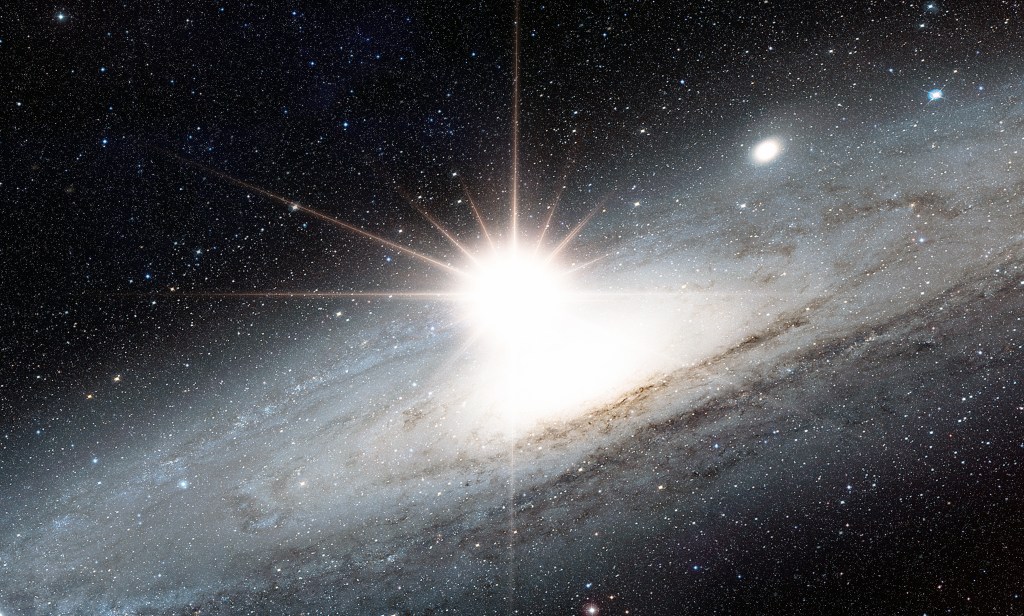
A picture of the Andromeda Galaxy with a bright white light near its center. The bright light is almost outshining the entire galaxy.
Supernova explosion in the center of the Andromeda galaxy “Elements of this image furnished by NASA” It is essentially an enhanced photo of a supernova explosion in a neighboring galaxy. Stock Photo ID: 2495486227 by muratart.

The Betelgeuse Supernova

Betelgeuse the bright red star in the constellation Orion is thought to be close to going supernova, and when it does it will be about as bright as half a full moon in our sky but concentrated in a point. What does “close” mean? Some astronomers say within decades, some say within a few thousand years. Could Kevin’s beautiful picture above depict this future event?

This is a map of the Orion constellation showing Orion’s belt in the middle. Betelgeuse is a red star or dot up to the left | The Betelgeuse Supernova
Illustration of the Orion constellation. To find Betelgeuse, first find Orion’s belt, then look up to the left. The reddish star is Betelgeuse. It is visible at this time of year (on a clear night). Stock Vector ID: 1631025025 by Tedgun.

We are stardust

The first stars in the Universe were made of 75% hydrogen and 25% helium and trace amounts of Lithium, just like the entire Universe at the time. Heavier elements that could form rocky planets or other solid celestial bodies did not exist.

However, inside the cores of these stars, heavier elements such as carbon, oxygen, and iron were formed by fusion. These early stars are referred to as first generation stars. They tended to be large and ended their lives in massive supernova explosions. The dusty remains of these explosions became the building blocks of the second and third generation stars we see today as well as the planets, our bodies and all life. We are stardust.

The picture consists of two pie chart graphs representing stars. The left one is a first-generation star with one pie for the 75% hydrogen and one pie for the 25% helium.
The first-generation stars consisted of 75% hydrogen and 25% helium and trace amounts of Lithium. A second or third generation star like our sun is still mostly hydrogen and helium but also many other elements. The rocky planets circling the sun are mainly elements heavier than hydrogen and helium. Image credit NASA, ESA, CSA, STScI.

Finally, a 33 second YouTube video illustrating a Supernova (the creation of the Crab nebula)


Would you like to see Betelgeuse explode into a supernova in your lifetime?


To see the Super Facts click here

The Swedish War King

“The Swedish War King” is not about a super fact. It is just what I think might be interesting information. Americans are obsessed with the British Royalty. However,  there 43 monarchies around the world, including Sweden (my native country). Some of the kings and queens of the past are quite interesting.

The focus of this post is Karl XII  or Carolus Rex, the Swedish War King who invaded Russia before Napoleon did. I made a list of Swedish monarchs that I find interesting. Then I will focus on Karl XII . The number following the name of the king is his/her time of reign.

Painting showing The Swedish War King with an interesting hairdo and wearing a large robe.
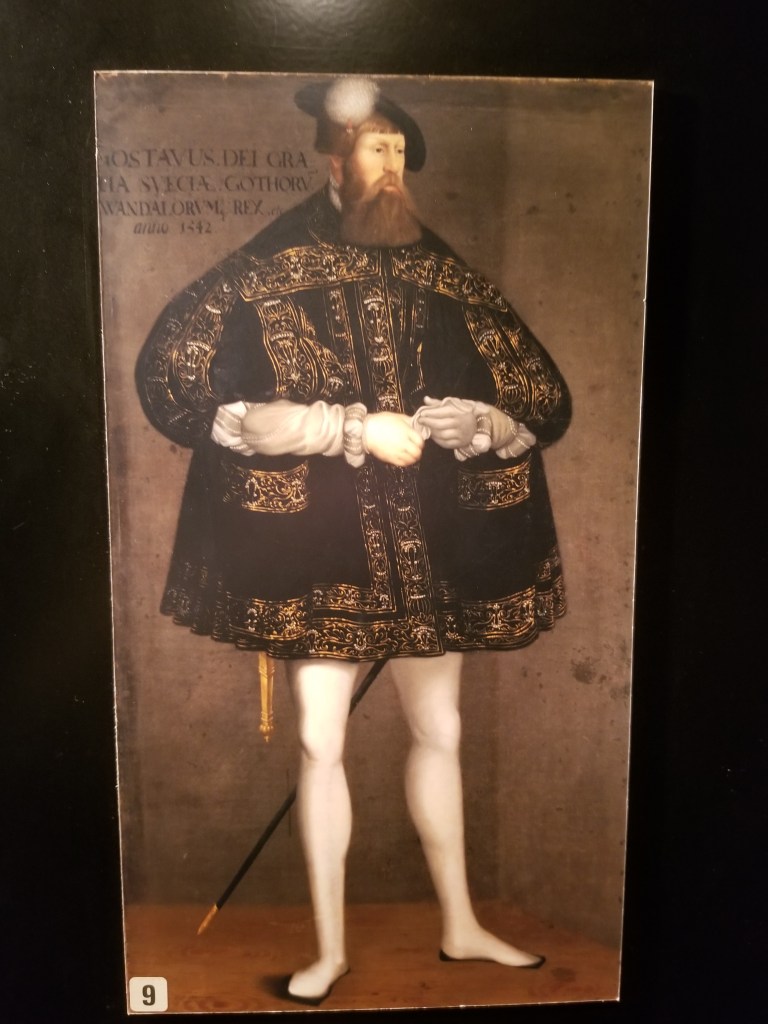
Painting of Gustav I Vasa liberator of Sweden from Denmark. Fashion was somewhat different back in the day.
  • Olof Skötkonung, 995–1022, son of King Erik VII and Sigrid the Haughty. He was Sweden’s first Christian King. The Swedish Viking era ended during his reign.
  • Erik IX, 1156 – 18 May 1160. Saint Erik was both a king and a saint. He tried to Christianize Finland and led the first crusade east. He was assassinated. Thereof his short reign.
  • Gustav Vasa or Gustav I, 6 June 1523 – 29 September 1560. From 1389 to 1523, Sweden was often united with Denmark and Norway under the kings of the Kalmar Union. Sweden’s full independence was restored under Gustav I in 1523. Gustav was elected king in Strängnäs 6 June 1523. Therefore, June 6 is celebrated as Sweden’s Independence Day. The Danish king at the time was King Christian II. In Sweden he is referred to Christian the Tyrant and in Denmark as Christian the Good.
  • Gustav II Adolf, 30 October 1611 – 6 November 1632. He is known as the “father of modern warfare”, or the first modern general, and under his reign Sweden became one of the great powers of Europe. Sweden was one of the primary military forces in Europe during the Thirty Years’ War (on the Protestant side). An estimated 4-8 million people died in the Thirty Years’ War, so this was a big war.
  • Queen Christina, 6 November 1632 – 16 June 1654. She was the daughter Gustav II Adolf. Gustav Adolf was closely attached to his daughter, and he taught her everything about being a monarch. Ironically, she fought to end the Thirty Years’ War. She converted to Catholicism, abdicated, and moved to Rome.
  • Carl XII, Charles XII, or Karl XII, or Carolus Rex, 5 April 1697 – 30 November 1718, was the Swedish War King, known for among other things invading Russia before Napoleon did. (see video below).
  • Gustav III, 12 February 1771 – 29 March 1792, was an autocrat and a believer in enlightened absolutism (educated despots). He ended the age of liberty and took away most of the powers of the riksdag/congress. He was assassinated.
  • Carl XIV Bernadotte or Charles XIV John, 5 February 1818 – 8 March 1844, was the king of Sweden and Norway. He was a former General in Napoleons army. Under his reign Sweden entered a long period of peace and neutrality that still lasts today. He is the founder of the current dynasty.
  • Carl XVI Gustaf Bernadotte or as he sometimes spells it himself Cal XVI, 15 September 1973 – present. He is champion for the dyslexic community. He was formerly made fun of because of his problems with spelling. Not anymore. His work for the dyslexic community has earned him respect.
This is a photo of a well-dressed 8-member royal family.
The current Swedish Royal family. The two people in the middle are Queen Silvia and King Carl XVI Bernadotte. To the right of the king is the future monarch of Sweden princess Victoria and to the left of Queen Silvia is her husband. The others are their other two children and their spouses.

When Karl XII was king (5 April 1697 – 30 November 1718) Sweden was a large and powerful country. I should add that Sweden is viewed as a very small country, but it is significantly larger than California even today.

However, back when Karl XII became king Sweden included what is now Sweden, Finland, Estonia, parts of Norway, Denmark, Latvia, Germany, Poland, and Russia. Karl XII attempted to enlarge Sweden and in doing so he invaded Russia with a goal of taking Moscow and overthrow Tsar Peter the Great. It failed. The Russian winter killed the project.

According to the video below Karl XII was an inspiration for Napolean to do same thing. It was my blogger friend Debbie who alerted me this video. It is a bit long, 15 minutes, so you may want to watch only if you are really interested.


To see the Super Facts click here

Black Holes Monsters in the Sky

“This”Black Holes Monsters in the Sky” is a submission for Kevin’s No Theme Thursday

Black Holes Monsters in the Sky
Image by Kevin from The Beginning at Last

Black holes, everyone has heard of them, no one understands them. They are inscrutable monsters in the sky. They are regions of spacetime wherein gravity is so strong that nothing can escape, not light, not anything. Some of them are small, only 15 kilometers across, and some have a diameter 27 billion times larger than that.

As you get close to a black hole your time will run slower. You won’t notice it, but others will see you move in slow motion. If you return from your close encounter an hour on your clock might correspond to years elsewhere. As you approach the event horizon, the boundary of no escape, you become invisible and time will stop, at least from an outside view.

Black holes are invisible. They are truly black. However, we can see them if they are consuming matter. The matter close to black holes will heat up and glow. The closer to the event horizon the redder it is. It is called an accretion disk as in the depiction above.

There are an estimated 100 million black holes in our galaxy, the Milky Way. At the center of the Milky Way is a super massive black hole called Sagittarius A-star. It is 4 million times more massive than our sun. There are supermassive black holes located at the center of most large galaxies. The supermassive black holes are considered to play a crucial role in the formation of galaxies.

I’ve looked up in the sky, and I’ve seen the spot where Sagittarius A-star is located. I’ve tried to look at it with my telescope, but I cannot see it. It is not possible to see it with a telescope, but it is there. The picture above may depict the view from a planet in the center of our galaxy. Three scientists received the Nobel prize in physics in 2020 for their research on black holes (Roger Penrose, Reinhard Genzel, and Andrea Ghez).

However, before them the tele evangelist Jack Van Impe won the 2001 Ig Nobel Prize in Astrophysics for his discovery that black holes meet all the technical requirements for Hell. The Ig Nobel prize is an alternative and less serious Nobel Prize. To find out more about Black Holes click here.

Below is an animation created by NASA that depicts what an observer falling into a black hole would see.


To see the Super Facts click here

Wind power is not a major cause of bird death

Superfact 17: Fossil fuels kill a lot more birds per gigawatt hour than wind power does. Cats, windows, cars, poison and powerlines are examples of things that kill a lot more birds than wind power does. Wind power killing birds is not the huge environmental problem it is often made out to be.

Wind power killing birds is often mentioned as a slam dunk environmentally based argument against wind power and evidence for the hypocrisy of environmentalists. This is misguided. Wind power killing birds is a real problem and it should be addressed, and it is being addressed. No energy source comes without environmental problems. However, wind turbines account for only a small fraction of overall bird deaths compared to other human causes. It is not a good argument against wind power, and it does not demonstrate any hypocrisy by environmentalists. In fact, a study made in 2012 (overview here) concluded that fossil fuels killed 24 million birds per year in the US, which correspond to 35 times more birds per GWh than wind power kills according to this study. Even though this study and other similar studies are estimates based on assumptions that are far from perfect, they are good indicators that replacing fossil fuels with wind power likely saves birds rather than kills them.

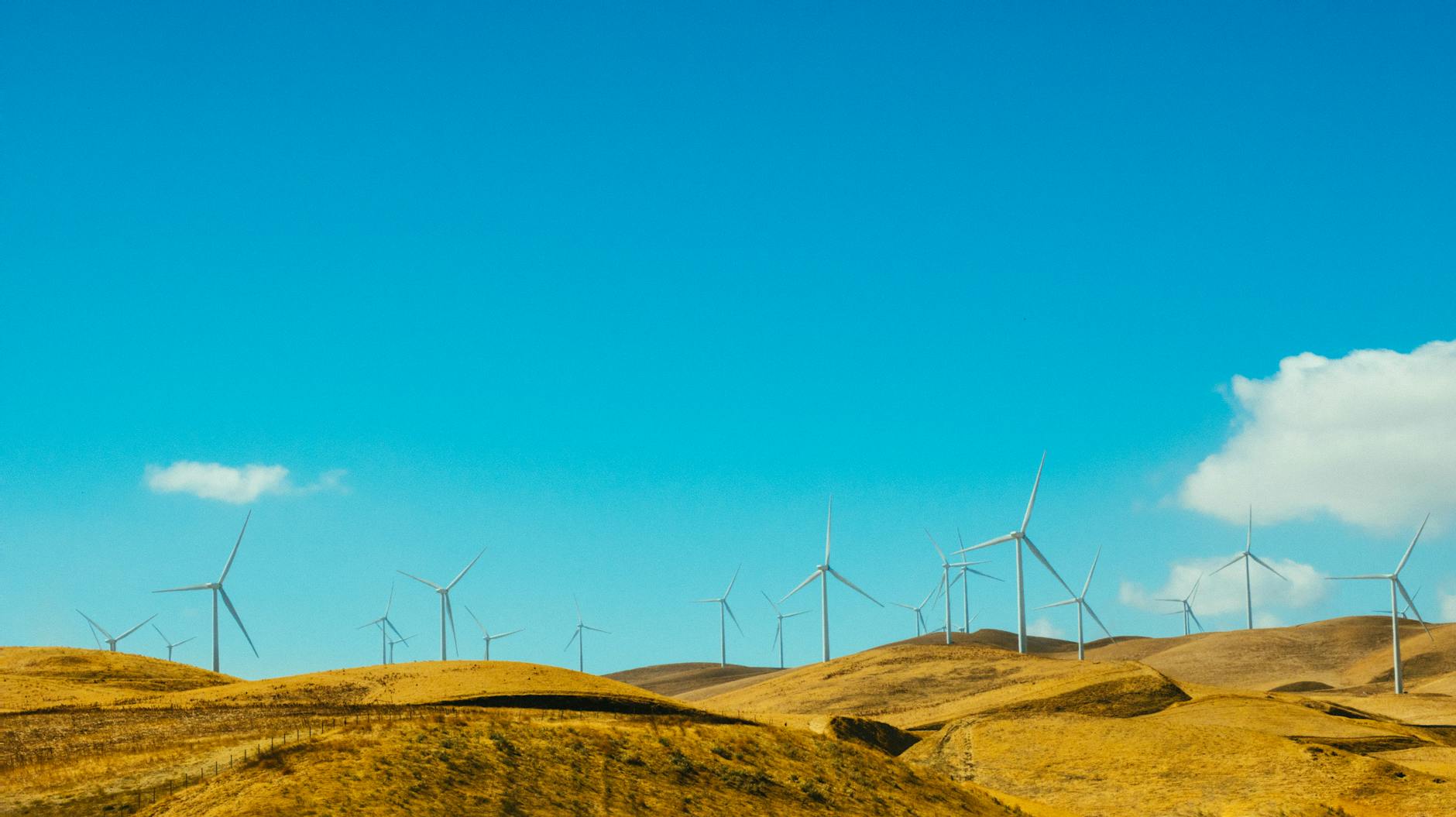
Photo by Pixabay on Pexels.com

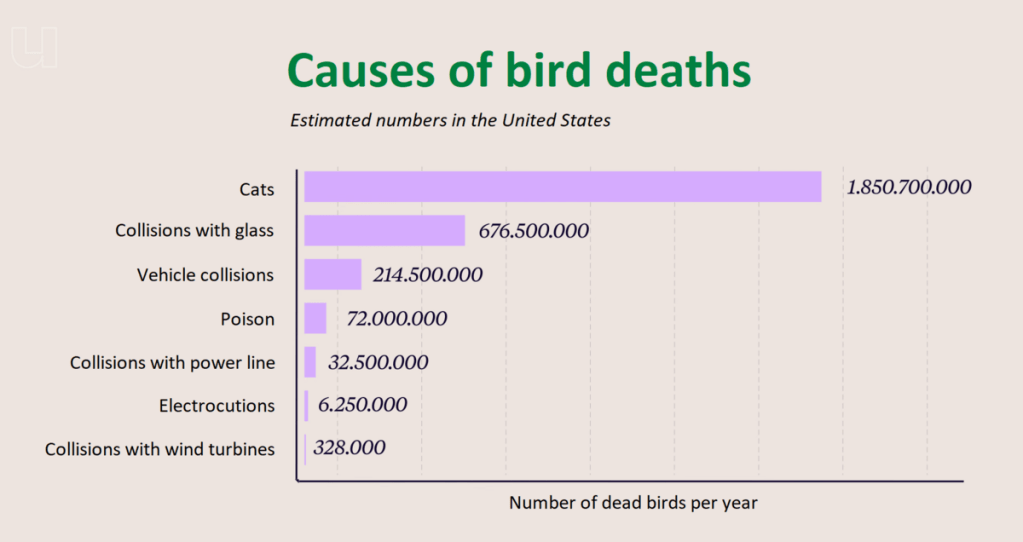
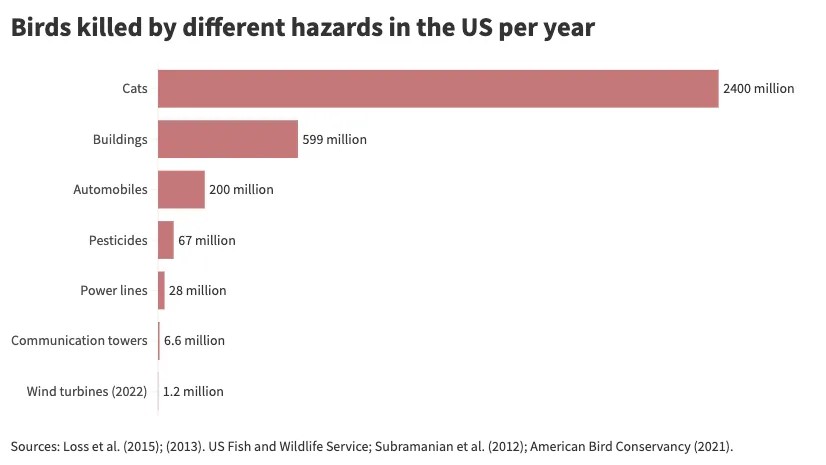
In any case, as this Wikipedia article states, collisions with wind turbines are a minor source of bird mortality compared to other human causes. According to the graph below cats kill 5,600 times more birds than wind power and collisions with powerlines kills 99 times more birds than wind power, and yet we rarely discuss these problems. Even though these numbers are estimates they are mostly confirmed by other studies and analysis, as this overview from MIT and this analysis by Hannah Richie shows. The numbers aren’t the same, but they make the same point. FYI Hannah Richie is the deputy editor and lead researcher at Our World in Data. Our World in Data is a scientific online publication that focuses on large global problems. They are associated with Oxford University and is one of the most respected statistics, analysis and research organizations in the world.

The graph shows that Wind Turbines kill 328,000 birds per year in the US, Electrocutions kill 6,250,000 birds, Collisions with powerlines kill 32,500,000 birds, Poison kills 72,000,000 birds, Vehicle collisions kill 214,500,000 birds, Collisions with glass kill 676,500,000 birds, and cats kill 1,850,700,000 birds per year in the US.
From Wikipedia: Universiteit van Nederland, CC BY 3.0 <https://creativecommons.org/licenses/by/3.0&gt;, via Wikimedia Commons
Bar graph showing cats killing an estimated 2,400 million birds per year, buildings killing an estimated 599 million birds per year, automobiles killing an estimated 200 million birds per year, pesticides killing an estimated 67 million birds per year, powerlines killing an estimated 28 million birds per year, communication towers killing an estimated 6.6 million birds per year, and wind turbines killing an estimated 1.2 million birds per year.
An alternative graph taken from Hannah Richie / Our World in Data, using alternative sources essentially showing the same thing. Sources: Loss et al. (2015), (2013), US Fish and Wildlife Service; Subramnayan et al. (2012), American Bird Conservancy (2021).

Wind power has been on the receiving end of false claims, nonsense, and strange rumors for quite some time. It is not the only energy source maligned by false information, but it is an interesting case study in misinformation regarding energy sources. To read about nonsense and rumors about wind power click here.

Photo by Athena Sandrini on Pexels.com


To see the other Super Facts click here