The Number of people in the World without Electricity has halved since 2000

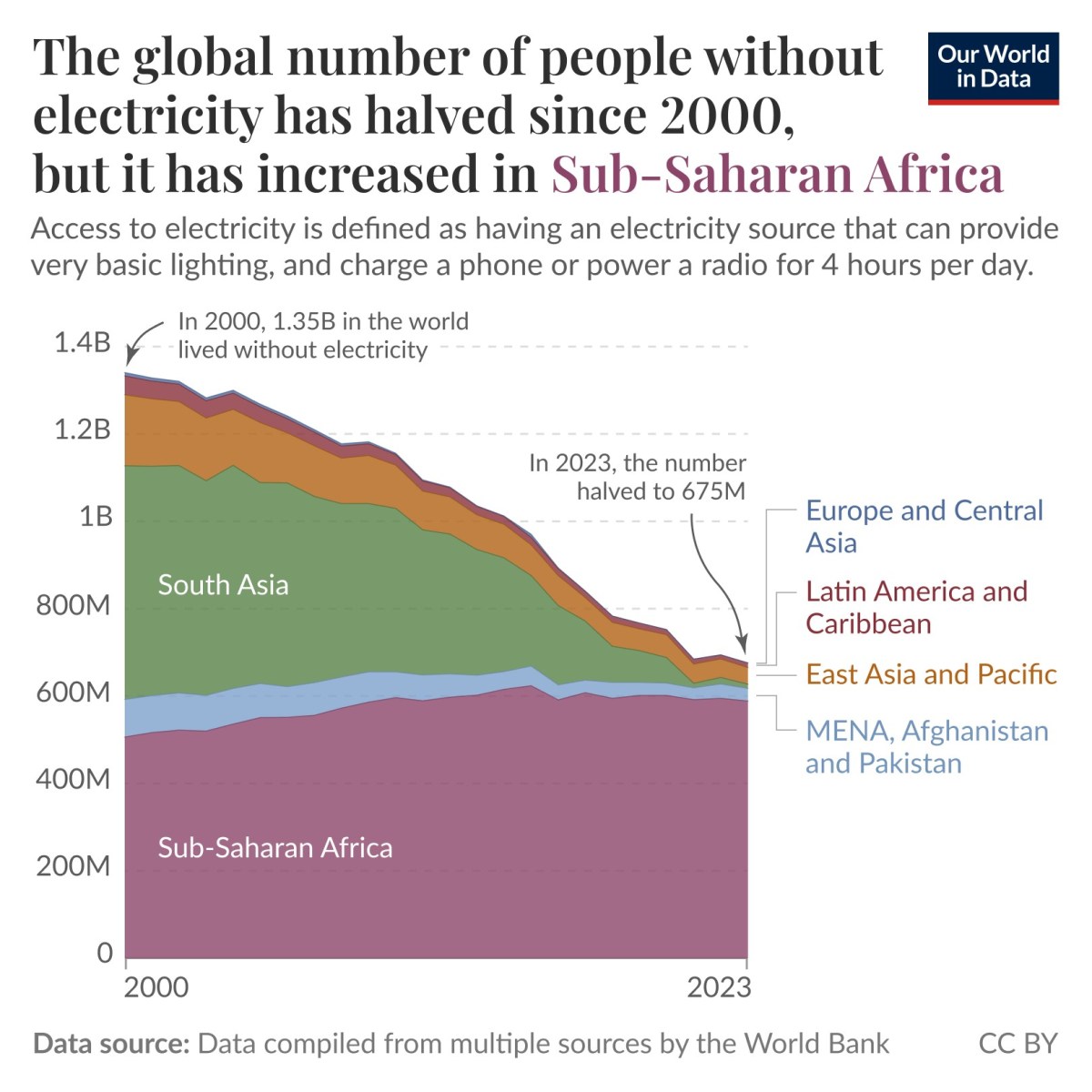
Super fact 109 : The global number of people without electricity has halved since 2000, but it has increased in Sub-Saharan Africa. In the year 2000 1.35 billion people in the world was without electricity and in the year 2023 it was 675 million people according to Our World in Data. The dark aspect of the statistics is that the number of people without electricity in Sub-Saharan Africa has increased from 500 million people to more than 600 million people.

The graph shows the number of people without electricity in five regions of the world, Europe and Central Asia, Latin America and the Caribbean, East Asia and the Pacific, MENA, Afghanistan, and Pakistan and Sub-Saharan Africa. The graph shows that the number of people in the world without electricity has gone from 1.35 billion to 675 million, and that all regions except Sub-Saharan Africa show a dramatic improvement. As a result, Africa now has the vast majority of people in the world without electricity. | The Number of people in the World without Electricity has halved since 2000
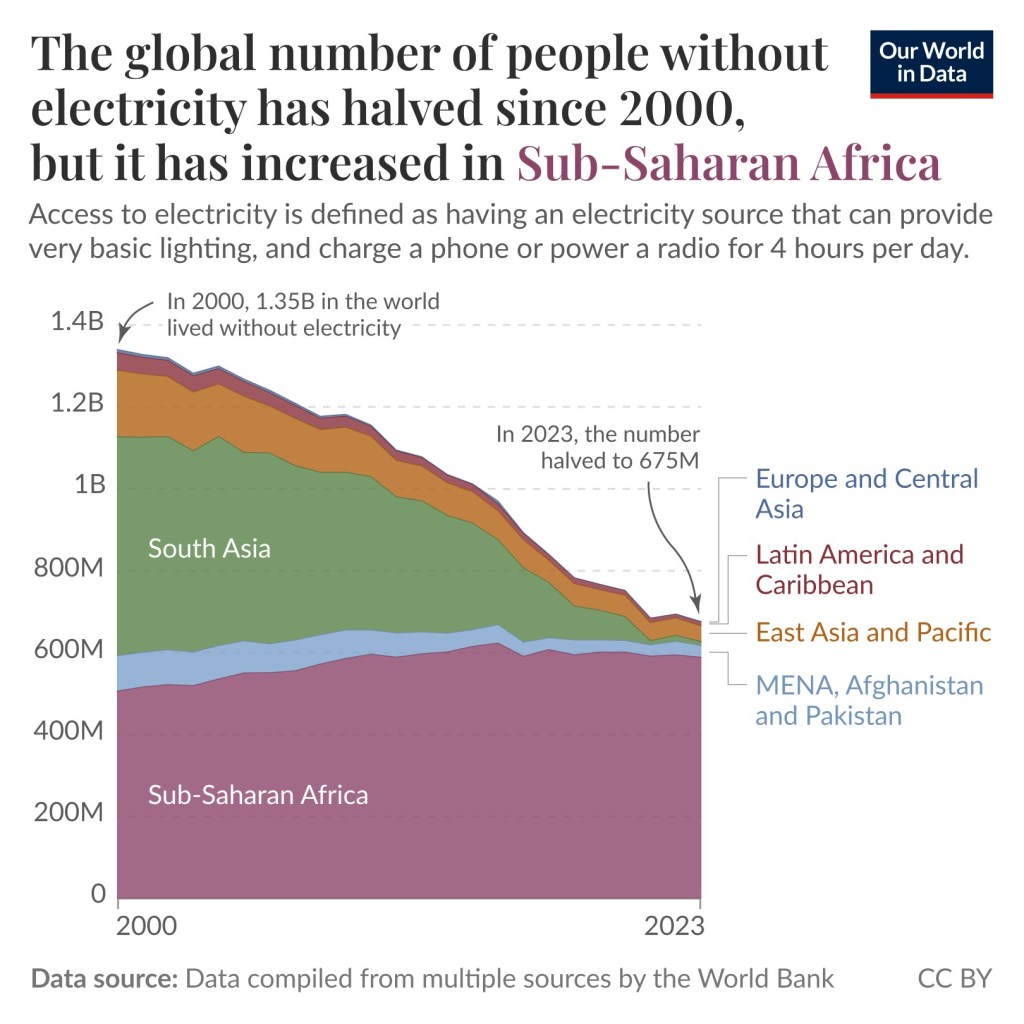
The global number of people without electricity has halved since 2000, but it has increased in Sub-Saharan Africa. Access to electricity is defined as having an electricity source that can provide very basic lightning and charge a phone or power a radio for 4 hours per day. Data source: Data compiled from multiple sources by the World Bank. CC BY. The graphs come from this page from Our World in Data.

This also means that the share of people without electricity living in Sub-Saharan Africa increased from 37% in the year 2000 to 80% now. However, it is also true that the share of people in Sub-Saharan Africa with electricity has doubled, rising from 26% to 53%. What is going on is that population growth has outpaced this expansion, meaning the number of people without electricity has still risen.

For the rest of the world, it is unequivocally good news. For example, in South Asia more than 500 million people lacked electricity in the year 2000, 414 million lacked electricity in 2010, and only 27 million people lacked electricity in 2023. Another way to look at the access to energy gap is by considering how long it is possible to run an air conditioner in different countries. Click here for data and analysis. In summary, the news for Sub-Saharan Africa is complicated but for the rest of the World, it is very good news. To read more about this topic click here.

I consider this a super fact because I believe it is an important but surprising fact in two parts. First the great news for the world and secondly the mixed news for Sub-Saharan Africa.

No Relief for the Heat Down in Africa

As mentioned, four of the five regions of the world, Europe and Central Asia, Latin America and the Caribbean, East Asia and the Pacific, MENA, Afghanistan, and Pakistan have made substantial progress. However, Sub-Saharan Africa is a complicated case. Note that MENA stand for Middle East and North Africa.

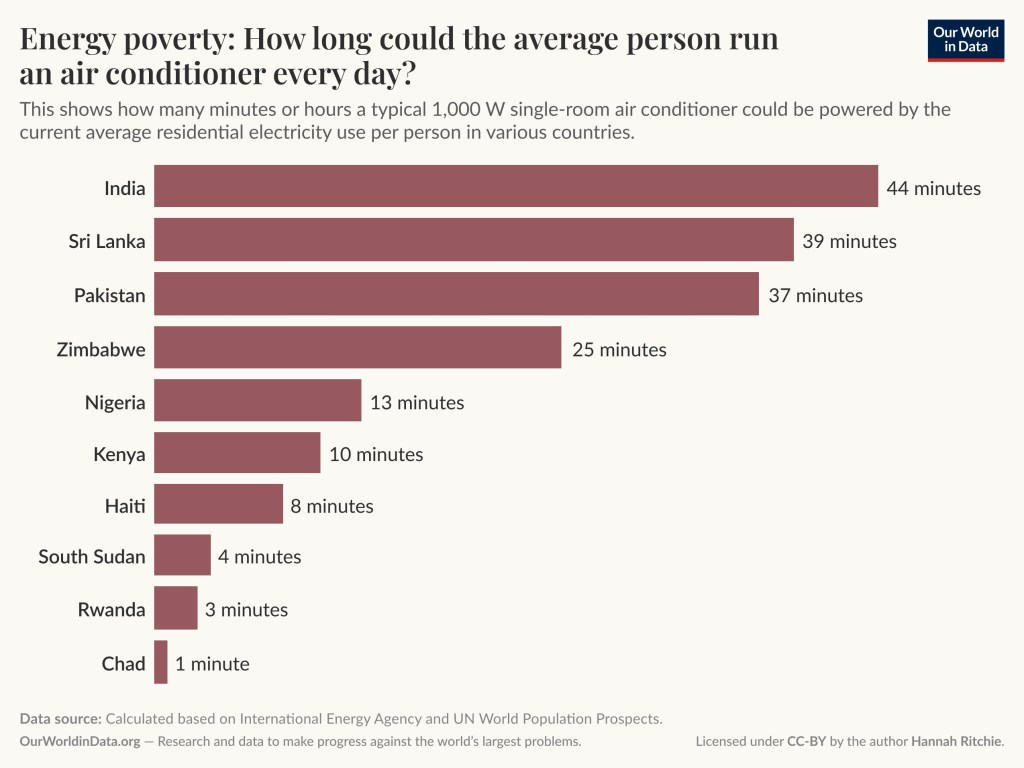
An alternative way of looking at access to electricity is to consider how much electricity is being used in each country and how that translates into the number of hours or minutes that an air conditioner could be running. Note it doesn’t mean that an air conditioner will be shut off after, let say 25 minutes, just that is much electricity one person use. What should be noted from the graph below is how dire the situation still looks like in Sub-Saharan countries. Sub-Saharan Africa is still very behind in this regard, and the fact that global warming is likely to hit Africa very hard that is not good news.

The bar graph includes India 44 minutes, Sri Lanka 37 minutes, Pakistan 37 minutes, Zimbabwe 25 minutes, Nigeria 13 minutes, Kenya 10 minutes, Haiti 8 minutes, South Sudan 4 minutes, Rwanda 3 minutes, Chad 1 minute.
Energy Poverty: How long could the average person run an air conditioner every day? This is how many hours a typical 1000 W single-room air conditioner could be powered by the current average residential electricity use per person in various countries. Data source: Calculated based on International Energy Agency and UN World Population Prospects. OurWorldinData.org – Research and data to make progress against the world’s largest problems. Licensed under CC BY by the author Hannah Ritchie. The graph is coming from this page from Our World in Data.


To see the other Super Facts click here

Wind power is providing more than a quarter of Texas Power

Superfact 16: Wind power is providing more than a quarter of Texas Power. In 2023, wind represented 28.6 percent  of Texas energy generation. In 2022, wind power accounted for about 25 percent  of Texas’ energy generation.

I am referring to this fact as a super fact because, it is true, important, and yet it’s a fact that is difficult to believe for many people. That wind power, allegedly a marginal energy source, is successful in fossil fuel loving Texas is hard to believe. I have come across what appears to be well informed people who were certain it was nonsense. However, as you can see from the Texas government links above, it is true, something they could not dispute.

The reason for the success of wind power in Texas is economics, which is another fact that may be surprising to some. Fossil fuels are a major source of income for us in Texas, but everyone also wants to save money. Texas has its own electric grid, it’s deregulated, and organized along free market principles.  

When companies sell their energy (to ERCOT) it works like a continuous auction. The one with the lowest price is picked first and allowed to contribute with whatever they are able to and also, of course, considering what the grid-powerlines can carry safely. Naturally, the price of wind in Texas includes federal subsidies, which make it even cheaper.

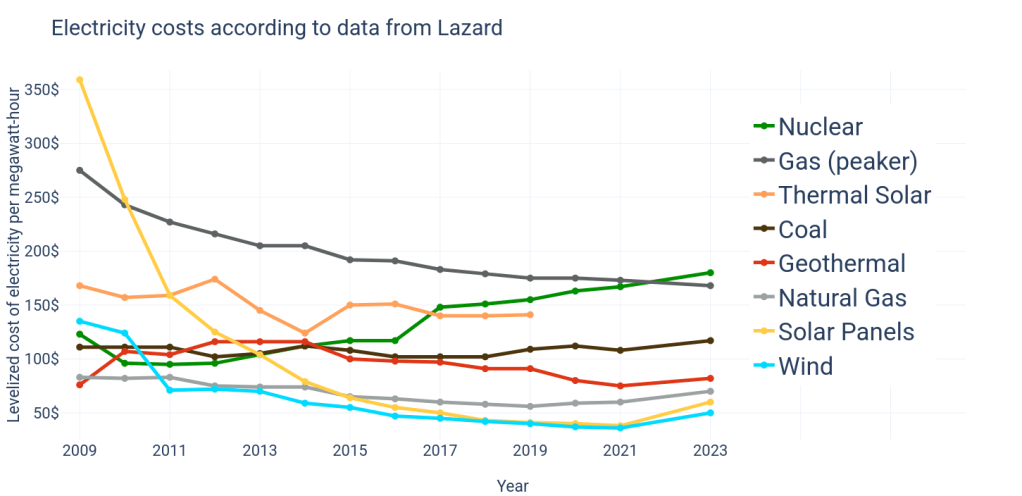
However, all energy sources are subsidized, and fossil fuels have a long history of government subsidies. Below is the average unsubsidized levelized cost of energy according to Lazard. Levelized means that construction costs, land rent, and other costs not directly caused by electricity generation are taken into consideration. Notice how cheap wind is (blue line). This is for the United States not just Texas. I don’t have any numbers, but I’ve heard that for Texas solar is the cheapest .

The image shows 8 graphs representing the price of Nuclear, Gas (peaker), Thermal Solar, Coal, Geothermal, Natural Gas, Solar Panels, and Wind. Today Wind is the cheapest.
Average unsubsidized levelized cost of energy. Notice that the light blue line indicates that wind power is pretty cheap. Mir-445511, CC BY-SA 4.0 https://creativecommons.org/licenses/by-sa/4.0, via Wikimedia Commons.

Affordability

Windpower is not only relatively cheap. Wind power is one of the most efficient and sustainable energy sources available. The energy required to manufacture, install, and maintain wind turbines is small compared to the energy they produce over their lifespan. This is known as their energy return on investment (EROI), which is quite favorable for wind energy.

The Institute of Environmental Management and Assessment (IEMA) states that the average wind farm will pay back the energy that was used in its manufacture within 3-5 months of operation. This article in the journal Renewable Energy found that the average windfarm produces 20-25 times more energy during its operational life than was used to construct and install its turbines. It included data from 119 turbines across 50 sites going back 30 years.

Wind power is providing more than a quarter of Texas Power
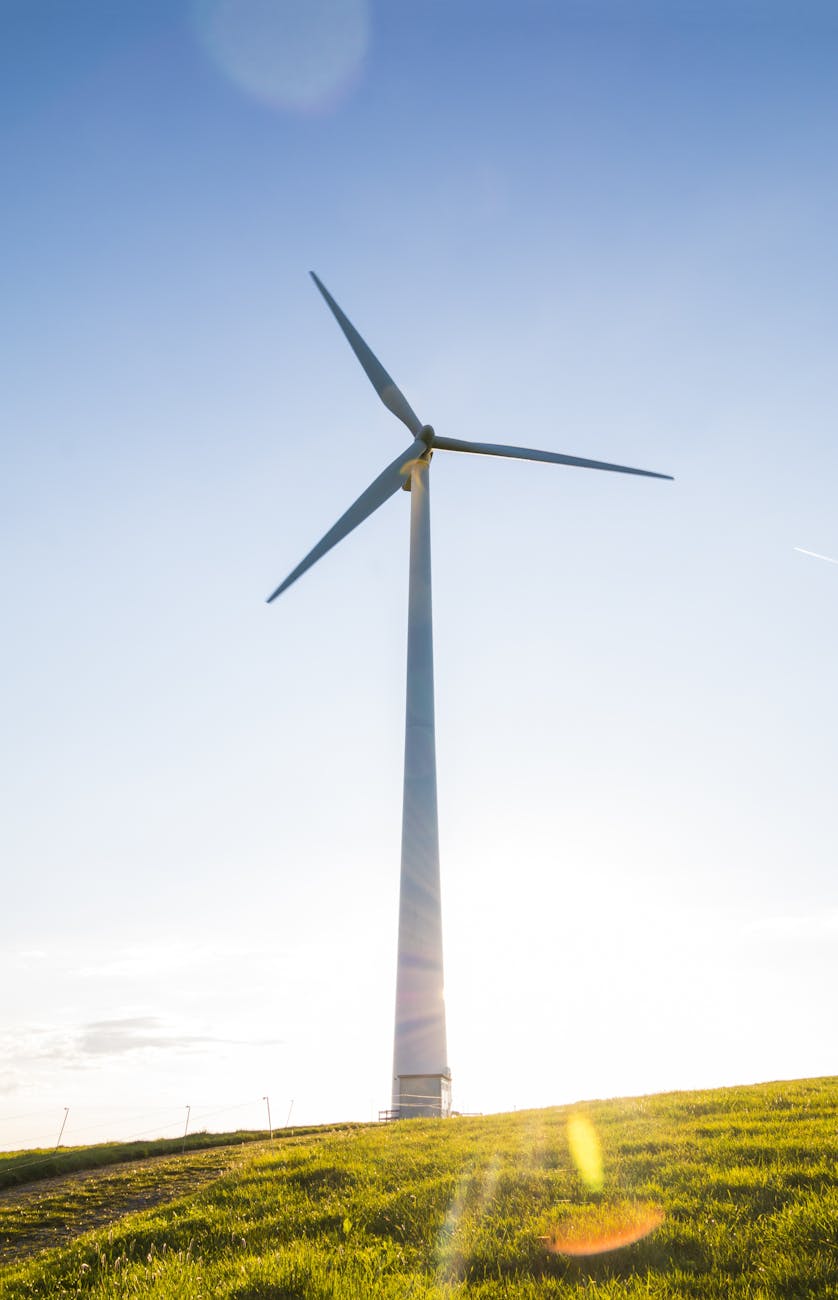
Photo by Pixabay on Pexels.com

False Claims

It is important to be aware that there are many false claims floating around about wind power. The sound from wind power stations does not cause cancer, it does not use any other energy sources while operating; it solely harnesses the kinetic energy from the wind to generate electricity, meaning it only relies on wind to function as its primary energy source. Windpower is not a major cause if bird deaths. To read more about false claims about wind power click here.

Wind power is providing more than a quarter of Texas Power
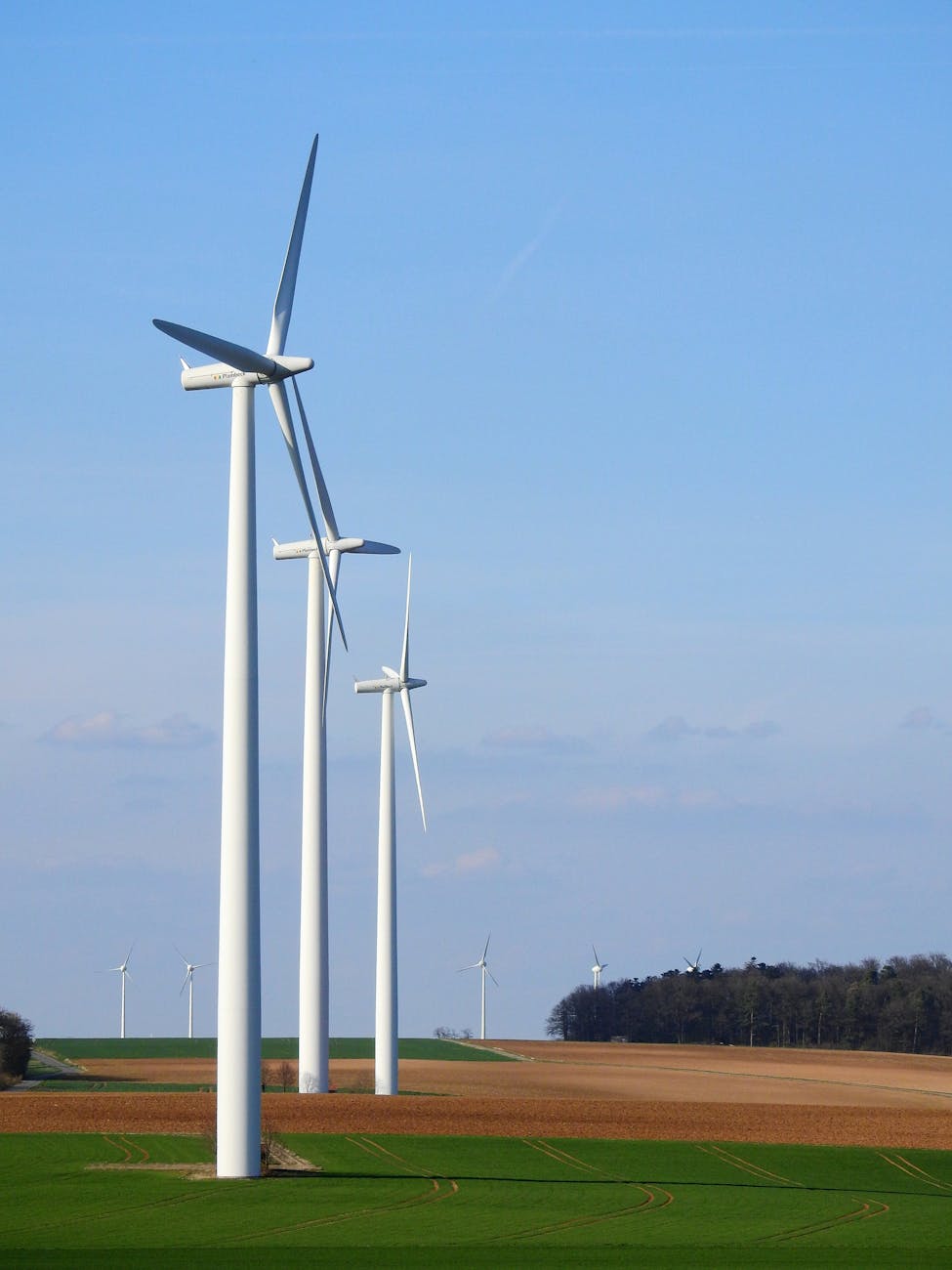
Photo by Pixabay on Pexels.com

There are positive and negative aspects of wind power, like any other source of energy. One issue with wind power (and solar) is that it is an intermittent source of energy. When the wind is not blowing you need other sources of energy (until there is sufficient energy storage). This is less of a problem when you have a mix of energy sources as Texas does.


To see the other Super Facts click here


Electrification

This is not one of the super fact posts. It is just a post related to an interest of mine that is informational. I volunteer for an organization called Citizens Climate Lobby, or CCL. CCL is a bipartisan organization that works with both Democrats and Republicans to create the political will for climate solutions. During the month of August CCL is promoting what is called electrification. Clean energy is taking the world with storm, but energy / electric power is not the only source of carbon emissions / greenhouse gases.

Take for example, transportation. Most cars still use gasoline and to move towards a fossil fuel free future we must move towards using transportation that uses less fossil fuels such as EV cars. We need to electrify transportation. Another aspect of electrification is replacing gas stoves with induction stoves, installing solar panels, as well as lowering the energy use of your house.

A picture of houses by a lake | Electrification
Lowering the energy consumption of your house lowers your emissions. Photo by Frans van Heerden on Pexels.com

EV Cars

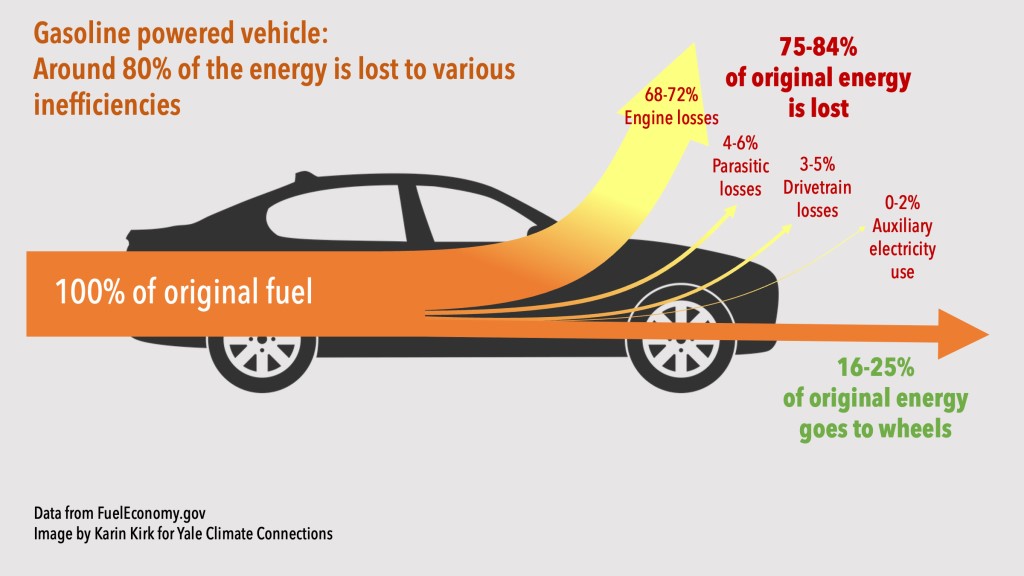
At least here in Texas it is quite common to believe that EV cars do not reduce emissions. After all EV cars use electricity from the dirty grid, right? Often this is said to environmentalists and people who care about fossil fuels emissions as if they don’t understand that the electricity for EV cars typically comes from the dirty grid. However, they do know that. In fact, they know a little bit more. EV cars are much more efficient than Internal Combustion Engine cars , or ICE, and therefore the emissions caused by EVs via the electrical grid, even a coal powered grid, is significantly less per mile. In fact, replacing gasoline-powered cars with EVs saves energy, regardless of the energy source used to recharge the EVs. For an ICE 16-25% of the original energy goes to the wheels whereas for an EV 87-91% of the original energy goes to the wheels.

Image showing an ICE car and its various losses | Electrification
16-25% of original energy goes to the wheels. Data from FuelEconomy.gov, Image by Karin Kirk for Yale Connections.
Image showing an EV car and its various losses | Electrification
87-91% of original energy goes to the wheels. Data from FuelEconomy.gov, Image by Karin Kirk for Yale Connections.

On the other hand, it takes more energy to manufacture an EV battery for an EV car than it does to produce a combustion engine. So, the production of an electric vehicle does emit more carbon than a petrol car. However, the lower emissions resulting from driving an EV means that an electric car quickly pays back its debt, so to speak. It is typically paid back within two years.

According to Hannah Richie at Our World in Data the statistics show that switching from an average ICE to an equally sized EV will save 1.2 tons of carbon emissions per person and year. That is a lot considering that the average carbon footprint per year is 4 tons worldwide and 14.4 tons per year for an American. Hannah Richie at Our World in Data also states that other environmental damages related to EVs such as mining for minerals are less than mining and extraction for fossil fuel cars, and she claims that the price of lithium-ion batteries has fallen by 98% over the last three decades.

Blonde woman pumping gas.
Photo by Andersen EV on Pexels.com

EVs are becoming increasingly common. According to Our World in Data in 2022, 88% of all cars sold in Norway were EVs and 54% of all cars in Sweden were EVs. The United States is lagging a bit at 7.5% but there is a tax credit $7,000.00 for new EVs and a $4,000.00 tax credit for buying used EVs. I should add that we have not yet bought an EV because after I took early retirement, I did not need a car. We just share my wife’s hybrid, which we hardly ever drive.

Induction Stoves

We bought an electric stove, an induction stove, a couple of years ago when our previous stove stopped working. They come with an $840.00 rebate. I’ve read that professional chefs prefer gas stoves. However, our induction stove provides everything we need for our cooking needs and my beer brewing needs and it is easier to clean. If you are a professional chef you may want to be able switch the high heat on and off quicker, but we are not professional chefs even though the food we cook is delicious.

Another downside of an induction stove is that if the power goes out you can’t cook, but that has not been a problem for us. Considering that we get our electricity from a power company, Green Mountain Energy, that utilizes renewable energy, wind and solar, you can claim that our stove is 100% fossil fuel free.

One cooking plate is red hot. The stove itself is made of granite.
Our induction stove with the lights in the kitchen turned off.

Heat Pumps

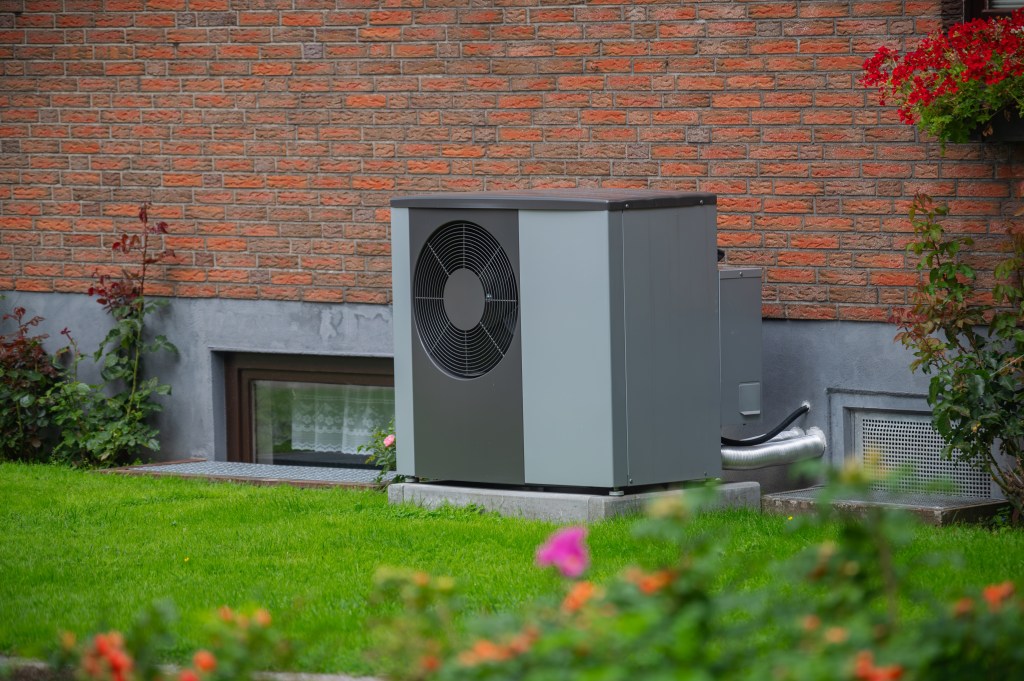
Air source heat pumps, which are the most common type of heat pumps, are a great, energy efficient choice for heating your home and water and as well as being low maintenance, they can help to cut your heating costs and lower your carbon footprint. An air source heat pump absorbs heat from the air outside a building and releases it inside. It uses the same vapor-compression refrigeration process and much the same equipment as an air conditioner, but in the opposite direction.

Air-to-air heat pumps provide hot or cold air directly to rooms. Heat pumps are the main way to phase furnaces but are also typically more efficient than other types of heaters and air conditioners and thus they reduce greenhouse gas emissions. There is an up to $8,000.00 upfront discount for heat pumps and a 30% tax credit up to $2,000.00. I should say we do not have a heat pump.

Grey heat pump standing towards the wall of an old red brick house.
Air heat pump installed on the exterior facade of the old house. Sustainable heating solutions for old construction. Stock Photo ID: 2349325553 by Snapshot freddy.

Rooftop solar

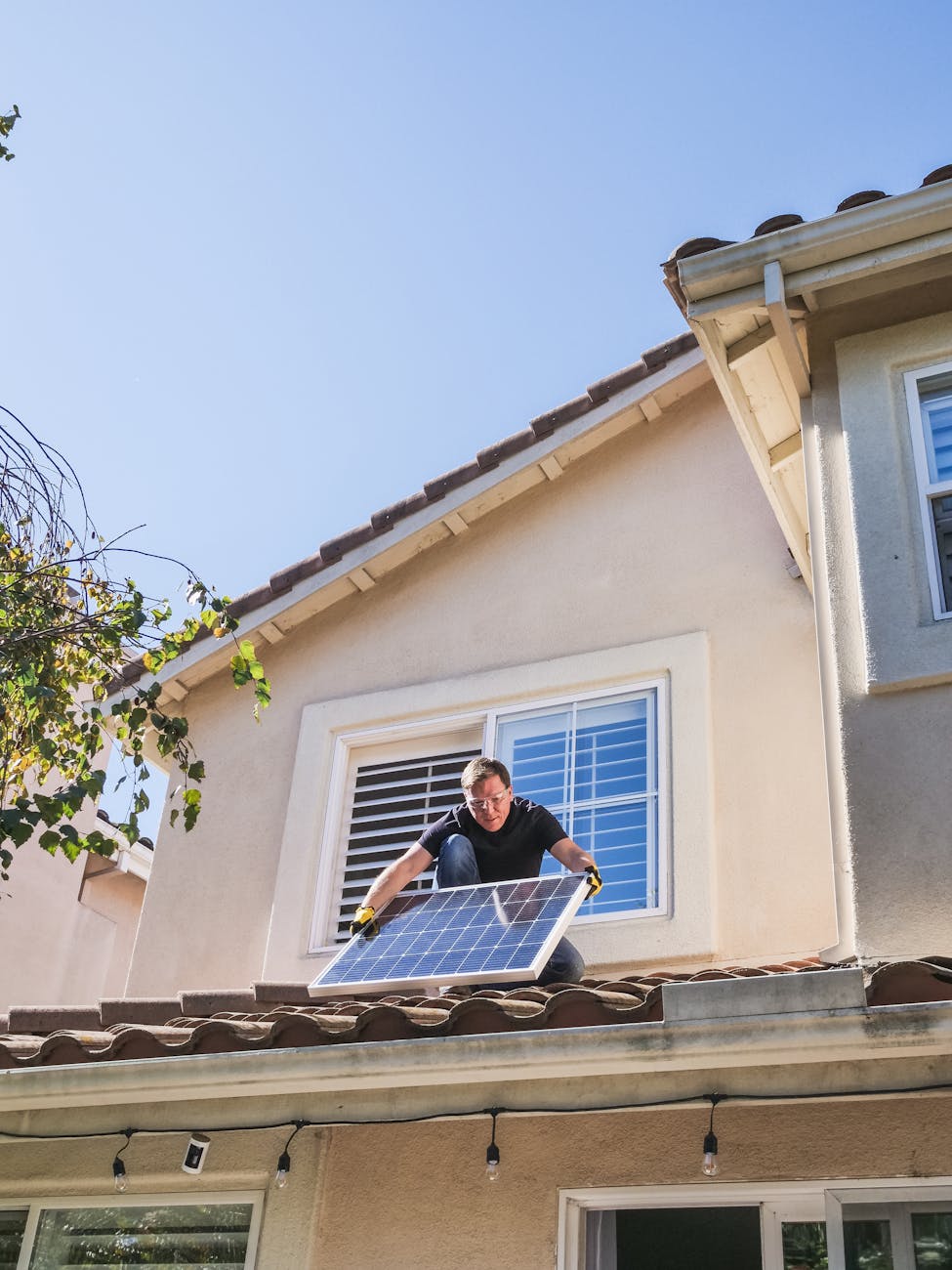
Another great thing that we have been thinking about but do not have yet is rooftop solar. Rooftop solar power system, or rooftop photo voltaic systems, consist of electricity-generating solar panels mounted on the rooftop of a residential or commercial building or structure. Residential rooftop solar power systems typically feature a capacity of about 5–20 kilowatts.

The average American household uses 1.2 kilowatts on average. Most rooftop solar systems are connected to the grid and can feed the extra power into the grid for compensation. I should add this is not entirely without difficulty. There are also hybrid systems which include any combination of wind turbines, diesel generators, and batteries for electricity on demand. There is a 30% tax credit for rooftop solar.

Solar panels being installed | Electrification
Photo by Kindel Media on Pexels.com

Miscellaneous Energy Savings

Saving energy is not exactly the same thing as electrification but it is a related topic. If you electrify your home and also reduce your energy needs, you are reducing emissions.

A few years ago, we changed the insulation in our house to reduce our energy needs and our electric bill. It made a difference. We also did weatherstripping, installed three pane windows and high security doors, that were well-insulated and reduced heat-loss. We received significant tax credits for doing this. I don’t remember how much, but it was several thousand dollars. I can add that you get a $150 tax credit for a home energy audit.

What do you think about electrification and energy savings?

Do you have additional ideas for electrification and energy savings?


To see the Super Facts click here