
With this blog I just wanted highlight Jacqui Murray’s reblog of my Science for Babies Post. I would like for you to head over to Ask A Tech Teacher and check out her post. Also thank you very much Jacqui for your kind repost.
Vaccines do not cause Autism
Super fact 61 : An overwhelming body of scientific evidence has proven that vaccines do not cause autism. In addition, research shows that Tylenol (acetaminophen) is not a likely cause of autism.
Autism is a complex disorder caused by a combination of genetic and environmental factors. It is estimated that approximately 80-90% of the risk for autism is genetic. There are other factors that also increase the risk for autism such as advanced parental age, birth complications, and prenatal exposure to certain chemicals or infections. However, despite what many people believe, or have heard, vaccines (and Tylenol) is not one of them.

The belief that vaccines cause autism originated primarily from a single, fraudulent 1998 study published by Andrew Wakefield. The study falsely claimed a link between the measles, mumps, and rubella (MMR) vaccine and autism in 12 children. Since then, dozens of high-quality scientific studies, involving millions of children across multiple countries, have found no link between vaccines and autism. One Danish study involved 657,000 children. Leading global health organizations such as CDC, WHO, the American Academy of Pediatrics AAP, have affirmed this conclusion. You can read more about it here, and here, and here. In general, routine vaccines has been shown to be safe.
Some studies have shown minor associations between acetaminophen and autism, but association, or correlation, is not causality. Tylenol is often used more often in challenging pregnancies. Research shows no causal link between Tylenol and autism. This is what Nature, a prestigious, leading weekly scientific journal that publishes peer-reviewed research papers, says. You can read more here, here, and here.
If you focus on the medical research and what reputable medical associations say as opposed to social media memes, talk show hosts, and politicians say, it is obvious that this super fact is true. It is obviously important and yet a lot of people refuse to accept it, including a lot of people I personally know. That makes it a super fact. It is a true and important fact that is surprising or hard to accept for many people.
I try to avoid politics as much as possible in this blog but perhaps this post may seem political to some, but it really isn’t. It’s the government agencies, politicians, political think tanks and individuals who reject scientific evidence that does not support their agendas who are being overly political. Just presenting the facts does not make you political. Just like thermometers don’t have political parties (global warming) neither do statistical tools, DNA or viruses.
What about the Autism Epidemic?
It is true that autism diagnoses have increased by about 300% over the last 20 years. There are two main reasons for this increase. First, the definition of autism spectrum disorder has been broadened. Second, public health programs have increased screening that look for signs of autism at wellness visits for children ages 18–24 months. There is also an increased awareness about autism among parents and in society. The subgroup consisting of severe cases of autism has increased very little if at all. You can read more about that here.
However, it should also be noted that in addition to genetics, which is the major cause, certain factors such as higher parental age, air pollution, infections during pregnancy, obesity, diabetes, immune system disorders, low birthrate, extreme prematurity, are associated with an increased risk. Some of these factors have gotten worse. What is not the cause is vaccines. You can read more about that here, here, here, and here.
Related Super Facts
One of my super facts posts that is related to this post is:
Smallpox Killed 300 million People in the Last Century Before Eradication

There are also super facts that may not be directly related to this post but that share one particular feature with this super fact, and that is that they are frequent targets of denial, derision, mockery, and misrepresentation by some (or many) of our political leaders.
- Global Warming is Happening and is Caused by us
- EV Cars Indeed Emit Less Carbon Pollution
- Emissions of ozone-depleting gases have fallen by 99 Percent
- Sulfur dioxide pollution has fallen by 95 percent in the US
To see the other Super Facts click here
Superfluid Liquids are Like Magic
Super fact 60 : Superfluids such as liquid Helium cooled below -455.58 Fahrenheit exhibit some very strange characteristics such as it flows right through many solids, it climbs walls, it has near zero viscosity, it exhibits circulating flows that never stop despite no energy being added. It is a Macroscopic Quantum Phenomenon.
When gases are cooled far enough, they will turn into liquids and eventually typically to solids. For example, Oxygen becomes a liquid when its temperature drops to -297 Fahrenheit, which is -183 Celsius, or 90 degrees Kelvin. Kelvin is 0 at absolute zero, the coldest possible temperature, and in addition it uses Celsius for the scale. So, 90 degrees Kelvin is 90 degrees Celsius above absolute zero or 162 degrees Fahrenheit above absolute zero. When Oxygen becomes a liquid, it turns into a pale blue liquid. Oxygen becomes a solid at 54 Kelvin, or −218.8 Celsius, and −361.8 Fahrenheit (at normal pressure). It becomes sky blue ice.
Helium stays a gas until very extreme temperatures. Helium becomes a liquid at 4.2 kelvin or -269 Celsius, or -452.11 Fahrenheit. If the temperature is reduced further by almost half to 2.17 Kelvin, or -270.98 Celsius, or -455.8 Fahrenheit, then Helium suddenly becomes a superfluid, exhibiting macroscopic quantum phenomena. It is so different from normal liquid Helium that it is called Helium II. Its heat conductivity (speed of heat/cold transfer) suddenly increases by one million, and the temperature will become the same throughout the liquid instantly. Even a big pool of liquid helium would almost instantly get the same temperature throughout, and the atoms will start behaving in unison. Regular bubbles can no longer exist (atom sized electron bubbles can exist though).
The liquid starts behaving in bizarre ways. If you place an open metal container of Helium II in a closed room the Helium II would climb out of the container and escape, and a thin film of Helium II would climb the walls and the ceiling. If the floor was made of metal or glazed tile the Helium II would remain on the floor. If the floor was made of unglazed tile or stone, it would leak right through the floor as if the floor was a sieve. If you get a whirlpool or fountain going it will keep going forever without any energy loss. In addition, it would also exhibit many quantum effects that are out of scope for this post.
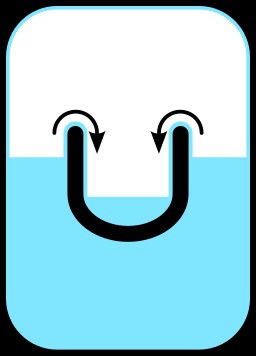
I consider this a super fact because this is a strange, surprising and not a well-known phenomenon. It is a quantum effect that you can observe with your own eyes. It is important because the discovery of superfluidity and its twin effect superconductivity are very important for science and might lead to revolutionizing energy transport in the future. It is no doubt that the phenomenon is real (true), and it has been documented by numerous experiments and papers. It is described in thousands of textbooks, and I’ve observed the phenomenon with my own eyes (that is next).
Our Experiment with Superfluid Helium
During my first class in Quantum Physics, we performed experiments with liquid Helium. We started out by cooling helium using liquid nitrogen (colder than -196 Celsius or -321 Fahrenheit). Then using vacuum pumps, we kept cooling the Helium until it became liquid. We continued cooling it and we could see lots of bubbles and boiling as we kept going, and then it boiled extra much, and then very quickly the bubbles vanished, and the content of the entire glass container settled down and then stood perfectly still.
As 2.17 Kelvin was reached the viscosity (flow resistance) was instantly lowered with about one million times, and non-microscopic bubbles could no longer exist. The heat conductivity (the speed with which temperature spreads) increased by one million times. It means that the heat of a drop falling in one end of a swimming pool of Helium II would spread throughout the swimming pool in a second. Except, we only had a glass container in which sameness reigned throughout the liquid.
We continued doing experiments such as watching the Helium II climb walls inside the experimental setup, and of course the famous fountain. Insert a little metallic straw and watch a Helium fountain start to flow, by itself. Without any energy or pressure added, it just kept going by itself because no energy was lost either.
I can add that it was more of a demonstration than an experiment that we actively participated in because playing with extreme temperatures high or low is dangerous. If you’ve read this blog for a while you might remember when I put a Cesium-137 sample (800 times more radioactive than Plutonium-239) in my jeans pocket instead of back into its lead brick container and walked around with it a whole day. Or that time when I replaced a fuse for a 380 volt three phase powered laser with my finger because I was curious what would happen if I put my finger in there, and I was shocked, and it hurt. Students shouldn’t play with dangerous stuff.
Below is a one minute and forty four second YouTube video of a Superfluid / Helium II experiment showing an eternal fountain.
Below is a four minute explanation of a superfluid / Helium II experiment.
I can add that Helium II (super cold helium) is not the only superfluid but the easiest one to achieve.
Other Physics Related Superfacts
- Some Things Cannot be Known
- Radon Represents our Largest Exposure to Ionizing Radiation
- We are Star Dust
- The Speed of Light In Vacuum Is a Universal Constant
- Two events may be simultaneous for some but not for others
- The Strange Worlds of Exoplanets
- The vastness of space and the beginning of infinity
- The Bizarre Reality of Black Holes
- Every Symmetry is Associated with a Conservation Law
- GPS uses relativity for accuracy
- Time Dilation Goes Both Ways
- The Pole-Barn Paradox and Solution
- The Enormous Kuiper belt
- Time is a Fourth Dimension
- Electric Charge is not the only type of Fundamental Charge
To see the other Super Facts click here
More Science Books for Babies
This is my second and last post covering books from the Baby University series. There are 44 of them. I think the Baby University series books are quite interesting for children. They may not really be for babies, but they appear to me to be great for young children. The point of the books is not to make young children understand complex scientific concepts but to introduce them to scientific vocabulary and build their curiosity. We bought 10 of these books for our soon to be born first grandchild (due date September 17). We also bought other books for him. If you want to see my post for the five first books, click here.
Below I am presenting five books in the series, Evolution for Babies, Nuclear Physics for Babies, Astrophysics for Babies, Quantum Entanglement for Babies, and Newtonian Physics for Babies. For each of the books I am providing my review for the book and a link to my review as well as a link to the book on Amazon and a photo of the front cover.
Evolution for Babies
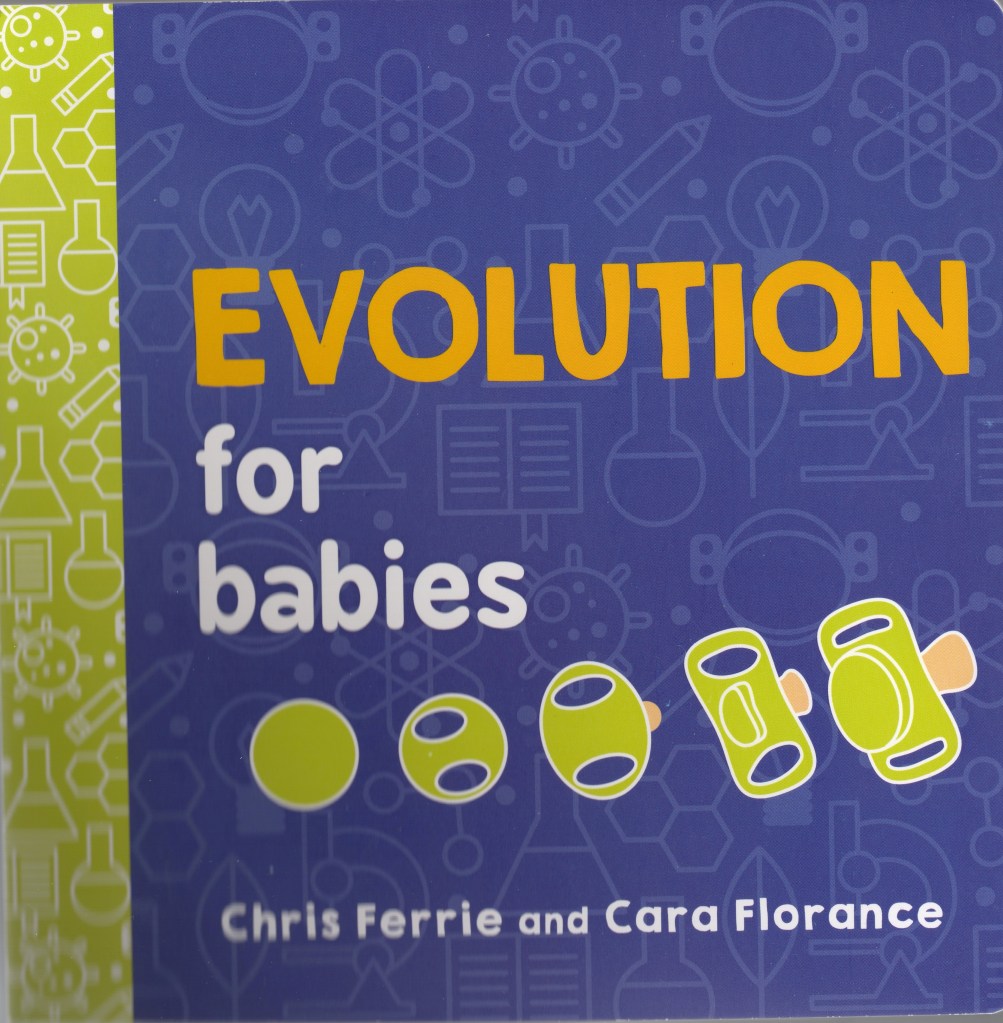
This is the Amazon link for Evolution for Babies.
My Review for Evolution for Babies
Natural Selection as Simple as Possible
This simple board book just shows different kinds of balls falling through a hole until one ball doesn’t. It’s too big for the hole. That’s the surviving ball. Balls like that ball will be the survivors. That is Natural selection. It is very simple, but I guess it is to the point. I guess anyone can understand that. Even a baby.
Nuclear Physics for Babies

This is the Amazon link for Nuclear Physics for Babies.
My Review for Nuclear Physics for Babies
The Blue Balls Keep the Red Balls Together
This book is about red balls called protons. They have a positive charge, and they repel each other. There are also blue balls called neutrons. If you put a blue ball between two red balls, the two red balls will not repel and will not fly apart. The more red balls there are, the more blue balls we need. The red and blue balls are at the center of the atom. If the number of red balls and blue balls is not right the nucleus becomes unstable, and it releases energy. That is radioactive decay. The book explains half-life. So that’s the story. It is simple and fun, and your baby can start working on his PhD in nuclear physics when he turns one years old.
Note: I would like to add one thing that I did not note in my review. The neutrons would not be able to hold together two protons just by being neutral. What the baby book is not mentioning is that neutrons (and protons) have a force that acts like glue, called the strong nuclear force. The strong force, color charges, quarks and gluons is what my previous post is about.
Astrophysics for Babies

This is the Amazon link for Astrophysics for Babies.
My Review for Astrophysics for Babies
Stars and Planets are Balls. The Sun is a Star
Earth is like a ball, and the sun is like a ball, and the earth orbits the sun. The sun is a star that looks big because it is close. Other stars look tiny because they are far away. Stars are heavy balls of hot gas. Inside stars atoms squeeze together. Smaller atoms squeeze together making bigger atoms and releasing energy in the process. The exploding stars spread bigger atoms across the Universe. The book is colorful and simple reading, but it features the Periodic table, which is not for babies, but ignoring that, this is a simple and fun book for young children.
Quantum Entanglement for Babies

This is the Amazon link for Quantum Entanglement for babies.
My Review for Quantum Entanglement for Babies
Quantum Entanglement Using Balls
We bought this book for our future grandchild who will soon be born. It is a very short board book which takes one minute to read. It is about balls, like most of the “for babies” books. There are two red balls and two blue balls. Hide them in boxes. We know the colors, but Alice and Bob do not. However, in quantum physics the balls have a special bond. We put the tangled balls in two boxes. When the boxes are opened, both balls are blue or both balls red. What’s the point?
I am an adult who knows a little bit about Quantum Entanglement, and I did not understand what they meant. How is a baby going to understand it? It is a nice colorful board book but I wish they’ve taken a different approach.
Newtonian Physics for Babies
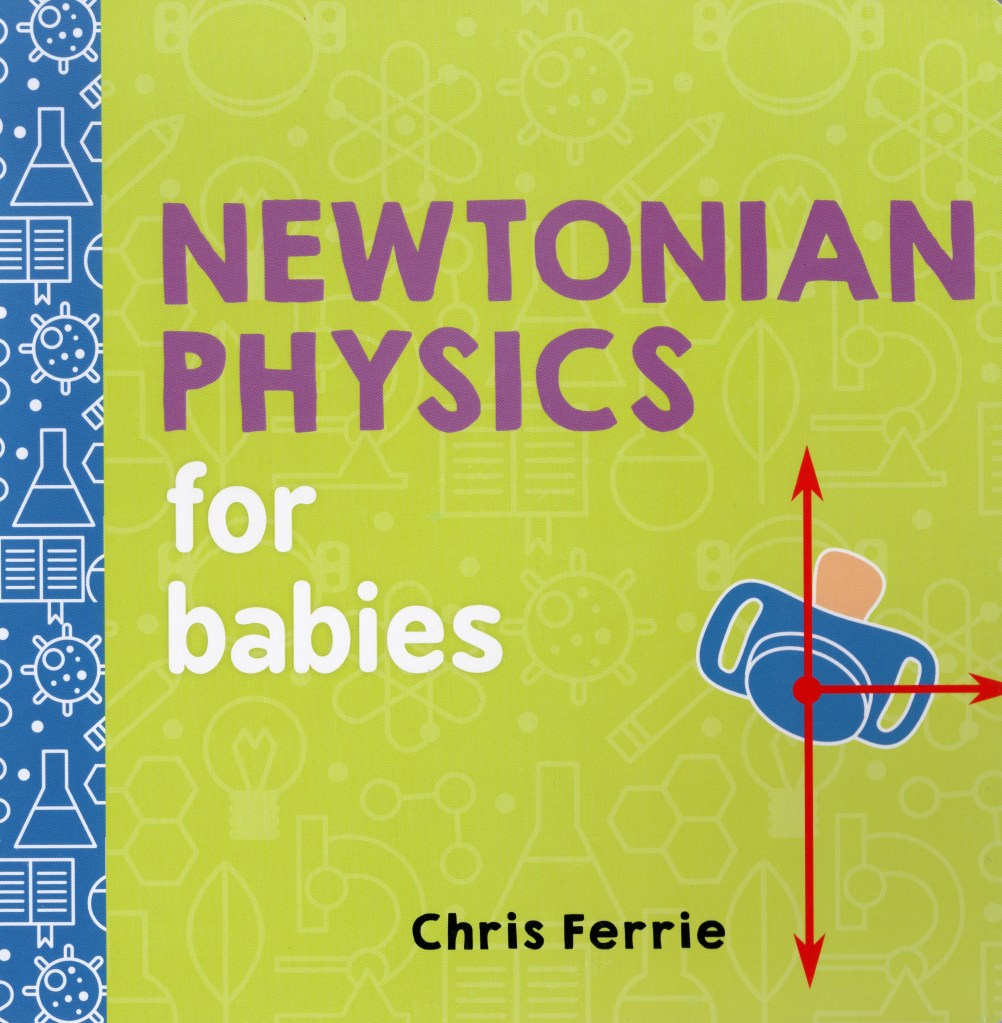
This is the Amazon link for Newtonian Physics for Babies.
My Review for Newtonian Physics for Babies
Newtons Laws and a Ball Explained to the Very Young
We bought this book for our future grandchild who will soon be born. It is a very short board book which takes one minute to read. The book is about a ball. A ball feels the force of gravity, and it is pulling it down. When the ball is on the ground the ball still feels the force of gravity but the ground pushes back with an equal force and the ball is at rest. If there is a net force the ball moves.
At the end the book lists the three laws of motion. 1. If an object has zero net force, it does not change its motion. 2. The net force is equal to mass times acceleration. 3. For every force, there is an equal force in the opposite direction. It is very simply expressed, and the illustrations are fun, but I still think this book requires the child to be a bit older for him to understand, maybe 3-4 years old rather than a baby. However, I think the book can evoke an interest in science and physics at an earlier age. Despite it being one of the tougher books in the series, I think it seems to be a pretty good book.
To watch a woman read Astrohysics for Babies. Click on the YouTube video below.
To see the Super Facts click here
Electric Charge is not the only type of Fundamental Charge
Super fact 59 : Most people have heard of electrical charges, positive and negative. However, in nature there are also color charges—red, green, and blue—which are analogous to electric charges. In addition, there are anti-red, anti-green, and anti-blue charges.
Esther’s writing prompt: 10th September : Charge
Click here or here to join in.
As you may know, atoms consist of particles. Electrons surround the nucleus of the atom. The nucleus of the atom is in the middle of the atom and it consists of protons and neutrons. Electrons have a negative charge. Protons have a positive charge. Neutrons do not have an electrical charge. Electrons are so called elementary particles. They are not composed of other particles. Protons and Neutrons, on the other hand, are not elementary particles. They are composite particles consisting of quarks, gluons and quark pairs called mesons.

Quarks have electric charges, just like an electron and a positron, which is why a proton has an electric charge, a positive electric charge. However, in addition quarks have something called color charge. Unlike electric charges, which come in two forms, negative and positive, they come in three forms red, green and blue and in anti-red, anti-green, and anti-blue (well six forms actually). I should say that the color charges, red, green and blue, are not real colors. They are just names. Just electric charges are associated with electric forces; color charges are associated with the nuclear strong force. The strong force is even stronger than the electrical force.
If you take an equal amount of positive and negative electric charges you get something that is electrically neutral. If you take an equal amount of red, green and blue you get what is called white, or neutral. If you take an equal amount of red and anti-red you also get white. Any other mix gives you a net color charge.

I can add that gluons are elementary particles that in many respects are like photons. Light consists of photons. It is because of the photons that we can see. In addition, the photons transport electrical charge. Photons are massless elementary particles with the intrinsic spin of one, and they belong to a group of elementary particles called Bosons. Gluons transport color charge, and they are massless and have an intrinsic spin of one and belong to the same group of elementary particles called Bosons. Unlike photons, they are stuck inside the nucleus and unlike photons they never get to see the light of day. The pun was intended.
Matter, light, and electrical charges are all part of our daily life. We can touch matter, see light, and we come across electrical charge when we touch something that is charged or when we see lightning. However, we do not come across quarks, gluons, and color charges in our daily life because they are hidden at the center of the atoms. Yet they are fundamental to the existence of matter, of us. We know color charges exist, the existence of color charges is an important fact, and yet it is not a well-known fact and often a big surprise to people. Therefore, I think it is a super fact.
The 118 Elements and the 3,500 Isotopes
There are 118 known elements. Why not 500, or just 4 or 5, like the ancient Greeks believed? Each element is defined by it having a certain number of protons and the same number of electrons if it is to be electrically neutral. The problem with having more than one proton in the nucleus is that protons all carry a positive charge and therefore want to push each other away. Same charges repel and different charges attract. What saves the nucleus from blowing apart are the neutrons and the associated strong nuclear force (protons & neutrons) which is guided by the color charges. The quantum model for electricity is called Quantum electrodynamics or QED. The quantum model for color charges is called Quantum chromodynamics or QCD.
As you add more protons it becomes increasingly more difficult for the nuclear forces (strong and weak) to hold the nucleus together. The positive charge of the protons is pushing too hard. That’s why there are only 118 Elements. Another thing to note is that the number of neutrons does not have to be the same as the number of protons. This means that for each element there are several kinds of so-called isotopes. For example, carbon has six protons and six electrons (if the atom is electrically neutral) but the carbon atom / element can have six neutrons, seven neutrons, or eight neutrons. You call them carbon-12, carbon-13, and carbon-14, where the number represents the number of protons plus the number of neutrons.


It is the electrons that determine the chemical properties of an element, and therefore isotopes with a different amount of neutrons are chemically identical. However, they are different with respect to properties that relate to he nucleus, such as radioactivity/stability, and of course weight. Also, when atoms combine into molecules their chemical properties change drastically, but again that is due to the rearrangement of the electrons. There are around 3,500 known isotopes, most of them radioactive.
What is a Quark?
To learn more about Protons, Neutrons, Quarks, Gluons, Color Charges, and Quantum Chromodynamics you can watch this 10 minute video below.
Other Physics Related Superfacts
- Some Things Cannot be Known
- Radon Represents our Largest Exposure to Ionizing Radiation
- We are Star Dust
- The Speed of Light In Vacuum Is a Universal Constant
- Two events may be simultaneous for some but not for others
- The Strange Worlds of Exoplanets
- The vastness of space and the beginning of infinity
- The Bizarre Reality of Black Holes
- Every Symmetry is Associated with a Conservation Law
- GPS uses relativity for accuracy
- Time Dilation Goes Both Ways
- The Pole-Barn Paradox and Solution
- The Enormous Kuiper belt
- Time is a Fourth Dimension
 Super Facts