
More Science Books for Babies

This is my second and last post covering books from the Baby University series. There are 44 of them. I think the Baby University series books are quite interesting for children. They may not really be for babies, but they appear to me to be great for young children. The point of the books is not to make young children understand complex scientific concepts but to introduce them to scientific vocabulary and build their curiosity. We bought 10 of these books for our soon to be born first grandchild (due date September 17). We also bought other books for him. If you want to see my post for the five first books, click here.

Below I am presenting five books in the series, Evolution for Babies, Nuclear Physics for Babies, Astrophysics for Babies, Quantum Entanglement for Babies, and Newtonian Physics for Babies. For each of the books I am providing my review for the book and a link to my review as well as a link to the book on Amazon and a photo of the front cover.

Evolution for Babies

The front cover of Evolution for Babies is blue and features the title, author (Chris Ferrie) and a green illustration of evolving binkies | More Science Books for Babies
Front cover of Evolution for Babies.

This is the Amazon link for Evolution for Babies.

My Review for Evolution for Babies

Natural Selection as Simple as Possible

This simple board book just shows different kinds of balls falling through a hole until one ball doesn’t. It’s too big for the hole. That’s the surviving ball. Balls like that ball will be the survivors. That is Natural selection. It is very simple, but I guess it is to the point. I guess anyone can understand that. Even a baby.

Nuclear Physics for Babies

The front cover of Nuclear Physics for Babies is light blue and features the title, author (Chris Ferrie and Clara Florance) and a blue and red illustration showing protons and neutrons and a binky.
Front cover of Nuclear Physics for Babies.

This is the Amazon link for Nuclear Physics for Babies.

My Review for Nuclear Physics for Babies

The Blue Balls Keep the Red Balls Together

This book is about red balls called protons. They have a positive charge, and they repel each other. There are also blue balls called neutrons. If you put a blue ball between two red balls, the two red balls will not repel and will not fly apart. The more red balls there are, the more blue balls we need. The red and blue balls are at the center of the atom. If the number of red balls and blue balls is not right the nucleus becomes unstable, and it releases energy. That is radioactive decay. The book explains half-life. So that’s the story. It is simple and fun, and your baby can start working on his PhD in nuclear physics when he turns one years old.

Note: I would like to add one thing that I did not note in my review. The neutrons would not be able to hold together two protons just by being neutral. What the baby book is not mentioning is that neutrons (and protons) have a force that acts like glue, called the strong nuclear force. The strong force, color charges, quarks and gluons is what my previous post is about.

Astrophysics for Babies

The front cover of Astrophysics for babies is dark blue and features the title, author (Chris Ferrie and Julia Kregenow), and there is an illustration of the sun and a binky orbiting the sun | More Science Books for Babies
Front cover of Astrophysics for Babies.

This is the Amazon link for Astrophysics for Babies.

My Review for Astrophysics for Babies

Stars and Planets are Balls. The Sun is a Star

Earth is like a ball, and the sun is like a ball, and the earth orbits the sun. The sun is a star that looks big because it is close. Other stars look tiny because they are far away. Stars are heavy balls of hot gas. Inside stars atoms squeeze together. Smaller atoms squeeze together making bigger atoms and releasing energy in the process. The exploding stars spread bigger atoms across the Universe. The book is colorful and simple reading, but it features the Periodic table, which is not for babies, but ignoring that, this is a simple and fun book for young children.

Quantum Entanglement for Babies

The front cover of Quantum Entanglement for babies is red and features the title, author (Chris Ferrie) and an illustration of a two binkies supposedly entangled.
Front cover of Quantum Entanglement for Babies.

This is the Amazon link for Quantum Entanglement for babies.

My Review for Quantum Entanglement for Babies

Quantum Entanglement Using Balls

We bought this book for our future grandchild who will soon be born. It is a very short board book which takes one minute to read. It is about balls, like most of the “for babies” books. There are two red balls and two blue balls. Hide them in boxes. We know the colors, but Alice and Bob do not. However, in quantum physics the balls have a special bond. We put the tangled balls in two boxes. When the boxes are opened, both balls are blue or both balls red. What’s the point?

I am an adult who knows a little bit about Quantum Entanglement, and I did not understand what they meant. How is a baby going to understand it? It is a nice colorful board book but I wish they’ve taken a different approach.

Newtonian Physics for Babies
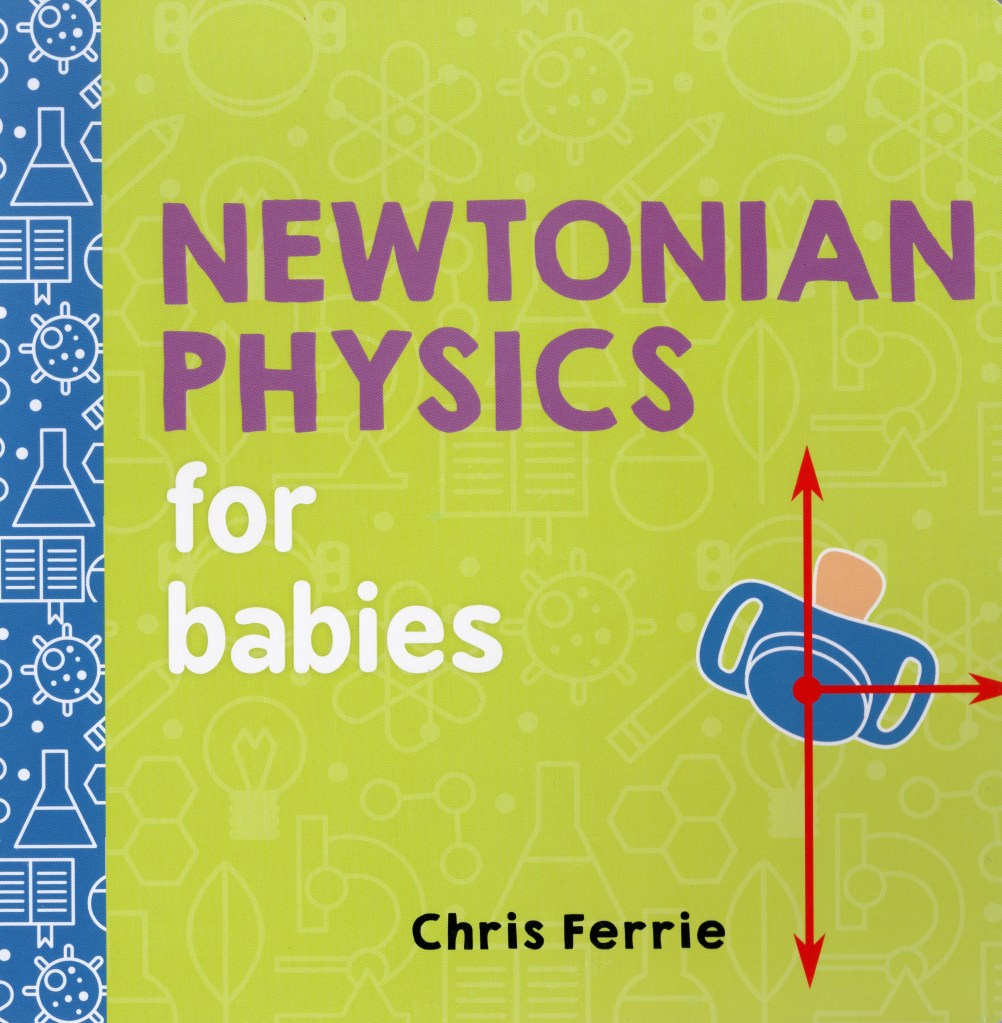
The front cover of Newtonian Physics for babies is green and features the title, author (Chris Ferrie) and an illustration of a binky with three red arrows representing forces | More Science Books for Babies
Front cover of Newtonian Physics for Babies.

This is the Amazon link for Newtonian Physics for Babies.

My Review for Newtonian Physics for Babies

Newtons Laws and a Ball Explained to the Very Young

We bought this book for our future grandchild who will soon be born. It is a very short board book which takes one minute to read. The book is about a ball. A ball feels the force of gravity, and it is pulling it down. When the ball is on the ground the ball still feels the force of gravity but the ground pushes back with an equal force and the ball is at rest. If there is a net force the ball moves.

At the end the book lists the three laws of motion. 1. If an object has zero net force, it does not change its motion. 2. The net force is equal to mass times acceleration. 3. For every force, there is an equal force in the opposite direction. It is very simply expressed, and the illustrations are fun, but I still think this book requires the child to be a bit older for him to understand, maybe 3-4 years old rather than a baby. However, I think the book can evoke an interest in science and physics at an earlier age. Despite it being one of the tougher books in the series, I think it seems to be a pretty good book.


To watch a woman read Astrohysics for Babies. Click on the YouTube video below.


To see the Super Facts click here

Quick Easy Introduction to Astrophysics

The goal of this blog is to create a list of what I call super facts. Important facts that are known to be true and yet they are surprising, shocking or disputed among non-experts. In a sense it is myth busting. However, it is not the only type of posts I do. This is a review for a popular book on Astrophysics called “Astrophysics for People in a Hurry” by Neil De Grasse Tyson. It is a New York Times best seller and the #1 best seller in Astronomy & Astrophysics on Amazon. It has almost 37,000 ratings/reviews on Amazon and more 194,000 reviews/ratings on Goodreads.

Below is a list of the four formats in which it comes on Amazon.

  • Hardcover –  Publisher : W. W. Norton & Company; First Edition (May 2, 2017), ASIN : 0393609391, ISBN-10 : 9780393609394, ISBN-13 : 978-0393609394, 224 pages, item weight : 2.31 pounds, dimensions : ‎ 7.3 x 4.8 x 0.9 inches, it costs $6.21 – $13.26 on US Amazon. Click here to order it from Amazon.com.
  • Kindle –  Publisher – W. W. Norton & Company (May 2, 2017), ASIN : B01MAWT2MO, 222 pages, it costs $9.00 on US Amazon. Click here to order it from Amazon.com.
  • Audiobook –  Publisher : Blackstone Audio Inc (May 2, 2017), ASIN : B06XB2PX7G, it costs $10.20 on US Amazon. Click here to order it from Amazon.com.
  • Audio CD –  Publisher : Blackstone Publishing; Unabridged edition (May 2, 2017), ISBN-10 : 1538408015, ISBN-13 : 978-1538408018, it costs $24.95 on US Amazon. Click here to order it from Amazon.com.
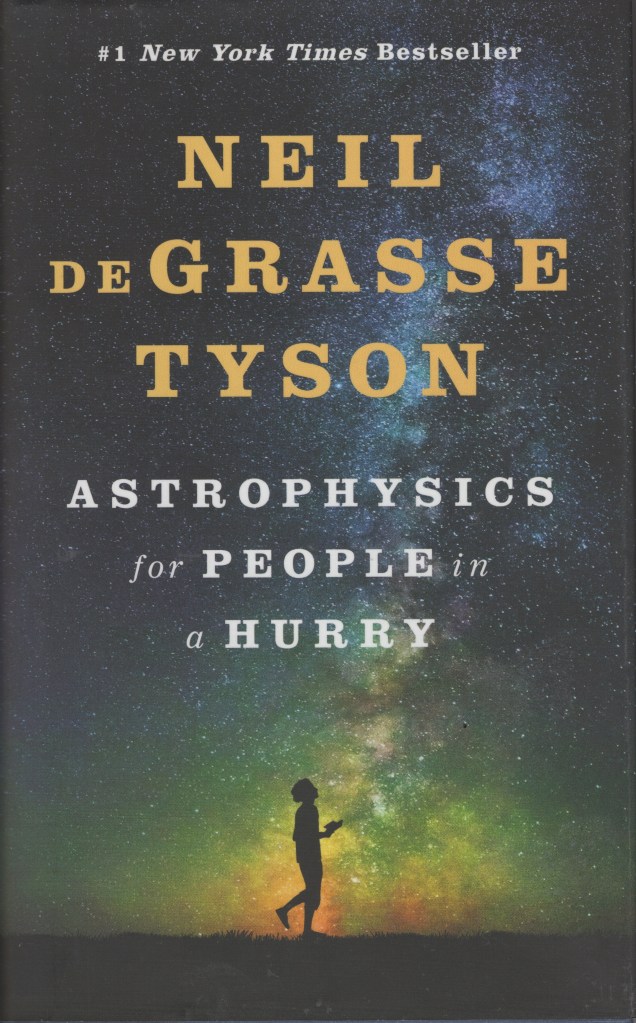
“Astrophysics for People in a Hurry” by Neil De Grasse Tyson front cover | Quick Easy Introduction to Astrophysics
Front cover of the book Astrophysics for People in a Hurry. Click on the image to go to the Amazon page for the hardcover version of the book.

Amazon’s Description of Astrophysics for People in a Hurry

Over a year on the New York Times bestseller list and more than a million copies sold.

The essential universe, from our most celebrated and beloved astrophysicist.

What is the nature of space and time? How do we fit within the universe? How does the universe fit within us? There’s no better guide through these mind-expanding questions than acclaimed astrophysicist and best-selling author Neil deGrasse Tyson.

But today, few of us have time to contemplate the cosmos. So Tyson brings the universe down to Earth succinctly and clearly, with sparkling wit, in tasty chapters consumable anytime and anywhere in your busy day.

While you wait for your morning coffee to brew, for the bus, the train, or a plane to arrive, Astrophysics for People in a Hurry will reveal just what you need to be fluent and ready for the next cosmic headlines: from the Big Bang to black holes, from quarks to quantum mechanics, and from the search for planets to the search for life in the universe.

This is my four-star review for Astrophysics for People in a Hurry

The reason I gave the book four stars instead of five is because I felt that if you have an interest in the topic, you will have heard it all before. However, in retrospect that might not be a good reason to deduct a star. After all, the book seems to be targeting people who do not know much about the subject and thus will not have heard it all before.

Quick and Entertaining Overview of Astrophysics

I’ve read a number of Neil DeGrasse Tyson’s books and I love them. This book is a compressed version of what he has been explaining in other books. If you’ve already read a number of Neil De Grasse books, or perhaps other popular science Astrophysics books such as those by Stephen Hawking, you will not find much new in this book. However, I think it is a brief but good summary of Astrophysics written for a layman. It is 208 pages, each page having about half as much text per page as a typical popular science book. It is an easy and fairly quick read.

He briefly explains the Big Bang, physical laws, spectra, nebulae, the speed of light, very briefly relativity and quantum physics, the cosmic background radiation, galaxies, gravitational lensing, dark matter, dark energy, neutron stars, the composition of the solar system and exoplanets. He covers a lot of ground quickly and he makes it easy to understand without simplifying so much that it becomes misleading. This book is exactly what the title says. However, as I mentioned, if you’ve read a lot on the topic already, especially if it is Neil DeGrasse Tyson’s books, you’ve seen it before. I still think it was very enjoyable though and I still learned something new. He is a very entertaining author.

“Astrophysics for People in a Hurry” by Neil De Grasse Tyson back cover
Front cover of the book Astrophysics for People in a Hurry. Click on the image to go to the Amazon page for the hardcover version of the book.
To see the Super Facts click here