Choosing Super Facts

This is my 100th post on my Superfactful blog. There are 50 super-fact posts. The other posts are posts about the blog, like this one, or posts featuring interesting information that I think is important, or book reviews of non-fiction books, travel posts with some information, posts about me, or mysteries.

However, the goal of this blog is to create a long list of facts that are important, not trivia, and that are known to be true and yet are either disputed by large segments of the public or highly surprising or misunderstood by many, perhaps shocking. Learning or accepting such a fact will change how you view the world. This makes these facts deserving of special attention, which is why I refer to them as super facts. You can also consider the super facts as a form of myth busting, major myth busting.

As mentioned, at the time of writing this I have come up with 50 super facts and made 50 posts about those super facts, but I am hoping to come up with hundreds. I am open to suggestions for super facts as well as critique of super facts. Tell me if you think it is trivia, not important, not surprising, or not an established fact. To see the first 50 super facts click here.

A blue brain is splitting up into pieces | Choosing Super Facts
Smash your old beliefs with new surprising facts, super facts. Expand your mind. Shutterstock ID: 1685660680 by MattL_Images

Deciding on What is an Important Fact

Deciding what is an important fact or not is subjective, but for the same reason it also makes it an easy thing to decide. Ultimately, I decide what is important. It is difficult to compare the importance of facts, but my main concern is to avoid trivia. I also try to avoid facts that may be important to me but do not concern others very much.

For example, I am looking for facts that people discuss a lot, or are often mentioned in the mainstream media, or facts that people dispute fiercely despite a scientific consensus and overwhelming evidence telling us what is true. I am looking for facts from science that could change people’s perspective on nature, our world, or the universe, or facts that could change people’s view of the world, that are related to important historical events, such as the deaths of millions of people, etc.

Shocking Facts

Deciding whether a fact is highly surprising, misunderstood by many, shocking, or contentious and disputed is also not an exact science. In some cases, there are polls stating how common a certain belief is amongst the public but in most cases (that I consider) I have no polls to fall back on. I just have to use my judgment. In some cases, almost everyone I’ve spoken to about the subject is misinformed, bamboozled, or they misunderstand it. In other cases, I need to decide based on my impression. I have to guess.

A shocked woman in front of a screen | Choosing Super Facts
Super facts can be surprising, shocking, or something you refuse to believe, and yet they are true. Photo by Andrea Piacquadio on Pexels.com

Finding the Truth

As I mentioned, deciding on what is important or highly surprising is not an exact science. I think that is OK. There’s going to be super facts that are impressive and some that are less so. However, the third criteria is the one thing that I need to get right, and that is whether the fact is true or not.

We humans are not very rational, and we often believe with intense conviction things which are false. I think that is true for all of us. We don’t know what those false beliefs are, otherwise, we wouldn’t have them. However, this is where the super facts can come in handy, as tools for personal growth if we are willing to change our minds in the face of new evidence. This is easier said than done since we are emotional beings embedded in our culture, our tribal attachments and favorite myths. We have biases, we jump to conclusions, we overestimate our understanding of subjects we don’t know much about (see the Dunning Kruger effect), and we tend to believe what we want to believe. That goes for me too.

Adding to the difficulty on deciding what is true is the fact that the internet and especially social media is full of misinformation. There are an enormous amount of YouTube videos, podcasts, and websites touting false claims, conspiracy theories, and pseudo-science. There are political think tanks deceiving the public and industry funded organizations spending billions of dollars on misinformation, as well as people claiming to have special insights and superior knowledge.

I see the most ridiculous claims on Facebook and Instagram on a daily basis and the amazing thing is that people fall for it. If it supports their pre-existing beliefs or opinions, they see it as proof or conclusive evidence and they don’t take the time to question the source. When I see this, I often point out that the source is not reliable, or it may even be a satirical site, and I often add something from Snopes to my comment assuming they’ve investigated it.

Sure, when I do this, I am raining on someone’s parade, and it is quite often not welcome. No matter how politely I try to explain the situation I end up getting insulted or blocked. I should say, I’ve also fallen for fake information myself, but I try to accept it when someone points it out to me using reliable sources. The point is, we humans are really bad at deciding what is true, and we underestimate how bad at it we are, and deciding what is true is often a quite challenging task.

Before I publish a super fact, I need to be fairly certain that it is true. Outside of mathematics and logic you cannot be 100% sure about anything, but some facts we can say with very high certainty are true. For example, the earth is not flat like a pancake, the Sun is bigger than the earth, the capital of the United States is Washington DC, the heart pumps the blood, we breathe oxygen, carbon dioxide is a greenhouse gas, the light speed in vacuum is a universal constant, time dilation is real, Cesium-137 is radioactive, etc. Most likely you only know a very tiny fraction of a percentage of the facts that we know to be true with very high certainty. Some of those facts will surprise you, shock you, or are facts you would like to dispute, and I call them super facts.

Determining What Facts Are True

When I determine whether something is true with a high degree of certainty I start with my own expertise. For example, when someone claims that the second law of thermodynamics (entropy) contradict evolution I know that to be false because I have a degree in physics (master’s degree) and I’ve taken several classes in thermodynamics and statistical mechanics. In addition, I am very familiar with the faulty argumentation behind the claim because I’ve read dozens of creationist books. Yes, I was once bamboozled by creationism myself. Then I learned more about science, evolutionary biology, physics and thermodynamics.
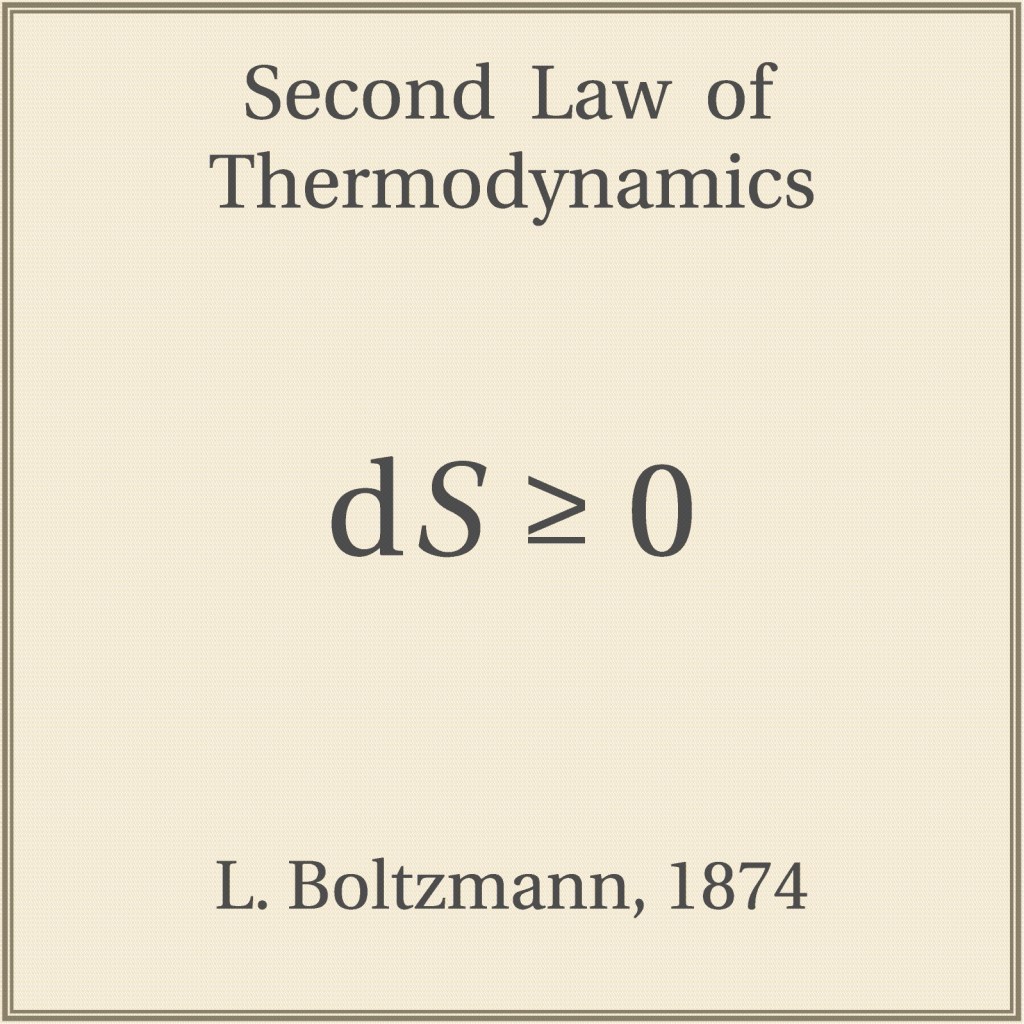
Ludwig Boltzman’s formula from 1874
Second law of thermodynamics Shutter Stock Vector ID: 2342031619 by Sasha701

However, my personal expertise is not enough. I also find out about scientific consensus or expert consensus and evidence from reliable sources. I should say that using scientific consensus as a reliable indicator that something is true does not fall under the “appeal to authority fallacy”. The “appeal to authority fallacy” refers to appealing to influential people or organizations who may not necessarily be experts, and regardless of the evidence. In science you don’t really have authorities, you have experts who often disagree with each other. In the event almost all experts agree on a certain fact that has been thoroughly vetted you can trust that fact with nearly 100% certainty, and that is not appeal to authority but a probability argument.

I typically select several reliable sources such as research papers published in respectable journals, national academies, government websites such as NASA, NOAA, EPA, FBI, respected research organizations such Our World in Data, Pew Research Center, and academic publications and books. I make sure that they various sites I find don’t contradict each other regarding my prospective super fact. If they all seem to agree I accept the super fact and include a few of the links in my post.

If I don’t have much personal expertise on a subject I start out by asking Google AI. I don’t ask ChatGPT because I believe it is less reliable with respect to information. Then I check Wikipedia and or another online encyclopedia such as encyclopedia Britannica. This is not to establish the truth but to get an idea. Wikipedia is not an academically acceptable source, but it is rarely wrong and serves as a good first filter to save time. Then I start focusing on the reliable sources above and I will make sure I understand the evidence.

So, in summary I will use my expertise, scientific consensus, reliable sources and better, agreement between reliable sources, to determine if I can say with confidence that something is true. I will also frequently include links from Wikipedia in my posts because Wikipedia typically feature good summaries that are easy to understand. Naturally, anyone is free to dispute any of my super facts. Just make sure you provide good evidence from an arguably reliable source, or I cannot take it seriously.

Picture shows a scale held by a pointing finger. Fact is on the left shown as a bright light bulb. Myth is shown on the right as grey ball | Choosing Super Facts
Fact or myth. Shutterstock Asset id: 2327968607

Sources I will not consider are claims from unreliable sources, political think tanks, talk show hosts, politicians, articles written by contrarians heavily funded by industry or political organizations, and random Reels or YouTube videos, and I will not entertain conspiracy theories for my purposes. Also, I will ignore, articles with click bait titles, sources making claims about a great swindle by the scientific community, articles claiming everyone is lying to you, articles purporting to reveal the hidden truth, articles insisting on presenting the truth that “they”/the-others won’t tell you, etc. Cults will tell you that everyone else is lying to you. I’ve learned not to fall for it at this point.

My Super Fact List

Finally, here are a few examples of my super facts.

To see all the Super Facts click here

We Exploded Thousands of Nuclear Bombs

Super fact 48 : Since 1945 we have set off more than 2,000 Nuclear Bombs corresponding to a yield of an estimated 42,000 times that of the Hiroshima Bomb.

According to the Arms Control Association there’s been 2,056 nuclear bomb tests. According to the UN there’s been more than 2,000 nuclear bomb tests, and according to Wikipedia there’s been 2,121 nuclear bomb tests, totaling 635 Megaton. Using the typical yield estimate for the Hiroshima bomb of 15 Kiloton that corresponds to more than 42,000 Hiroshima bombs. I think most of us know about the Hiroshima and Nagasaki bombs and we know about nuclear testing. However, I think the number of tests and the large total yield will come as a surprise to many, at least it was a surprise to me. That is why I consider this a super fact.

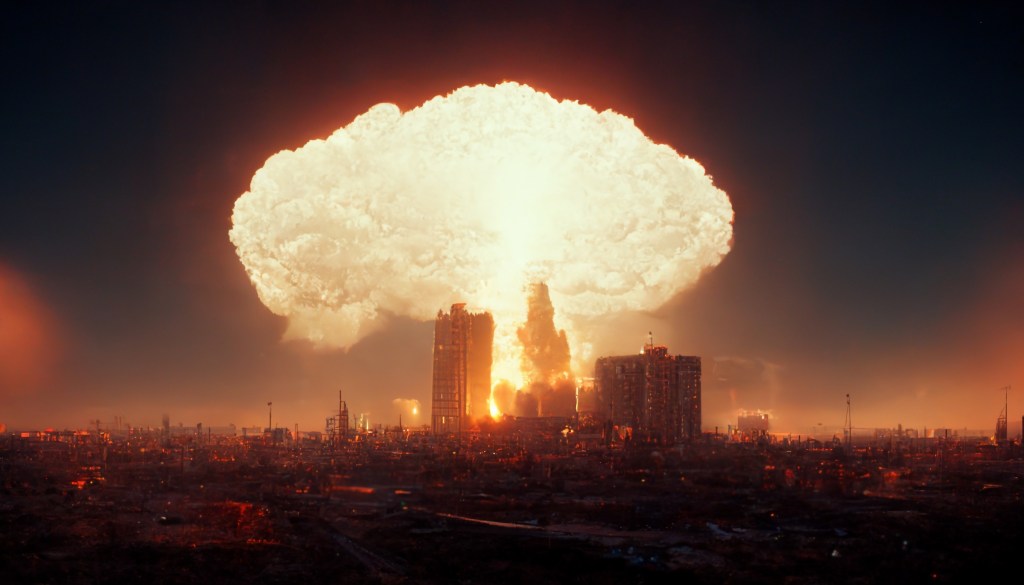
Atomic bomb explosion in a city - nuclear attack on a crowded city – 3D rendering of a mushroom cloud encompassing a city with skyscrapers | We Exploded Thousands of Nuclear Bombs
Nuclear bomb dropped on a big city. Shutterstock, asset id: 2188083835 by CI Photos.

Nuclear Landscaping

It may also come as a surprise that many of these tests were not for military purposes. Another usage for nuclear bombs is nuclear landscaping. Towards the end of the 1950’s the existing Panama Canal was thought to be insufficiently large and some people, including Edward Teller, the father of the Hydrogen bomb (Thermonuclear bomb), suggested that a new wider and deeper canal could be built simply by using nuclear bombs to blow multiple huge holes across Panama. The US was also interested in creating a new harbor in Alaska using nuclear bombs.

Thus, Project Plowshare was created to achieve this. As part of the Project Plowshare 35 nuclear warheads were detonated. The Soviet Union also had a similar program named “Nuclear Explosions for the National Economy” that included 124 nuclear bomb tests. Due to concerns over radioactive fallout the nuclear landscaping projects were eventually put to rest. The last Plowshare detonation was on May 17, 1973. The book Atomic Awakening by James Mahaffey recounts the history of nuclear testing and nuclear landscaping in greater detail.

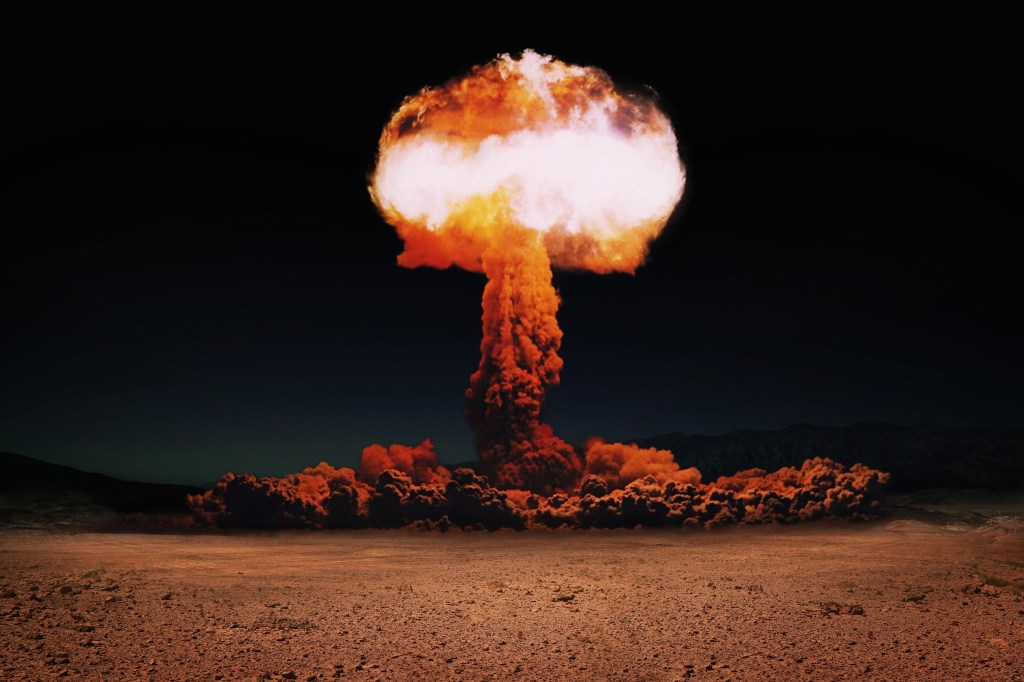
An enormous nuclear bomb explosion in the dessert featuring a huge mushroom cloud.
Hydrogen bomb test by Alones Shutterstock Asset id: 2194195335.

Project Orion

Another non-military use of nuclear bomb testing was Project Orion. Project Orion was a study conducted from 1956 to 1964 by the US Air Force, NASA, and DARPA into the viability of a nuclear pulse spaceship that would be directly propelled by a series of atomic explosions behind the craft. A thick steel pusher plate would catch the blast and accelerate the ship forward.

The “Pascal B” shot in Operation Plumb Bob in 1957 was the first nuclear weapons test of the pusher concept. The Limited Test Ban Treaty of 1963 made it difficult to continue with the project. According to the book Atomic Awakening, if the design had been successfully completed, we could have created an interstellar spaceship that could have taken a crew and a large load to other planets and stars.

I can add that According to Atomic Awakening, in addition to Nuclear Landscaping and Project Orion, Nuclear Blasts were a tourist attraction.

Number of Nuclear Tests by Country

Below is a list of countries and the number of nuclear tests that they’ve performed according to the Arms Control Association and Wikipedia.

  • The United States – 1,030 – According to Wikipedia – 1,032
  • The USSR/Russia – 715 – According to Wikipedia – 727
  • France – 210 – According to Wikipedia – 215
  • United Kingdom – 45 – According to Wikipedia – 88
  • China – 45 – According to Wikipedia – 47
  • North Korea – 6 – According to Wikipedia – 6
  • India – 3 – According to Wikipedia – 3
  • Pakistan – 2- According to Wikipedia – 2

However, it should be noted that partially due to nuclear arms control legislation such as; the Limited Test Ban Treaty (LTBT): Signed in 1963,  the Threshold Test Ban Treaty (TTBT): Signed in 1974, and the Comprehensive Nuclear-Test-Ban Treaty (CTBT) opened for signing in 1996, the number of nuclear tests have been significantly reduced. This is illustrated by the graph below from Our World in Data. The last nuclear test was done by North Korea in 2017.

The histogram graph shows how many nuclear tests took place each year since 1945. The different countries, the portion by each country, the US, USSR/Russia, France, United Kingdom, China, North Korean, India, and Pakistan are colored differently. The histogram shows the 1961 was the year when most nuclear tests took place. The vast majority of the tests took place between 1950 and 1990 | We Exploded Thousands of Nuclear Bombs
Data Source: Arms Control Association (2024). OurWorldInData.org/nuclear weapons.

Tsar Bomba

The biggest nuclear bomb ever exploded was RDS-220, or AN602, or Tsar Bomba. It was detonated by the Soviet Union on October 30th, 1961, on the arctic island of Novaya Zemlya, and yielded more than 50 Megaton. In other words, it was 3,300 times more powerful than the Hiroshima bomb. According to Atomic Awakening, windows in Finland 1,900 kilometers (1,180 miles) away shattered. There are no cities large enough to match the size of the explosion. This is the kind of bomb that could obliterate states or small countries.

Tsar Bomba was a so-called thermonuclear device, or a hydrogen bomb as they are typically called. Hydrogen bombs are much more powerful than fission bombs, such as Uranium bombs or Plutonium bombs. To read my related post called “Ukraine Gave up Thousands of Nuclear Warheads” click here.

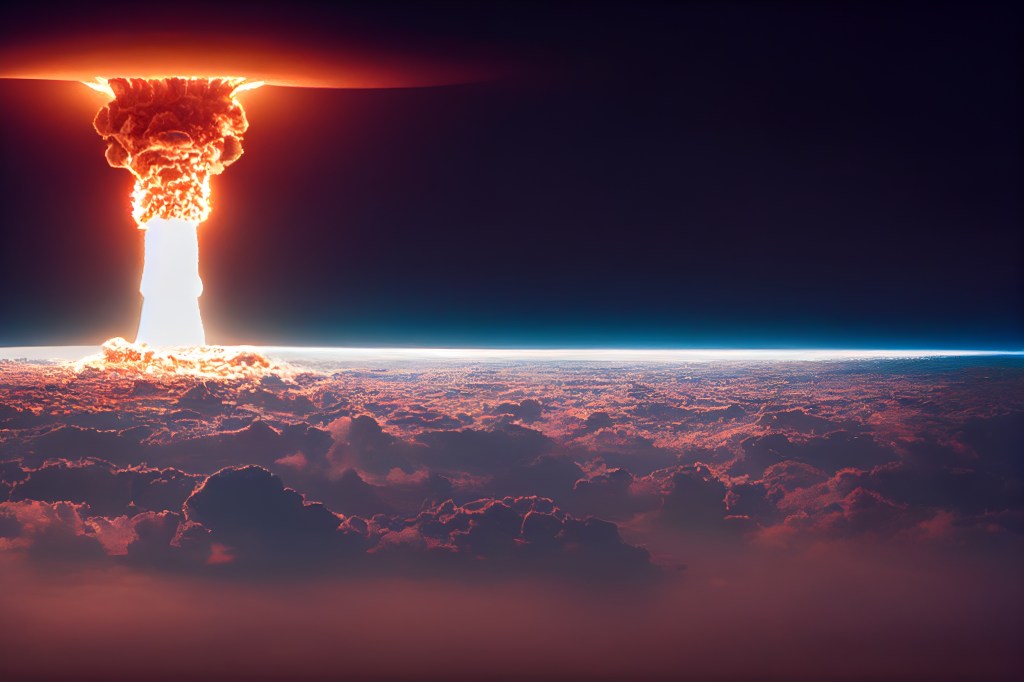
Russian Tsar Bomba mushroom cloud rising high above the clouds. High quality photo realist ( 3d make ) | We Exploded Thousands of Nuclear Bombs
This is an illustration of the Tsar Bomba explosion by by mbafai Shutterstock Asset id: 2208486661. To see a photo of the actual Tsar Bomba explosion click here (it is copyrighted).

Would you pay to watch a Nuclear Bomb Test? (Nuclear Bomb Test Tourism)


To see the other Super Facts click here

Gustav Vasa

Image above by Kevin from The Beginning at Last

Today, June 6 is the National Day of Sweden (or the Independence Day of Sweden). Gustav Vasa, or Gustav I, Sweden’s hero king and the father of modern Sweden, was elected king of Sweden on June 6th, 1523. This was after the Swedish War of Liberation from Denmark 1521 to 1523. Gustav rose to lead the Swedish War of Liberation following the Stockholm Bloodbath, where his father was executed.  Gustav Vasa or Gustav I was King of Sweden from 1523 until his death in 1560. Since I am originally Swedish (now living in Texas) June 6 is a significant date for me.

In the picture there muscular man holding up crown | Gustav Vasa
This picture is how I imagine Gustav Vasa at his coronation. BTW this is a submission for Kevin’s No Theme Thursday
A bearded king and his queen are marching down the middle of beautiful large building, perhaps a cathedral or a castle | Gustav Vasa
This is how I imagine Gustav Vasa’s marriage to Catherine of Saxe-Lauenburg on September 24th, 1531. This picture is also from Kevin’s No Theme Thursday

Depictions of Gustav Vasa

Kevin’s pictures above were, like I said, how I imagine Gustav Vasa. The depictions below might be closer to the truth.

Painting of Gustav Vasa with an interesting hairdo and wearing a large robe.
Painting of Gustav I Vasa. Fashion was somewhat different back in the day.
Gustav Vasa is wearing a big black robe and black beanie looking hat that is slanted on his head.
Portrait of Gustav Vasa (from Wikipedia Commons).

The Kalmar Union

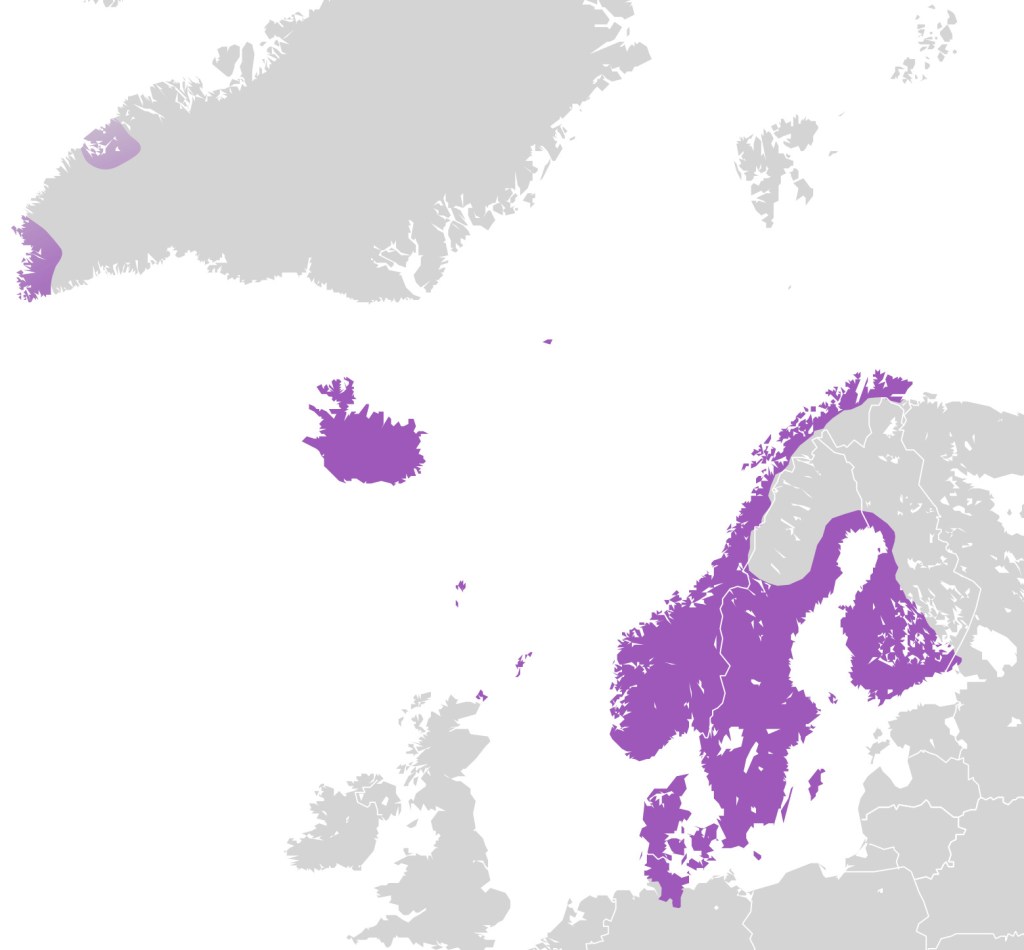
In 1397 a union was formed between Denmark, Norway and Sweden called the Kalmar Union (Kalmar is a city a Sweden). The Kalmar Union came to be dominated by Denmark and there were occasional rebellions. During Gustav’s childhood, parts of the Swedish nobility tried to make Sweden independent. Gustav’s father Erik Johansson Vasa was part of that nobility.

Map showing Denmark, Sweden and Norway in purple. Iceland and Finland are also included.
The Kalmar Union. Finland was part of Sweden at the time. Ssolbergj, CC BY-SA 3.0 <https://creativecommons.org/licenses/by-sa/3.0&gt;, via Wikimedia Commons

After some problematic interactions with Denmark and the Danish King Christian II, King Christian massacred 100 Swedish nobles, November 7-9, 1520, on Stortorget in Stockholm, including Gustav’s father. In 1521 Gustav led a rebellion (or a civil war) against Denmark, which ended in the deposition of King Christian II from the throne of Sweden, effectively ending the Kalmar Union. I can add that King Christian is called Christian the Tyrant in Sweden and Christian the good in Denmark.

Sweden and Denmark has had a complicated history that included a lot of hostilities and eleven wars, but you wouldn’t know it if you looked at the situation today. There hasn’t been a war between Sweden and Denmark in more than 180 years and Swedes and Danes get along very well. However, it is best not to bring up the past. That is probably true for marriages as well.

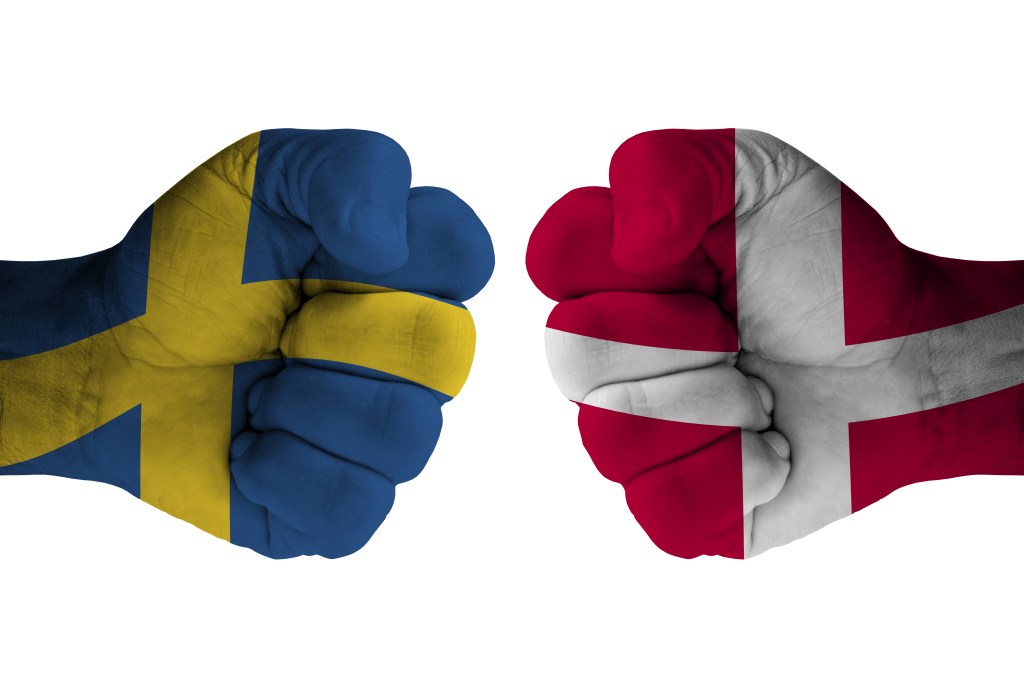
On the left, a fist with a yellow and blue flag. On the right, a fist with a red and white flag.
Denmark vs Sweden. The yellow and blue flag is the Swedish flag. Red and white is the Danish. Shutterstock Stock Photo ID: 1114320377 by Hasanov Jeyhun.

Gustav Vasa’s Burial Place

Gustav Vasa died on September 29, 1560, and is buried together with three of his wives (while only two are engraved) in the Cathedral of Uppsala. Uppsala is an old city north of Stockholm famous for its Viking graves/mounds. During the Viking era Uppsala was the religious center of Sweden. Later as Sweden became Christian it remained the religious center of Sweden, however, the Viking temple in old Uppsala was replaced by a Christian church. Uppsala hosts one of the most prominent Universities in the world and it also happens to be where I studied Engineering Physics.

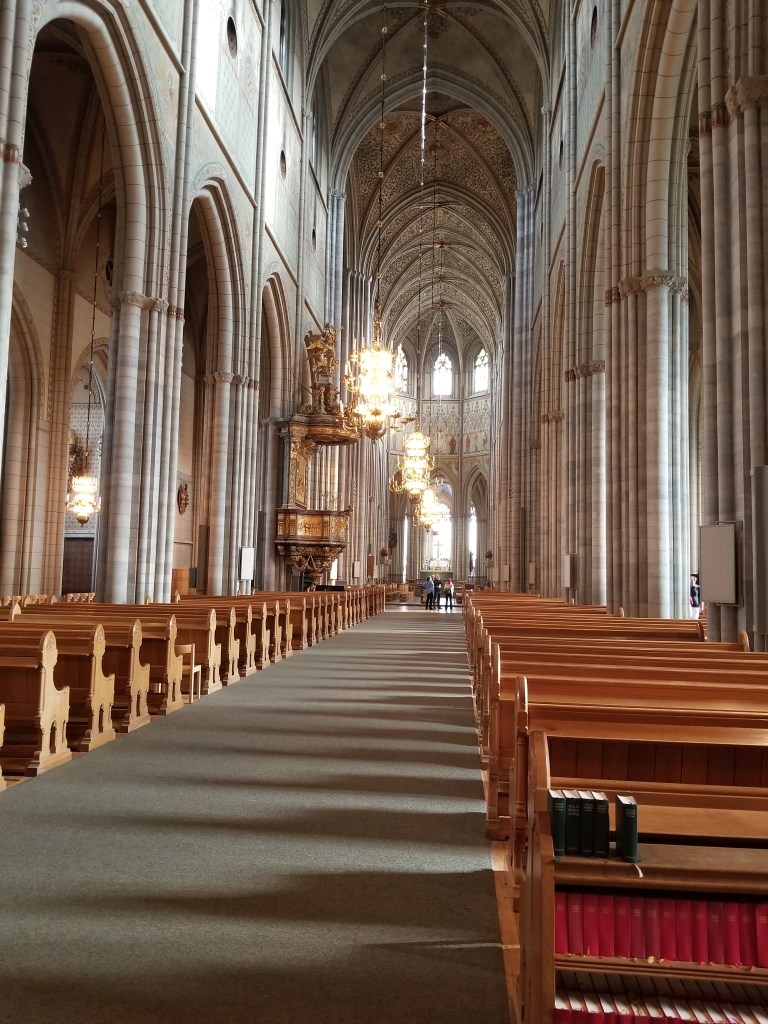
The largest cathedral in Sweden, Uppsala Domkyrka. This is where Gustav I Vasa is buried. Gustav I is arguably Sweden’s most prominent king.
Inside Uppsala Domkyrka
Inside Uppsala Domkyrka.
The tomb of Gustav I Vasa in Uppsala Domkyrka | Heavily decorated coffin shaped tomb placed in a large, decorated room filled with paintings.
The tomb of Gustav I Vasa in Uppsala Domkyrka. In the background is my son and his wife.

Photos from Sweden

Photo of a Leonberger standing on of a bench
I am a fan of Leonberger dogs, and this is a photo of the only Swedish Leonberger I met personally. Her name was Amie. We met her at an interesting place, at the top of a north Swedish mountain called Skule Mountain (Skull Mountain).
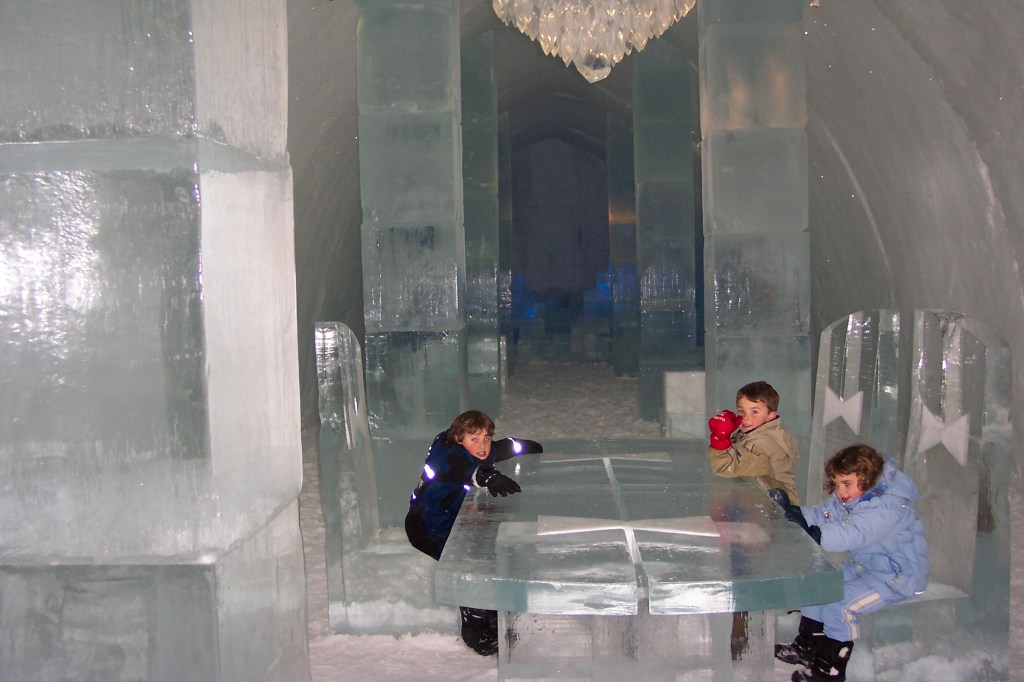
Three children sitting around a large table made of ice in a large room with columns of ice. There is an ice chandelier above the table.
One of the interesting tourist attractions in northern Sweden is the Ice Hotel in Jukkasjärvi . The ice hotel in Jukkasjärvi is the first/original and largest ice hotel in the world. My kids at the lobby of the ice hotel in northern Sweden.

A guard in a dark blue uniform wearing a golden helmet and a gun in standing in front of a booth in front of a big brick castle.
Sweden has a king (Carl XIV), and he owns a couple of big castles. This is my kids with the guard in front of the Winter Castle in Stockholm.
My photo of Drottningholm castle taken from the garden, a very large garden.
Drottningholm, one of the Royal Palaces in Sweden. It was built in the 1660’s and inspired by Versailles.
A photo of the Vasa Ship taken from below.
A photo of the Vasa ship from the bottom floor. My son is standing on the right in a green and black shirt.
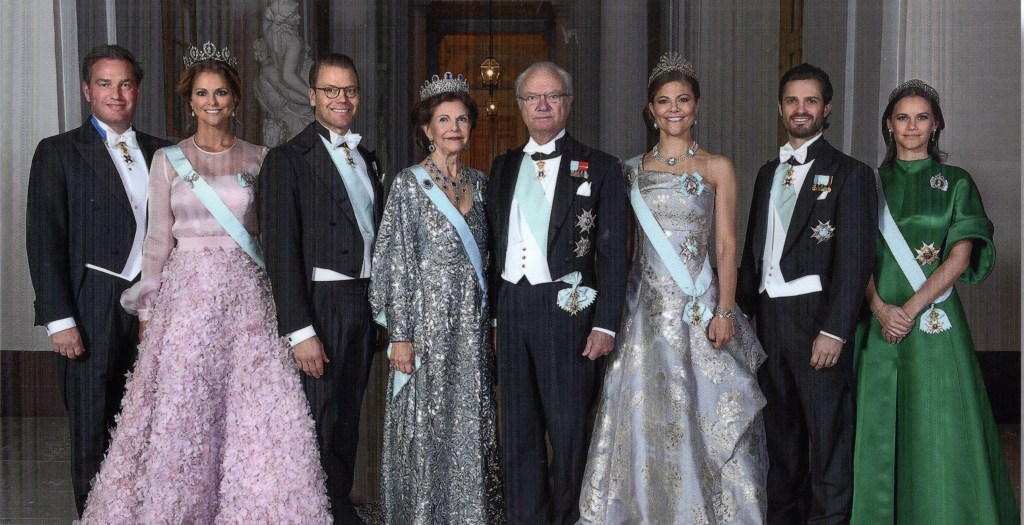
This is a photo of a well-dressed 8-member royal family.
The Swedish Royal family. The two people in the middle are Queen Silvia and King Carl XVI Bernadotte. To the right of the king is the future monarch of Sweden princess Victoria and to the left of Queen Silvia is her husband. The others are their other two children and their spouses.
Yellow and Blue Swedish flag | Gustav Vasa
Finally, the Swedish Flag (Wikimedia Commons). All other photos above are mine

Other Scandinavian Posts


To see the Super Facts click here

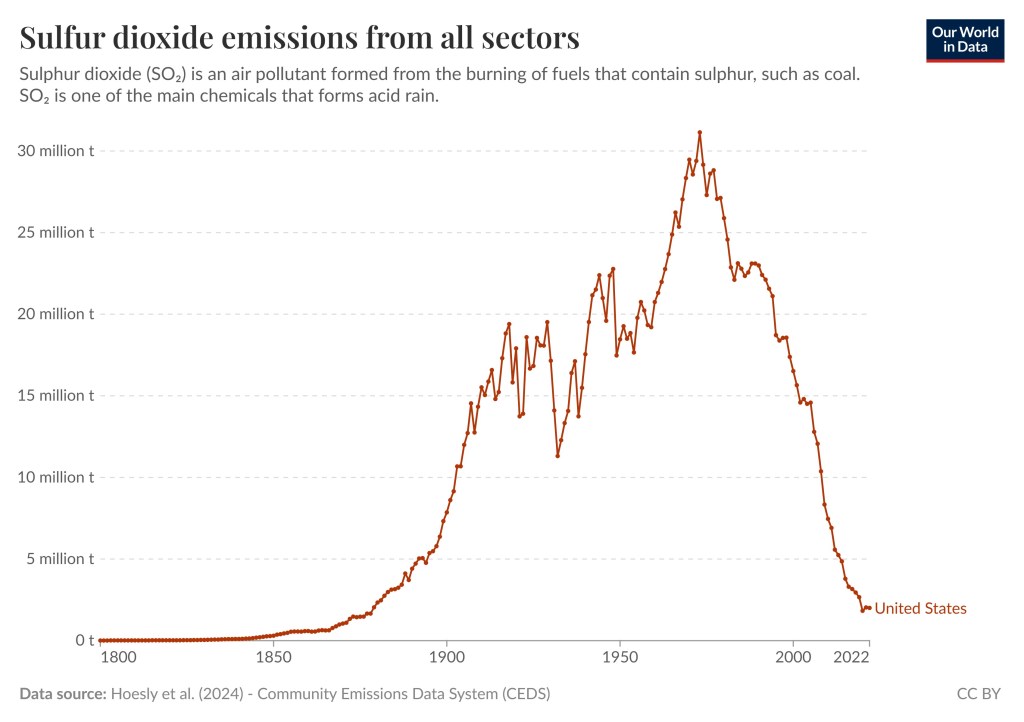
Sulfur dioxide pollution has fallen by 95 percent in the US

Super fact 44 : Sulfur dioxide pollution has fallen by approximately 95 percent in the US since the 1970s. This significant reduction is primarily due to regulations like the Clean Air Act. Global sulfur dioxide pollution has also fallen but not as much.

Sulfur dioxide is a colorless gas with the formula SO2. It has a pungent smell, which you notice after using matches. It is released naturally by volcanic activity and is produced as a by-product of burning sulfur-bearing fossil fuels and from metals refining. Sulfur dioxide is somewhat toxic to humans and by reacting with water it creates acid rain, which is a serious environmental problem.

The good news is that the Clean Air Act has driven technological advancements and the adoption of cleaner practices in industries that produce sulfur dioxide emissions. This has resulted in a drop of sulfur dioxide pollution in the US by 95% according to EPA and Statista and 94% according to Our World In Data. Statista is a pay site, so I am not going to link to it. Below is a graph from Our World In Data showing the reduction in sulfur dioxide pollution in the US.

The graph shows a steep increase towards the end of the 19th century with a peak in 1973, followed by a steep decline | Sulfur dioxide pollution has fallen by 95 percent in the US
US sulfur dioxide pollution since 1800. Data Source: Hoesly et al (2024) – Community Emissions Data System (CEDS). This graph is taken this page in Our World In Data.<<Link-5>> US Emissions peaked in 1973.

I should mention that by clicking this link you can visit the graph above Our World in Data and select different countries and regions and play around with the settings.

Sulfur Dioxide Emissions Worldwide

The worldwide emissions peaked in 1979 and fell sharply after that even though the progress (reduction in sulfur dioxide emissions) has not been as spectacular as in the US. Worldwide reductions are around 48%. Again, by visiting the Our World In Data page you can play around with the graph and the settings and view different countries and regions. This is an additional source visualizing the data.

The graph shows a steep increase in sulfur dioxide emissions around 1950 with a peak in 1979, followed by a steep decline, but not as dramatic as for the US
Sulfur dioxide pollution worldwide since 1800. Data Source: Hoesly et al (2024) – Community Emissions Data System (CEDS). This graph is taken this page in Our World In Data. Worldwide Emissions peaked in 1979.
This graph shows the sulfur dioxide emissions for the world as well as for China and India. China follows the world wide emissions but on a smaller scale whilst India has steady increase in emissions that stabilized/peaked in 2023 | Sulfur dioxide pollution has fallen by 95 percent in the US
Sulfur dioxide pollution worldwide since 1800 with three major polluters included. The United States is in red, China in green and India in blue. The graph for India is the one corresponding to the least overall pollution but it has no reduction. Data Source: Hoesly et al (2024) – Community Emissions Data System (CEDS). This graph is taken this page in Our World In Data.

Good News with Respect to Pollution

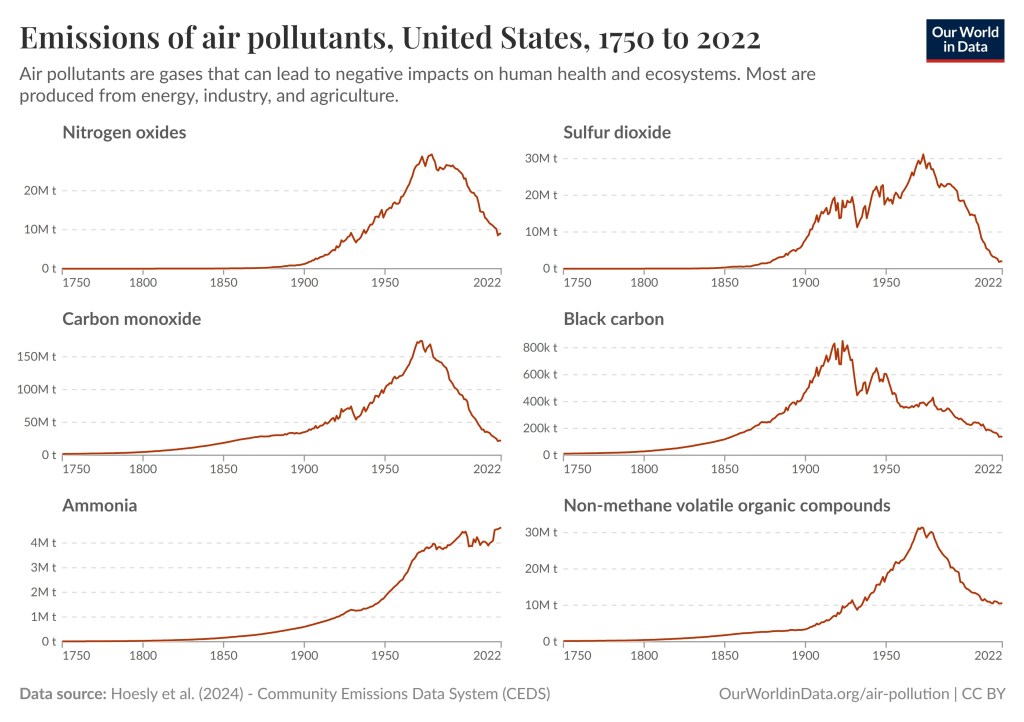
Sulfur dioxide emissions have gone down worldwide, which is good news. However, sulfur dioxide is not the only pollutant that we have succeeded in reducing. The graph below demonstrates that the US has also made great progress in reducing Nitrogen Oxides pollution, Carbon Monoxide, Black Carbon, and Non-methane volatile organic compounds. We have not been as successful with reducing Ammonia pollution.

However, according to Google AI sulfur dioxide, followed by Nitrogen Oxides pollution, Carbon Monoxide, and Black Carbon are the most serious pollutants. The graph below is taken from this page in Our World in Data.

The graphs for nitrogen oxide emissions, sulfur dioxide emissions , carbon monoxide and non-methane organic compounds pollution peak around 1970’s and then show a sharp downturn. The graph for black carbon peak around 1920 and then show a sharp downturn whereas the graph for ammonia does not peak. All graphs are in red.
US nitrogen oxide emissions, sulfur dioxide emissions, carbon monoxides, black carbon, ammonia and non-methane organic compounds pollution since 1750. Data Source: Hoesly et al (2024) – Community Emissions Data System (CEDS). This graph is taken from this page in Our World In Data.

The graphs for the world do not look as impressive. However, even in this case it looks like some progress has been made. Four graphs have peaked and are turning downwards, and one graph has flattened but unfortunately the graph for ammonia pollution is still heading upwards.

It should be noted that these pollutants are more or less local in the sense that they affect the polluting country and/or surrounding countries the most, whilst the climate change / global warming effect from carbon dioxide and other long lasting greenhouse gases tend to affect the entire planet.

The graphs for nitrogen oxide emissions, sulfur dioxide emissions , carbon monoxide peak around 1970’s and then show a small downturn. The graph for black carbon peak around 2020 and then shows a small downturn. The graph for non-methane organic compounds pollution flattened around 2020 whereas the graph for ammonia keeps growing. All graphs are in blue | Sulfur dioxide pollution has fallen by 95 percent in the US
Worldwide nitrogen oxides emissions, sulfur dioxide emissions, carbon monoxide emissions, black carbon, ammonia and non-methane organic compounds pollution since 1750. Data Source: Hoesly et al (2024) – Community Emissions Data System (CEDS). This graph is taken from this page in Our World In Data.

Aside from the success in reducing these pollutants there is more good news.


To see the other Super Facts click here

Peace Is Boring News

Do you remember the Oklahoma Brouhaha? The thirty-year war between Episcopalians and Baptists in Oklahoma. It began in 1970, and thousands of people were killed. The Baptist Republican Army committed terrorist attacks that killed thousands of Episcopalians.

The US Army was called in to establish peace, but it was seen as an occupation and only made things worse. People were dying in Oklahoma but also in Texas, Arkansas and Louisiana. The Governor of Texas was complaining about all the Oklahoma terrorism and wanted to close the border with Oklahoma.

Oh, you don’t remember? Were you asleep during history class? No don’t worry, it is not a super fact you didn’t know about. The Oklahoma Brouhaha never happened. I made that up.

Yesterday I started talking to my daughter about The Troubles, the war between Catholics and Protestants in Northern Ireland that started in 1968 and lasted for more than 30 years. I don’t remember how the discussion started.

My daughter knows history well, much better than most adults I know, but she had still not heard about The Troubles. Her face looked like yours would if you thought I was serious about the Oklahoma Brouhaha. How could this have happened so recently in a peaceful, prosperous and beautiful European country known for its friendly and happy people, great pubs, cute gnomes, and fairy tales?

I can add that an acquaintance of mine survived a bombing of a hotel by the Irish Republican Army (IRA) in 1984. He frequently talked about it. Another acquaintance of mine used to be a member of the IRA. Therefore, I have a small personal connection to it.

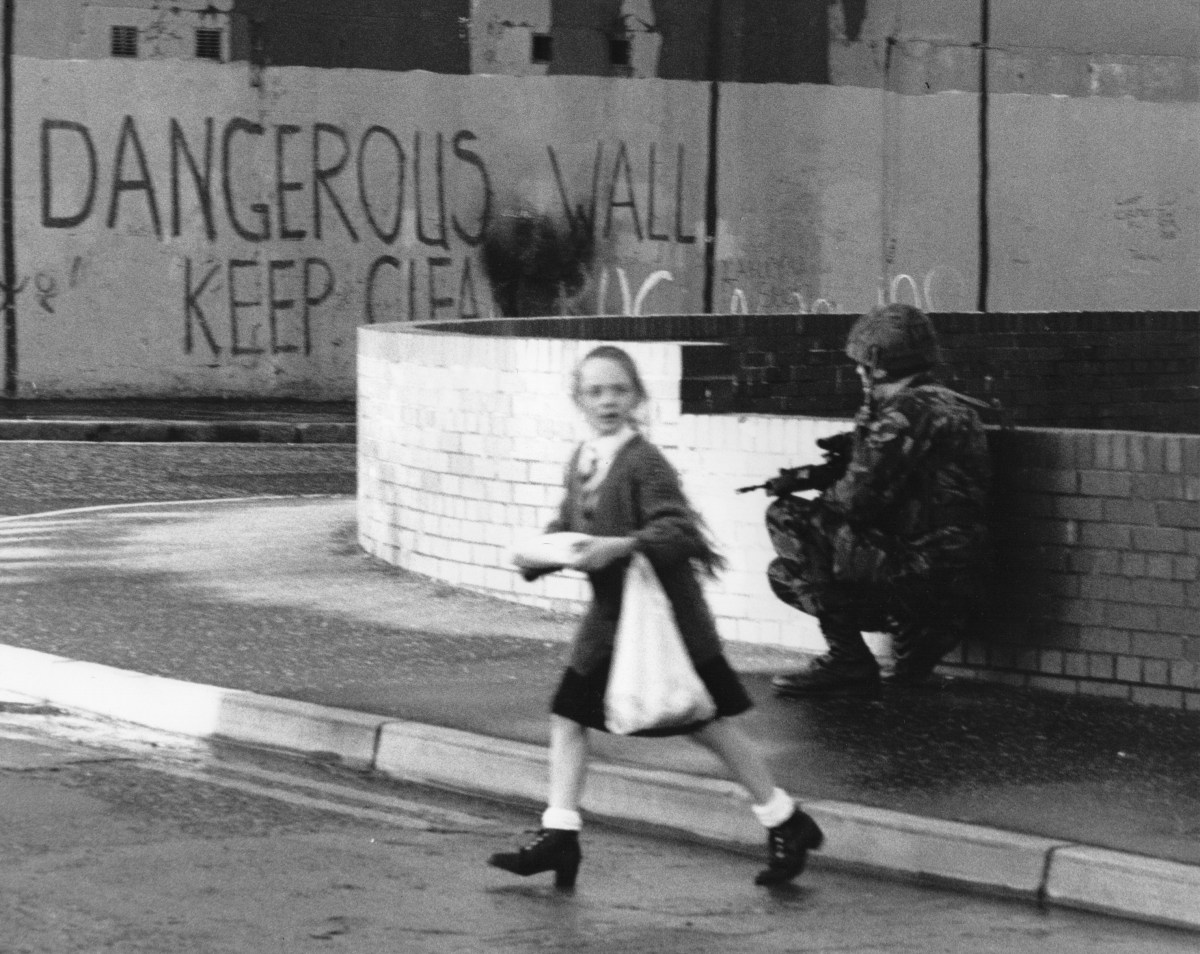
Black and white photo showing a young girl crossing the street as an armed soldier is hunkered down behind her. There is big wall with text written on it saying, “Dangerous Wall keep Clear.”
West Belfast, Northern Ireland,UK; February, 1994; Girl running with plate of chips past wall where two IRA Volunteers were killed by British soldiers Shutterstock Asset id: 1951602385, Editorial credit: RORY NUGENT.com

I on the other hand was flabbergasted that she did not know about The Troubles. But it makes sense. Half my life I was watching the news every day about the war between Catholics and Protestants in Northern Ireland (on Swedish TV), but once peace was achieved, and Gerry Adams and Ian Paisley shook hands, I didn’t hear a peep about it ever again. How could someone in their 20s know about it?

Peace is Boring News

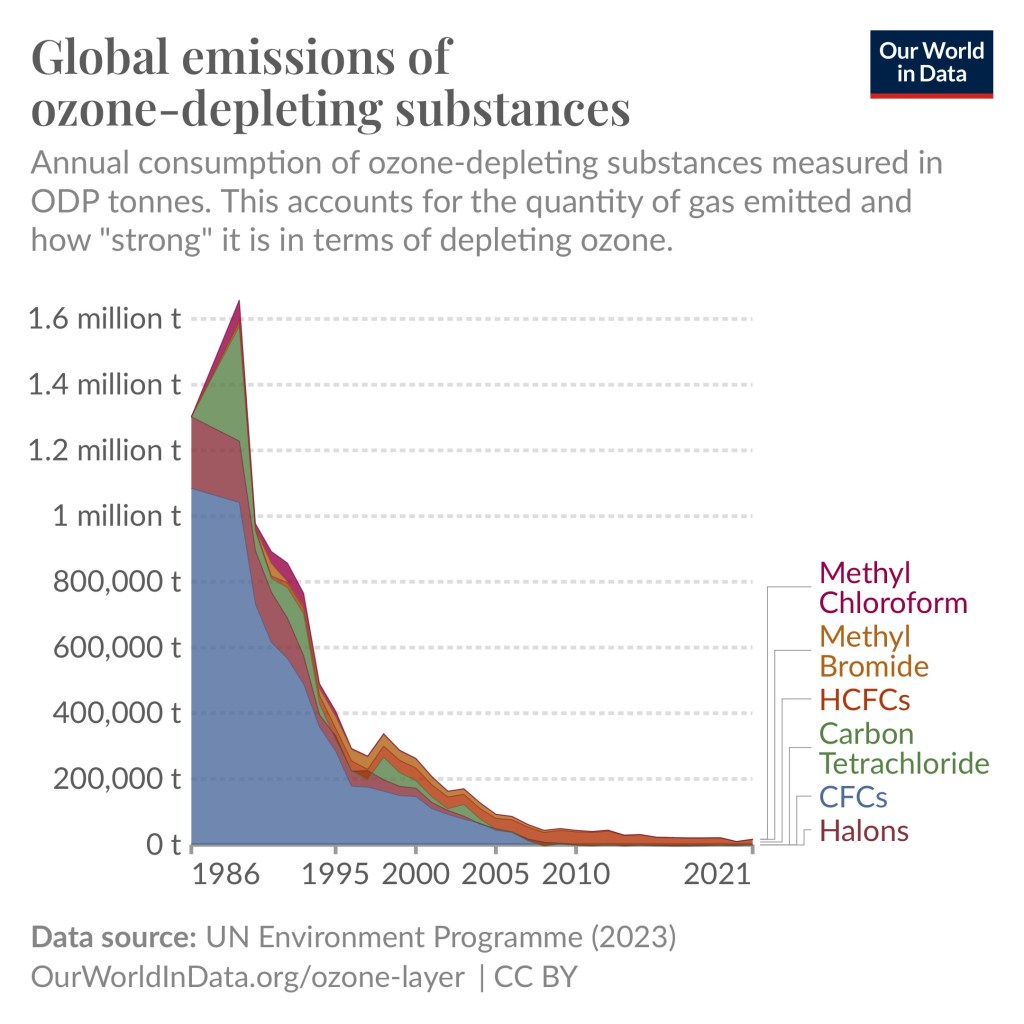
Peace is boring News. Peace is not even news. No news is good news. The same goes for other topics, such as the environment. Environmental disasters and environmental threats are news, and it should be, but an environmental problem that has been solved is no longer news and will be forgotten. One example of that is the super fact post I made yesterday “By 2018 the emissions of ozone-depleting gases had fallen by 99.7 percent”. What else have we forgotten about?

Gases visualized in the diagram are CFCs, Halons, HCFCs, Carbon Tetrachloride, Methyl Bromide, Methyl Chloroform. The diagram shows a peak around the end of 1980’s | Peace Is Boring News
The phase out of six ozone depleting gases. Data source UN Environment Program (2023).

I guess my point is first of all, we forget, and secondly, that it is important to remember that bad news gets attention because it is interesting. Therefore, it is important to remember that there’s a lot of good out there that we forget about.

Below is a youTube video showing Irish comedian David Tynan O’Mahony (born in Dublin), stage name Dave Allen, making fun of Reverend Ian Paisley. Reverend Ian Paisley was a hell and brimstone preacher who agitated against Catholics (it was hate speech), not just in Northern Ireland, but against all Catholics.

For example, he called the pope the anti-Christ. I should add that Ian Paisley and Gerry Adams the leader of the political wing of the Irish Republican Army (Sinn Féin) eventually shook hands in 2007 and came to an agreement. The tone was much different then, but that was long after this YouTube video was made.

The video below is not inflammatory, just very funny. I should mention that as Dave Allen is imitating Ian Paisley it sounds like he is saying “naatching of teeth”. That is “gnashing of teeth” in a north Irish accent. The ending is priceless with perfect comedic timing and effect. The video is 2 minutes and 42 seconds long.

I have one more video if you are interested. It is the Cranberries singing “Zombie” a famous song about the war in Northern Ireland. My daughter knew this song. She just didn’t realize that the song was about the war in Northern Ireland.


To see the Super Facts click here