
Super fact 79 : Distant galaxies appear redder (redshifted) because of the universe’s expansion. The farther away the galaxy, the redder it is. This cosmological redshift is also increasing because the Universe’s expansion is accelerating. Our Universe is getting more and more red every day.
Esther’s writing prompt: January 14 : Red
Click here or here to join in.
Many people are aware that the Universe is expanding but may not know that this results in a measurable redshift. The faster a galaxy is moving away from us the redder it appears. This is called the cosmological redshift. Measuring these redshifts was how we discovered that our Universe is expanding.
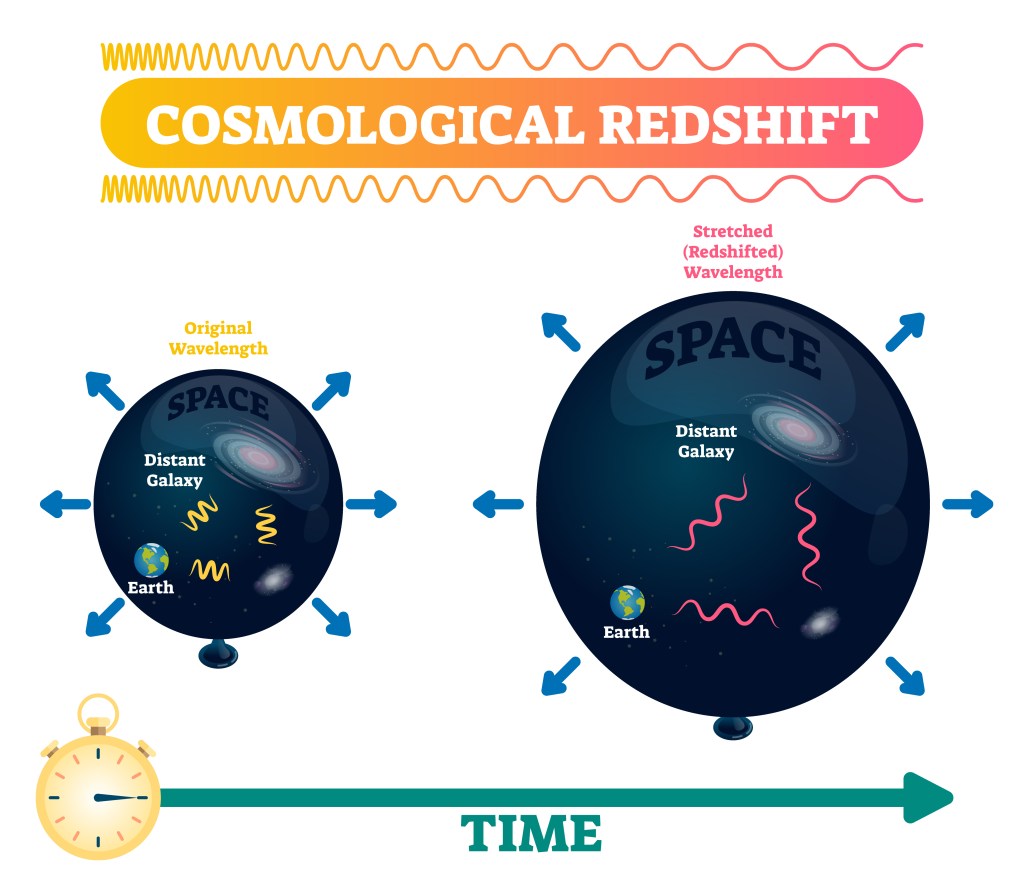
At the end of the 1990’s it was also discovered that the Universe’s expansion was accelerating. This discovery came from measuring the redshifts (and apparent dimness) of distant Type Ia supernovae. I should add that measuring the increase in the cosmological redshift directly is difficult. However, it is expected to be possible when the Extremely Large Telescope (ELT) starts gathering data in 2027. I can add that there are also other types of evidence showing that the Universe’s expansion is accelerating.
Another surprising aspect is, if the Big Bang was like an explosion, gravity would pull back the galaxies making the expansion slow down and perhaps eventually even reverse. However, the opposite is happening. A common explanation is that a repulsive force, a sort of anti-gravity, referred to as dark energy, is responsible for this acceleration.
I call this a super fact because this is an observed phenomenon, it is important knowledge for how we view the world, and it is surprising. Many people have heard bits and pieces of this but do not have the fuller picture.
The Doppler Effect
The cosmological redshift is an example of the so called doppler effect. The doppler effect is the change in the frequency or wavelength of a wave in relation to an observer if the origin of the wave and the observer are moving compared to each other. If an object is moving towards you, let say an ambulance, the frequency of its sound will be higher (wavelength shorter).
After it passes you and moves away from the frequency will be lower (wavelength longer). In other words, the sound changes when the ambulance passes you. The same is true for other kinds of waves, including waves on the water, and light. If a light is travelling towards you at a high speed, it will look bluer. If a light is travelling away from you at a high speed it will look redder. The latter is what is called a redshift, cosmological redshift in our case.
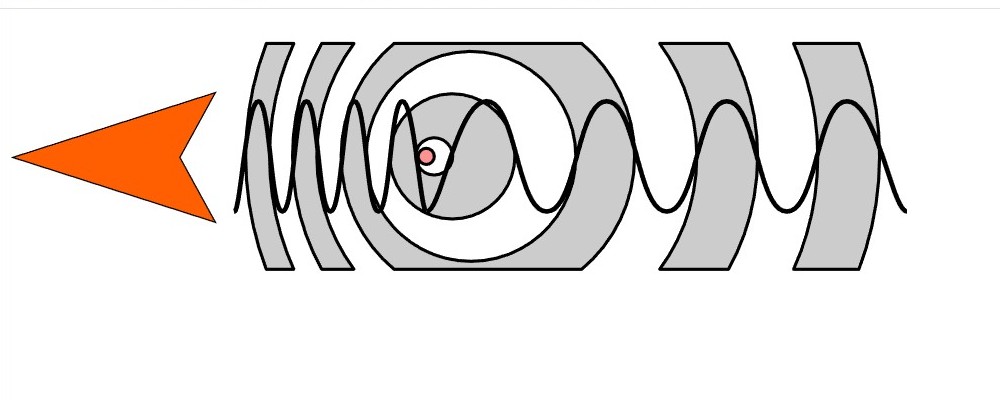

Below is a three minute video explaining the doppler effect and redshift.
I can add that the constancy of the speed of light in vacuum changes the exact size of the doppler effect. The doppler effect remains as is for the most part but the formulas for the classical doppler effect, which you would use for sound, and the relativistic doppler effect, which you would use for light in space, are different. It is just to pick the right formula.

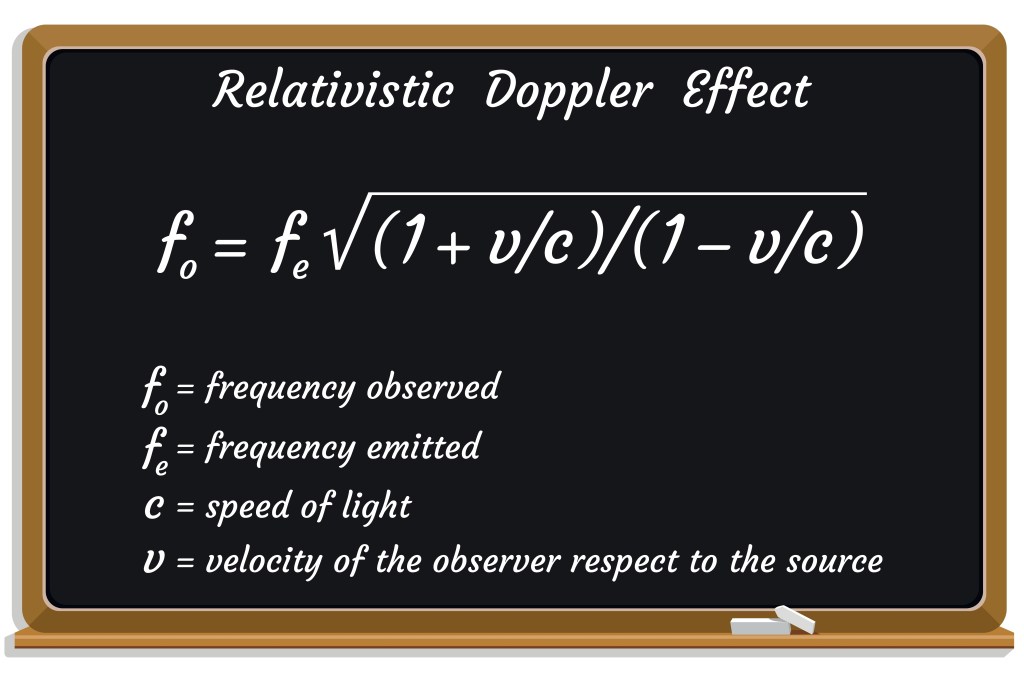
Measuring redshift
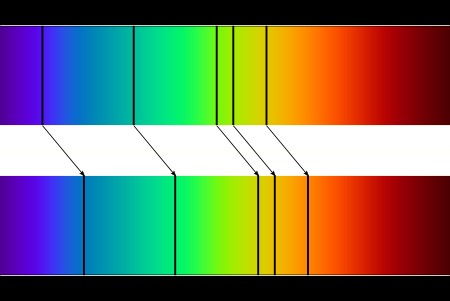
A common misconception is that astronomers take pictures of distant galaxies and somehow measure the “redness” of them, but that is not the case. When you take a spectrum of a heated element (such as hydrogen or helium in stars) it creates characteristic dark lines in the spectrum — like a fingerprint. Everything on the periodic table has its own characteristic fingerprint of lines at characteristic frequencies. In addition to measuring the cosmological redshift it makes it possible to identify the elements in a star and their proportions. See the picture below.
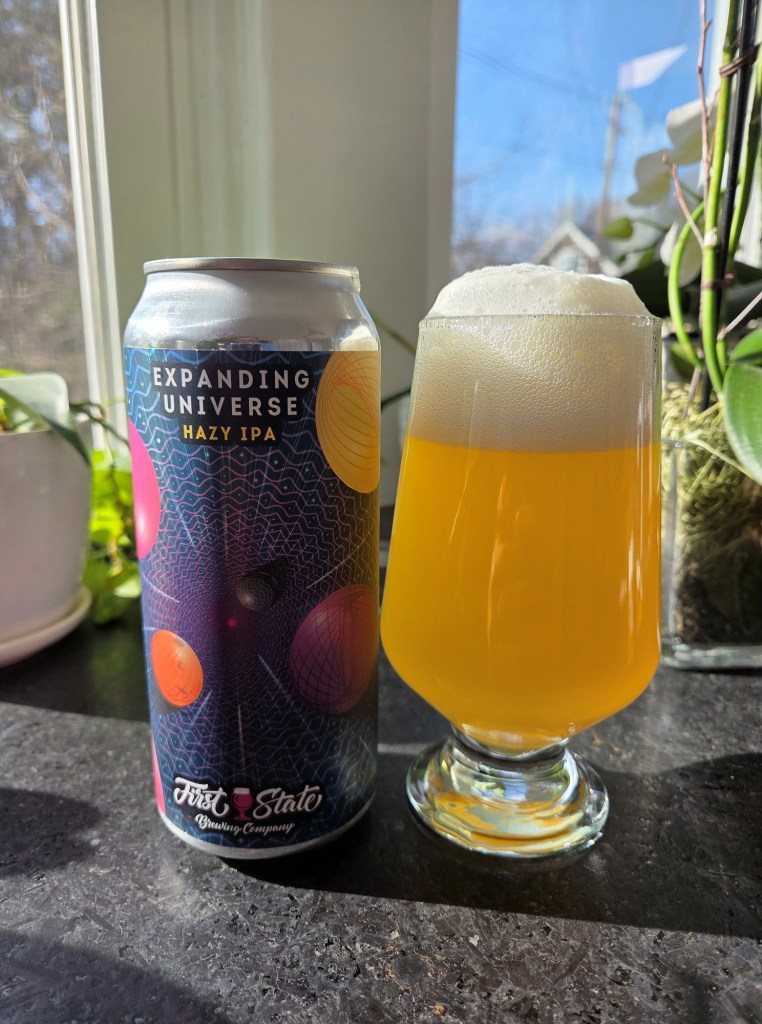
Expanding Universe Hazy IPA
Expanding Universe is a Hazy IPA, or a so called New England style IPA from First State Brewing, ABV 6.5%, IBU 25 (IBU = International Bitter Units). The fact that it is an IPA (India Pale Ale) means that it is Ale and therefore not a Lager. The fact that it is an IPA means that it is hop-forward and has an intense flavor and aroma. The fact that it is a Hazy / New England style IPA means that it is more fruity than bitter and looks cloudy, hazy, like juice. The flavor of Expanding Universe is mango, pineapple, and grapefruit. It has a low bitterness, it is fruity, juicy, and it is great if you like New England IPAs.
Related Posts
- The Speed of Light In Vacuum Is a Universal Constant
- Two events may be simultaneous for some but not for others
- We are Star Dust
- The vastness of space and the beginning of infinity
- GPS uses relativity for accuracy
- There is strong evidence for the Big Bang
- Time Dilation Goes Both Ways
- The Edge of the Observable Universe is 46.5 billion Light Years Away
 Super Facts