The Edge of the Observable Universe is 46.5 billion Light Years Away

Super fact 67 : The Edge of the Observable Universe is 46.5 billion light years away despite the age of the Universe being 13.8 billion years. We can see 3.4 times further than light can travel in 13.8 billion years.

Esther’s writing prompt: October 29 : Edge

Click here or here  to join in.

That sounds impossible at first. The age of the universe is 13.8 billion years. How can we see something that is farther away than 13.8 billion light-years if that’s how long the light had to travel. The reason it works is that space itself has been expanding the entire time that the light has been traveling toward us. The light we see today from the most distant regions of the universe was emitted 13.8 billion years ago, but the space between us and the origin of that light has stretched enormously. You can say that the light hitched a ride on the expanding space.
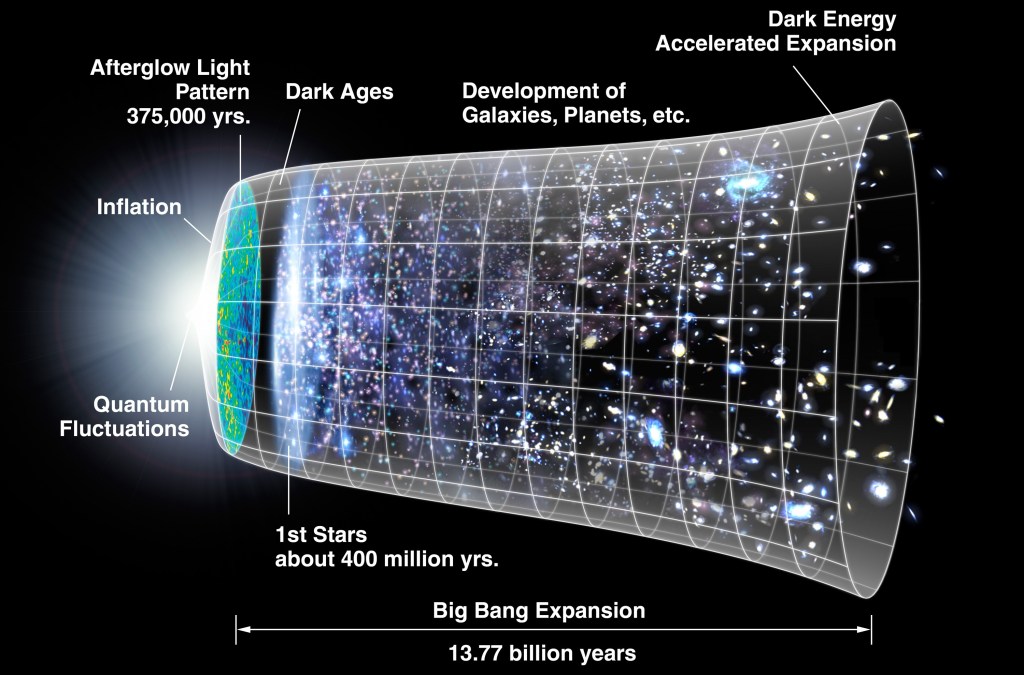
The pictures show an expanding Universe starting with quantum fluctuations followed by inflation, then an afterglow light pattern 375,000 after the Big Bang and then the so-called dark ages, the creation of stars and galaxies. | The Edge of the Observable Universe is 46.5 billion Light Years Away
An overview of the last 13.8 billion years. This file is in the public domain in the United States because it was solely created by NASA. From Wikimedia commons.

As mentioned, the edge of the observable universe is now about 46.5 billion light-years away in every direction, which means that the observable universe is about 93 billion light-years across (46.5 billion light years times 2) vastly larger than what you’d expect if you just multiplied the age of the universe by the speed of light. Beyond that observable edge there may be much more—possibly an infinite Universe, but it is forever hidden from us because light hasn’t had time to reach us yet and will never reach us.

The speed of light in vacuum is a universal constant and nothing can travel faster then the speed of light. However, space itself can expand faster than the speed of light if measured across large enough distances. The distance between two points in space can expand faster than the speed of light if that distance is large enough. This is possible because there is nothing material that is traveling faster than light. It is just the space of the Universe itself expanding because of dark energy.

Space is expanding right where you are standing too. Can you feel space expanding around you? Well, probably not but it is. I consider this a super fact because it is an important aspect of our view of the universe, it is surprising to those who did not know it before, and it is true.


Galaxies are Moving Beyond the Observable Universe

In the future the far away galaxies will continue to move away from us faster and faster, and beyond a certain distance their light will no longer ever reach us again. Therefore, more and more galaxies will disappear from our view. They won’t vanish physically; they’ll just slip beyond our observable horizon. In about 100 billion years, observers in the Milky Way (or what is left of it) may only see the Local Group of galaxies (Milky Way, Andromeda, etc.). Everything else will have faded out of visibility.

Our Local Group of galaxies consists of 80 galaxies compared to the estimated two trillion galaxies in the current observable universe. That means that the observable universe at that point will have 25 billion times fewer galaxies than now, or in other words only 0.000000004% of the galaxies in the observable universe will remain observable.

3D rendered Digital Illustration of a cluster of galaxies. | The Edge of the Observable Universe is 46.5 billion Light Years Away
Large-scale structure of Multiple Galaxies in Deep Universe. When will all these galaxies forever disappear beyond the edge of the observable universe. Asset id: 389006449 by vchal

The Cosmological Event Horizon Another Edge of the Universe

Beyond roughly 16 billion light-years, galaxies recede faster than light due to the expansion of space. Again, that’s allowed in relativity because it’s space expanding, not them moving through space faster than light. Eventually, most of them will cross a boundary called the cosmic event horizon. Once they do, their light will never be able to reach us, not even given infinite time. We can still see these galaxies because of the light they emitted in the past, but the light they emit now will never reach us.

The cosmological event horizon, not to be confused with the event horizon for a black hole, is 16 billion light years away. That is another limit, or edge of the universe. Below is a 10 minute video explaining both the horizon / edge of the observable universe and the cosmological event horizon for those who are interested.

Black Holes Edges of the Universe

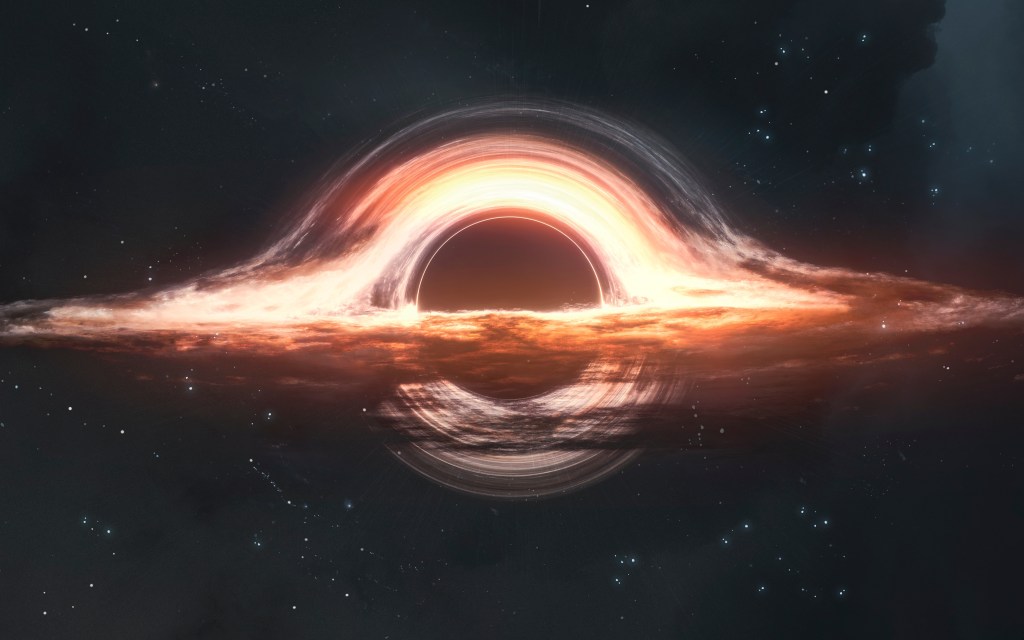
A black hole with a large bright accretion disk.
3D illustration of giant Black hole in deep space. High quality digital space art in 5K – realistic visualization. Stock Illustration ID: 2476711459 by Vadim Sadovski.

A black hole is a region of spacetime where gravity is so strong that nothing, including light, can escape it. The boundary of no escape is called the event horizon. If you pass the event horizon you cannot come back out no matter how much energy you use. Nothing can escape, no matter, no radiation, not light, or other electromagnetic radiation, and no information. Nothing at all can escape. The curvature of time and space itself forbids it.

I should add that right at the event horizon, there is so called Hawking radiation, but without complicating things it is not the same thing as escaping a black hole. You can guess from physical laws what might be inside, but you can never observe and report what is inside to planet Earth. In a sense, the event horizon of a black hole is another edge of the Universe. You can read about different types of black holes here. You can read more about black holes here, or here.

Below is an animation created by NASA that depicts what an observer falling into a black hole would see.
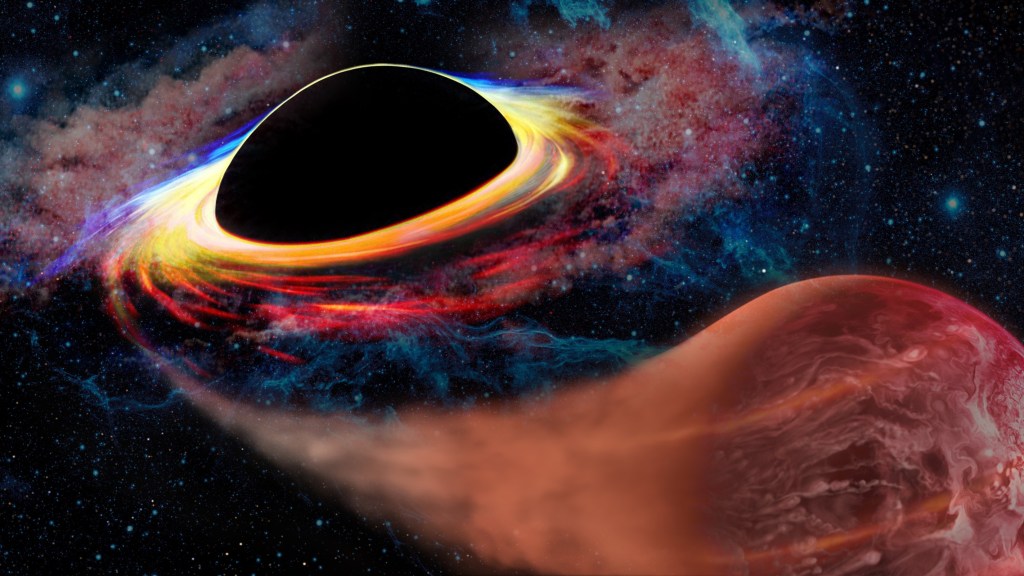
Black hole devouring a planet. The planet is on the right. It is being consumed.
Black hole devouring a planet. Black Hole Stock Photo ID: 2024419973 by Elena11
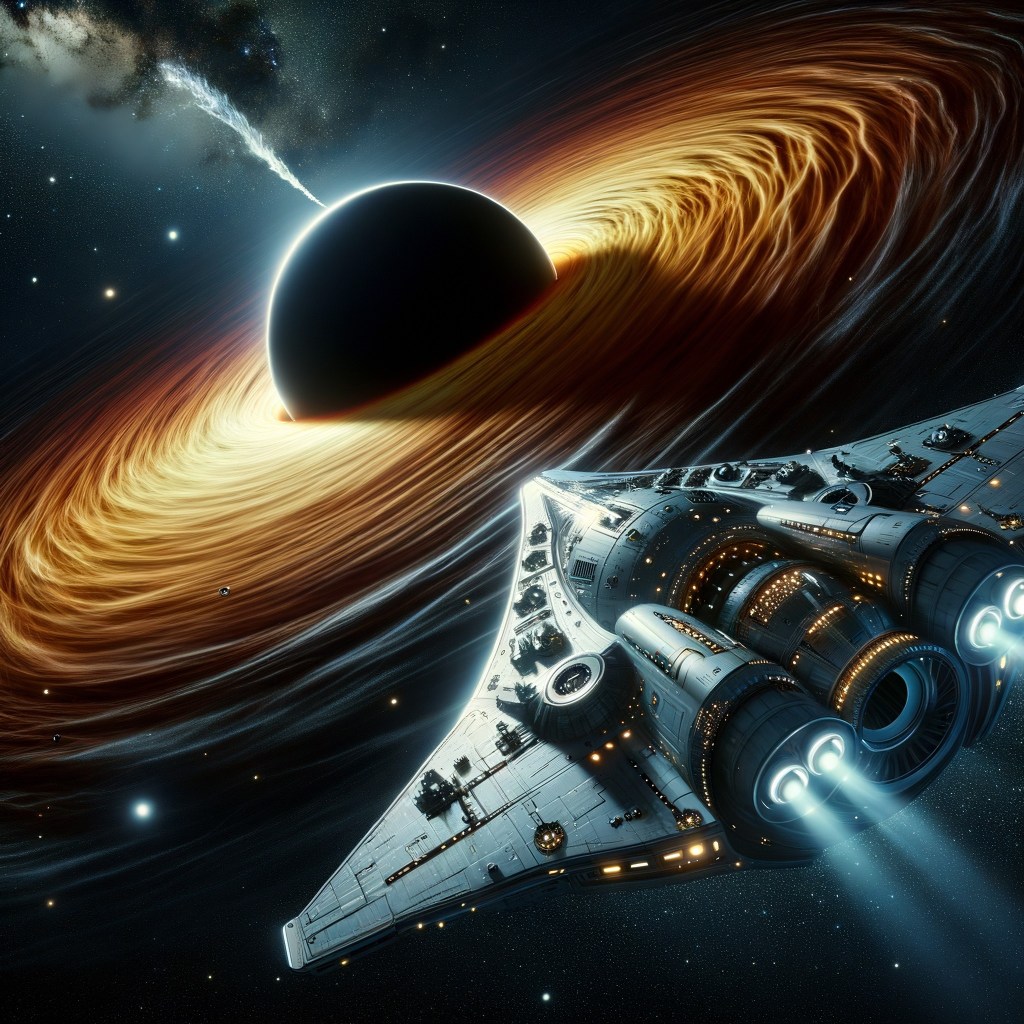
A black hole with an orange accretion disk is approached by futuristic starship. | The Edge of the Observable Universe is 46.5 billion Light Years Away
Realistic spaceship approaching a black hole. This content was generated by an Artificial Intelligence (AI) system. Stock AI-generated image ID: 2448481683 AI-generated image Contributor Shutterstock AI Generator.
A depiction of a black hole surrounded by a space-time geometric grid that is bending due to gravity.
AI-generated image Description : This image depicts what a black hole is doing to space around it. Gravity bends space time depicted as a grid. Stock AI-generated image ID: 2457551367 by AI-generated image Contributor Shutterstock.AI
Fuzzy orange blur surrounding a black speck.
The photo of the supermassive black hole at the center of the galaxy M87 taken by the event horizon telescope in 2017. CC BY 4.0, Event Horizon Telescope, uploader cropped and converted TIF to JPG, CC BY 4.0 <https://creativecommons.org/licenses/by/4.0&gt;, via Wikimedia Commons.
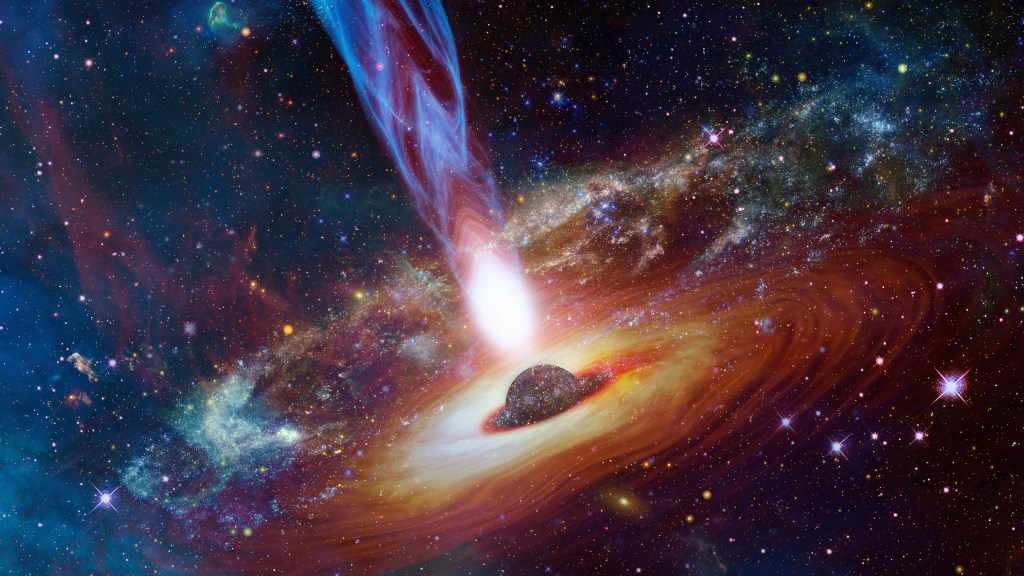
The quasar is ejecting an enormous energy beam. In the background are stars possibly being absorbed by the quasar. | The Edge of the Observable Universe is 46.5 billion Light Years Away
Quasar in deep space (a huge black hole emitting an energy beam). Elements of this image furnished by NASA. Asset id: 1758938918. by NASA images.


To see the Other Super Facts click here

The Enormous Kuiper belt

Super fact 55 : The enormous Kuiper belt.

The Kuiper Belt is a vast torus/donut shaped region of space beyond Neptune, filled with icy, rocky bodies, including dwarf planets like Pluto. It shares a lot of similarities with the Asteroid belt, but it is much larger, and further out. The Kuiper belt is 20 times wider than the Asteroid belt, 1,000 larger by volume, and 20 to 200 times more massive than the Asteroid belt. It extends from roughly 30 to 50 astronomical units (AU) from the Sun.

I can add that one Astronomical Unit (AU) is the distance from the sun to Earth.

In the middle of the picture is the sun and around it is Mercury, Venus, Earth and Mars. Then there is a grey circular band representing the asteroid belt. Further out is Jupiter, Saturn, Uranus, Neptune and Pluto and a large circular band representing the Kuiper belt | The Enormous Kuiper belt
I drew this illustration of the solar system and the Kuiper belt. It is not entirely to scale, and in reality, Mercury and Venus are not attached to the sun.

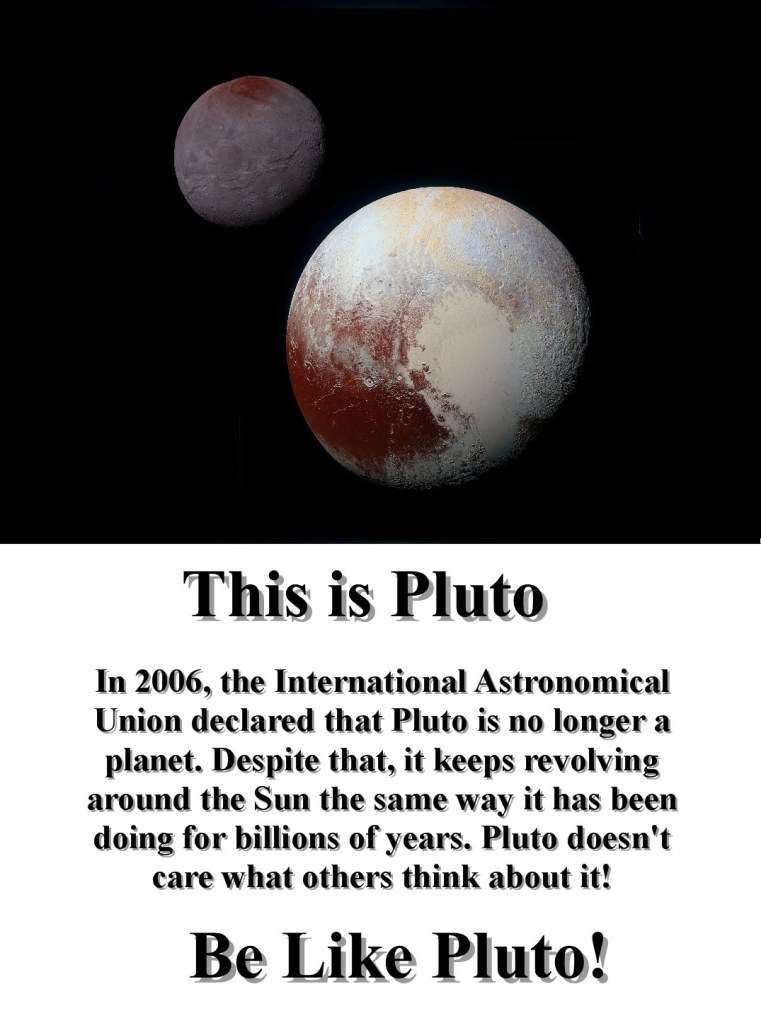
The Kuiper belt is like a giant Asteroid belt located further out, beyond Neptune. The Kuiper Object Pluto, formerly known as the Planet Pluto, is the most admired, the cutest and most beloved of all planets, and it was the first Kuiper object discovered in 1930. However, we did not know of the existence of the Kuiper belt at the time. The Kuiper belt was discovered in 1992 and predicted to possibly exist by Astronomer Gerard Kuiper in 1951. The discovery of the Kuiper belt was one of the reasons Pluto was demoted from its planet status in 2006. There are other dwarf planets in the Kuiper belt similar Pluto, including Makemake, Haumea, and Eris. However, there could be hundreds. Ceres is a dwarf planet located in the Asteroid belt. To read more about the Kuiper belt and verify the facts above, click here, or here, or here.

This picture features the photo of Pluto taken by NASA’s New Horizons spacecraft in 2015 plus some text. The text says : This is Pluto! In 2006, the International Astronomical Union declared that Pluto is no longer a planet. Despite that, it keeps revolving around the Sun the same way it has been doing for billions of years. Pluto doesn't care what others think about it! Be Like Pluto!
Pluto and its moon Charon from NASA/JHUAPL/SwRI. NASA / Johns Hopkins University Applied Physics Laboratory / Southwest Research Institute, Public domain, via Wikimedia Commons. NASA’s New Horizons spacecraft captured this high-resolution enhanced color view of Pluto in 2015.

I selected this to be a super fact because the existence of the Kuiper belt drastically changed our view of our Solar system, so it is important, we know it exists, so it is a true fact, and despite its enormous size the Kuiper belt is much less known than the Asteroid belt, and its existence often comes as a surprise to people.

The Kuiper Belt Resides in Darkness

You may wonder why the Kuiper belt was discovered so late whilst the Asteroid belt has been known since the beginning of the 19th century (Ceres 1801, Pallas 1802, Vesta 1807, etc.) The reason is that the Kuiper belt resides in darkness. The Asteroid belt is 2.2AU to 3.2AU from the sun whereas the Kuiper belt is between 30 to 50AU from the sun.

Let’s say you take an object that is 2.5AU from the sun and place it at a distance that is 40AU from the sun. Due to the spreading of the light the object will now receive 16 X 16 = 256 times less sunlight. This is called Geometric dilution. In addition, this light needs to be reflected back to earth for us to see the object, and once again the light will  spread resulting in 256 X 256 = 65,536 times less light reaching our telescopes. The Kuiper belt is huge, but it resides in darkness. Despite this fact, we have now discovered and catalogued more than 2,000 Kuiper belt objects. However, it is estimated that there are hundreds of thousands of Kuiper belt objects wider than 100 kilometers.

What is a Dwarf Planet?

A planet as well as dwarf planet is a celestial body that orbits the Sun and is nearly round due to its own gravity. Basically, it must be large enough to have compressed itself to a near spherical shape. To be classified as a planet and not a dwarf planet it must also have cleared its orbit of debris. So, a dwarf planet is therefore a celestial body that orbits the Sun, is nearly round due to its own gravity, but has not cleared the neighborhood around its orbit. Obviously, a planet in the Asteroid belt or the Kuiper belt is a dwarf planet. Just to make this complicated Astronomers have found giant exoplanets that have not cleared their orbit of debris . I wonder, are these exo-planets giant dwarf planets?

Oort Cloud

Astronomer and Author David Lee Summers (blog here) reminded me of the Oort cloud, which could be interesting to bring up in this context. The Oort Cloud is a vast spherical cloud of icy bodies, which is hypothesized to surround the solar system, extending from about 2,000 to 200,000 AU. It is thus thousands of times further out and wide than the Kuiper belt. I say hypothesized because the objects are so small, there’s really no direct observation of them and there’s some variation in numbers for its distance and extent, meaning it’s still not well defined yet. Still, its outer edge is believed to be the boundary between where the sun’s gravity dominates and the galaxy’s gravity dominates.

The Oort cloud is generally considered to be the outer edge of the solar system and believed to be the origin of most long period comets. The Oort cloud is thought to encompass two regions: a disc-shaped inner Oort cloud aligned with the solar ecliptic (also called its Hills cloud) and a spherical outer Oort cloud enclosing the entire Solar System.

The picture is of the Oort cloud with an inset picture of the Kuiper belt at the top. The inset picture is an enlargement of the dot in the middle corresponding to the Kuiper belt.
NASA This SVG image was created by Medium69.Cette image SVG a été créée par Medium69.Please credit this : William Crochot, Public domain, via Wikimedia Commons.

Other Astronomy Related Super Facts


To see the other Super Facts click here

Quasar TON 618

This is a submission for Kevin’s No Theme Thursday

Quasar TON 618
Image by Kevin from The Beginning at Last

Kevin’s artistic picture above reminds me of a Quasar, a supermassive black hole emitting enormous amounts of energy.

What is a Quasar ?

A Quasar is a supermassive black hole at the center of a galaxy that is emitting enormous amounts of energy. The quasar is the supermassive black hole plus its accretion disk, the gas it is feeding on and the radiation it emits. The quasar is actively feeding on gas and stars and emitting enormous amounts of radiation in the process. The radiant energy of quasars is enormous; the most powerful quasars have luminosities thousands of times greater than that of a galaxy such as the Milky Way, and millions of times greater than the largest and most luminous stars in the known universe.

Supermassive black hole at the center of a quasar. Singularity in space devouring matter and light | Quasar TON 618
Supermassive black hole at the center of a quasar. Singularity in space devouring matter and light. From Shutterstock Asset id: 2484018599 by Nazarii Neshcherenskyi.

TON 618

TON 618 is a hyper luminous Quasar known to house one of the most massive black holes ever discovered, with an estimated mass of around 40 to 60 billion solar masses. Its luminosity is estimated to be 140 trillion times that of the Sun. The diameter of TON 618 is 780 billion kilometers or 82.6 light-years. Keep in mind that the distance to the moon is 1.3 light seconds and 82.6 light years is more than two billion times larger than that. Our sun is gigantic with a diameter 109 times larger than the diameter of earth. 1.3 million earths could fit inside the volume of our sun. However, in comparison to TON 618, our sun is a lot less than tiny. The diameter of TON 618 is 561 million times larger than that of the sun’s diameter and 177 octillion (an octillion is 27 zeros) suns could fit inside the volume of TON 618. In other words, we are comparing a dust particle to planet earth size wise. I am pretty sure you are not going to be able to imagine this.

The quasar is ejecting an enormous energy beam. In the background are stars possibly being absorbed by the quasar.
Quasar in deep space. Elements of this image furnished by NASA. Asset id: 1758938918. by NASA images.

When TON 618 was discovered in 1957, quasars and supermassive black holes were not yet recognized and understood by astronomers. The word quasar inspired shock and awe in every nerd on the planet. The concept of quasars, or quasi-stellar radio sources, wasn’t fully recognized until 1963. When I was a kid in the 1970’s there was a lot of speculation as to what these gigantic ultra bright but far away objects could be. TON 618 is located 18.2 billion light years away. Considering that the reachable limit of the Universe is 16.5 billion light years even if you travel at the speed of light, you could never travel to TON 618 (barring the warp drive in Star Trek).

The Event Horizon

When we are talking about the diameter of a black hole we are not talking about a sphere with a solid surface. The black hole is a sphere, or an oval, wherein gravity is so strong that nothing can escape, not light, not anything. It’s truly black. As you approach the event horizon you become invisible, space deforms, and from the perspective of an outside observer, time appears to stop for someone reaching the event horizon of a black hole. Time will continue for someone falling in, well in some sense. You’ll be transported beyond our universe and time as we know it. We can guess but we can’t really know.

A black hole with an orange accretion disk is approached by futuristic starship.
When this spaceship reaches the event horizon the time will stop from our perspective, and they will never enter the black hole. From their perspective they will enter right through the event horizon, and they will be transported infinitely far into a future beyond time. Stock AI-generated image ID: 2448481683 AI-generated image Contributor Shutterstock AI Generator.

Black Holes

Black holes are invisible. They are truly black. However, we can see them if they are consuming matter. The matter close to black holes will heat up and glow. The closer to the event horizon the redder it is. It is called an accretion disk as in the depiction above. There are an estimated 100 million black holes in our galaxy, the Milky Way. At the center of the Milky Way is a super massive black hole called Sagittarius A-star. It is 4 million times more massive than our sun. There are supermassive black holes located at the center of most large galaxies. The supermassive black holes are considered to play a crucial role in the formation of galaxies.

A black hole with a large bright accretion disk | Quasar TON 618
3D illustration of giant Black hole in deep space. High quality digital space art in 5K – realistic visualization. Stock Illustration ID: 2476711459 by Vadim Sadovski.

Black Hole Animation

Below is an animation created by NASA that depicts what an observer falling into a black hole would see. The video is about 4 minutes long.

TON 618  Animation

Below is an animation of TON 618, a quasar and the largest black hole known in the universe. This video is about 5 minutes.

To see my The Bizarre Reality of Black Holes Super Fact Click Here
To see the Super Facts click here

Note : Today March 14 is Albert Einstein’s birthday, the man who gave us the General Theory of Relativity, which mathematically describes black holes. It is also Pi Day (first 10 digits 3.1415926535), and there’s a rare moon eclipse tonight called a blood moon or a worm moon. Also, Dallas is under a fire warning. Be careful.

Important Note : I am going on a ski vacation tomorrow and I will take a one-week break from blogging as well as a break from reading other people’s blogs.

The Betelgeuse Supernova

This is a submission for Kevin’s No Theme Thursday

The Betelgeuse Supernova
Image by Kevin from The Beginning at Last

Supernova

A supernova is an explosion of a star so violent that it can outshine an entire galaxy. It can occur when a super massive star’s core contracts (the death of the star) and as it reaches a critical point it triggers nuclear reactions that cause the star to explode. Alternatively, it can occur when a white dwarf star is triggered into runaway nuclear fusion by a collision with another star.

Depending on how far away the supernova is it can be as luminous as a bright new star, the moon, or a second sun. It occurs suddenly and lasts for several weeks or months before fading away. If a supernova shines bright enough, the other stars in the sky will vanish from view. We can’t see the stars during the day, not because of the blue sky, but because of the ambient light from the sun. 

This is also one major reason photos from space often lack stars in the black sky. If a supernova is close enough to earth it could destroy earth. Luckily there are no super massive stars close enough to earth to pose a risk.

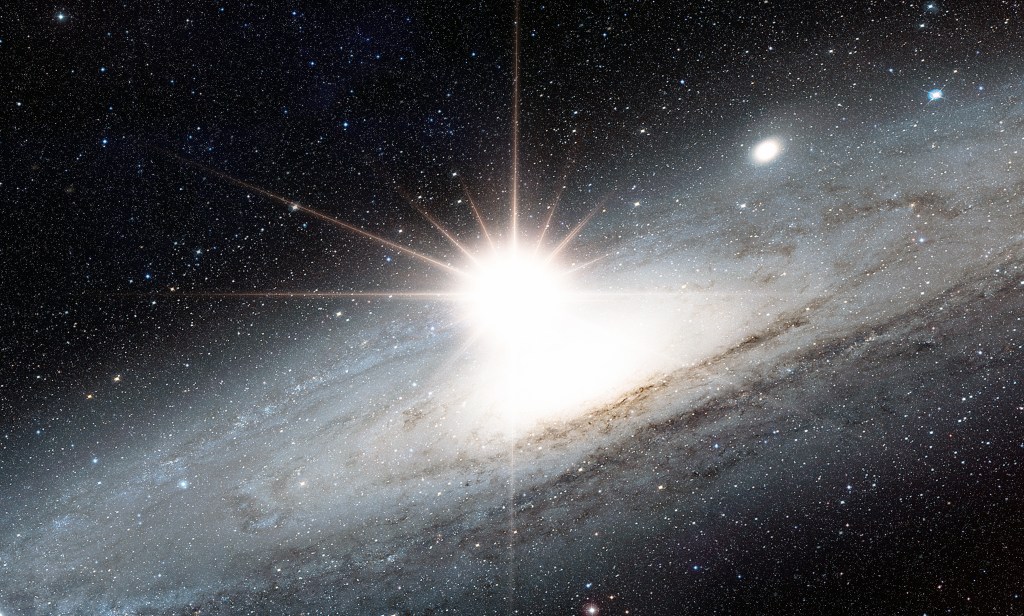
A picture of the Andromeda Galaxy with a bright white light near its center. The bright light is almost outshining the entire galaxy.
Supernova explosion in the center of the Andromeda galaxy “Elements of this image furnished by NASA” It is essentially an enhanced photo of a supernova explosion in a neighboring galaxy. Stock Photo ID: 2495486227 by muratart.

The Betelgeuse Supernova

Betelgeuse the bright red star in the constellation Orion is thought to be close to going supernova, and when it does it will be about as bright as half a full moon in our sky but concentrated in a point. What does “close” mean? Some astronomers say within decades, some say within a few thousand years. Could Kevin’s beautiful picture above depict this future event?

This is a map of the Orion constellation showing Orion’s belt in the middle. Betelgeuse is a red star or dot up to the left | The Betelgeuse Supernova
Illustration of the Orion constellation. To find Betelgeuse, first find Orion’s belt, then look up to the left. The reddish star is Betelgeuse. It is visible at this time of year (on a clear night). Stock Vector ID: 1631025025 by Tedgun.

We are stardust

The first stars in the Universe were made of 75% hydrogen and 25% helium and trace amounts of Lithium, just like the entire Universe at the time. Heavier elements that could form rocky planets or other solid celestial bodies did not exist.

However, inside the cores of these stars, heavier elements such as carbon, oxygen, and iron were formed by fusion. These early stars are referred to as first generation stars. They tended to be large and ended their lives in massive supernova explosions. The dusty remains of these explosions became the building blocks of the second and third generation stars we see today as well as the planets, our bodies and all life. We are stardust.

The picture consists of two pie chart graphs representing stars. The left one is a first-generation star with one pie for the 75% hydrogen and one pie for the 25% helium.
The first-generation stars consisted of 75% hydrogen and 25% helium and trace amounts of Lithium. A second or third generation star like our sun is still mostly hydrogen and helium but also many other elements. The rocky planets circling the sun are mainly elements heavier than hydrogen and helium. Image credit NASA, ESA, CSA, STScI.

Finally, a 33 second YouTube video illustrating a Supernova (the creation of the Crab nebula)


Would you like to see Betelgeuse explode into a supernova in your lifetime?


To see the Super Facts click here

Black Holes Monsters in the Sky

“This”Black Holes Monsters in the Sky” is a submission for Kevin’s No Theme Thursday

Black Holes Monsters in the Sky
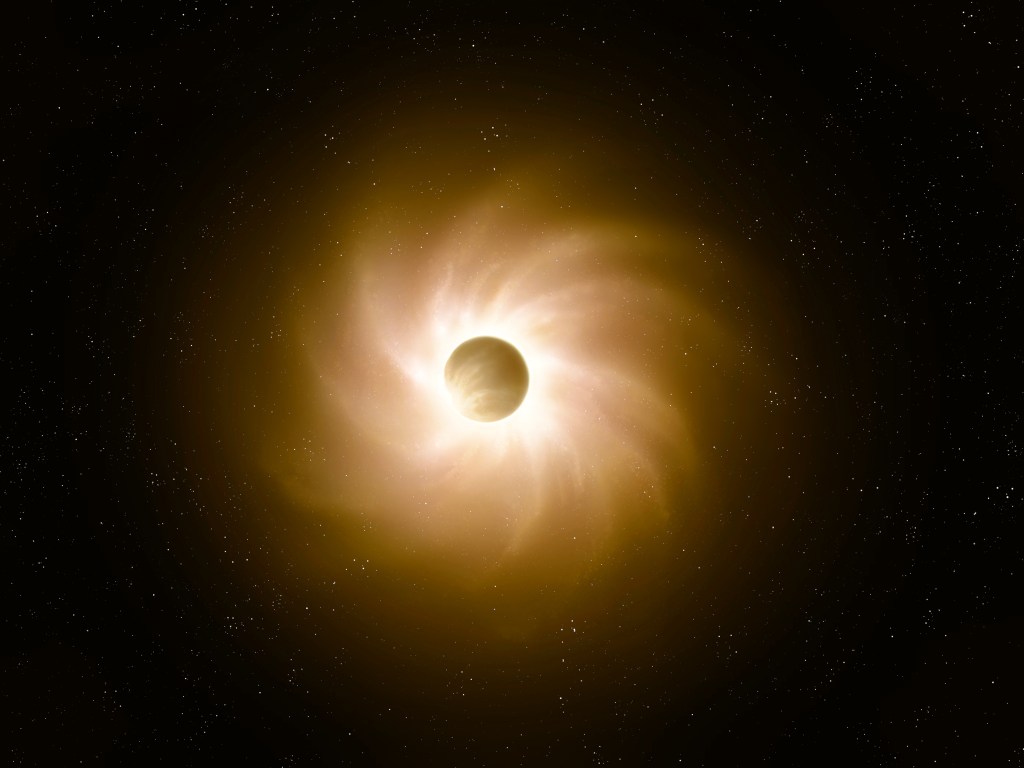
Image by Kevin from The Beginning at Last

Black holes, everyone has heard of them, no one understands them. They are inscrutable monsters in the sky. They are regions of spacetime wherein gravity is so strong that nothing can escape, not light, not anything. Some of them are small, only 15 kilometers across, and some have a diameter 27 billion times larger than that.

As you get close to a black hole your time will run slower. You won’t notice it, but others will see you move in slow motion. If you return from your close encounter an hour on your clock might correspond to years elsewhere. As you approach the event horizon, the boundary of no escape, you become invisible and time will stop, at least from an outside view.

Black holes are invisible. They are truly black. However, we can see them if they are consuming matter. The matter close to black holes will heat up and glow. The closer to the event horizon the redder it is. It is called an accretion disk as in the depiction above.

There are an estimated 100 million black holes in our galaxy, the Milky Way. At the center of the Milky Way is a super massive black hole called Sagittarius A-star. It is 4 million times more massive than our sun. There are supermassive black holes located at the center of most large galaxies. The supermassive black holes are considered to play a crucial role in the formation of galaxies.

I’ve looked up in the sky, and I’ve seen the spot where Sagittarius A-star is located. I’ve tried to look at it with my telescope, but I cannot see it. It is not possible to see it with a telescope, but it is there. The picture above may depict the view from a planet in the center of our galaxy. Three scientists received the Nobel prize in physics in 2020 for their research on black holes (Roger Penrose, Reinhard Genzel, and Andrea Ghez).

However, before them the tele evangelist Jack Van Impe won the 2001 Ig Nobel Prize in Astrophysics for his discovery that black holes meet all the technical requirements for Hell. The Ig Nobel prize is an alternative and less serious Nobel Prize. To find out more about Black Holes click here.

Below is an animation created by NASA that depicts what an observer falling into a black hole would see.


To see the Super Facts click here