The goal of this blog is to create a list of super facts. Important facts that are true with very high certainty and yet surprising, misunderstood, or disputed by many. This blog aims to be challenging, educational, and fun, without it being clickbait. I determine veracity using evidence, data from reputable sources and longstanding scientific consensus. Prepare to be challenged (I am). Intentionally seek the truth not confirmation of your belief.
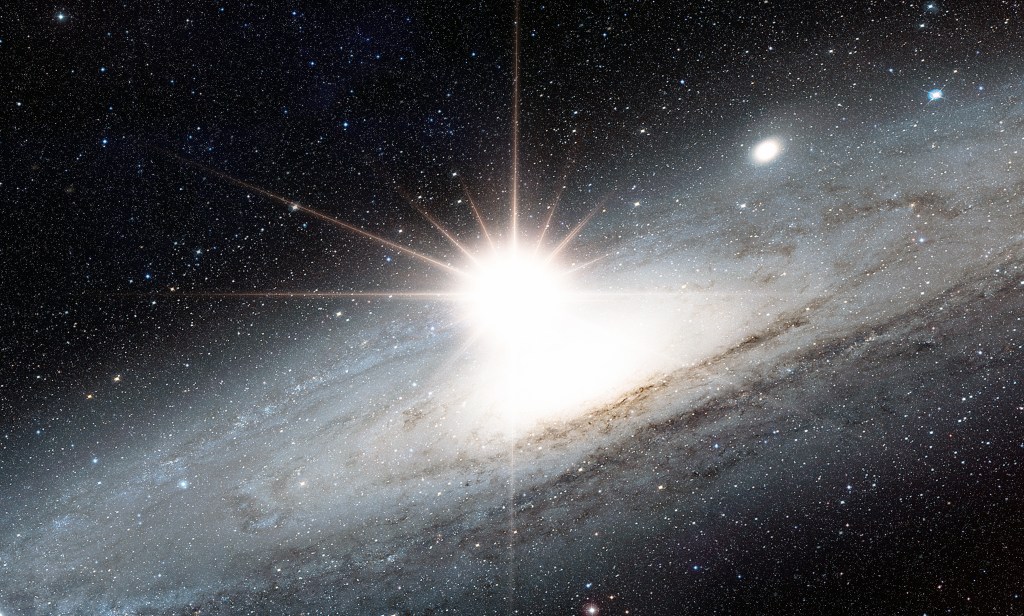
A supernova is an explosion of a star so violent that it can outshine an entire galaxy. It can occur when a super massive star’s core contracts (the death of the star) and as it reaches a critical point it triggers nuclear reactions that cause the star to explode. Alternatively, it can occur when a white dwarf star is triggered into runaway nuclear fusion by a collision with another star.
Depending on how far away the supernova is it can be as luminous as a bright new star, the moon, or a second sun. It occurs suddenly and lasts for several weeks or months before fading away. If a supernova shines bright enough, the other stars in the sky will vanish from view. We can’t see the stars during the day, not because of the blue sky, but because of the ambient light from the sun.
This is also one major reason photos from space often lack stars in the black sky. If a supernova is close enough to earth it could destroy earth. Luckily there are no super massive stars close enough to earth to pose a risk.
Supernova explosion in the center of the Andromeda galaxy “Elements of this image furnished by NASA” It is essentially an enhanced photo of a supernova explosion in a neighboring galaxy. Stock Photo ID: 2495486227 by muratart.
The Betelgeuse Supernova
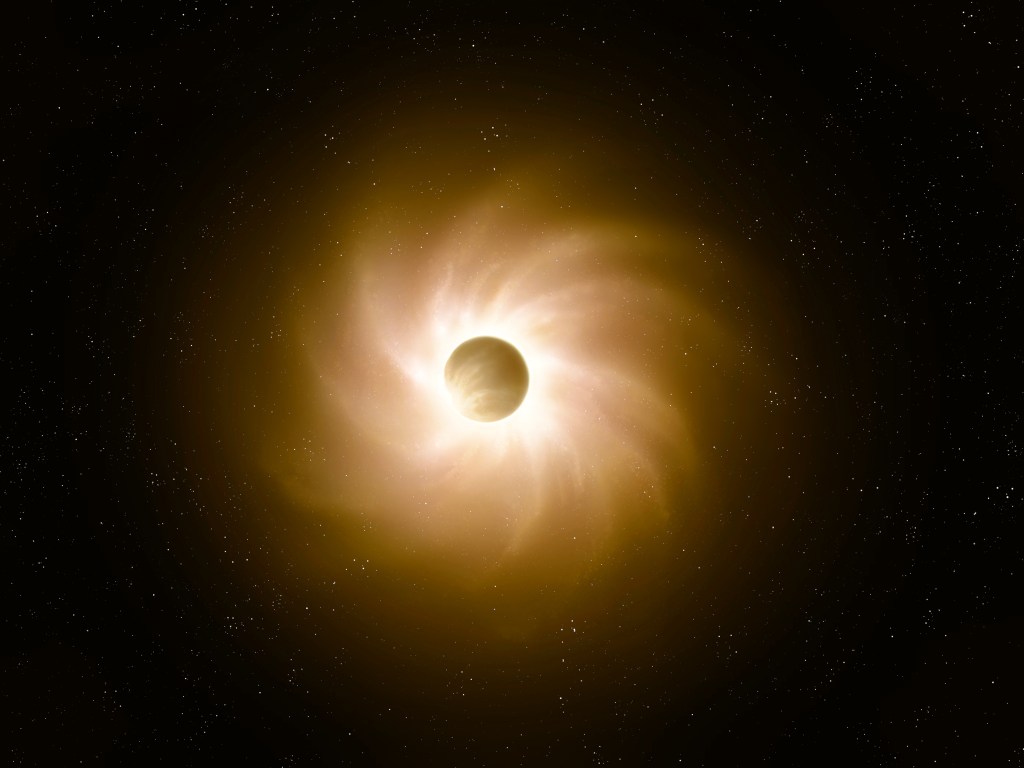
Betelgeuse the bright red star in the constellation Orion is thought to be close to going supernova, and when it does it will be about as bright as half a full moon in our sky but concentrated in a point. What does “close” mean? Some astronomers say within decades, some say within a few thousand years. Could Kevin’s beautiful picture above depict this future event?
Illustration of the Orion constellation. To find Betelgeuse, first find Orion’s belt, then look up to the left. The reddish star is Betelgeuse. It is visible at this time of year (on a clear night). Stock Vector ID: 1631025025 by Tedgun.
We are stardust
The first stars in the Universe were made of 75% hydrogen and 25% helium and trace amounts of Lithium, just like the entire Universe at the time. Heavier elements that could form rocky planets or other solid celestial bodies did not exist.
However, inside the cores of these stars, heavier elements such as carbon, oxygen, and iron were formed by fusion. These early stars are referred to as first generation stars. They tended to be large and ended their lives in massive supernova explosions. The dusty remains of these explosions became the building blocks of the second and third generation stars we see today as well as the planets, our bodies and all life. We are stardust.
The first-generation stars consisted of 75% hydrogen and 25% helium and trace amounts of Lithium. A second or third generation star like our sun is still mostly hydrogen and helium but also many other elements. The rocky planets circling the sun are mainly elements heavier than hydrogen and helium. Image credit NASA, ESA, CSA, STScI.
Finally, a 33 second YouTube video illustrating a Supernova (the creation of the Crab nebula)
Would you like to see Betelgeuse explode into a supernova in your lifetime?
Black holes, everyone has heard of them, no one understands them. They are inscrutable monsters in the sky. They are regions of spacetime wherein gravity is so strong that nothing can escape, not light, not anything. Some of them are small, only 15 kilometers across, and some have a diameter 27 billion times larger than that.
As you get close to a black hole your time will run slower. You won’t notice it, but others will see you move in slow motion. If you return from your close encounter an hour on your clock might correspond to years elsewhere. As you approach the event horizon, the boundary of no escape, you become invisible and time will stop, at least from an outside view.
Black holes are invisible. They are truly black. However, we can see them if they are consuming matter. The matter close to black holes will heat up and glow. The closer to the event horizon the redder it is. It is called an accretion disk as in the depiction above.
There are an estimated 100 million black holes in our galaxy, the Milky Way. At the center of the Milky Way is a super massive black hole called Sagittarius A-star. It is 4 million times more massive than our sun. There are supermassive black holes located at the center of most large galaxies. The supermassive black holes are considered to play a crucial role in the formation of galaxies.
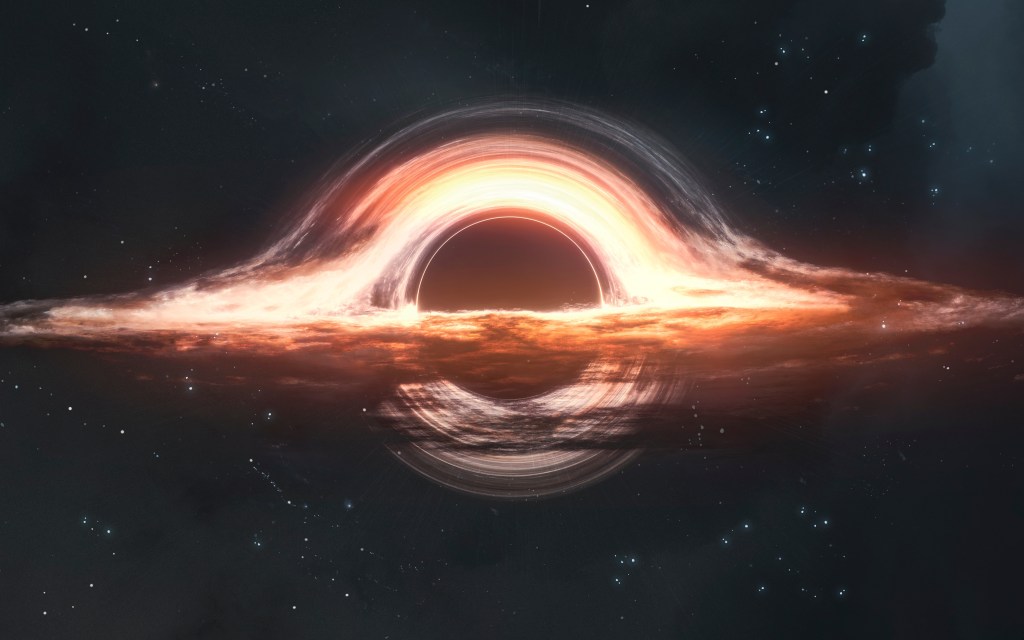
I’ve looked up in the sky, and I’ve seen the spot where Sagittarius A-star is located. I’ve tried to look at it with my telescope, but I cannot see it. It is not possible to see it with a telescope, but it is there. The picture above may depict the view from a planet in the center of our galaxy. Three scientists received the Nobel prize in physics in 2020 for their research on black holes (Roger Penrose, Reinhard Genzel, and Andrea Ghez).
However, before them the tele evangelist Jack Van Impe won the 2001 Ig Nobel Prize in Astrophysics for his discovery that black holes meet all the technical requirements for Hell. The Ig Nobel prize is an alternative and less serious Nobel Prize. To find out more about Black Holes click here.
A couple of weeks ago I made a post about exo planets. My blogger friend and Astronomer David Lee Summers stopped by and mentioned that investigating exo planets was his day job. He is working with the NASA-funded NEID spectrometer. He also happens to be an author of several science fiction books and scifi-horror books. Below is the front cover of one of his books. This is a reblog of one of his posts regarding NEID spectrometer. Head over there and check it out.
Portion of the NASA funded spectroscope that David works with. Above is an image of the NEID fiber feed (Port Adaptor) mounted on the WIYN telescope obtained during commissioning of the instrument. The Port Adaptor feeds light from the telescope to the NEID instrument, which is located on another floor of the building, below the telescope.Front cover of the book The Astronomer’s Crypt by David Lee Summers
Finally, I am also posting my Amazon review of the Astronomer’s Crypt (see below) as well as Amazon’s description of the book.
Amazon’s Description of The Astronomer’s Crypt
Two years ago on a stormy night, in the dead of winter, Mike Teter experienced something that would change his life forever. Mike was a telescope operator at the world renowned Carson Peak Observatory in New Mexico. We won’t tell you what he saw that night on the mountain nor what happened afterward on a dark stretch of highway, because it would haunt you just as it has haunted Mike. But what we will tell you is that Mike is back at Carson Peak. And what he witnessed that night two years ago is about to become a reality…
My Review of The Astronomer’s Crypt
To visit a more complete description of this book click here.
An Intense and Fun Horror Thriller Taking Place in an Astronomical Observatory
The protagonist Mike Teter is a telescope operator at a fictitious observatory in New Mexico, the Carson Peak observatory. The Carson Peak observatory features two large buildings hosting a 5-meter and a 2.5-meter telescope. It is located on sacred land adjacent to an Apache reservation. There are caves nearby that host ancient sacred artifacts that should not be removed from the caves. The observatory is a labyrinthine and dangerous place that appears to be haunted. There are long corridors and hidden rooms. The observatory has a history of deadly accidents. For example, a Dr. Burroughs and a graduate student had been killed there.
One day Mike has what seems to be hallucinations. A large ancient evil creature looking like a mix of a dinosaur and a bird appears before him, and he encounters a talking coyote that gives him a warning about the sacred portals, he sees the ghost of Dr. Burroughs, and he witnesses the gruesome death of his friend the Astronomer Dr. Wallerstein. He’s had enough and he quit his job only to return to it at a later time. He thought that the things he saw were just nerves. However, this time things really go amiss. A creepy but wealthy lawyer by name of Mr. Vassago is trying to acquire sacred artifacts. There are drug cartel thugs, greedy adventurers, freak accidents, severe storms, hostage situations, ghosts, and ancient evil monsters. Mike Teter is faced with a very complicated and nightmarish situation.
The story is action packed, suspenseful and features a lot of plot twists. The characters are well-developed, relatable and multi-layered. The observatory is realistically described, and it is obvious that the author is very familiar with astronomical observatories. As you read this book you will learn something about observatories as well as the job of telescope operators. The author skillfully creates a chilling scenery of a dark haunted observatory, which brought my imagination to the spaceship in the movie Alien. It is obvious that the author is highly intelligent. A lot of things happened in just a few pages, and it was difficult to put the book down. It is one of the most intense and fun horror thrillers I’ve ever read, and I highly recommend it.
About David Lee Summers
David Lee Summers is an author, editor and astronomer living somewhere between the western and final frontiers in Southern New Mexico. He is the author of twelve novels. His short stories and poems have appeared in numerous magazines including Cemetery Dance, Realms of Fantasy, Star*Line, and The Santa Clara Review.
David also edited Tales of the Talisman Magazine for ten years. When he’s not writing, he operates telescopes at Kitt Peak National Observatory.
“Supermoon October 2024” is not a super-fact post but some fun facts about the Moon. It is a super-moon post instead.
As many of you probably have read, we currently have a so-called supermoon (October 17 & October 18). The moon’s orbit around earth is not a perfect circle but slightly elliptical. Therefore, the moon’s distance to earth varies.
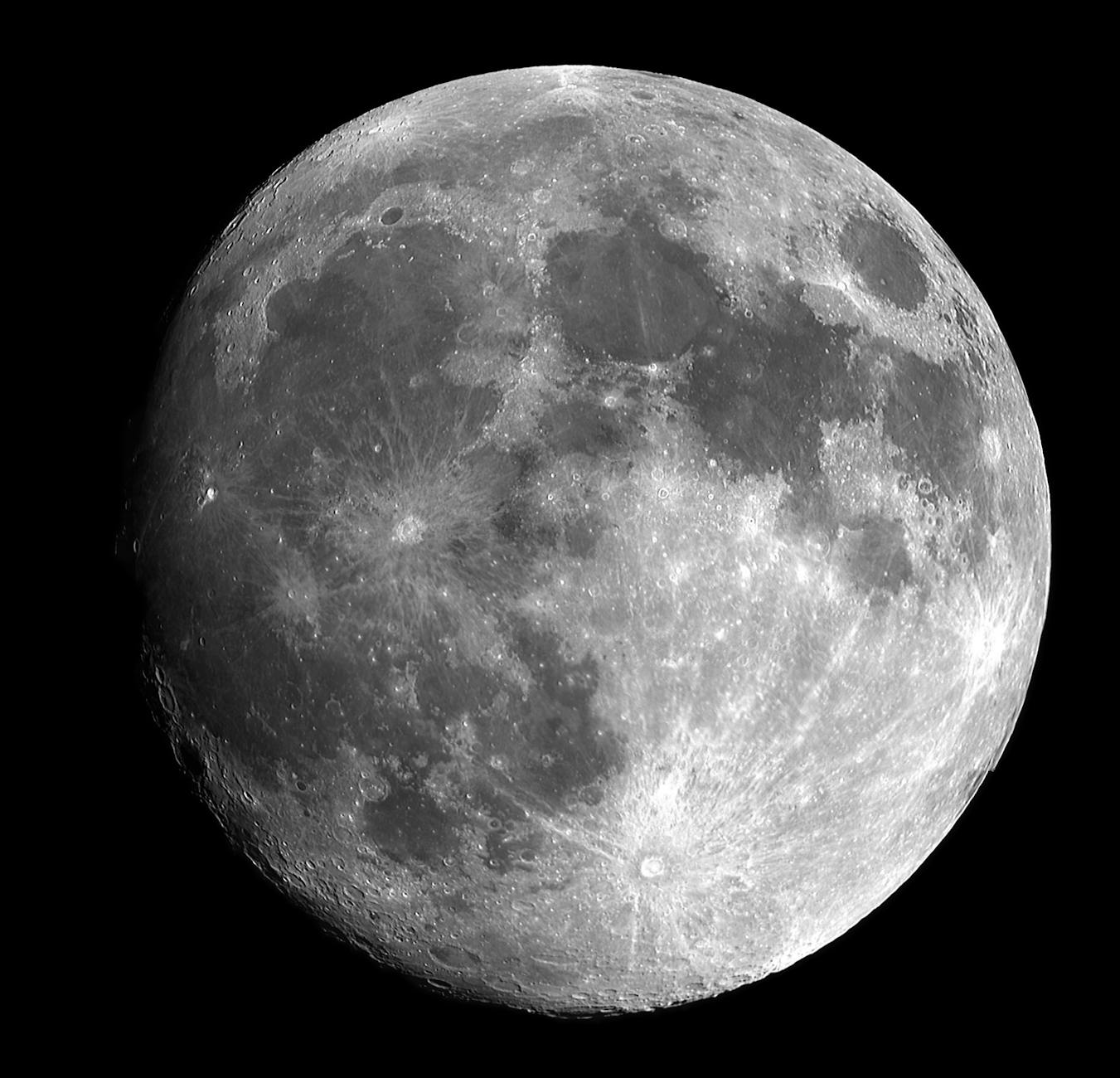
A supermoon is when a full moon occurs when the moon is at its closest point to Earth, called perigee, making it appear larger and brighter than usual. Or more correctly, the term supermoon is usually used to describe a full moon that comes within at least 90% of the perigee. Since this is a special moon event, I took out my little telescope and looked at the moon and its craters. I also took a look at Jupiter, and I saw three of the four Galilean moons.
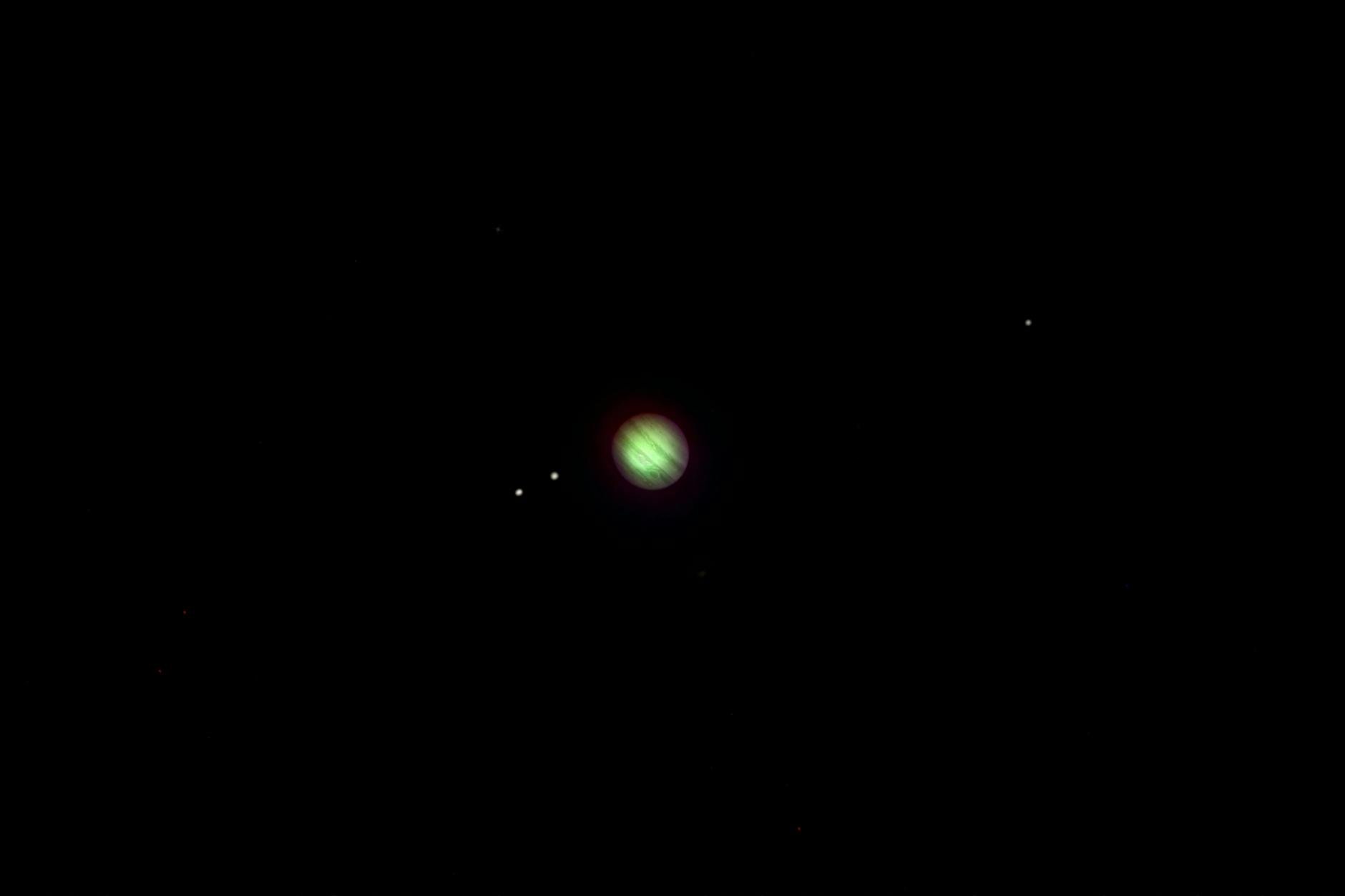
Photo by Pixabay on Pexels.comThe green speck is Jupiter. The three little dots are three of the four Galilean Moons. I roughly saw this in my telescope an hour ago, but it is not my photo. Photo by Raoni Aldrich Dorim on Pexels.com
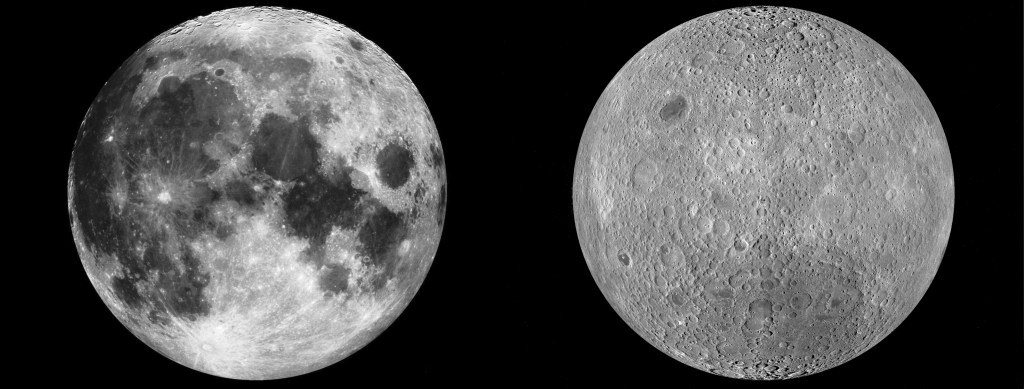
This is a very common misunderstanding. The moon is always showing the same side towards us (or almost exactly the same side). When there is a full moon the backside, or far side, of the moon is dark, but that is not the case when the moon is half, or a crescent, etc. When the moon is new, the far side / backside is “full” from sunlight. If you wondered, NASA and other space agencies have photographed the far side of the moon.
The near side of the Moon and the far side of the Moon. Comparison between the two hemispheres of the Moon. Elements of this image were furnished by NASA. Stock Photo ID: 2157518223 by Claudio Caridi.
Below is a youTube video showing an animation composed of actual satellite photos by NASA.
A few comments about this animation. You see no stars because the sun is shining, and the earth is also quite bright. The reason you don’t easily see stars during the day is not because the sky is blue but because there is too much light to see them. The sun ruins the starry sky. In addition, stars are not easily captured by cameras when there is ambient light. And again, of course, contrary to the belief of some, the backside of the moon is not always dark.
The far side of the moon is different
As you can see in the YouTube video and the enhanced photo above, the far side looks different from the nearside and it is different in appearance and terrain. The near side of the moon has large, dark, flat-lying basins called maria. They look like oceans. The far side is a lot more rugged and covered by lots of craters. Another difference is that the far side of the moon has a much thicker crust compared to the near side.
The moon is drifting away from earth at about 3.8 centimeters per year
The moon is moving away from earth due to the gravitational forces between the moon and earth, which also causes tidal bulges in the Earth’s oceans and the moon. Back in high school I took a physics test on which you had to calculate how much the moon was moving away from earth based on the size of the tidal waves on earth. I did not solve that one, but not many did. The calculation made perfect sense though and some geniuses got it.
NASA found water on the moon
In 2020, NASA announced the discovery of water on the sunlit surface of the Moon. You can read about it here.
The moon was likely created by a celestial collision : The most widely accepted explanation for the existence of the moon is that the Moon was created when a planet-like object, the size of Mars slammed into Earth, soon after the solar system began forming. That was about 4.5 billion years ago.
The matter in our bodies and our planet was formed by fusion in the cores of distant stars and then spread across the Universe by supernova explosions. This matter was later incorporated in second and third generation stars like our sun and its planets.
What do I mean by “We are Star Dust”? Let me explain. The first stars in the Universe were made of 75% hydrogen and 25% helium and trace amounts of Lithium, just like the entire Universe at the time. There were no heavier elements that could form planets or other solid celestial bodies. These early stars tended to be large and heavier elements like carbon, oxygen, and iron were formed by fusion in the cores of these stars.
Many of the first stars, called first generation stars, ended their lives in massive supernova explosions and the dusty remains of these explosions, including the metals formed in their cores, became the building blocks of the stars we see today. These second and third generation stars have planets and other smaller solid objects orbiting them, formed from the gas and dust (star dust) left over from the supernova explosions. So, we are star dust. The atoms formed inside the first-generation stars are now within us.
The first-generation stars consisted of 75% hydrogen and 25% helium and trace amounts of Lithium. A second or third generation star like our sun is still mostly hydrogen and helium but also many other elements. The rocky planets circling the sun are mainly elements heavier than hydrogen and helium. Image credit NASA, ESA, CSA, STScI.Remnants of a recent supernova W49B, 26,000 light years away. Credit: X-ray: NASA/CXC/MIT/L.Lopez et al.; Infrared: Palomar; Radio: NSF/NRAO/VLA.
For those who know astronomy this may be basic information, but I’ve met many people who are unfamiliar with this information, and they are quite often surprised and astonished. That is why I consider this information a super fact. I can add that this process, the birth and death of first-generation stars, the supernova explosions, the disbursal of the matter, which later clump together to form new stars and rocky planets as well, takes many millions of years.
This is an Illustration of a supernova. Stock Vector ID: 2109918599 by Varunyuuu.
A Refresher
For those who need a refresher of things like stars and planets and galaxies. Our sun is a star, a third-generation star. It is much bigger than our Earth. If Earth is the size of a small pea or a caper, then the sun would be the size of a beach ball. However, our sun is not a big star, and it is only one star among between 100 and 400 billion stars in our galaxy the Milky Way.
Many galaxies including our own are disc shaped or look like spirals. If you imagine a dust storm cloud in which there are a thousand dust particles per cubic foot, each representing a star. Then this dust cloud would be 100 to 400 feet thick, and a thousand feet wide and long. I can add that there are between 100 billion to 2 trillion galaxies in the visible Universe. Also, the Universe is much bigger than the visible Universe and might be infinitely large.
A glimpse of our milky way galaxy. Photo by Stefan Stefancik on Pexels.com
As mentioned, orbiting around our sun there are planets, dwarf planets, moons, planet rings, asteroids, comets, meteoroids, interplanetary dust, etc. The star closest to the sun is Proxima Centauri, which is 4.24 light-years away, but it is too small to be seen. The stars that are visible in the night sky tend to be large stars that are not too far away.
Here in Dallas where I live you can typically see 15 stars with the naked eye, and you cannot see the Milky Way. That’s because of the light pollution. In northern Sweden where I grew up you could see 3,000 stars, our galaxy the Milky Way, as well as the Andromeda Galaxy on a clear night with the naked eye.
In 1885 a supernova explosion was recorded in the Andromeda Galaxy. Below is a constructed photo showing how it might have looked like if we had had better equipment back then. Notice that the supernova explosion is essentially outshining the entire galaxy. We are the result of the gases and dust spread by such explosions. You can also read more here.
Supernova explosion in the center of the Andromeda galaxy “Elements of this image furnished by NASA” It is essentially an enhanced photo of a supernova explosion in a neighboring galaxy. Stock Photo ID: 2495486227 by muratart.