What is Time

Image above by Kevin from The Beginning at Last

Many and strange are the universes that drift like bubbles in the foam upon the River of Time—first sentence of Wall of Darkness by Arthur C. Clarke, 1949.

What is Time? What is the arrow of time? Does entropy define an arrow of time? Is there a past and a future? Has time always existed as, for example, in the eternal inflation cosmological model in which universes continuously pop into existence via Big Bangs like the bubbles on the River of Time in the Arthur C. Clarke quote above. Does time have a beginning as a recent Big Bang model by Stephen Hawking imply. If time came into existence with the universe itself then there is no place for creation, just as in an infinitely existing universe. There cannot be anything north of the north pole, and there cannot be anything before time itself.

In the theories of relativity time is relative. The speed of clocks as well as the order of events differ from observer to observer. The presence of energy or mass will bend time. There is no universal flow of time. There is no universal time.

The goal of this blog is to create a list of what I call super facts. Important facts that we know to be true and yet they are surprising, shocking or disputed among non-experts. It is a type of myth busting. However, I also create posts that are not super facts but that feature other interesting information, such as this book review and book recommendation.
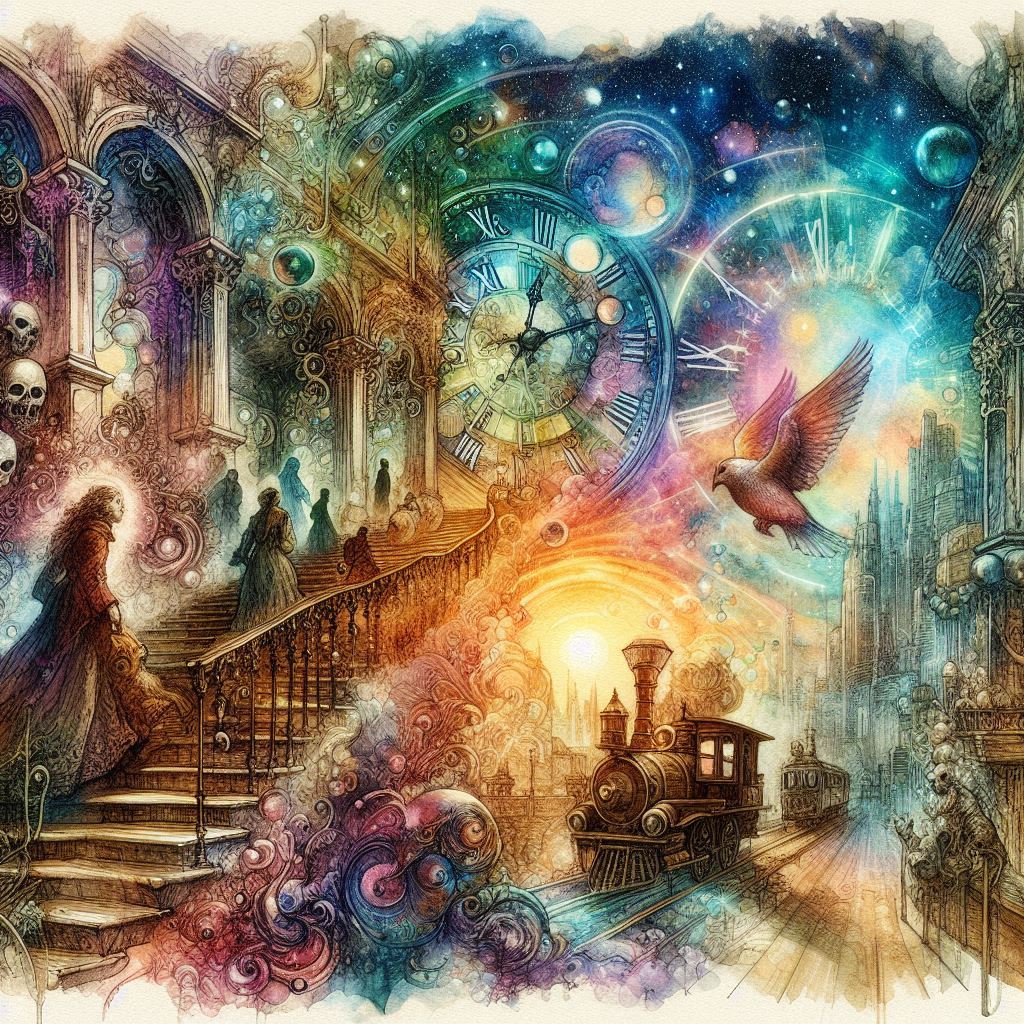
In the picture there are objects from the past as well as futuristic elements and several clocks | What is Time
This picture reminded me of the mysteries of time. This is a submission for Kevin’s No Theme Thursday

About Time: Einstein’s Unfinished Revolution by Paul Davies

The book I am about to present focuses a lot on relativity. This is not strange since the theories of relativity shed a lot of light on time. Yes, pun intended. I’ve come across a lot of people who make various claims about time, and even consider themselves philosophers of time, and yet they do not even understand the special theory of relativity.

Because of this they say a lot of profound sounding things about time that ultimately are nonsensical. There is no way around it. If you want to say profound things about time and expand human knowledge on this topic you need to first have some understanding of relativity as well as other related physics such as thermodynamics and entropy. This book will provide that.

I should say that the book is somewhat outdated, being written in 1995 and 1996. However, most of it is still relevant and I know of no other book that approaches the topic in such an honest and rigorous way. The book comes in two formats hardcover and paperback. I bought the paperback version.

  • Hardcover –  Publisher – Simon & Schuster; First Edition (March 13, 1995), ISBN-10 : 0671799649, ISBN-13 : 978-0671799649, 316 pages, item weight : 1.3 pounds, dimensions : ‎ 6.25 x 1.25 x 9.5 inches, it costs $18.09 on US Amazon. Click here to order it from Amazon.com.
  • Paperback –  Publisher – Simon & Schuster; First Edition (April 9, 1996), ISBN-10 : 0684818221, ISBN-13 : 978-0684818221, 316 pages, item weight : 0.704 ounces according to Amazon but I think that should be 0.704 pounds, dimensions : ‎ 9.21 x 6.14 x 0.8 inches, it costs $12.28 on US Amazon. Click here to order it from Amazon.com.
Front cover of hardback version of the book About Time: Einstein's Unfinished Revolution by Paul Davies
Front cover of hardback version of the book About Time: Einstein’s Unfinished Revolution by Paul Davies. Click on the image to go to the Amazon page for the hardcover version of the book.

Amazon’s Description of About Time: Einstein’s Unfinished Revolution

An elegant, witty, and engaging exploration of the riddle of time, which examines the consequences of Einstein’s theory of relativity and offers startling suggestions about what recent research may reveal.

The eternal questions of science and religion were profoundly recast by Einstein’s theory of relativity and its implications that time can be warped by motion and gravitation, and that it cannot be meaningfully divided into past, present, and future.

In About Time, Paul Davies discusses the big bang theory, chaos theory, and the recent discovery that the universe appears to be younger than some of the objects in it, concluding that Einstein’s theory provides only an incomplete understanding of the nature of time. Davies explores unanswered questions such as:

* Does the universe have a beginning and an end?

* Is the passage of time merely an illusion?

* Is it possible to travel backward — or forward — in time?

About Time weaves physics and metaphysics in a provocative contemplation of time and the universe.

My four-star review for About Time: Einstein’s Unfinished Revolution

The link above will take you to my original review for About Time: Einstein’s Unfinished Revolution. Below is a slightly modified version of the review.

Our Evolving Concept of Time

Science, particularly physics, has revealed to us some profound insights about time, and yet it remains a mysterious topic. In the first chapter of the book “A Very Brief History of Time” the author describes how the concept of time has evolved throughout human history. The ancient philosophers had a very fuzzy notion of time, and they often dismissed both motion and time as illusions. The author tells us about “cyclic time”, and the “linear time” concept from Judeo-Christian thinking, and how it was incorporated into science as a “time variable”. This made it possible to solve the paradoxes created by such Greek thinkers as Zeno, who based on apparent paradoxes concluded that motion and time cannot really exist. Those “false” paradoxes were solved with the concept of linear physical time.

Physical time also made Calculus and Physics possible, and it became clear that there was a difference between physical time, which is a measurable entity used to sequence events, and experienced time, which is the subjective human feeling of a past, present, and a future.

Most of the rest of the book is focused on the Special Theory of Relativity and the General Theory of Relativity. The theories of relativity revolutionized how we view time, and they enabled a much deeper understanding of time. Special relativity refuted the concept of universal absolute time. Not only do clocks in different systems run at different speeds, but there is no universal “Now”.

However, the theories of relativity are not all there is to know about time, and we are not even done drawing conclusions about time based on the theories of relativity. This is why the book is called “About Time Einstein’s Unfinished Revolution”. The book also discusses quantum time, the arrow of time, worm holes, neuroscience and modern psychological experiments.

The book contains a lot of information and yet it scratches only on the surface. Time is a quite complex concept when you start digging into it. Take, for example, the discussion on the arrow of time. The conclusion of the books seems to be that there really is an arrow of time. Time has direction. The author is presenting both “sides” of the issue and to really get a grasp of the issue you need to clarify and look at the physics. Time certainly seems to have a direction if you look at the concept of entropy. The Cosmos is filled with irreversible processes. Our memory, which is essential for our experience of a self, is another example.

However, time has a direction even on the most fundamental level in subatomic particles. Kaon, a type of meson, decays in a way that is not time symmetric. The same may be true for the neutron. These particles “know” the difference between the past and the future. One could easily imagine how this chapter could be turned into a several thousand pages long book by just digging deeper into the related physics.

“About Time Einstein’s Unfinished Revolution” covers a lot of interesting topics related to time and it is often quite informative. The book is also well written, well organized, it has a good pace, and it is very interesting. It strikes a good balance between depth and breadth, and it does not overwhelm its readers. However, I do have some critique of the book, which prompted me to give the book four stars instead of five stars.

To understand some of the discussions in the book you should have a decent understanding of the theories of relativity, in my opinion. The author is explaining the theories of relativity to some degree, but the explanations did not seem to be that good. I did not have a problem with understanding these explanations since I already studied these topics, but I don’t think I would have understood what I needed to understand had I encountered the theories of relativity for the first time while reading this book.

Another criticism I have of the book is that he introduces ugh Everett’s many-worlds interpretation of quantum mechanics and in my opinion promotes it. This interpretation is in my opinion both strange and implausible and is not necessary for the discussions in the book.

In short, it proposes that every quantum measurement creates new universes, each corresponding to a different possible outcome of that measurement. In essence, our Universe is just one of many, and each quantum event splits the universe into multiple versions, where each version experiences a different outcome.

The problem with this interpretation is not so much that you get multiverses, but that you an infinite number of new fully evolved universes every nanosecond, which in turn create an infinite number of universes, which in turn create an infinite number of universes, and so on infinitely, and there is no way to empirically verify their existence. It is a so-called solution to a problem that is fictitious in my opinion and is derived from an old naïve interpretation of quantum waves. It is “hip” and “cool” interpretation, but I don’t see how it is useful. I should add that I have no problem with, for example, the multiverse idea stemming from string theory.

Anyway, except for my two complaints I think this is a pretty good book that I can recommend.

Front cover of paperback version of the book About Time: Einstein's Unfinished Revolution by Paul Davies.
Front cover of paperback version of the book About Time: Einstein’s Unfinished Revolution by Paul Davies. Click on the image to go to the Amazon page for the paperback version of the book.

About Paul Davis

Paul Davies is an internationally acclaimed physicist, cosmologist, and astrobiologist at Arizona State University, where he runs the pioneering Beyond Center for Fundamental Concepts in Science. He also chairs the Search for Extraterrestrial Intelligence Post-Detection Taskgroup, so that if SETI succeeds in finding intelligent life, he will be among the first to know.

The asteroid 1992OG was officially renamed Paul Davies in his honor. In addition to his many scientific awards, Davies is the recipient of the 1995 Templeton Prize–the world’s largest annual prize–for his work on science and religion. He is the author of more than twenty books, including The Mind of God, About Time, How to Build a Time Machine, and The Goldilocks Enigma. He lives in Tempe, Arizona.

Other Relativity Related Posts

To see the Super Facts click here

Quasar TON 618

This is a submission for Kevin’s No Theme Thursday

Quasar TON 618
Image by Kevin from The Beginning at Last

Kevin’s artistic picture above reminds me of a Quasar, a supermassive black hole emitting enormous amounts of energy.

What is a Quasar ?

A Quasar is a supermassive black hole at the center of a galaxy that is emitting enormous amounts of energy. The quasar is the supermassive black hole plus its accretion disk, the gas it is feeding on and the radiation it emits. The quasar is actively feeding on gas and stars and emitting enormous amounts of radiation in the process. The radiant energy of quasars is enormous; the most powerful quasars have luminosities thousands of times greater than that of a galaxy such as the Milky Way, and millions of times greater than the largest and most luminous stars in the known universe.

Supermassive black hole at the center of a quasar. Singularity in space devouring matter and light | Quasar TON 618
Supermassive black hole at the center of a quasar. Singularity in space devouring matter and light. From Shutterstock Asset id: 2484018599 by Nazarii Neshcherenskyi.

TON 618

TON 618 is a hyper luminous Quasar known to house one of the most massive black holes ever discovered, with an estimated mass of around 40 to 60 billion solar masses. Its luminosity is estimated to be 140 trillion times that of the Sun. The diameter of TON 618 is 780 billion kilometers or 82.6 light-years. Keep in mind that the distance to the moon is 1.3 light seconds and 82.6 light years is more than two billion times larger than that. Our sun is gigantic with a diameter 109 times larger than the diameter of earth. 1.3 million earths could fit inside the volume of our sun. However, in comparison to TON 618, our sun is a lot less than tiny. The diameter of TON 618 is 561 million times larger than that of the sun’s diameter and 177 octillion (an octillion is 27 zeros) suns could fit inside the volume of TON 618. In other words, we are comparing a dust particle to planet earth size wise. I am pretty sure you are not going to be able to imagine this.

The quasar is ejecting an enormous energy beam. In the background are stars possibly being absorbed by the quasar.
Quasar in deep space. Elements of this image furnished by NASA. Asset id: 1758938918. by NASA images.

When TON 618 was discovered in 1957, quasars and supermassive black holes were not yet recognized and understood by astronomers. The word quasar inspired shock and awe in every nerd on the planet. The concept of quasars, or quasi-stellar radio sources, wasn’t fully recognized until 1963. When I was a kid in the 1970’s there was a lot of speculation as to what these gigantic ultra bright but far away objects could be. TON 618 is located 18.2 billion light years away. Considering that the reachable limit of the Universe is 16.5 billion light years even if you travel at the speed of light, you could never travel to TON 618 (barring the warp drive in Star Trek).

The Event Horizon

When we are talking about the diameter of a black hole we are not talking about a sphere with a solid surface. The black hole is a sphere, or an oval, wherein gravity is so strong that nothing can escape, not light, not anything. It’s truly black. As you approach the event horizon you become invisible, space deforms, and from the perspective of an outside observer, time appears to stop for someone reaching the event horizon of a black hole. Time will continue for someone falling in, well in some sense. You’ll be transported beyond our universe and time as we know it. We can guess but we can’t really know.

A black hole with an orange accretion disk is approached by futuristic starship.
When this spaceship reaches the event horizon the time will stop from our perspective, and they will never enter the black hole. From their perspective they will enter right through the event horizon, and they will be transported infinitely far into a future beyond time. Stock AI-generated image ID: 2448481683 AI-generated image Contributor Shutterstock AI Generator.

Black Holes

Black holes are invisible. They are truly black. However, we can see them if they are consuming matter. The matter close to black holes will heat up and glow. The closer to the event horizon the redder it is. It is called an accretion disk as in the depiction above. There are an estimated 100 million black holes in our galaxy, the Milky Way. At the center of the Milky Way is a super massive black hole called Sagittarius A-star. It is 4 million times more massive than our sun. There are supermassive black holes located at the center of most large galaxies. The supermassive black holes are considered to play a crucial role in the formation of galaxies.

A black hole with a large bright accretion disk | Quasar TON 618
3D illustration of giant Black hole in deep space. High quality digital space art in 5K – realistic visualization. Stock Illustration ID: 2476711459 by Vadim Sadovski.

Black Hole Animation

Below is an animation created by NASA that depicts what an observer falling into a black hole would see. The video is about 4 minutes long.

TON 618  Animation

Below is an animation of TON 618, a quasar and the largest black hole known in the universe. This video is about 5 minutes.

To see my The Bizarre Reality of Black Holes Super Fact Click Here
To see the Super Facts click here

Note : Today March 14 is Albert Einstein’s birthday, the man who gave us the General Theory of Relativity, which mathematically describes black holes. It is also Pi Day (first 10 digits 3.1415926535), and there’s a rare moon eclipse tonight called a blood moon or a worm moon. Also, Dallas is under a fire warning. Be careful.

Important Note : I am going on a ski vacation tomorrow and I will take a one-week break from blogging as well as a break from reading other people’s blogs.

The Great Sun and Moon Spectacle

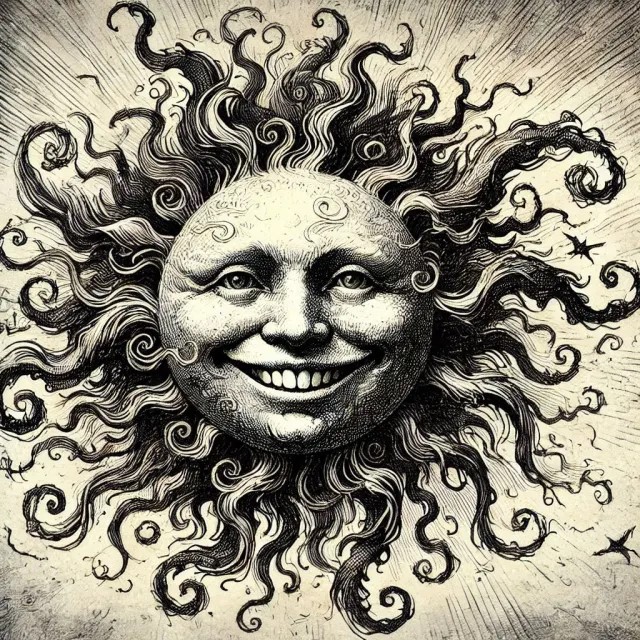
We are all in our places with sunshiny faces  ready to experience the astronomical event of the century, a spectacle that Mr. Sun, Sun, Golden Mr. Sun and the moon provided for us.

This is a submission for Kevin’s No Theme Thursday

The Great Sun and Moon Spectacle
Image by Kevin from The Beginning at Last

For us in Dallas, Texas, 2024 was the year when the sun and the moon put up an unforgettable spectacle for all of us to see. On April 8, 2024, the sun and the moon and earth lined up perfectly so that the moon fully covered the sun. We had a total solar eclipse, and we were lucky with the weather. I can add that experiencing a total solar eclipse is quite different from experiencing a partial or annular solar eclipse. I’ve experienced a partial solar eclipse as well and I can attest to the difference.

Unlike a partial eclipse, it gets dark during a total solar eclipse, the stars come out if the sky is clear like it was. The birds and the insects become quiet. It happens very suddenly, in just a few seconds. The total solar eclipse lasted four minutes.

The Motion of the Sun and the Moon

To understand what a solar eclipse is, the video below might help. What you see is the moon and the earth as seen from the sun’s viewpoint. We see earth all lit up by the sun, like a full moon, and we also see the moon lit up by the sun. 

In this situation, when the people on earth look up in the sky, they see the sun, but they don’t see the moon, even though it is there. It is a new moon, or a black moon if it happens twice in the same month. As the moon begins to partially cover the sun the shadows on the ground start looking different and if you use solar eclipse glasses you can see the sun disappearing and looking like a bright crescent, but it is still daylight and looking at the sun without eclipse glasses would just hurt your eyes.

Well, this is true until the sun is fully covered by the moon. When that happens, the light turns off and at that point it is safe to look at the sun without glasses. What you’ll see is a pitch-black circle in the sky surrounded by wispy faint lights. Those wispy faint lights are the sun’s corona.

Below is a youTube video showing an animation composed of actual satellite photos by NASA.


Solar Eclipse Preparation

I drank a very special beer for the occasion, a Trappist Belgian Strong Ale, or Quadruple, called Westvleteren 12 from Brouwerij Westvleteren (Sint-Sixtusabdij van Westvleteren).

A table set for five with a large parasol | The Great Sun and Moon Spectacle
Our patio table. The little brown packages contain AAS / ISO certified solar eclipse glasses.
My daughter holding a Westvleteren 12 glass with a bow. Grandpa and grandma sitting on chairs in the background | The Great Sun and Moon Spectacle
Our daughter holding a Westvleteren 12 glass with a bow. Grandpa and grandma in the background.
A mini-Australian Shepherd sitting on the patio floor | The Great Sun and Moon Spectacle
Rollo our mini-Australian Shepherd on the patio.

The Partial Eclipse Phase

It was partially cloudy during the partial eclipse, but we were able to get a good look at the eclipse as it progressed. As mentioned, to see the partial eclipse, you have to use good solar eclipse glasses. It is primarily for safety reasons, but it is also pointless to look at the sun during a partial eclipse. You won’t see the eclipse crescent because the powerful light from the sun overwhelms your view.

I had a little filter that was placed in front of my phone camera as I took a few pictures. Admittedly they were pretty bad. I have an old Samsung Galaxy S8+ but even using newer phones it is difficult to get decent photos of something like this.

The photo shows a shiny crescent on black background | The Great Sun and Moon Spectacle
Partial eclipse photo taken with my old Samsung Galaxy phone and a filter.

The Total Eclipse

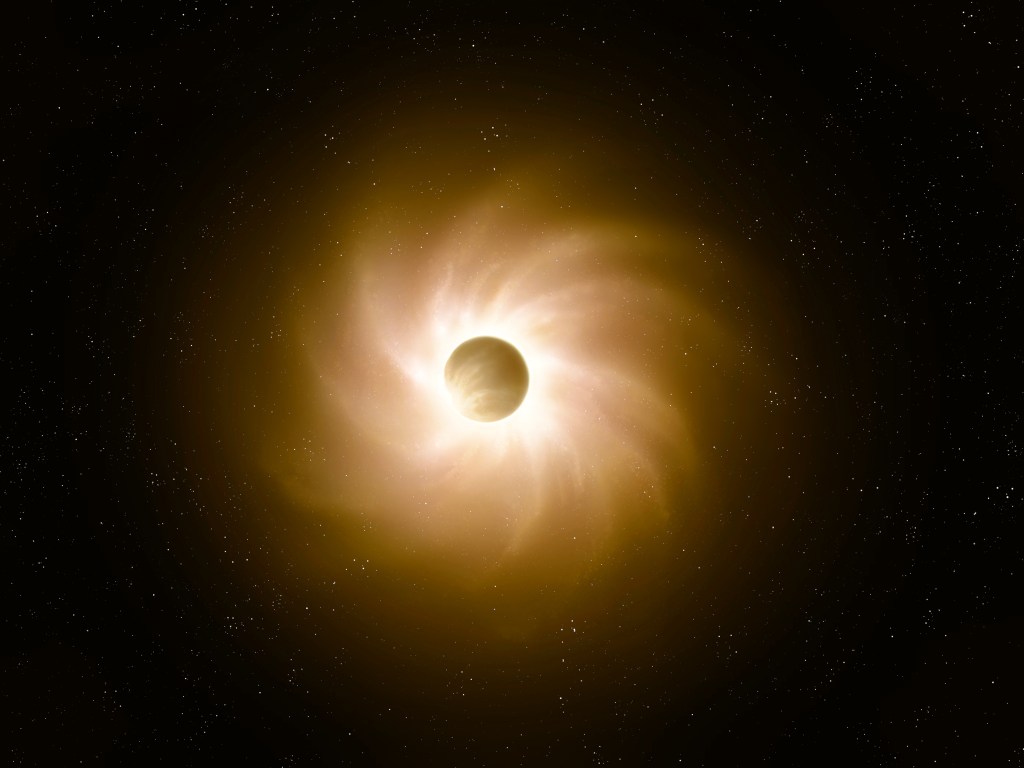
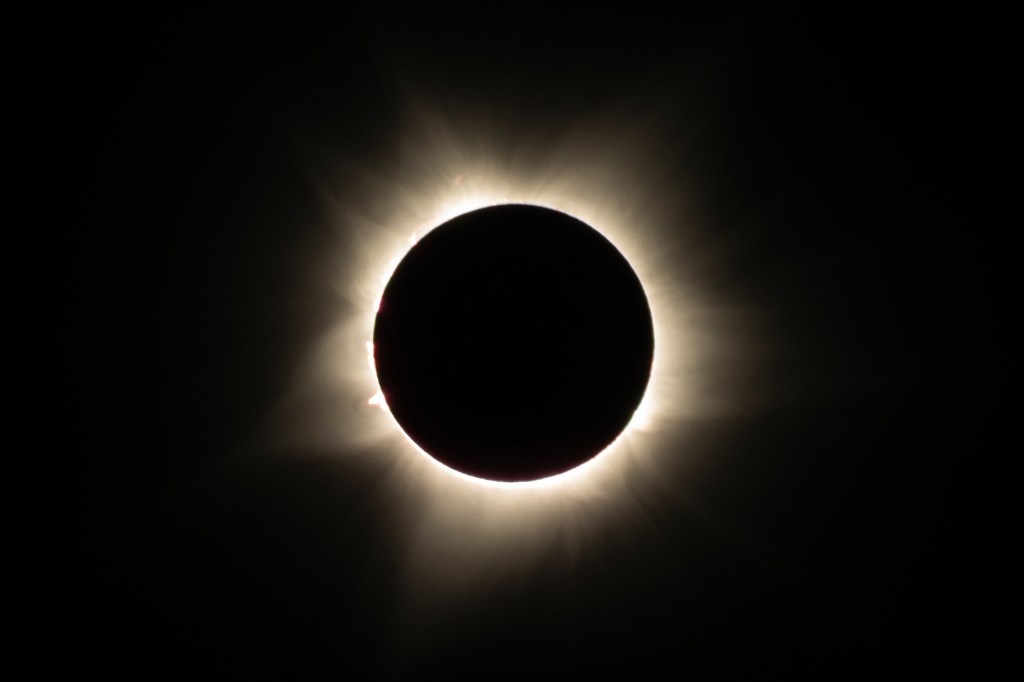
At 1:40PM Dallas time the total solar eclipse happened and luckily it was not covered by clouds. At this point it suddenly got dark and it was safe to look straight at the sun without using the eclipse glasses. The total eclipse lasted four minutes. I have included a shutter stock photo below which closely represents what we actually saw. We saw a black circle and around the black circle was a wispy white fog like light. This was the sun’s corona and it shone with about the same power as the full moon. It kind of looked like a black hole.

Black circle surrounded by a wispy white fog like light. That’s the sun’s corona | The Great Sun and Moon Spectacle
Except for the black background this looks like what we saw with our eyes. The sky we had was dark, like twilight, but not black. Solar Eclipse Stock Photo ID: 2344355767 by aeonWAVE

The Stars and the Planet Venus

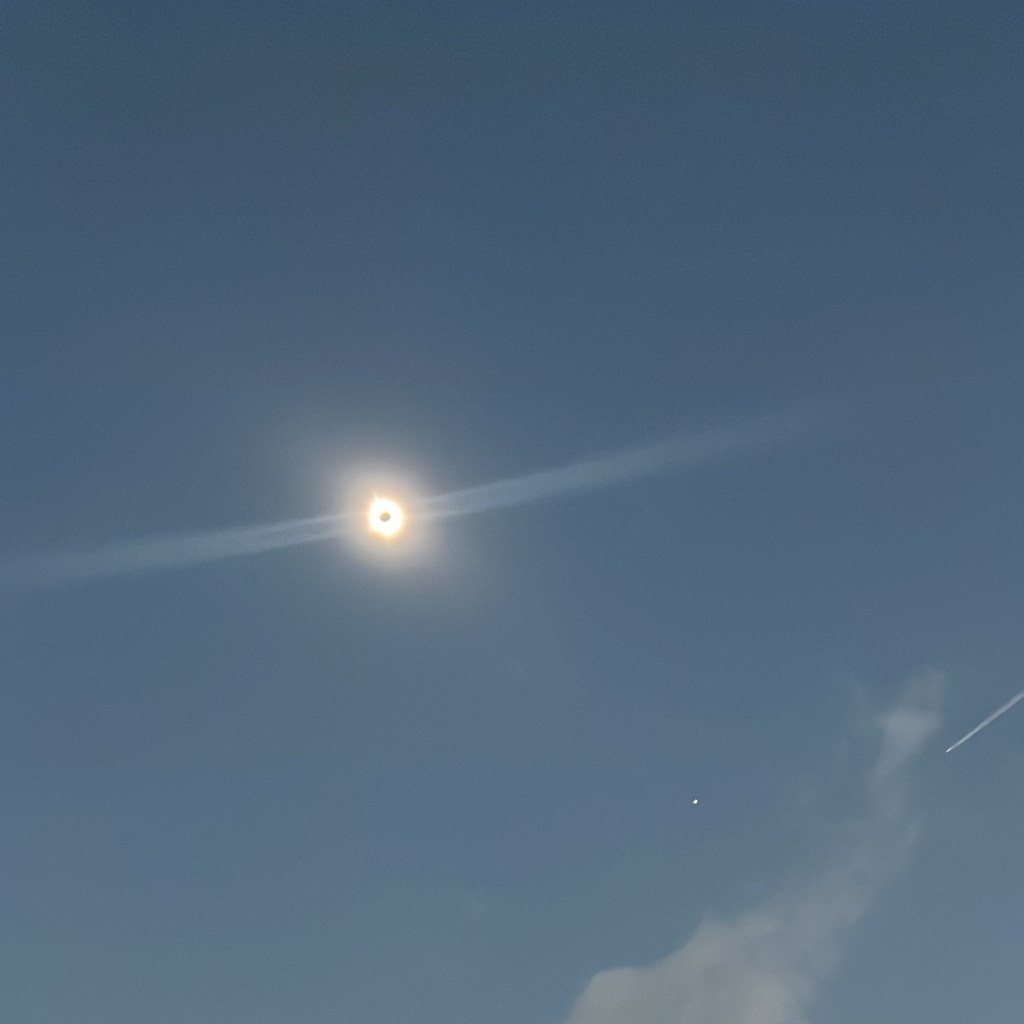
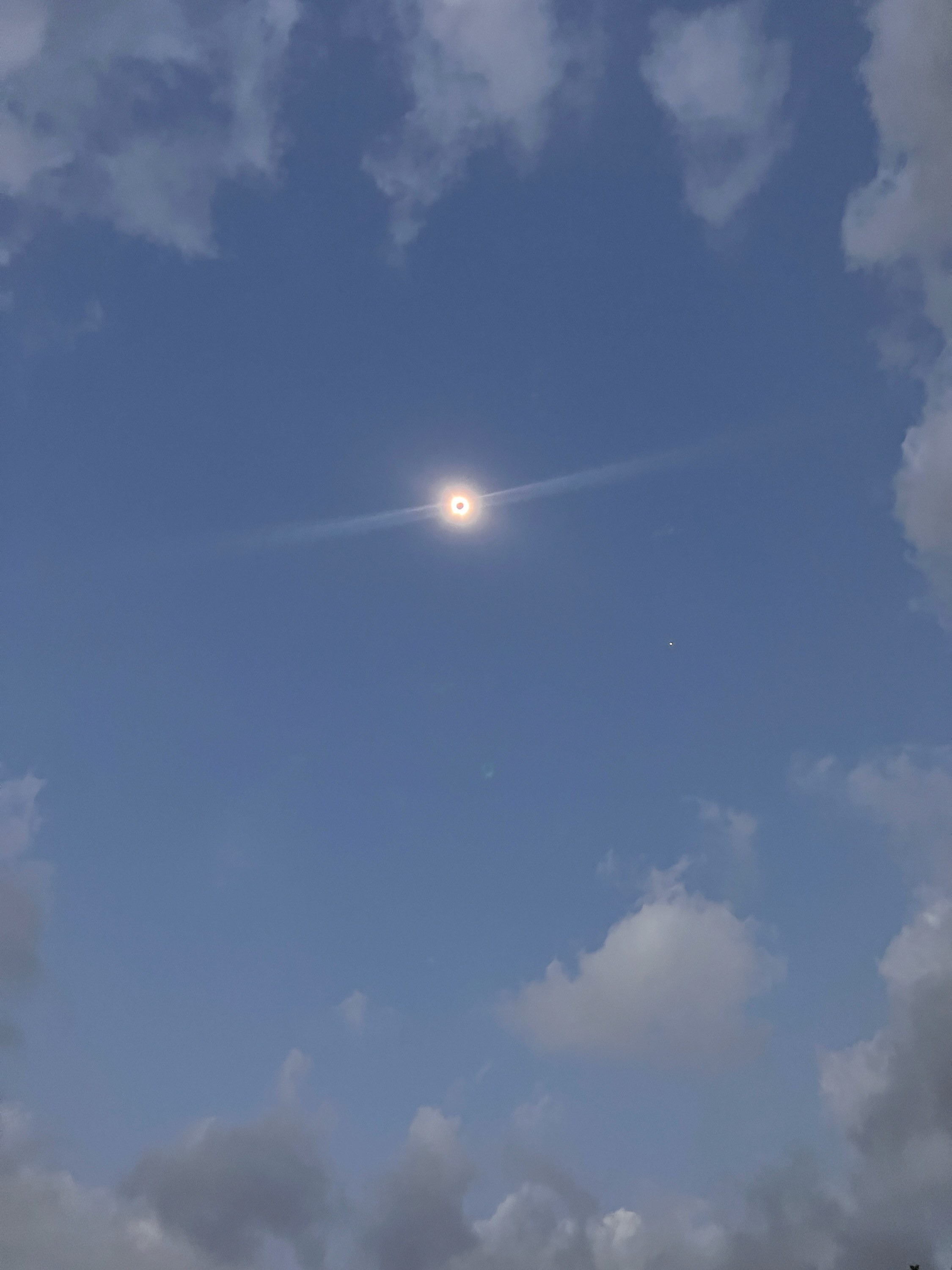
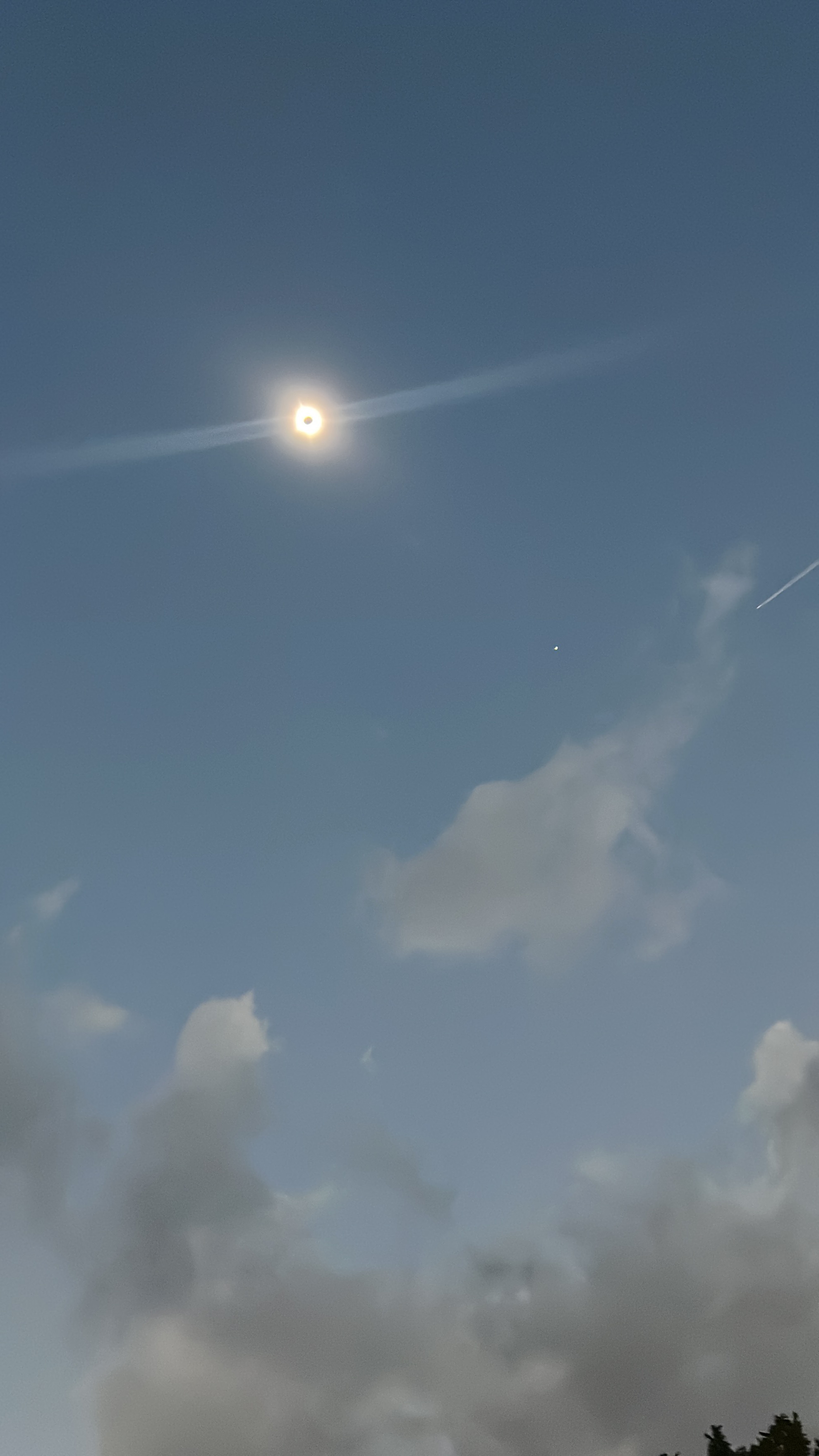
The photo shows the sun totally covered by the moon. It is very small in the photo. There is star like object, that’s Venus, a cloud and airplane contrail | The Great Sun and Moon Spectacle
Total solar eclipse photo that my daughter took. Can you find Venus?

Total Eclipse Photos

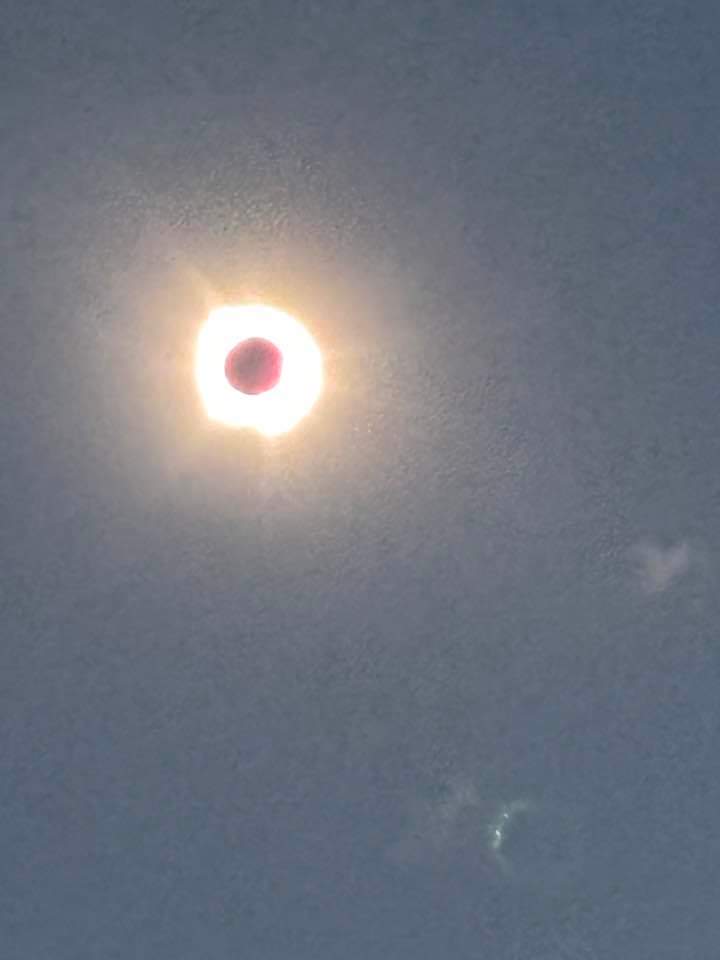
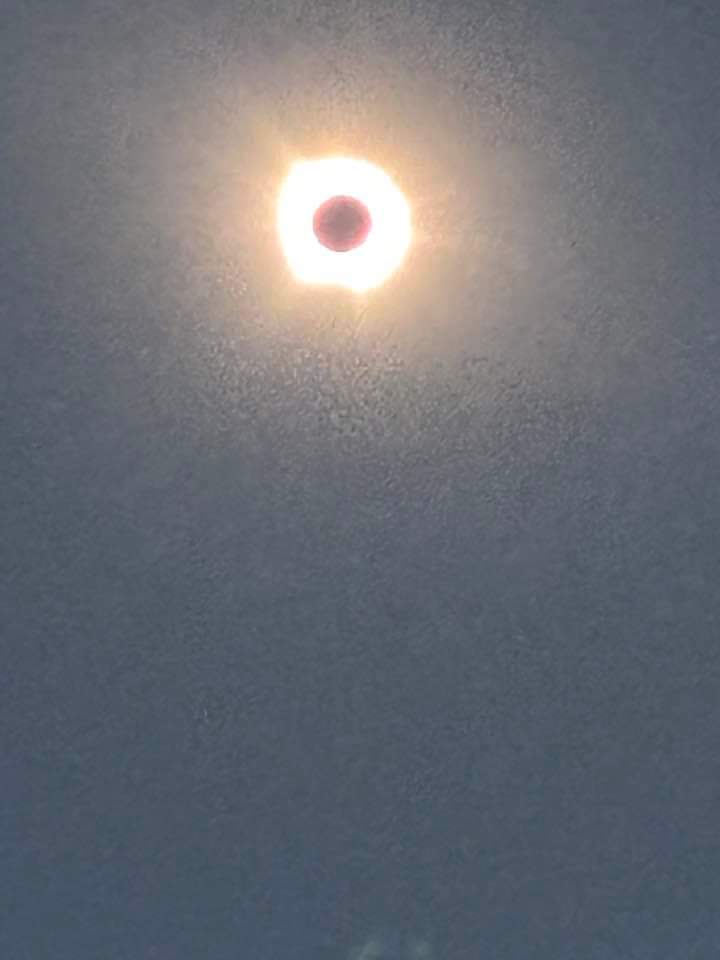
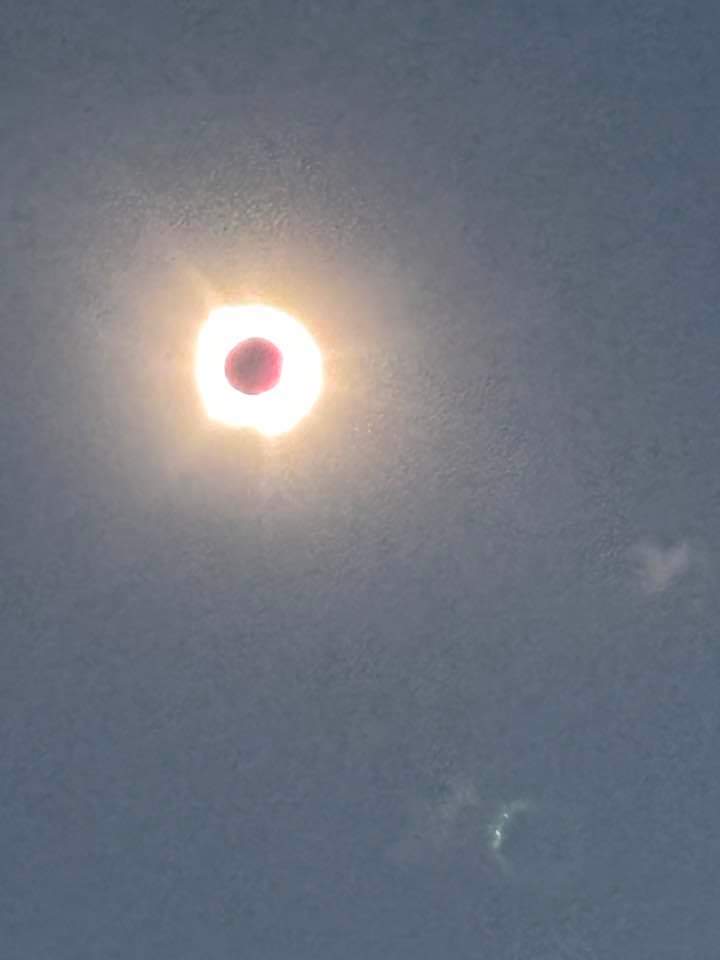
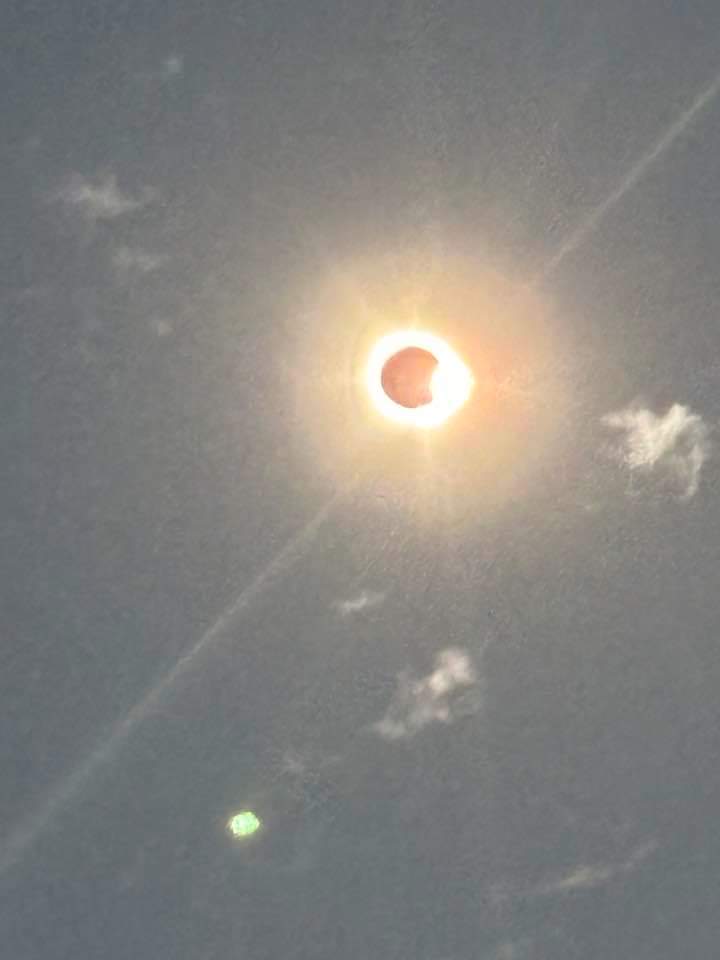
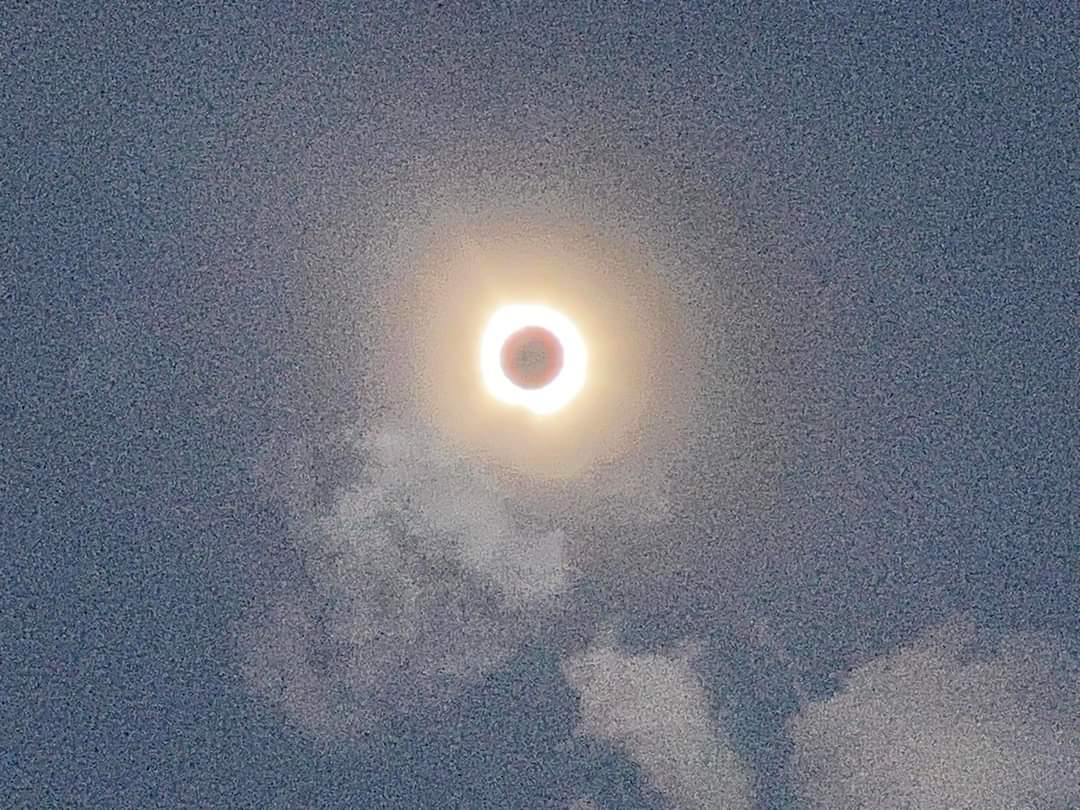
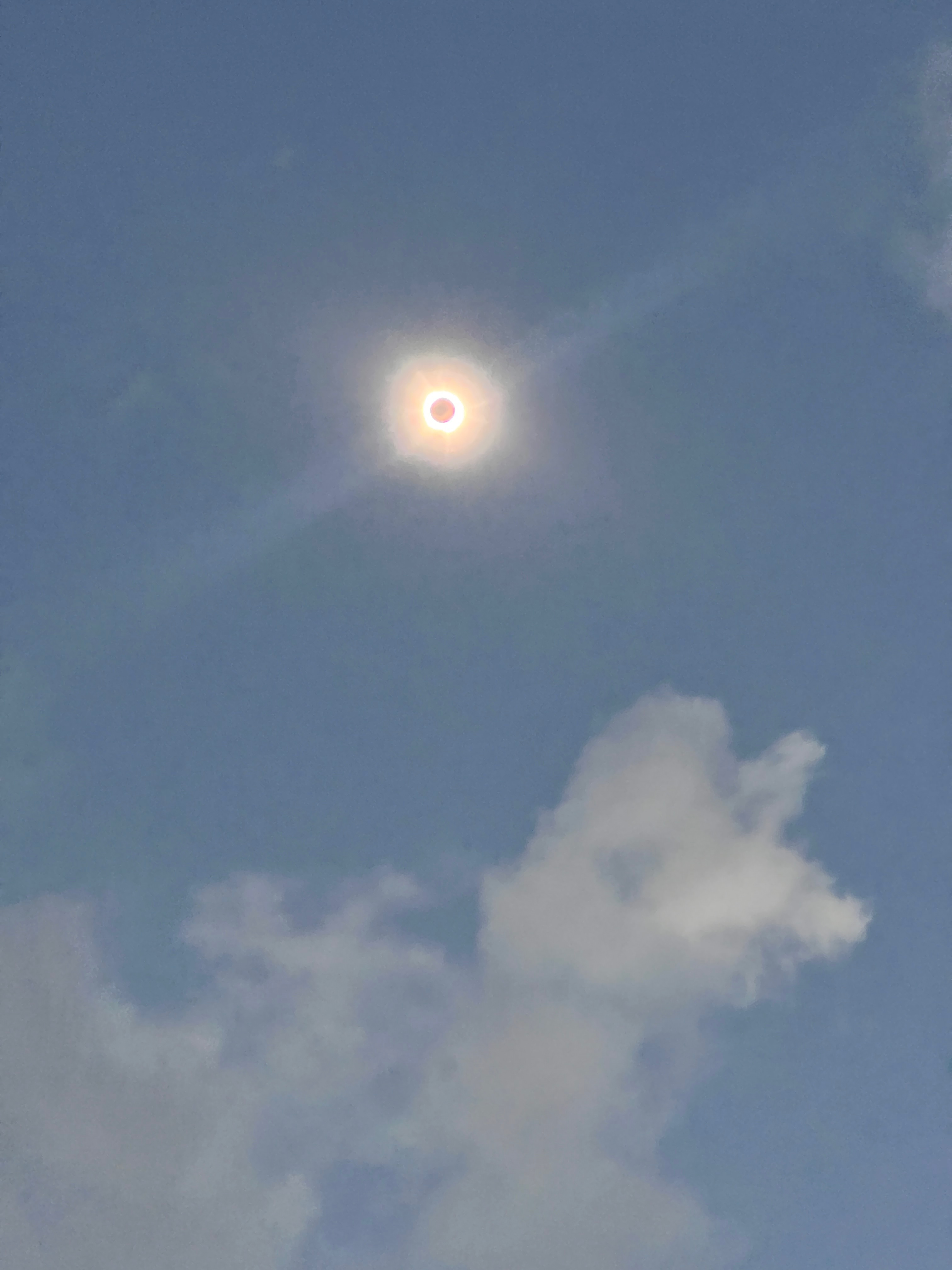
These eight pictures were taken with cell phones by my daughter Rachel, Denise Mosier-Wanken, and Margaret Weiss Bloebaum.

Did you see the total solar eclipse?


To see the Super Facts click here


Black Holes Monsters in the Sky

“This”Black Holes Monsters in the Sky” is a submission for Kevin’s No Theme Thursday

Black Holes Monsters in the Sky
Image by Kevin from The Beginning at Last

Black holes, everyone has heard of them, no one understands them. They are inscrutable monsters in the sky. They are regions of spacetime wherein gravity is so strong that nothing can escape, not light, not anything. Some of them are small, only 15 kilometers across, and some have a diameter 27 billion times larger than that.

As you get close to a black hole your time will run slower. You won’t notice it, but others will see you move in slow motion. If you return from your close encounter an hour on your clock might correspond to years elsewhere. As you approach the event horizon, the boundary of no escape, you become invisible and time will stop, at least from an outside view.

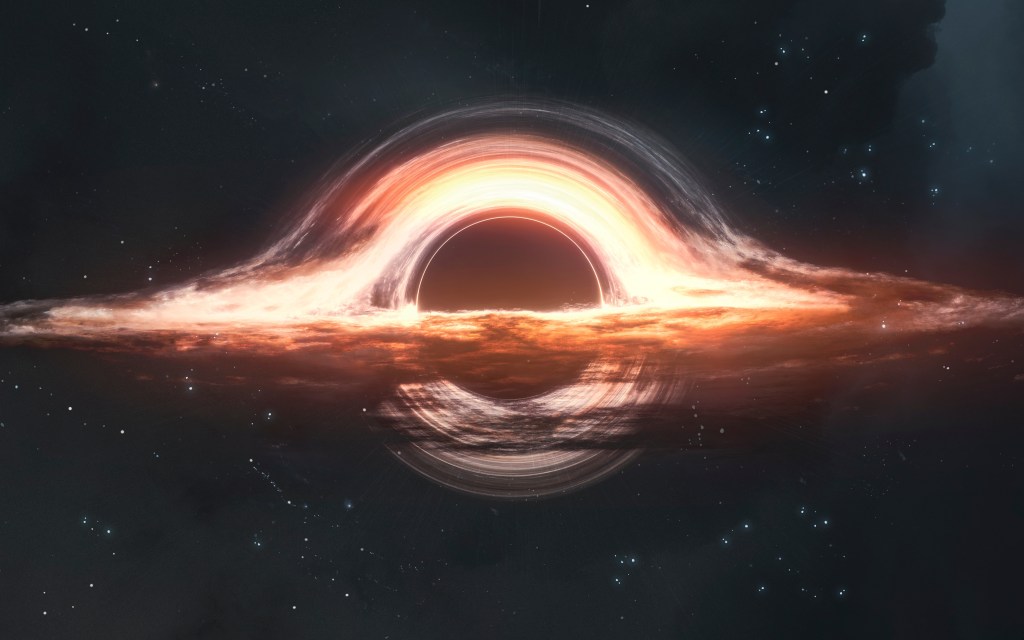
Black holes are invisible. They are truly black. However, we can see them if they are consuming matter. The matter close to black holes will heat up and glow. The closer to the event horizon the redder it is. It is called an accretion disk as in the depiction above.

There are an estimated 100 million black holes in our galaxy, the Milky Way. At the center of the Milky Way is a super massive black hole called Sagittarius A-star. It is 4 million times more massive than our sun. There are supermassive black holes located at the center of most large galaxies. The supermassive black holes are considered to play a crucial role in the formation of galaxies.

I’ve looked up in the sky, and I’ve seen the spot where Sagittarius A-star is located. I’ve tried to look at it with my telescope, but I cannot see it. It is not possible to see it with a telescope, but it is there. The picture above may depict the view from a planet in the center of our galaxy. Three scientists received the Nobel prize in physics in 2020 for their research on black holes (Roger Penrose, Reinhard Genzel, and Andrea Ghez).

However, before them the tele evangelist Jack Van Impe won the 2001 Ig Nobel Prize in Astrophysics for his discovery that black holes meet all the technical requirements for Hell. The Ig Nobel prize is an alternative and less serious Nobel Prize. To find out more about Black Holes click here.

Below is an animation created by NASA that depicts what an observer falling into a black hole would see.


To see the Super Facts click here