The Greatest Intellectual Achievement

The Greatest Intellectual Achievement of the human race is arguably the Standard Model of Elementary Particles. The Standard Model consists of Special Relativity, Quantum Physics, Noether’s theorem and gauge theories, Quantum Electrodynamics, Quantum Chromodynamics, and a framework for all elementary particles, and more. It is a towering achievement of physics that was created by thousands of geniuses over a period of several decades. It is the theory of almost everything.

Despite that fact it is not getting a lot of respect. Everyone is just trying to find something wrong with it. The reason is that as soon as it was created people realized that something was wrong with it. It could not be reconciled with General Relativity. Something was missing. So, finding out what is wrong with it or what is missing has been a top priority for physics for several decades. The book “The Theory of Almost Everything” by Robert Oerter is a very interesting book covering the standard model, its components, its history, and what could be missing. It contains a few formulas but other than that it is mostly readable to laymen.

Book Formats for The Theory of Almost Everything

The Theory of Almost Everything: The Standard Model, the Unsung Triumph of Modern Physics by Robert Oerter comes in three formats. I bought the hardback format.

  • Hardcover –  Pi Press (July 22, 2005), ISBN-10 : 0132366789, ISBN-13 : 978-0132366786, 336 pages, item weight : 1.2 pounds, dimensions : ‎ 6.37 x 1.11 x 9.3 inches, it costs $35.08 on US Amazon. Click here to order it from Amazon.com.
  • Paperback –  Penguin Publishing Group (September 26, 2006), ISBN-10 : 0452287863, ISBN-13 : 978-0452287860, 336 pages, item weight : 10.8 ounces, dimensions : ‎ 5.51 x 0.81 x 8.34 inches, it costs $16.99 on US Amazon. Click here to order it from Amazon.com.
  • Kindle –  Publisher : Plume (September 26, 2006), ASIN : B002LLCHV6, ISBN-13 : 978-1101126745, 348 pages, it costs $6.99 on US Amazon. Click here to order it from Amazon.com.
Front cover of The Theory of Almost Everything: The Standard Model, the Unsung Triumph of Modern Physics by Robert Oerter.
Front cover of The Theory of Almost Everything: The Standard Model, the Unsung Triumph of Modern Physics by Robert Oerter. Click on the image to go to the Amazon page for the hardcover version of the book.

Amazon’s Description of The Theory of Almost Everything

There are two scientific theories that, taken together, explain the entire universe. The first, which describes the force of gravity, is widely known: Einstein’s General Theory of Relativity. But the theory that explains everything else—the Standard Model of Elementary Particles—is virtually unknown among the general public.

In The Theory of Almost Everything, Robert Oerter shows how what were once thought to be separate forces of nature were combined into a single theory by some of the most brilliant minds of the twentieth century. Rich with accessible analogies and lucid prose, The Theory of Almost Everything celebrates a heretofore unsung achievement in human knowledge—and reveals the sublime structure that underlies the world as we know it.

My five-star Amazon review for The Theory of Almost Everything

Below is my full length giant review of The Theory of Almost Everything. Unless you are really interested, I suggest you read the somewhat shorter Amazon version by clicking the link above.

An introduction to the greatest intellectual achievement of the Human Race

The public has to a large extent missed the greatest scientific revolution in the history of the human race because mainstream media has largely ignored this breakthrough, despite the fact that the Nobel Prize committee has been raining Nobel Prizes over it. In the 1970’s a theory that explained, at the deepest level, nearly all of the phenomena that rule our daily lives came into existence. The theory called “The Standard Model of Elementary Particles” is a set of “Relativistic Quantum Field Theories” that explains how elementary particles behave, which elementary particles there are, and why they have the properties they have, for example, isospin, spin, charge, color charge, flavor, even mass, or mass relations in many cases.

The theory explains how all of the fundamental forces in nature work except gravity. The theory describes how the elementary particles interact; decay, how long they are expected to exist, and how they combine into other subatomic particles. The theory uses only 18 adjustable parameters to accomplish all of this.

Bright yellow flashes representing electrons orbiting a center in the atom. | The Greatest Intellectual Achievement
Close up illustration of atomic particle for nuclear energy imagery. From iStock photos.

In the extension the theory thus explains how nucleons and atoms are formed and what properties the atoms will have, and how molecules will form and what properties molecules will have, their chemical reactions, and what elasticity, electric conductivity, heat conductivity, color, hardness, texture, etc. any material will possess. In the extension it explains why mass and matter exist, how the sun and the stars work, and the theory is therefore the ultimate basis of all other science. It also provides a formula, or an equation of almost everything.

Best of all it has been thoroughly verified experimentally, in fact the predictions the theory has made have been confirmed with such stunning accuracy and precision that it could be considered the most successful scientific theory ever. A theory that successfully unites all physics and basically all of human knowledge of the Universe into one single theory has never before existed.

However, “The Standard Model” does not incorporate gravity and the general theory of relativity, and cannot explain dark energy, dark matter and why neutrinos have mass. Therefore, almost as soon as the theory came into existence physicists started looking for the next theory that would finish what the “The Standard Model” did not finish.

Example of such theories are GUT theories, SO(5), SO(10), string theories (abandoned), super string theories, and M-theories. Even though those new theories are extremely interesting they have not been verified or able to predict anything. In comparison with the “Standard Model”; super string theories, grand unified theories, chaos theories, you name it, are essentially nothing, but are still better known. Hopefully this will change in the future, either because the Standard Model gets the respect it deserves, or because a more complete theory can be verified.

About the book

This book explains to the layman what the “Standard Model” is and how it came into existence. The book is by no means a perfect book. I think there are several problems with the book. However, I decided not to take off any star because there are very few books written for science interested non-physicists that explain the “Standard Model of Elementary Particles”. Dr. Oerter deserves five stars just for his decent attempt at doing so. I find Dr. Oerter to be a good writer and popularizer. I don’t think he is as good as Isaac Asimov, or Carl Sagan, but close, and he is writing on a much more complex topic then, for example, Carl Sagan did.

I studied physics as an engineering student, and I could understand most of text (but not every detail regarding everything). However, I believe anyone who is somewhat familiar with science, especially physics and math, can understand most of this book. For me more diagrams and more equations would have helped. For readers without much background in physics more and better diagrams would definitely have helped. Dr. Oerter came close to writing a good book for the layman, but the book was still lacking in certain aspects. In the remainder of the review, I will give a brief synopsis for each chapter and present my opinions and reflections on each chapter. In a sense I have written a short review for every chapter. My intent is to both tell you what the book is about and give my opinions on the different sections of the book.

Chapter 1: The first unifications

In Chapter one Oerter gives an interesting overview of the history of physics. Physics has typically been divided up into many fields. New discoveries have led to either new sub disciplines or the merging of existing sub disciplines (unifications). Nineteenth century physics was divided into many sub disciplines.

Dynamics (the laws of motion)

Thermodynamics (the laws of temperature, heat and energy)

Waves (oscillations in water, air, and solids)

Optics

Electricity

Magnetism

However, because of the atomic hypothesis, thermodynamics and wave mechanics were swallowed up by dynamics. For example, temperature and heat were now explained in terms of atomic and molecular motion. The theory of electromagnetic fields subsumed optics, electricity, and magnetism (light is an electromagnetic wave). All of physics, it seemed, could be explained in terms of particles (atoms) and fields. New discoveries would alter the picture once again and the old field theories had to be abandoned, and the laws of classical mechanics (dynamics) had to be altered.

Finally, the physicists were able to come up with a unified theory that explained almost all of physics and in the extension all of science, the standard model of elementary particles. This chapter was very basic and not difficult to understand. I think his approach to give an overview of physics was both unique and enlightening. His description of how physics and our understanding of the Universe went through periods when our knowledge expanded and gave rise to new fields and due to new discoveries, that led to a deeper understanding resulted in the merging of these fields. So, in summary more knowledge lead to more fields, then deeper understanding united them. This went back and forth a few times. Finally, we have a unified theory of almost everything, the Standard Model (if we exclude the General theory of relativity).

Chapter 2: Einstein’s relativity and Noether’s theorem

Even though the book is a Physics book, I think it is also a book on Philosophy. The way I see it Physics is in a sense both Science and Philosophy, the kind of Philosophy that can be falsified, verified and proven wrong or correct. Let me explain what I mean by telling you about Noether’s theorem. Noether’s theorem states that whenever a theory is invariant under a continuous symmetry, there will be a conserved quantity. As an example of what a continuous symmetry is, is the following: any physical experiment that is performed at a certain time will have the same result if it is performed exactly the same way a certain time later. That seemingly self-evident observation means that Energy is conserved.

Another example is any physical experiment that is performed at a certain place will have the same result if it is performed exactly the same way somewhere else. That seemingly self-evident observation means that momentum is conserved. Let me add that “exactly the same way” really means that! Gravity, other forces, differences in light, or anything else cannot be different in the second experiment. The only thing allowed to be different is the position “x” (if that is our symmetry variable). That is what a continuous symmetry means, changing just one thing, and everything stays the same.

Noether’s theorem has been the guiding principle behind the standard model, and it is used to find conservation laws where symmetries are found, and it is used to find symmetries where conservation laws are found. It is a spontaneous symmetry brake that allows the Higgs Boson to give all other particles their mass (excepting mass less particles). This is the reason that matter and everything in our Universe exists. The Higgs Boson is also called the God particle. So, Noether’s theorem is both very useful in a practical sense and deeply philosophical at the same time. In addition to Noether’s theorem the standard model is built upon the special theory of relativity and a modern formulation of quantum mechanics (Quantum field theory), QED, QCD, as well as some discoveries regarding elementary particles. I can add that Noether’s theorem was formulated by a Jewish woman, Emmily Noether, who could not get a job in academia because she was a woman. This theorem is one of those very important but mostly unknown discoveries, like the invention of paper by the Chinese Tsai Lun.

Oerter does not attempt to explain the special theory of relativity; however, he tries to give the reader an idea of what it is. The problem with his approach is that he gives the reader just enough information to enable the observant reader to come up with the apparent paradoxes within the special theory of relativity, but not enough information to help the reader to easily resolve them. He also confuses the reader by not distinguishing between rest mass and relativistic mass. The observant reader will think that he is contradicting himself. The term relativistic mass is the total mass and the total quantity of energy in a body. The rest-mass is the mass of the body when it is not moving. The formula E = mc^2 is always true, when it refers to relativistic mass, which is why we talk about an energy/mass equivalence. The other more complex formula Oerter presents refers to rest mass. There is no such thing as an energy/rest mass equivalence (except at speed 0) but that is what the reader who is not already familiar with the subject will end up believing.

Another mistake Oerter does is in regard to the fact that the speed of clocks will be measured differently in different reference frames. On page 35 last paragraph Oerter writes “Here, we have an apparent paradox: If each reference frame sees the other as slowed down, whose clock will be ahead when the passengers leave the train?” Then he implies that the paradox has to be solved by incorporating the General theory of relativity. Even though that may be how it was first solved, you can solve this form of the so called “Twin Paradox” and other similar paradoxes from within the framework of the special theory of relativity itself. So even though I enjoyed reading about Nother’s theorem and still think this chapter could use some improvement.

Chapter 3: (The End of the World as we know it) + Chapter 4: (Improbabilities)

Oerter explains Quantum Physics in a very typical manner, and he mostly avoids making it look weirder than it actually is which he should be commended for (that is not true for every author). However, there is one thing that all Physicists seem to do when they explain Quantum Physics to the layman which annoys me greatly. The matter waves (or quantum fields) in Quantum Physics are quite strange entities. The reason they are so strange is because they do not exist in a real sense, they are more correctly stated mathematical abstractions. Oerter states this clearly, which is good.

However, he then goes on to mention De Witts’ idea about multiple Universes without acknowledging that these “bizarre solutions” to various Quantum Wave conundrums are completely unnecessary. So, to some extent he is still making Quantum Physics appear weirder then it is (but I have seen worse). Well, OK, Quantum Physics is weird, but we don’t need to make it seem even weirder.

After giving a background to the special theory of relativity and Quantum Physics, Oerter continues explaining relativistic Quantum Physics including the fantastic prediction you get when you combine the special theory of relativity with Quantum Physics; that for every particle there is a twin particle with exactly the same mass, and spin, but opposite charge and isospin. These particles were called anti-particles and until they were actually found physicists tried to get rid of them from the theory. However, the combination of the special theory of relativity and Quantum Physics would lead not only to much better explanation for such things as the radiation and light spectrum and the properties of atoms, it would also lead to new discoveries. This is what is referred to as Relativistic Quantum Mechanics.

Chapter 5: The Bizarre Reality of QED

Richard Feynman came up with a new representation of relativistic quantum physics for electrons that did not use waves, called Quantum Electro Dynamics (QED). This was one of the first steps towards the standard model. Instead of viewing electrons as particles governed by waves, Feynman viewed electrons as particles guided by fields consisting of all possible paths and their probabilities. He used the two-slit experiment as a guide when formulating the equations for the probabilities of the paths for the electrons (and in the extension may other particles). When he summed up all the possible paths and compared with the old Quantum Mechanics (Wave Mechanics) he got the same answer as Quantum Mechanics in every case. In fact, his new approach was able to explain and calculate phenomena’s like the electrons spin and the fine structure constant that Quantum Mechanics (Wave Mechanics) could not explain properly, and his approach also would prove crucial for the development of Relativistic Quantum Field Theory.

So, in summary, first came Quantum Mechanics, then Relativistic Quantum Mechanics, and then QED and Relativistic Quantum Field Theory. I can add that this chapter also explains Feynman diagrams and an infinity problem that cropped up. The three infinities that cropped up corresponded to the electron’s mass, the photon’s mass, and the electron’s charge. However, the problems with these infinitives were solved using a normalization process that is also explained in this chapter. I can add that I think QED probably seems less strange to laymen then Wave Mechanics because it is easier to visualize the probabilities of possible paths as compared to waves that do not even exist, even though their “amplitude squares” represents something real. This chapter was probably one of the harder chapters to understand (for those who know nothing about QED). This chapter could really have been made better by using many more diagrams and figures. Again, I am not going to knock a star for that because the book is overall so unique and important.

Chapter 6: Feynman Particles, Schwinger Fields

Chapter 6 was a short but interesting chapter. Julian Schwinger took a different approach to QED than Feynman; he sorts of invented a new wave mechanics, in which a quantum field can be pictured as a quantum harmonic oscillator at each point in space. Even though the two approaches used different models Freeman Dyson proved in 1949 that Schwinger’s field theory point of view and Feynman’s sum-over-all-paths approach were in practice identical. However, the two approaches are useful for different things and form the basis of Quantum Field Theory. QED and Quantum Field Theory eliminate the distinction of particle and field and in a sense removed the conundrum of the particle and wave duality. In the nineteenth century light was an electromagnetic wave (well it still is) and in the old Quantum Physics it was both a wave and a particle, however, in Relativistic Quantum Field Theory it is something completely new-a quantum field, neither a particle nor a wave, but an entity with the aspects of both.

Chapter 7: Welcome to the Subatomic Zoo

In this chapter Oerter describes the history of the “strong nuclear force” and the “weak nuclear force” and the subatomic zoo that later emerged. There are four fundamental forces of nature, electromagnetism, gravity, and the “strong nuclear force” and the “weak nuclear force”. The two latter fundamental forces were not known until the 1930’s. The studies of these two new forces led to the predictions and discoveries of new elementary particles. One of these was the pion, however, when the physicists looked for this particle in the cosmic background radiation, they found an elementary particle that was similar to the pion but had the wrong mass.

After some confusion it became clear that it was not a pion but a new never foreseen particle that was named the meson. This was a problem because it was a new entity which the existing physics theories could not explain. However, it got worse. More elementary particles were discovered in the 1940’s 1950’s and the 1960’s. Our Universe turned out to be a lot stranger than people thought, and people started talking about the subatomic zoo. These newly discovered elementary would remain big mysteries until the event of the Standard Model in 1974. This chapter was pretty straight forward and easy to understand. Oerter does an excellent job in making this history interesting and entertaining to the reader and the chapter also contains some humor.

Chapter 8: The Color of Quarks

In the 1960’s physics had become ugly because of the subatomic zoo. Murray Gell-Mann and Yuval Neeman suggested a periodic table for elementary particles (like there is a periodic table for the elements). This periodic table was referred to the eightfold way. The eightfold way was also referred to as the SU(3) theory. It led to the discovery of an elementary particle that was even more fundamental than the known elementary particles, the Quark. It was soon established that there were two kinds of fundamental elementary particles: leptons and Quarks, in addition to the Bosons. Let me explain the details. There are elementary particles with whole number spin, and they are called Boson’s, and there are elementary particles with half number spin called Fermions.

The Pauli Exclusion Principle (that no two particles can occupy the same state) applies to Fermions but not to Bosons and therefore the two different types of particles behave very differently and follow different kinds of statistical rules (Bose-Einstein statistics versus Fermi-Dirac statistics). All force carriers are Boson’s while some Fermions are used to build “normal matter”. Examples of Bosons are the photon, gluons, W and Z Boson, mesons, the Higgs Boson (the God particle). The Fermions come in three families, each with four particles and their anti-particle.
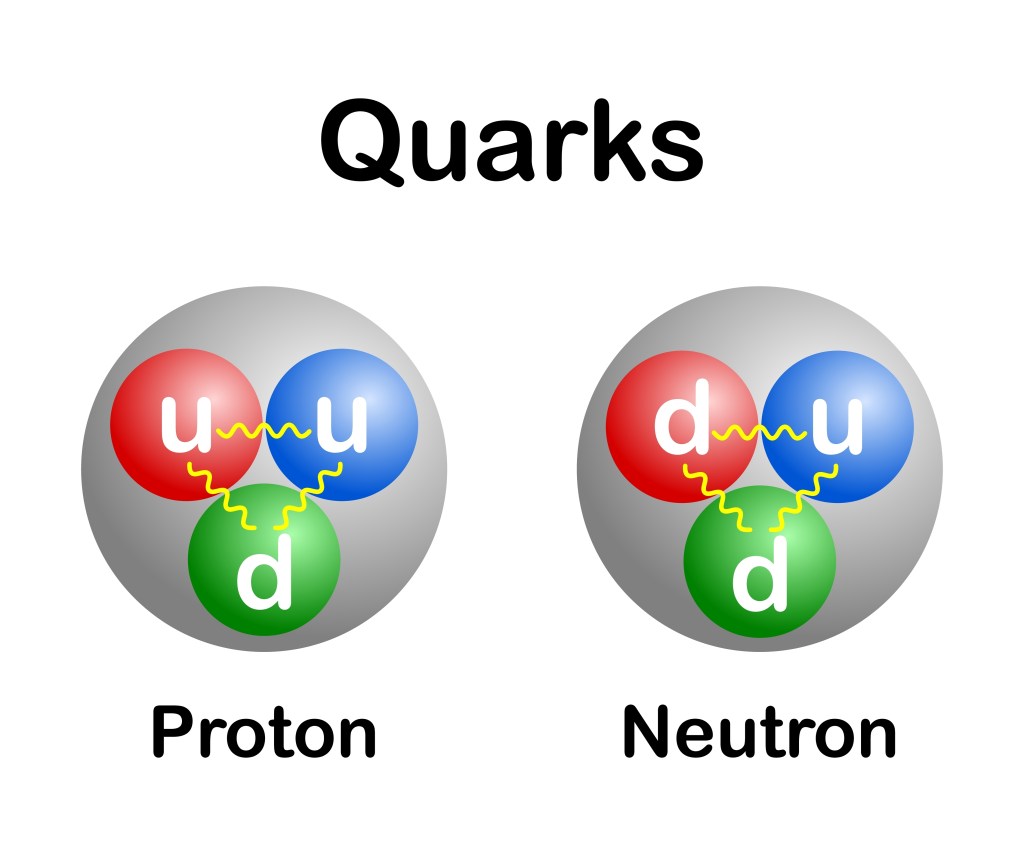
vector illustration of up and down quarks in proton and neutron on white background. The proton (left) is a red and blue up quark and a green down quark. The neutron is a red and green down quark and a blue up-quark. | The Greatest Intellectual Achievement
The proton and neutron each consist of three quarks. Protons consist of two up quarks and one down quark. Neutrons consist of two down quarks and one up quark. Both protons and neutrons have a net white charge. The yellow squiggly lines are gluons transporting color charge between the quarks. Asset id: 2333679305 by KRPD.

Electron / positron

Neutrino / anti-neutrino

Up quark / anti up quark

Down quark / anti down quark

muon / anti-muon

Mu Neutrino / anti-mu-neutrino

Charm quark / anti charm quark

Strange quark / anti strange quark

tau / anti-tau

Tau Neutrino / anti-tau-neutrino

Top quark / anti top quark

Bottom quark / anti bottom quark

The quarks can be used to build other particles, but leptons cannot. For example, a quark and an anti-quark pair form a particle called a meson (there are many kinds of mesons). A triplet of quarks is called a Baryon. An example of a baryon is the proton which consists of two up quarks and one down quark. Another example is the neutron which consists of one up quark and two down quarks. So just like electrons, protons and neutrons build atoms; the quarks build other elementary particles, for example, protons. As mentioned, the six flavors of Quarks are up, down, strange, charm, top and bottom.

However, the Quarks also have colors (well they are not real colors), red, blue and green which sort of correspond to the three kinds of charges for the strong nuclear force. Based on this new model a new Quantum Field Theory called Quantum-Chromodynamics (QCD) was created which together with QED would form the basis of “The Standard Model of Elementary Particles”. This was also a very straight forward chapter that was both interesting and not very difficult to understand. Again, Oerter makes the story interesting and captivating. This is perhaps the most interesting chapter in the book.

To learn more about Protons, Neutrons, Quarks, Gluons, Color Charges, and Quantum Chromodynamics you can watch this 10 minute video below.


Chapter 9: The Weakest Link

Despite the eightfold way, the Quarks, QED and QCD, all was still not well. The Weak Nuclear force was still not fully understood. Martinus Veltman, Steven Weinberg, Abdus Salam, and Sheldon Glashow were the people chiefly responsible for developing a theory for the weak nuclear force. It involved W+, W- and Z0 Bosons and something called spontaneous symmetry breaking.

These theories in turn led to something called the Higgs field and the so called Higgs particle or Higgs Boson (named after Peter Higgs who first introduced the concept of spontaneous symmetry breaking in elementary particle theory). The Higgs particle provided the physics community with a very nice surprise. The Higgs particle gives electrons (and other leptons) and the Quarks their mass. Unexpectedly we thus got an explanation as to why many elementary particles have mass and therefore why matter exists. This is why the Higgs Boson is often referred to as the God particle. It just showed up because of the theories explaining the weak force and turned out to be what created our Universe by giving the elementary particles their mass.

There was just one problem. The Higgs Boson had not yet been found when this book was written. Once the Large Hadron Collider (LHC) came online it became possible to find the Higgs Boson. This final touch to the Standard Model was the one that was the most difficult to grasp. I had a hard time understanding what spontaneous symmetry break really was, and the Mexican hat potential, etc. I think that Oerter needs to look over this chapter and find a different approach to explaining spontaneous symmetry break. I think that Oerter actually sorts of “gave up” at this point. This topic is too abstract for the layman so instead of making a good effort explaining spontaneous symmetry.

What looks like the inside of particle collider with particles flying around. | The Greatest Intellectual Achievement
Collision of Particles in the Abstract Collider. From iStock photos.

Chapter 10: The Standard Model at Last

The standard model is built from relativistic quantum field theory, specifically QED and QCD. In chapter 9 QED was incorporated into electroweak theory which led to the Higgs Boson etc. QED is interwoven together with QCD to create a single theory whose essential elements can be written in a single equation.

Yes, that is right; an equation of everything, or almost everything. This equation is stated on 207 in this chapter. The equation over all equations that there ever was. You should buy this book just to look at it.

The Langrangian function that summarizes all of the propagators and interactions in the standard model.

The equation of everything is not as complicated as you may think. It is a Lagrangian function that summarizes all propagators and interactions, and it contains 18 adjustable numerical parameters. I admit that I don’t understand the equation fully, but Oerter explains the parameters and as mentioned it is just a big Lagrange function. As Oerter states “this equation is the simplicity at the bottom of it all, the ultimate source of all complex behavior that we see in the physical world; atoms, molecules, solids, liquids, gases, rocks, plants and animals”.

Oerter also discusses the birth of the Universe in the context of the Standard Model. In my opinion this was a very cool chapter, and Oerter does a good job at exciting the reader in this chapter. Naturally the equation of everything is a little bit difficult to understand and if you don’t know what a differential equation is you can forget about it. However, understanding the equation of everything is not important. The main point of this chapter is that there is such an equation.

Chapter 11: The Edge of Physics, Chapter 12: New Dimensions

As Oerter states in chapter 11 “The standard model is by far the most successful scientific theory ever. Not only have some of its predictions been confirmed to spectacular precision, one part in 10 billion for the electron magnetic moment, but the range of application of the theory is unparalleled. From the behavior of quarks inside the proton to the behavior of galactic magnetic fields, the Standard Model works across the entire range of human experience. Accomplishing this with merely 18 adjustable parameters is an unprecedented accomplishment, making the Standard Model truly a capstone of twentieth-century science.” However, this is not the end of physics. Gravity is explained by the General Theory of Relativity but is not incorporated into the Standard Model.

There is also dark matter and dark energy which is not part of the Standard Model. The neutrinos seem to have mass; however, they are predicted to have no mass in the Standard Model. In addition, it would be nicer to have fewer adjustable parameters than 18. Is there may be a better theory? In chapter 12 Oerter is discussing Grand Unified Theories (GUT), or SO(5) and SO(10) theories as well as super string theories, and M-theories. These are theories that might be able to do everything the Standard Model can do plus what it cannot do. However, none of these theories have ever predicted anything, so unlike the Standard Model they are speculation. There is some controversy regarding these issues, and I think Oerter might have been a tiny bit biased against super string theory here. However, he still explains what super string theory is about pretty well.

Final Conclusion and Recommendation

I highly recommend this book for anyone who wants to understand something about our world and the Universe. However, don’t expect to understand everything, it is not written so that you can. I wish Physicists would become a little better at explaining these matters to the layman using nice descriptive pictures and a little bit of math too (don’t assume math is always bad). I once read a 30 page long Swedish book on the special theory of relativity that successfully explained the kinematics, dynamics, and magnetism in relativity to your average high school kid. The Lorenz transforms, formulas for acceleration, E = mc² and magnetism were derived using simple algebra and a tiny bit of calculus at one point. That is the way these kinds of books should be written, but I have seen this only once in my life. Excluding this single example (the Swedish book), Oerter’s book is one of the best books on Physics for the layman that I have ever read.
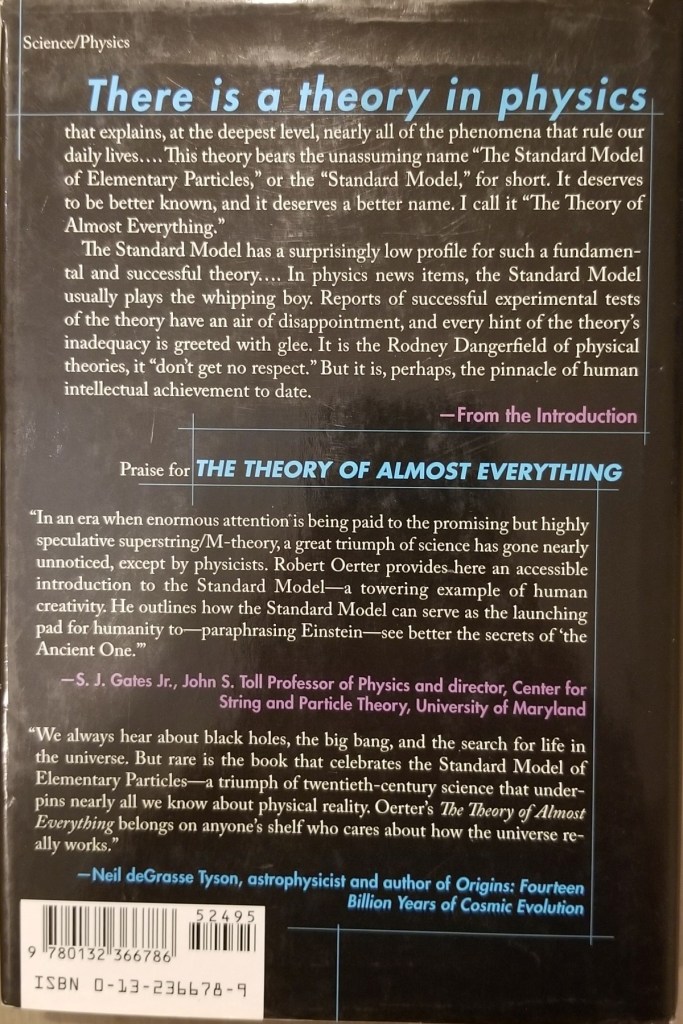
Back cover of The Theory of Almost Everything: The Standard Model, the Unsung Triumph of Modern Physics by Robert Oerter.
Back cover of The Theory of Almost Everything: The Standard Model, the Unsung Triumph of Modern Physics by Robert Oerter. Click on the image to go to the Amazon page for the paperback version of the book.

Here are some other posts that are related to the content of this book.


To see the Super Facts click here

Relativity by Albert Einstein

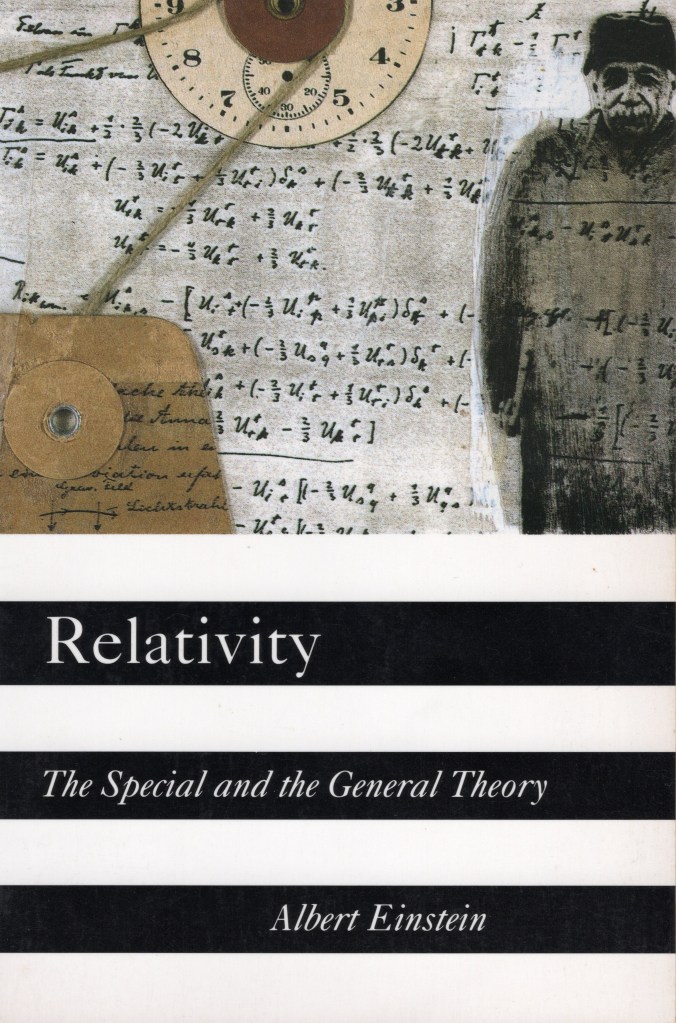
This is not a super fact post but another kind of fact-oriented post. It is a book review for a book that I find interesting, Relativity: The Special and the General Theory by Albert Einstein. Yes, the book was written by Albert Einstein in 1916 and translated into English in 1920. It is written for laymen, average readers, and despite being more than 100 years old (well this reprint is from 1995) it does not feel outdated.

I should say that I wrote my review decades ago and Amazon has hidden about 900 of the oldest reviews including mine. So, you can no longer find it. Luckily, I still had it, but I cannot provide a link to it. The book comes in formats, hardcover (2024), paperback (1995), Kindle (2014), Audio (2009). I bought the paperback version.

  • Publisher : Independently published (July 29, 2024), ASIN : B0DBQVVJVQ, ISBN-13 : 979-8334454118, 109 pages, item weight : 7.8 ounces, dimensions : ‎ 6 x 0.47 x 9 inches, Translator : Robert W. Lawson, it costs $12.33 on US Amazon. Click here to order it from Amazon.com.
  • Paperback –  Publisher : Crown (June 6, 1995), ASIN : 0517884410, ISBN-13 :  978-0517884416, 208 pages, item weight : 8 ounces, dimensions : ‎ 5.2 x 0.5 x 8 inches, it costs $7.89 on US Amazon. Click here to order it from Amazon.com.
  • Kindle –  Publisher : Amazon Kindle Direct Publishing (February 23, 2014), ASIN : B004M8S53U, 126 pages, it costs $0.99 on US Amazon. Click here to order it from Amazon.com.
  • Audiobook –  Publisher : HighBridge, a division of Recorded Books (November 14, 2009), ASIN : B002XGLDAA, Listening Length : 2 hours and 14 minutes, it costs $12.09 on US Amazon. Click here to order it from Amazon.com.
The front cover of the paperback version feature Albert Einstein in front of a black board full of equations, title “Relativity: The Special and the General Theory” and author – Albert Einstein | Relativity by Albert Einstein
Front cover of Relativity: The Special and the General Theory by Albert Einstein. Click on the image to go to the Amazon page for the paperback version of the book.

Amazon’s Description of Relativity by Albert Einstein

This book was originally written in German by Albert Einstein in 1916 and later translated to English by Robert W. Lawson in 1920. In Einstein’s own words, “The present book is intended, as far as possible, to give an exact insight into the theory of Relativity to those readers who, from a general scientific and philosophical point of view, are interested in the theory, but who are not conversant with the mathematical apparatus of theoretical physics. It is an easy-to-understand collection of the ideas of one of the greatest scientists of the twentieth century including the idea he is most known for, the theory of relativity.

Redesigned inside and out to have a fresh, appealing look, this new edition of a classic Crown Trade Paperback is a collection of Einstein’s own popular writings on his work and describes the meaning of his main theories in a way virtually everyone can understand.

Below is my review for Relativity: The Special and the General Theory by Albert Einstein. First, I should mention that the book is divided into two sections, one for the Special Theory of Relativity and another for the General Theory of Relativity. In addition, there are five short appendices. The five appendices are not written for layman and require at least high school mathematics.

Relativity Explained by Einstein himself

I found it very interesting to read an explanation of the theories of relativity by the developer of those theories. However, it is important to remember that the inventors of science theories aren’t always the best ones to explain them. Isaac Newton is a prime example.

Another thing to remember is that today there are a lot of books and online graphics that use clever pedagogic techniques and visualizations to assist you in understanding these theories, and naturally this book does not contain any of that.

This book was originally written in 1916 and updated in 1920 and since then it has been reprinted/edited several times (as this book is an example of). I should say that the General Theory of Relativity had just been published so there weren’t much else out there for laymen at the time.

I’ve already read many good books on relativity, and I believe I understand special relativity pretty well, but my understanding of general relativity is partial. I did not buy this book to understand relativity. The reason I bought this book was to gain another perspective on the subject. If you just want to learn and understand relativity, I recommend Relativity Visualized by Lewis Carroll Epstein instead.

“Relativity: The Special and the General Theory” features no derivations of the formulas in relativity (except in the appendix) and no visualizations demonstrating relativistic effects and phenomena. The book is focused on the conceptual foundations of relativity and physics.

For example, what are Geometrical propositions, what does it mean to measure the length of a rod, or the time of an event, what do we mean by speed, what is simultaneity, what is the difference between what we observe and what we measure, etc? Einstein spends one and a half page explaining addition of velocities in classical-pre-relativistic kinematics (w = v + u) and what assumptions that are inherent with the approach. In that sense the book is quite philosophical, which is what I meant by “another perspective”. The book covers both the Special Theory of Relativity and the General Theory of Relativity. However, the sections on the General Theory of Relativity are quite short and very introductory.

There are some issues with the book. In appendix 1 Einstein (I presume) derives the Lorentz transforms. However, it is not, in my opinion, the best derivation from a pedagogical standpoint and it also had typos in it. As far as I can tell the formula on page 50 is wrong unless what Einstein means with the “m” is “additional relative mass” and not actual “mass” as stated.

The book features an addition written in 1920 where he is discussing an ad hoc modification to his theory that he had previously made but it turned out to be unnecessary (related to cosmology). The language is also very old fashioned. On the other hand, this kind of stuff makes you feel as if you travel back in time to when the theories of relativity were being churned out.

I don’t recommend the book for learning the theories of relativity but overall I liked the book. It focuses very much on basic concepts and near philosophical aspects of time, space and relativity. The book presents a valuable perspective if you already understand what the theories of relativity are about.

The back cover of the paperback features an overview of the background to relativity and to this book as well as ISBN number and publisher | Relativity by Albert Einstein
Back cover of Relativity: The Special and the General Theory by Albert Einstein. Click on the image to go to the Amazon page for the hardback version of the book.

Other Relativity Related Posts


To see the Super Facts click here

What is Time

Image above by Kevin from The Beginning at Last

Many and strange are the universes that drift like bubbles in the foam upon the River of Time—first sentence of Wall of Darkness by Arthur C. Clarke, 1949.

What is Time? What is the arrow of time? Does entropy define an arrow of time? Is there a past and a future? Has time always existed as, for example, in the eternal inflation cosmological model in which universes continuously pop into existence via Big Bangs like the bubbles on the River of Time in the Arthur C. Clarke quote above. Does time have a beginning as a recent Big Bang model by Stephen Hawking imply. If time came into existence with the universe itself then there is no place for creation, just as in an infinitely existing universe. There cannot be anything north of the north pole, and there cannot be anything before time itself.

In the theories of relativity time is relative. The speed of clocks as well as the order of events differ from observer to observer. The presence of energy or mass will bend time. There is no universal flow of time. There is no universal time.

The goal of this blog is to create a list of what I call super facts. Important facts that we know to be true and yet they are surprising, shocking or disputed among non-experts. It is a type of myth busting. However, I also create posts that are not super facts but that feature other interesting information, such as this book review and book recommendation.

In the picture there are objects from the past as well as futuristic elements and several clocks | What is Time
This picture reminded me of the mysteries of time. This is a submission for Kevin’s No Theme Thursday

About Time: Einstein’s Unfinished Revolution by Paul Davies

The book I am about to present focuses a lot on relativity. This is not strange since the theories of relativity shed a lot of light on time. Yes, pun intended. I’ve come across a lot of people who make various claims about time, and even consider themselves philosophers of time, and yet they do not even understand the special theory of relativity.

Because of this they say a lot of profound sounding things about time that ultimately are nonsensical. There is no way around it. If you want to say profound things about time and expand human knowledge on this topic you need to first have some understanding of relativity as well as other related physics such as thermodynamics and entropy. This book will provide that.

I should say that the book is somewhat outdated, being written in 1995 and 1996. However, most of it is still relevant and I know of no other book that approaches the topic in such an honest and rigorous way. The book comes in two formats hardcover and paperback. I bought the paperback version.

  • Hardcover –  Publisher – Simon & Schuster; First Edition (March 13, 1995), ISBN-10 : 0671799649, ISBN-13 : 978-0671799649, 316 pages, item weight : 1.3 pounds, dimensions : ‎ 6.25 x 1.25 x 9.5 inches, it costs $18.09 on US Amazon. Click here to order it from Amazon.com.
  • Paperback –  Publisher – Simon & Schuster; First Edition (April 9, 1996), ISBN-10 : 0684818221, ISBN-13 : 978-0684818221, 316 pages, item weight : 0.704 ounces according to Amazon but I think that should be 0.704 pounds, dimensions : ‎ 9.21 x 6.14 x 0.8 inches, it costs $12.28 on US Amazon. Click here to order it from Amazon.com.
Front cover of hardback version of the book About Time: Einstein's Unfinished Revolution by Paul Davies
Front cover of hardback version of the book About Time: Einstein’s Unfinished Revolution by Paul Davies. Click on the image to go to the Amazon page for the hardcover version of the book.

Amazon’s Description of About Time: Einstein’s Unfinished Revolution

An elegant, witty, and engaging exploration of the riddle of time, which examines the consequences of Einstein’s theory of relativity and offers startling suggestions about what recent research may reveal.

The eternal questions of science and religion were profoundly recast by Einstein’s theory of relativity and its implications that time can be warped by motion and gravitation, and that it cannot be meaningfully divided into past, present, and future.

In About Time, Paul Davies discusses the big bang theory, chaos theory, and the recent discovery that the universe appears to be younger than some of the objects in it, concluding that Einstein’s theory provides only an incomplete understanding of the nature of time. Davies explores unanswered questions such as:

* Does the universe have a beginning and an end?

* Is the passage of time merely an illusion?

* Is it possible to travel backward — or forward — in time?

About Time weaves physics and metaphysics in a provocative contemplation of time and the universe.

My four-star review for About Time: Einstein’s Unfinished Revolution

The link above will take you to my original review for About Time: Einstein’s Unfinished Revolution. Below is a slightly modified version of the review.

Our Evolving Concept of Time

Science, particularly physics, has revealed to us some profound insights about time, and yet it remains a mysterious topic. In the first chapter of the book “A Very Brief History of Time” the author describes how the concept of time has evolved throughout human history. The ancient philosophers had a very fuzzy notion of time, and they often dismissed both motion and time as illusions. The author tells us about “cyclic time”, and the “linear time” concept from Judeo-Christian thinking, and how it was incorporated into science as a “time variable”. This made it possible to solve the paradoxes created by such Greek thinkers as Zeno, who based on apparent paradoxes concluded that motion and time cannot really exist. Those “false” paradoxes were solved with the concept of linear physical time.

Physical time also made Calculus and Physics possible, and it became clear that there was a difference between physical time, which is a measurable entity used to sequence events, and experienced time, which is the subjective human feeling of a past, present, and a future.

Most of the rest of the book is focused on the Special Theory of Relativity and the General Theory of Relativity. The theories of relativity revolutionized how we view time, and they enabled a much deeper understanding of time. Special relativity refuted the concept of universal absolute time. Not only do clocks in different systems run at different speeds, but there is no universal “Now”.

However, the theories of relativity are not all there is to know about time, and we are not even done drawing conclusions about time based on the theories of relativity. This is why the book is called “About Time Einstein’s Unfinished Revolution”. The book also discusses quantum time, the arrow of time, worm holes, neuroscience and modern psychological experiments.

The book contains a lot of information and yet it scratches only on the surface. Time is a quite complex concept when you start digging into it. Take, for example, the discussion on the arrow of time. The conclusion of the books seems to be that there really is an arrow of time. Time has direction. The author is presenting both “sides” of the issue and to really get a grasp of the issue you need to clarify and look at the physics. Time certainly seems to have a direction if you look at the concept of entropy. The Cosmos is filled with irreversible processes. Our memory, which is essential for our experience of a self, is another example.

However, time has a direction even on the most fundamental level in subatomic particles. Kaon, a type of meson, decays in a way that is not time symmetric. The same may be true for the neutron. These particles “know” the difference between the past and the future. One could easily imagine how this chapter could be turned into a several thousand pages long book by just digging deeper into the related physics.

“About Time Einstein’s Unfinished Revolution” covers a lot of interesting topics related to time and it is often quite informative. The book is also well written, well organized, it has a good pace, and it is very interesting. It strikes a good balance between depth and breadth, and it does not overwhelm its readers. However, I do have some critique of the book, which prompted me to give the book four stars instead of five stars.

To understand some of the discussions in the book you should have a decent understanding of the theories of relativity, in my opinion. The author is explaining the theories of relativity to some degree, but the explanations did not seem to be that good. I did not have a problem with understanding these explanations since I already studied these topics, but I don’t think I would have understood what I needed to understand had I encountered the theories of relativity for the first time while reading this book.

Another criticism I have of the book is that he introduces ugh Everett’s many-worlds interpretation of quantum mechanics and in my opinion promotes it. This interpretation is in my opinion both strange and implausible and is not necessary for the discussions in the book.

In short, it proposes that every quantum measurement creates new universes, each corresponding to a different possible outcome of that measurement. In essence, our Universe is just one of many, and each quantum event splits the universe into multiple versions, where each version experiences a different outcome.

The problem with this interpretation is not so much that you get multiverses, but that you an infinite number of new fully evolved universes every nanosecond, which in turn create an infinite number of universes, which in turn create an infinite number of universes, and so on infinitely, and there is no way to empirically verify their existence. It is a so-called solution to a problem that is fictitious in my opinion and is derived from an old naïve interpretation of quantum waves. It is “hip” and “cool” interpretation, but I don’t see how it is useful. I should add that I have no problem with, for example, the multiverse idea stemming from string theory.

Anyway, except for my two complaints I think this is a pretty good book that I can recommend.

Front cover of paperback version of the book About Time: Einstein's Unfinished Revolution by Paul Davies.
Front cover of paperback version of the book About Time: Einstein’s Unfinished Revolution by Paul Davies. Click on the image to go to the Amazon page for the paperback version of the book.

About Paul Davis

Paul Davies is an internationally acclaimed physicist, cosmologist, and astrobiologist at Arizona State University, where he runs the pioneering Beyond Center for Fundamental Concepts in Science. He also chairs the Search for Extraterrestrial Intelligence Post-Detection Taskgroup, so that if SETI succeeds in finding intelligent life, he will be among the first to know.

The asteroid 1992OG was officially renamed Paul Davies in his honor. In addition to his many scientific awards, Davies is the recipient of the 1995 Templeton Prize–the world’s largest annual prize–for his work on science and religion. He is the author of more than twenty books, including The Mind of God, About Time, How to Build a Time Machine, and The Goldilocks Enigma. He lives in Tempe, Arizona.

Other Relativity Related Posts

To see the Super Facts click here

The Pole-Barn Paradox and Solution

Super fact 39 : Relativistic length contraction goes both ways. If two observers are moving compared to each other both will observe the length of the objects in the other’s system to be shorter in the direction of motion. The first observer will think that a yard stick in the second observer’s frame will be shorter whilst the second observer will think that the yard stick in the first observer’s frame is the shorter one.

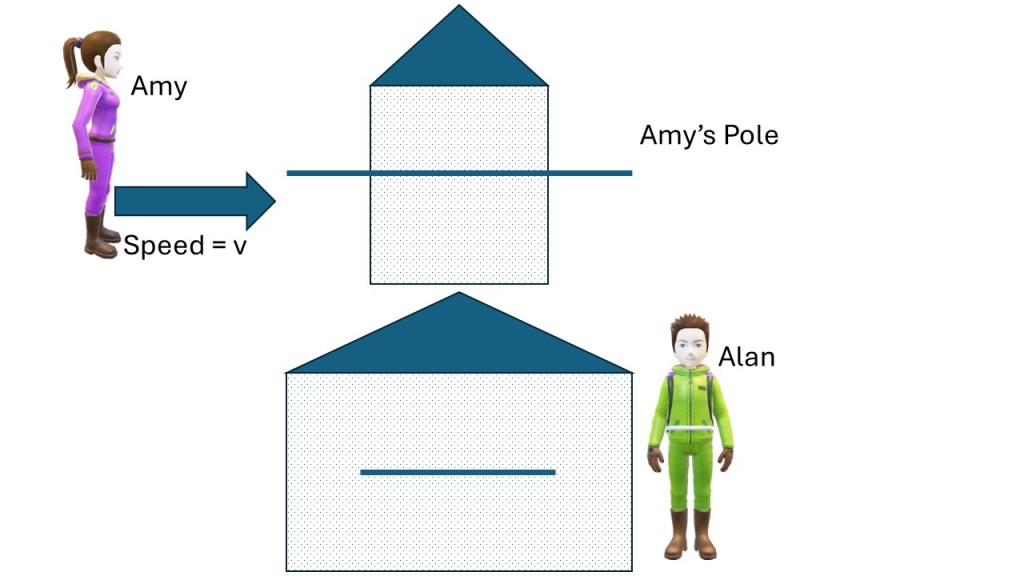
Assume a pole and a barn are of equal length when both objects are stationary. If the pole is moving (at a high speed) compared to the barn, then the pole will be shorter than the barn from the barn’s perspective but longer than the barn from the pole’s perspective. Does the pole fit inside the barn or not? This is referred to as the pole-barn paradox, or the barn-door paradox, or the ladder paradox (if a ladder is used instead of a pole).

I call this conundrum a super fact because whilst most people have heard of relativistic time dilation and perhaps length contraction, the fact that it goes both ways comes as a surprising head scratcher. The situation is analogous to my super fact post “Time Dilation Goes Both Ways” where I state:

Super fact 38 : If two observers are moving compared to each other both will observe the other’s time as being slower. In other words, both observers will observe the other’s clocks as ticking slower. Time slowing down is referred to as Time Dilation. And this post is about how time dilation goes both ways.

Both the time dilation paradox and the pole-barn paradox are solved by the non-simultaneity in relativity. However, the pole-barn paradox is more concrete and perhaps more in your face. You can easily imagine the problematic paradox.

A picture of a girl, Amy who is speeding past a man, Alan and his barn. Amy has a pole. The pole is contracted along the direction of motion from Alan’s perspective and the barn is shorter along the direction of motion from Amy’s perspective | The Pole-Barn Paradox and Solution
Amy is speeding past Alan and his barn at a high speed. Amy has a pole. Because of the high-speed Amy’s pole appears shortened and will easily fit in Alan’s barn. However, to Amy it is Alan’s barn that is contracted, and her pole has the normal length and will therefore not fit in Alan’s barn.

Postulates of Special Relativity

The two postulates of special relativity are:

  • The laws of physics are the same in all inertial frames of reference. An inertial frame is a system that moves at a constant velocity.
  • The speed of light in a vacuum is constant for all observers, regardless of the motion of the light source.

The first postulate is called the principle of relativity and goes all the way back to Galileo Galilei. It means that no experiment can determine whether you are at rest or moving at a constant velocity. The reciprocity of length contraction follows from this postulate. If the length of the pole in the example above is half as long as the barn in both the barn frame and the pole frame then you could tell who was standing still and who was moving from that fact, and that violates the first postulate. The first postulate demands that if the pole is half as long in the barn frame and that the barn is half as long in the pole frame.

The second postulate is the more shocking one and is special to relativity. It was discovered experimentally at the end of the 19th century but was too difficult for scientists to accept at first so various ad hoc explanations were put forth to explain it away, until the theories of relativity were created. I designated this postulate as my super fact #4 and you can read about it here.

Length Contraction

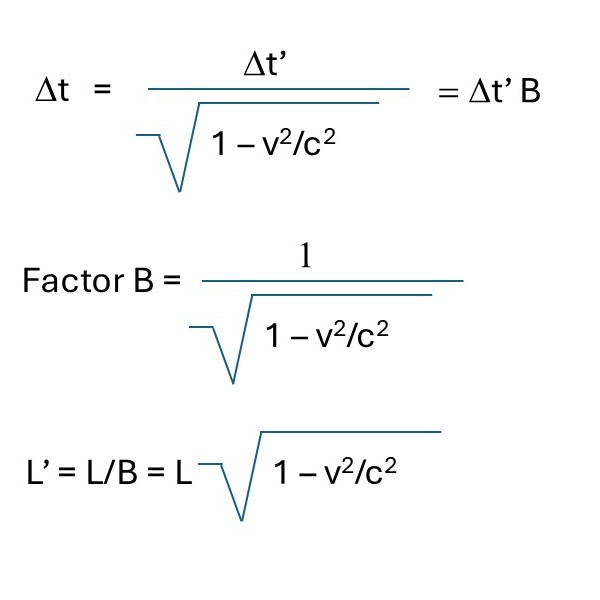
Time dilation means that a time interval between two events in a certain frame is longer by a factor B in a frame moving relative to the first frame (see picture below). Let’s imagine Amy moving at the speed v compared to Alan and his barn. Amy passes the left side of the barn at a certain time and soon after the right side. The time difference from Alan’s perspective is T and the width of the barn is L, so L = vT. From Amy’s perspective the time difference is T’ and width of the barn L’ and L’ = vT’. We denote Amy’s measurements with a prime. Note the velocity must be the same in both systems. However, Amy’s clock ticks slower (from Alan’s perspective) so T’ = BT or T = T’/B (time dilation). So, L’ = vT’ = vT/B = L/B.

If the derivation of the formulas above is confusing to you, ignore the math, and just remember that Alan measures a shorter time for the passing of the pole (because Amy’s clock is slower) from his perspective and therefore the pole must be shorter as measured from his system. If Alan measures two seconds for the passing of the pole than Amy measures maybe four seconds. It is Amy’s pole, so her longer measurement corresponds to the proper length of the pole whilst Alan’s measurement is the contracted length. Note the length contraction can only happen along the direction of motion, not perpendicular to it. To read more about length contraction click here.

This picture shows the formula for time dilation, the expression for the beta factor, and the formula for length contraction | The Pole-Barn Paradox and Solution
The beta factor used in the formula for time dilation as well as length contraction.

Solution to the Pole-Barn Paradox

So, Amy’s pole cannot fit in Alan’s barn. The pole is moving fast so it must move in and out of the barn. Now let’s create the paradox. Imagine the barn having doors on each side that open for the moving pole and then close for a moment to entrap the pole and then they open as the pole leaves the barn. Here is the paradox, if they open and close at the same time, than the pole can be inside the barn (entrapped) from Alan’s perspective but not from Amy’s perspective. From Amy’s perspective the pole does not fit.

However, the solution to the paradox lies in “open and close at the same time”. If the doors open and close at the same time from Alan’s perspective, then they don’t open and close at the same time from Amy’s perspective.

From Amy’s perspective the door on the left side will open first and let the pole in and then after that the right door will open. After the pole has fully entered the barn and some of it is sticking out on the right-hand side then the left door will close but the door on the right will remain open  until the pole is entirely outside. Relativistic non-simultaneity solves the paradox.

A picture of a girl, Amy who is speeding past a man, Alan and his barn. Amy has a pole. The pole is contracted along the direction of motion from Alan’s perspective and the barn is shorter along the direction of motion from Amy’s perspective. There are two doors on each side of the barn. In Amy’s world the left door is open letting the pole into the barn, whilst the right door is closed. In Alan’s world both doors are close thus enclosing his shorter pole.
In Alan’s frame the doors can be closed at the same time and enclose Amy’s pole. In Amy’s frame the doors open and close to let the pole through but they don’t open and close at the same time.

Finally, below is a YouTube video that explains and solves the pole-barn / barn-door / ladder paradox simply and efficiently in a little over two minutes.

Book Recommendations on Relativity

To see the other Super Facts click here

Time Dilation Goes Both Ways

Super fact 38 : If two observers are moving compared to each other both will observe the other’s time as being slower. In other words, both observers will observe the other’s clocks as ticking slower. Time slowing down is referred to as Time Dilation. And this post is about how time dilation goes both ways.

A lot of people know that if someone moves very fast his clocks will run slower. That’s relativity. If someone speeds through space in a rocket ship, close to the speed of light his time will slow down. When one hour passes on earth only half an hour may pass in the rocket. What comes as a shock to many people is when they find out that the converse is also true. When one hour passes in the rocket only half an hour will pass on earth.

Clearly that looks like a contradiction, but there is an explanation. I consider this a super fact because it is so strange and almost impossible for people to believe, and yet it is true.

The image shows two clocks side by side. On the left is a wall clock and on the right a wristwatch | Time Dilation Goes Both Ways
The guy on earth says my clock (left) is ticking double as fast as the rocket man’s clock (right). The rocket man say’s my clock (right) is ticking double as fast as the clock on earth (left). Who is right? Surprisingly both of them.

Postulates of Special Relativity

The two postulates of special relativity are:

  • The laws of physics are the same in all inertial frames of reference. An inertial frame is a system that moves at a constant velocity.
  • The speed of light in a vacuum is constant for all observers, regardless of the motion of the light source.

The first postulate is called the principle of relativity and goes all the way back to Galileo Galilei. It means that no experiment can determine whether you are at rest or moving at a constant velocity. The reciprocity of time dilation follows from this postulate. If the time for the rocket man in the example above was ticking at half the speed compared to the time for the guy on earth and they both agreed, then you could tell who was standing still and who was moving from that fact.

The first postulate demands that they disagree. The guy on earth thinks the rocket man’s clock is ticking at half the speed of his own clock, whilst the rocket man think it is earth man’s clock that is going slow. Therefore, you can’t tell who is standing still, which is what the first postulate requires.

The second postulate is the more shocking one and is special to relativity. It was discovered experimentally at the end of the 19th century but was too difficult for scientists to accept at first so various ad hoc explanations were put forth to explain it away, until the theories of relativity were created. I designated this postulate as my super fact #4 and you can read about it here.

The picture shows two people Alan and Amy. Alan is on the ground. Amy is flying by Alan in a rocket speeding left. Both Alan and Amy are pointing lasers to the left | Time Dilation Goes Both Ways
In this picture Amy is traveling past Alan in a rocket. Both have a laser. Both measure the speed of both laser beams to be c = 299,792,458 meters per second. The speed of light is a universal constant.

Time Dilation

In the pictures below I am showing two rocket systems in space, Amy’s rocket and Alan’s rocket. They are travelling at a high speed compared to each other. Each rocket has a light clock that consists of a light beam bouncing up and down between a mirror in the ceiling and a mirror on the floor. The two light clocks are identical, and each bounce corresponds to a microsecond.

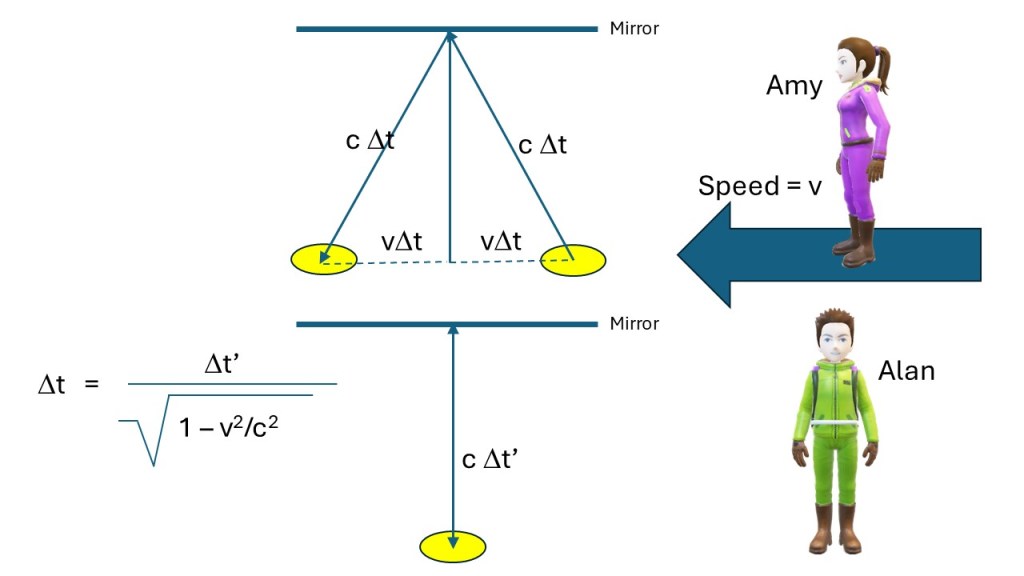
Amy is passing Alan at a high speed, and therefore Alan will see Amy’s light clock running slower than his because Amy’s light beam must travel further. Remember, the speed of light is identical for both light clocks (light speed is a universal constant). For those interested I am also deriving the formula for time dilation.

The picture shows two systems, each with a clock consisting of light beams bouncing between mirrors. In this set up Alan is stationary compared to us and therefore his light beam only moves vertically.
Alan and Amy have identical light clocks. We call the time it takes for the light beam to go from the floor to the ceiling (one clock tick) Dt in Amy’s case and Dt’ (reference frame) for Alan. Amy is speeding past Alan towards the left. From Alan’s perspective Amy’s clock is running slower. Using Pythagoras theorem, it is possible to derive the formula for time dilation shown in the lower left corner.

Since Amy moving left is the same as Amy standing still and Alan moving right you can say that Alan is the one moving fast. In this case it is Alan’s light clock that is ticking slower because from this viewpoint it is his light beam that has to travel further. From Amy’s perspective it is Alan’s clock that is going slower.

The picture shows two systems, each with a clock consisting of light beams bouncing between mirrors. In this set up Amy is stationary compared to us and therefore her light beam only moves vertically | Time Dilation Goes Both Ways
It is equally correct to say that Amy is standing still and that it is Alan that is moving fast to the right. This time (pun not intended) it is Alan’s clock that is ticking slower. Dt corresponds to Alan’s clock ticks and Amy’s clock ticks are Dt’.

This seemingly contradictory situation is resolved by the fact that Amy’s and Alan’s perspectives will drift apart as they continue their journey. They will increasingly disagree on whether events are simultaneous or not, and they will disagree in which order events occur. This is another shocking fact, or as I refer to it, super fact. It is strange but it resolves the apparent contradiction of reciprocal time dilation. I am explaining this in greater detail in this post.

The Twin Paradox

But what happens if one of Amy or Alan decides to turn around so that they meet up again. If Amy’s clock runs slower from Alan’s perspective and Alan’s clock runs slower from Amy’s perspective, how can you reconcile that when they meet up again? It turns out that whoever is turning around or accelerating or decelerating to turn back is the one who will have the least time pass. If Amy is the one turning back, then she will age less than Alan. During her acceleration she will see Alan’s clock starting to run faster and faster until he is older her.

Let say Alan’s clock is running half the speed of Amy’s clock from Amy’s perspective and Amy’s clock is running half the speed of Alan’s clock from Alan’s perspective. Let’s also say that Amy traveled to the left for 10 years before turning around.

From Alan’s perspective she would have traveled 20 years before turning around. However, from Amy’s perspective 5 years would have passed on Alan’s clock. As she turns around Alan’s clock will run faster and catch up so that when they meet up again Amy will be aged 20 years, while Alan will be aged 40 years. That is 35 years of catching up for Alan’s clock from Amy’s perspective. Alan’s clock advanced 35 years from Amy’s perspective after Amy turned around. In the end Amy will be the younger one.

The picture shows Amy on the left turning around and Alan on the right. Text explains what happens | Time Dilation Goes Both Ways
Observe that the fast-forward advancement of Alan’s clock from Amy’s perspective happens only while Amy is in the process of turning around (accelerating / decelerating). Further, how fast the fast forward happens depends on the distance as well. Once Amy is traveling at a constant speed again (inertial frame) Alan’s clock will run slower again from Amy’s perspective.

A somewhat halting but OK analogy for the 35 years of catching up that happens on Alan’s clock from Amy’s perspective is when you turn a boat around on a wavy sea. As you are moving in the direction of the waves the waves will hit you much less often (if at all) but after you turn around and move against them the waves will hit your boat very frequently. Alan’s clock will run faster for Amy whilst she is turning around.

Book Recommendations on Relativity

To see the other Super Facts click here