The Edge of the Observable Universe is 46.5 billion Light Years Away

Super fact 67 : The Edge of the Observable Universe is 46.5 billion light years away despite the age of the Universe being 13.8 billion years. We can see 3.4 times further than light can travel in 13.8 billion years.

Esther’s writing prompt: October 29 : Edge

Click here or here  to join in.

That sounds impossible at first. The age of the universe is 13.8 billion years. How can we see something that is farther away than 13.8 billion light-years if that’s how long the light had to travel. The reason it works is that space itself has been expanding the entire time that the light has been traveling toward us. The light we see today from the most distant regions of the universe was emitted 13.8 billion years ago, but the space between us and the origin of that light has stretched enormously. You can say that the light hitched a ride on the expanding space.

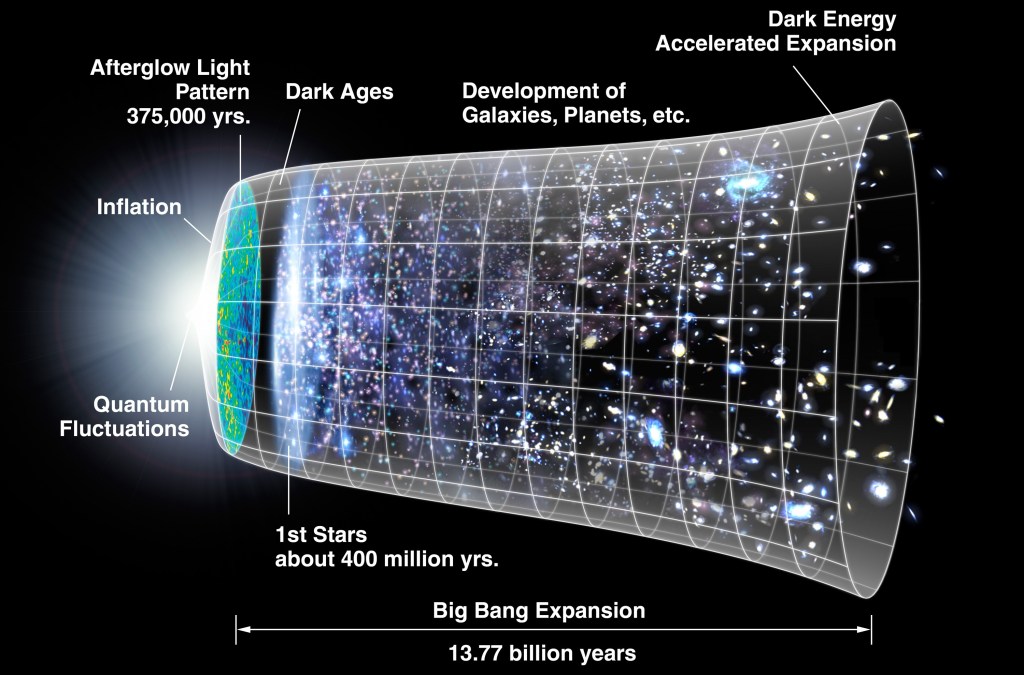
The pictures show an expanding Universe starting with quantum fluctuations followed by inflation, then an afterglow light pattern 375,000 after the Big Bang and then the so-called dark ages, the creation of stars and galaxies. | The Edge of the Observable Universe is 46.5 billion Light Years Away
An overview of the last 13.8 billion years. This file is in the public domain in the United States because it was solely created by NASA. From Wikimedia commons.

As mentioned, the edge of the observable universe is now about 46.5 billion light-years away in every direction, which means that the observable universe is about 93 billion light-years across (46.5 billion light years times 2) vastly larger than what you’d expect if you just multiplied the age of the universe by the speed of light. Beyond that observable edge there may be much more—possibly an infinite Universe, but it is forever hidden from us because light hasn’t had time to reach us yet and will never reach us.

The speed of light in vacuum is a universal constant and nothing can travel faster then the speed of light. However, space itself can expand faster than the speed of light if measured across large enough distances. The distance between two points in space can expand faster than the speed of light if that distance is large enough. This is possible because there is nothing material that is traveling faster than light. It is just the space of the Universe itself expanding because of dark energy.

Space is expanding right where you are standing too. Can you feel space expanding around you? Well, probably not but it is. I consider this a super fact because it is an important aspect of our view of the universe, it is surprising to those who did not know it before, and it is true.


Galaxies are Moving Beyond the Observable Universe

In the future the far away galaxies will continue to move away from us faster and faster, and beyond a certain distance their light will no longer ever reach us again. Therefore, more and more galaxies will disappear from our view. They won’t vanish physically; they’ll just slip beyond our observable horizon. In about 100 billion years, observers in the Milky Way (or what is left of it) may only see the Local Group of galaxies (Milky Way, Andromeda, etc.). Everything else will have faded out of visibility.

Our Local Group of galaxies consists of 80 galaxies compared to the estimated two trillion galaxies in the current observable universe. That means that the observable universe at that point will have 25 billion times fewer galaxies than now, or in other words only 0.000000004% of the galaxies in the observable universe will remain observable.

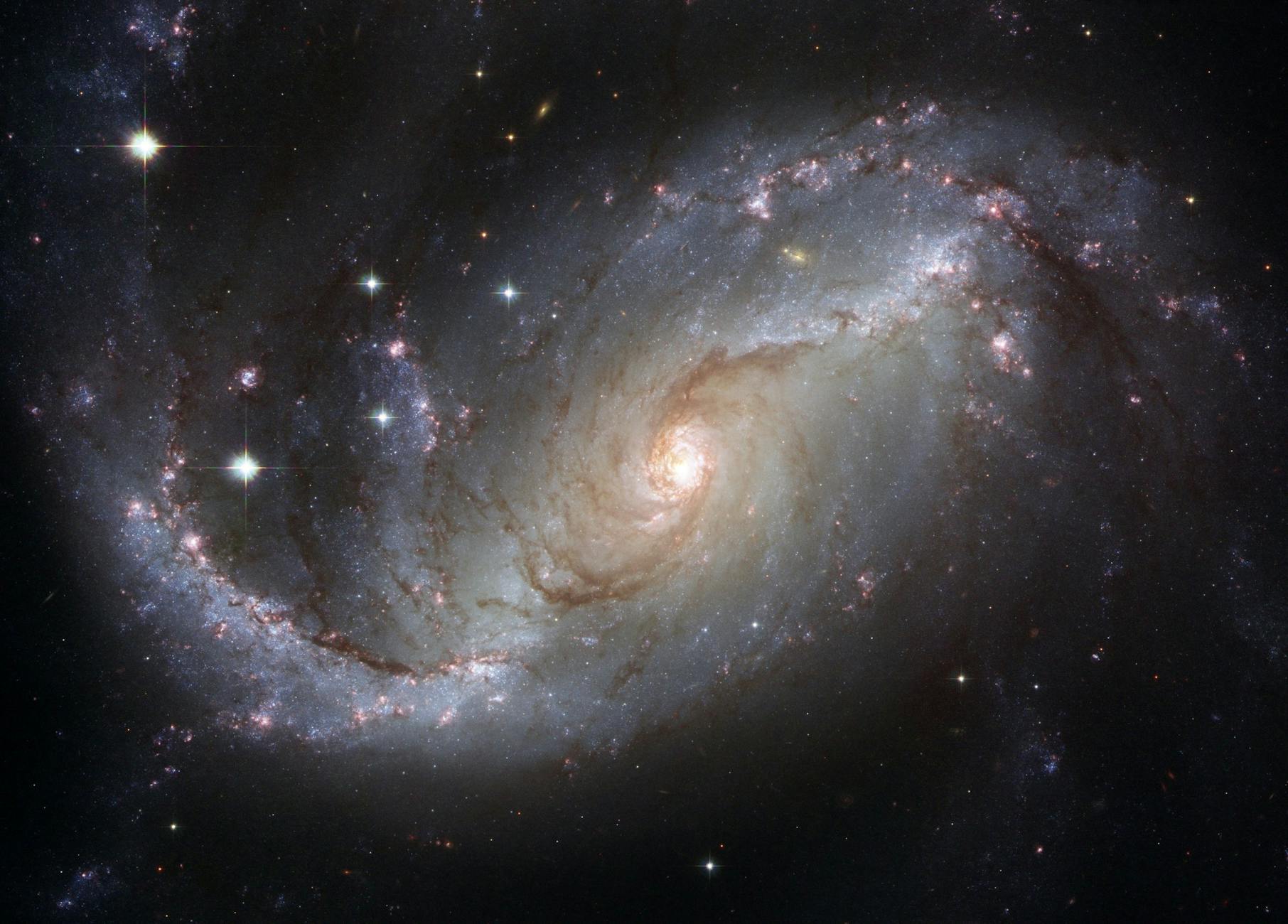
3D rendered Digital Illustration of a cluster of galaxies. | The Edge of the Observable Universe is 46.5 billion Light Years Away
Large-scale structure of Multiple Galaxies in Deep Universe. When will all these galaxies forever disappear beyond the edge of the observable universe. Asset id: 389006449 by vchal

The Cosmological Event Horizon Another Edge of the Universe

Beyond roughly 16 billion light-years, galaxies recede faster than light due to the expansion of space. Again, that’s allowed in relativity because it’s space expanding, not them moving through space faster than light. Eventually, most of them will cross a boundary called the cosmic event horizon. Once they do, their light will never be able to reach us, not even given infinite time. We can still see these galaxies because of the light they emitted in the past, but the light they emit now will never reach us.

The cosmological event horizon, not to be confused with the event horizon for a black hole, is 16 billion light years away. That is another limit, or edge of the universe. Below is a 10 minute video explaining both the horizon / edge of the observable universe and the cosmological event horizon for those who are interested.

Black Holes Edges of the Universe

A black hole with a large bright accretion disk.
3D illustration of giant Black hole in deep space. High quality digital space art in 5K – realistic visualization. Stock Illustration ID: 2476711459 by Vadim Sadovski.

A black hole is a region of spacetime where gravity is so strong that nothing, including light, can escape it. The boundary of no escape is called the event horizon. If you pass the event horizon you cannot come back out no matter how much energy you use. Nothing can escape, no matter, no radiation, not light, or other electromagnetic radiation, and no information. Nothing at all can escape. The curvature of time and space itself forbids it.

I should add that right at the event horizon, there is so called Hawking radiation, but without complicating things it is not the same thing as escaping a black hole. You can guess from physical laws what might be inside, but you can never observe and report what is inside to planet Earth. In a sense, the event horizon of a black hole is another edge of the Universe. You can read about different types of black holes here. You can read more about black holes here, or here.

Below is an animation created by NASA that depicts what an observer falling into a black hole would see.

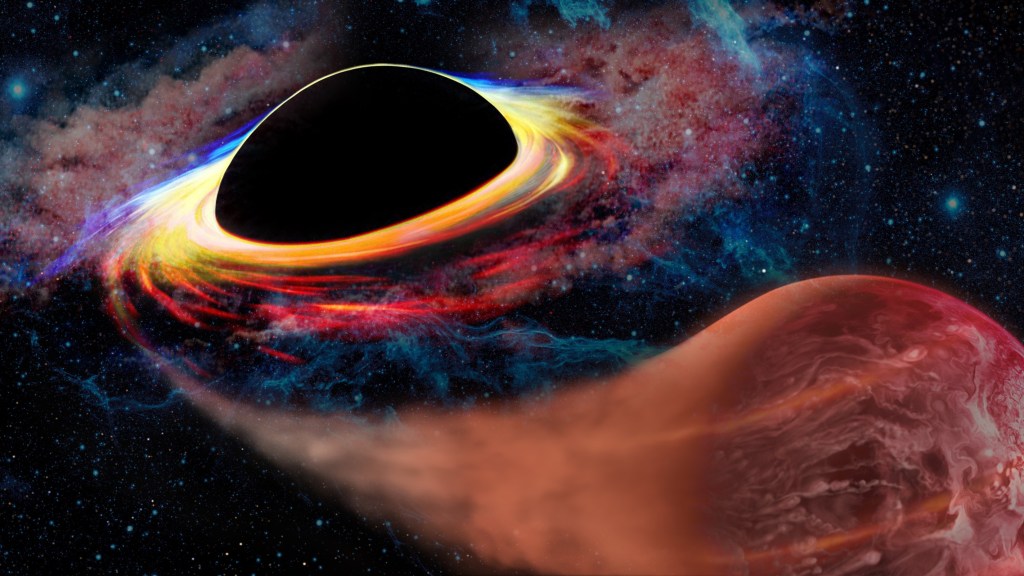
Black hole devouring a planet. The planet is on the right. It is being consumed.
Black hole devouring a planet. Black Hole Stock Photo ID: 2024419973 by Elena11
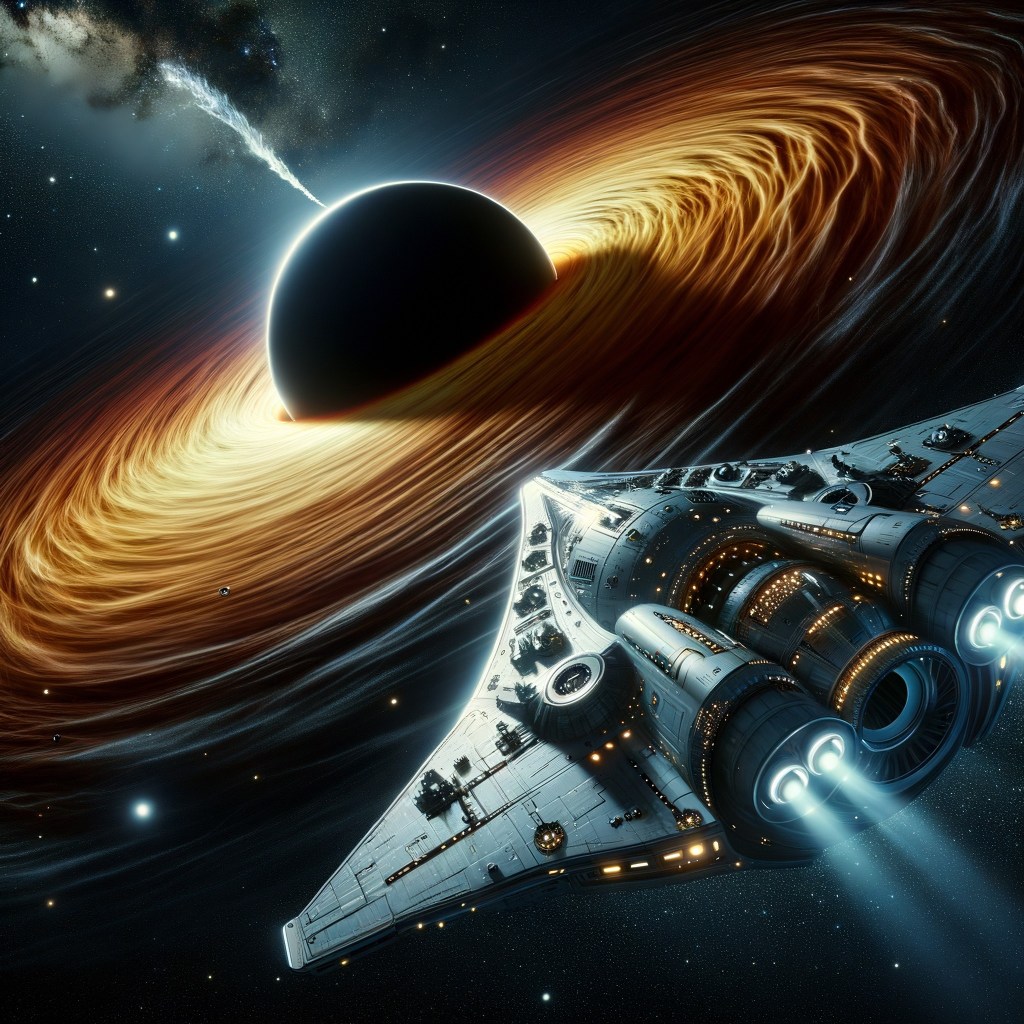
A black hole with an orange accretion disk is approached by futuristic starship. | The Edge of the Observable Universe is 46.5 billion Light Years Away
Realistic spaceship approaching a black hole. This content was generated by an Artificial Intelligence (AI) system. Stock AI-generated image ID: 2448481683 AI-generated image Contributor Shutterstock AI Generator.
A depiction of a black hole surrounded by a space-time geometric grid that is bending due to gravity.
AI-generated image Description : This image depicts what a black hole is doing to space around it. Gravity bends space time depicted as a grid. Stock AI-generated image ID: 2457551367 by AI-generated image Contributor Shutterstock.AI
Fuzzy orange blur surrounding a black speck.
The photo of the supermassive black hole at the center of the galaxy M87 taken by the event horizon telescope in 2017. CC BY 4.0, Event Horizon Telescope, uploader cropped and converted TIF to JPG, CC BY 4.0 <https://creativecommons.org/licenses/by/4.0&gt;, via Wikimedia Commons.
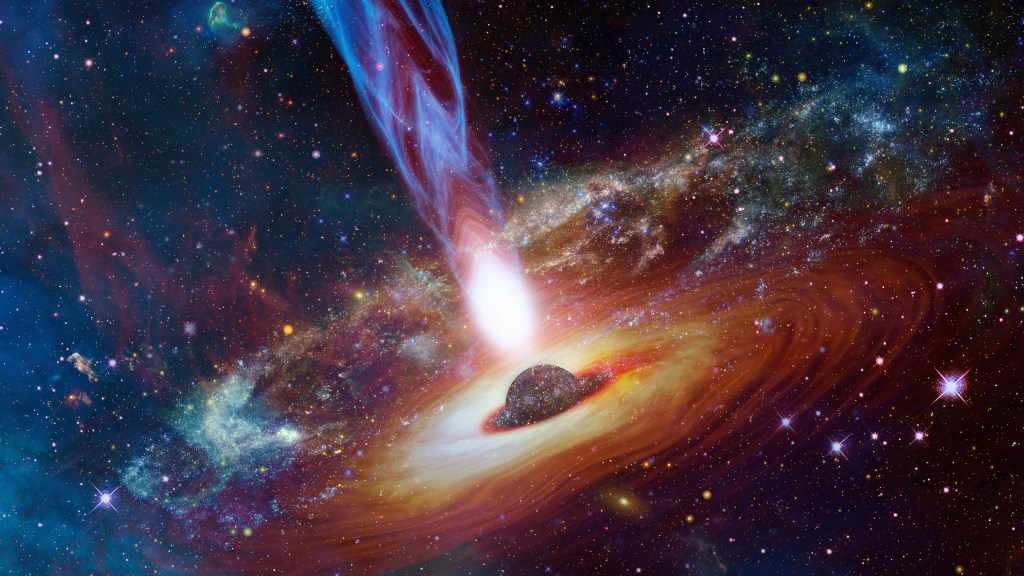
The quasar is ejecting an enormous energy beam. In the background are stars possibly being absorbed by the quasar. | The Edge of the Observable Universe is 46.5 billion Light Years Away
Quasar in deep space (a huge black hole emitting an energy beam). Elements of this image furnished by NASA. Asset id: 1758938918. by NASA images.


To see the Other Super Facts click here

The Little Book of Cosmology

Cosmology is the science of the origin and development of the universe, and this post is about a book on Cosmology, The Little Book of Cosmology by Lyman Page. This is a big and, in my opinion, interesting topic. A lot of cosmology is speculative, multiverses, what was before the big bang, has the universe always existed, has there been an infinite number of big bangs, what about conformal cyclic cosmology in which each cycle result in a new big bang (Roger Penrose), what is the future and end of the universe, is the Universe a hologram, is it self-aware, etc.

This book is not focused on scientific speculation but on what we know about the structure of the universe, the big bang and the expansion of the universe, the well understood basics. I think it is amazing how much we can learn from the Cosmic Microwave Background Radiation (CMB).

The goal of this blog is to create a list of what I call super facts. Important facts that we know to be true and yet they are surprising, shocking or disputed among non-experts. Super facts are special facts that a well-informed person may want to know. However, I sometimes create posts that are not super facts but just interesting information, such as this one. The Little Book of Cosmology is a relatively short and easy read. I bought the hardback version of it.

  • Hardcover –  Publisher : Princeton University Press; First Edition (April 7, 2020), ISBN-10 : 0691195781, ISBN-13 : 978-0691195780, 152 pages, item weight : 2.31 pounds, dimensions : 5.59 x 0.79 x 8.58 inches, it costs $15.39 on Amazon. Click here to order it from Amazon.com.
  • Kindle –  Publisher : Princeton University Press (April 7, 2020), ASIN : B07Z1DWB4P, 132 pages, it costs $9.99 on US Amazon. Click here to order it from Amazon.com.
The front cover features the title, the author, and geodesic lines forming a hyperbolic cone mesh | The Little Book of Cosmology by Lyman Page
Front cover of The Little Book of Cosmology. Click on the image to go to the Amazon page for the hardcover version of the book.

Amazon’s description of The Little Book of Cosmology by Lyman Page

The cutting-edge science that is taking the measure of the universe

The Little Book of Cosmology provides a breathtaking look at our universe on the grandest scales imaginable. Written by one of the world’s leading experimental cosmologists, this short but deeply insightful book describes what scientists are revealing through precise measurements of the faint thermal afterglow of the Big Bang—known as the cosmic microwave background, or CMB—and how their findings are transforming our view of the cosmos.

Blending the latest findings in cosmology with essential concepts from physics, Lyman Page first helps readers to grasp the sheer enormity of the universe, explaining how to understand the history of its formation and evolution in space and time. Then he sheds light on how spatial variations in the CMB formed, how they reveal the age, size, and geometry of the universe, and how they offer a blueprint for the formation of cosmic structure.

Not only does Page explain current observations and measurements, he describes how they can be woven together into a unified picture to form the Standard Model of Cosmology. Yet much remains unknown, and this incisive book also describes the search for ever deeper knowledge at the field’s frontiers—from quests to understand the nature of neutrinos and dark energy to investigations into the physics of the very early universe.

This is my five star review for The Little Book of Cosmology

What the Cosmic Microwave Background (CMB) can tell us

This is a short book describing the evolution of the Universe since the Big Bang and its composition. How do we know all this stuff? The Cosmic Microwave Background (CMB) can tell us a lot.

The CMB is a black body radiation remnant from the time (400,000 years after the Big Bang) when the Universe had cooled enough to allow the formation of hydrogen atoms and the decoupling of photons from electrons so that they could roam free.

CMB is in itself evidence for the Big Bang but in addition we get additional information from the minor anisotropy and polarization of the CMB, and add the composition of the elements (hydrogen, helium, lithium, and heavier elements), redshifts of galaxies, gravity lensing, and we can tell quite a bit about the evolution of the Universe and where it is heading.

It’s fascinating science detective work. This eventually leads to the Standard Model of Cosmology, which is something I’ve never heard of before, but it’s cool.

I found the facts about the size and age of the Universe, the early giant stars in the Universe, dark energy and dark matter, very interesting. The book is filled with basic and fascinating facts that I did not know. Because of the CMB (rather than particle accelerator experiments) we know roughly the mass (rest mass) of neutrinos.

We know why dark energy can’t be space dust, or rogue planetoids, or black holes or neutrinos, so what is it? The book explains why it can’t be any of those. There’s a lot we can know because of the CMB and other information, and some things we don’t know. Finding out what we do know was quite exciting and finding out what the mysterious “what we don’t know” was equally exciting. Again, the focus is on CMB and how it is measured, it tells us a lot.

The book is easy to read and require no degree in physics or mathematics. I admit I have a degree in Engineering Physics, and I am also interested in astronomy and cosmology, but I can tell it was light reading. It is a truly popular science book like those that Neil De Grasse Tyson writes, and it was short but very informative. There’s a lot of information you can extract from CMB. It was a fun short read for anyone interested in the mysteries of the Universe.

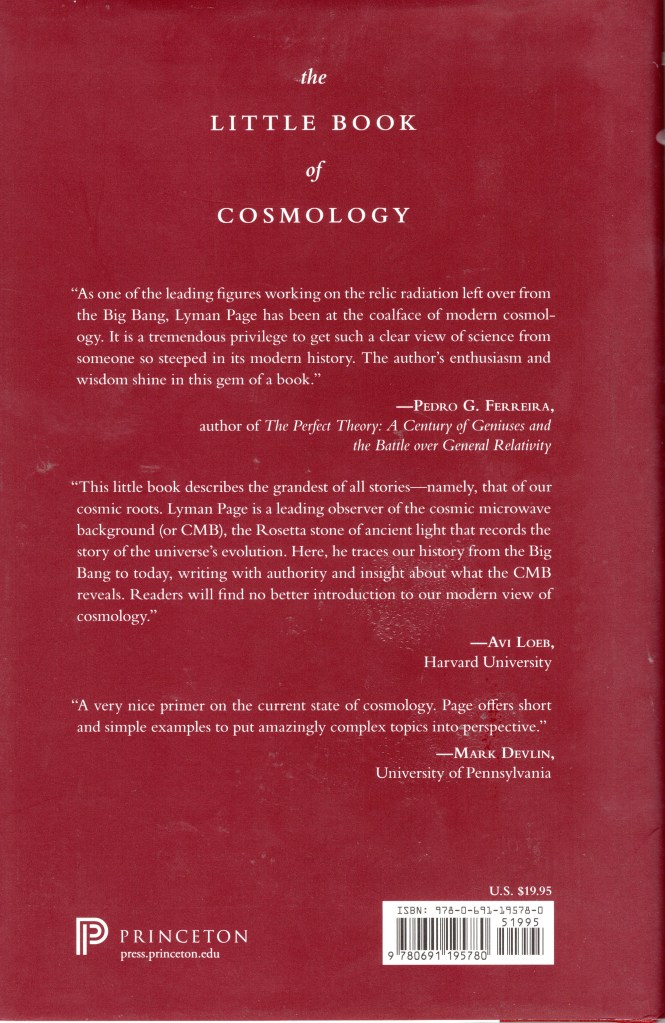
The back cover feature advanced praise for the book | The Little Book of Cosmology by Lyman Page
Back cover of The Little Book of Cosmology. Click on the image to go to the Amazon page for the kindle version of the book.

To see the Super Facts click here


The vastness of space and the beginning of infinity

Superfact 14: The vastness of space and the beginning of infinity

The Universe is unimaginably large. Our solar system is enormous. It consists of our star, the sun, the planets including earth, dwarf planets, asteroids, comets, rocks, the Kuiper belt, the Oort cloud, and much else. It is 100,000 times wider than the distance between the sun and our earth. Yet it is just one star system among between 100 and 400 billion in our galaxy, the Milky Way. 

But that is not all. According to the Nobel Prize winner in physics, Roger Penrose, our universe is just one in an eternal (infinite) series of universes, an eternal chain of Big Bangs that has always existed. See his conformal cyclic cosmology (CCC) model (and the book cycles of time).

According to Stephen Hawking, M-theory, an extension or collection of string theories, states that there are 10^500 or 10000000000000…(followed by five hundred zeros) possible multi-verses that are all equally possible. Hugh Everett’s multiverse or multi-world theory states that there are infinitely many universes.

Now try to imagine the size of it all. You can’t do that, can you?

The vastness of space and the beginning of infinity
Photo by Pixabay on Pexels.com

About The Universe

When the astrophysicist Brian Cox was asked the question “what is the one fact about the Universe that blows your mind the most?”, he answered, “One. Just the size and scale of it…”.

At first, I thought his answer was a bit boring. I mean, what about neutron stars, which essentially are giant atomic nuclei? What about the amazing mysteries surrounding black holes, and what about supermassive black holes, quasars, magnetars, the great attractor, what about the big bang, quantum physics, massless particles, the amazing general theory of relativity, dark energy, etc.

Then I tried to imagine the size and scale of the universe and I realized that he knew what he was talking about. The more you think about it, the more it blows your mind.

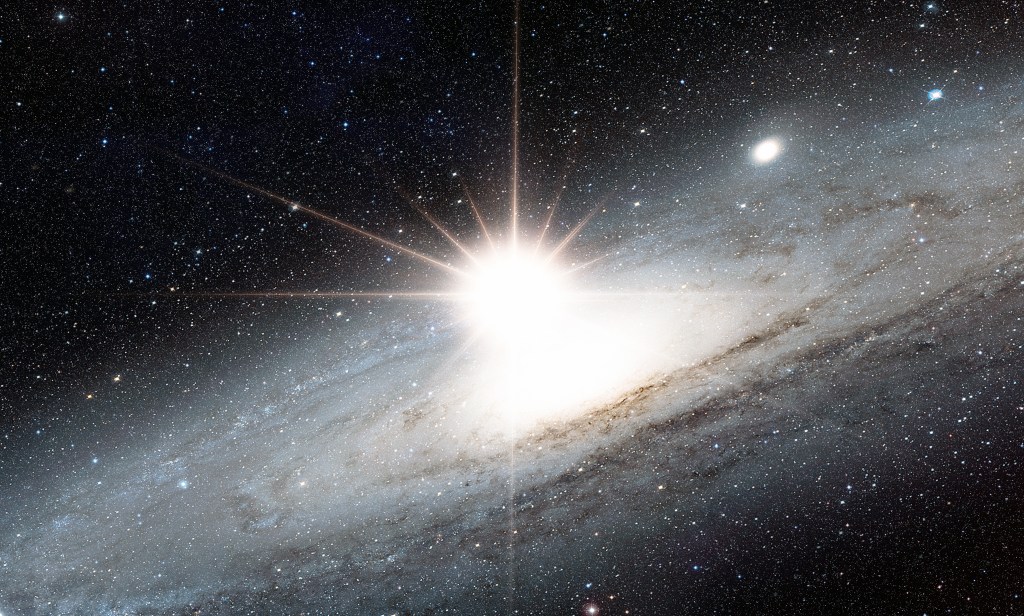
A picture of the Andromeda Galaxy with a bright white light near its center. The bright light is almost outshining the entire galaxy.
An illustration of the Andromeda galaxy with a supernova explosion near its center. “Elements of this image furnished by NASA” Stock Photo ID: 2495486227 by muratart.

The vastness of space and the beginning of infinity

Below is a 55 second video in which astrophysicist Brian Cox ruminates on what it means to live a finite fragile life in an infinite eternal Universe.

Our sun is a star. The sun’s diameter is 109 times larger than earth’s diameter, which means that you could fit more than one million earths inside the sun. The distance between the sun and the earth is called an astronomical unit or 1 AU. 1 AU is approximately 11.7 million times larger than earth’s diameter and 107,340 times larger than the sun’s diameter.

The solar system including all the planets, dwarf planets, asteroids, the Kuiper belt and the Oort cloud is 100,000 AU across with the sun just being a dust speck in the middle.

I mentioned that M-theory implies that there are at least 10^500 multiverses. To get an idea of how bif that number is;  It is a quintillion times a quintillion times a quintillion times a quintillion times a quintillion times a quintillion times a quintillion times a quintillion times a quintillion times a quintillion times  a quintillion times a quintillion times a quintillion times a quintillion times a quintillion times a quintillion times a quintillion times a quintillion times a quintillion times a quintillion times a quintillion times a quintillion times a quintillion times a quintillion a quintillion times a quintillion times a quintillion times. By the way a quintillion is a million trillion.

The vastness of space and the beginning of infinity
Photo by Philippe Donn on Pexels.com

Below are two more videos. The first one is trying to give a perspective on the size of our solar system, our galaxy, and the Universe. It is 11 minutes and 9 seconds long. The second one is very long, half an hour, and it is a bit advanced, so I recommend it only to star nerds.

However, at 22 minutes and a bit more than 30 seconds it states the observable universe is less than a 15 millionth of the universe (which might be even bigger) which contains at least 30 quintillion galaxies.


To see the other Super Facts click here