
Super fact 52 : Climate change, including increased heat, extended drought, and a thirsty atmosphere, has been a key driver in increasing the risk and extent of wildfires in the United States, particularly the western United States during the last two decades. The number of Wildfire acres burned in the United States has significantly increased even though the number of wildfires has not. Another important factor is forest management.
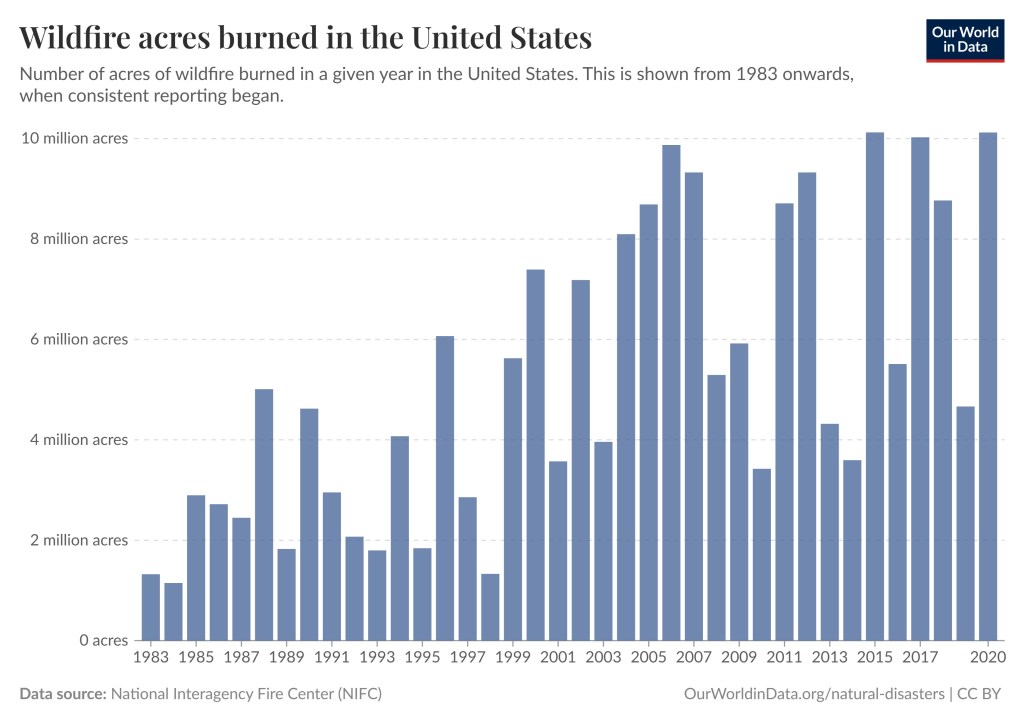
To some people this does not come as a surprise. However, due to the complexity of the issue combined with political spin, this is a surprise to me, or even something they refuse to believe. I’ve come across many people who are surprised to hear that there really is a connection between climate change and wildfires in regions of the world which are getting dryer and hotter due to climate change. There are also others who are surprised to hear about the complex picture and the importance of good forest management. In any case, since it is a surprising fact to many, and an important fact, I consider it a super fact.
As super fact 52 above states, Climate change is a key driver in the worsening of wildfires in the US, particularly in the American West. A 2016 study published in PNAS found that human-caused climate change caused over half of the documented increases in fuel aridity since the 1970s and doubled the cumulative forest fire area since 1984. I can add that we know that Climate Change, or if you call it Global Warming, is Happening and is Caused by us, primarily due to our burning of fossil fuels. I can also add that Scientists Agree that Global Warming is happening and that we are the Cause.
Wildfires and the Complex Statistical Picture
In general, you can’t look at wildfire statistics and draw conclusions without considering the context. Below are some considerations.
- Wildfires are not started by climate change or poor forest management. They are started by lighting, falling powerlines, campfires that are not properly put out, and sometimes by arson. That doesn’t mean that climate change and poor forest management does not increase the risk and extent of wildfires.
- Research organizations such as NOAA recognize that wildfire is a natural part of the western US ecosystem. However, climate change is significantly exacerbating the problem by creating conditions more conducive to intense and widespread wildfires.
- Suppression of fire in certain ecosystems may in fact increase the likelihood that a wildfire will occur.
- There are wildfires started intentionally to prevent future wildfires.
- In the past, forests evolved with frequent, low-intensity fires that helped clear out underbrush. They can have ecological benefits. Therefore, the number of wildfires may not have increased over the last 100 years.
- Local conditions and forest management have evolved through time complicating the wildfire statistics around the world.
- In the past reporting was not always consistent.
That does not mean that we don’t know whether climate change worsens wildfires or not. Research organizations such as NASA, NOAA, NOAA (again), NOAA on LA fires , Ohio University, are all in agreement on the fact that Climate change has been a key driver in increasing the risk and extent of wildfires in the United States. Other organizations such as AccuWeather, Texas 2036, the Nature Conservancy, IFAW, American Progress, and the New York Times concurs.

Fix Our Forest Act
Climate change is a huge problem that is going to take decades to tackle and the whole world needs to be involved in that effort. However, we can quickly address wildfires here in the US, especially the American West by addressing the other half of the problem, forest management. There is currently a bill in congress called the Fix Our Forest Act that does that. It streamlines and enhances forest management based on the science. In the house of representatives, it has the number H.R.471 and in the Senate it is S.1642.
I was recently in Washington DC to do volunteer lobbying for these bills. You can read about it here.
To see the other Super Facts click here

 Super Facts
We have had very significant and worsening forest fires all over this country in the last few years; almost all of them started by lightning. There are major fires in two of the western provinces at the moment; unbelievably we have been getting complaints from politicians in your mid-west states about the smoke.
Many of these complainers are also climate change deniers, so I would say that another arm of your discussion should be the need to educate people about the issues. Our fires are mainly in wilderness areas, so forest management as such isn’t the cause so much as the lack of rain, snow, and the higher than normal temperatures all setting the table for a bolt of lightning to get everything going. Our northern areas (north of 60° north latitude) are warming at an alarming rate (as are those of many other northern countries) and of course we’re more readily seeing it happen.
Climate change is definitely a super fact and it does need worldwide effort and attention, but with Trump in office, the world is concerned with the more immediate and pressing problems he’s causing. Climate change is taking a back seat.
LikeLiked by 5 people
Yes I certainly hear you and I agree with you Lynette. In northern Sweden forest management is excellent and still we’ve been visited by extreme wildlfires (close to the arctic circle) due to the dryer and hotter summers. However, both forest management and climate change are important key drivers behind the extent of wildfires. Some want to pretend it has nothing to do with climate change. I can add that as a CCL member I’ve met with many politicians and most of them know that climate change / global warming is real and that we are the cause, but due to peer pressure, pressure from the executive branch, and pressure from their “base” as well as fossil fuel industry advocacy groups such as the Texas Public Policy Foundation, it is very difficult for them to admit that publicly. You are right education is certainly needed.
LikeLiked by 1 person
Thank you very much, Thomas. Good luck in your efforts.
LikeLiked by 1 person
Thank you so much Lynette
LikeLiked by 1 person
I am glad you are going to lobby, Thomas. I will be happily surprised if it gets passed though. I find it strange the people can’t make the connection between climate change and increased wild fires. It is quite obvious to me.
LikeLiked by 2 people
Thank you so much Robbie. I think that some of the stuff we support have a chance of passing. It has happened before. It was baby steps though. I should say that the proposed 25% excise tax on renewables did not pass in congress/Senate. It is believed our phone and writing campaign had something to do with that. Also we protested, together with Texas farmers, against very discriminatory permitting requirements for renewable energy and Governor Abbot and the Texas house let those bad bills (SB388, SB819, SB715) slide. They were never voted on. So I think it is not hopeless.
LikeLike
🙏 I’m so glad to hear this 💗
LikeLiked by 1 person
Excellent post, Thomas. Your paragraph, Wildfires and the Complex Statistical Picture, echoes my beliefs — especially here in the southwestern part of the country. As for the political parties, I disregard them both — unless I determine they are speaking and acting based on the evidence.
LikeLiked by 1 person
Thank you so much Gwen. I agree the politics is messy and both sides have issues. I try to focus on the science.
LikeLiked by 1 person
And that’s why I look forward to your posts… 😊
LikeLiked by 1 person
That is very kind of you to say Gwen
LikeLiked by 1 person
Dear Pulane Phoka, I really admire your blog and writing. I offer guest posting and backlink services that can help grow your website’s domain authority, increase traffic, and improve your reach. I can also help enhance your website’s SEO performance.
If you’re interested in growing your blog further, please feel free to contact me. I would love to assist you at a very reasonable price. Thank you!
Emailgull72049@gmail.com
WhatsApp 923443701642
LikeLiked by 1 person
Thank you for your kind offer gulHasan but my name is not Pulane Phoka.
LikeLiked by 1 person
Spam comment! You should block this, Thomas, or you will see many more.
LikeLiked by 1 person
Hi,
I hope you’re doing well. I specialize in high-quality backlinks and off-page SEO. If you are looking to improve your website’s authority, rankings, and visibility through clean and relevant backlink outreach, I’d be happy to assist.
You can share your niche, metrics, and budget requirements, and I will find suitable sites that match your needs.
Looking forward to working with you.
LikeLiked by 1 person
Thank you so much for your kind offer Guestposting but I am not ready for that just yet.
LikeLike
Okay thanks
LikeLiked by 1 person
Thanks, Thomas. I wish you all the best.
My grandfather worked for the Forest Service as a surveyor in Wisconsin many years ago. By the time I knew him, he was retired, but we were always very aware of fires—and bears!
The ferocity of the fires recently, particularly in the West, seems due in part to drought and the dryness of the landscape. My husband and his friends were at one time involved with a private observatory near Wrightwood, CA. One person in particular was careful to clear brush from the grounds, but when the Bridge Fire came through last year (?), it burned so hot and so fast that nothing could be done. Happily, there was no one in the observatory at the time, or things might have been much sadder.
Historic Amateur Observatory Destroyed in California Wildfires – Sky & Telescope
LikeLiked by 1 person
Thank you so much Denise. Thank you also for the link. I am so sorry about the observatory but I am glad no one was hurt. I subscribe to Sky & Telescope and remember reading this article before.
LikeLiked by 1 person
Lulu: “Our Mama and Dada have been keeping a concerned eye on the situation here in California … A crazy number of acres has already burned this year, and it isn’t even fire season yet. Not good!”
LikeLiked by 1 person
I am so sorry to hear that Lulu. I hope it does not get bad. I wish you all better luck with that.
LikeLike
We’ve been okay here so far but all of the alerts from Watch Duty are getting to be a bit exhausting! Still, better to know what’s popping up than not, right?
LikeLiked by 1 person
Yes it sounds exhausting but information saves many lives
LikeLike
How can people not see the connection between climate change and an increase in wildfires?! There are several burning in Canada as well, including Saskatchewan, Manitoba and northern Ontario. We here in southern Ontario often suffer poor air quality due to the drifting smoke. Everyone suffers! Thank you for stating the facts, Thomas.
LikeLiked by 1 person
Thank you so much for your comment Debbie. I agree, I think you can see it, but you have to back it up with statistics and analysis since it is a complicated topic. There are some who try to dispute it.
LikeLiked by 1 person
When I worked in Flagstaff, Arizona, I lived through several forest fires that threatened the town itself. At least two of the fires were started by homeless people camping in wooded areas and burning campfires. Lightning is a huge causse of wildfires during monsoon season. We’ve had several wildfires start that way on the local level. In Williams, AZ, they do routine burns every year to help prevent wildfires. The problem is the smoke. People with lung problems end up in the emergency room. California’s irresponsible environmental policies actually exacerbate the wildfire problem because brush is not allowed to be cleared. When I studied Emergency Management, I wrote a research paper on the Paradise Camp Fire that displaced so many people. Overgrown brush caught fire when power lines went down. PG & E was not properly maintaining the line, and the State of California would not allow brush to be cleared. And then we have the recent L.A. fires, where fire hydrants contained no water and reservoirs were dry. The Grand Canyon fire that is currently burning is being fueled by high winds and drought conditions. Getting politicians to address water issues, drought, or fire risk is almost impossible if their primary motivation is growth, extending suburbia, and increasing the local population. Their myopic vision increases the chance that we will run out of water or burn down in a fire. But I guess they won’t take it seriously until it actually happens.
LikeLiked by 1 person
I am sorry to hear about the wildfires you are having in Arizona. It is great that you wrote a research paper on the Paradise Camp Fire. I learned something from reading your comment. A lot of the things you bring up in your comment are addressed by the Fix Our Forest Act, such as efficient clearing overgrown brush with less red tape and creating wider and better maintained utilities rights-of-way strips for the power lines.
LikeLiked by 1 person
Thanks for telling me that!
LikeLiked by 1 person
One of the long-term effects of wildfires is the risk of mud slides after the vegetation is burned away and the rain returns. I’ve witnessed this in Arizona and California.
LikeLiked by 2 people
I did not know that but it makes sense.
LikeLiked by 1 person
Thanks for this important post. I work in a wilderness area that nearly burned down three years ago. I have been noticing that the Arizona/New Mexico monsoon has been much less active than it should be over the last five years. Twenty years ago, you could count on rain almost daily in late July and August. For the last couple of years, we’ve been lucky to get rain once or twice a week. I see how stressed and dry the vegetation is at Kitt Peak. Normally after experiencing a wildfire event, it would be a long time before one would have to worry about another. Now, I worry about any lightning strike without rain or an untended campfire setting off another fire in our area.
LikeLiked by 1 person
Thank you so much David. I am sorry the Arizona/New Mexico monsoon has been much less active than it should. I hope there will be no wildfires at Kitt Peak, or anywhere else around there. I wish you all the best with your Astronomer duties without any wildfires interupting you.
LikeLiked by 1 person
What an interesting post! The Fix Our Forest Act sounds helpful; I never knew that forest management had such an impact on this issue. I also didn’t know that some wildfires have ecological impact, so I guess it’s not as cut and dried as it seems.
LikeLiked by 1 person
Thank you Ada. It is an issue people get confused about. Climate Change indeed make forest fires worse, and it is also true that good/bad forest management has a large impact, and then some fires are good fires, and then what actually starts the fires (lightning, powerlines, poorly extinguished campfires) isn’t what’s behind making them worse.
LikeLiked by 1 person
And also you are right, the fires have an ecological impact and make the global warming / climate change problem worse.
LikeLike
Living in the west, I’m well aware that fires are getting bigger and wilder due to drier conditions (climate change). Native Americans have some wonderful ideas about forest management, including controlled burns, which have been used for centuries. I think that some people who are responsible for forest management are starting to listen to the old wisdom.
Thanks for sharing the news about what’s happening in Washington. I’ll read about the Fix Our Forest Act further. Hopefully it’s well thought out.
Thanks, Thomas, for another excellent superfact!
LikeLiked by 1 person
Thank you so much Diane. We are going to need good forest management more than ever and I think the Fix Our Forest Act is a good bill. I think what you describe, controlled burns, is being used to some degree and is likely to be used more in the future.
LikeLiked by 1 person
One of our challenges out here is access. There just aren’t any roads into some of these areas. Satellite identification of “hot spots” helps fire fighters get in there early, but it’s not easy. We’re getting rain today! So needed.
LikeLiked by 1 person
I grew up on the country side in northern Sweden but we did not have any wildfire problems until lately. However, I don’t live there anymore. Now I live in a big city (Dallas). Firefighters not having access sounds scary. I am glad you are getting rain today.
LikeLiked by 1 person
Thanks for spreading the knowledge around Thomas. Wildfires most definitely have much to do with climate change. 🙂
LikeLiked by 1 person
Yes you are right. Thank you very much Debby.
LikeLiked by 1 person
Most welcome Thomas. 🙂
LikeLiked by 1 person
We had 2 fire warnings in Lake County, Calif this weekend. Luckily they were contained quickly! 🩷🙌
LikeLiked by 1 person
That is scary. I am happy they were contained quickly.
LikeLiked by 1 person
Thanks Thomas. We had those big ones awhile back which were devastating!
😱🩷
LikeLiked by 1 person
Yes I believe you are talking about the fires that were all over the news. Horrifying.
LikeLike
Does climate change also increase the risk of floods? There were floods in Arizona the same summer there were floods in California. I think that was like ten years ago or more.
But what about the risk of floods in the tropical rainforest, or in west coasts of continents like Europe and North America, or in the Monsoon Season of South, Southeast, and East Asia? Or the risk of floods in the taiga? Etc.
LikeLiked by 1 person
Yes it does. Warm air holds more water. For example, the 2025 Central Texas flooding that killed 130 people (recently) was made worse by climate change, which created conditions for more intense rainfall. Also hurricanes are getting wetter due to climate change. However, the total picture is complicated. Some places have a higher risk for drought, and sometimes both are true, you can have more droughts as well as more flooding in some places. Thinking about it, this could be another super fact.
LikeLike
Oops! I meant there were floods in Arizona the same summer there were fires in California.
LikeLiked by 1 person
Actually I read it that way without realizing it, but you are right.
LikeLike