
I recently read a very interesting book on the history of our Planet Earth, Becoming Earth: How Our Planet Came to Life by Ferris Jabr. Life of various forms, microbes, fungi, plants, animals, etc., has had a large impact on climate, earth’s crust, the composition of the atmosphere, the oceans, and still do. This fact filled book is about this four and half billion history. Below is my review of the but first something about the book formats.
Becoming Earth Book Formats
Becoming Earth: How Our Planet Came to Life by Ferris Jabr comes in four formats. I bought the hardback format.
- Hardcover – Publisher : Random House (June 25, 2024), ISBN-10 : 0593133978, ISBN-13 : 978-0593133972, 304 pages, item weight : 2.31 pounds: 6.3 x 1.1 x 9.55 inches, it costs $16.68 on US Amazon. Click here to order it from Amazon.com.
- Paperback – Publisher : Random House Trade Paperbacks (April 1, 2025), ISBN-10 : 0593133994, ISBN-13 : 978-0593133996, 320 pages, item weight : 4.8 ounces, dimensions : 5.15 x 0.75 x 7.97 inches, it costs $ 13.57 on US Amazon. Click here to order it from Amazon.com.
- Kindle – Publisher : Random House (June 25, 2024), ASIN : B0CJTLBCDX, ISBN-13 : 978-0593133989, 423 pages, it costs $5.99 on US Amazon. Click here to order it from Amazon.com.
- Audio– Publisher : Random House Audio (June 25, 2024), Listening Length : 9 hours and 27 minutes, ASIN : B0CKM3P33F, it costs $0.99 on US Amazon with membership. Click here to order it from Amazon.com.

Amazon’s Description of Becoming Earth
NEW YORK TIMES BESTSELLER • A vivid account of a major shift in how we understand Earth, from an exceptionally talented new voice. Earth is not simply an inanimate planet on which life evolved, but rather a planet that came to life.
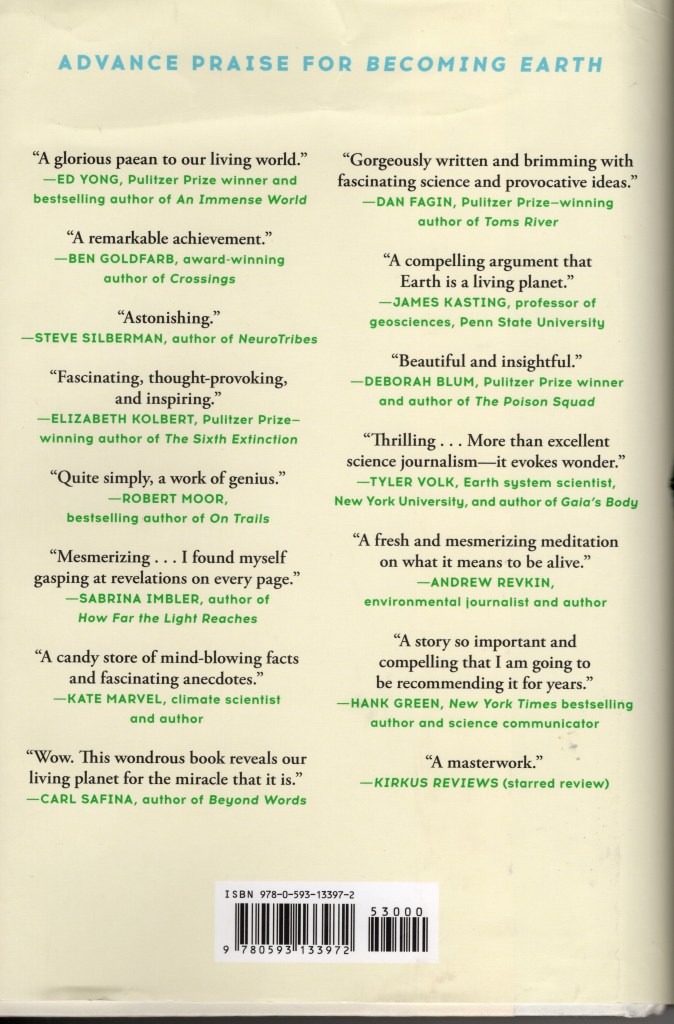
“Glorious . . . full of achingly beautiful passages, mind-bending conceptual twists, and wonderful characters. Jabr reveals how Earth has been profoundly, miraculously shaped by life.”—Ed Yong, Pulitzer Prize winner and bestselling author of An Immense World
FINALIST FOR THE LOS ANGELES TIMES BOOK PRIZE • FINALIST FOR THE OREGON BOOK AWARD • AN AMERICAN LIBRARY ASSOCIATION NOTABLE BOOK OF THE YEAR
A BEST BOOK OF THE YEAR: Smithsonian, Chicago Public Library, Booklist, Scientific American, Nature
A BEST BOOK OF THE SUMMER: The Atlantic and NPR’s Science Friday
One of humanity’s oldest beliefs is that our world is alive. Though once ridiculed by some scientists, the idea of Earth as a vast interconnected living system has gained acceptance in recent decades. We, and all living things, are more than inhabitants of Earth—we are Earth, an outgrowth of its structure and an engine of its evolution. Life and its environment have coevolved for billions of years, transforming a lump of orbiting rock into a cosmic oasis—a planet that breathes, metabolizes, and regulates its climate.
Acclaimed science writer Ferris Jabr reveals a radical new vision of Earth where lush forests spew water, pollen, and bacteria to summon rain; giant animals engineer the very landscapes they roam; microbes chew rock to shape continents; and microscopic plankton, some as glittering as carved jewels, remake the air and sea.
Humans are one of the most extreme examples of life transforming Earth. Through fossil fuel consumption, agriculture, and pollution, we have altered more layers of the planet in less time than any other species, pushing Earth into a crisis. But we are also uniquely able to understand and protect the planet’s wondrous ecology and self-stabilizing processes. Jabr introduces us to a diverse cast of fascinating people who have devoted themselves to this vital work.
Becoming Earth is an exhilarating journey through the hidden workings of our planetary symphony—its players, its instruments, and the music of life that emerges—and an invitation to reexamine our place in it. How well we play our part will determine what kind of Earth our descendants inherit for millennia to come.
My five-star review for Becoming Earth
A Page Turner for People with a Curious Mind
This book gives us a brief overview of the natural history of Earth, emphasizing that not only is life impacted by geological forces, but life is influencing and even creating the composition of the atmosphere, impacting climate and even affecting geological forces. The author explains how microbes, plants, and animals transformed the planet. He is explaining how humans are transforming planet Earth and its climate through fossil fuel consumption, agriculture, and pollution. He is noting that we have altered more layers of the planet in less time than any other species, pushing Earth into a crisis. The author promotes the idea that Earth itself is a living organism (Gaia hypothesis). I am not sure if I entirely buy that idea, but he makes a good case for it.
The book covers a lot of history. Earth is four and half billion years old and a lot has happened. As a result, there are no deep dives into topics. However, the book is filled with hundreds of interesting facts and information, which makes the book a page turner to anyone with a curious mind. One major example of this is that about three billion years ago Cyanobacteria evolved a new type of photosynthesis that used sunlight, water, and carbon dioxide to create energy, while releasing oxygen as a waste product. This transformed the atmosphere and enabled complex life by allowing aerobic respiration to evolve. This invention turned the sky blue, gave us the protective ozone layer, but also caused climate change (snowball Earth) resulting in massive extinctions.
However, there is much more. Another example is that microbes helped transform Earth’s crust. During the first half billion years of Earth’s history, Earth was a water world save for volcanic islands. Trees communicate and assist each other via fungi (Mycorrhizas). Phytoplankton produces 50% of all oxygen, the invention of the Haber-Bosch process more than doubled the world’s crop harvest, there once was 30-60 million Bison roaming the plains, humans now emit 60 to 120 times more carbon dioxide each year than all the world’s volcanoes.
As I mentioned there are hundreds more interesting facts. He also presents a lot of facts and information regarding the destruction of the environment, which may not sit well with everyone. However, I think it is important information. The book includes a large number of references for further reading.
The book is well written and well organized and included fun personal anecdotes. It was easy and entertaining reading and like I said, it is a page turner to people with a curious mind. I loved this book and I highly recommend it.
To see the Super Facts click here

 Super Facts
Thanks for passing on information about this book, Thomas. I’m interested. I agree with the comment that “… we are also uniquely able to understand and protect the planet’s wondrous ecology and self-stabilizing processes” but in my opinion, that’s only if we are able to overcome our greed, another uniquely human quality.
LikeLiked by 2 people
Yes I agree that is a great comment. I also agree with you that for that to happen greed cannot rule the day. However, it seems like we are making progress.
LikeLiked by 1 person
Thanks so much for this great review, Thomas. I’m going to Amazon to find this now.
LikeLiked by 2 people
That is great. As a lover of nature and wildlife I have a feeling you will like it.
LikeLike
I’ve ordered it as a paperback for my book collection.
LikeLiked by 1 person
That is great Robbie
LikeLike
Great post and review, Thomas. I just ordered a copy. Thank you!
LikeLiked by 2 people
That is great and thank you Gwen for your kind words
LikeLike
Sounds like a really interesting book. Will definitely check it out, I’ve always been interested in learning more about the planet and how it evolved into what it is now.
LikeLiked by 2 people
I like natural history and Earth’s history too. It is very interesting. Thank you Pooja.
LikeLiked by 1 person
Definitely interesting. My pleasure.
LikeLiked by 1 person
I have long anthropomorphized Earth and all of its residents–trees, rocks, soil. American Indians did, too. This book sounds fascinating.
LikeLiked by 2 people
Yes I’ve noticed. Your books are so fascinating and so is this book.
LikeLiked by 1 person
Thank you for highlighting this book and for your review.
LikeLiked by 2 people
Thank you so much Esther
LikeLiked by 1 person
it looks like an interesting and informative book. Thanks, Thomas!
LikeLiked by 2 people
Thank you Denise. I have not read many books this fact-filled, and it is not a text book but a book for laymen.
LikeLiked by 1 person
Thanks for the great review of Becoming Earth. Yes, it’s easy to forget how much the Earth we know is system where life and geology influence each other.
LikeLiked by 2 people
Yes that is exactly it. Thank you so much David.
LikeLiked by 1 person
Seems like a great book with lots of good info. Thanks for the recommendation, Thomas!
LikeLiked by 2 people
Yes I thought it was a great book. Thank you K. Ravindra
LikeLiked by 1 person
It’s amazing how Earth came to be. Makes you wonder about the science, art, and wonder of it all.
LikeLiked by 1 person
You are right simlux and the more scientists uncover about our past and how life on Earth evolved the more interesting it gets.
LikeLiked by 1 person
“Beyond the sparkle of facts, this writing emanates an invitation to re-examine our place in Earth’s cosmic symphony.” This review is captivating, presenting the core of Becoming Earth with a warm balance.
You successfully highlight the premise that life is a transformative agent. The use of the Cyanobacteria example elegantly demonstrates life’s duality—that fundamental change always involves immense consequences.
Your easily digestible review (as a “page turner”) will surely encourage readers to immediately delve into this complex natural history. The sincerity in your recommendation feels truly grounded.
LikeLiked by 1 person
Thank you so much for your kind words Livora
LikeLiked by 1 person
Hmmmm sounds intriguing and interesting.. curiosity may get me. It sounds like a page turner.. I’m reading a book about bears right now , well one of who knows how many books.. I read too much at once.. depends on the day which one I grab.. I let it talk to me.. some catch me and keep me the whole book others I stop at points and hop to another.. this is an interesting 🤔 one. Hmmmm
LikeLiked by 1 person
Yes I think this is a very interesting book. I also tend to read multiple books at once. Nothing wrong with that except you might forget if you wait too long to switch. Bears are definitely interesting animals.
LikeLiked by 1 person
Sometimes I do wait too long and have to start over but I usually just need a quick reminder and can skip through to find the memory.. this bear one is so good it’s called mark of the grizzly and I’m reading Bear attacks.. fascinating..
LikeLiked by 1 person
It sounds like a good book. Bear attacks, that is very scary.
LikeLiked by 1 person
Well it has some scary parts forsure but it really touches on the whys and when’s and it’s fascinating .. I have had a few Bear run ins and my grandfather went to an island in Ak just to photograph them and he would be inches away.. pushing all boundaries.. he was too curious not to, it’s just who he was.. but I’ve been fascinated for many years because of the run in I’ve had and strange moments… they really don’t want to attack and it takes a lot to get them there.. I had a bear right outside my bedroom window many times .. up that close is a little heart racing.. but I had a window between us.. real life w three dogs … that was interesting.. 🤨 but they always have shown me grace .. they can follow you for many miles and stalk u and u never know it.. that’s a little spooky.. but it shows you the things to do. I don’t plan on hanging out with any but they find me somehow , and me them.. so thought it would be good to have some education.
LikeLiked by 1 person
Here in Dallas, where I live, we don’t have bears, but we have them in northern Sweden where I come from, and I’ve visited Yellowstone National Park and Grand Teton National Park and I’ve seen lots of Grizzly Bears and Black Bears there. However, not any of the kind of encounters that you describe. I believe you when you say they don’t want to attack. They seem peaceful, but naturally they want to protect their prey, and cubs and fear threats like everyone else. I wrote about Grizzly bear 399 here:
https://superfactful.com/2024/10/24/grizzly-399-is-dead/
LikeLiked by 1 person
Oh wow 😮 what a sad story but also so sweet.. she was one in a million .. bears are so significant to me.. I love this story thank you for sharing. I loved Sweden when I went there , but I didn’t see a bear that time.. we don’t have them in our island but I have heard there has been one that swam across the Puget sound area and made it to the island before. I surely don’t purposely run into them but when I do it always feels like I walked into a different dimension. The size and power is much different up close .. like a Mac truck of energy. I wouldn’t expect anything less than protection for their cubs , like us parents w kids.
LikeLiked by 1 person
Thank you much Kerri. I agree bears are fascinating animals. It is great that they are significant to you. Just curious is your island in Washington State or British Columbia? The bears in Sweden are in the north where the population is sparse. That’s where I am from.
After all this time being the star in Grand Teton and Yellow Stone she was killed by a car. It is sad.
LikeLiked by 1 person
We’re in Washington state on the Puget Sound.
LikeLiked by 1 person
I’ve heard that is a beautiful place
LikeLiked by 1 person
It’s so beautiful here, it’s a wonderful place to live…. but right now floods in the mainland are horrific.. our island is thankfully a safe oasis of magic but we have large trees everywhere where ground is softening and winds are picking up and pushing so many down. That’s a little scary..it was a sunny day about two months ago after a dry summer.. and I was in the kitchen looking out the window and heard a cracking.. I knew a tree was coming but had no idea where or what direction.. right in front of me across the street I walked daily BAM it fell… I haven’t walked around since… the weather and a dry summer damage has been bringing trees down left and right…walking in the rain is my favorite but not so much this year.. I’d rather be swimming in the lake. 😂but it is absolutely stunning here. Our island looks at Mt Rainier and the cascades and sunsets and rises are absolutely off the charts.
LikeLiked by 1 person
We reached the bottom of the layers of replies so I have to reply to one of your previous posts but it is a reply to your latest comment.
Anyway, it is wonderful that you live in such a beautiful place, but I am sorry about the strange weather causing trees to fall and I am sorry to hear about the flooding on the mainland, but at least you don’t have that. One day I would like to visit your beautiful place.
LikeLiked by 1 person
It’s a place you’ll forever love… 💕 put it in the bucket list and let me know when you guys come this way.
LikeLiked by 1 person
Thank you so much Kerri
LikeLiked by 1 person
Java Bean: “Ayyy, our Dada says this made him think again of the Great Filter ― apparently he is concerned that we are on the wrong side of it and are not doing the greatest job of avoiding it …”
LikeLiked by 1 person
Oh the Great Filter again. It is a bit scary. Maybe beings with high communication abilities are doomed before they invent interstellar travel. You can certainly wonder where everybody is. If we humans kill ourselves I hope you dogs survive.
LikeLike
Wonderful post
LikeLiked by 1 person
Thank you Satyam
LikeLiked by 1 person
I love the title of your review, Thomas. This book sounds marvelous. I’m in awe of this planet, and the book sounds like a celebration that might mirror that feeling. Thanks so much for sharing your review. Have a wonderful holiday with your family and friends.
LikeLiked by 1 person
I agree with you our planet and all its life is truly wonderous, and it may be unique among the trillion of planets in our Galaxy. This book is kind of like a celebration like you say. It is full of interesting facts, but it is not written like textbook. It is also filled with stories.
LikeLiked by 1 person
It really sounds great. Thanks for sharing it, Thomas. 😀
LikeLiked by 1 person
This is a wonderful review, Thomas! So much fascinating information. Thanks for sharing it! ❤️
LikeLiked by 1 person
Thank you so much for your very kind words Cindy
LikeLiked by 1 person
You’re so welcome,Thomas! 💕
LikeLiked by 1 person
Interesting read. I think I will grab this book. A bit Ironic as I just completed the book Origin by Dan Brown, of course fiction but it danced on this topic where we came from and where we are going. I still have to post my review on my blog but he does a great job and he writes fiction wrapped with non-fiction. I don’t want to give the book plot away but strange how i see this while just completing the Dan Brown book.
LikeLiked by 1 person
Origin by Dan Brown also sounds like a very good book. Before reading this book I read a novel the Overstory by Richard Powers, which I thought was a very good book. It was not about our origins but the power nature and featured some amazing facts about biology, trees and forests. I am looking forward to your review.
LikeLike
Congratulation on your book, it’s your first book?
LikeLiked by 1 person
This is a book review. However, I did write a book about Leonberger dogs.
LikeLike
Congratulations again! I had a look at your book on Amazon and I can see it has real potential. One thing I noticed is that your A+ content hasn’t been fully set up yet this is one of the biggest factors that influences both buyer trust and conversion rates on Amazon. Authors who optimise this often see a noticeable lift in reviews and sales. I’d love to share a few specific ideas design to your book would you be open to a short voice call this week?
LikeLiked by 1 person
Sorry but I don’t know what A+ content is
LikeLiked by 1 person
Hi Thomas,
Great question! Let me break it down simply:
A+ Content is Amazon’s way to make your book listing stand out with images, formatted text, comparison charts, and author layouts that make your page look professional and trustworthy.
Why it matters for YOUR book:
First impressions – turn casual browsers into buyers fast.
Higher conversions – more visitors actually buy.
More reviews – confident buyers leave feedback that drives sales.
Better visibility – Amazon’s algorithm favors well-designed listings.
Authors I’ve worked with see real results: more sales, stronger social proof, and a listing that truly reflects their book’s quality.
I’ve got some sample A+ Content I’ve made for other authors and I’d love to show you what’s possible. Drop me your Gmail or WhatsApp, and I’ll send them over you’ll see the difference immediately!
Best,
Varnell
LikeLiked by 1 person