
The goal of this blog is to create a list of what I call super facts. Super facts are important and true facts that nevertheless are very surprising to many, misunderstood, or disputed among the public. They are special facts that we all can learn something important from. However, I also make posts that are not super facts but feature other interesting information, such as this book review and book recommendation.
The Light Eaters: How the Unseen World of Plant Intelligence Offers a New Understanding of Life on Earth by Zoë Schlanger – May 7, 2024
Below I am listing the four versions of this book. I bought the hardback version.
- Hardback – Publisher : Harper (May 7, 2024), ISBN-10 : 0063073854, ISBN-13 : 978-0063073852, 304 pages, item weight : 2.31 pounds, dimensions : 6 x 0.92 x 9 inches. It costs $ 19.90 on US Amazon. Click here to order it from Amazon.com.
- Paperback – Publisher : Harper Perennial (May 13, 2025), ISBN-10 : 0063073862, ISBN-13 : 978-0063073869, 304 pages, item weight : 11.2 ounces, dimensions : 5.5 x 0.75 x 8 inches. It costs $15.99 on US Amazon. Click here to order it from Amazon.com.
- Kindle – Publisher : Harper (May 7, 2024), ASIN : B0CFM4SMPF, 298 pages, it costs $ 14.99on US Amazon. Click here to order it from Amazon.com.
- • Audiobook – Publisher : Harper (May 7, 2024), ASIN : B0CJWQ6X99, Listening length : 10 hours and 56 minutes. Click here to order it from Amazon.com.
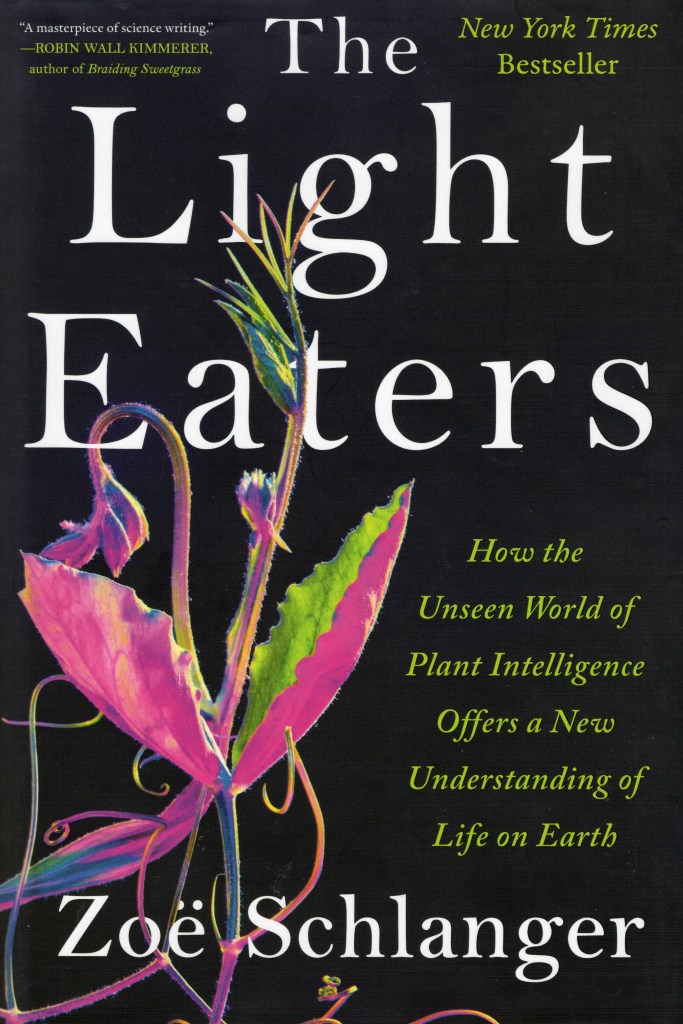
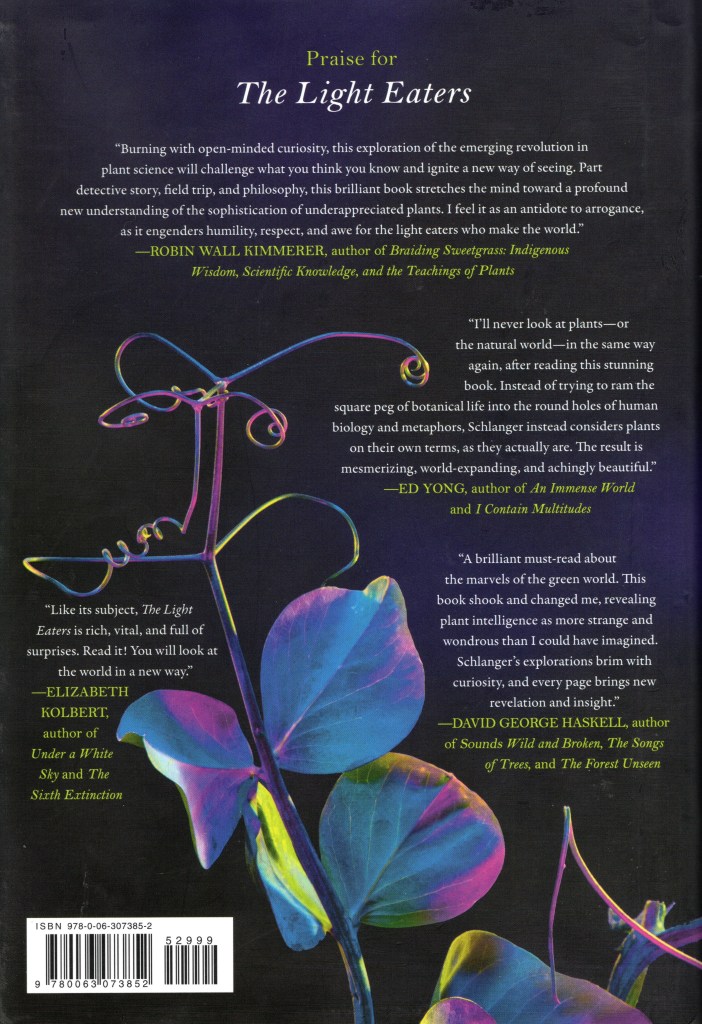
Amazon’s Description of the Book
NEW YORK TIMES BESTSELLER
The New Yorker’s Best Books of 2024 • TIME’s 10 Best Nonfiction Books of 2024 • New York Magazine’s 10 Best Books of the Year • Washington Post’s 50 Notable Works of Nonfiction of 2024 • Smithsonian’s 10 Best Science Books of the Year • A Best Book of the Year: Boston Globe, Scientific American,New York Public Library, Christian Science Monitor, Library Journal, and Publishers Weekly • An Amazon Best Nonfiction Book of the Year
Longlisted for the National Book Critics Circle Nonfiction Prize • Finalist for the Chautauqua Prize • Finalist for the Los Angeles Times Book Prize • Winner of the National Outdoor Book Award for Natural History
“A masterpiece of science writing.” ―Robin Wall Kimmerer, author of Braiding Sweetgrass
“Mesmerizing, world-expanding, and achingly beautiful.” ―Ed Yong, author of An Immense World
“Rich, vital, and full of surprises. Read it!” ―Elizabeth Kolbert, author of Under a White Sky and The Sixth Extinction
Award-winning Atlantic staff writer Zoë Schlanger delivers a groundbreaking work of natural history and popular science that probes the hidden world of the plant kingdom, “destabilizing not just how we see the green things of the world but also our place in the hierarchy of beings, and maybe the notion of that hierarchy itself.” (The New Yorker)
It takes tremendous biological creativity to be a plant. To survive and thrive while rooted in a single spot, plants have adapted ingenious methods of survival. In recent years, scientists have learned about their ability to communicate, recognize their kin and behave socially, hear sounds, morph their bodies to blend into their surroundings, store useful memories that inform their life cycle, and trick animals into behaving to their benefit―a fascinating display of plant behavior and sensory abilities, to name just a few remarkable talents.
The Light Eaters is a deep immersion into the drama of green life and the complexity of this wild and awe-inspiring world that challenges our very understanding of agency, consciousness, and intelligence. In this captivating exploration of plant intelligence, we see that plants, rather than imitate human intelligence, have perhaps formed a parallel system. What is intelligent life if not a vine that grows leaves to blend into the shrub on which it climbs, a flower that shapes its bloom to fit exactly the beak of its pollinator, a pea seedling that can hear water flowing and make its way toward it? Zoë Schlanger takes us across the globe, digging into her own memories and into the soil with the scientists who have spent their waking days studying these amazing entities up close.
What can we learn about life on Earth from the living things that thrive, adapt, consume, and accommodate simultaneously? More important, what do we owe these life forms once we come to understand their rich and varied abilities? Examining the latest epiphanies in botanical research, Schlanger spotlights the intellectual struggles among the researchers conceiving a wholly new view of their subject, offering a glimpse of a field in turmoil as plant scientists debate the tenets of ongoing discoveries and how insights into plant communication influence our understanding of what a plant is.
We need plants to survive. But what do they need us for―if at all? An eye-opening and informative look at the ecosystem we live in, this book challenges us to rethink the role of plants―and our own place―in the natural world, tackling the enthralling question of plant consciousness along the way.
This is my five-star review for The Light Eaters
It is a truly great and fact filled book
Plant Behavior and Communication is Real. What about Plant Intelligence?
This is a very interesting book that describes the ways plants behave and communicate via chemicals, fungus, sound, electric signals and light. Many plants even exhibit memory functions and are able mimic the look of other plants from a distance. A leaf is the only thing in our known world that can manufacture sugar out of materials, light and air, that have never been alive. They can produce complex chemicals, like caffeine, that humans and animals can’t produce. If weighed, plants would amount to 80% of Earth’s living matter.
Plants can regrow virtually any amputated part. Some plants inject poisons into the ground around their roots to prevent anything else from growing nearby. Plants can recognize and protect their kin. Many plants will rearrange their leaves to avoid shading siblings. One of the points of the book is that we may have underestimated plants.
The book also discusses the possibility that plants may have a type of intelligence, perhaps even consciousness, depending on how you define it. This is a philosophical discussion. It should be noted that there was a very popular book in the 1970’s that made outlandish and pseudoscientific claims about plants. In the long run this book created a lot of skepticism towards claims within botany that seemed far-fetched despite collaborating evidence. The author laments this conservatism at the same time as she understands it.
There is a problem with getting unconventional work published in botany, at the same time the arduous peer-review process is an essential safeguard against false paths.
However, it has been established that plants do a lot of amazing things, and we are just beginning to realize the extent of plant behavior and communication. Some examples are, plants can communicate with each other even when they are too far apart to be passing information through their roots (perhaps pheromonal substances).
Plants produce electrical impulses and seem to have nodes at the tips of their roots that serve as local command centers. Plants can react to an attack of munching insects by summoning those insects’ specific predators to come and pick them up. They can perceive gravity, but we don’t know how. Primrose increases the sweetness of its nectar within three minutes if you play an audio recording of honeybee flight to it. Pea plants and many other plants grow their roots toward the sound of running water.
Other examples are, Tomatoes make thirty-five sounds per hour when drought stressed. Goldenrod can sense the volatile signals of nearby gall-forming flies and jump-start its immune system before the flies even make contact. Researchers who played tones at different frequencies to alfalfa sprouts for two hours saw that they increased the plants’ content of vitamin C. Plants can hear the caterpillars or pick up the vibrations they cause. Trichomes allow plants to sense the footsteps of moths and caterpillars.
Nasa poissoniana can store and recall information. It can remember the time intervals between bumble bee visits and anticipate the next time their pollinator was likely to arrive. Bittersweet nightshade recruit ants as bodyguards. Cornish mallow, a pink-flowered plant, will turn its leaves hours before sunrise to face the horizon in exactly the direction its expects the sun to rise. A common vine in this rainforest was capable of spontaneously morph into the shape of almost any plant it grew beside.
Plant mimicry is not that unusual. Scientists have long observed that virtually all plants are highly sensitive to touch of any kind and will change their growth accordingly. The book features several dozen more amazing examples of plant behavior, communication, sensing, and forms of memory including generational memory.
The book also delves into some other topics such as the importance of microbes for both plants and animals, including humans. Microbes influence our immune systems, our smells, and our attractiveness to mosquitos. Emerging research suggests that they may play a role in autism, depression, anxiety, and possible even who we are attracted to. The author also notes that pollution steadily filling the air appears to sabotage plants ability to send and interpret each other’s signals.
This is a book that is filled with interesting and perhaps even shocking information, and it certainly made me more interested in plants and botany. I think the book made the outlandish ideas about plant intelligence and conscience appear almost plausible. Plants are all around us and they are more interesting than I thought. The book is also well written and well organized. I should say that I did not think the first three chapters were very interesting, but it got better the further I read. I highly recommend this book.
To see the Super Facts click here

 Super Facts
I have read this book, Thomas, and learned a lot about plants from it. Thanks for reminding me of some of the phenomena it discusses. As a gardener, I’m interested in plants. I suspect they do have something analogous to what we call intelligence.
LikeLiked by 2 people
Thank you so much Audrey. It is a truly fascinating book. I have not paid enough attention to botany and I learned a lot from this book. Plants are a lot more capable than I thought. It is great that you are a gardener. We are going to plant tomatoes in our backyard soon.
LikeLiked by 1 person
My tiny tomato and pepper plants are doing well on the windowsill, soon to be potted up and go outside.
LikeLiked by 1 person
That is great. We are going to plant peppers too. I hope our tomato plants and peppers will grow well.
LikeLiked by 1 person
Fascinating Thomas. This reminds me of The Findhorn Garden, a spiritual community in Scotland. The plants grew like they were on steroids because of the TLC.
Fascinating findings “Some plants inject poisons into the ground around their roots to prevent anything else from growing nearby. Plants can recognize and protect their kin. Many plants will rearrange their leaves to avoid shading siblings.”
Thanks for sharing. The cover is amazing! 🤩 🌹🌸🌺
LikeLiked by 2 people
Thank you so much for your kind words Cindy. Yes this book is filled with amazing plant discoveries and it is based on peer review (hard examining of accuracy and repeated testing) and not hyperbole.
LikeLike
Sounds fascinating, I’ll look for it. Maggie
LikeLiked by 2 people
Thank you Maggie. It is a fascinating book.
LikeLiked by 1 person
Thank you very much for your review and other information, Thomas. I have read reviews of this book before and have been intending to find a copy – it’s on my list – but haven’t done so yet. Your review has encouraged me to get going on that!
LikeLiked by 3 people
Thank you so much Lynette. It is a really great book. However, I should mention that I thought the first three chapters were vague and ho-hum, then it really started to shine.
LikeLiked by 1 person
Thanks for the heads up about that.
LikeLiked by 1 person
Two things need to happen for plants to enter the next phase of their evolving intelligence:
They need to learn how to talk back to people who talk to plants.
They need to learn to run away from people and animals who try to eat them.
LikeLiked by 2 people
Yes you are right, but then they would be more like animals, or people. It reminds me of a horror movie I saw.
LikeLiked by 1 person
This is a fascinating review, Thomas. I will look for this book. It sounds amazing.
LikeLiked by 1 person
Thank you Robbie. It is a truly fascinating book.
LikeLike
It sounds fascinating.
LikeLiked by 1 person
It is fascinating and yet this is a book that is based on peer reviewed and reproduced research. I am saying that because there is a lot of sensationalistic pseudoscientific books out there making similar sounding claims that are not based on science. Some even claiming that plants can read people’s thoughts.
LikeLike
This is good to know, Thomas. I know you do your homework and I trust your recommendations.
LikeLiked by 1 person
Thank you so much Robbie. Yes I try to verify before I believe things.
LikeLike
🌈💖
LikeLiked by 1 person
Oh, wow, Thomas! What a great review of what seems to be a truly fascinating book! I had no idea, for example, that plants can inject poisons into the ground around their roots to prevent anything else from growing nearby, or that they can recognize and protect their kin. It seems they’re able to defend and protect in unforeseen ways, and, like you say, are underestimated. The importance of microbes is another area that intrigues me, especially since they seem to affect humans, too. The role they play in depression, etc. is particularly interesting. Thanks so much for sharing this wonderful review, Thomas! I’ll add this book to my reading list for sure and can’t wait to start learning more about this topic! 🌲🌱
LikeLiked by 2 people
Thank you so much for your very kind words Ada. You are right, this book is filled with interesting facts and discoveries. I should say I only mentioned a small portion of the fascinating facts in this book (the review was long enough). There is a lot more. I should also mention that this book is based on peer reviewed studies and research, which means that the claims have been harshly vetted and confirmed by multiple scientists. It is not hyperbole.
LikeLike
How fascinating! I think I’d like to read this. Thank you for such a great review.
LikeLiked by 2 people
Thank you so much for your kind words Kymber. It is indeed a fascinating book.
LikeLiked by 1 person
Hi Thomas
In the 70s we all discussed “The Secret Life of Plants” by Peter Tompkins. We still have it in our library and just recently Merlin Sheldrake’s “Entangled Life” was a seller. Time and again, non-fiction writers take up this topic and present it as something groundbreakingly new. Of course, it always is a little bit different, but it’s essentially the same idea. Nevertheless it’s worth reading.
Thanks for this great review
The Fab Four of Cley
🙂 🙂 🙂 🙂
LikeLiked by 2 people
Thank you Klausbernd. I should say there is a very important difference between The Secret Life of Plants and The Light Eaters. In my review I wrote “It should be noted that there was a very popular book in the 1970’s that made outlandish and pseudoscientific claims about plants.” I did not mention the book by name but it was “The Secret Life of Plants”. According to the author and the scientists interviewed by the author, The Secret Life of Plants was not based on peer reviewed and carefully vetted research and it got a lot wrong. This created a shadow over this kind of research, making it hard for many to take this kind of research seriously. A lot of scientists are upset about this. The big difference between The Secret Life of Plants and the Light Eaters is that Light Eaters basis its claims on carefully/harshly vetted research and confirmed by multiple scientists., whilst The Secret Life of Plants features a lot of unsubstantiated claims that set botany back.
LikeLiked by 2 people
Well, ‘The Secret Life of Plants’ was a big success and made a lot of readers see plants in a different way.
LikeLiked by 1 person
Yes I remember that book. I was a kid at the time and I was fascinated by it, but it turned out to be pseudoscience.
LikeLiked by 1 person
I should maybe give some examples. The Secret Life of Plants falsely claimed plants possess telepathy, featured experiments that could not be replicated, and falsely claimed that plants have the ability to detect human thoughts using polygraphs. It promoted the idea that plants have human-like consciousness. It was pseudo-scientific.
This book Light Eaters features dozens, maybe hundreds of amazing claims that are based on peer reviewed studies and replicable experiments. It is not pseudo-scientific. It does discuss the possibility of plant intelligence and eludes the possibility of a form of plant consciousness, but not human-like consciousness. When the author brings this up, she makes it clear that it is speculation and philosophy, not fact or science. That is a very important distinction between the two books. Maybe I did not discuss that enough in my review. In fact, I did not even mention the book by name. Sorry, this got lengthy but I just wanted to explain.
LikeLiked by 2 people
Hi Thomas
Thank you for explaining.
We are not biologists just laymen. And like most of the readers we not that interested in the secret life of the light easters. In the 70s it was in, but it seems to me now it isn’t.
Thanks again
The Fab Four of Cley
🙂 🙂 🙂 🙂
LikeLiked by 2 people
Thank you so much Klaus. That book, the secret life of plants, did a lot of damage to the reputation of this kind of botany (as this book explains). However, the topic is getting a lot of attention again and a book like this, which is scientific and not pseudoscientific will probably have a different impact. It has become very popular.
LikeLiked by 1 person
Java Bean: “Ayyy, I sure hope not, or else there are a number of plants out there that are going to be very, very angry with me …”
LikeLiked by 2 people
Ha ha you are right. However, the intelligence and consicence part are speculation and philosophy. The claims about what plants can do, is however, based on carefully vetted and rpeated peer reviewed research.
LikeLike
I’ve read articles about plants using fungi to communicate with each other across their root system. Kinda like an underground Internet! Or actually, maybe more like an underground Gopher, if anyone remembers Gopher …
LikeLiked by 2 people
Yes you are right. That is one way plants communicate, but there are many more.
LikeLike
Thank you for the fascinating post, Thomas. I’ve read other investigations into whether or not plants communicate and think. There is definitely some interesting evidence that both happen, even though it’s not on a level that humans can intuitively observe. It certainly helps us as we consider what is meant by communication and cognition.
LikeLiked by 2 people
Thank you so much David, I should say that pseudo-scientific books have been written in this area, which have given books like this one a bad name. However, this book is based on peer reviewed and reproduced research (and it is still amazing without hyperbole). She references more than 250 peer reviewed studies. I should also say that when she speaks of intelligence, she is not referring to human-like intelligence but the ability of plants to change fairly rapidly in seemingly clever ways in response to a changing environment. She makes it clear that when you talk about plant intelligence and possibly plant consciousness this is philosophy and not science.
LikeLiked by 1 person
You make very good points here. And yes, I think understanding what actually constitutes “intelligence” is a very interesting scientific question and one that has typically been approached from a largely human-centric point of view. Of course we currently live in an era where “Artificial Intelligence” is very much part of the landscape, but I’m not sure how much “intelligence” those algorithms actually exhibit. Some of those programs are good mimics of human intelligence, but do they actually “comprehend” their environment. A plant can survive on its own. If humans were gone, would machine intelligence survive? I don’t think it’s clear that it could.
LikeLiked by 2 people
David, those are some very interesting thoughts. Defining what we mean by intelligence is certainly a difficult task we have not sufficiently explored. I should say that I brought this up (and the author brought this up) because there are a lot of pseduoscientific books out there that approaches the subject in a non-scientific way. This book references 250+ peer reviewed science publications unlike the books that claim that plants can read people’s minds (have ESP) and feature unreproducible experiments.
LikeLiked by 1 person
Fascinating! I knew about trees, but not so much other plants. We are just beginning to understand so much about life on this precious and diverse planet. Thank you for being part of our enlightenment!
LikeLiked by 2 people
Yes you are so right JoAnna. There is so much more to explore. And thank you for your kind words.
LikeLike
I enjoyed reading all about this and about the book. I do remember and have read the 1970s book about plants. I remember the saying ‘plants are like people’. I’m glad this book has the backing experiments and all. I know I talk to my plants and give them names. Maybe they like it. School kids almost always have a science class where some have two plants, and they either talk nice to one and talk bad to the other, or play harsh music to one and nice music to another to compare how they grow. Thanks for the review 🙂
LikeLiked by 2 people
Thank you so much Barbara. I think that the book you mentioned, is likely The Secret Life of Plants, which did a lot of damage to the reputation of this kind of botany (as this book explains) because of the pseudoscience (plants can read human thoughts), hypebole, and unreproducable experiments. This book is based on peer reviewed science and repeatable/reproducible science. A lot has been discovered since the 1970’s. No need to embellish.
LikeLiked by 1 person
It is amazing how you can walk by things everyday and not really think much about it only to realize from reading things like this, everything has a system, connected, communicates. How thigs survive and adapt. This was great and I love the picture of the dog!
LikeLiked by 1 person
Yes I agree. There’s a lot going on that you are unaware of. The dog / puppy on the right hand side is our Leonberger puppy at the age of three months. His name was Bronco. If you click on it you’re taken to my Leonberger blog.
LikeLiked by 1 person
I think intelligence comes in many shapes, not just our human one. I long ago suspected plants were smarter than we give them credit for. This sounds interesting.
LikeLiked by 1 person
People assume plants don’t have intelligence just because they don’t have brains.
Almost all people think that emotions and the experience of pain requires a brain, which plants do not have, neither do bacteria or fungi.
LikeLiked by 2 people
Earthworms have ganglia. I wouldn’t be surprised if plants have something that directs their actions beyond instinct. “Turn to the sun”….
LikeLiked by 1 person
Yes that is a very interesting thought. Plants use electrical signals similar to neurons but they don’t have neurons it is different.
LikeLike
Yes you are right World Questioner. No brain and no neurons, but it is interesting that they still use electrical signals and use the same chemicals as animals to transmit those signals, but there are no neurons.
LikeLike
Yes that intelligence can come in many forms is a very interesting idea that the book brought up. It was speculative, which the author admitted, but plant communication and behavior is so impressive that the thought needs to be there.
LikeLiked by 1 person
Wow, this book sounds so interesting. Great review! I just finished reading Lab Girl by Hope Jahren. I think the two books back-to-back would make for a wonderful experience.
LikeLiked by 1 person
Thank you so much Priscilla. I have not read Lab Girl but I will do that. Thank you so much for the recommendation. I’ve read another book by Hope Jahren, The Story of More, which was great, but I gave it four stars instead of five because I did not think she gave nuclear power a fair shake.
LikeLiked by 1 person
Hi Thomas. Wow, what an informative and interesting review. I find it fascinating. Now I understand better why people talk to their plants. Maybe they can hear too? 😊
LikeLike
This book sounds fascinating, Thomas. Thanks for your review and recommendation. I feel this way about trees, especially when we walk through redwoods, so why not plants too? Humans can’t be the only intelligent species. And they’re not always intelligent anyway. 🙂
LikeLiked by 1 person
Thank you so much Lauren. It was indeed a fascinating read.
LikeLiked by 1 person
Enjoyed your post and learned a bit – and so glad you read past the first three chapters to find a groove and dive in to this interesting book.
LikeLiked by 1 person
Thank you so much for your kind words Prior. I try not to judge a book until I am finished with it. Sometimes books get much better as you read further.
LikeLiked by 1 person
yes – and shhhhh – but if a slow start – I always jump around and skim – just to explore that way – terrible habit – but it works for me
LikeLiked by 1 person
That is perfectly OK. I do that sometimes too. Not with this book though. I was a bit annoyed during the first three chapters but I kept going and then while reading the fourth chapter, I realized, this is going to be good so I stayed with it.
LikeLiked by 1 person
🙂🙂
LikeLiked by 1 person
another fascinating topic (I prefer not to think of plants as being too sentient… it hurts me to imagine them hurting…)
LikeLiked by 1 person
Yes you are right. I was listening to a botanist talking about these issues and he said that maybe it is possible that plants are sentient in some sense, but they cannot feel pain. Pain is a survival adaptation that causes you to withdraw and run away from danger. Plants cannot do that so they have no use for pain, so it never evolved.
LikeLiked by 1 person
that makes me feel a bit better when I clip my hedges!
LikeLiked by 1 person
Yes I admit I was worried about the same thing. Then I heard the botanist talking.
LikeLiked by 1 person
You would be interested in a book titled The Sectet Life of Plants, by Peter Tompkins and Christopher Bird. Plants, in some ways, are indees actually more mentally advanced than ourselves.
LikeLiked by 1 person
Thank you for the suggestion Ana. I am familiar with that book but unfortunately The Secret Life of Plants was not based on peer reviewed and carefully vetted research and it got a lot wrong. It is considered pseudo science by botanists. This book on the other hand is based on peer reviewed research, so you can trust it.
LikeLiked by 1 person
Okay ~ just adding to your pool of references but I guess you already have it.
LikeLiked by 1 person
I appreciate it Ana. Thank you so much.
LikeLiked by 1 person
This sounds fascinating, Thomas! Thank you for showcasing it.
LikeLiked by 1 person
Thank you so much for your kind words Lori.
LikeLiked by 1 person
You are very welcome, Thomas.
LikeLiked by 1 person