The goal of this blog is to create a long list of facts that are important, not trivia, and that are known to be true yet are either disputed by large segments of the public or highly surprising or misunderstood by many.
Author: thomasstigwikman
My name is Thomas Wikman. I am a software/robotics engineer with a background in physics. I am currently retired. I took early retirement. I am a dog lover, and especially a Leonberger lover, a home brewer, craft beer enthusiast, I’m learning French, and I am an avid reader. I live in Dallas, Texas, but I am originally from Sweden. I am married to Claudia, and we have three children. I have two blogs. The first feature the crazy adventures of our Leonberger Le Bronco von der Löwenhöhle as well as information on Leonbergers. The second blog, superfactful, feature information and facts I think are very interesting. With this blog I would like to create a list of facts that are accepted as true among the experts of the field and yet disputed amongst the public or highly surprising. These facts are special and in lieu of a better word I call them super-facts.
Superfact 20: Domesticated Turkeys and Wild Turkeys are the same species, but Wild Turkeys can fly.So yes, there are flying turkeys.
I think this is a super-fact, because the Turkey is a very important bird to Americans and at the same time a lot of people, including Americans, do not know that Turkeys are not flightless birds.
Domesticated turkeys are flightless but wild turkeys are not flightless. Wild turkeys can fly distances of more than a mile, sometimes at speeds of 55 miles per hour. I’ve seen it with my own eyes on turkey hunts. I’ve seen turkeys fly and glide across the sky at the height of 30-50 feet. I’ve seen them flap their wings and then take off.
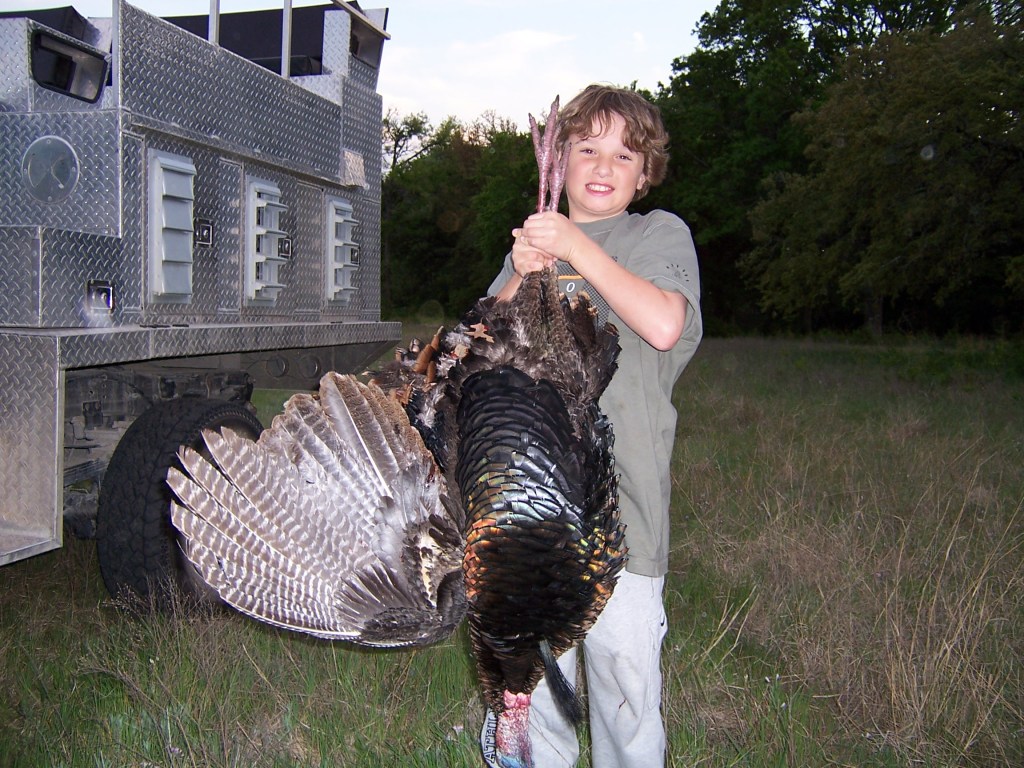
The turkey my oldest son shot when he was 11 years old.My son holding the turkey he shot.
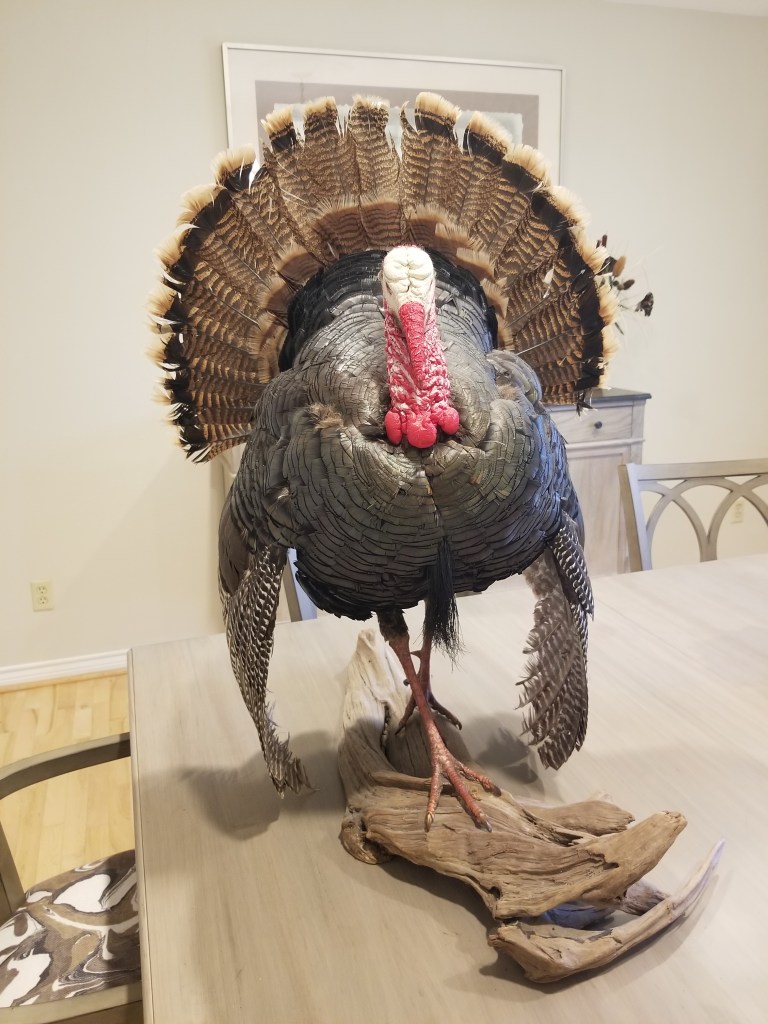
The photo above is a Tom, a male turkey, that my oldest son shot when he was 11 years old. Male turkeys are called Toms and females hens. We took it to a taxidermist for preservation and mounting. I should add that we typically ate the meat of everything we shot. Taking a wild turkey to the taxidermist makes eating the animal more complicated but you can typically ask for the breast meat of the turkey.
Personally, I think that legal hunting is a lot more humane than eating meat from animals from factory farms.
Eastern Wild Turkey Meleagris gallopavo flying over the snow in Ottawa, Canada Stock Photo ID: 1358163995 by Jim Cumming.
I should add that legal hunting is often encouraged for conservation and population management. For example, moose are hunted in Sweden (my native country) to manage their large population (400,000 moose), which can cause damage to forests and agriculture, as well as starvation among moose, if not managed. Illegal hunting, on the other hand, is something nefarious. Below is a video showing wild turkeys flying (video is about one minute long).
Superfact 19: An account impersonating you on Facebook does not mean you have been hacked. When someone using your name and photo starts sending friend requests to your friends on Facebook, they are most likely just copying your information. You have not been hacked.
I am considering this a super-fact because almost every time I see this the person being impersonated states “….I have been hacked”. Most likely they have not been hacked. They don’t need to change their password or take special precautions related to their account or password. It is not the problem.
Facebook is the world’s largest social network with over 3 billion users and few people understand this common Facebook problem, which is why I am calling it super-fact. All that happened is that someone downloaded their photo, copied some information, and started sending out friend requests to their friends. It is so easy to do that. Any 10-year-old can do it and there’s no hacking required. If you think about it for a minute, I am sure you all could do it.
However, it is not appropriate behavior and Facebook can delete your account and ban you if you resort to this behavior.
WP AI generated image
So, what can you do to reduce the chance of being impersonated? You can go to Settings & Privacy > Privacy Settings and set your profile to private by setting “Who can see your posts?” to friends only, but if you want visibility and don’t want to go that far you can set the “Who can see your friends list?” to “only me”. You can also set “Who can see posts you’re tagged in?” to “Friends” or “Only me”. You can “Limit Who can see your profile picture and cover photo?” to “Friends.”
Additional things you can do are regularly search your name on Facebook to check for fake profiles and avoid oversharing.
The actions above will greatly reduce the chance that someone will impersonate you but if it happens anyway, you can report the offender by going to the fake profile and click on the three dots (…) on their cover photo, select “Find support” or “report profile” and choose “Pretending to Be Someone” and follow the instructions to report the account. Encourage your friends to do the same.
The goal of this blog is to create a list of what I call super facts, but this is not a super-fact post. I sometimes create posts that are not super fact posts but related to this goal as well as other factual posts, and this is one of those. This post is about the Dunning–Kruger effect. The Dunning–Kruger effect is a cognitive bias in which people with limited competence in a particular domain overestimate their abilities. Those who are incompetent in a given area tend to be ignorant of their incompetence. What is so interesting about this effect is how widespread it is and how extreme it can get.
Some extreme examples include people without much knowledge in a given field lecturing the experts in the field, people without experience or much knowledge in an area telling the professionals in the field how to do their job. It includes people insisting on absurd claims despite not understanding the topic. It includes people dismissing scientific consensus on a topic without having much knowledge about that topic. It includes managers lacking engineering experience refusing to listen to the engineers, etc.
We are all occasional victims of the Dunning–Kruger effect. The problem comes when the one with the lower ability is stubborn and unreasonable and does not attempt to understand what the better-informed person is saying. Sometimes the situation becomes absurd. Below I am listing a few interesting cases, starting with a time when I was the ignorant one.
Creationism Bamboozled Me
When I was a teenager, I read creationist books that claimed that evolution was a hoax, and that earth was likely 6,000 years old. This is still a very common belief here in the US. These books appeared to me to be very convincing, and I took it upon myself to spread the word and correct the misconceptions. I was good at science and math, but this was before I had studied biology and physics in depth. I was accepted into the “Natur / Natural Science” Highschool program (similar to taking all AP Science classes) and I later studied physics in college.
As a result of what I learned I came to realize that the creationism I had come to embrace was bunk. The young earth claims and the anti-evolution rhetoric was not tenable. I realized this not by reading counter creationist books; I was just learning about the science. Understanding some science made all the difference. I just never knew how much I was missing. It was a lot. To read more about this click here and here. One more thing I learned is that you should avoid science related books written by lawyers and theologians with agendas. It is not their field and they don’t know what they are misunderstanding.
The fossil record is a lot more solid and much less problematic than the creationist books I had read claimed. Shutter Stock Photo ID: 1323000239 by Alizada Studios
Entropy and Evolution
Related to this is the myth that entropy contradicts evolution. Entropy is the measure of a system’s thermal energy per unit temperature that is unavailable for doing useful work. It is also the measure of the number of possible microscopic arrangements or states of individual atoms and molecules of a system that comply with the macroscopic condition of the system. These two definitions are identical.
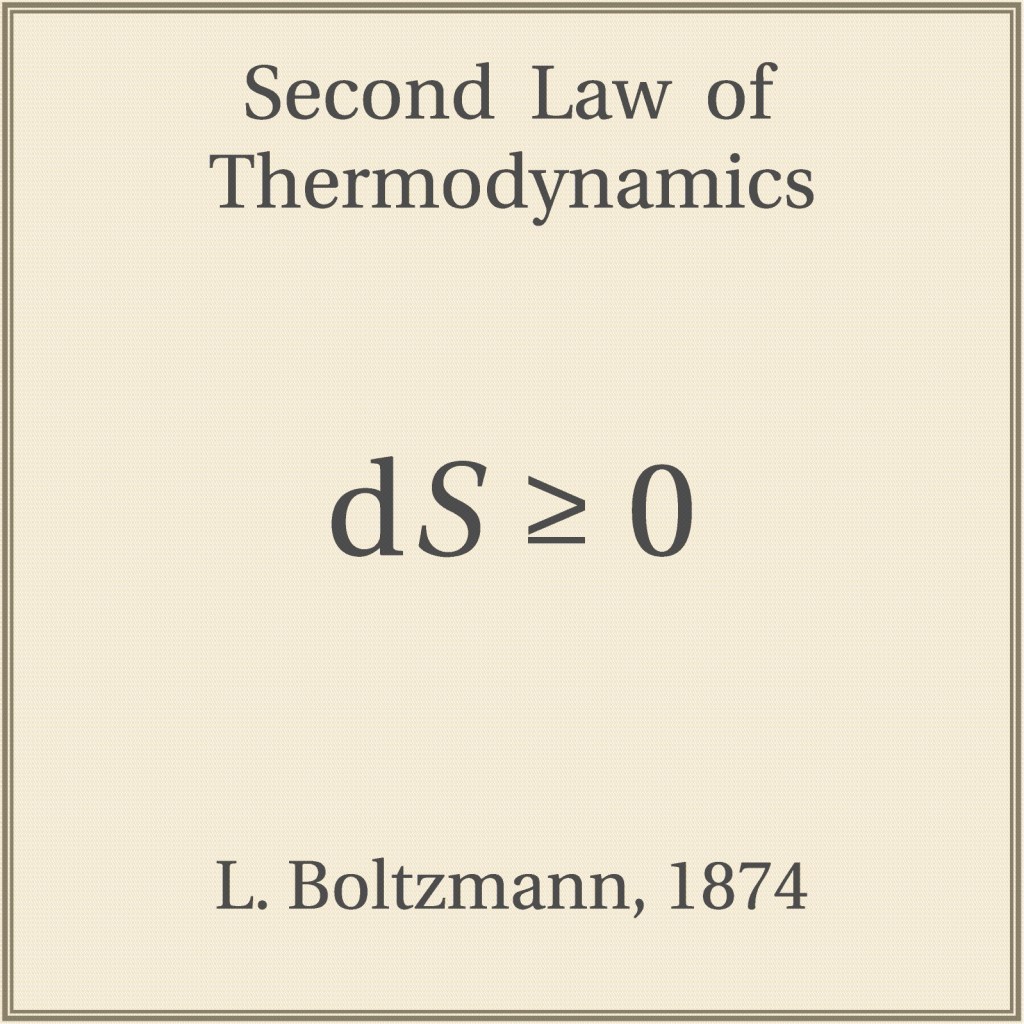
The formula is S = K * ln (W), where S is entropy, K is Boltzmann’s constant, and W is the number of microstates whose energy equals to the one of the system. Entropy is said to be the amount of disorder in a system, but in this context “disorder” may not correspond exactly to what people mean by disorder. Anyway, the issue is the second law of thermodynamics, which states that the entropy of an isolated system left to spontaneous evolution cannot decrease with time.
The creationists like to say that evolution decreases disorder in the biosphere and therefore contradicts the second law of thermodynamics.
Second law of thermodynamics Shutter Stock Vector ID: 2342031619 by Sasha701
If you take a college level class in thermodynamics you will realize within half an hour that this creationist / anti-evolution claim is false. The most important point being that evolution does not occur within an isolated system.
First of all, the earth, the biosphere, plants and animals receive energy from the outside, the sun for starters. Whether evolution decreases disorder in the biosphere or not, the claim fails instantly on the point that the system is not closed.
Despite decades and even centuries of conclusive debunking many people continue to make the false claim that the second law of thermodynamics and evolution are incompatible. There are people writing to prominent physicists and lecturing them and mocking them for “not knowing” that the second law of thermodynamics and evolution are incompatible. Typically, people who know almost nothing about the subject. They know too little to realize that their arguments are absurd.
The awkward algorithm
One day the engineering manager at my job at Siemens asked me and another guy to do research on how a certain process might improve our system. It was the CEO of the company (he was not an engineer) who was requesting this.
However, it was instantly obvious to me that this process was not compatible with what we were doing. Before, I had opened my mouth, the engineering manager told me “Thomas I know what you are going to say. This process is not applicable to what we are doing, but the CEO just learned about this process, and he is very excited about it. Just pretend to work on it for a few weeks and then write a report about why it did not work out. This is easier than explaining to the CEO why it wouldn’t work.”
Isotopes are real
On one occasion I was arguing on Facebook with an acquaintance regarding whether the current rapid Global Warming trend was natural or not. He said it was natural, and he insisted that he knew a lot about the science. I knew that he did not have a college level science degree, and it was obvious from what he said that he did not understand the science behind climate change.
One of the pieces of evidence I mentioned to him was that isotope studies showed that the carbon dioxide in the atmosphere originated from our burning of fossil fuels. That was when he said that the atoms of a certain element were all identical. There was no such thing as isotopes. He accused me of fabricating the existence of isotopes.
Three natural isotopes of carbon Stock Vector ID: 2063998442 by zizou7
I posted a research article of one isotope study (carbon-12/carbon-13/carbon-14) and an article from Wikipedia on isotopes. Wikipedia isn’t an academically acceptable source, but it featured a good introduction.
He focused on the fact that Wikipedia articles are not always entirely accurate and used it as a reason to dismiss everything I said about isotopes. I was surprised he had never heard of Carbon-14. Isotopes is well known high school science and there are thousands of articles about it on the internet. He just didn’t know anything about this basic fact. He started insulting and mocking me perhaps because he felt I was lecturing him, but how would I have handled this? He knew too little about the subject to realize how much he was missing.
The Current Global Warming is not natural
Nearly all climate scientists say the same thing, Global Warming / Climate Change is real, and it is us. Just because the climate has changed for natural reasons in the past does not mean that is the case now. The same people who told us about the natural variability of climate in the past are the ones telling us it is not natural now. We should listen.
It is not orbital cycles, not the sun, not volcanoes, not bacteria or other lifeforms, and not cosmic radiation, it is us, primarily because of emissions from fossil fuels. The paleoclimatologists and the climate scientists and atmospheric physicists are telling us that it is not natural because of the quite substantial and solid evidence. Yet a very substantial proportion of us insist that it is natural causes without knowing much about the evidence. Why? Because they know too little about the evidence to consider it. The Dunning-Kruger effect again. BTW I will make a more detailed post about this in the future.
Wind Power Myths
Wind power has been on the receiving end of false claims, nonsense, and strange rumors for a while. It is not the only energy source that is a victim of widespread falsehoods, but it is a considerable problem. One false claim is that wind power requires an additional power source to operate (such as a companion diesel engine).
Another false claim is that wind power generates less power than it consumes, and yet another false claim is that wind power causes cancer. These claims are absurd and no one with basic insights in engineering and science would know they are false, yet many people fall for them. The people who fall for these claims think they know more than others, not less. Dunning-Kruger again. I am discussing nonsense and rumors about wind power here.
Superfact 18: Accents are very difficult to lose. People may speak and understand a second language perfectly and still have a strong accent in that language assuming they did not learn the second language in childhood. This is a fact that is well known to the 20.6% of people in the US who are bilingual and to the 43% of people in the world who are bilingual. Yet many monolingual people are unaware of and surprised by this basic and important language fact.
I can’t lose my accent
On one occasion when I took my oldest son to the playground a guy doing the same started talking to me. Hearing my accent, he asked me where I was from (Sweden) and how long I had been here (10 years). Then the guy said, “I am surprised that after all these years you still have an accent”.
This is a sentiment I’ve come across many times here in the US, but not as often in Europe. Monolingual people are surprised to hear bilingual people’s accent. When I tell people about the reality of accents and that it is difficult to lose one without major speech therapy, they act very surprised. It is a basic and important language fact that is surprising to those who don’t know it. That’s why I think this counts as a super fact.
I have difficulty hearing my own accent, which is to be expected according to this article . However, my accent becomes obvious to me when I hear myself speaking on a recording such as when I was interviewed by NBC about the tornado that ravaged our neighborhood five years ago. At first, I was thinking “oh shoot my accent is so obvious and now the whole world knows”, then I was thinking it is no big deal. If you want to hear my accent, click on this link. It is NBC news and my interview is located at : 1 minute and 11 seconds.
Accents are very difficult to lose
What monolingual people typically do not know but practically all bilingual people do know, is that it’s difficult to lose an accent as an adult learning a new language. Children can do it but not adults, not without major speech therapy. This article states that the cut off age is around 12 years old.
According to a test I took, my vocabulary and understanding of English grammar at the time of the incident above was above the average for native English speakers, and it was just as easy for me to understand, speak, read and write English, as Swedish. Yet my accent was obvious.
It should not really come as a surprise to monolingual people, but it does. After all, if you think about it, famous foreign actors such as Arnold Schwarzenegger, Werner Herzog, Marion Cotillard, Stellan Skarsgård. etc., speak with an accent even after living in the US and/or working for Hollywood, several decades, and they are not faking it. I have several friends and relatives who speak with a strong foreign accent after living in the United States for 30, 40, 50, and 60 years. If they came as adults, they still have their accent.
Arnold Schwarzenegger a bilingual man Stock Photo ID: 2501506607 by Ralf Liebhold
As this article states, “accents are extremely difficult to lose because our infant brains codify a lifetime’s worth of sounds before we’ve spoken our first word”. As this article explains as we age our brains become more specialized in our native language sounds, making it harder to accurately perceive and produce new sounds from another language, a phenomenon often referred to as the “critical period hypothesis” in language acquisition; essentially, the window for easily acquiring perfect pronunciation closes during childhood.
Past childhood it is much harder to accurately perceive and produce new sounds from another language Stock Photo ID: 1818291203 by pathdoc
A few second language facts
The most popular second language in the world with respect to the number of non-native speakers (data taken from this site).
(1) English – 1,140 million non-native speakers
(2) Hindi – 264 million non-native speakers
(3) Chinese (Mandarin) – 199 million non-native speakers
(4) Urdu – 162 million non-native speakers
(5) French – 132 million non-native speakers
(6) Arabic – 109 million non-native speakers
(7) Russian – 107 million non-native speakers
(8) Spanish – 74 million non-native speakers
(9) Bengali – 43 million non-native speakers
(10) Portuguese – 28 million non-native speakers
The most popular second language in the world with respect to number of countries.
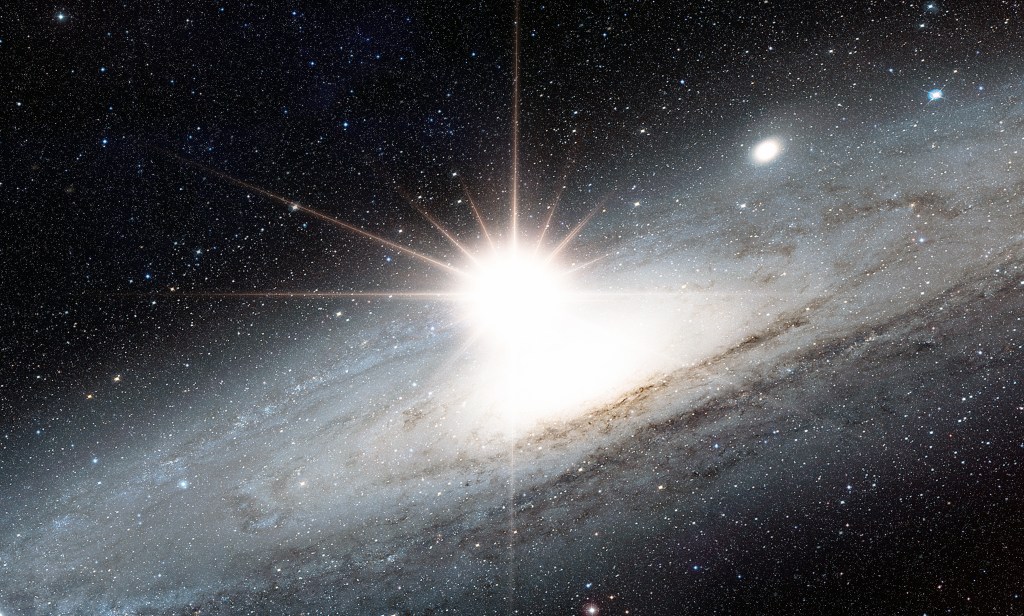
A supernova is an explosion of a star so violent that it can outshine an entire galaxy. It can occur when a super massive star’s core contracts (the death of the star) and as it reaches a critical point it triggers nuclear reactions that cause the star to explode. Alternatively, it can occur when a white dwarf star is triggered into runaway nuclear fusion by a collision with another star.
Depending on how far away the supernova is it can be as luminous as a bright new star, the moon, or a second sun. It occurs suddenly and lasts for several weeks or months before fading away. If a supernova shines bright enough, the other stars in the sky will vanish from view. We can’t see the stars during the day, not because of the blue sky, but because of the ambient light from the sun.
This is also one major reason photos from space often lack stars in the black sky. If a supernova is close enough to earth it could destroy earth. Luckily there are no super massive stars close enough to earth to pose a risk.
Supernova explosion in the center of the Andromeda galaxy “Elements of this image furnished by NASA” It is essentially an enhanced photo of a supernova explosion in a neighboring galaxy. Stock Photo ID: 2495486227 by muratart.
The Betelgeuse Supernova
Betelgeuse the bright red star in the constellation Orion is thought to be close to going supernova, and when it does it will be about as bright as half a full moon in our sky but concentrated in a point. What does “close” mean? Some astronomers say within decades, some say within a few thousand years. Could Kevin’s beautiful picture above depict this future event?
Illustration of the Orion constellation. To find Betelgeuse, first find Orion’s belt, then look up to the left. The reddish star is Betelgeuse. It is visible at this time of year (on a clear night). Stock Vector ID: 1631025025 by Tedgun.
We are stardust
The first stars in the Universe were made of 75% hydrogen and 25% helium and trace amounts of Lithium, just like the entire Universe at the time. Heavier elements that could form rocky planets or other solid celestial bodies did not exist.
However, inside the cores of these stars, heavier elements such as carbon, oxygen, and iron were formed by fusion. These early stars are referred to as first generation stars. They tended to be large and ended their lives in massive supernova explosions. The dusty remains of these explosions became the building blocks of the second and third generation stars we see today as well as the planets, our bodies and all life. We are stardust.
The first-generation stars consisted of 75% hydrogen and 25% helium and trace amounts of Lithium. A second or third generation star like our sun is still mostly hydrogen and helium but also many other elements. The rocky planets circling the sun are mainly elements heavier than hydrogen and helium. Image credit NASA, ESA, CSA, STScI.
Finally, a 33 second YouTube video illustrating a Supernova (the creation of the Crab nebula)
Would you like to see Betelgeuse explode into a supernova in your lifetime?












 Super Facts