The goal of this blog is to create a list of super facts. Important facts that are true with very high certainty and yet surprising, misunderstood, or disputed by many. This blog aims to be challenging, educational, and fun, without it being clickbait. I determine veracity using evidence, data from reputable sources and longstanding scientific consensus. Prepare to be challenged (I am). Intentionally seek the truth not confirmation of your belief.
Author: thomasstigwikman
My name is Thomas Wikman. I am a software/robotics engineer with a background in physics. I am currently retired. I took early retirement. I am a dog lover, and especially a Leonberger lover, a home brewer, craft beer enthusiast, I’m learning French, and I am an avid reader. I live in Dallas, Texas, but I am originally from Sweden. I am married to Claudia, and we have three children. I have two blogs. The first feature the crazy adventures of our Leonberger Le Bronco von der Löwenhöhle as well as information on Leonbergers. The second blog, superfactful, feature information and facts I think are very interesting. With this blog I would like to create a list of facts that are accepted as true among the experts of the field and yet disputed amongst the public or highly surprising. These facts are special and in lieu of a better word I call them super-facts.
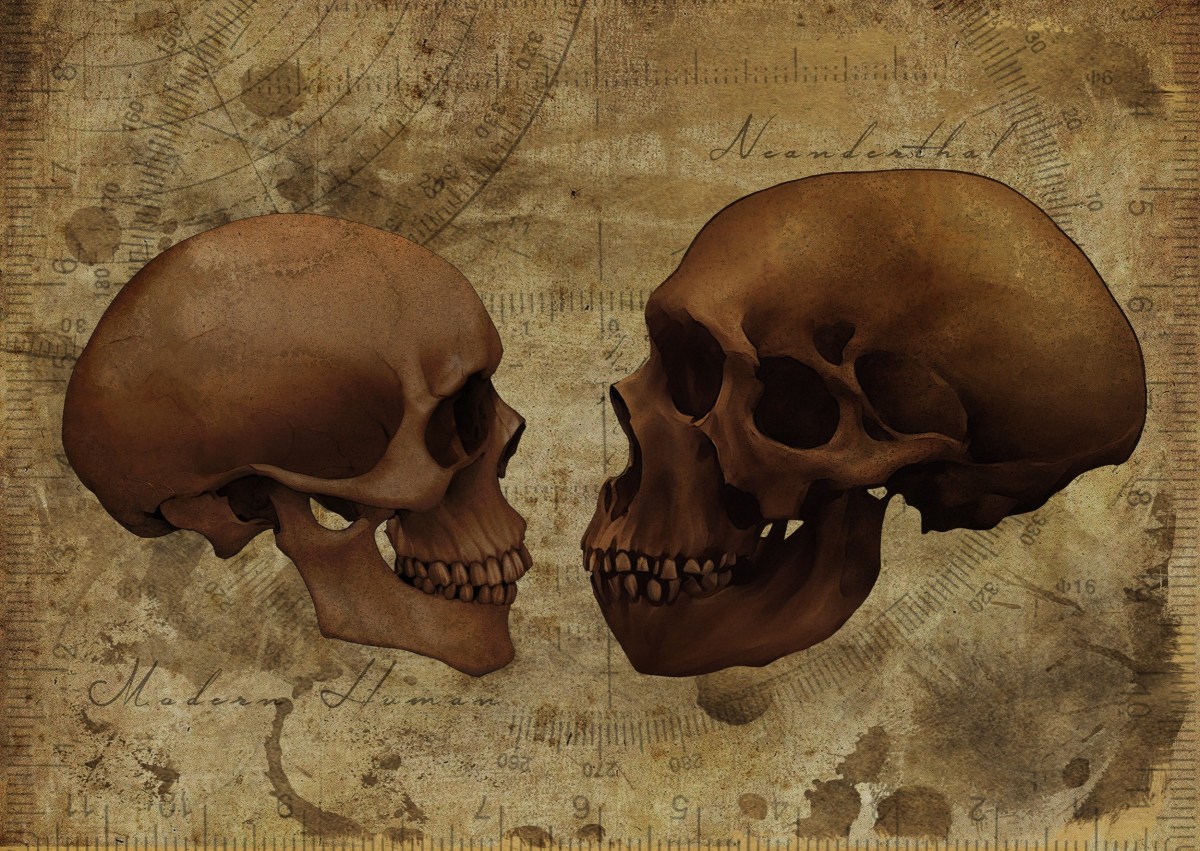
Superfact 114: Early humans (early Homo sapiens) lived at the same time as many other homo species including Neanderthals (Homo Neanderthalensis) and Humans and Neanderthals Interbred.
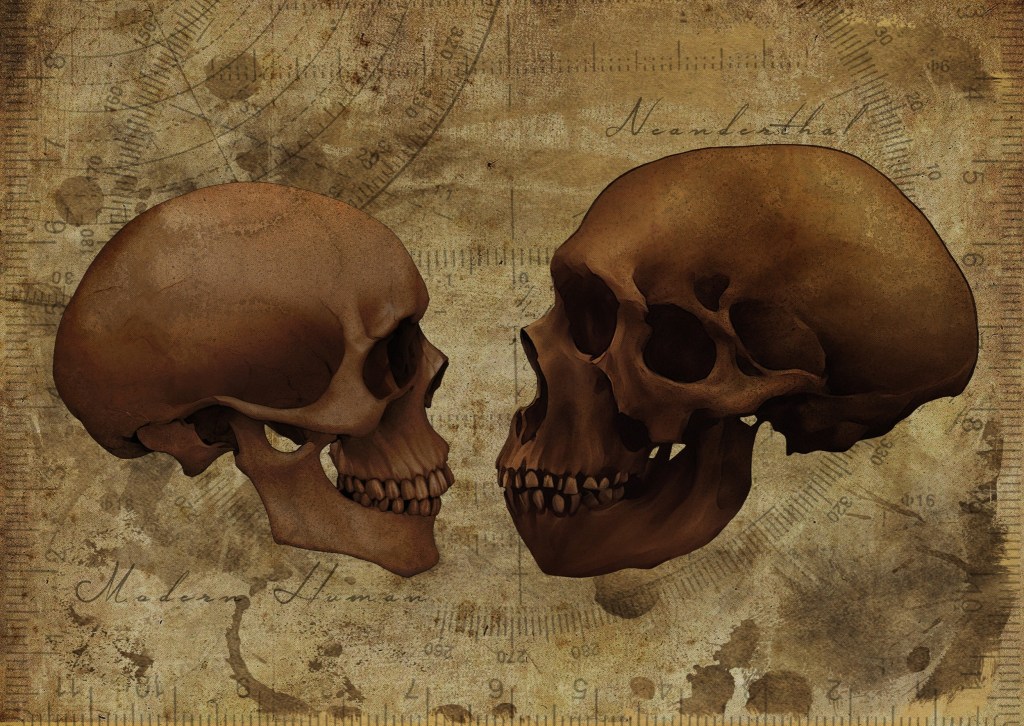
Neanderthals Archaic Extinct Human Skull Vs Modern Human Skull Comparison. Shutterstock Asset id: 2238778267 by Winters860
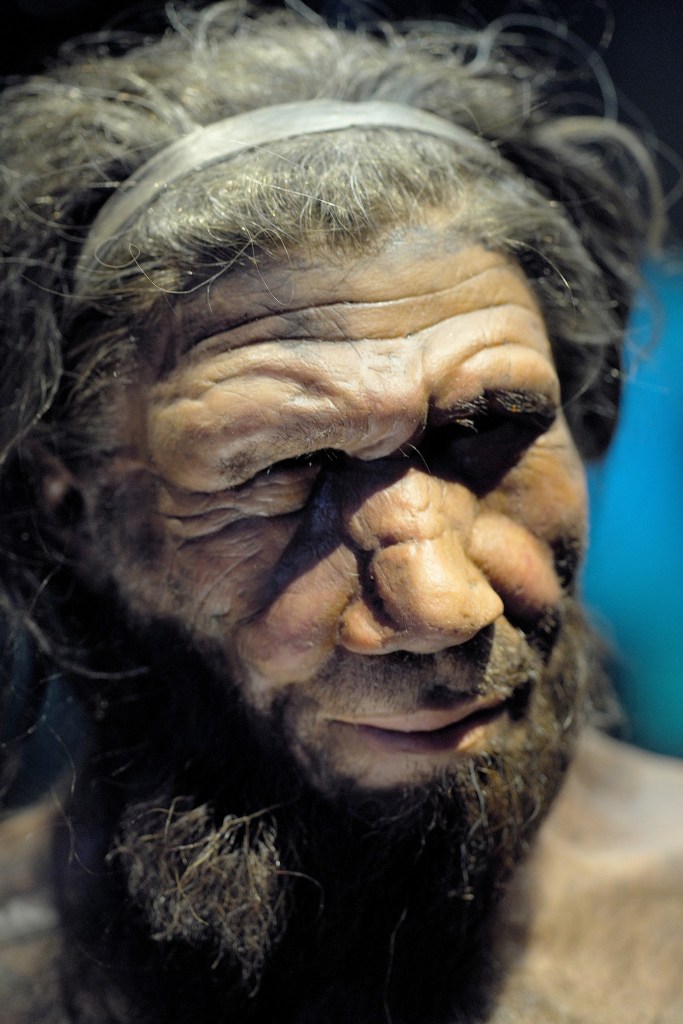
It’s been known for more than a decade that ancient members of our species, Homo sapiens, met and mated with our evolutionary cousins, Neanderthals. If you have read the Savage Land trilogy by Jacqui Murray, or you have taken a DNA test from, for example, 23AndMe, then you already knew that. Today, up to 2% of the genomes of people outside sub-Saharan Africa originated from Neanderthals. The Neanderthal genome was successfully sequenced in 2010. You can read more about it here. More recently, an analysis of Neanderthal X chromosomes found that most cross-species couplings involved Neanderthal males and modern human females.
My wife and I took a DNA test with 23AndMe to find out about inherited diseases as well as our ancestry. I found out that my ancestry was 99.8% Northwestern European, 85.3% Scandinavian/Sweden/Norway, 14.4% Finnish, 0.1% other Northwestern European, and 0.2% Siberian. I also found out that I had strong Neanderthal ancestry. The report said that I have more Neanderthal variants than 99% of customers. Even though this kind of information is fun, it is risky to have some of this information exposed, so I deleted it.
Geneticist sequencing human genome Asset id: 2479929725 by FOTOGRIN
Anyway, I consider this a super fact because it comes as a surprise to many that humans and Neanderthals interbred, and that many of us therefore have traces of neanderthal DNA. It is also an important fact that we know is true.
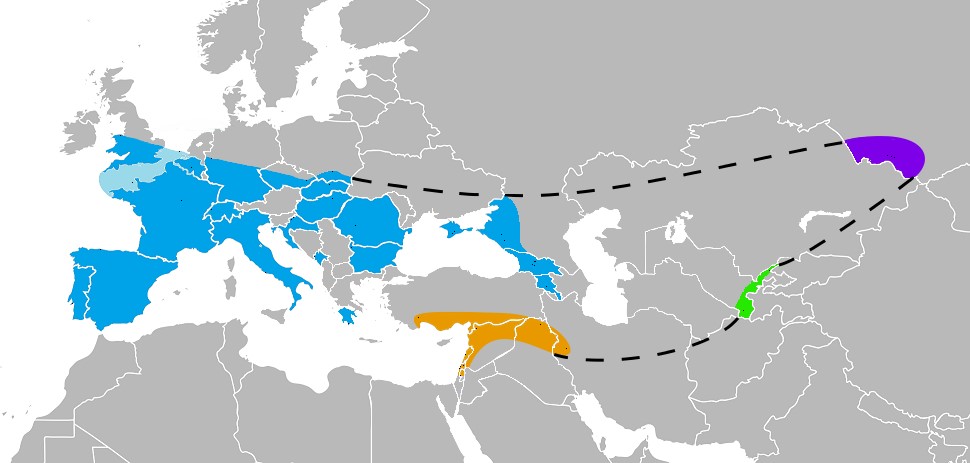
Known Neanderthal range in Europe (blue), Southwest Asia (orange), Uzbekistan (green), and the Altai mountains (violet), as inferred by their skeletal remains (not stone tools). There were 165 such places by 2017. Nilenbert, N. Perrault, auteur du guide complet du canotageI, CC BY-SA 3.0 <http://creativecommons.org/licenses/by-sa/3.0/>, via Wikimedia Commons
Early Homo Sapiens lived at the same time as many other human species
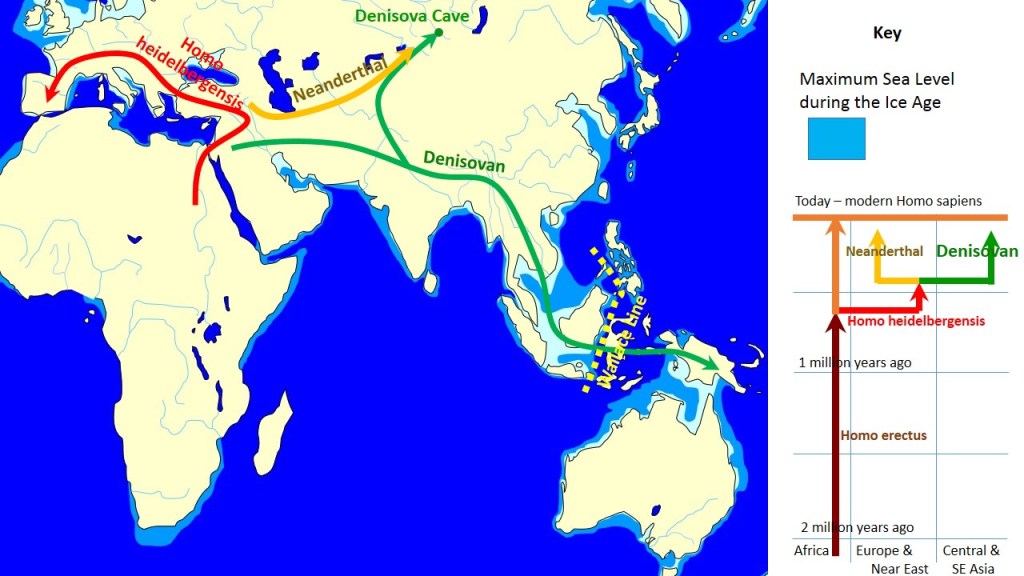
Early humans, early homo sapiens, lived at the same time as many other human species, not just Neanderthals. Early Homo sapiens lived at the same time as Denisovans, Homo floresiensis, Homo naledi, Homo luzonensis. Homo heidelbergensis, Homo erectus, and maybe other species as well. Neanderthals interbred with homo sapiens and died out around 40,000 years ago. The Denisovans also interbred with homo sapiens and died out around 30,000 to 50,000 years ago. Moreover, Homo Neanderthalensis interbred with Homo Denisova. You can read more here and here.
The evolution and geographic spread of Denisovans as compared with Neanderthals, Homo heidelbergensis and Homo erectus. John D. Croft at English Wikipedia, CC BY-SA 3.0 https://creativecommons.org/licenses/by-sa/3.0, via Wikimedia Commons.
Speciation is considered relative
Homo Neanderthalensis and Homo Sapiens were different species, so it may seem strange that they could interbreed. However, species is a complex non-static concept, and it is considered relative.
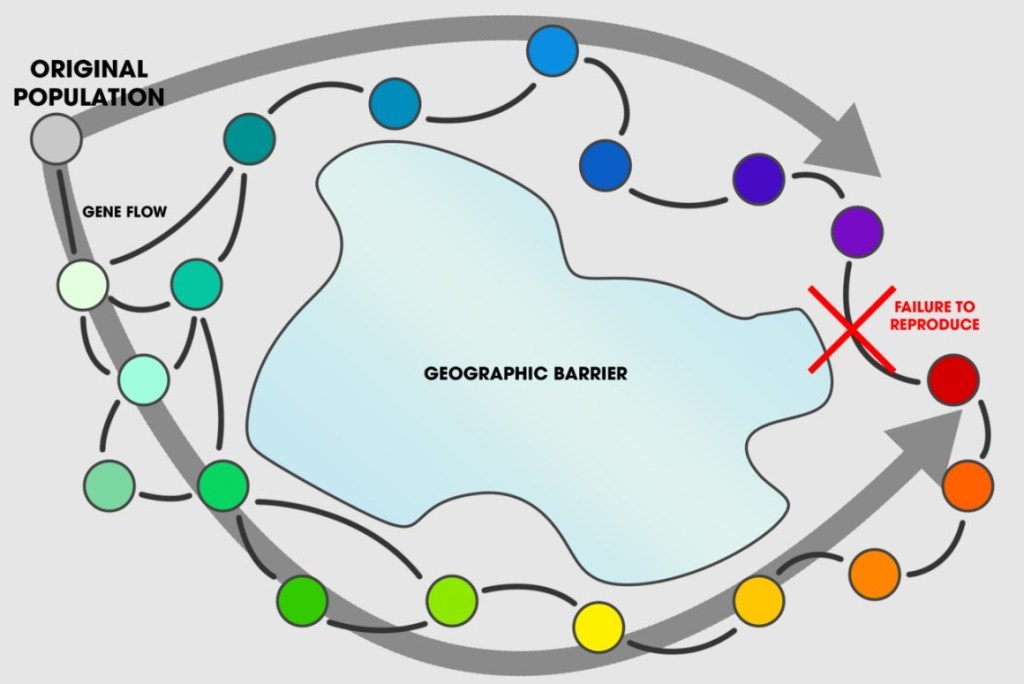
It is often said that two animals belong to the same species if they can interbreed in nature and produce viable, fertile offspring. However, it is not that simple. An animal A may be able to successfully interbreed with an animal B, and that animal B may be able to successfully interbreed with an animal C, but animal A and C cannot interbreed. Animal A could be said to be a different species relative to animal C, but animal B could be said to be the same species as both animal A & C using the definition above. A great geography related example of this is ring species. In a ring species, gene flow occurs between neighboring populations of a species, but at the ends of the ring the populations don’t interbreed.
Illustration of ring species, an example of how speciation can be relative. All the circles next to each other can interbreed but at the end it no longer works. Andrew Z. Colvin, CC BY-SA 4.0 <https://creativecommons.org/licenses/by-sa/4.0>, via Wikimedia Commons
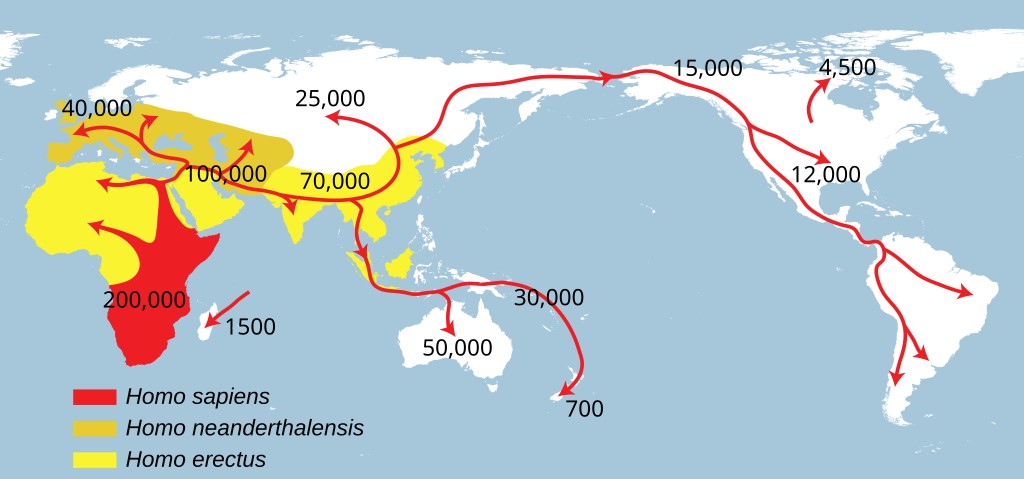
For the case of Neanderthals and Homo sapiens (and Denisovans); at certain points in history, you could consider Homo Neanderthalensis and Homo Sapiens to be different subspecies rather than different species. That is why you sometimes hear the terms Homo Sapiens Neanderthalensis and Homo Sapiens Sapiens. I can add that Homo sapiens certainly got around, as you can see on the map below.
The spread of Homo Erectus (yellow), Homo Sapiens (red) and Homo Neanderthalensis (dark yellow). NordNordWest, Public domain, via Wikimedia Commons
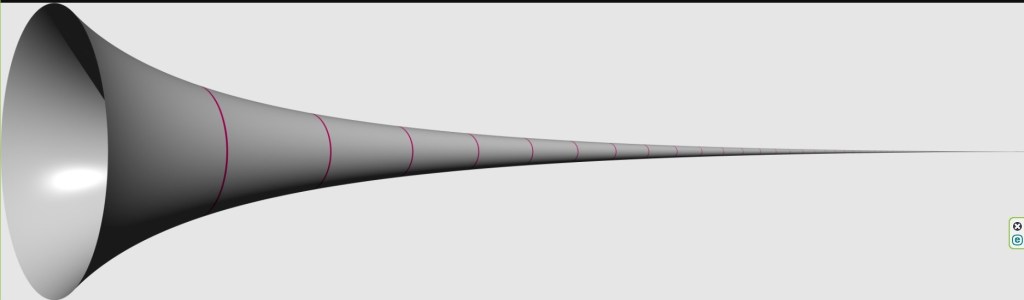
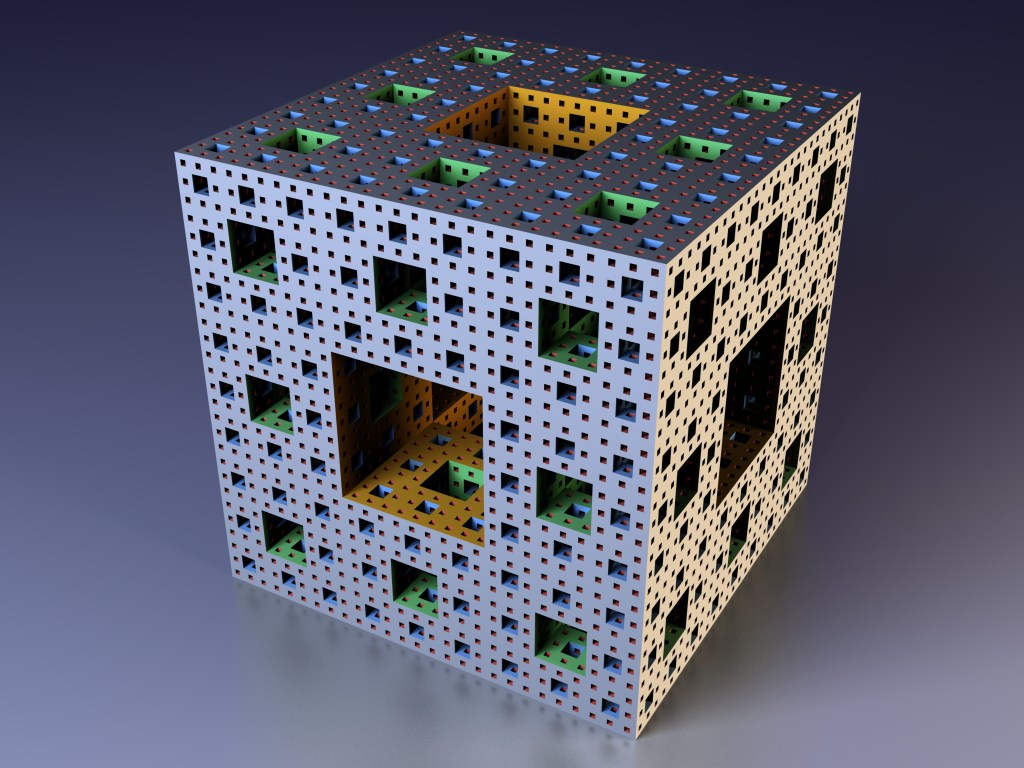
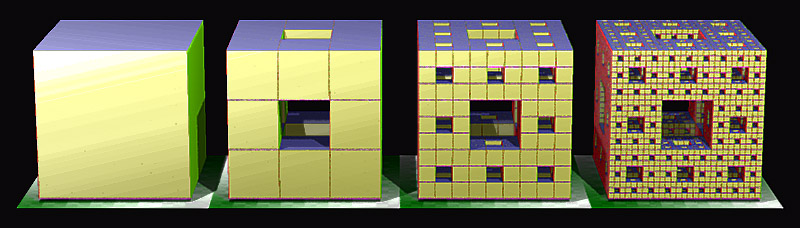
Super fact 113 : There are shapes that have a limited volume but an infinite surface area. Two examples are Gabriel’s Horn and the Menger Sponge.
3D illustration of Gabriel’s horn. RokerHRO, Public domain, via Wikimedia Commons.
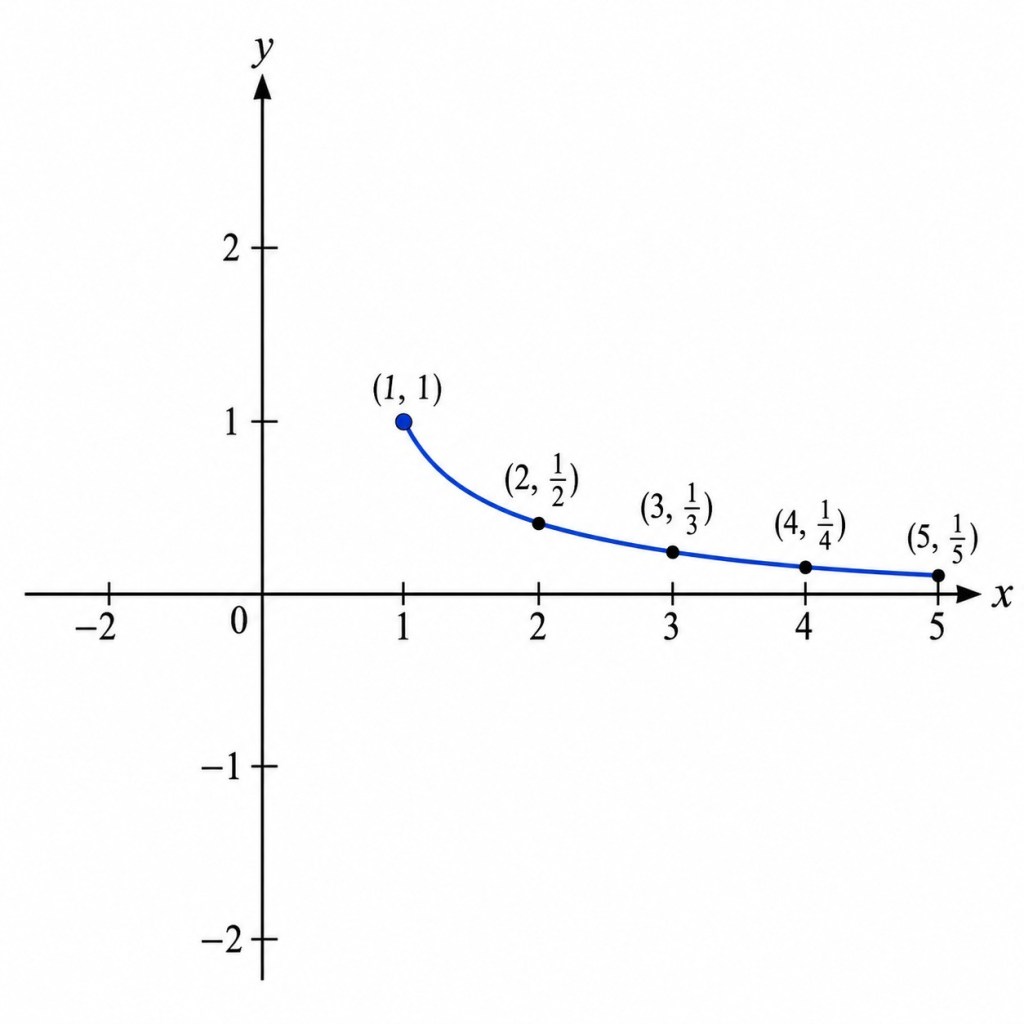
You get Gabriel’s horn by rotating the curve y = 1/x around the x-axis in a coordinate system with the horn starting at x = 1, and y = 1, as in the picture below. Well, you can choose other start values too. A Gabriel’s horn with a beginning radius 1, or widest radius 1, (as in this example) will have a volume equal to pi. Pi is a popular constant. However, it will have an infinite surface area.
This seems like a paradox. The amount of paint you need to fill up Gabriel’s Horn (with widest radius = 1) is pi. However, the surface area of the outside and inside is infinite. So, wouldn’t you need an infinite amount of paint to paint the inside of Gabriel’s Horn? The amount of paint you need to fill up the horn should be more than if you just paint the inside, shouldn’t it? What’s going on? The solution to the paradox is to realize that the radius of Gabriel’s Horn will become increasingly small as it stretches out to the right, and for a coat of paint to take up volume it must have thickness. This is explained well here.
If you rotate this curve around the x-axis, you get a trumpet shape. That is Gabriel’s Horn. I was lazy and drew this using ChatGPT instead of drawing it myself.
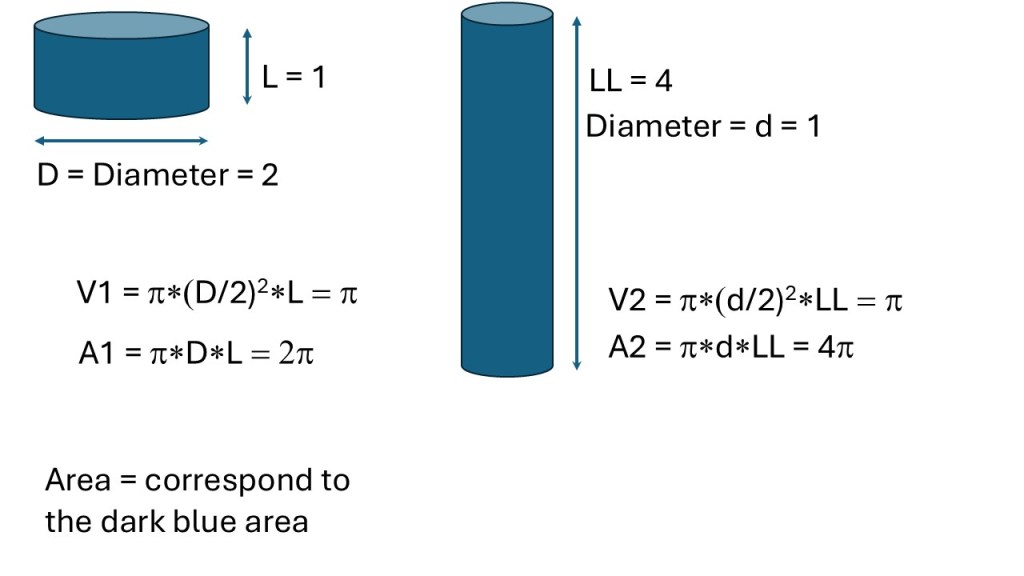
To understand why it is possible for the surface area of Gabriel’s Horn to become infinite you can imagine two cylinders of equal volume, one short (and thick), and one long (and thin). The longer and thinner cylinder will have a larger surface area as shown in the picture below. As Gabriel’s Horn is stretched out and getting thinner and thinner you get an infinite surface area, as you go towards infinity, while the volume does not become infinite. This is analogous to the infinite series in my previous post where adding an infinite number of subsequently smaller addends results in a finite number (corresponding to the volume being finite in this case).
This picture (drawn by me) shows that when you elongate a cylinder but keep the volume the same the dark blue surface area gets larger.
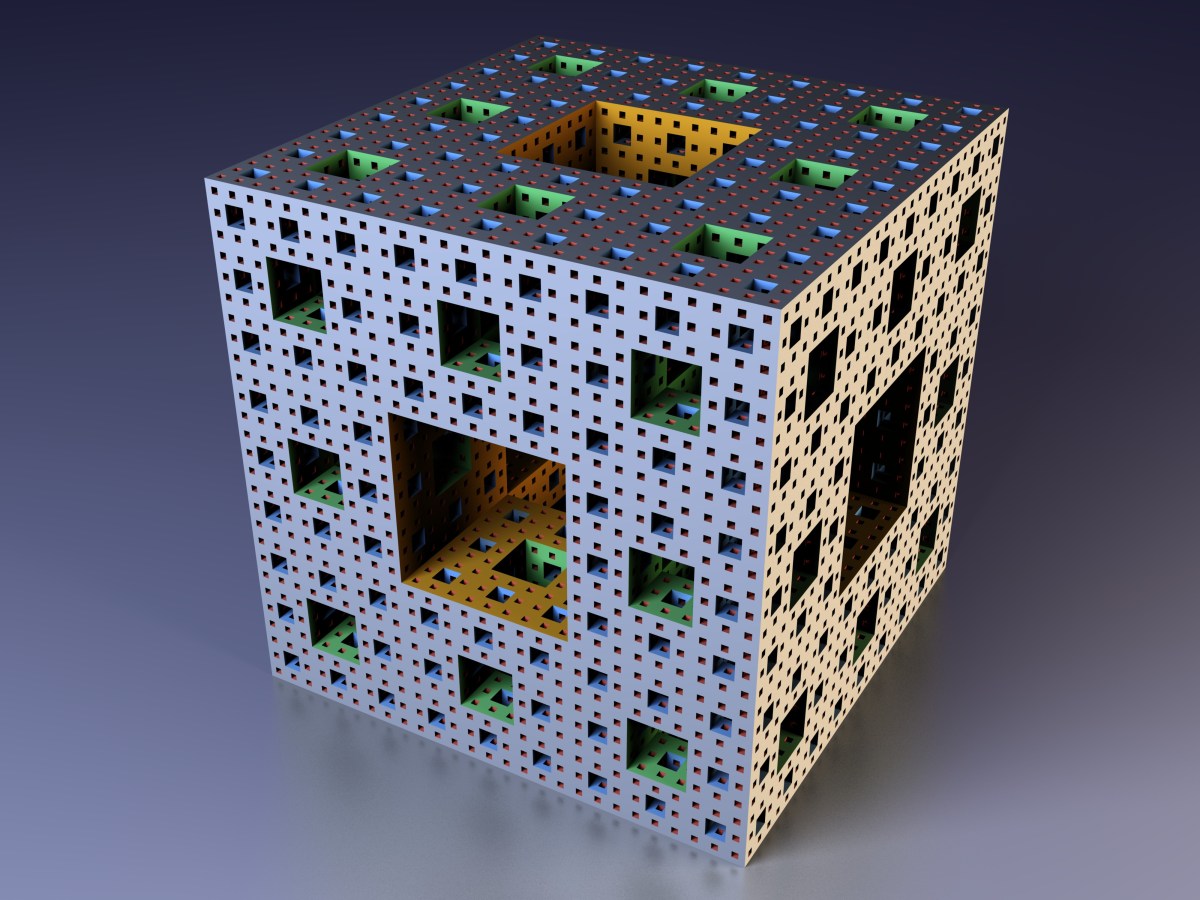
The way you construct a Menger sponge or a Menger cube is by starting with a cube.
Then divide every face of the cube into nine squares in a similar manner to a Rubik’s Cube, dividing the cube into 27 smaller cubes.
Then remove the smaller cube in the middle of each face and remove the smaller cube in the center of the larger cube, leaving 20 smaller cubes. This is a level 1 Menger sponge.
Repeat steps two and three for each of the remaining smaller cubes and continue to iterate infinitely many times.
As you are repeating this process over and over the volume of the Menger sponge will decrease a little bit in every step whilst the area will grow towards infinity.
An illustration of the iterative construction of a Menger sponge up to M3, the third iteration.
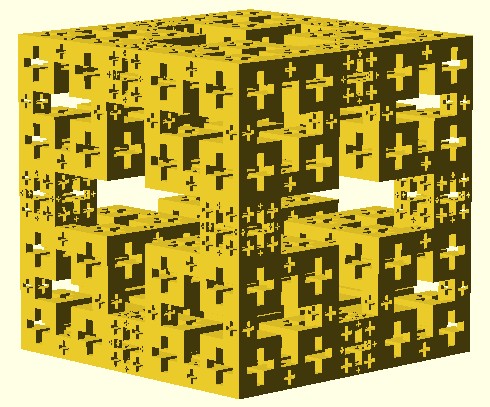
The Jerusalem Cube is like the Menger sponge/cube but instead of removing cubes you remove cross or plus looking 3D shapes from the larger cubes.
Super fact 112 : Adding infinitely many numbers may result in a finite number. In addition, adding infinitely many numbers may result in an irrational important constant such as Pi. The same holds true for infinitely nested radicals (square roots).
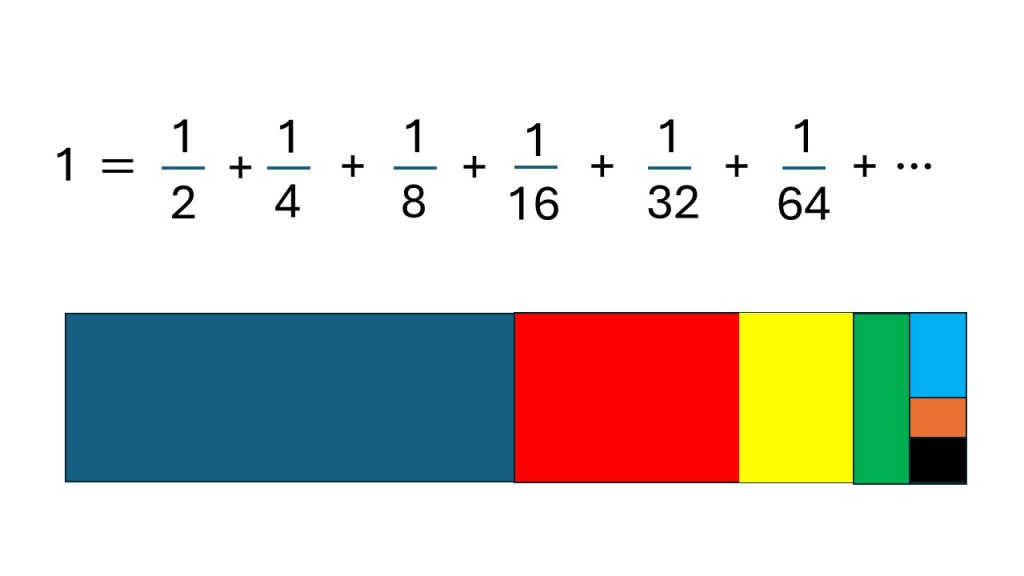
The differently colored rectangles represent the fractions in the equation. Each subsequent addend is the half of the previous. Despite having an infinite number of addends, the total sum is just 1.
That you can add infinitely many numbers and get a finite number as the result is possible to understand if you imagine cutting a rectangle into smaller and smaller pieces and then adding them to get the rectangle back. If you start with half the rectangle and then you add the half of the remaining half and then the half of that remaining half, etc., you can keep doing that forever without exceeding the size of the rectangle. This is illustrated in the picture above. Note all these pictures are drawn by me.
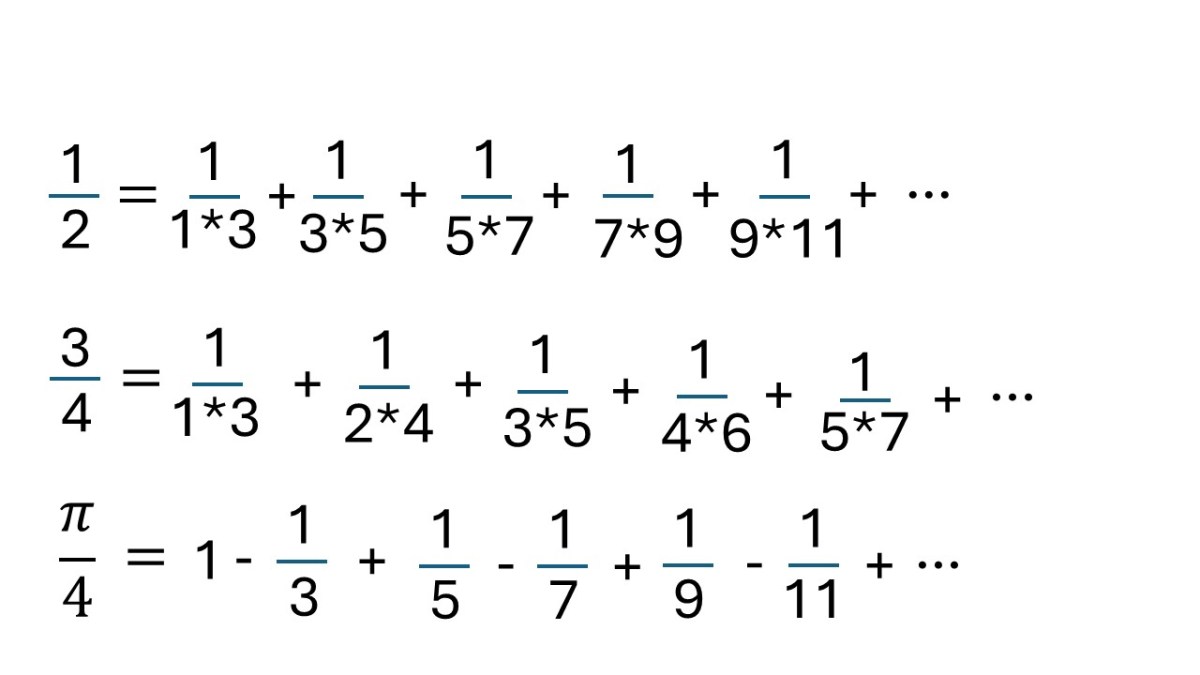
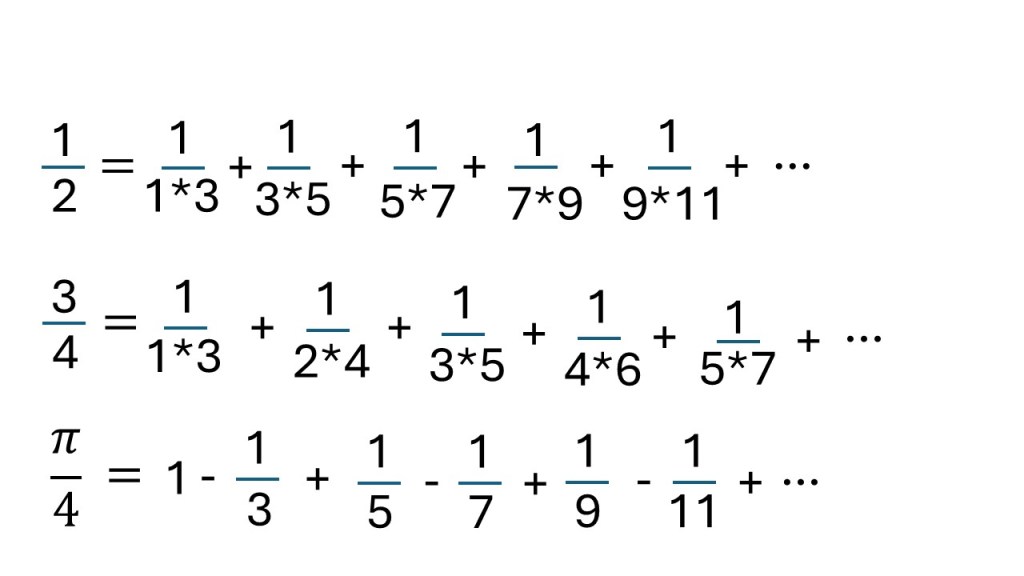
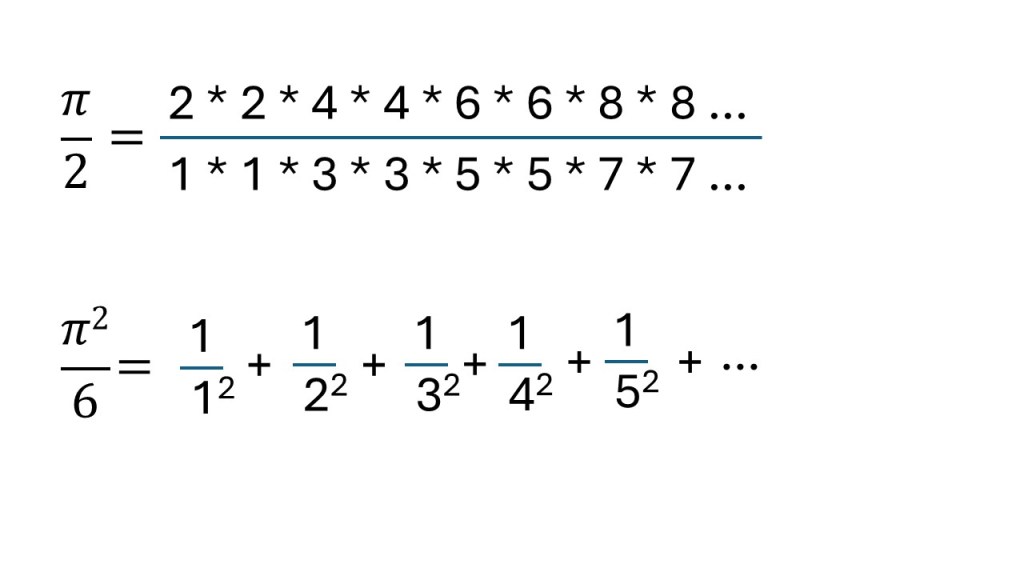
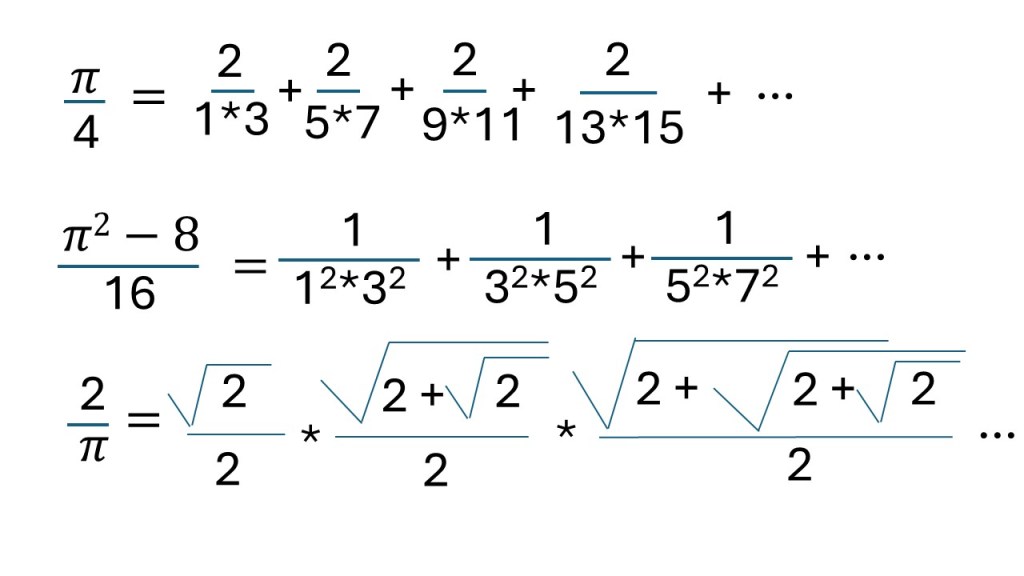
If you’ve never seen an infinite series before this may come as a surprise. However, what is even more surprising is that you can add an infinite number of addends that are constructed from simple patterns and get all kinds of surprising results including irrational numbers with special meaning such as pi. You can easily find thousands of examples in mathematical handbooks and online. This reality is important in mathematics and our understanding of the world, as well as surprising, and therefore a super fact in my opinion.
Three fascinating examples of infinite series. Note that I indicate multiplication using a star *.
Infinitely Nested Radicals
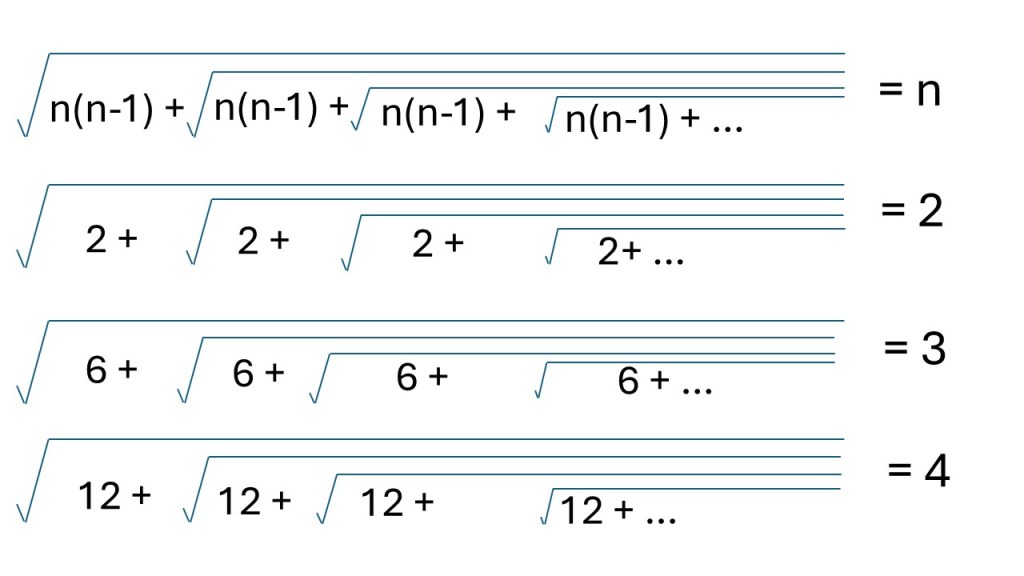
In addition, to adding an infinite number of addends you multiply an infinite number of factors and end up with a non-infinite (finite) result. You can even have an infinite number of nested radicals. To explain what a radical is. A square is a number multiplied by itself. For example, the square of 5 is five times five, which is twenty five. A cube is a number multiplied by itself three times. The cube of five is five times five times five, which is one hundred and twenty five. The square is denoted by adding a superscript of 2 (5 with a superscript 2). The cube is denoted by adding a superscript of 3 (5 with a superscript 3).
The square root is the opposite of the square. The square root of twenty five is five. The cube root is the opposite of the cube. The cube root of one hundred and twenty five is five. The square root and the cube root are examples of radicals. Radicals are indicated by using a little house on top of the number as shown in the pictures below. For radicals that are not square roots you add a number indicating what type of radical you have. The cube root has the number three above the house. All the examples below are square roots and in those cases the number two is left out.
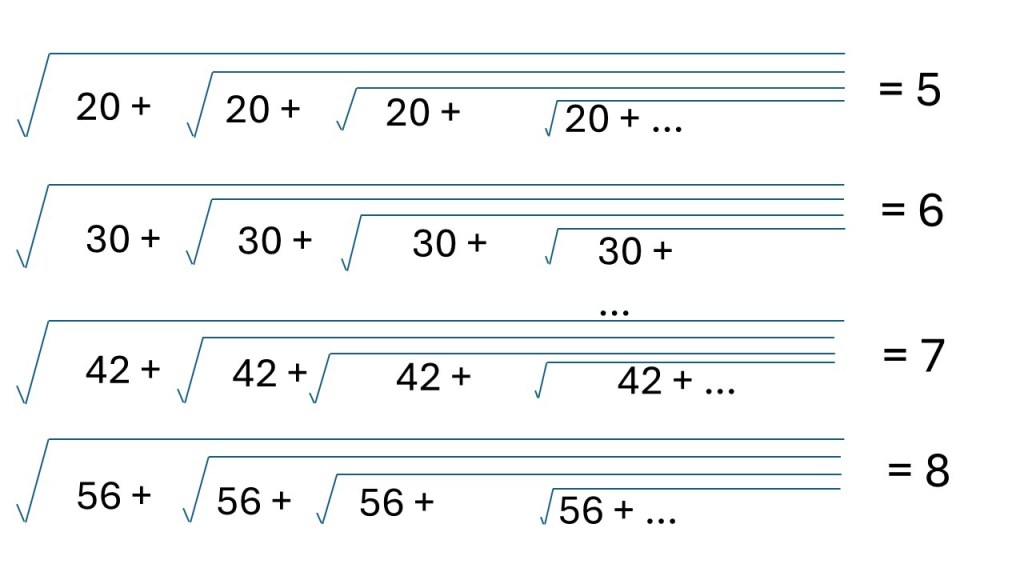
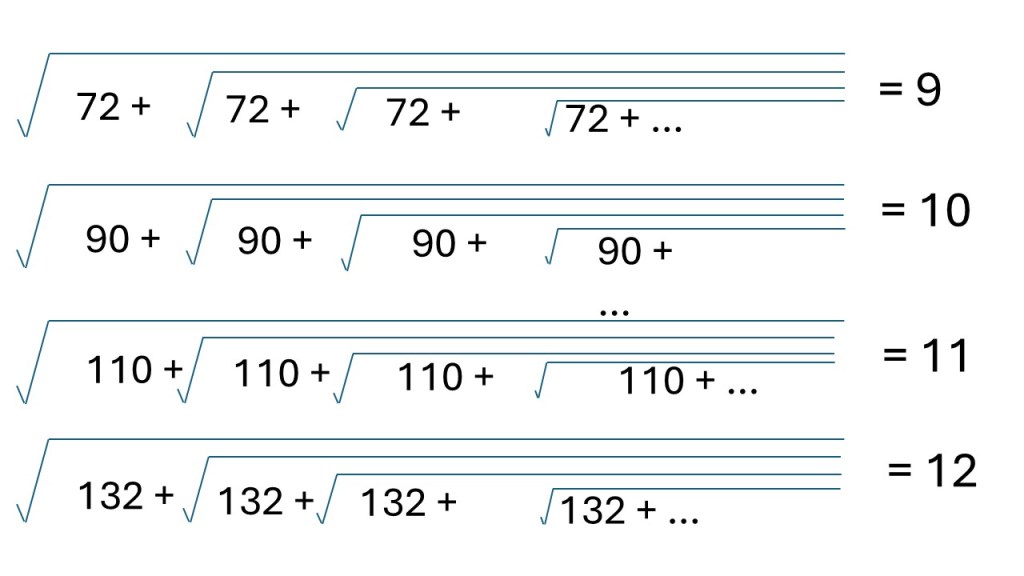
The three pictures below show one example of infinitely nested radicals (square root) using numbers n(n-1) repeatedly in the square roots. When n = 2 then n(n-1) is 2*1 = 2. When n = 3 then n(n-1) is 3*2 = 6, etc.
Infinitely nested square roots using n = 2 is the same as 2. Infinitely nested square roots using n = 3 is the same as 3, etc.Infinitely nested square root for n = 9,10,11,12
Infinite Series and Pi
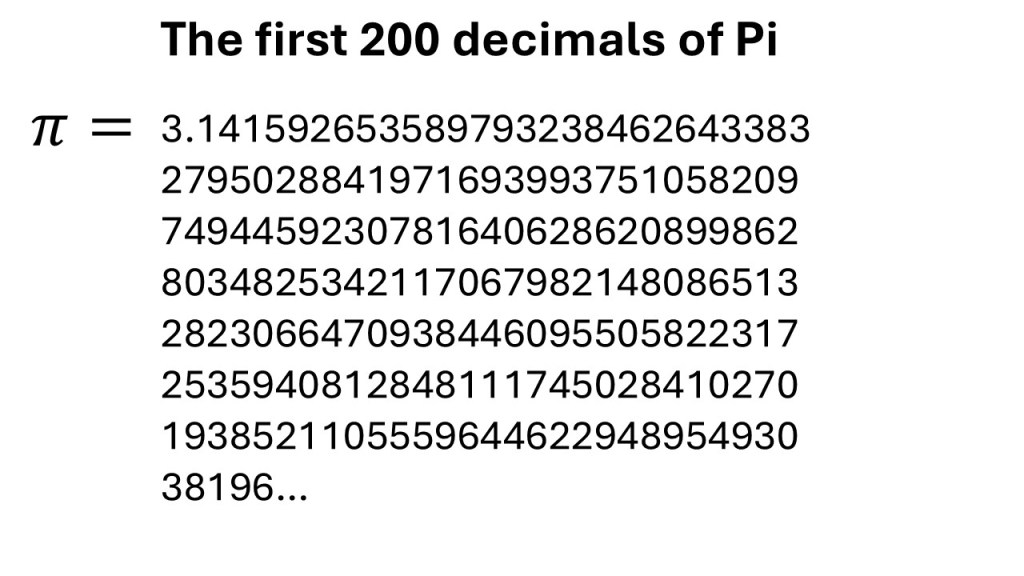
The constant pi is a special mathematical number that tells you exactly how the distance around the edge of any circle compares to the distance straight across the middle (diameter). Pi is an irrational number, meaning it cannot be expressed as a fraction and when written as a decimal it has an infinite number of decimals that have no repeating patterns. Despite pi being irrational, it shows up as the result of a very large number of infinite series that follow surprisingly simple patterns.
The first 200 decimals of pi.Infinite multiplication and infinite number of addends.Infinite series and infinitely nested square roots (radicals) resulting in pi.
Super fact 111 : Russel’s Paradox is a logical contradiction discovered in 1901 that showed that the mathematical discipline of “Set Theory” was fundamentally flawed. Mathematicians had naively assumed that any definable property can be used to form a collection (or set) of items, but that is not true. An example of the Paradox is “A male barber shaves all men who do not shave themselves and only men who do not shave themselves. Does he shave himself?” Both “yes” and “no” are impossible answers. That is an example of an impossible set. Set theory needed an exclusion of such impossible sets.
Bearded client visiting barber shop. Shutterstock asset id: asset id: 1821348236 by Body Stock.
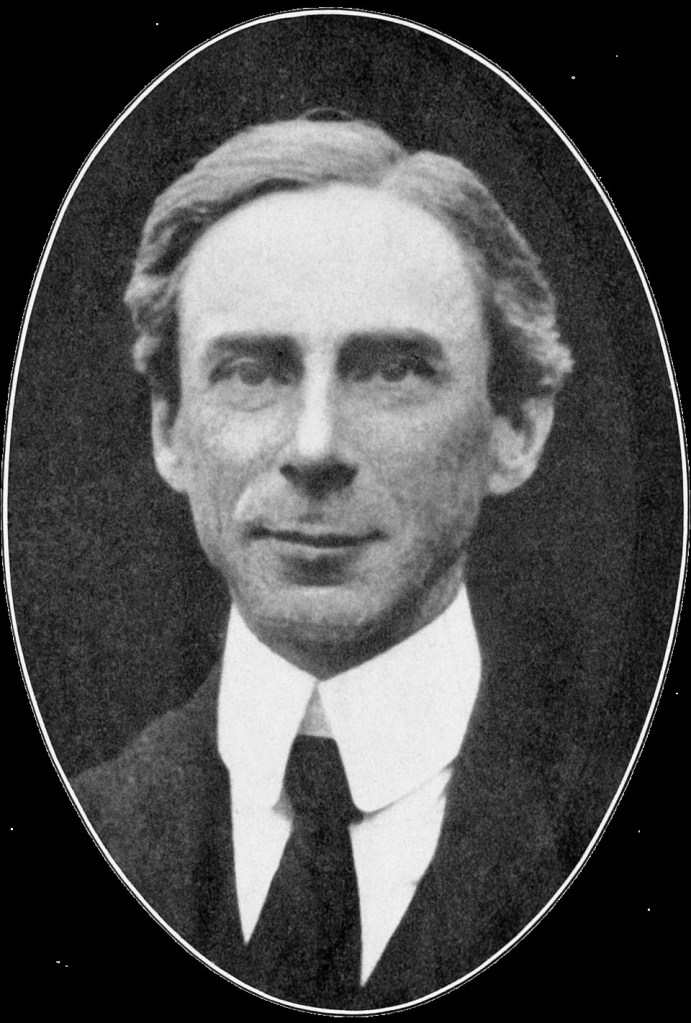
Russell’s paradox is a famous logical contradiction discovered by the philosopher and mathematician Bertrand Russell in 1901. To solve the contradiction, you need to remove the assumption that any property can form a set. In other words, not every set is possible. Basically, self-reference cannot be allowed.
To take the example above “A male barber who shaves all men who do not shave themselves and only men who do not shave themselves.” Is something that cannot exist. If the barber shaves himself then he is shaving someone who shaves himself, which was not allowed. If the barber does not shave himself, then he is not shaving all the men who do not shave themselves. Either way, it does not work. Such a barber cannot exist. In general, you cannot define a set anyway you like.
I consider this a super fact because it shows that contractions can be hidden even in mathematical disciplines, and it is important because you certainly don’t want contradictions hidden in a mathematical or scientific discipline. Contradictions lead to more contradictions and lots of problems.
Bertrand Russell portrait. Honourable Bertrand Russell.jpg: Photographer not identifiedderivative work: Conquistador, Public domain, via Wikimedia Commons
A Crazy Barber Story Involving Our Children
This happened soon after the September 11 attacks in 2001. In addition to planes crashing into buildings, there were attempts at biological warfare by spreading anthrax through the postal service. This is something we paid special attention to at my work because we were making postal sorting machines. It is also the reason I do not like people who write addresses in cursive.
Anyway, my wife called me at work, and she was very upset because our daughter’s hair was falling out. She touched her hair and it just fell off. She did not know what could be causing her hair to suddenly fall out, but she thought that it might have been biological warfare. I told her to call our doctor who had the good sense of suggesting that perhaps the kids had been playing barbershop. As it turned out they had. Our son confessed to cutting off our daughter’s hair. He had realized that this was bad, so he tried to put her hair back as well as he could. Afterwards, she was walking around with loose hair on top and that’s when my wife found her.
Our son is cutting his sisters hair. The picture is generated with the help of ChatGPT.
The goal of this blog is to create a list of what I call super facts. Super facts are important true facts that nevertheless are surprising to many, misunderstood, or disputed among the non-experts. They are special facts that we all can learn something important from. However, I also make posts that are not super facts but feature other interesting information, such as this book review and book recommendation. I should say that this book is not written by a scientist but an environmentalist, and he did not provide references for his hundreds of factual claims. However, I fact checked at least 20 claims and found only one that was not entirely correct, so I think his facts are for the part correct. The book is:
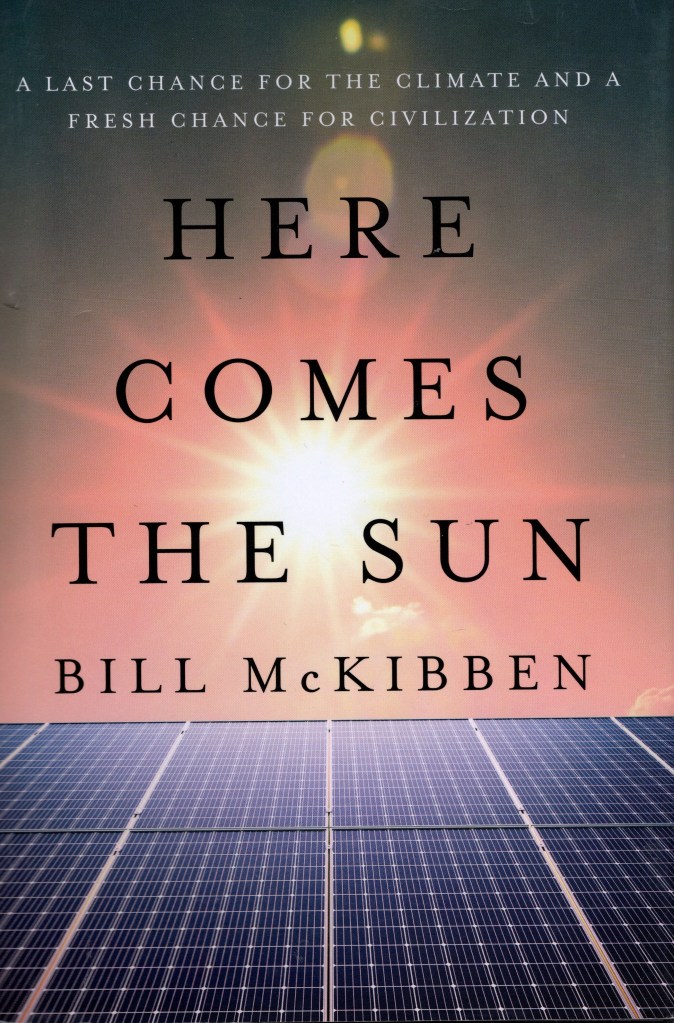
Here Comes the Sun: A Last Chance for the Climate and a Fresh Chance for Civilization by Bill McKibben
Below I am listing the four versions of this book. I bought the hardback version.
Hardback – Publisher : W. W. Norton & Company (August 19, 2025), ISBN-10 : 1324106239, ISBN-13 : 978-1324106234, 224 pages, item weight : 12 ounces, dimensions : 5.8 x 0.9 x 8.6 inches. It costs $15.91on US Amazon. Click here to order it from Amazon.com.
Paperback – Publisher : W. W. Norton & Company (August 11, 2026), ISBN-10 : 1324130628, ISBN-13 : 978-1324130628, 240 pages, item weight : 13 ounces, dimensions : 1 x 5.5 x 8.25 inches. It costs $19.99 on US Amazon. Click here to order it from Amazon.com.
Kindle – Publisher : W. W. Norton & Company (August 19, 2025), ASIN : B0DXQGBM4Z, 220 pages, it costs $9.40 on US Amazon. Click here to order it from Amazon.com.
Audiobook – Publisher : Highbridge Audio (August 19, 2025), ASIN : B0F95QL1C2, Listening length : 7 hours and 36 minutes. $0.00 with membership. Click here to order it from Amazon.com.
The front cover of Here Comes the Sun: A Last Chance for the Climate and a Fresh Chance for Civilization by Bill McKibben. Click on the image to go to the Amazon page for the hardback version of the book.
Amazon’s Description of the Book
From the acclaimed environmentalist, a call to harness the power of the sun and rewrite our scientific, economic, and political future.
Our climate, and our democracy, are melting down. But Bill McKibben, one of the first to sound the alarm about the climate crisis, insists the moment is also full of possibility. Energy from the sun and wind is suddenly the cheapest power on the planet and growing faster than any energy source in history―if we can keep accelerating the pace, we have a chance.
Here Comes the Sun tells the story of the sudden spike in power from the sun and wind―and the desperate fight of the fossil fuel industry and their politicians to hold this new power at bay. From the everyday citizens who installed solar panels equal to a third of Pakistan’s electric grid in a year to the world’s sixth-largest economy―California―nearly halving its use of natural gas in the last two years, Bill McKibben traces the arrival of plentiful, inexpensive solar energy. And he shows how solar power is more than just a path out of the climate crisis: it is a chance to reorder the world on saner and more humane grounds. You can’t hoard solar energy or hold it in reserves―it’s available to all.
There’s no guarantee we can make this change in time, but there is a hope―in McKibben’s eyes, our best hope for a new civilization: one that looks up to the sun, every day, as the star that fuels our world.
Here comes the sun tells the story of the spectacular success of renewables around the world, especially the success of solar power and wind power, with a special emphasis on solar power. The success of renewables was one reason that the IPCC will likely retire the RCP8.5 emissions scenario. The RCP8.5 emissions scenario, which was the extremely bad emissions scenario, was never very likely to begin with, but the fact that the world, including China, is turning away from coal and fossil fuels made this scenario implausible as they stated. I am not sure whether Bill McKibben could have predicted this when he wrote this book, but I think this recent event makes this book very relevant now in 2026.
The book describes a very interesting situation for our world and contains interesting personal anecdotes and is written in a positive and optimistic way. However, I was delighted that the book was full of interesting facts, for example, in 2024 92.5% of all new electricity bought online around the world came from renewables. Other facts are, Chinese emissions are dropping. He tells us that forty percent of the world’s ship traffic consists of moving coal and gas back and forth across the ocean to be burned. He states that the entire continent of Africa has barely produced 3% of the greenhouse gases warming the atmosphere, whilst they are likely to bear the brunt of the effects of global warming.
Other interesting facts are; Chinese citizens can expect to live on average 2.2 years longer than they would have a decade ago, due to the sharp drop in pollution (thanks to renewables and EVs). Dealing with cleantech waste is a small problem compared to fossil fuels, and we have enough minerals, especially considering recycling. He tells us about various physics facts related to the sun, how our health is effected by the sun, the history of the day “Sunday”, sun worship in the ancient world, and other sun related facts.
He reviews the history of fossil fuels and renewables, particularly solar power, and the how the fossil fuel industry and certain politicians are fighting against renewables with disinformation and bad faith arguments. He explains the problems with fossil fuels and the dangers they pose, which is not just limited to climate change. He also explains a little bit about why we know that fossil fuels are causing global warming / climate change, why we need to keep pushing for renewables despite their success. He states that because fossil fuels themselves are easy to concentrate, they often yield authoritarian outcomes.
In the past renewables were an expensive alternative and fossil fuels cheap, but that situation has been reversed. He explains why EVs are in general cleaner and better for the environment than cars with internal combustion engines. He explains how we get around the intermittence issue with wind and solar and that batteries are getting much cheaper and environmentally friendlier, and why a lot of negative information you hear about batteries is not true anymore. Salt batteries is an example of an emerging technology.
My only concern with the book is that Bill McKibben is not a scientist. He is an activist. Because of that it is extra important that he provides references to reputable sources for all his claims. Typically, scientists provide references to their claims even though you in general can trust scientists more than activists. However, Bill McKibben provided no references to any of his several hundred facts and claims, except for some general and vague information in the back about where he got his information from.
I should say that I fact checked about two dozen of his claims and found only one that was not entirely accurate, so overall I trust this book. The book is easy, lighthearted and positive reading. It is not a heavy science book, the book was well organized, and he is a good author. Therefore, I highly recommend this book.
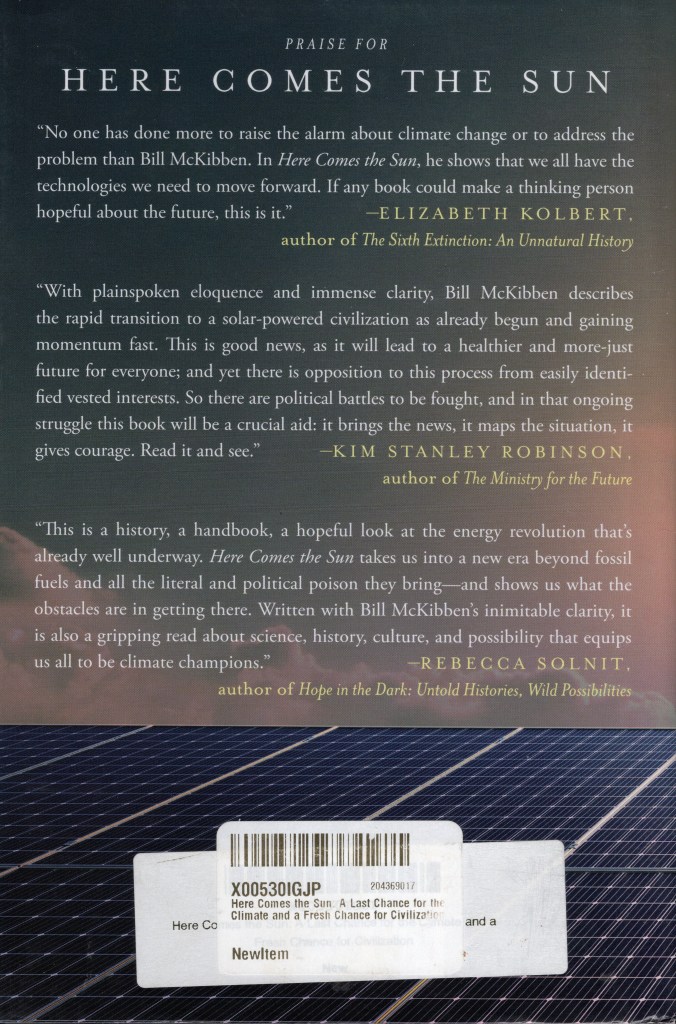
The back cover of Here Comes the Sun: A Last Chance for the Climate and a Fresh Chance for Civilization by Bill McKibben. Click on the image to go to the Amazon page for the paperback version of the book.





 Super Facts