The Evolution of Eyes is Convergent

Superfact 104: The evolution of eyes is convergent, meaning different, unrelated animal species independently evolved similar types of eyes. Biologists estimate that eyes have evolved independently between 40 to over 65 different times across various lineages. An example is the evolution of Cephalopod eyes (like squid and octopus) and vertebra eyes.

Esther’s writing prompt: May 20, 2026: Eyes

Click here to join in.

First of all, eyes evolved. Creationists often say that eyes are too complex too have evolved. That is because the eye is composed of many interdependent, finely tuned parts, for example, the cornea, iris, retina and lens. And that it cannot function without all those components already evolved. This is referred to as the argument for irreducible complexity.

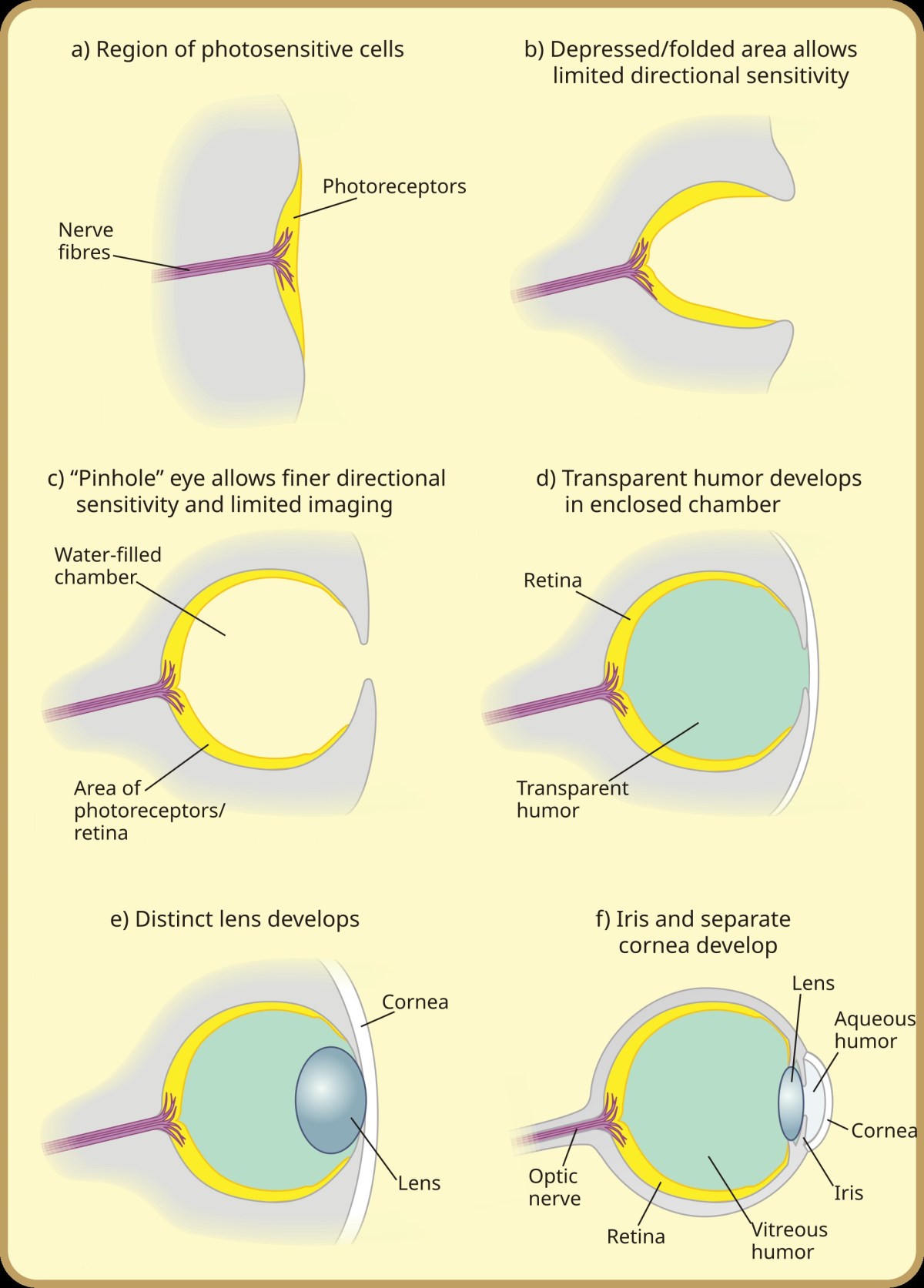
The problem with that argument is that evolution is not linear. The various intermediate steps may not have functioned as the final product but could still have provided evolutionary advantage. There are many intermediate “eyes” existing today in nature. As you can see in the picture below the evolution of the vertebra eye did not start with all the current parts.
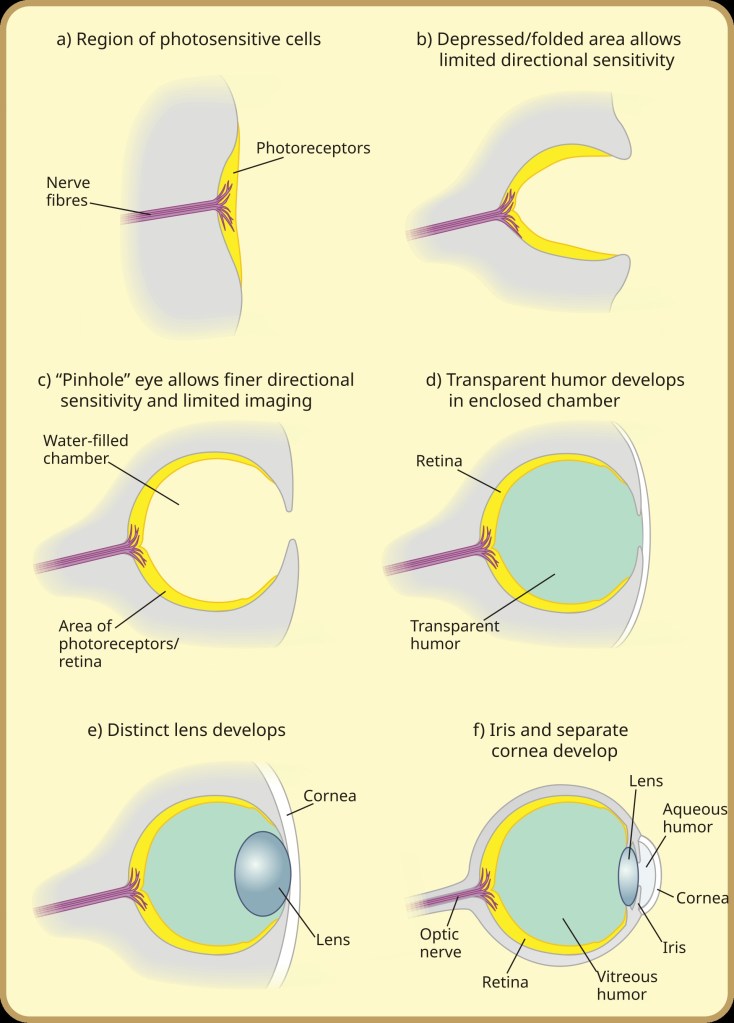
The picture shows six stages of the evolution of the vertebra eye. First a region of photosensitive cells and nerve fibers. Second a depressed/folded area that allows limited directional sensitivity. Thirdly, a “Pinhole” eye that allows finer directional sensitivity and limited imaging. Fourth, a transparent humor develops in an enclosed chamber. Fifth, a distinct lens develops. Sixth, Iris and separate cornea develop. | The Evolution of Eyes is Convergent
Major stages in the evolution of the eye in vertebrates. Matticus78 at the English-language Wikipedia, CC BY-SA 3.0 http://creativecommons.org/licenses/by-sa/3.0/, via Wikimedia Commons.

In addition, the evolution of eyes is largely convergent. Biologists estimate that eyes have evolved independently between 40 to over 65 different times across various lineages. The cephalopods (like octopuses and squid) and vertebrates (like humans, mammals, birds and fish) evolved their camera-style eyes completely independently. This is one of nature’s most famous examples of convergent evolution, where two unrelated species arrive at the exact same biological solution to survive in their environments.

The fact that eyes evolved and that the irreducible complexity argument does not work comes as a surprise to creationists. That the various kinds of eyes in nature evolved separately but converged on similar complex structures is in general an amazing fact. It is a kind of an important fact that is true. Therefore, it is a super-fact in my opinion.

Eyes Are not an Example of Irreducible Complexity

The evidence that the complexity of eyes is not an example of irreducible complexity is strong. We can trace lineages via DNA and sub-optimality. We can also simulate the evolution of the eye using computers. In a simulation based on mutations and natural selection it took 363,992 generations to evolve an eye from an eyespot (light-sensing organelle) to a complex camera type eye, which probably corresponds to around half a million years. See The Evidence for Evolution by Alan R. Rogers.

I can add a personal anecdote. In my job as a software engineer trying to find better algorithms for sorting mail using the photos of the mail, including the address block, I tried using genetic algorithms. Genetic algorithms is a type of Artificial Intelligence that simulates evolution to create better systems (better algorithms and software). The genes corresponding to the best algorithms were allowed to propagate, recombine and mutate. That was the natural selection component.

What I saw was that the genetic algorithm could evolve the system into a complex and effective system of interdependent complex components that did not exist at the beginning. Several complex components working together did not require that components/parts evolve one after another. They can go through several formats from primitive to advanced and they can have different functions along the way. Some parts might evolve and then disappear and new kinds of parts pop up, as the total algorithm kept evolving. There is no reason to believe that irreducible complexity even exists.

The Vertebra Eye versus the Cephalopod Eye
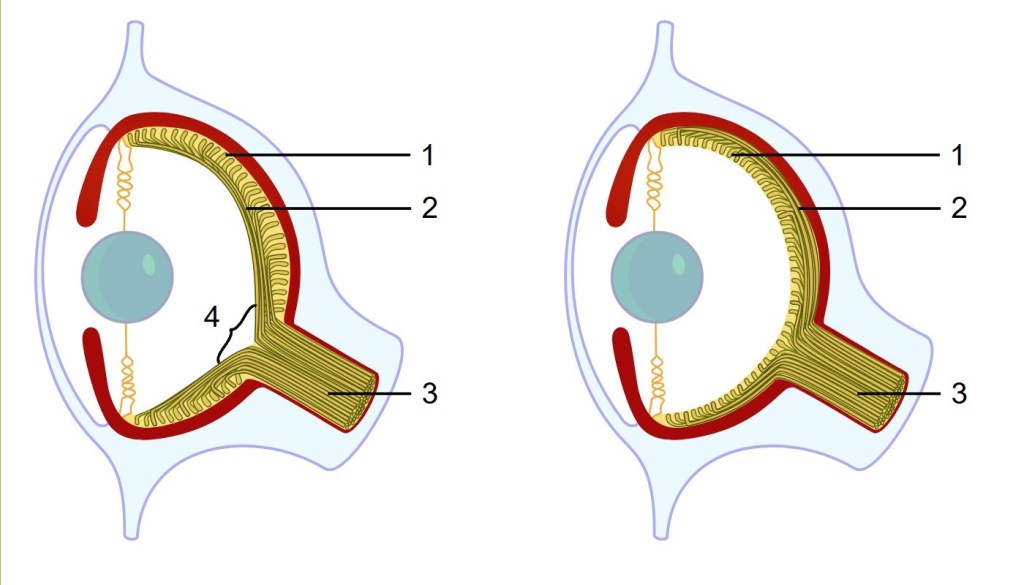
The cephalopod eye on the right is very similar to the vertebra eye on the left, except it does not have a blind spot.
1 is the retina and 2 the nerve fibers. 3 is the optic nerve. 4 is the vertebrate blind spot. Caerbannog, CC BY-SA 3.0 <http://creativecommons.org/licenses/by-sa/3.0/&gt;, via Wikimedia Commons.

While both eyes share features like a cornea, iris, lens, and retina, they were built from different starting materials and possess some structural differences. In vertebrate eyes, the nerve fibers route before the retina, blocking some light and creating a blind spot where the fibers pass through the retina. In cephalopod eyes, the nerve fibers route behind the retina, and do not block light or disrupt the retina. In other words, the cephalopod eyes not having a blind spot are more perfect than our eyes.
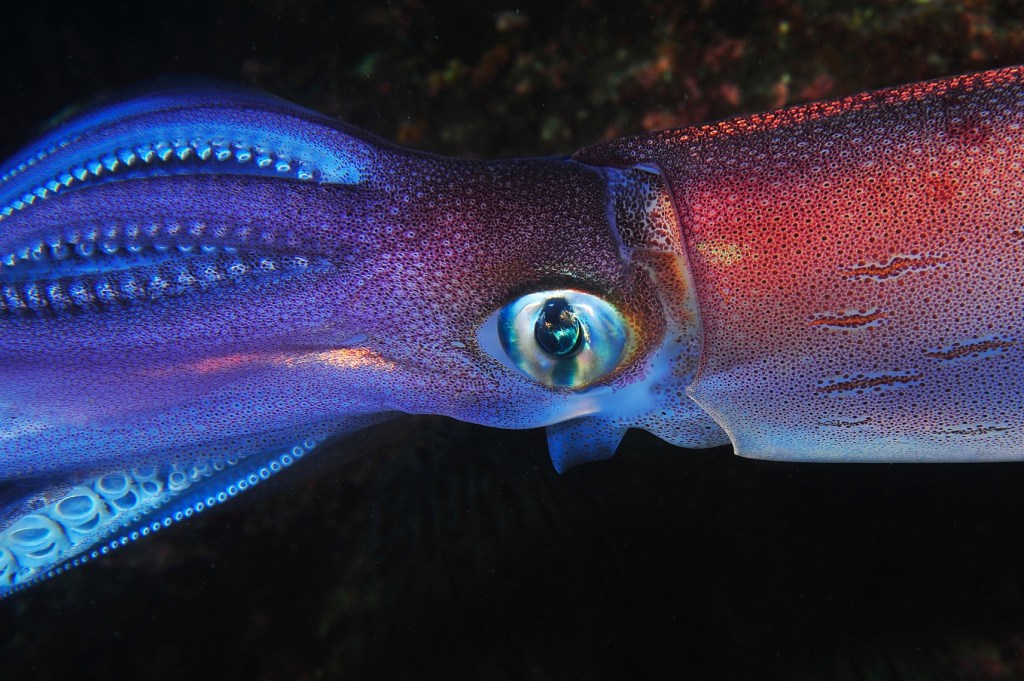
Close up of squid with its eye at the center. | The Evolution of Eyes is Convergent
Look into the loving eyes of the squid. He does not have a blind spot. Atlantic Ocean squid macro photo. Shutterstock asset id: 1859007028 by Rui Palma

My Other Responses to Esther’s Prompts


To see the Other Super Facts click here

Large Language Models is just One Branch of Artificial Intelligence

Superfact 90: Large Language Models (LLMs) such as ChatGPT, Claude, Llama and Gemini are just one type of popular applications of Artificial Intelligence among hundreds of applications of Artificial Intelligence, and LLMs represents just one branch of Artificial Intelligence.

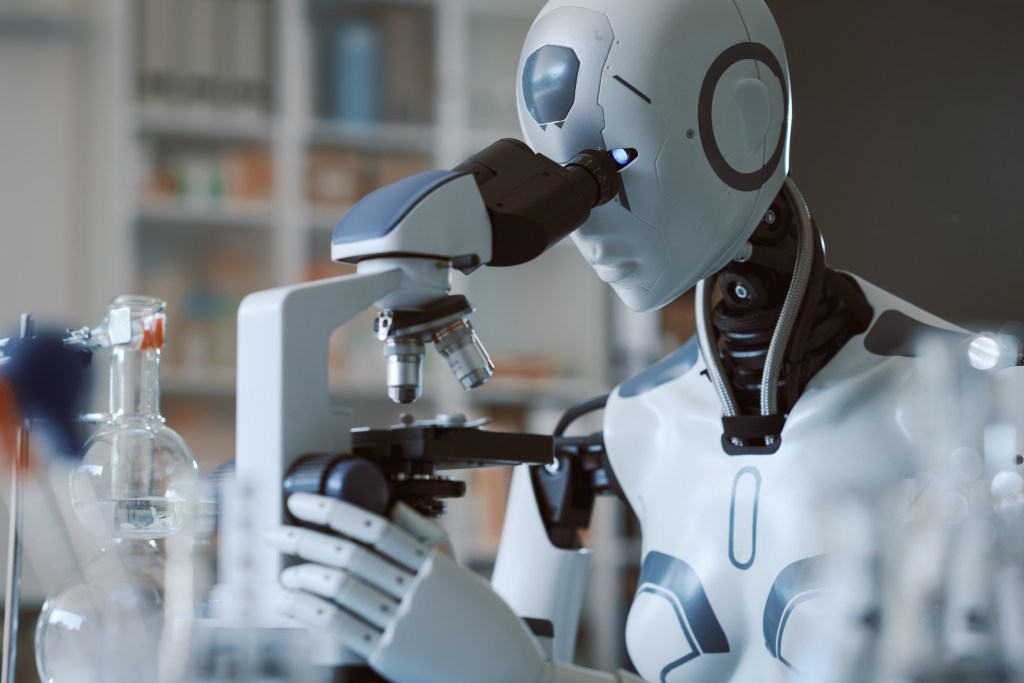
White female AI robot using a microscope in the scientific laboratory | Large Language Models is just One Branch of Artificial Intelligence
Artificial intelligence and research concept. Shutterstock Asset id: 2314449325 by Stock-Asso

LLMs are currently the most popular “viral” AI. We can all access LLMs in our browsers. This has created the common misconception that Artificial Intelligence is the same as Large Language Models. However, LLMs represent only one branch of narrow AI systems designed to perform specific tasks.

Applications of Artificial Intelligence other than what Large Language Models are used for include robotics, robot motion planning, advanced control systems using AI, self-driving cars, image processing, optical character recognition, classification, facial recognition systems, medical imaging diagnostics, game playing such as chess playing computers, financial fraud detection, cybersecurity, investment robots, route optimization, mathematical proof generation, recommendation algorithms, virtual assistants, programming code generation, smart home devices, drug discovery, and that is just for starters.

There are probably many applications and types of Artificial Intelligence that we have not yet invented.

C3P0 and R2D2 from Star Wars
Two Robots powered by Artificial Intelligence. Shutterstock Asset id: 558350728 by Willrow Hood.

LLMs use large neural networks with many hidden layers, so called deep learning algorithms, and they employ the Rumelhart backpropagation learning algorithm invented by David Rumelhart, Geoffrey Hinton, and Ronald Williams. Clearly neural networks with multiple hidden layers and using the Rumelhart backpropagation algorithm are incredibly successful but it is just one of many kinds of Artificial Intelligence algorithms, and who knows what we will see in the future. Related to this post is my previous post Artificial Intelligence is Not New. We have only just begun.

I consider this a super fact because it is true, kind of important, and I believe that the multitude of Artificial Intelligence algorithms and applications is a surprise to many.

The many Artificial Intelligence Algorithms

AI Humanoid Face Concept. Technology Digital Robot Head Side View with Circuit Board Components. Tech Blue Background. Artificial Intelligence Agent or Assistant Concept. Vector Digital Illustration. | Large Language Models is just One Branch of Artificial Intelligence
Shutterstock Asset id: 2645975149

Due to the great improvement and success of Neural Networks, they have become very popular and Large Language Models use very large Neural Networks with multiple hidden layers (employing the Rumelhart back propagation algorithm). You can read more about that here.

However, there are many other AI algorithms, hundreds, maybe thousands. One example is genetic algorithms. These are types of algorithms that mimics evolution. They iteratively select a set of the best candidate solutions, then combine them (crossover), and also add random changes (mutation) to generate new solutions. Then select the best solutions and then you do it again. Selecting the best solutions corresponds to natural selection. I tried out such algorithms at my work, and over many iterations / generations you can get some impressive results. It is easy to understand how a complex organ such as an eye can evolve in a similar way in nature.

One type of decision tree based machine learning algorithm that I used specifically for classification tasks at work was C4.5 and C5. More specifically I used this type of machine learning algorithm for evaluating the results from automatic mail sorting systems. Basically, how well can a result from a certain machine be trusted. I don’t remember exactly but my classes were something along the line of super reliable, pretty reliable, average, and this result probably sucks. Other examples of this type of machine learning are ID3, Random Forest, Gradient Boosting, and CART. These types of algorithms are still very popular.

One advantage of using decision tree based machine learning over neural networks for the same task is that when a decision has been made you can follow the decision tree backwards and see why a decision / classification was made. In fact, if you have less than 100 parameters you could likely do it over a lunch. When a neural network makes a decision all you have is a large bunch of numbers that were spit out by an algorithm that looped possibly thousands of times and changing all the numbers every time. You can’t backtrack and figure out exactly how a decision was made. You just have to trust the neural network. The advantage of a neural network in this situation is that if it is trained properly, it is likely to have a better result.

Another type of algorithm used in Artificial Intelligence is search algorithms. For robot motion planning I used an algorithm called A* or A-star, which is a very efficient pathfinding algorithm. It comes in dozens of variants and there are hundreds of other types of search algorithms.

These are just a few examples, but there’s also knowledge based agents, AI-agents with reinforcement learning algorithms, algorithms based on Bayes’ Theorem, Vector Machines, Markov Decision Processes, clustering algorithms,  K-nearest neighbor (KNN) algorithm, simulated annealing, hill climbing,  the ant colony optimization algorithm, and of course neural networks and there are also many types of neural networks. I used a relatively unknown form of artificial intelligence called reflex control for my robotics research. The point is, there is zoo of artificial intelligence algorithms out there. Deep learning neural networks are very popular AI algorithms but far from the only ones.

My Personal Experience with Artificial Intelligence

In 1986, when I was in college in Sweden, I took a class in the LISP programming language. LISP was the first Artificial Intelligence programming language, and it was invented in 1958. In 1987, as a university level exchange student, I took a class called Artificial Intelligence at Case Western Reserve University. That same year I also took a class called Pattern Recognition which introduced neural networks to me.

In 1986 a landmark paper was published by David Rumelhart, Geoffrey Hinton, and Ronald Williams introducing the Rumelhart backpropagation algorithm. Geoffrey Hinton received the Nobel Prize in physics in 2024. David Rumelhart and Ronald Williams were both dead and could therefore not receive the Nobel Prize. The Nobel Prize was also given to John J. Hopfield, another pioneer in neural networks. He invented the Hopfield network. You can read more about neural networks and the Nobel Prize in physics in 2024 here.

The Rumelhart backpropagation algorithm was a giant leap forward for neural networks and for Artificial Intelligence and it is the algorithm used by ChatGPT and the other large language models. Geoffrey Hinton is often interviewed in media and often presented as the father of Artificial Intelligence. He is not, but he us arguably partially responsible for the greatest leap forward in neural networks, as well as Artificial Intelligence.

In the pattern recognition class, we used the Rumelhart backpropagation algorithm on a simple neural network to read images with text. Later I did research in the field of Robotics where I implemented various Artificial Intelligence algorithms as mentioned above. I have a PhD in Applied Physics and Electrical Engineering with specialty in Robotics. Later I would use artificial intelligence algorithms in my professional career.

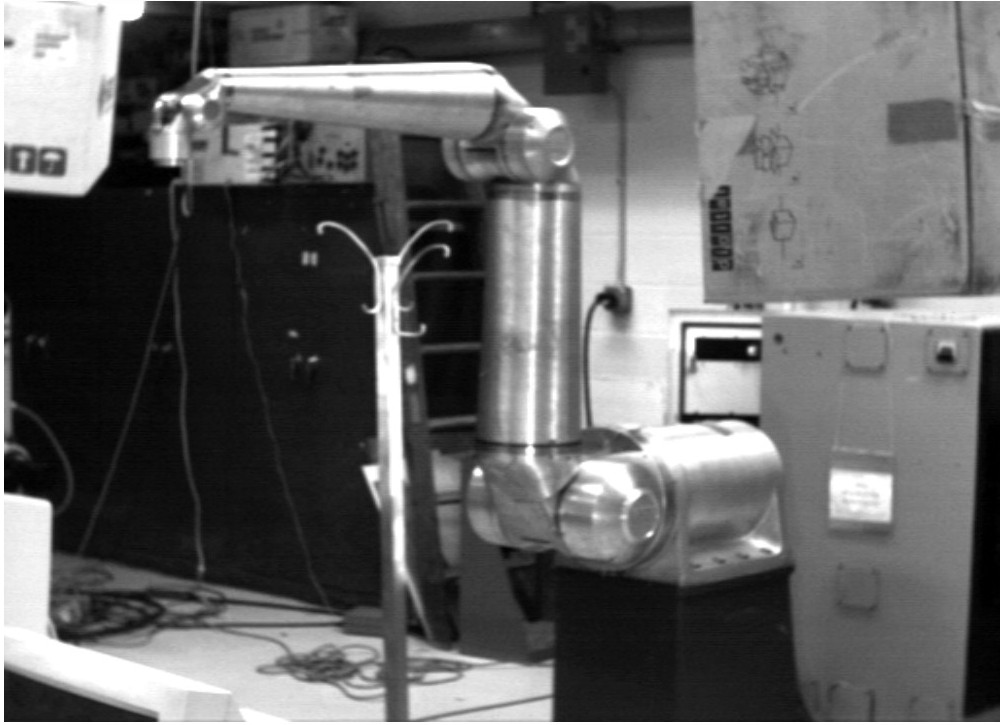
A picture of a large silver colored industrial robot.
I used mostly the seven joint Robotics Research Corporation Robot for my robotics research. The robot was able to detect and avoid colliding with the objects surrounding it. I used echolocation for object detection.

My previous posts on Artificial Intelligence, “Artificial Intelligence is Not New”, and “The Nobel Prize in Physics and Neural Networks”, describe how neural networks work in greater detail.

Note on potential harm of AI

The potential harm of AI is a related and important topic that I did not address. I don’t know much about this topic. However, Grant from “Grant at Tame Your Book” have written an excellent, well research and professional post about this issue called Don’t Confuse AI with a Benign Tool. Please check it out.


To see the Other Super Facts click here