Deforestation peaked back in the 1980s

Super fact 45 : Deforestation peaked back in the 1980s, meaning that is when it was worst. Deforestation has not stopped but the rate of deforestation has slowed as a result of government policies, corporate initiatives, and international agreements.

The rate of global deforestation has slowed significantly since the 1980s. Overall we are still losing forests. We had a 47-million-hectare loss of forest in the last decade, which is very bad, but that is better than the 151-million-hectare loss of forest in the 1980s. For temperate forests we have succeeded in reversing deforestation and temperate forests are now gaining forest. To read more about how government policies, corporate initiatives, and international agreements have slowed the rate of deforestation you can click here, or here, or here.

Aerial photo of a forest. The upper left side shows lot of green trees whilst the lower right side is brown
Amazon rainforest illegal deforestation landscape. Aerial view of trees cut and burned to make land for agriculture and cattle pasture in Amazonas, Brazil. Asset id: 2471967219 by PARALAXIS

This is a super fact because we get a lot of bad news about deforestation, and we should, it is still a big problem. However, we are making progress and because of our negativity bias as well as that of the media, we tend to miss the story about the progress. Therefore, the fact that we are making progress comes as a surprise to many people.

The graphs show that during the 1700’s and the first half of the 1800’s the loss of forests was 19 million acres per decade. From the mid-1800’s to 1920 it was roughly 30 million acres per decade and from the 1920 and on it was 115 million acres per decade until the 1980s and the first half of the 1990s when it was 151 million acres per decade. Since then, it has fallen and in the last decade forest loss was 47 million acres | Proof that deforestation peaked back in the 1980s
Decadal losses in global forest over the last three centuries. Decadal forest loss is measured as the average net loss every ten years, in hectares. This deforestation minus increases in forest area through afforestation. There is no single dataset that applies consistent or transparent methodology for deforestation over centuries. Two different datasets are therefore shown: these still shown the overall development and transition of forestation from temperate to tropical areas, but magnitudes should not be combined at the crossover point. Data sources: Pre-1995 data from Williams (2006). The second series is based on data from UN FAO Global Forest Resources Assessments. The graph comes from Our World in Data – Research and data to make progress against the world’s largest problems.

Peak Agricultural Land

There is one aspect to this story which both explains part of the reduction in deforestation but also provides additional hope for the future and that is that even though the world produces more food than ever, the amount of land we use for doing that is falling. Global land use for agriculture has peaked and is now falling. There has been a global decoupling of agricultural land and food production. I should explain that agricultural land is the total amount of arable land that is used to grow crops, and pasture used to raise livestock. That global land use for agriculture has peaked is illustrated in the graph below.
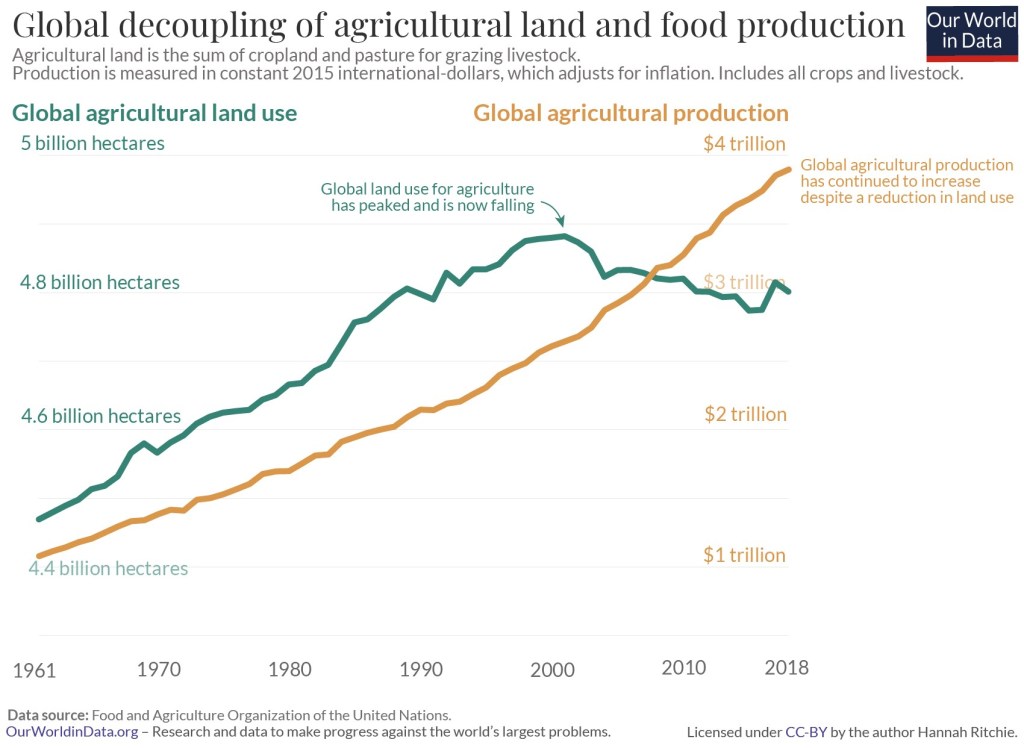
The graph shows a green line chart representing global agricultural land use and an orange line chart representing global agricultural production. The orange line graph keeps rising but the green line chart peaks and then starts going down | Evidence that deforestation peaked back in the 1980s
Global decoupling of agricultural land and food production. Agricultural land is the sum of cropland and pasture for grazing livestock. Production is measured in constant 2015 international dollars, which adjusts for inflation. Includes all crops and livestock. Data source: Food and Agriculture Organization of the United Nations. Our World in Data – Research and data to make progress against the World’s largest problems.

There are more trees now than 35 years ago (there’s a catch)

Another related good news story is that there are more trees in the world today than there were 35 years ago. A lot of the losses of forest in tropical areas have been compensated for by gains in Europe, North America and Asia. For example, tree planting programs in places like China have added a lot of trees as well as forests. In addition to tree planting programs climate change resulting in northern latitudes warming has resulted in temperate forests expanding.

However, this story is not as good as it sounds. There is a huge catch and that is that there is an important distinction between tree cover and forest cover. Tree cover refers to the total area covered by trees, while forest cover specifically refers to areas where trees form a forest ecosystem. Tree cover has increased but as you can guess from the graph above depicting global deforestation, the forest cover continues to decrease.

In addition, a lot of trees were planted for industrial timber plantations, mature oil palm estates and other specifically planted forests. These add to the global tree cover but not necessarily to biodiversity. Not all tree planting is equal.

So even though having more trees compared to 35 years ago is a good thing, it may not be as great as it sounds and does not contradict the fact that deforestation continues. This is important to point out because there are those who attempt to use the fact that we now have more trees to make the case that the talk about deforestation is a hoax. Don’t fall for that.

Summary

The good news is that even though deforestation is still happening the rate of it has slowed down. It peaked in the 1980s. This slowdown is largely due to government policies, corporate initiatives, and international agreements. An additional circumstance that aids in slowing deforestation is that the amount of land we use for agriculture is falling and we have passed peak land use for agriculture. Another positive situation is that we now have more trees than 35 years ago.

However, it is important to point out that does not mean that deforestation has been reversed. Tree cover and forest cover are not the same thing. The benefit of this is limited even though it is still a good thing to have more trees.

Environmental Success Stories

Aside from the success in reducing the rate of deforestation there is additional surprising, as well as good news regarding the environment.


To see the other Super Facts click here

Eating Organic is not Necessarily Ecological

Super fact 31: The common perception that organic food is by default better for the environment or is an ideal way to reduce environmental impact is a misconception. Across several metrics, organic agriculture proves to be more harmful for the world’s environment than conventional agriculture.

There are things you can do as an individual to reduce your carbon footprint, use public transportation instead of driving, fly less, eat less read meat, don’t waste food, reduce your energy usage. There are straightforward actions you can take to reduce your use of water and avoid adding harmful pollution to the environment. However, as with eating locally grown food, eating organic food is often viewed as an environmentally friendly choice even though it often is not.

Organic farming is a method of growing food without using synthetic chemicals or genetically modified organisms (GMOs). Organic farming practices are intended to protect soil fertility, promote ecological balance, and reduce environmental impact. That’s all good. On the other hand, it should be noted that modern farming techniques, for example, using synthetic pesticides, have greatly increased cereal yield per acre and GMOs can reduce the use of toxic pesticides. It is complicated.

I consider this a super fact because it is often incorrectly assumed that eating organic food is the best choice for the environment.

Global Land Use

Before looking at the details of conventional farming versus organic farming lets look at global land use. In the figure below from Our World in Data you can see that agriculture already uses nearly half of all habitable land in the world. We cannot easily enlarge this percentage and therefore crop yield per acre is a very important factor to consider, and this is a great weakness for organic farming.

Also notice that 80% of agricultural land is used for livestock, meat, dairy and textile, but it only provides 17% global calorie supply. This second observation indicates that the type of food you eat may matter a lot more than whether it is produced via organic or conventional farming.

Earth’s surface is 29% land of which 76% is habitable land. Of that 45% is used for agriculture, of which 80% is used for livestock, meat, dairy and textiles and 16% is used for crops for food. livestock, meat, dairy and textiles provide 17% of the global calories supply and 38% of the global protein supply.
Global land-use graphics. Licensed under CC-BY by authors Hannah Ritchie and Max Roser (September 2023).

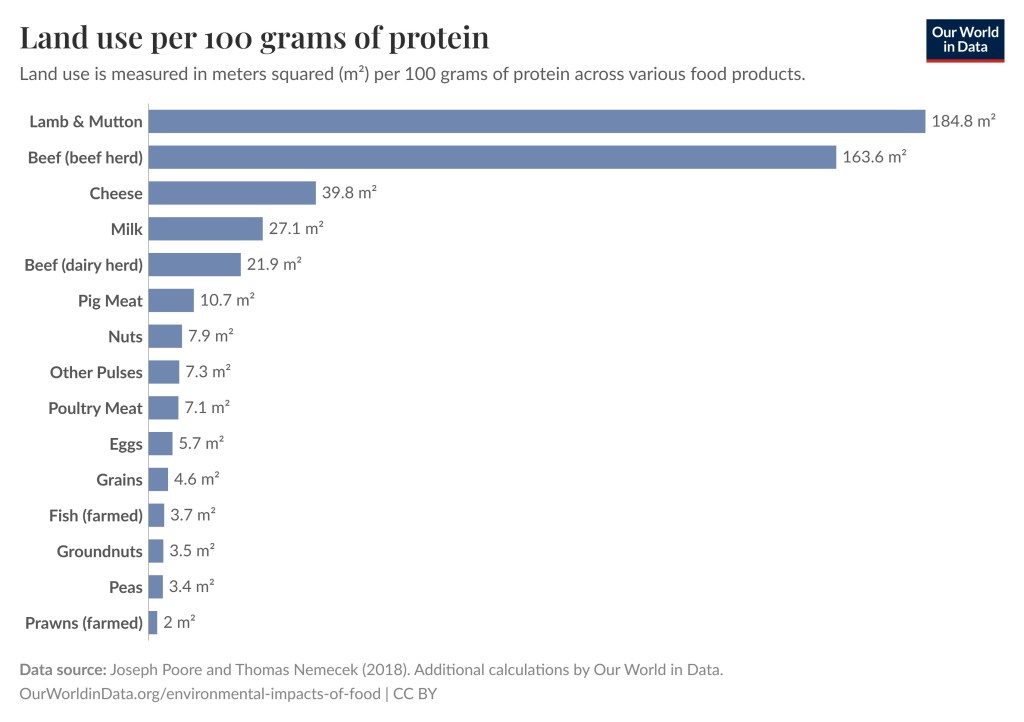
As you can see in the graph below, again from Our World in Data, the land used for producing 100 grams of protein varies enormously between different food groups. 100 grams of protein from lamb and mutton require on average 52.8 times as much land as 100 grams of protein from groundnuts. This graph does not make a distinction between organic farming and conventional farming, but it highlights the huge difference between different food sources. I’ll get to the difference between organic farming and conventional farming with respect to land use later in the post.

The graph shows that for 100 grams of protein you need on average 184.8 square meters for Lamb & Mutton, 163.6 square meters for beef, 39.8 square meters for cheese, 27.1 square meters for milk, 7.9 square meters for nuts, 4.6 square meters for grains, and 3.5 square meters for groundnuts. There are a few more items listed in the graph | Eating Organic is not Necessarily Ecological
Additional calculations by Our World in Data. OurWorldinData.org/environmental-impacts-of-food | CC BY

Agriculture and Greenhouse Gas Emissions

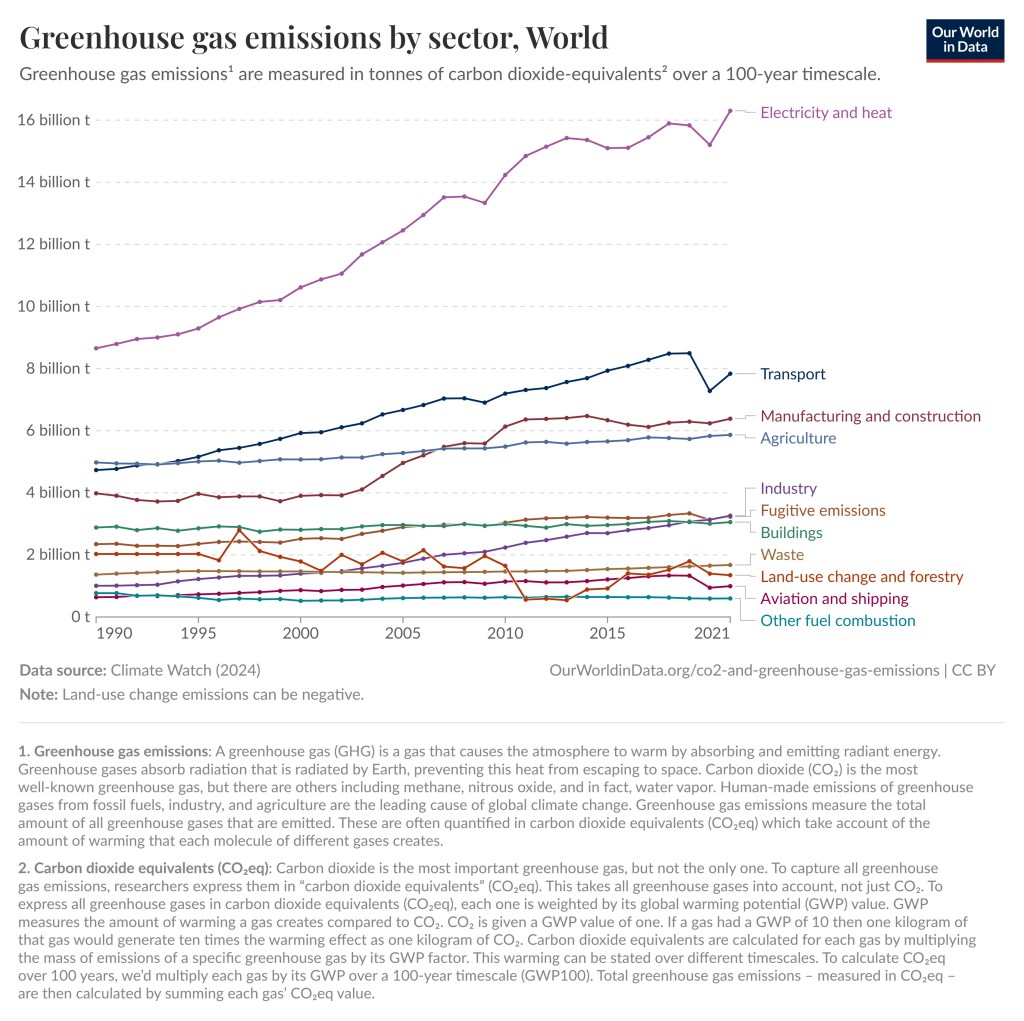
The next two graphs focus on the greenhouse gas emissions including those from agriculture. Electricity and Transport dominate both globally and in the United States, but globally agriculture comes in at 6 billion of the 40 billion tons of greenhouse gas emissions for 2021, which is 15%. For the United States agriculture comes in at 10.6% of greenhouse gas emissions for 2021. In other words, agriculture was not the largest contributor of greenhouse gas emissions but still an important factor.

The largest contributor of greenhouse gas emissions in the World is electricity and then comes Transport. After that comes manufacturing and construction, agriculture, industry, fugitive emissions, buildings, waste, land-use change and forestry, aviation and shipping, other fuel combustion | Eating Organic is not Necessarily Ecological
Data source : Climate Watch (2024). Note : Land use emissions can be negative. OurWorldinData.org/co2-and-greenhouse-gas-emissions| CC BY
The largest contributor of greenhouse gas emissions in the US is electricity and heat but it has gone down. Transport is number two. Then comes buildings, manufacturing and construction, fugitive emissions, agriculture, industry, waste, aviation and shipping, other fuel combustion, land-use change and forestry | Eating Organic is not Necessarily Ecological
Data source : Climate Watch (2024). Note : Land use emissions can be negative. OurWorldinData.org/co2-and-greenhouse-gas-emissions| CC BY

Finally, the contribution for different types of food. Notice that beef (beef herd) at 49.89kg is 188 times larger than the 0.26kg for nuts. 188 people eating nuts contribute as much to carbon emissions as one person eating beef.

The graphs show that beef (beef herd) generates 49.89 kilograms of carbon emissions per 100 gram of protein that it provides. For Lamb and mutton, it is 19.85 kilograms, for prawns 18.19 kilograms, for milk 9.5 kilograms, for eggs 4.21 kilograms, for grains 2.7 kilograms, for groundnuts 1.23 kilograms, for peas 0.44 kilograms and for nuts 0.26 kilograms | Eating Organic is not Necessarily Ecological
Greenhouse gas emissions per 100 grams of protein. Greenhouse gas emissions are measured in kilograms of carbon dioxide equivalents (see below). Data source: Poore and Nemecek (2018). OurWorldinData.org/co2-and-greenhouse-gas-emissions| CC BY

Carbon dioxide equivalents (CO2eq)

Carbon dioxide is the most important greenhouse gas, but not the only one. To capture all greenhouse gas emissions, researchers express them in “carbon dioxide equivalents” (CO2eq). This takes all greenhouse gases into account, not just CO2. To express all greenhouse gases in carbon dioxide equivalents (CO2eq), each one is weighed by its global warming potential (GWP) value. GWP measures the amount of warming a gas creates compared to CO2. CO2 is given a GWP value of one.

If a gas had a GWP of 10 then one kilogram of that gas would generate ten times the warming effect as one kilogram of CO2. Carbon dioxide equivalents are calculated for each gas by multiplying the mass of emissions of a specific gas by its GWP factor. This warming can be stated over different timescales. To calculate CO2eq over 100 years, we’d multiply each gas by its GWP over a 100-year timescale (GWP100). Total greenhouse gas emissions – measured in CO2eq – are then calculated by summing each gas’ CO2eq value.

Environmental Impact of Organic Versus Conventional Agriculture

At this point it should be clear that eating different types of food, nuts and vegetables versus red meat makes huge difference regarding the environment. How about organic versus conventional farming? Well, it is complicated. You have to take into account land use, greenhouse gas emissions, biodiversity, pesticide application, energy use and more.

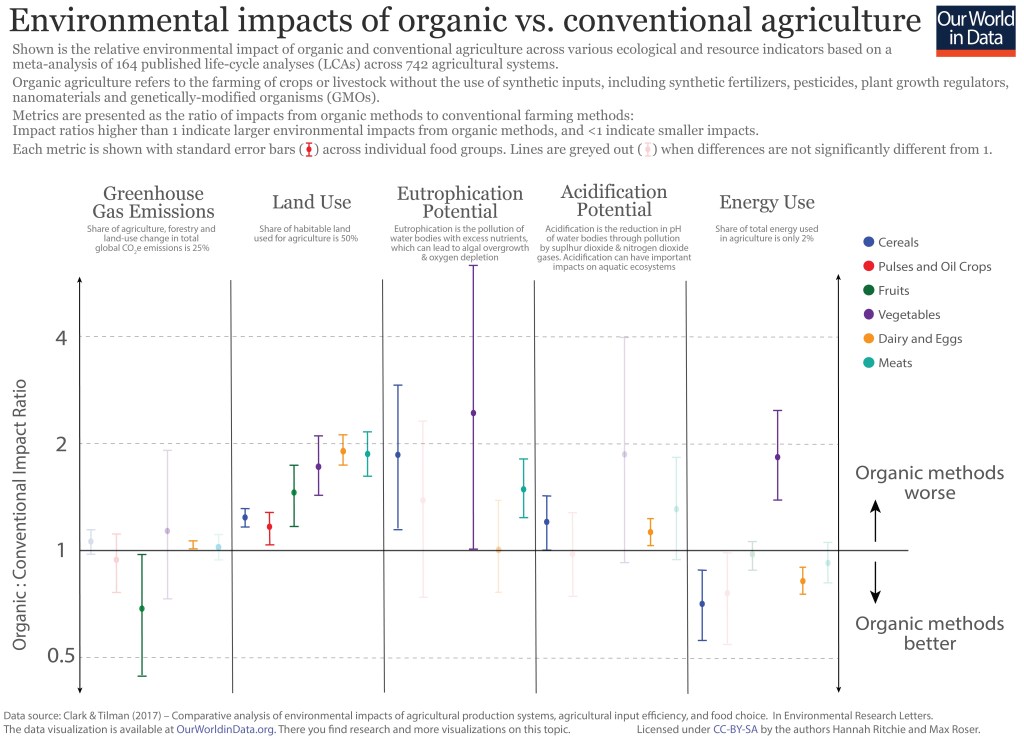
Clark and Tilman (2017) published a meta-analysis of results of published organic-conventional comparisons across 742 agricultural systems over 90 unique foods. The food groups consisted of cereals, pulses and oil crops, fruits, vegetables, dairy and eggs, and meats. As you can see in the resulting graph below organic agriculture is worse for the environment for most food groups with regards to land use, eutrophication potential, and acidification potential. The result is mixed with respect to greenhouse gas emissions and energy use.

It appears that it is best to choose organic pulses and fruits and choose non-organic for all other food products (cereals, vegetables, dairy and eggs, and meat). However, if your primary concern is whether the potato accompanying your steak is conventionally or organically produced, then your focus is arguably misplaced. Whether you go organic or non-organic the steak is much worse for the environment.

The graph shows the six food groups and their impact across greenhouse gas emissions, land use, eutrophication potential,  acidification potential and energy usage.
Shown is the relative environmental impact of organic and conventional agriculture across various ecological and resource indicators based on a meta-analysis of 164 published life-cycle analyses (LCAs) across 742 agricultural systems. Roughly, lower in the graph means organic is better and higher up in the graph means conventional farming is better. Data source: Clark & Tilman (2017) – Comparative analysis of environmental impacts of agricultural production systems, agricultural input efficiency, and food choice. In Environmental Research Letters. The data visualization is available at OurWorldinData.org. There you can find research and more visualizations on this topic. Licensed under CC BY-SA by the authors Hannah Ritchie and Max Roser.

Conclusion

In this post I present empirical evidence from reliable sources comparing organic to conventional agriculture in terms of environmental impact. Despite strong public perception of organic agriculture producing better environmental outcomes, conventional agriculture often performs better on environmental measures including land use, greenhouse gas emissions, and pollution of water bodies. There are, however, some contexts where organic agriculture may be better for the environment. In short it is complicated.

What really matters though is the type of food you eat, not whether it is organic or not. Another thing to note is that if you eat 300 steaks per year you will have a 100 times larger environmental impact compared to someone who eats 3 steaks per year. Quantity matters. This post was about environmental impacts. There are other considerations such as health, what you like, whom you want to support, etc.

To see the other Super Facts click here