The Enormous Kuiper belt

Super fact 55 : The enormous Kuiper belt.

The Kuiper Belt is a vast torus/donut shaped region of space beyond Neptune, filled with icy, rocky bodies, including dwarf planets like Pluto. It shares a lot of similarities with the Asteroid belt, but it is much larger, and further out. The Kuiper belt is 20 times wider than the Asteroid belt, 1,000 larger by volume, and 20 to 200 times more massive than the Asteroid belt. It extends from roughly 30 to 50 astronomical units (AU) from the Sun.

I can add that one Astronomical Unit (AU) is the distance from the sun to Earth.

In the middle of the picture is the sun and around it is Mercury, Venus, Earth and Mars. Then there is a grey circular band representing the asteroid belt. Further out is Jupiter, Saturn, Uranus, Neptune and Pluto and a large circular band representing the Kuiper belt | The Enormous Kuiper belt
I drew this illustration of the solar system and the Kuiper belt. It is not entirely to scale, and in reality, Mercury and Venus are not attached to the sun.

The Kuiper belt is like a giant Asteroid belt located further out, beyond Neptune. The Kuiper Object Pluto, formerly known as the Planet Pluto, is the most admired, the cutest and most beloved of all planets, and it was the first Kuiper object discovered in 1930. However, we did not know of the existence of the Kuiper belt at the time. The Kuiper belt was discovered in 1992 and predicted to possibly exist by Astronomer Gerard Kuiper in 1951. The discovery of the Kuiper belt was one of the reasons Pluto was demoted from its planet status in 2006. There are other dwarf planets in the Kuiper belt similar Pluto, including Makemake, Haumea, and Eris. However, there could be hundreds. Ceres is a dwarf planet located in the Asteroid belt. To read more about the Kuiper belt and verify the facts above, click here, or here, or here.
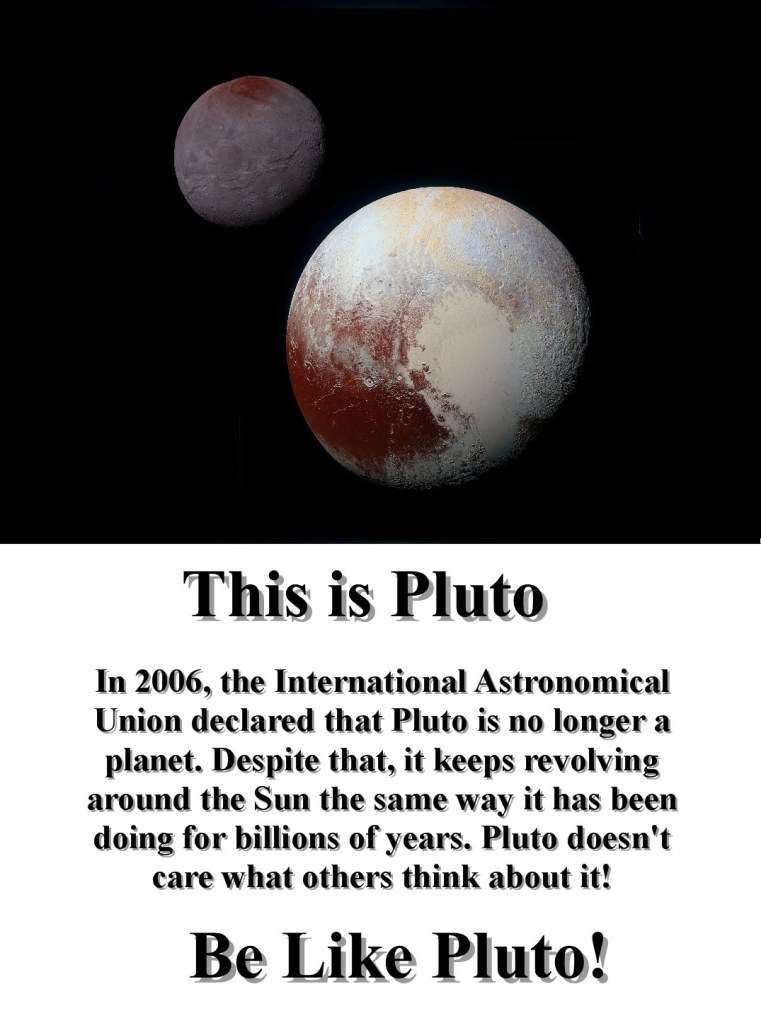
This picture features the photo of Pluto taken by NASA’s New Horizons spacecraft in 2015 plus some text. The text says : This is Pluto! In 2006, the International Astronomical Union declared that Pluto is no longer a planet. Despite that, it keeps revolving around the Sun the same way it has been doing for billions of years. Pluto doesn't care what others think about it! Be Like Pluto!
Pluto and its moon Charon from NASA/JHUAPL/SwRI. NASA / Johns Hopkins University Applied Physics Laboratory / Southwest Research Institute, Public domain, via Wikimedia Commons. NASA’s New Horizons spacecraft captured this high-resolution enhanced color view of Pluto in 2015.

I selected this to be a super fact because the existence of the Kuiper belt drastically changed our view of our Solar system, so it is important, we know it exists, so it is a true fact, and despite its enormous size the Kuiper belt is much less known than the Asteroid belt, and its existence often comes as a surprise to people.

The Kuiper Belt Resides in Darkness

You may wonder why the Kuiper belt was discovered so late whilst the Asteroid belt has been known since the beginning of the 19th century (Ceres 1801, Pallas 1802, Vesta 1807, etc.) The reason is that the Kuiper belt resides in darkness. The Asteroid belt is 2.2AU to 3.2AU from the sun whereas the Kuiper belt is between 30 to 50AU from the sun.

Let’s say you take an object that is 2.5AU from the sun and place it at a distance that is 40AU from the sun. Due to the spreading of the light the object will now receive 16 X 16 = 256 times less sunlight. This is called Geometric dilution. In addition, this light needs to be reflected back to earth for us to see the object, and once again the light will  spread resulting in 256 X 256 = 65,536 times less light reaching our telescopes. The Kuiper belt is huge, but it resides in darkness. Despite this fact, we have now discovered and catalogued more than 2,000 Kuiper belt objects. However, it is estimated that there are hundreds of thousands of Kuiper belt objects wider than 100 kilometers.

What is a Dwarf Planet?

A planet as well as dwarf planet is a celestial body that orbits the Sun and is nearly round due to its own gravity. Basically, it must be large enough to have compressed itself to a near spherical shape. To be classified as a planet and not a dwarf planet it must also have cleared its orbit of debris. So, a dwarf planet is therefore a celestial body that orbits the Sun, is nearly round due to its own gravity, but has not cleared the neighborhood around its orbit. Obviously, a planet in the Asteroid belt or the Kuiper belt is a dwarf planet. Just to make this complicated Astronomers have found giant exoplanets that have not cleared their orbit of debris . I wonder, are these exo-planets giant dwarf planets?

Oort Cloud

Astronomer and Author David Lee Summers (blog here) reminded me of the Oort cloud, which could be interesting to bring up in this context. The Oort Cloud is a vast spherical cloud of icy bodies, which is hypothesized to surround the solar system, extending from about 2,000 to 200,000 AU. It is thus thousands of times further out and wide than the Kuiper belt. I say hypothesized because the objects are so small, there’s really no direct observation of them and there’s some variation in numbers for its distance and extent, meaning it’s still not well defined yet. Still, its outer edge is believed to be the boundary between where the sun’s gravity dominates and the galaxy’s gravity dominates.

The Oort cloud is generally considered to be the outer edge of the solar system and believed to be the origin of most long period comets. The Oort cloud is thought to encompass two regions: a disc-shaped inner Oort cloud aligned with the solar ecliptic (also called its Hills cloud) and a spherical outer Oort cloud enclosing the entire Solar System.

The picture is of the Oort cloud with an inset picture of the Kuiper belt at the top. The inset picture is an enlargement of the dot in the middle corresponding to the Kuiper belt.
NASA This SVG image was created by Medium69.Cette image SVG a été créée par Medium69.Please credit this : William Crochot, Public domain, via Wikimedia Commons.

Other Astronomy Related Super Facts


To see the other Super Facts click here

Alien Civilizations and the Fermi Paradox

This is a submission for Kevin’s No Theme Thursday

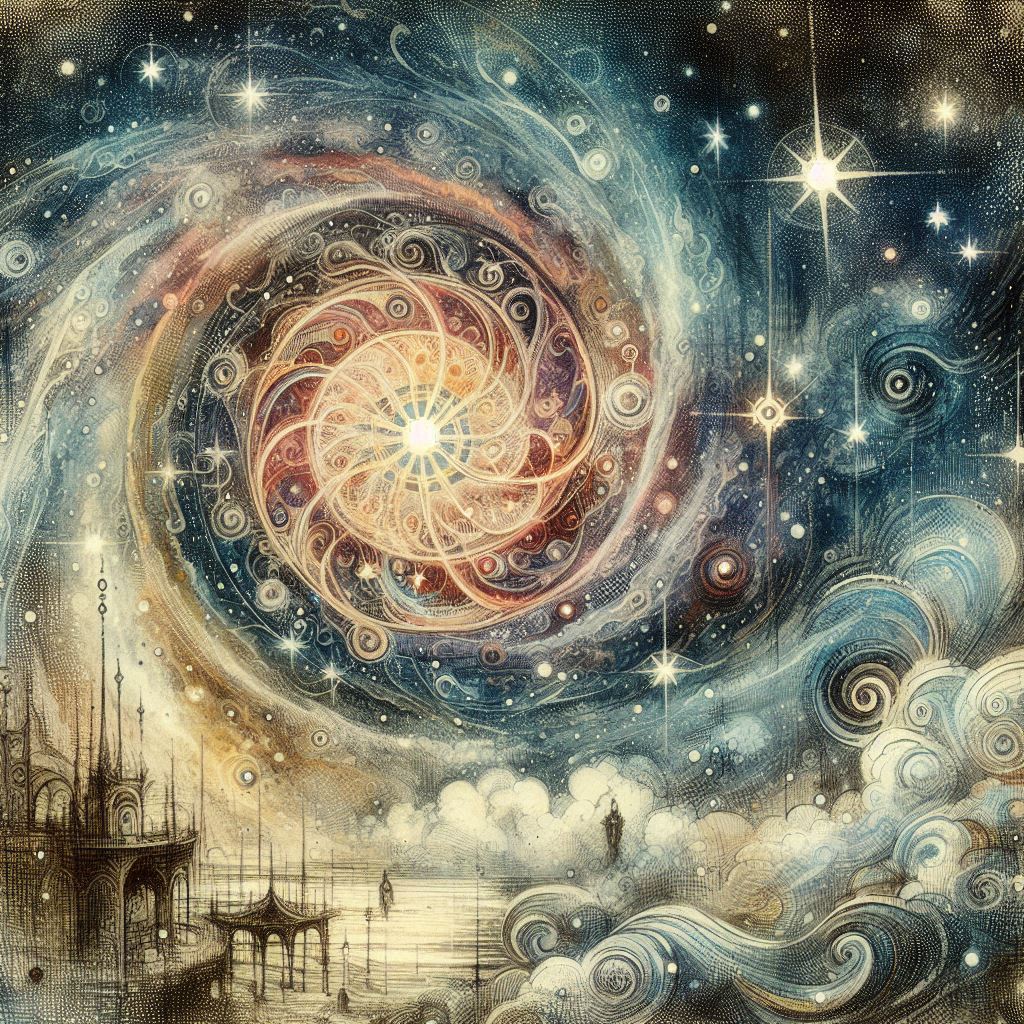
The AI generated image shows magical rotating things in the sky and an alien civilization below | Alien Civilizations and the Fermi Paradox
Image by Kevin from The Beginning at Last

Kevin’s artistic picture above makes me think of Alien Civilizations. Do they exist? Do they exist in our Galaxy? To quote Enrico Fermi, if they do exist “Where is Everybody?”. That is the famous Fermi Paradox.

A telescope and a background showing the milky way
Did we find an advanced civilization in our Galaxy, which has hundreds of billions of stars?

We have found thousands of exoplanets,  and it is estimated that there are 11 billion potentially habitable Earth-sized planets orbiting stars roughly the same size as the sun in the Milky Way. It is estimated that there are an additional 40 billion potentially habitable Earth-sized planets orbiting red dwarf stars in the Milky Way. Earth is an estimated 4.5 billion years old whilst our Milky Way Galaxy is an estimated to be 13.6 billion years old. Add that there are at least hundreds of billions of Galaxies like the Milky Way in the observable Universe. Yet, human astronomers have not detected any signs of alien civilizations, and there is no evidence Earth has been visited by aliens in the past.

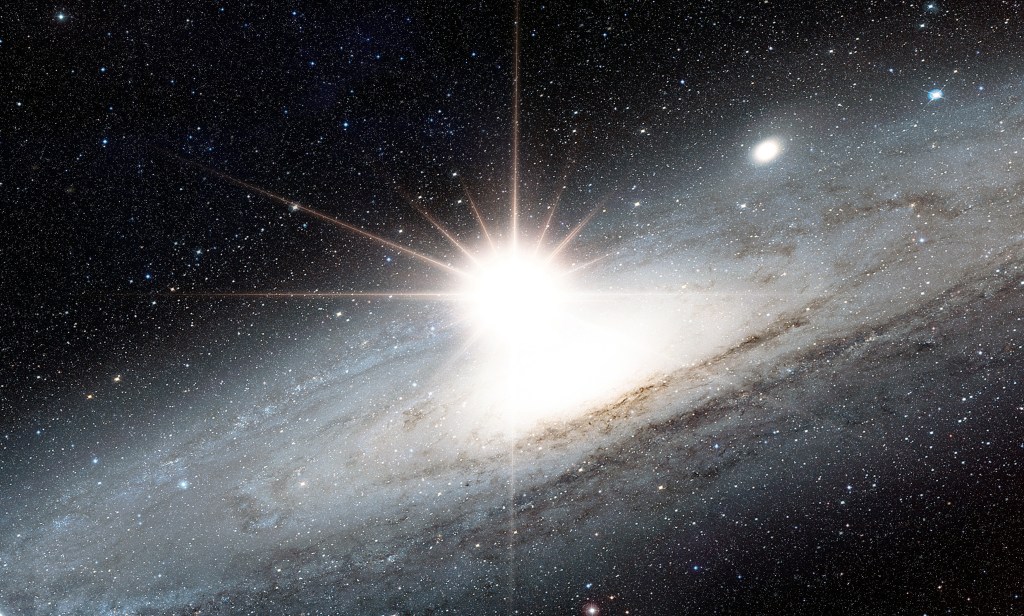
A picture of the Andromeda Galaxy with a bright white light near its center. The bright light is almost outshining the entire galaxy | Alien Civilizations and the Fermi Paradox
It should be noted that even though our Galaxy is 13.6 billion years old, its beginnings were very violent with a lot of supernova explosions, which were necessary for higher elements to come into existence and making life possible. So, we need to count out the first couple of billions of years. This is a supernova explosion in the center of the Andromeda galaxy “Elements of this image furnished by NASA” It is essentially an enhanced photo of a supernova explosion in a neighboring galaxy. Stock Photo ID: 2495486227 by muratart.
Blue and brown Earth like planet with rings.
Exoplanets, we found thousands but there are likely many billion habitable exoplanets in our Galaxy. This is an imagined Earth like exoplanet. Stock Illustration ID: 1440413666 by Dotted Yeti.
A planet surrounded by rings that are hundreds of times wider than the planet | Alien Civilizations and the Fermi Paradox
This is an illustration of a real exoplanet that we’ve found. J1407b is an exoplanet 20 times more massive than Saturn. It has enormous rings and is often referred to as Super Saturn. It may not harbor life. Stock Illustration ID: 2329821675 by Love Employee.

In this context, I would like to mention the Drake equation. The Drake equation is a probabilistic equation used to estimate the number of communicative extraterrestrial civilizations in the Milky Way Galaxy. It was created in 1961 by American astrophysicist and astrobiologist Frank Drake. This is the equation N = R * Fp * Ne * Fl * Fi * Fc * L. where N is the number of civilizations in the Milky Way galaxy with which communication might be possible.

  • R = the average rate of star formation in our galaxy.
  • Fp = the fraction of those stars that have planets.
  • Ne = the average number of planets that can potentially support life per star that has planets.
  • Fl = the fraction of planets that could support life that actually develop life at some point.
  • Fi = the fraction of planets with life that go on to develop intelligent life (civilizations).
  • Fc = the fraction of civilizations that develop a technology that releases detectable signs of their existence into space.
  • L = the length of time for which such civilizations release detectable signals into space.

We have a pretty good idea of what R * Fp * Ne is but the remaining factors are unknown.

An astronaut is standing on the surface of an alien planet. He is surrounded by giant mushrooms and in the sky, there is a large moon or a planet.
Exoplanet with life Stock Illustration ID: 1524001694 by Dotted Yeti

This is not really a super fact but more of a mystery. The goal of this blog is to create a list of what I call super facts. Important facts that we to be true, and yet they are disputed by many non-experts, or just highly surprising to the general public. However, I also post interesting facts and book reviews in this blog.

Is there Scientific Evidence for Alien Civilizations?

UFO sightings are not proof of alien spacecraft. The term “UFO” or “Unidentified Flying Object”, simply describes something in the sky that a person can’t recognize. Studies by NASA, Pentagon’s All-domain Anomaly Resolution Office show that the vast majority of these observations can be attributed to mundane phenomenon. Also, ask yourself, why would an alien civilization fly across interstellar space and only reveal themselves to random people with bad cameras and not to humanity as a whole. Why would they be flying around in little saucers? The typical flying saucer stories are not credible. Some UFO reports are also hoaxes or based on misidentified objects or misinterpretations of natural phenomena.

Grey alien with big black eyes showing peace sign, 3d render | Alien Civilizations and the Fermi Paradox
Alien showing peace sign. Shutter stock asset id: 2245224525 by adike

When I was in the Swedish army I was stationed near the Finnish Swedish border up north, which was close to Murmansk, a big Russian city which had the world’s largest navy base at the time. One night when I looked up in the sky I saw a shiny green elliptical shape in the night sky. It was quite big. I did not know what it was, but a lot of people called in to report it as a UFO. Were we being visited by space aliens as many believed. Some were even certain of it. No, it turned out to be Natrium cloud left behind by an intercontinental missile test launched from the Murmansk naval base.

A black hole with an orange accretion disk is approached by futuristic starship.
Was it a spaceship like this that we saw in the sky? No it was just a boring Natrium cloud left by a Russian missile. This spaceship approaching a black hole was generated by an Artificial Intelligence (AI) system. Stock AI-generated image ID: 2448481683 AI-generated image Contributor Shutterstock AI Generator.

Stories about past visitations are often guesses and conjecture mixed up with misrepresentation and fabrications. These stories are not taken seriously by scientists.  SETI (Search for Extraterrestrial Intelligence) has not found any definitive evidence of alien life. SETI have not detected any signals that convincingly can be attributed to an alien intelligence. In summary, there is no scientific evidence for aliens in the declassified UFO videos, in purported alien bodies, mutilated cows or in anything else.

But why have we not found any traces of alien intelligence? Where is Everybody? That’s the Fermi Paradox.

Solutions to the Fermi Paradox

Interstellar travel and interstellar communication are incredibly difficult. Maybe we should take the fact that nothing can travel faster than the speed of light seriously. You can always speculate about warping space and wormholes but that does not mean such travel is at all physically possible. The distances in the universe are enormous and require thousands or millions of years of travel even at speeds close to the speed of light. Likewise, those distances make communication difficult. Perhaps interstellar travel and communication is too difficult to be worth it.

The so called “Great Filters” hypothesis suggests that advanced civilizations don’t last that long. Maybe they self-destruct in nuclear wars or germ warfare. Perhaps they burn fossil fuels causing severe global warming ending civilization. Maybe AI destroyed their civilization. There could also be a great filter before intelligent life occurs. What if life itself is extremely unlikely to happen.

The “Dark Forest” hypothesis suggests that advanced civilizations are hiding to avoid detection from hostile advanced civilizations. A related idea is that there is a very advanced civilization in our galaxy, which destroys all other civilizations when they become too advanced and a potential threat. If that is true, maybe we shouldn’t advertise our existence using projects like SETI.

Another suggestion is that advanced civilizations are extremely rare because they can only arise under extremely rare conditions. Not only does a planet need to be habitable, but plate tectonics, climate, the shape of continents and oceans all to be just right for intelligent life and advanced civilizations to evolve. Also, consider the fact that intelligent human life existed for hundreds of thousands of years before the rise of civilization. Perhaps we are the only civilization in our Galaxy. Perhaps we are the first civilization in our Galaxy.

Yet another suggestion is that beings that are part of advanced civilizations eventually will escape into a virtual reality world or escape into other alternative worlds.

Here is a video giving an overview of the Fermi Paradox


I would like to end with a famous quote by the famous science fiction writer Arthur C. Clark “There are two possibilities: either we are alone in the Universe, or we are not. Both are equally terrifying,”

So, what do you think? Where is Everybody?

To see the Super Facts click here

There is strong evidence for the Big Bang

Super fact 37: There is strong evidence for the Big Bang, and we know a lot about how the Universe evolved through time since the Big Bang.

Considering the evidence that has accumulated throughout the years for the Big Bang it is hard to deny it happened. In my experience very few people are aware of this evidence, and they are surprised to find out how much evidence there is and how many details we know about the evolution of the universe. It is easy to believe that scientists are guessing when you don’t know much about the evidence yourself. But they are not guessing. That is why I call this a super fact.

In addition, there’s a lot of misconceptions around the Big Bang as well surprising facts. A few additional things that might surprise people are that the Big Bang was not like an explosion, the Universe did not expand into something. In addition, there might be multiverses and multiple Big Bangs, and there are cyclic models, and so-called eternal inflation. There are things we know and things we don’t know.

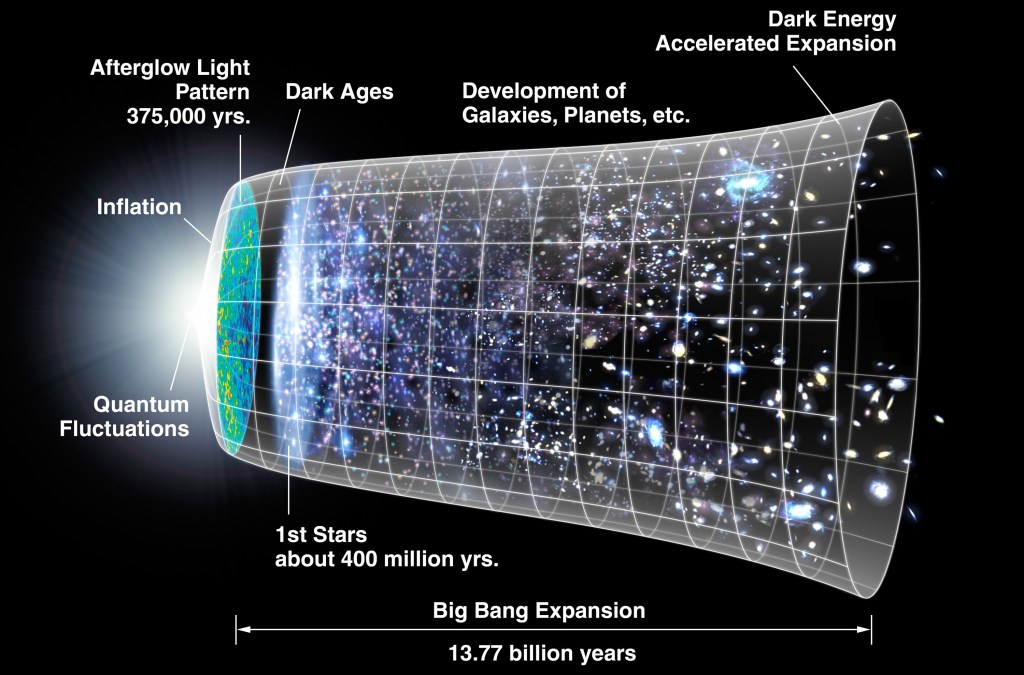
The pictures show an expanding Universe starting with quantum fluctuations followed by inflation, then an afterglow light pattern 375,000 after the Big Bang and then the so-called dark ages, the creation of stars and galaxies | There is strong evidence for the Big Bang
This file is in the public domain in the United States because it was solely created by NASA. (from Wikimedia commons

The Expansion of the Universe

It used to be believed that the Universe was static. In 1929 the astronomer Edwin Hubble discovered that the universe was expanding. He made this observation by analyzing the light from distant galaxies and noticing that their light was redshifted. I am going to explain what that means next.

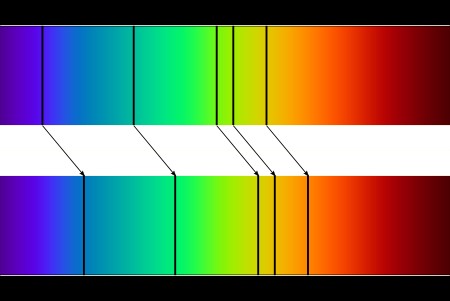
Light emitted from elements, atoms and molecules have light absorption patterns that are unique to the atom/element in question. This is called a light spectrum. This makes it possible to identify the elements in a star and their proportions. Red shifted means that the absorption lines have moved towards red because the frequency of the light has been shifted due to the motion. This is called the doppler effect.

You can notice this phenomenon for the case of sound when an ambulance is coming towards you and then speeding by you. The sound changes. Hubble was using the redshift to the determine that further away the galaxy was the faster it was moving away from us.

The top shows a colorful spectrum from blue to red with absorption lines in black. The bottom portion of the picture shows the same thing expect the black absorption lines have moved a bit to the right.
Visualization of redshifted absorption lines are redshifted due to velocity away from observer. Top lines are for an object at rest and in the bottom picture the object is moving away. Maxmath12, CC0, via Wikimedia Commons. This file is made available under the Creative Commons CC0 1.0 Universal Public Domain Dedication.

A natural explanation for this is that the universe is expanding, and that it once must have been much more compressed, but it is not the only explanation. However, there is more evidence.

The Cosmic Microwave Background Radiation

If you assume that the universe once was much more compact and much hotter than today, particles such as protons, neutrons and electrons would have been free and close together preventing light from freely moving around. However, as the universe kept expanding and cooling these particles eventually should have been able to form atoms allowing light or electromagnetic radiation to freely move around.

Some physicists, Alpher, Herman and Gamow predicted around 1950 that this should have left behind a detectable microwave background radiation. This radiation was detected by chance in 1964 by two physicists, Penzias and Wilson. This radiation had the expected properties and careful study of this Cosmic Microwave Background Radiation (CMBR or CMB) has given us a lot of information about our universe and may give us information about other universes (multiverses).

Its existence is strong evidence that the universe once was very compressed and much hotter, i.e., the Big Bang. An interesting fact is that in old TVs, between the channels (old people will remember this), you had this fuzz, or war of the ants as some people called it, and part of that TV fuzz is the CMBR.

A big sky map with varying colors, yellow, red, green and blue | There is strong evidence for the Big Bang
This is a sky map of the cosmic background radiation from when the universe was around 380,000 years old. It was created with the help of satellite (NASA) measurements. The colors are artificial and show tiny temperature variations. NASA / WMAP Science Team, Public domain, via Wikimedia Commons.

You can watch a 4-minute video about the discovery of the CMBR narrated by Neil DeGrass Tyson on this PBS web page by clicking here.

Abundances of Light Elements

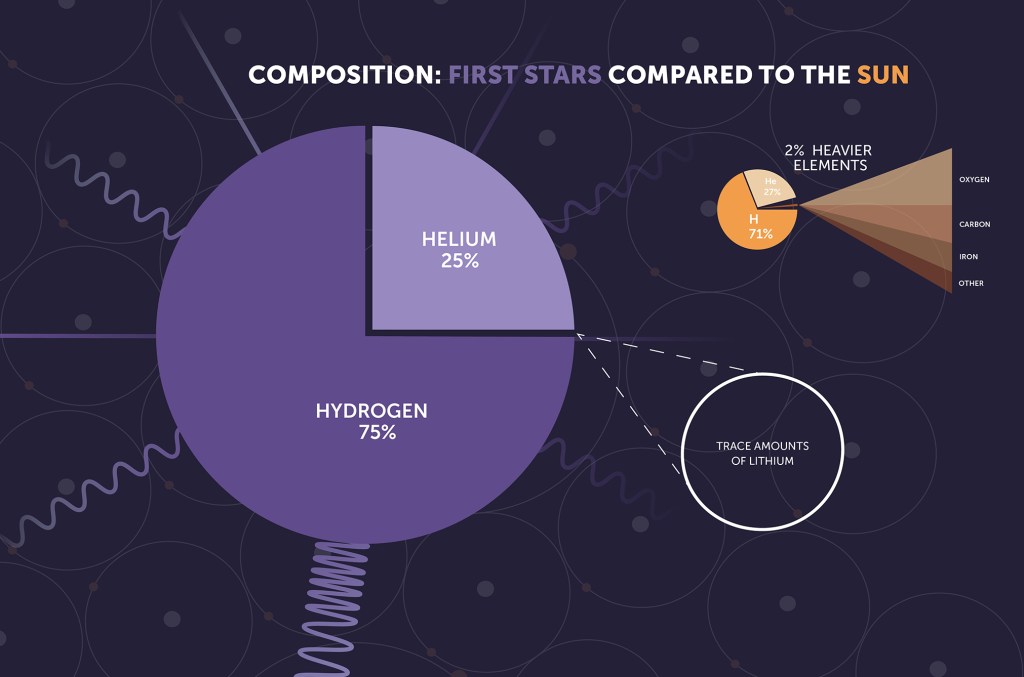
Yet another piece of evidence is the relative abundance of hydrogen and helium compared to heavier elements. The physics at the beginning of the Universe under the Big Bang tells us that initially regular matter should have consisted of 75% hydrogen and 25% helium and hardly anything else, and that is composition the oldest stars had when they were new. In addition, the oldest stars we’ve found appear to have an age just under the 13.8 billion years that we get for our Universe assuming the Big Bang theory (that’s another piece of evidence).

The picture consists of two pie chart graphs representing stars. The left one is a first-generation star with one pie for the 75% hydrogen and one pie for the 25% helium.
The first-generation stars consisted of 75% hydrogen and 25% helium and trace amounts of Lithium. A second or third generation star like our sun is still mostly hydrogen and helium but also many other elements. The rocky planets circling the sun are mainly elements heavier than hydrogen and helium. Image credit NASA, ESA, CSA, STScI

A Very Brief History of Time

So, it all started with a quantum fluctuation. The first 0.000000000000000000000000000000001 seconds is called the inflationary period characterized by super-fast expansion, much faster than the speed of light, as we know it today. At this time the strong nuclear force becomes distinct from the weak nuclear force.

I should point out that during the first 0.0000000000001 seconds the physics laws may not have applied in a normal sense. I should also point out that this was not an explosion. An explosion explodes into something but there was nothing else outside of the universe, so this is more like superfast growth.

At a fraction of a second protons and neutrons form from quarks and after one second neutrinos came into existence and if primordial black holes exist, they were formed at this time too. After two minutes nucleus consisting of neutrons and protons are formed, and the first elements hydrogen and helium formed. After 20 minutes an opaque hot plasma forms, after 100,000 years neutral helium atoms form, and after 375,000 years CMBR is created, etc.

This is just a small sample of everything that we know happened after the Big Bang, based on the known laws of physics. You can read about all the details in books like The First Three Minutes by Steven Weinberg or A Brief History of Time by Stephen Hawking.

vector illustration of up and down quarks in proton and neutron on white background. The proton (left) is a red and blue up quark and a green down quark. The neutron is a red and green down quark and a blue up quark | There is strong evidence for the Big Bang
The proton and neutron each consist of three quarks. They are formed at a fraction of a second after the Big Bang. Asset id: 2333679305 by KRPD.

Pre–Big Bang Cosmology

So, what was there before the Big Bang, if anything? Well, that part is speculation, but there are many good ideas. A popular hypothesis speaks of quantum fluctuations setting off the Big Bang. There are models in which the whole of spacetime is finite, including the Hartle–Hawking no-boundary condition. This means that time itself came into existence with the Big Bang and therefore nothing could have preceded it. This means that the Big Bang could not have been caused or created by anything else, just like a universe that has existed eternally could not have been caused or created by anything else.

In a sense, despite being 13.8 billion years old, the universe in this scenario would have always existed. Because the concept of “always” stops at 13.8 billion years ago. Stephen Hawking used the analogy of the north pole. You can’t go further north from the north pole.

There are other models that include multiverses, for example, eternal inflation, in which universal inflation ends locally here and there in a random fashion, each endpoint leading to a bubble universe, expanding from its own big bang. You can view this model as inflation being the river of time with the various universes popping up like bubbles in the stream.

In another model inflation is due to the movement of branes in string theory and Big Bangs are the result of colliding branes. There are cyclical models, such as Nobel Prize winner Roger Penrose’s Conformal cyclic cosmology in which one universe gives rise to another universe as it dies.

Notice that Pre-Big Bang Cosmology is speculative, but the reality of the Big Bang is backed by strong evidence.

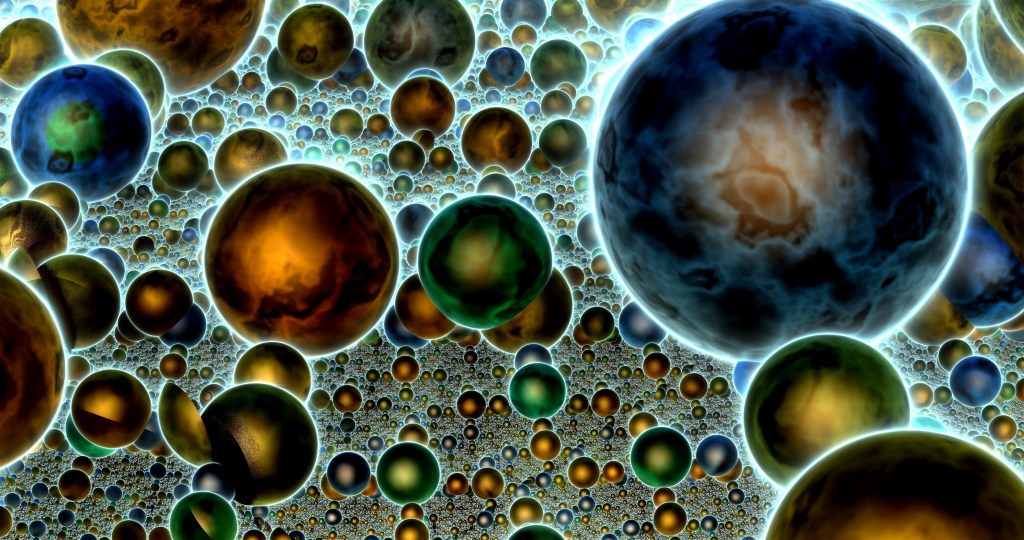
Thousands of universes represented as colorful balls | There is strong evidence for the Big Bang
The surface of a multiverse with a lot of universes 3d rendering Asset id: 2256998119 by Dr. Norbert Lange.

To see the other Super Facts click here

Quasar TON 618

This is a submission for Kevin’s No Theme Thursday

Quasar TON 618
Image by Kevin from The Beginning at Last

Kevin’s artistic picture above reminds me of a Quasar, a supermassive black hole emitting enormous amounts of energy.

What is a Quasar ?

A Quasar is a supermassive black hole at the center of a galaxy that is emitting enormous amounts of energy. The quasar is the supermassive black hole plus its accretion disk, the gas it is feeding on and the radiation it emits. The quasar is actively feeding on gas and stars and emitting enormous amounts of radiation in the process. The radiant energy of quasars is enormous; the most powerful quasars have luminosities thousands of times greater than that of a galaxy such as the Milky Way, and millions of times greater than the largest and most luminous stars in the known universe.

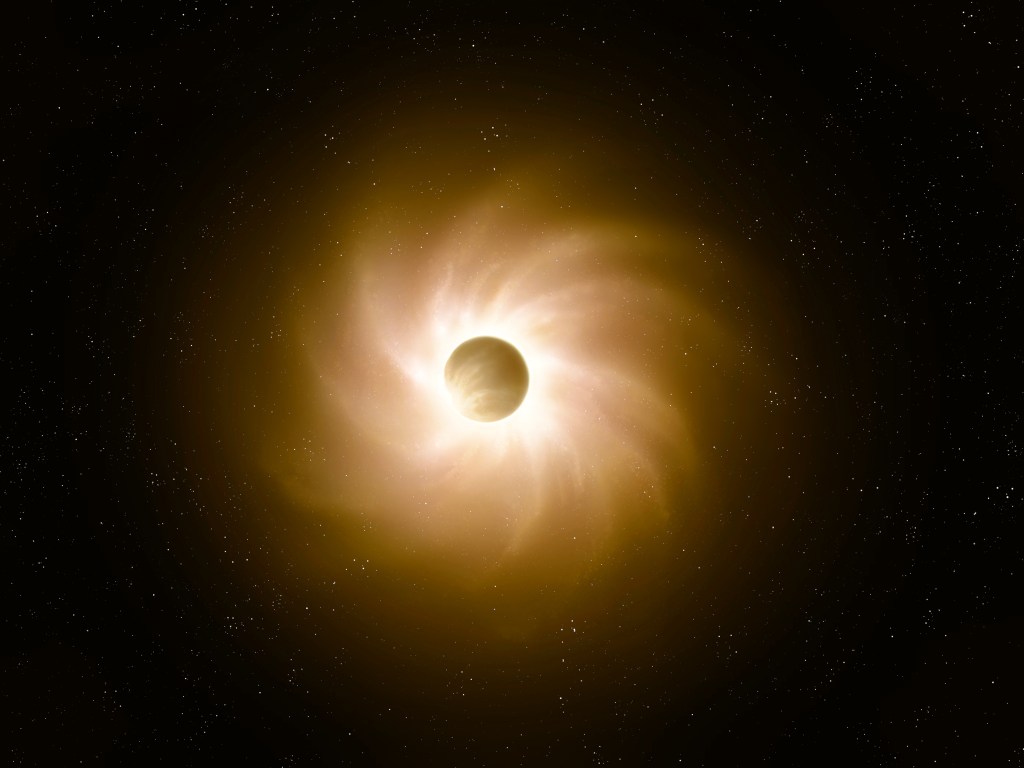
Supermassive black hole at the center of a quasar. Singularity in space devouring matter and light | Quasar TON 618
Supermassive black hole at the center of a quasar. Singularity in space devouring matter and light. From Shutterstock Asset id: 2484018599 by Nazarii Neshcherenskyi.

TON 618

TON 618 is a hyper luminous Quasar known to house one of the most massive black holes ever discovered, with an estimated mass of around 40 to 60 billion solar masses. Its luminosity is estimated to be 140 trillion times that of the Sun. The diameter of TON 618 is 780 billion kilometers or 82.6 light-years. Keep in mind that the distance to the moon is 1.3 light seconds and 82.6 light years is more than two billion times larger than that. Our sun is gigantic with a diameter 109 times larger than the diameter of earth. 1.3 million earths could fit inside the volume of our sun. However, in comparison to TON 618, our sun is a lot less than tiny. The diameter of TON 618 is 561 million times larger than that of the sun’s diameter and 177 octillion (an octillion is 27 zeros) suns could fit inside the volume of TON 618. In other words, we are comparing a dust particle to planet earth size wise. I am pretty sure you are not going to be able to imagine this.

The quasar is ejecting an enormous energy beam. In the background are stars possibly being absorbed by the quasar.
Quasar in deep space. Elements of this image furnished by NASA. Asset id: 1758938918. by NASA images.

When TON 618 was discovered in 1957, quasars and supermassive black holes were not yet recognized and understood by astronomers. The word quasar inspired shock and awe in every nerd on the planet. The concept of quasars, or quasi-stellar radio sources, wasn’t fully recognized until 1963. When I was a kid in the 1970’s there was a lot of speculation as to what these gigantic ultra bright but far away objects could be. TON 618 is located 18.2 billion light years away. Considering that the reachable limit of the Universe is 16.5 billion light years even if you travel at the speed of light, you could never travel to TON 618 (barring the warp drive in Star Trek).

The Event Horizon

When we are talking about the diameter of a black hole we are not talking about a sphere with a solid surface. The black hole is a sphere, or an oval, wherein gravity is so strong that nothing can escape, not light, not anything. It’s truly black. As you approach the event horizon you become invisible, space deforms, and from the perspective of an outside observer, time appears to stop for someone reaching the event horizon of a black hole. Time will continue for someone falling in, well in some sense. You’ll be transported beyond our universe and time as we know it. We can guess but we can’t really know.

A black hole with an orange accretion disk is approached by futuristic starship.
When this spaceship reaches the event horizon the time will stop from our perspective, and they will never enter the black hole. From their perspective they will enter right through the event horizon, and they will be transported infinitely far into a future beyond time. Stock AI-generated image ID: 2448481683 AI-generated image Contributor Shutterstock AI Generator.

Black Holes

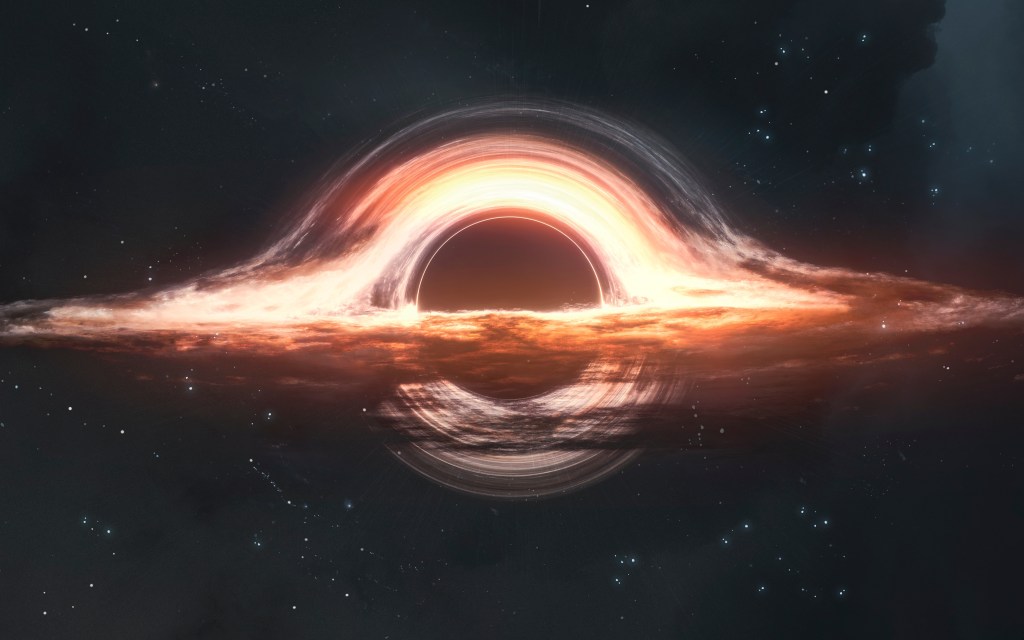
Black holes are invisible. They are truly black. However, we can see them if they are consuming matter. The matter close to black holes will heat up and glow. The closer to the event horizon the redder it is. It is called an accretion disk as in the depiction above. There are an estimated 100 million black holes in our galaxy, the Milky Way. At the center of the Milky Way is a super massive black hole called Sagittarius A-star. It is 4 million times more massive than our sun. There are supermassive black holes located at the center of most large galaxies. The supermassive black holes are considered to play a crucial role in the formation of galaxies.

A black hole with a large bright accretion disk | Quasar TON 618
3D illustration of giant Black hole in deep space. High quality digital space art in 5K – realistic visualization. Stock Illustration ID: 2476711459 by Vadim Sadovski.

Black Hole Animation

Below is an animation created by NASA that depicts what an observer falling into a black hole would see. The video is about 4 minutes long.

TON 618  Animation

Below is an animation of TON 618, a quasar and the largest black hole known in the universe. This video is about 5 minutes.

To see my The Bizarre Reality of Black Holes Super Fact Click Here
To see the Super Facts click here

Note : Today March 14 is Albert Einstein’s birthday, the man who gave us the General Theory of Relativity, which mathematically describes black holes. It is also Pi Day (first 10 digits 3.1415926535), and there’s a rare moon eclipse tonight called a blood moon or a worm moon. Also, Dallas is under a fire warning. Be careful.

Important Note : I am going on a ski vacation tomorrow and I will take a one-week break from blogging as well as a break from reading other people’s blogs.

Quick Easy Introduction to Astrophysics

The goal of this blog is to create a list of what I call super facts. Important facts that are known to be true and yet they are surprising, shocking or disputed among non-experts. In a sense it is myth busting. However, it is not the only type of posts I do. This is a review for a popular book on Astrophysics called “Astrophysics for People in a Hurry” by Neil De Grasse Tyson. It is a New York Times best seller and the #1 best seller in Astronomy & Astrophysics on Amazon. It has almost 37,000 ratings/reviews on Amazon and more 194,000 reviews/ratings on Goodreads.

Below is a list of the four formats in which it comes on Amazon.

  • Hardcover –  Publisher : W. W. Norton & Company; First Edition (May 2, 2017), ASIN : 0393609391, ISBN-10 : 9780393609394, ISBN-13 : 978-0393609394, 224 pages, item weight : 2.31 pounds, dimensions : ‎ 7.3 x 4.8 x 0.9 inches, it costs $6.21 – $13.26 on US Amazon. Click here to order it from Amazon.com.
  • Kindle –  Publisher – W. W. Norton & Company (May 2, 2017), ASIN : B01MAWT2MO, 222 pages, it costs $9.00 on US Amazon. Click here to order it from Amazon.com.
  • Audiobook –  Publisher : Blackstone Audio Inc (May 2, 2017), ASIN : B06XB2PX7G, it costs $10.20 on US Amazon. Click here to order it from Amazon.com.
  • Audio CD –  Publisher : Blackstone Publishing; Unabridged edition (May 2, 2017), ISBN-10 : 1538408015, ISBN-13 : 978-1538408018, it costs $24.95 on US Amazon. Click here to order it from Amazon.com.
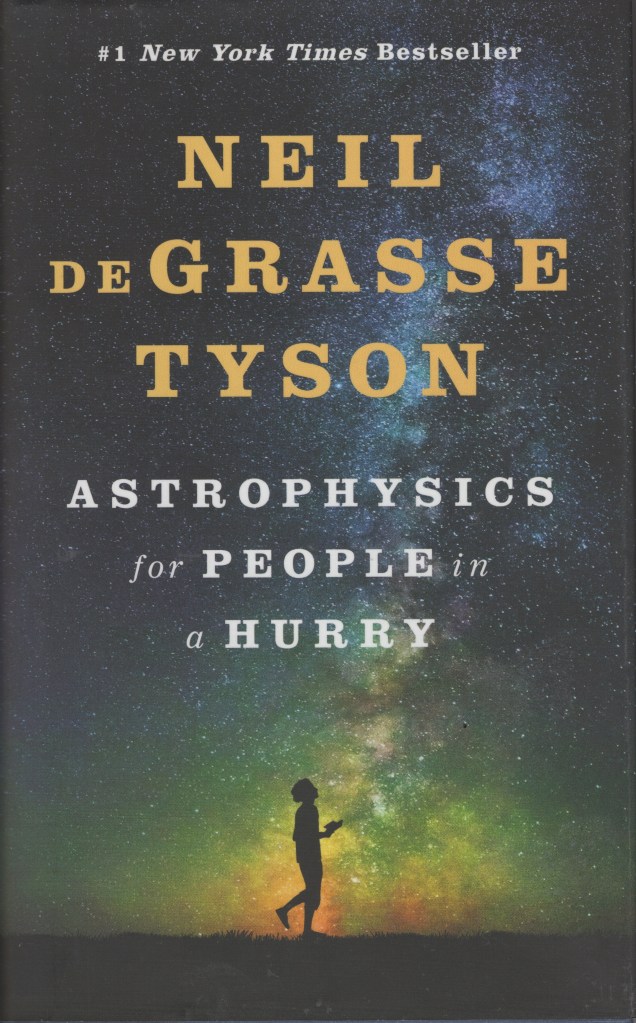
“Astrophysics for People in a Hurry” by Neil De Grasse Tyson front cover | Quick Easy Introduction to Astrophysics
Front cover of the book Astrophysics for People in a Hurry. Click on the image to go to the Amazon page for the hardcover version of the book.

Amazon’s Description of Astrophysics for People in a Hurry

Over a year on the New York Times bestseller list and more than a million copies sold.

The essential universe, from our most celebrated and beloved astrophysicist.

What is the nature of space and time? How do we fit within the universe? How does the universe fit within us? There’s no better guide through these mind-expanding questions than acclaimed astrophysicist and best-selling author Neil deGrasse Tyson.

But today, few of us have time to contemplate the cosmos. So Tyson brings the universe down to Earth succinctly and clearly, with sparkling wit, in tasty chapters consumable anytime and anywhere in your busy day.

While you wait for your morning coffee to brew, for the bus, the train, or a plane to arrive, Astrophysics for People in a Hurry will reveal just what you need to be fluent and ready for the next cosmic headlines: from the Big Bang to black holes, from quarks to quantum mechanics, and from the search for planets to the search for life in the universe.

This is my four-star review for Astrophysics for People in a Hurry

The reason I gave the book four stars instead of five is because I felt that if you have an interest in the topic, you will have heard it all before. However, in retrospect that might not be a good reason to deduct a star. After all, the book seems to be targeting people who do not know much about the subject and thus will not have heard it all before.

Quick and Entertaining Overview of Astrophysics

I’ve read a number of Neil DeGrasse Tyson’s books and I love them. This book is a compressed version of what he has been explaining in other books. If you’ve already read a number of Neil De Grasse books, or perhaps other popular science Astrophysics books such as those by Stephen Hawking, you will not find much new in this book. However, I think it is a brief but good summary of Astrophysics written for a layman. It is 208 pages, each page having about half as much text per page as a typical popular science book. It is an easy and fairly quick read.

He briefly explains the Big Bang, physical laws, spectra, nebulae, the speed of light, very briefly relativity and quantum physics, the cosmic background radiation, galaxies, gravitational lensing, dark matter, dark energy, neutron stars, the composition of the solar system and exoplanets. He covers a lot of ground quickly and he makes it easy to understand without simplifying so much that it becomes misleading. This book is exactly what the title says. However, as I mentioned, if you’ve read a lot on the topic already, especially if it is Neil DeGrasse Tyson’s books, you’ve seen it before. I still think it was very enjoyable though and I still learned something new. He is a very entertaining author.

“Astrophysics for People in a Hurry” by Neil De Grasse Tyson back cover
Front cover of the book Astrophysics for People in a Hurry. Click on the image to go to the Amazon page for the hardcover version of the book.
To see the Super Facts click here