The goal of this blog is to create a list of super facts. Important facts that are true with very high certainty and yet surprising, misunderstood, or disputed by many. This blog aims to be challenging, educational, and fun, without it being clickbait. I determine veracity using evidence, data from reputable sources and longstanding scientific consensus. Prepare to be challenged (I am). Intentionally seek the truth not confirmation of your belief.
Super fact 73 : The second law of thermodynamics, or the fact that entropy is always increasing in an isolated system does not contradict evolution. Life is not a closed system. The environment is providing energy, the sun is providing energy, geological forces are providing energy, etc.
Does physical laws such as the second law of thermodynamics disprove evolution? This is a trilobite fossil. Shutter Stock Photo ID: 1323000239 by Alizada Studios
A lot of people have never heard of the second law of thermodynamics, or entropy and are unaware of the claim that the second law of thermodynamics contradicts evolution. So how can debunking this claim be surprising, and a super fact? The reason is that this is a popular claim among creationists and according to this Gallup poll 40% of Americans believe in creationism. The fact that this popular but false claim is rooted in a very basic misunderstanding of the second law of thermodynamics and what entropy is makes it super fact.
In the past I’ve read many creationist books that make the claim that the second law of thermodynamics contradicts evolution. One of them was Scientific Creationism (1985) by Henry M. Morris (the father of modern creation science), where he stated that the second law of thermodynamics says that everything tends towards disorder, making evolutionary development (ordering) impossible. The Death of Evolution: Restoring Faith and Wonder in a World of Doubt by Jim Nelson Black, another book I read, and which I gave a one star review on Amazon, makes the same claim. I’ve also come across a lot of people making this claim.
The people who make the claim that the Second Law of Thermodynamics contradict evolution typically do not understand the second law of thermodynamics and do not know what entropy is. Despite that fact they see it as a powerful argument against evolution. I’ve even seen it used against highly respected physics professors who “believe in”, well accept the reality of evolution, by people who had no understanding of the second law of thermodynamics. At one point I even believed the claim myself. Then I studied physics, and well, oops, I was forced to admit that I had been bamboozled.
The Second Law of Thermodynamics
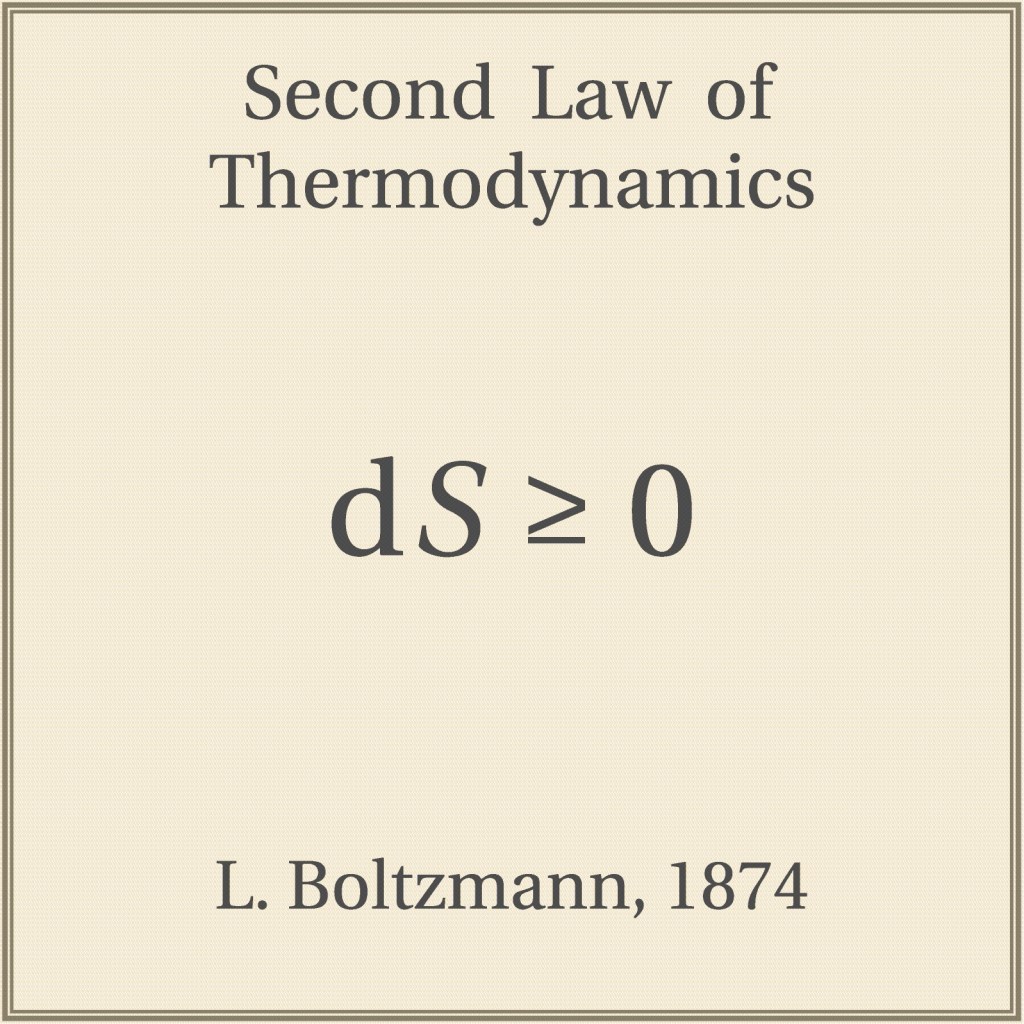
The Second Law of Thermodynamics states that the total entropy (disorder) of an isolated system always increases over time. This means that natural processes tend to move from order to disorder (within the isolated system). It should be noted that disorder is a popular but imperfect metaphor for entropy. Entropy is not the same thing as what people think of as disorder. In physics entropy refers to the logarithm of the number of microstates compatible with the system’s measurable macroscopic state. As molecules randomly arrange themselves into new macroscopic states, the number of possible microstates will increase.
It also means that heat will spontaneously flow from hotter to colder objects, but never the reverse. Another thing it means is that mechanical energy can be converted to thermal energy, but never the reverse. It turns out that those seemingly different statements are physically identical.
Second law of thermodynamics. S corresponds to entropy. Shutter Stock Vector ID: 2342031619 by Sasha701
It is very possible that the entropy of an organism is lower compared to a blob corresponding to all its molecules randomly distributed within a blob. However, that organism did not evolve in isolation inside a hermetically enclosed box without any energy from the outside. Life and evolution operate in an environment full of energy coming from the sun, the Earth, winds, oceans, geological forces, radiation, etc. Evolution does not take place in an isolated system.
It is also important to understand that within an isolated system, pockets of lower entropy can form if they are offset by increased entropy elsewhere within the system. That’s what the word “total” in total entropy means. Crystal formation is an example of creating local pockets of lower entropy (less “disorder”) within a system, but this is always accompanied by a greater increase in entropy in the surroundings. The Universe is an isolated system so the entropy within the Universe should always increase, but again the local pockets of lower entropy that evolution may create are accompanied by a greater increase of entropy elsewhere.
Atoms in a crystal. The crystal represents a pocket of lower entropy. As this pocket of lower entropy forms there is equal of greater increase in entropy in the surroundings. What is true for the crystal is true for the molecules in living beings. Neither the formation of crystals nor the evolution of life contradicts the second law of thermodynamics. Asset id: 689181712 by BK_graphic.
Below is a YouTube video explaining how the second law of thermodynamics does not contradict evolution.
Entropy – Arrow of time
An interesting aspect of the second law of thermodynamics is that it makes entropy serve as an arrow of time. In general, the fundamental laws of physics are time reversible. The equations work the same forwards and backward in time. The equations for gravity, electromagnetism, and the strong nuclear force work the same regardless of time’s direction. An example is if you filmed a planet orbiting a star and played it backward, it would still follow the laws of motion the same way.
Throw a bunch of billiard balls on the floor and film them bouncing and hitting each other and the walls. If you then run the film backwards and forwards it would be far from obvious which is forward and which is backwards, except for the fact that the balls will slow down due to friction. However, balls slowing down due to friction is mechanical energy turning into heat, which is an example of the second law of thermodynamics. The fundamental laws of physics are time reversible, but the second law of thermodynamics is a notable exception. Entropy always increases in an isolated system (like the Universe). By measuring entropy, you can distinguish the past from the future, giving time a direction
The Greatest Intellectual Achievement of the human race is arguably the Standard Model of Elementary Particles. The Standard Model consists of Special Relativity, Quantum Physics, Noether’s theorem and gauge theories, Quantum Electrodynamics, Quantum Chromodynamics, and a framework for all elementary particles, and more. It is a towering achievement of physics that was created by thousands of geniuses over a period of several decades. It is the theory of almost everything.
Despite that fact it is not getting a lot of respect. Everyone is just trying to find something wrong with it. The reason is that as soon as it was created people realized that something was wrong with it. It could not be reconciled with General Relativity. Something was missing. So, finding out what is wrong with it or what is missing has been a top priority for physics for several decades. The book “The Theory of Almost Everything” by Robert Oerter is a very interesting book covering the standard model, its components, its history, and what could be missing. It contains a few formulas but other than that it is mostly readable to laymen.
Book Formats for The Theory of Almost Everything
The Theory of Almost Everything: The Standard Model, the Unsung Triumph of Modern Physics by Robert Oerter comes in three formats. I bought the hardback format.
Hardcover – Pi Press (July 22, 2005), ISBN-10 : 0132366789, ISBN-13 : 978-0132366786, 336 pages, item weight : 1.2 pounds, dimensions : 6.37 x 1.11 x 9.3 inches, it costs $35.08 on US Amazon. Click here to order it from Amazon.com.
Paperback – Penguin Publishing Group (September 26, 2006), ISBN-10 : 0452287863, ISBN-13 : 978-0452287860, 336 pages, item weight : 10.8 ounces, dimensions : 5.51 x 0.81 x 8.34 inches, it costs $16.99 on US Amazon. Click here to order it from Amazon.com.
Kindle – Publisher : Plume (September 26, 2006), ASIN : B002LLCHV6, ISBN-13 : 978-1101126745, 348 pages, it costs $6.99 on US Amazon. Click here to order it from Amazon.com.
Front cover of The Theory of Almost Everything: The Standard Model, the Unsung Triumph of Modern Physics by Robert Oerter. Click on the image to go to the Amazon page for the hardcover version of the book.
Amazon’s Description of The Theory of Almost Everything
There are two scientific theories that, taken together, explain the entire universe. The first, which describes the force of gravity, is widely known: Einstein’s General Theory of Relativity. But the theory that explains everything else—the Standard Model of Elementary Particles—is virtually unknown among the general public.
In The Theory of Almost Everything, Robert Oerter shows how what were once thought to be separate forces of nature were combined into a single theory by some of the most brilliant minds of the twentieth century. Rich with accessible analogies and lucid prose, The Theory of Almost Everything celebrates a heretofore unsung achievement in human knowledge—and reveals the sublime structure that underlies the world as we know it.
Below is my full length giant review of The Theory of Almost Everything. Unless you are really interested, I suggest you read the somewhat shorter Amazon version by clicking the link above.
An introduction to the greatest intellectual achievement of the Human Race
The public has to a large extent missed the greatest scientific revolution in the history of the human race because mainstream media has largely ignored this breakthrough, despite the fact that the Nobel Prize committee has been raining Nobel Prizes over it. In the 1970’s a theory that explained, at the deepest level, nearly all of the phenomena that rule our daily lives came into existence. The theory called “The Standard Model of Elementary Particles” is a set of “Relativistic Quantum Field Theories” that explains how elementary particles behave, which elementary particles there are, and why they have the properties they have, for example, isospin, spin, charge, color charge, flavor, even mass, or mass relations in many cases.
The theory explains how all of the fundamental forces in nature work except gravity. The theory describes how the elementary particles interact; decay, how long they are expected to exist, and how they combine into other subatomic particles. The theory uses only 18 adjustable parameters to accomplish all of this.
Close up illustration of atomic particle for nuclear energy imagery. From iStock photos.
In the extension the theory thus explains how nucleons and atoms are formed and what properties the atoms will have, and how molecules will form and what properties molecules will have, their chemical reactions, and what elasticity, electric conductivity, heat conductivity, color, hardness, texture, etc. any material will possess. In the extension it explains why mass and matter exist, how the sun and the stars work, and the theory is therefore the ultimate basis of all other science. It also provides a formula, or an equation of almost everything.
Best of all it has been thoroughly verified experimentally, in fact the predictions the theory has made have been confirmed with such stunning accuracy and precision that it could be considered the most successful scientific theory ever. A theory that successfully unites all physics and basically all of human knowledge of the Universe into one single theory has never before existed.
However, “The Standard Model” does not incorporate gravity and the general theory of relativity, and cannot explain dark energy, dark matter and why neutrinos have mass. Therefore, almost as soon as the theory came into existence physicists started looking for the next theory that would finish what the “The Standard Model” did not finish.
Example of such theories are GUT theories, SO(5), SO(10), string theories (abandoned), super string theories, and M-theories. Even though those new theories are extremely interesting they have not been verified or able to predict anything. In comparison with the “Standard Model”; super string theories, grand unified theories, chaos theories, you name it, are essentially nothing, but are still better known. Hopefully this will change in the future, either because the Standard Model gets the respect it deserves, or because a more complete theory can be verified.
About the book
This book explains to the layman what the “Standard Model” is and how it came into existence. The book is by no means a perfect book. I think there are several problems with the book. However, I decided not to take off any star because there are very few books written for science interested non-physicists that explain the “Standard Model of Elementary Particles”. Dr. Oerter deserves five stars just for his decent attempt at doing so. I find Dr. Oerter to be a good writer and popularizer. I don’t think he is as good as Isaac Asimov, or Carl Sagan, but close, and he is writing on a much more complex topic then, for example, Carl Sagan did.
I studied physics as an engineering student, and I could understand most of text (but not every detail regarding everything). However, I believe anyone who is somewhat familiar with science, especially physics and math, can understand most of this book. For me more diagrams and more equations would have helped. For readers without much background in physics more and better diagrams would definitely have helped. Dr. Oerter came close to writing a good book for the layman, but the book was still lacking in certain aspects. In the remainder of the review, I will give a brief synopsis for each chapter and present my opinions and reflections on each chapter. In a sense I have written a short review for every chapter. My intent is to both tell you what the book is about and give my opinions on the different sections of the book.
Chapter 1: The first unifications
In Chapter one Oerter gives an interesting overview of the history of physics. Physics has typically been divided up into many fields. New discoveries have led to either new sub disciplines or the merging of existing sub disciplines (unifications). Nineteenth century physics was divided into many sub disciplines.
Dynamics (the laws of motion)
Thermodynamics (the laws of temperature, heat and energy)
Waves (oscillations in water, air, and solids)
Optics
Electricity
Magnetism
However, because of the atomic hypothesis, thermodynamics and wave mechanics were swallowed up by dynamics. For example, temperature and heat were now explained in terms of atomic and molecular motion. The theory of electromagnetic fields subsumed optics, electricity, and magnetism (light is an electromagnetic wave). All of physics, it seemed, could be explained in terms of particles (atoms) and fields. New discoveries would alter the picture once again and the old field theories had to be abandoned, and the laws of classical mechanics (dynamics) had to be altered.
Finally, the physicists were able to come up with a unified theory that explained almost all of physics and in the extension all of science, the standard model of elementary particles. This chapter was very basic and not difficult to understand. I think his approach to give an overview of physics was both unique and enlightening. His description of how physics and our understanding of the Universe went through periods when our knowledge expanded and gave rise to new fields and due to new discoveries, that led to a deeper understanding resulted in the merging of these fields. So, in summary more knowledge lead to more fields, then deeper understanding united them. This went back and forth a few times. Finally, we have a unified theory of almost everything, the Standard Model (if we exclude the General theory of relativity).
Chapter 2: Einstein’s relativity and Noether’s theorem
Even though the book is a Physics book, I think it is also a book on Philosophy. The way I see it Physics is in a sense both Science and Philosophy, the kind of Philosophy that can be falsified, verified and proven wrong or correct. Let me explain what I mean by telling you about Noether’s theorem. Noether’s theorem states that whenever a theory is invariant under a continuous symmetry, there will be a conserved quantity. As an example of what a continuous symmetry is, is the following: any physical experiment that is performed at a certain time will have the same result if it is performed exactly the same way a certain time later. That seemingly self-evident observation means that Energy is conserved.
Another example is any physical experiment that is performed at a certain place will have the same result if it is performed exactly the same way somewhere else. That seemingly self-evident observation means that momentum is conserved. Let me add that “exactly the same way” really means that! Gravity, other forces, differences in light, or anything else cannot be different in the second experiment. The only thing allowed to be different is the position “x” (if that is our symmetry variable). That is what a continuous symmetry means, changing just one thing, and everything stays the same.
Noether’s theorem has been the guiding principle behind the standard model, and it is used to find conservation laws where symmetries are found, and it is used to find symmetries where conservation laws are found. It is a spontaneous symmetry brake that allows the Higgs Boson to give all other particles their mass (excepting mass less particles). This is the reason that matter and everything in our Universe exists. The Higgs Boson is also called the God particle. So, Noether’s theorem is both very useful in a practical sense and deeply philosophical at the same time. In addition to Noether’s theorem the standard model is built upon the special theory of relativity and a modern formulation of quantum mechanics (Quantum field theory), QED, QCD, as well as some discoveries regarding elementary particles. I can add that Noether’s theorem was formulated by a Jewish woman, Emmily Noether, who could not get a job in academia because she was a woman. This theorem is one of those very important but mostly unknown discoveries, like the invention of paper by the Chinese Tsai Lun.
Oerter does not attempt to explain the special theory of relativity; however, he tries to give the reader an idea of what it is. The problem with his approach is that he gives the reader just enough information to enable the observant reader to come up with the apparent paradoxes within the special theory of relativity, but not enough information to help the reader to easily resolve them. He also confuses the reader by not distinguishing between rest mass and relativistic mass. The observant reader will think that he is contradicting himself. The term relativistic mass is the total mass and the total quantity of energy in a body. The rest-mass is the mass of the body when it is not moving. The formula E = mc^2 is always true, when it refers to relativistic mass, which is why we talk about an energy/mass equivalence. The other more complex formula Oerter presents refers to rest mass. There is no such thing as an energy/rest mass equivalence (except at speed 0) but that is what the reader who is not already familiar with the subject will end up believing.
Another mistake Oerter does is in regard to the fact that the speed of clocks will be measured differently in different reference frames. On page 35 last paragraph Oerter writes “Here, we have an apparent paradox: If each reference frame sees the other as slowed down, whose clock will be ahead when the passengers leave the train?” Then he implies that the paradox has to be solved by incorporating the General theory of relativity. Even though that may be how it was first solved, you can solve this form of the so called “Twin Paradox” and other similar paradoxes from within the framework of the special theory of relativity itself. So even though I enjoyed reading about Nother’s theorem and still think this chapter could use some improvement.
Chapter 3: (The End of the World as we know it) + Chapter 4: (Improbabilities)
Oerter explains Quantum Physics in a very typical manner, and he mostly avoids making it look weirder than it actually is which he should be commended for (that is not true for every author). However, there is one thing that all Physicists seem to do when they explain Quantum Physics to the layman which annoys me greatly. The matter waves (or quantum fields) in Quantum Physics are quite strange entities. The reason they are so strange is because they do not exist in a real sense, they are more correctly stated mathematical abstractions. Oerter states this clearly, which is good.
However, he then goes on to mention De Witts’ idea about multiple Universes without acknowledging that these “bizarre solutions” to various Quantum Wave conundrums are completely unnecessary. So, to some extent he is still making Quantum Physics appear weirder then it is (but I have seen worse). Well, OK, Quantum Physics is weird, but we don’t need to make it seem even weirder.
After giving a background to the special theory of relativity and Quantum Physics, Oerter continues explaining relativistic Quantum Physics including the fantastic prediction you get when you combine the special theory of relativity with Quantum Physics; that for every particle there is a twin particle with exactly the same mass, and spin, but opposite charge and isospin. These particles were called anti-particles and until they were actually found physicists tried to get rid of them from the theory. However, the combination of the special theory of relativity and Quantum Physics would lead not only to much better explanation for such things as the radiation and light spectrum and the properties of atoms, it would also lead to new discoveries. This is what is referred to as Relativistic Quantum Mechanics.
Chapter 5: The Bizarre Reality of QED
Richard Feynman came up with a new representation of relativistic quantum physics for electrons that did not use waves, called Quantum Electro Dynamics (QED). This was one of the first steps towards the standard model. Instead of viewing electrons as particles governed by waves, Feynman viewed electrons as particles guided by fields consisting of all possible paths and their probabilities. He used the two-slit experiment as a guide when formulating the equations for the probabilities of the paths for the electrons (and in the extension may other particles). When he summed up all the possible paths and compared with the old Quantum Mechanics (Wave Mechanics) he got the same answer as Quantum Mechanics in every case. In fact, his new approach was able to explain and calculate phenomena’s like the electrons spin and the fine structure constant that Quantum Mechanics (Wave Mechanics) could not explain properly, and his approach also would prove crucial for the development of Relativistic Quantum Field Theory.
So, in summary, first came Quantum Mechanics, then Relativistic Quantum Mechanics, and then QED and Relativistic Quantum Field Theory. I can add that this chapter also explains Feynman diagrams and an infinity problem that cropped up. The three infinities that cropped up corresponded to the electron’s mass, the photon’s mass, and the electron’s charge. However, the problems with these infinitives were solved using a normalization process that is also explained in this chapter. I can add that I think QED probably seems less strange to laymen then Wave Mechanics because it is easier to visualize the probabilities of possible paths as compared to waves that do not even exist, even though their “amplitude squares” represents something real. This chapter was probably one of the harder chapters to understand (for those who know nothing about QED). This chapter could really have been made better by using many more diagrams and figures. Again, I am not going to knock a star for that because the book is overall so unique and important.
Chapter 6: Feynman Particles, Schwinger Fields
Chapter 6 was a short but interesting chapter. Julian Schwinger took a different approach to QED than Feynman; he sorts of invented a new wave mechanics, in which a quantum field can be pictured as a quantum harmonic oscillator at each point in space. Even though the two approaches used different models Freeman Dyson proved in 1949 that Schwinger’s field theory point of view and Feynman’s sum-over-all-paths approach were in practice identical. However, the two approaches are useful for different things and form the basis of Quantum Field Theory. QED and Quantum Field Theory eliminate the distinction of particle and field and in a sense removed the conundrum of the particle and wave duality. In the nineteenth century light was an electromagnetic wave (well it still is) and in the old Quantum Physics it was both a wave and a particle, however, in Relativistic Quantum Field Theory it is something completely new-a quantum field, neither a particle nor a wave, but an entity with the aspects of both.
Chapter 7: Welcome to the Subatomic Zoo
In this chapter Oerter describes the history of the “strong nuclear force” and the “weak nuclear force” and the subatomic zoo that later emerged. There are four fundamental forces of nature, electromagnetism, gravity, and the “strong nuclear force” and the “weak nuclear force”. The two latter fundamental forces were not known until the 1930’s. The studies of these two new forces led to the predictions and discoveries of new elementary particles. One of these was the pion, however, when the physicists looked for this particle in the cosmic background radiation, they found an elementary particle that was similar to the pion but had the wrong mass.
After some confusion it became clear that it was not a pion but a new never foreseen particle that was named the meson. This was a problem because it was a new entity which the existing physics theories could not explain. However, it got worse. More elementary particles were discovered in the 1940’s 1950’s and the 1960’s. Our Universe turned out to be a lot stranger than people thought, and people started talking about the subatomic zoo. These newly discovered elementary would remain big mysteries until the event of the Standard Model in 1974. This chapter was pretty straight forward and easy to understand. Oerter does an excellent job in making this history interesting and entertaining to the reader and the chapter also contains some humor.
Chapter 8: The Color of Quarks
In the 1960’s physics had become ugly because of the subatomic zoo. Murray Gell-Mann and Yuval Neeman suggested a periodic table for elementary particles (like there is a periodic table for the elements). This periodic table was referred to the eightfold way. The eightfold way was also referred to as the SU(3) theory. It led to the discovery of an elementary particle that was even more fundamental than the known elementary particles, the Quark. It was soon established that there were two kinds of fundamental elementary particles: leptons and Quarks, in addition to the Bosons. Let me explain the details. There are elementary particles with whole number spin, and they are called Boson’s, and there are elementary particles with half number spin called Fermions.
The Pauli Exclusion Principle (that no two particles can occupy the same state) applies to Fermions but not to Bosons and therefore the two different types of particles behave very differently and follow different kinds of statistical rules (Bose-Einstein statistics versus Fermi-Dirac statistics). All force carriers are Boson’s while some Fermions are used to build “normal matter”. Examples of Bosons are the photon, gluons, W and Z Boson, mesons, the Higgs Boson (the God particle). The Fermions come in three families, each with four particles and their anti-particle.
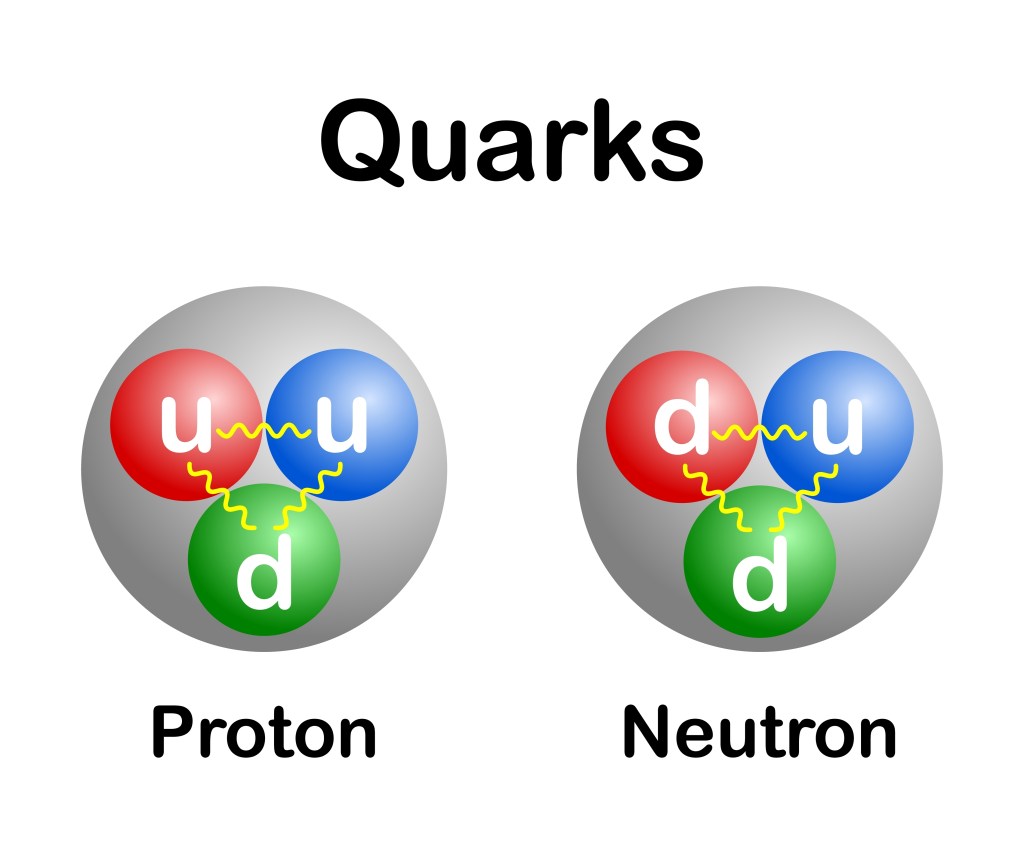
The proton and neutron each consist of three quarks. Protons consist of two up quarks and one down quark. Neutrons consist of two down quarks and one up quark. Both protons and neutrons have a net white charge. The yellow squiggly lines are gluons transporting color charge between the quarks. Asset id: 2333679305 by KRPD.
Electron / positron
Neutrino / anti-neutrino
Up quark / anti up quark
Down quark / anti down quark
muon / anti-muon
Mu Neutrino / anti-mu-neutrino
Charm quark / anti charm quark
Strange quark / anti strange quark
tau / anti-tau
Tau Neutrino / anti-tau-neutrino
Top quark / anti top quark
Bottom quark / anti bottom quark
The quarks can be used to build other particles, but leptons cannot. For example, a quark and an anti-quark pair form a particle called a meson (there are many kinds of mesons). A triplet of quarks is called a Baryon. An example of a baryon is the proton which consists of two up quarks and one down quark. Another example is the neutron which consists of one up quark and two down quarks. So just like electrons, protons and neutrons build atoms; the quarks build other elementary particles, for example, protons. As mentioned, the six flavors of Quarks are up, down, strange, charm, top and bottom.
However, the Quarks also have colors (well they are not real colors), red, blue and green which sort of correspond to the three kinds of charges for the strong nuclear force. Based on this new model a new Quantum Field Theory called Quantum-Chromodynamics (QCD) was created which together with QED would form the basis of “The Standard Model of Elementary Particles”. This was also a very straight forward chapter that was both interesting and not very difficult to understand. Again, Oerter makes the story interesting and captivating. This is perhaps the most interesting chapter in the book.
To learn more about Protons, Neutrons, Quarks, Gluons, Color Charges, and Quantum Chromodynamics you can watch this 10 minute video below.
Chapter 9: The Weakest Link
Despite the eightfold way, the Quarks, QED and QCD, all was still not well. The Weak Nuclear force was still not fully understood. Martinus Veltman, Steven Weinberg, Abdus Salam, and Sheldon Glashow were the people chiefly responsible for developing a theory for the weak nuclear force. It involved W+, W- and Z0 Bosons and something called spontaneous symmetry breaking.
These theories in turn led to something called the Higgs field and the so called Higgs particle or Higgs Boson (named after Peter Higgs who first introduced the concept of spontaneous symmetry breaking in elementary particle theory). The Higgs particle provided the physics community with a very nice surprise. The Higgs particle gives electrons (and other leptons) and the Quarks their mass. Unexpectedly we thus got an explanation as to why many elementary particles have mass and therefore why matter exists. This is why the Higgs Boson is often referred to as the God particle. It just showed up because of the theories explaining the weak force and turned out to be what created our Universe by giving the elementary particles their mass.
There was just one problem. The Higgs Boson had not yet been found when this book was written. Once the Large Hadron Collider (LHC) came online it became possible to find the Higgs Boson. This final touch to the Standard Model was the one that was the most difficult to grasp. I had a hard time understanding what spontaneous symmetry break really was, and the Mexican hat potential, etc. I think that Oerter needs to look over this chapter and find a different approach to explaining spontaneous symmetry break. I think that Oerter actually sorts of “gave up” at this point. This topic is too abstract for the layman so instead of making a good effort explaining spontaneous symmetry.
Collision of Particles in the Abstract Collider. From iStock photos.
Chapter 10: The Standard Model at Last
The standard model is built from relativistic quantum field theory, specifically QED and QCD. In chapter 9 QED was incorporated into electroweak theory which led to the Higgs Boson etc. QED is interwoven together with QCD to create a single theory whose essential elements can be written in a single equation.
Yes, that is right; an equation of everything, or almost everything. This equation is stated on 207 in this chapter. The equation over all equations that there ever was. You should buy this book just to look at it.
The Langrangian function that summarizes all of the propagators and interactions in the standard model.
The equation of everything is not as complicated as you may think. It is a Lagrangian function that summarizes all propagators and interactions, and it contains 18 adjustable numerical parameters. I admit that I don’t understand the equation fully, but Oerter explains the parameters and as mentioned it is just a big Lagrange function. As Oerter states “this equation is the simplicity at the bottom of it all, the ultimate source of all complex behavior that we see in the physical world; atoms, molecules, solids, liquids, gases, rocks, plants and animals”.
Oerter also discusses the birth of the Universe in the context of the Standard Model. In my opinion this was a very cool chapter, and Oerter does a good job at exciting the reader in this chapter. Naturally the equation of everything is a little bit difficult to understand and if you don’t know what a differential equation is you can forget about it. However, understanding the equation of everything is not important. The main point of this chapter is that there is such an equation.
Chapter 11: The Edge of Physics, Chapter 12: New Dimensions
As Oerter states in chapter 11 “The standard model is by far the most successful scientific theory ever. Not only have some of its predictions been confirmed to spectacular precision, one part in 10 billion for the electron magnetic moment, but the range of application of the theory is unparalleled. From the behavior of quarks inside the proton to the behavior of galactic magnetic fields, the Standard Model works across the entire range of human experience. Accomplishing this with merely 18 adjustable parameters is an unprecedented accomplishment, making the Standard Model truly a capstone of twentieth-century science.” However, this is not the end of physics. Gravity is explained by the General Theory of Relativity but is not incorporated into the Standard Model.
There is also dark matter and dark energy which is not part of the Standard Model. The neutrinos seem to have mass; however, they are predicted to have no mass in the Standard Model. In addition, it would be nicer to have fewer adjustable parameters than 18. Is there may be a better theory? In chapter 12 Oerter is discussing Grand Unified Theories (GUT), or SO(5) and SO(10) theories as well as super string theories, and M-theories. These are theories that might be able to do everything the Standard Model can do plus what it cannot do. However, none of these theories have ever predicted anything, so unlike the Standard Model they are speculation. There is some controversy regarding these issues, and I think Oerter might have been a tiny bit biased against super string theory here. However, he still explains what super string theory is about pretty well.
Final Conclusion and Recommendation
I highly recommend this book for anyone who wants to understand something about our world and the Universe. However, don’t expect to understand everything, it is not written so that you can. I wish Physicists would become a little better at explaining these matters to the layman using nice descriptive pictures and a little bit of math too (don’t assume math is always bad). I once read a 30 page long Swedish book on the special theory of relativity that successfully explained the kinematics, dynamics, and magnetism in relativity to your average high school kid. The Lorenz transforms, formulas for acceleration, E = mc² and magnetism were derived using simple algebra and a tiny bit of calculus at one point. That is the way these kinds of books should be written, but I have seen this only once in my life. Excluding this single example (the Swedish book), Oerter’s book is one of the best books on Physics for the layman that I have ever read.
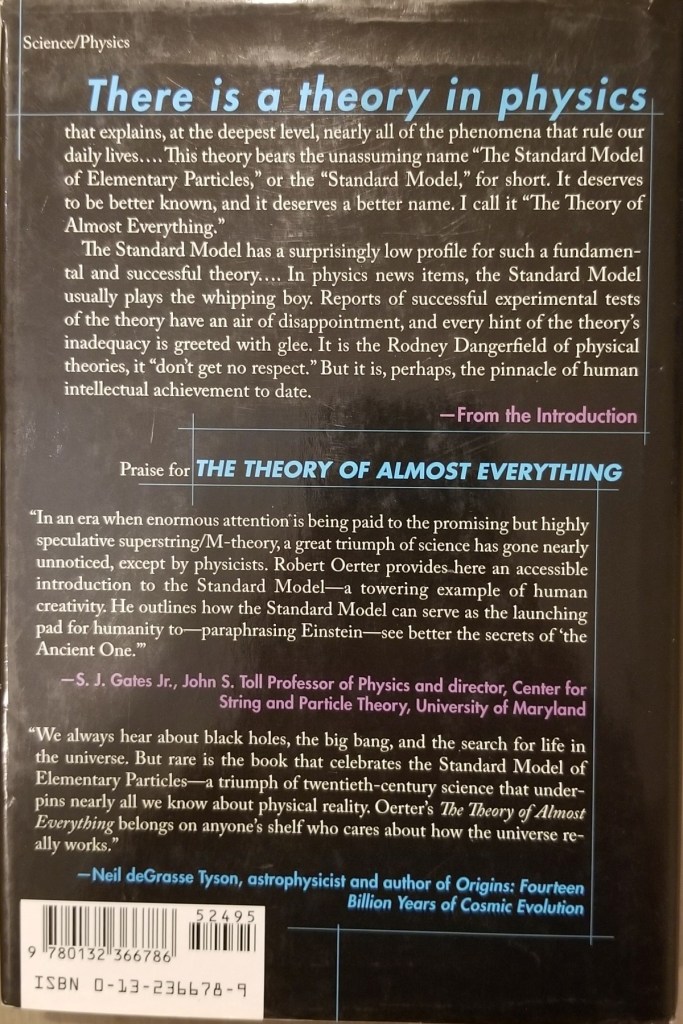
Back cover of The Theory of Almost Everything: The Standard Model, the Unsung Triumph of Modern Physics by Robert Oerter. Click on the image to go to the Amazon page for the paperback version of the book.
Here are some other posts that are related to the content of this book.
With this blog I just wanted highlight Jacqui Murray’s reblog of my Science for Babies Post. I would like for you to head over to Ask A Tech Teacher and check out her post. Also thank you very much Jacqui for your kind repost.
Super fact 60 : Superfluids such as liquid Helium cooled below -455.58 Fahrenheit exhibit some very strange characteristics such as it flows right through many solids, it climbs walls, it has near zero viscosity, it exhibits circulating flows that never stop despite no energy being added. It is a Macroscopic Quantum Phenomenon.
When gases are cooled far enough, they will turn into liquids and eventually typically to solids. For example, Oxygen becomes a liquid when its temperature drops to -297 Fahrenheit, which is -183 Celsius, or 90 degrees Kelvin. Kelvin is 0 at absolute zero, the coldest possible temperature, and in addition it uses Celsius for the scale. So, 90 degrees Kelvin is 90 degrees Celsius above absolute zero or 162 degrees Fahrenheit above absolute zero. When Oxygen becomes a liquid, it turns into a pale blue liquid. Oxygen becomes a solid at 54 Kelvin, or −218.8 Celsius, and −361.8 Fahrenheit (at normal pressure). It becomes sky blue ice.
Helium stays a gas until very extreme temperatures. Helium becomes a liquid at 4.2 kelvin or -269 Celsius, or -452.11 Fahrenheit. If the temperature is reduced further by almost half to 2.17 Kelvin, or -270.98 Celsius, or -455.8 Fahrenheit, then Helium suddenly becomes a superfluid, exhibiting macroscopic quantum phenomena. It is so different from normal liquid Helium that it is called Helium II. Its heat conductivity (speed of heat/cold transfer) suddenly increases by one million, and the temperature will become the same throughout the liquid instantly. Even a big pool of liquid helium would almost instantly get the same temperature throughout, and the atoms will start behaving in unison. Regular bubbles can no longer exist (atom sized electron bubbles can exist though).
The liquid starts behaving in bizarre ways. If you place an open metal container of Helium II in a closed room the Helium II would climb out of the container and escape, and a thin film of Helium II would climb the walls and the ceiling. If the floor was made of metal or glazed tile the Helium II would remain on the floor. If the floor was made of unglazed tile or stone, it would leak right through the floor as if the floor was a sieve. If you get a whirlpool or fountain going it will keep going forever without any energy loss. In addition, it would also exhibit many quantum effects that are out of scope for this post.
Unlike ordinary liquids, helium II will creep along surfaces in order to reach an equal level; after a short while, the levels in the two containers will equalize. The Rollin film also covers the interior of the larger container; if it were not sealed, the helium II would creep out and escape. From : Hampel, Clifford A. (1968). The Encyclopedia of the Chemical Elements. New York: Van Nostrand Reinhold. pp. 256–268 (referenced by Wikipedia). Design: Aarchiba; SVG rendering: Júlio Reis, CC BY-SA 3.0 <https://creativecommons.org/licenses/by-sa/3.0>, via Wikimedia Commons
I consider this a super fact because this is a strange, surprising and not a well-known phenomenon. It is a quantum effect that you can observe with your own eyes. It is important because the discovery of superfluidity and its twin effect superconductivity are very important for science and might lead to revolutionizing energy transport in the future. It is no doubt that the phenomenon is real (true), and it has been documented by numerous experiments and papers. It is described in thousands of textbooks, and I’ve observed the phenomenon with my own eyes (that is next).
Our Experiment with Superfluid Helium
During my first class in Quantum Physics, we performed experiments with liquid Helium. We started out by cooling helium using liquid nitrogen (colder than -196 Celsius or -321 Fahrenheit). Then using vacuum pumps, we kept cooling the Helium until it became liquid. We continued cooling it and we could see lots of bubbles and boiling as we kept going, and then it boiled extra much, and then very quickly the bubbles vanished, and the content of the entire glass container settled down and then stood perfectly still.
As 2.17 Kelvin was reached the viscosity (flow resistance) was instantly lowered with about one million times, and non-microscopic bubbles could no longer exist. The heat conductivity (the speed with which temperature spreads) increased by one million times. It means that the heat of a drop falling in one end of a swimming pool of Helium II would spread throughout the swimming pool in a second. Except, we only had a glass container in which sameness reigned throughout the liquid.
We continued doing experiments such as watching the Helium II climb walls inside the experimental setup, and of course the famous fountain. Insert a little metallic straw and watch a Helium fountain start to flow, by itself. Without any energy or pressure added, it just kept going by itself because no energy was lost either.
I can add that it was more of a demonstration than an experiment that we actively participated in because playing with extreme temperatures high or low is dangerous. If you’ve read this blog for a while you might remember when I put a Cesium-137 sample (800 times more radioactive than Plutonium-239) in my jeans pocket instead of back into its lead brick container and walked around with it a whole day. Or that time when I replaced a fuse for a 380 volt three phase powered laser with my finger because I was curious what would happen if I put my finger in there, and I was shocked, and it hurt. Students shouldn’t play with dangerous stuff.
Below is a one minute and forty four second YouTube video of a Superfluid / Helium II experiment showing an eternal fountain.
Below is a four minute explanation of a superfluid / Helium II experiment.
I can add that Helium II (super cold helium) is not the only superfluid but the easiest one to achieve.
Super fact 59 : Most people have heard of electrical charges, positive and negative. However, in nature there are also color charges—red, green, and blue—which are analogous to electric charges. In addition, there are anti-red, anti-green, and anti-blue charges.
As you may know, atoms consist of particles. Electrons surround the nucleus of the atom. The nucleus of the atom is in the middle of the atom and it consists of protons and neutrons. Electrons have a negative charge. Protons have a positive charge. Neutrons do not have an electrical charge. Electrons are so called elementary particles. They are not composed of other particles. Protons and Neutrons, on the other hand, are not elementary particles. They are composite particles consisting of quarks, gluons and quark pairs called mesons.
Four elements with a nucleus and electron shells. The number of electrons, protons, and neutrons is shown. The green particles circling the nucleus are electrons. The red particles in the nucleus (middle) are protons and the blue particles in the nucleus are neutrons. The colors of the particles in this picture have nothing to do with color charges. The four elements are Hydrogen, Carbon, Oxygen, and Nitrogen. There are 118 elements. These elements can combine into millions of different kinds of molecules that make up everything. Asset id: 1555863596 by OSweetNature.
Quarks have electric charges, just like an electron and a positron, which is why a proton has an electric charge, a positive electric charge. However, in addition quarks have something called color charge. Unlike electric charges, which come in two forms, negative and positive, they come in three forms red, green and blue and in anti-red, anti-green, and anti-blue (well six forms actually). I should say that the color charges, red, green and blue, are not real colors. They are just names. Just electric charges are associated with electric forces; color charges are associated with the nuclear strong force. The strong force is even stronger than the electrical force.
If you take an equal amount of positive and negative electric charges you get something that is electrically neutral. If you take an equal amount of red, green and blue you get what is called white, or neutral. If you take an equal amount of red and anti-red you also get white. Any other mix gives you a net color charge.
The proton and neutron each consist of three quarks. Protons consist of two up quarks and one down quark. Neutrons consist of two down quarks and one up quark. Both protons and neutrons have a net white charge. The yellow squiggly lines are gluons transporting color charge between the quarks. Asset id: 2333679305 by KRPD.
I can add that gluons are elementary particles that in many respects are like photons. Light consists of photons. It is because of the photons that we can see. In addition, the photons transport electrical charge. Photons are massless elementary particles with the intrinsic spin of one, and they belong to a group of elementary particles called Bosons. Gluons transport color charge, and they are massless and have an intrinsic spin of one and belong to the same group of elementary particles called Bosons. Unlike photons, they are stuck inside the nucleus and unlike photons they never get to see the light of day. The pun was intended.
Matter, light, and electrical charges are all part of our daily life. We can touch matter, see light, and we come across electrical charge when we touch something that is charged or when we see lightning. However, we do not come across quarks, gluons, and color charges in our daily life because they are hidden at the center of the atoms. Yet they are fundamental to the existence of matter, of us. We know color charges exist, the existence of color charges is an important fact, and yet it is not a well-known fact and often a big surprise to people. Therefore, I think it is a super fact.
The 118 Elements and the 3,500 Isotopes
There are 118 known elements. Why not 500, or just 4 or 5, like the ancient Greeks believed? Each element is defined by it having a certain number of protons and the same number of electrons if it is to be electrically neutral. The problem with having more than one proton in the nucleus is that protons all carry a positive charge and therefore want to push each other away. Same charges repel and different charges attract. What saves the nucleus from blowing apart are the neutrons and the associated strong nuclear force (protons & neutrons) which is guided by the color charges. The quantum model for electricity is called Quantum electrodynamics or QED. The quantum model for color charges is called Quantum chromodynamics or QCD.
As you add more protons it becomes increasingly more difficult for the nuclear forces (strong and weak) to hold the nucleus together. The positive charge of the protons is pushing too hard. That’s why there are only 118 Elements. Another thing to note is that the number of neutrons does not have to be the same as the number of protons. This means that for each element there are several kinds of so-called isotopes. For example, carbon has six protons and six electrons (if the atom is electrically neutral) but the carbon atom / element can have six neutrons, seven neutrons, or eight neutrons. You call them carbon-12, carbon-13, and carbon-14, where the number represents the number of protons plus the number of neutrons.
Three natural isotopes of Carbon Stock Vector ID: 2063998442 by zizou7This is a simplified Bohr model of the Uranium atom. There are 92 little blue balls circling a nucleus in the middle of the atom. Those are electrons. In the nucleus there are 92 protons. Those are the red balls with plus signs. In addition, there is a yellowish smudge around the protons in the nucleus. Those are the neutrons. Depending on the isotope, there are 143 neutrons for U-235, 146 neutrons for U-238 and 142 neutrons for U-234. Shutterstock asset id: 1999370450 by Patricia F. Carvalho
It is the electrons that determine the chemical properties of an element, and therefore isotopes with a different amount of neutrons are chemically identical. However, they are different with respect to properties that relate to he nucleus, such as radioactivity/stability, and of course weight. Also, when atoms combine into molecules their chemical properties change drastically, but again that is due to the rearrangement of the electrons. There are around 3,500 known isotopes, most of them radioactive.
What is a Quark?
To learn more about Protons, Neutrons, Quarks, Gluons, Color Charges, and Quantum Chromodynamics you can watch this 10 minute video below.








 Super Facts