The Unfolding Clean Energy Revolution

Superfact 100: The share of fossil fuels for electricity generation is decreasing and EVs are replacing internal combustion engines. The share of hydro and nuclear energy, which is clean energy,  is decreasing, but the sharp increase in the share provided by renewables such as wind and solar is more than making up for it. In addition, there are new clean energy sources that are very promising but not yet widely implemented such as geothermal energy and fusion energy. The energy landscape is changing rapidly.
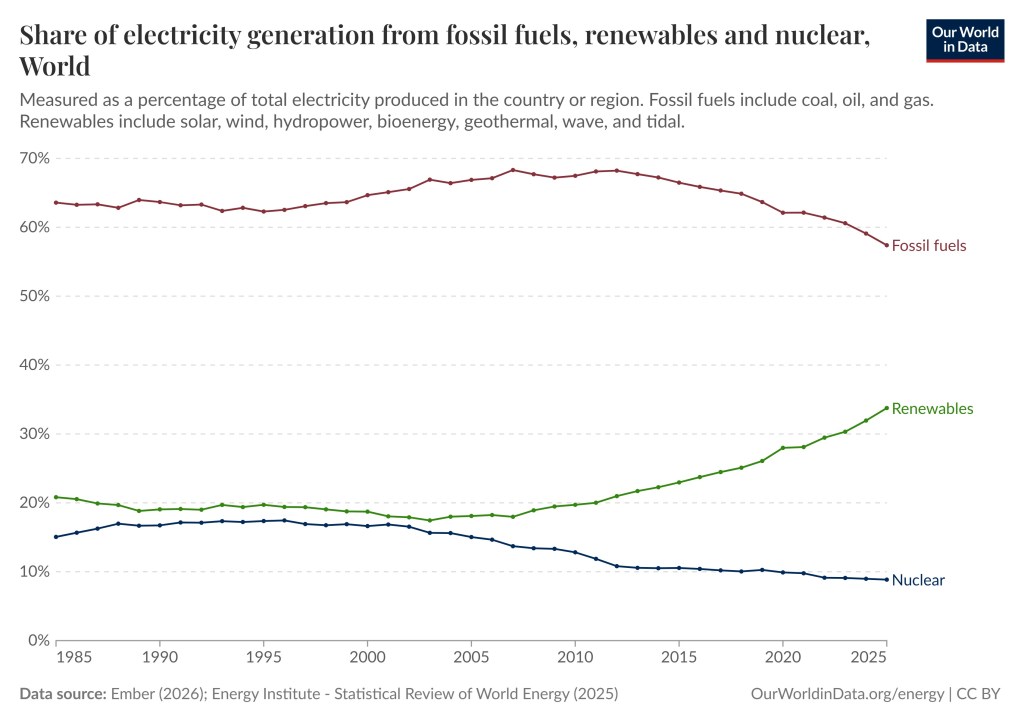
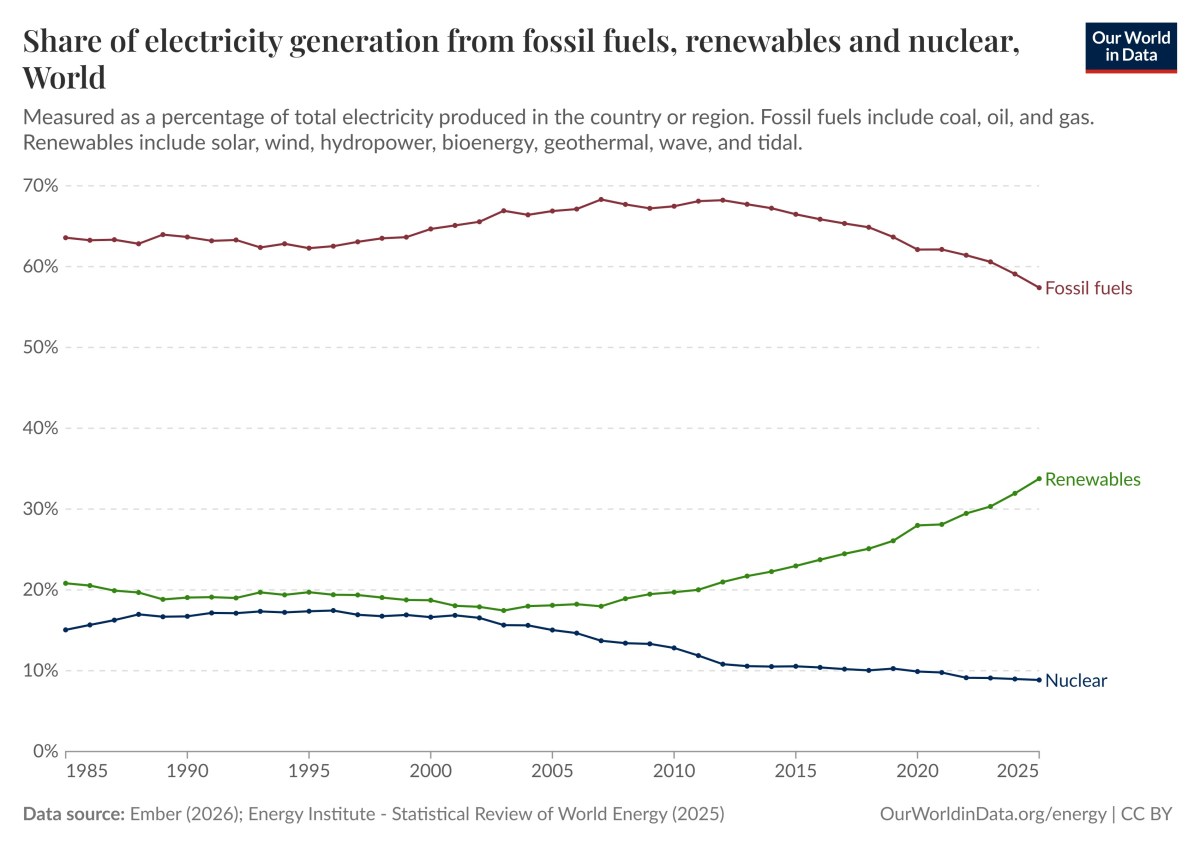
The chart includes three graphs showing the share of the world’s electricity generated by fossil fuels, nuclear and renewables from 1985 to 2025. | The Unfolding Clean Energy Revolution
Share of electricity generation from fossil fuels, renewables and nuclear, world. Measured as a percentage of total electricity produced in the world. Fossil fuels include coal, oil and gas. Renewables include solar, wind, hydropower, bioenergy, wave and tidal. Data source Ember (2026): Energy institute – Statistical Review of World Energy (2025)  OurWorldinData.org/energy | CC BY.

As can be seen in the graph above the share of electricity in the world generated by fossil fuels has gone down in recent years (from 66.48% in 2015 to 57.39% in 2025), and the share of electricity generated by nuclear has also gone down (from 10.55% in 2015 to 8.85% in 2025) whilst the share of electricity generated by renewables has increased (from 22.97% in 2015 to 33.76% in 2025). This is even though the most prominent source of renewable energy, hydro, has decreased its share substantially (from 16.2% in 2015  to 14% in 2025) as can be seen in the graph below.

What is going on is that two sources of renewable energy, wind and solar, have increased their share of electricity generated substantially (wind: from 3.5% in 2015 to 8.5% in 2025) and (solar: from 1.1% in 2015 to 8.7% in 2025), which can be seen in the graph below. It should be noted that renewable energy encompasses solar, wind, hydropower, bioenergy, geothermal, wave, and tidal sources.

To play around with the graph above and other similar graphs click here and select and look at the bottom charts. To play around with the graph below and similar graphs click here and select and look at the bottom charts.
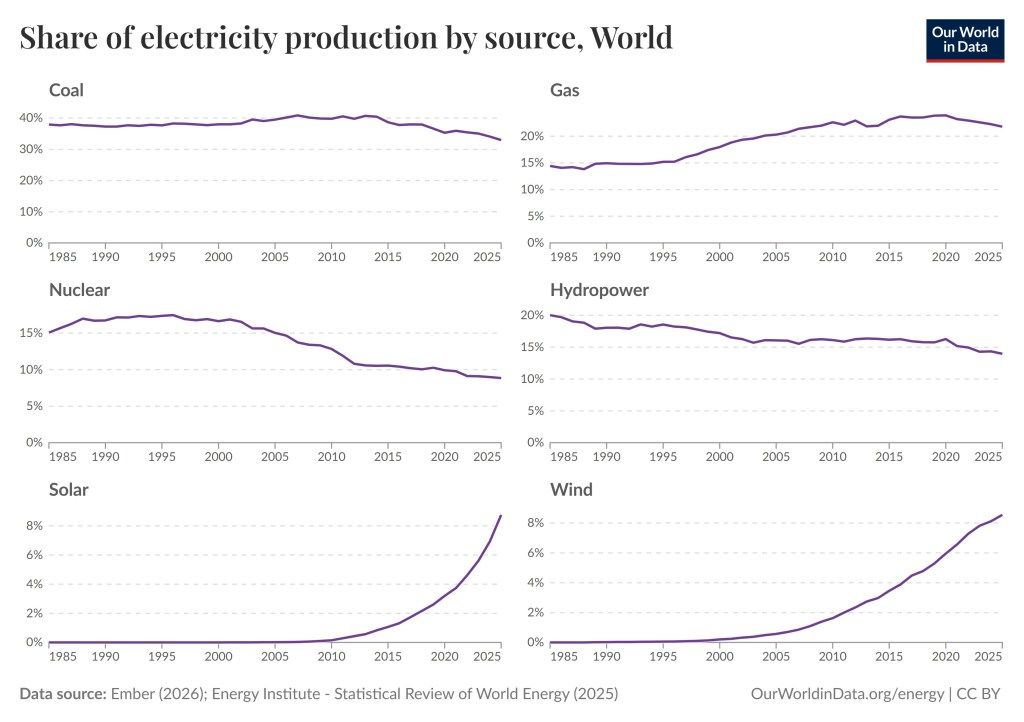
There are six graphs depicting the share of electricity production by six sources, coal, gas, nuclear, hydropower, solar and wind from 1985 to 2025. The graphs show that the share of electricity production by coal, gas, nuclear and hydropower have gone up and down but have been relatively steady with a decline over the last ten years. At the same time wind and solar have gone from almost to a sharp increase over the last 10-15 years.
Share of electricity production by source, World. Data source (2026): Energy Institute – Statistical Review of World Energy (2025)  OurWorldinData.org/energy | CC BY.

So far, I’ve been talking about the share of electricity production in the world by different energy sources. However, the world is using more and more electricity. Populations are growing, economies are growing, and the world is electrifying, for example, because of the worldwide adaption of EVs.

Just because an energy source’s share of electricity production is decreasing does not mean its total global electricity generation by that source is decreasing. In fact, as the share of electricity production by fossil fuels has decreased, the total production of electricity by fossil fuels has increased, well up until now. For the first time in history the total global electricity generation by fossil fuels went down in 2025. Note that since coal and oil decreased in the graph below fossil fuel consumption for electricity declined in 2025, despite s small increase in gas. This means that the use of fossil fuels is finally decreasing.
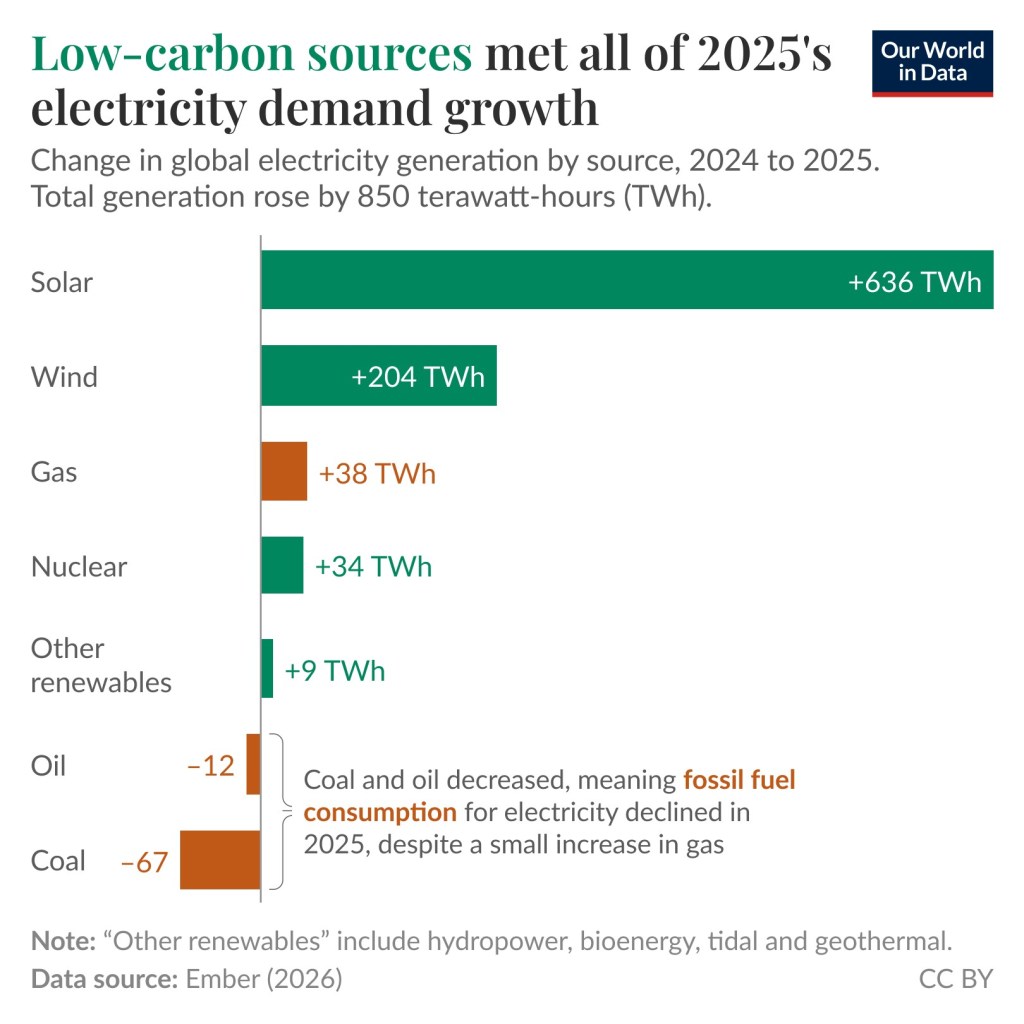
This is a bar graph showing an increase of 38TWh from gas, a decrease of 12TWh from oil, and a decrease of 67TWh from coal. The energy from wind, solar, nuclear, and other renewables increased by 850TWh. | The Unfolding Clean Energy Revolution
Low carbon sources met all of 2025’s electricity demand growth. Change in global electricity generation by source, 2024 to 2025. Total generation rose by 850 terawatt-hours (TWh). Note: “Other renewables” include hydropower, bioenergy, tidal and geothermal. Data source: Ember (2026). This graph comes from this page.

The practice of burning fossil fuels to generate electricity and for transportation is becoming less dominant. I believe this fact is surprising to many people, especially Americans since the current administration has taken a strong anti-renewable and anti-climate-science stance, and many Americans are not aware of what is happening in the rest of world in this regard. Superfact #100 is a super fact because the data is reliable, it is surprising to many people, and it is important.

It should be noted that we will likely keep using fossil fuels to produce fertilizers, plastics, medicines, and chemicals for a long time. However, this corresponds to only a few percent of our current use of fossil fuels and seems to be a lot better use of fossil fuels than burning it all up for energy. In fact, we may need the remaining fossil fuels for that purpose. In this post I am using data provided by Our World in Data which in turn got data from Ember Energy, or the International Energy Agency.

The Current Administration’s Opposition to Renewables and Climate Science

I am trying to keep politics out of my blog. However, the current administration’s strong opposition to and the misinformation they disseminate about renewables and climate science makes it difficult to discuss this renewable energy without bringing it up. It is an important piece in our understanding of what is going on. The misinformation about climate science (and other scientific topics) has bamboozled a lot of people and the actions taken to hinder the deployment of renewables have had real consequences. However, it is important to remember that the current situation here in the US is temporary and has a limited impact on the rest of the world.

Some actions that current administration has taken are:

  • Science organizations such as NOAA and NFS-NCAR have had their budgets severely cut and have been threatened to be dismantled. Websites related to climate science have been taken down. Click here to read more. NASA is also threatened to have its science programs severely cut (by 47%), as well as other programs, but it has not yet been implemented. Click here to read more.
  • Restricting or ordering the freezing of permits for renewables, canceling tax credits and investment credits for renewables, ordering the cancelation of renewables under construction, for additional information click here, or here.
  • In 2009 the EPA found that atmospheric concentrations of greenhouse gases endanger both current and future generations, enabling EPA to regulate greenhouse gases. This, so called endangerment finding was overturned in February 2026 by the administration. This article explain why there is no Scientific justification to revoke the endangerment finding.
  • The administration paid one billion dollars to France’s TotalEnergies in exchange for not developing windfarms on the east coast (kind of a bribe).
  • Pentagon has frozen permitting since last August halting more than 250 onshore wind projects, including those on private land, which is not only preventing us from meeting our energy needs, but is indirectly a violation of private property rights.
  • The United States is the only country to have withdrawn from the Paris Agreement (January 27, 2026). Three other countries, Iran, Libya, and Yemen, did not join.
  • 95,000 employees, including 10,000+ with PhD’s, at government science agencies (more than a third of them) have either been laid off / fired, or left, as a result of current policies. This effects CDC, NIH (National Institute of Health), and especially anything related to climate science. Many scientists have left the US for Europe.

There is not wonder many in the United States incorrectly believe clean energy is on its way out. I should say that even though support for solar and wind has declined in the US, solar and wind remain the sources of energy that most people want the federal government to encourage over any other source of energy, according to this Pew Research article.

Important Climate and Energy Facts

As I said, the misinformation about climate science has bamboozled a lot of people. As an example. We know that climate change / global warming is happening. We have also known for several decades that the current climate change / global warming is not natural. It is caused by us, chiefly due to the burning of fossil fuels. The scientific evidence is conclusive. It includes satellites directly measuring our greenhouse gases trapping heat, the upper troposphere is cooling whilst the lower atmosphere is warming, showing that the heating is from greenhouse gases, the unnatural speed of the warming, isotope studies, climate models, etc. How many people know about this? I believe very few people do. Below are eleven related super facts.

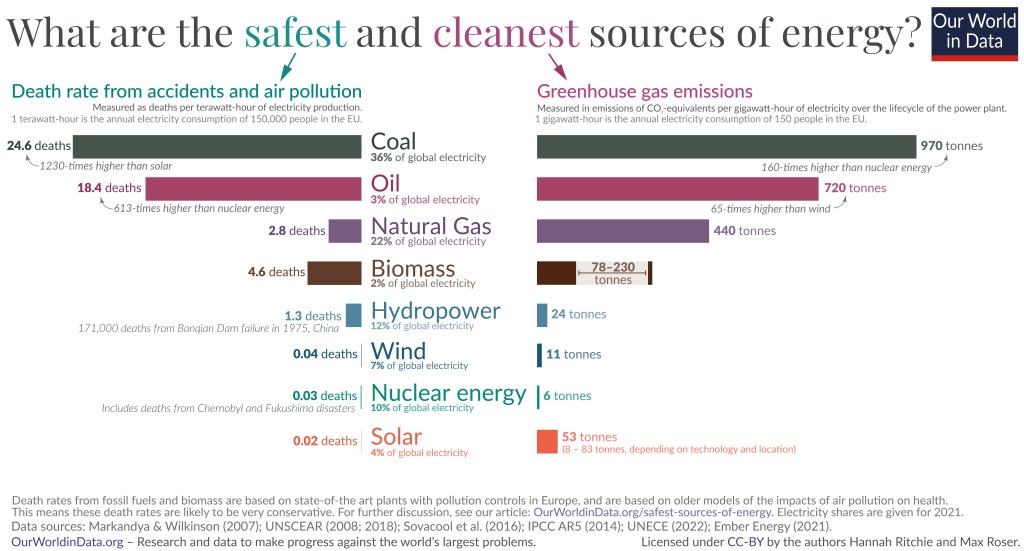
The graph depicts death rates and greenhouse gas emissions per unit for different energy sources including coal, oil, natural gas, biomass, hydropower, wind, nuclear power, and solar.
Greenhouse gas emissions and death rates from various sources of energy. Fossil fuels and biomass are based on state-of-the art plants with pollution control in Europe and are based on older models of the impacts of air pollution on health. This means that these death rates are likely to be very conservative. The graph shows that renewables and nuclear are the cleanest and safest forms of energy. For further discussion see the article: OurWorldinData.org/safest-sources-of-energy. Electricity shares are given for 2021. Data sources: Markandya & Wilkinson (2007); UNSCEAR (2008: 2018); Sovacol et al. (2016); IPCC AR5 (2014); UNECE (2022); Ember Energy (2001). OurWorldinData.org – Research and data to make progress against the world’s largest problems. Licensed under CC-BY by the authors Hannah Ritchie and Max Roser. Citation : Hannah Ritchie (2020) – “What are the safest and cleanest sources of energy?” Published online at OurWorldinData.org. Retrieved from: ‘https://archive.ourworldindata.org/20260202-100556/safest-sources-of-energy.html’ [Online Resource] (archived on February 2, 2026).

The Share of EVs

Another phenomenon that results in less burning of fossil fuels than we otherwise would have is that electric cars and plug-in hybrid are becoming more common in the world. Going from nearly non-existent in 2010 electric cars (EVs) are now starting to show up around the world. The share of electric cars on the roads in 2024 was in the United States was 2.7%, in the world 4.5%, in China 11%, in Sweden 13% and in Norway 32%.

What matters more (for the future) is the sale of new EVs and plug-in hybrids. The share of new cars that are electric was 22% for the world, 10% in the United States, 21% in the EU, 28% in the United Kingdom, 48% in China, 58% in Sweden, 92% in Norway. In 2025 the share of new cars that were electric was 98% in Norway according to this website. To see more EV statistics and play around with various graphs visit this link.

One thing that might be surprising to Americans is that EVs are quite common in many other countries including EU, the Scandinavian countries, and China. Another is that EVs are indeed significantly cleaner than internal combustion engines, even when charged from a relatively dirty grid. See this super fact (29) EV Cars Indeed Emit Less Carbon Pollution.
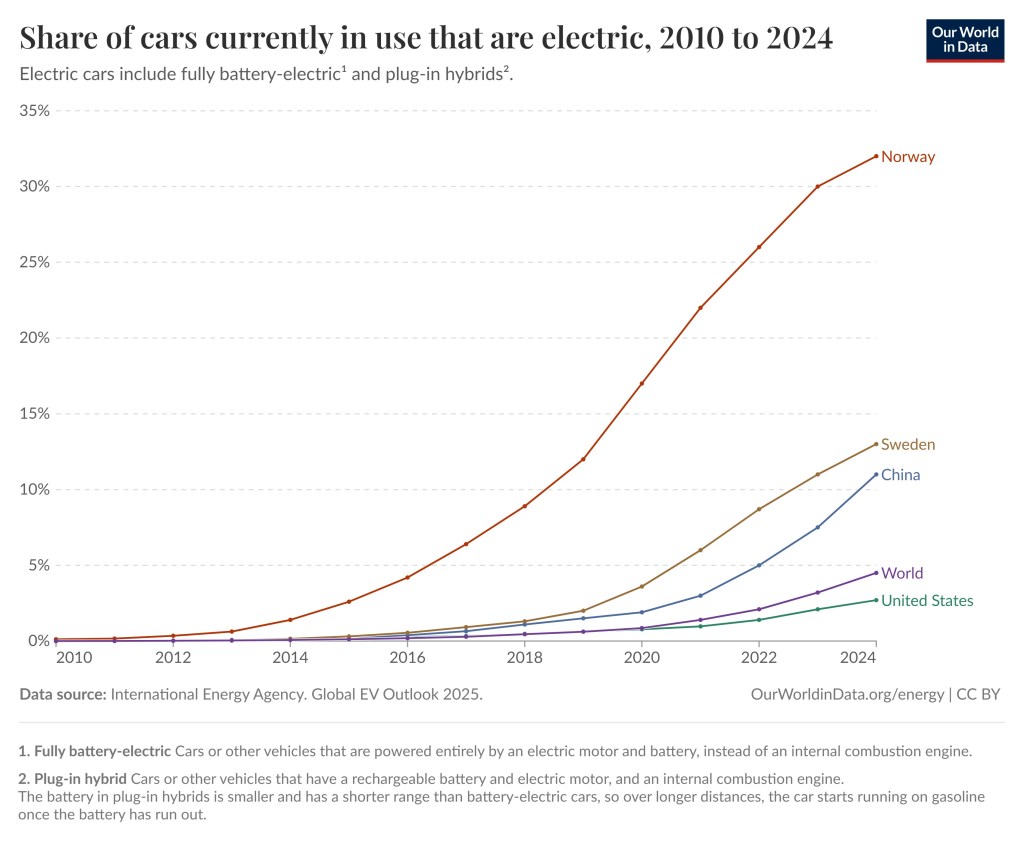
The graph shows the share of cars currently in use that are electric for the world, the United States, China, Sweden and Norway.
Share of cars currently in use that are electric, 2010 to 2024. Electric cars include fully battery-electric and plug-in hybrids. With battery-electric cars is meant cars or other vehicles that are powered entirely by an electric motor and battery, instead of an internal combustion engine. With plug-in hybrid is meant cars or other vehicles that have a rechargeable battery and electric motor, and an internal combustion engine. The battery in plug-in hybrids is smaller and has a shorter range than battery-electric cars, so over longer distances, the car starts running on gasoline once the battery has run out.
Data source: International Energy Agency Global EV Outlook 2025.   OurWorldinData.org/energy | CC BY
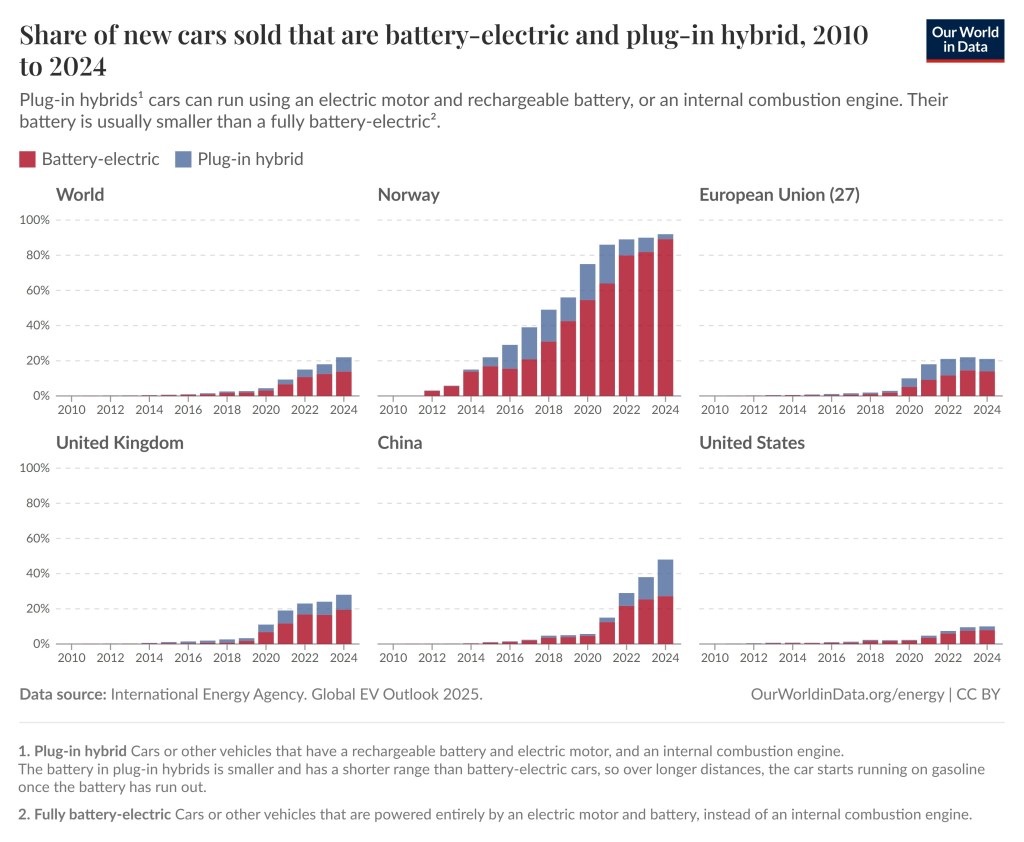
Share of new cars sold that are battery-electric (in brown) and plug-in hybrid (in blue), 2010 to 2024, for six countries and regions, including the world, United States, United Kingdom, China, Norway and the European Union. | The Unfolding Clean Energy Revolution
Battery-electric cars are depicted with brown and plug-in hybrid in blue. Share of new cars sold that are battery-electric and plug-in hybrid, 2010 to 2024. Plug-in hybrids cars can run using an electric motor and rechargeable battery, or an internal combustion engine. Their battery is usually smaller than a fully battery-electric. Data source: International Energy Agency Global EV Outlook 2025.   OurWorldinData.org/energy | CC BY
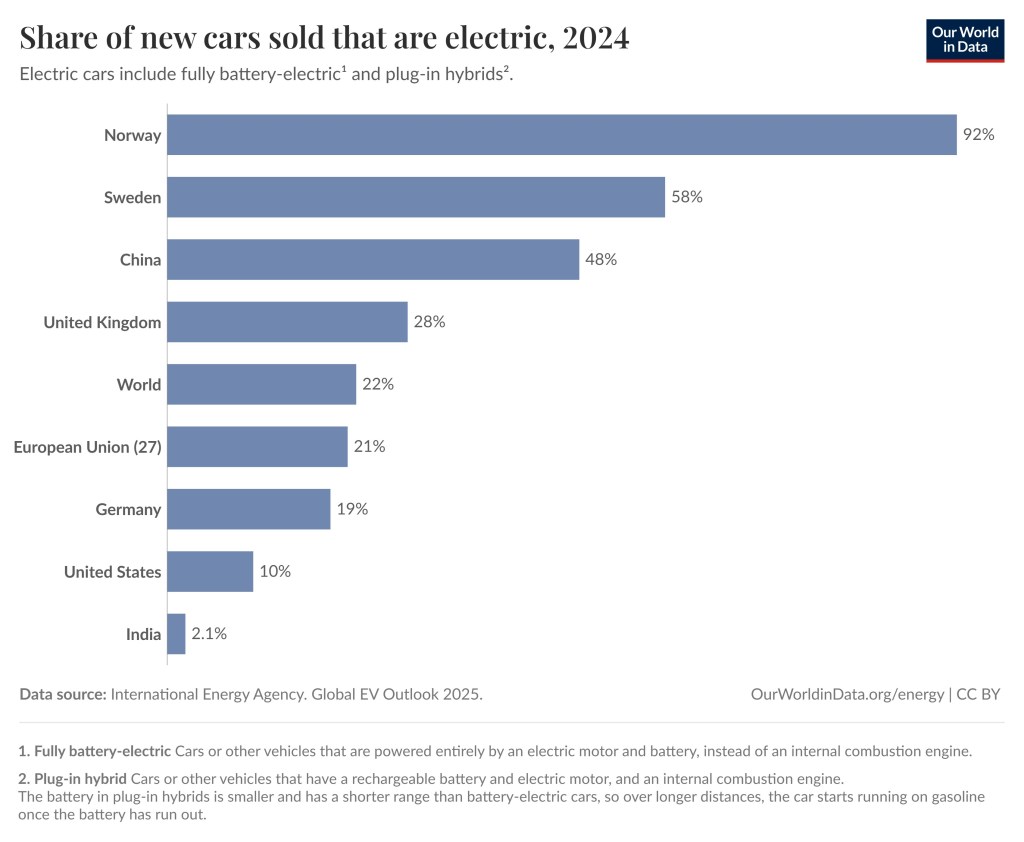
The bar graph shows the share of new cars sold that are electric in 2024 for the world and 8 countries. The numbers are India 2.1%, the United States 10%, Germany 19%, European Union 21%, United Kingdom 28%, China 48%. Sweden 58%, Norway 92%, and the World 22%
Share of new cars sold that are electric, 2024. Electric cars include fully battery-electric and plug-in hybrids. Data source: International Energy Agency  Global EV Outlook 2025.  OurWorldinData.org | CC BY

Share of electricity production by source EU, US, China

The first graph in this post depicted the share of electricity production by source for the world. The graph below breaks it up to show the share of electricity production by source for the three largest economies in the world, the United States, China and the EU. Again, the share of energy from coal, nuclear and hydro is decreasing whilst the share from wind and solar is going up for all three markets. One notable difference from the top graph is that gas keep increasing for the United States.
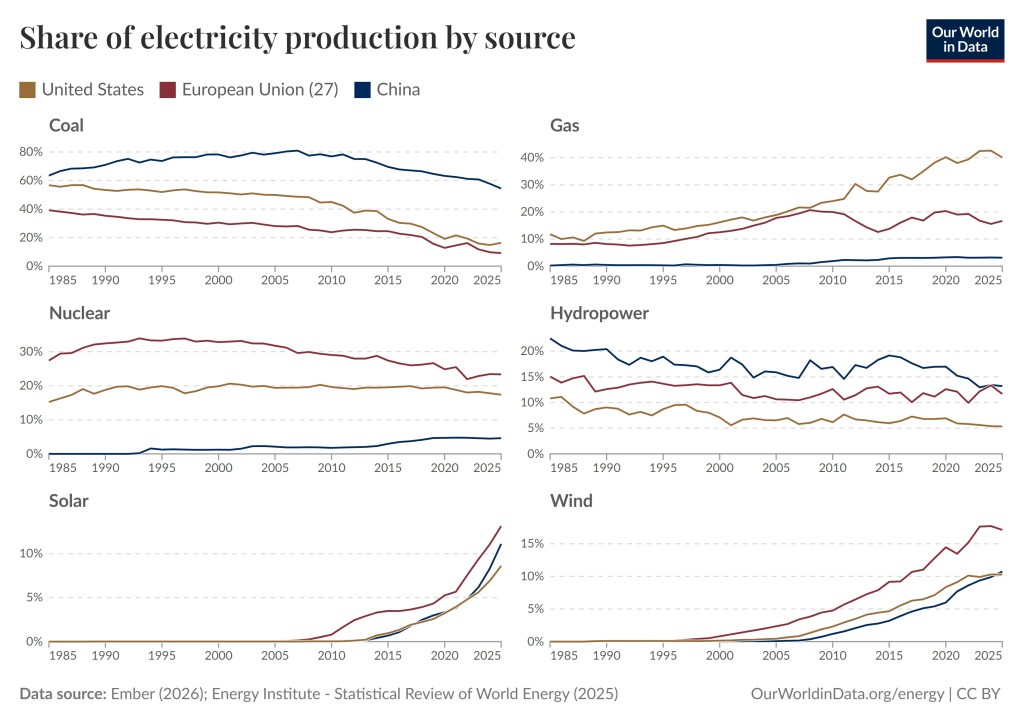
There are six charts in the picture depicting share of electricity production by coal, gas, nuclear, hydro, solar and wind. Each charts show three graphs in different colors representing the United States, the European Union, and China. | The Unfolding Clean Energy Revolution
Share of electricity production by source, United States, European Union, and China. Data source: Ember (2026): Energy Institute – Statistical Review of World Energy (2025)     OurWorldData.org/energy | CC BY

The Share of Electricity Production from Wind

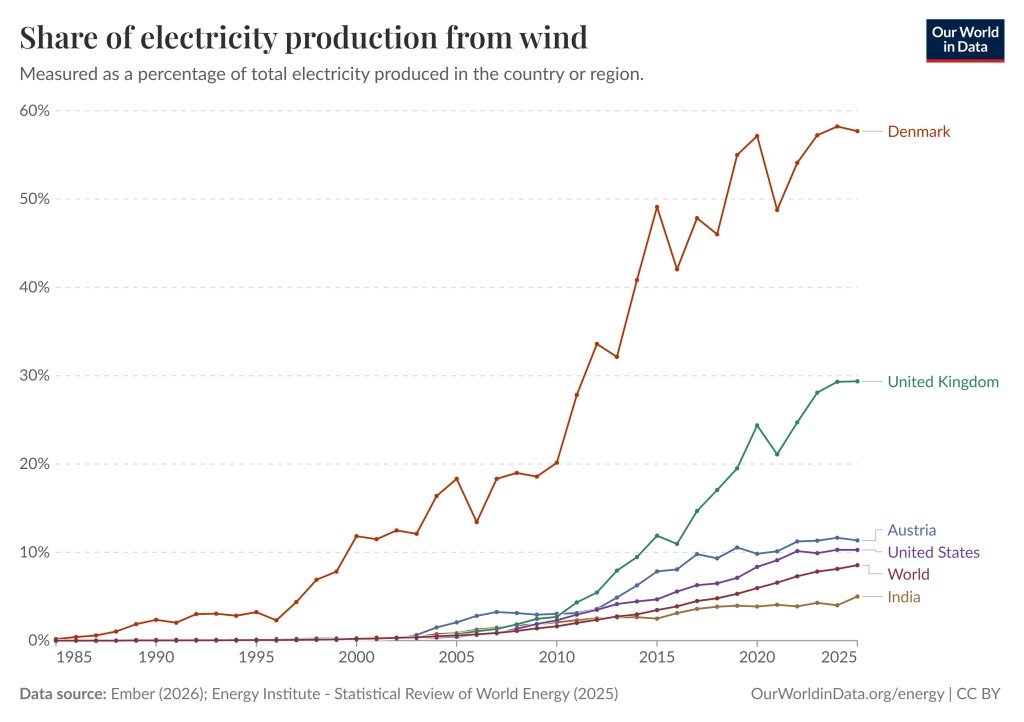
Below are a few charts depicting the share of electricity production from wind. The first graph is already included in the second chart from the top (above). However, this is a close up. The second graph depicts the share of electricity production from wind for multiple countries. It should be noted that Denmark and the United Kingdom are prominent users of wind power. For Denmark the share of electricity production from wind is almost 60%. By clicking here you can play around with the graphs and generate as many different graphs as you wish.
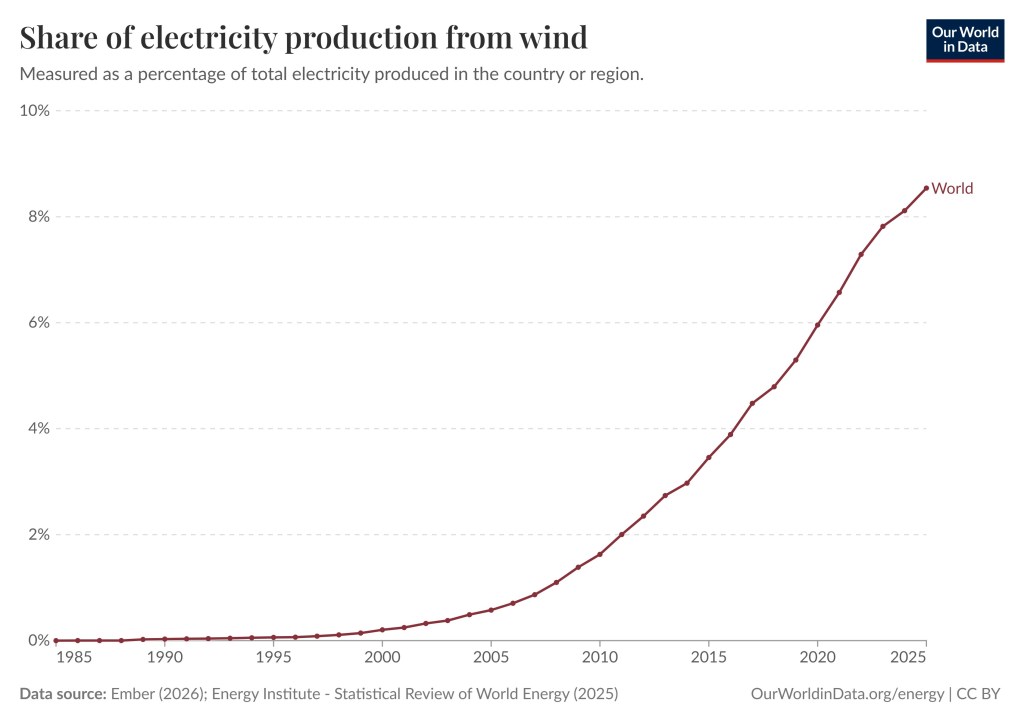
This graph shows the share of electricity production from wind for the world. In 1985 it is 0%, in the year 2000 it is 0.2%, in 2010 it is 1.6%, in 2015 3.5%, in 2020 4.0%, and in 2025 8.5%.
Share of electricity production from wind. Measured as a percentage of total electricity produced in the world. Data source: Ember (2026): Energy Institute – Statistical Review of World Energy (2025)   OurWorldinData.org/energy | CC BY
This graph shows the share of electricity production from wind for the world and for five selected countries, India, United States, Austria, United Kingdom, and Denmark. Denmark uses the most wind power at 57.7%.
Share of electricity production from wind. Measured as a percentage of total electricity produced in the country or region. Data source: Ember (2026): Energy Institute – Statistical Review of World Energy (2025)   OurWorldinData.org/energy | CC BY
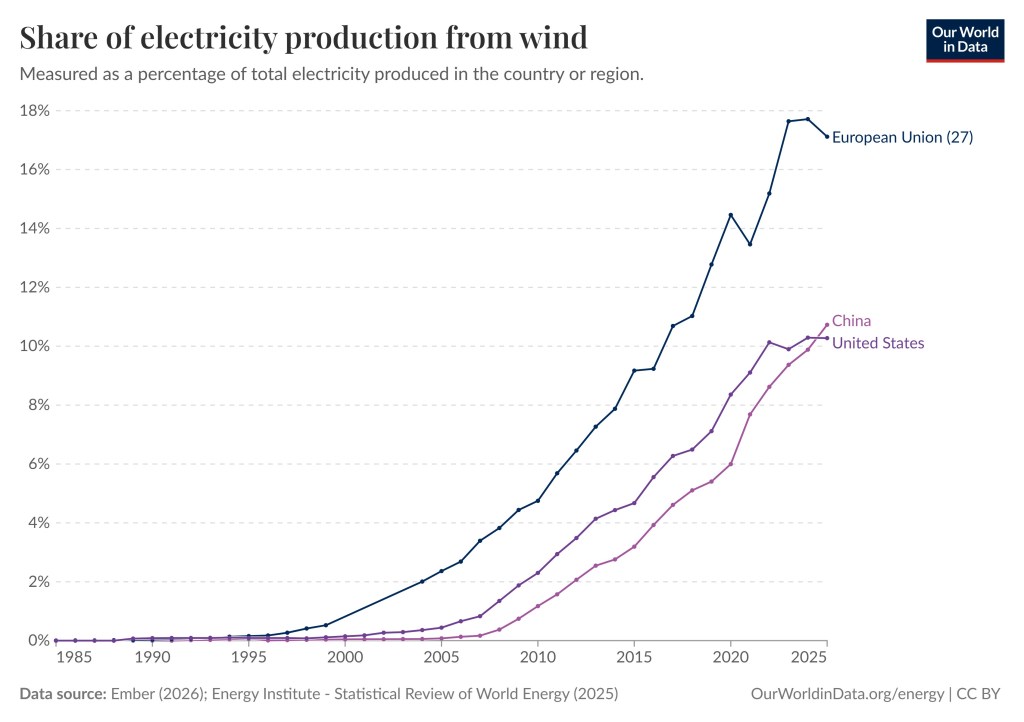
The graph shows the share of electricity production from wind for the United States (dark blue), China (purple), and the European Union (blue).
Share of electricity production from wind. Measured as a percentage of total electricity produced in the United States, China and the European Union. Data source: Ember (2026): Energy Institute – Statistical Review of World Energy (2025)   OurWorldinData.org/energy | CC BY

The Share of Electricity from Solar

The share of electricity from Solar for the world has grown from essentially 0% in the year 2000 to 3.19% in 2020 to 8.75% in 2025. For solar, the United States follows the rest of the world closely. Some countries have a higher percentage, such as the Cook Islands – 50%, Luxembourg – 30.52%, Chile – 25.06%. If you wish you can take a look here, or here, and you can play around with the different graphs. You can create millions of scenarios at your pleasure.
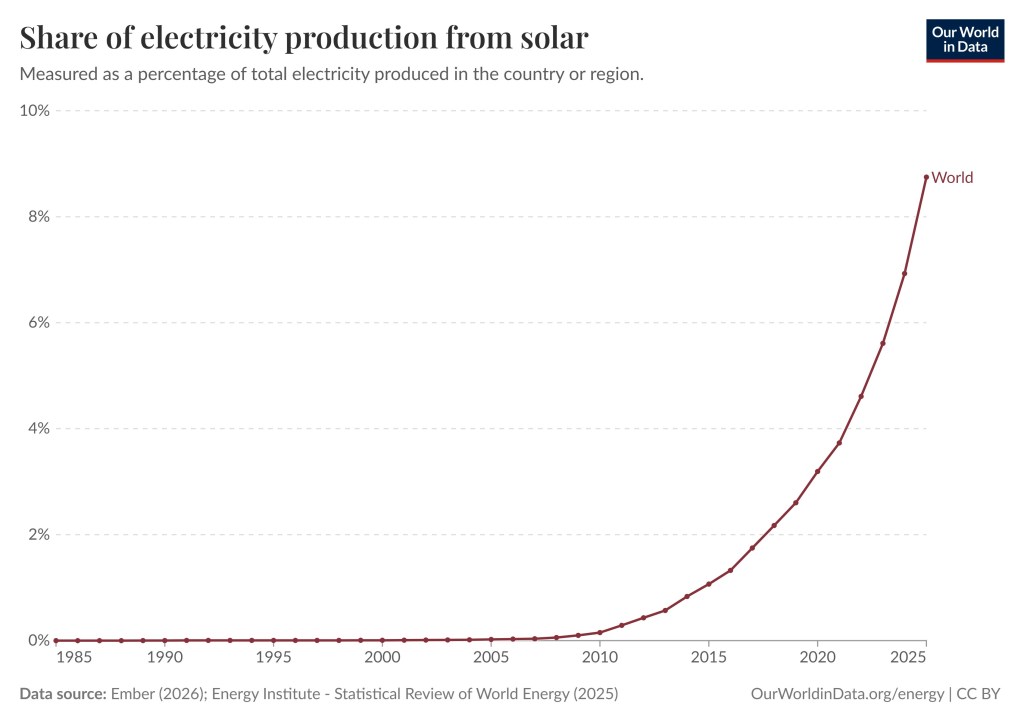
The graphs shows that the share of electricity from Solar remained nearly zero until the very recent sharp increase. | The Unfolding Clean Energy Revolution
Share of electricity from Solar. Measured as a percentage of total electricity produced in the country or region. Data source: Ember (2026): Energy Institute – Statistical Review of World Energy (2025)    OurWorldinData.org/energy | CC BY

The Share of Electricity Production from Hydropower

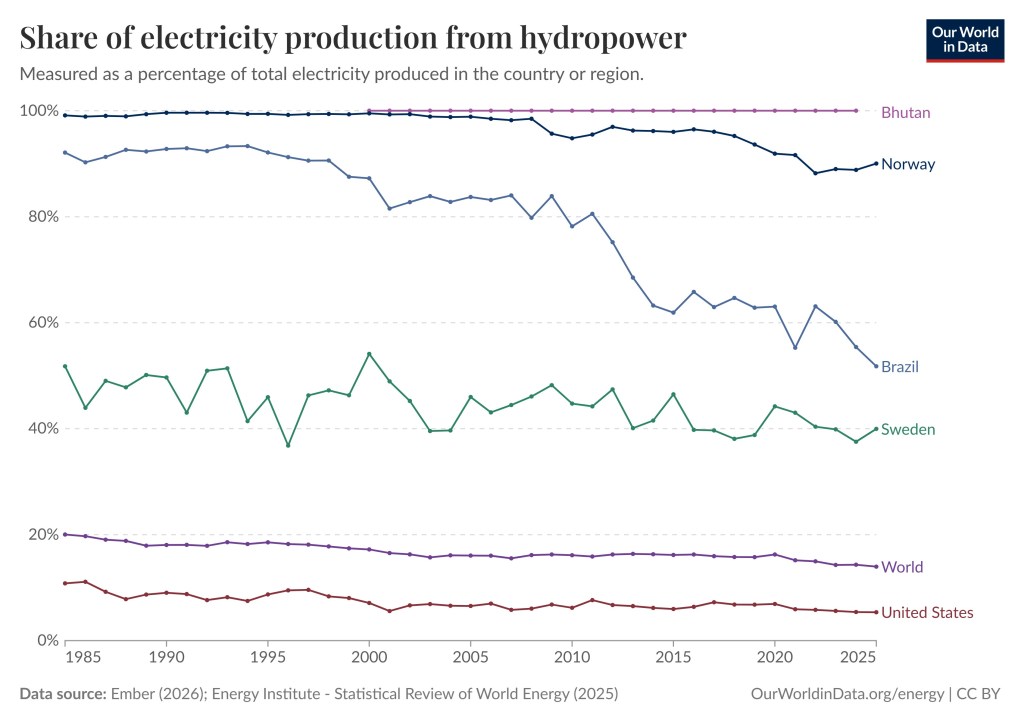
Hydro is a renewable energy source but its share of electricity production in the world has gone down. Unlike solar and wind, hydro is not an intermittent source of energy, so that is not necessarily something to celebrate. The intermittency of solar and wind can be mitigated using batteries, or energy sources that are not intermittent, preferably clean energy sources such as hydro and nuclear. Hydro is still the world’s most popular renewable energy source but that is changing quickly.

The graph below shows that the share of electricity production from hydropower for the world is 13.96%, USA 5.35%, Bhutan 100%, Norway 90.03%, Brazil 51.78%, Sweden 39.97%. If you wish you can take a look here, or here, and you can play around with the different graphs. You can create millions of scenarios at your pleasure.
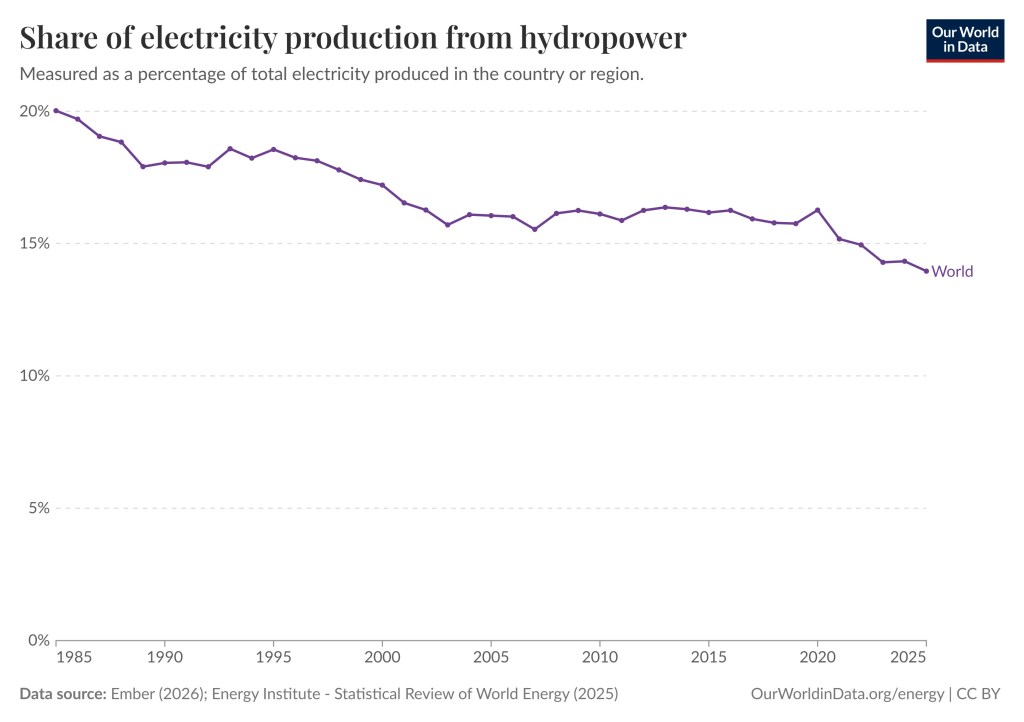
There is only one graph in the chart and that is for the share of electricity production from hydropower. It has slowly been going down from 1985 (20.02%) to 2025 (13.96%).
Share of electricity production from hydropower. Measured as a percentage of total electricity produced in the world. Data source: Ember (2026): Energy Institute – Statistical Review of World Energy (2025)    OurWorldinData.org/energy | CC BY
The chart shows six colored graphs going from 1985 to 2025. The graphs correspond to the world, Bhutan, Norway, Brazil, Sweden, and the United States. | The Unfolding Clean Energy Revolution
Share of electricity production from hydropower. Measured as a percentage of total electricity produced in the world and five countries (Bhutan, Norway, Brazil, Sweden, United States). Bhutan remains at 100% hydro, Norway went from 99.12% in 1985 to 90.03% in 2025, Brazil went from 92.10% hydro in 1985 to 51.78% in 2025, Sweden went from 51.76% hydro in 1985 to 39.97% in 2025, the United States went from 10.81% hydro in 1985 to 5.35% in 2025. The world went from 20.02% hydro in 1985 to 13.96% in 2025. Data source: Ember (2026): Energy Institute – Statistical Review of World Energy (2025)    OurWorldinData.org/energy | CC BY

The Share of Electricity Production from Nuclear

The share of electricity production in the world from nuclear went down from 15.06% in 1985 to 8.85% in 2025, which is a significant drop. During the same time the share of electricity production from nuclear in the United States went from 15.20% in 1985 to 17.36% in 2025, for China the numbers are 0% in 1985 to 4.61% in 2025, and for EU the share of electricity production in 1985 was 27.42% and in 2025 23.32%. However, in 1993% the share of electricity production in 1993 was 33.90%.

So, nuclear has taken a big step back in EU. Germany cancelled nuclear power entirely, for better and for worse. To interact with the graphs shown below or see other (millions) related charts or maps click here, or here.
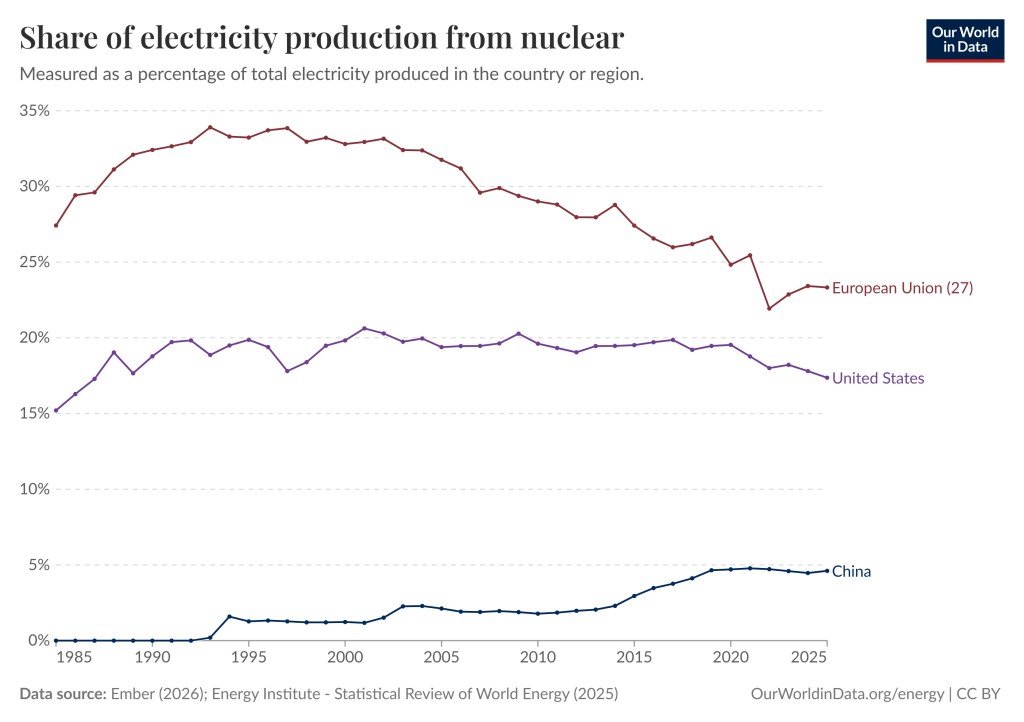
This chart features three graphs corresponding to the United States, EU, and China. The share of electricity production from nuclear has gone up in both the United States and China while the share has gone down in the EU after a record high in 1993.
Share of electricity production from nuclear. Measured as a percentage of total electricity produced in the world’s three largest economies, the United States, EU, and China. Data source: Ember (2026): Energy Institute – Statistical Review of World Energy (2025)    OurWorldinData.org/energy | CC BY

Geothermal a Promising source of Energy

Another reason to believe that the energy transition away from fossil fuels has begun, is that in addition to fossil fuels losing share of total electricity produced, there are promising emerging renewables, such as Geothermal energy. Geothermal energy uses natural heat from deep within the Earth to generate electricity or heat buildings. Wells tap into underground hot water/steam reservoirs, forcing it up to spin turbines that power generators, after which the water is cooled and reinjected to replenish the source (see the picture below).
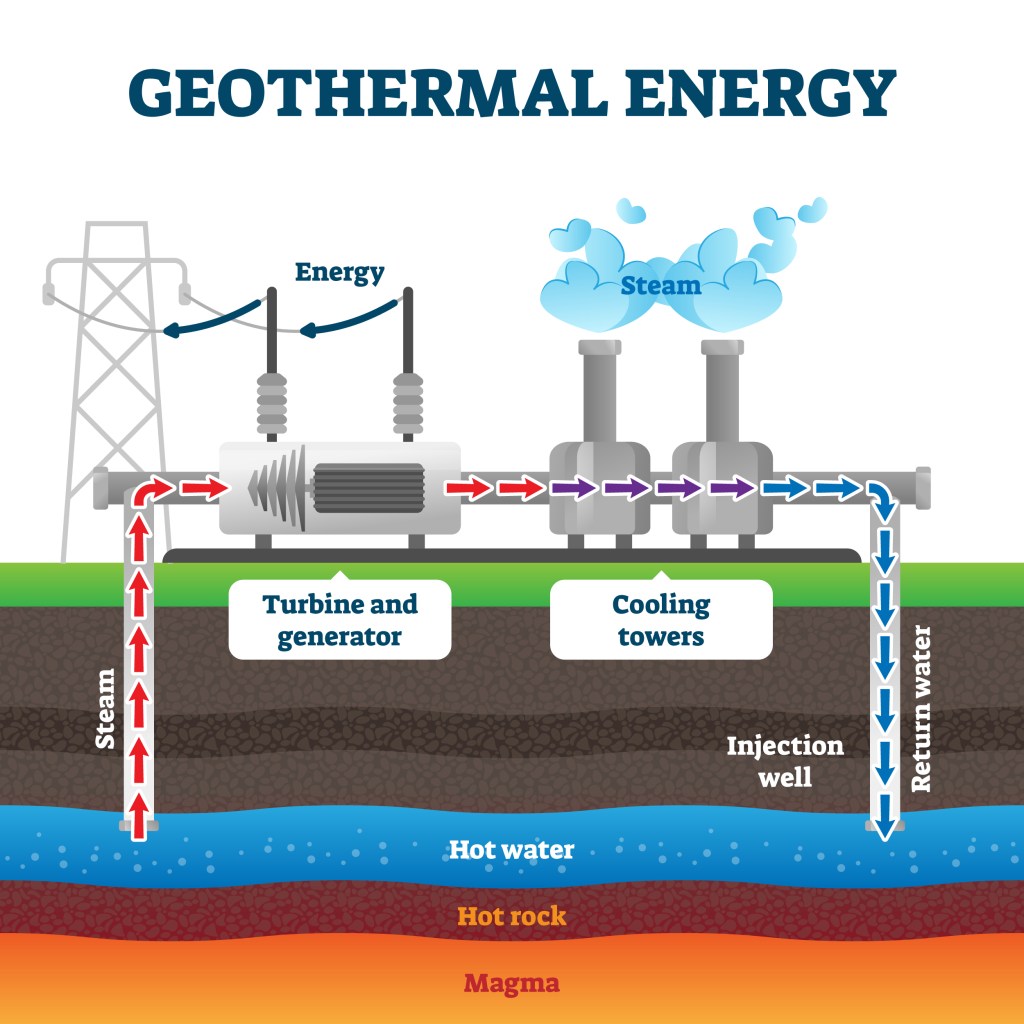
The illustration shows hot steam from hot water deep underground flowing up to earth’s surface and driving a turbine generating electricity. Then the steam is cooled and pushed back down into the ground.
Geothermal energy production example diagram illustration. Industrial renewable green energy plant example. Steam flow from the underground hot water to turbine generator and cooling towers. Shutterstock Asset id: 1637621995 by VectorMine.

Just like renewables geothermal energy is low emissions energy source but unlike renewables it is not an intermittent energy source. It is as of yet not widely used and not cost effective. However, it appears that might change soon. The advanced drilling techniques needed are utilizing oil and gas expertise and could therefore provide a good transition from fossil fuels to geothermal.
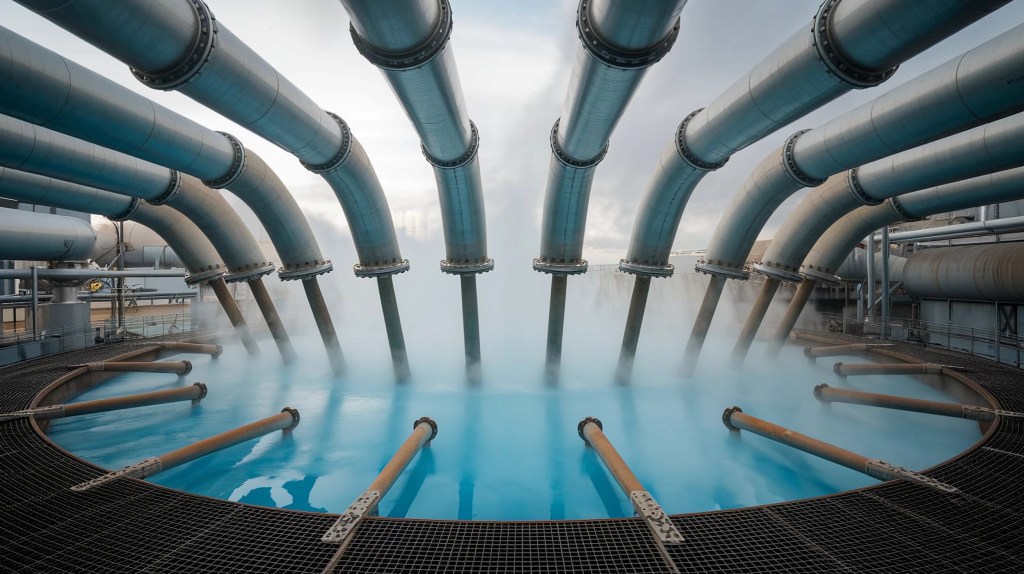
A geothermal plant. There are pipes going into a circular pool. | The Unfolding Clean Energy Revolution
Geothermal power plant from above Shutterstock Asset id: 2539157855 by Alrasyiqin

Is Fusion Power the Future ?

Fusion power is a clean, and near-limitless energy source generated by smashing light atomic nuclei together, usually hydrogen isotope, to form heavier ones. It is a form of nuclear power that releases immense heat. It replicates the process that powers the Sun. Unlike wind and solar it is not intermittent and can generate carbon-free baseload electricity without long-lived radioactive waste. However, it cannot yet be used to produce energy. That does not mean it will not work in the future.

The inside of a nuclear fusion plant. | The Unfolding Clean Energy Revolution
Nuclear fusion power generator concept image, 3d rendering Shutterstock asset id: 2262106105 by MeshCube.

Conclusion

The share of fossil fuels for electricity generation is decreasing despite the fact that the share from hydro and nuclear is also decreasing. The reason is the spectacular increase in the share provided by wind and solar. In addition, EV cars are rapidly replacing internal combustion cars around the world, especially in the EU and China. There are also renewable or clean energy sources that show great promise even though they are not yet widespread. This means that fossil fuels, coal, natural gas, and oil, which are all dirty and dangerous energy sources, are finally being replaced by cleaner alternatives.


To see the other Super Facts click here

Review of Atomic Awakening

I recently read a very interesting book on the history of nuclear power and its possible future, Atomic Awakening: A New Look at the History and Future of Nuclear Power by James Mahaffey. Something like 90% of the book was history, the history of physics, nuclear physics, the Manhattan project, the nuclear bombs, the nuclear tests, nuclear reactors, etc.

About 10% of the book examined the viability of nuclear power and discussed the public’s fear of it. His approach to that is something like; well, no wonder people are afraid of nuclear power, look at the history. However, that fear is still irrational. The awesome power of nuclear power can give us safe and clean energy, replace fossil fuels and fight global warming, and also take us to the stars. He points out that nuclear reactions are millions of times more powerful than chemical reactions.

What Are Isotopes?

I should explain what an isotope is. Atoms consist of a nucleus and electrons surrounding the nucleus. In the nucleus there are protons and neutrons (and some other stuff). Neutral atoms have an equal amount of electrons and protons, which determines what kind of element it is. Hydrogen has one electron and one proton. Helium has two electrons and two protons. Oxygen has eight electrons and eight protons, etc. The number of protons/electrons is called the atomic number of the element.

The number of protons plus the number of neutrons is called the mass number. Atoms of the same element but different number of neutrons are called isotopes. Uranium-235 or U-235 has 92 protons and 235 – 92 = 143 neutrons. The number if protons/electrons determine the chemical properties of the element. The number of neutrons determines nuclear properties such as the stability of the nucleus, radioactivity, etc., as well as the weight. Therefore U-238 and U-235 are identical chemically and look and feel the same, but U-235 is more radioactive, and you can use U-235 for fission but not U-238.

Illustration of nuclear chain reaction. Uranium-235 fission.
This is an illustration of a chain reaction with fission of a Uranium-235 isotope. Notice the atomic number (number of protons) is incorrectly stated as 95 in the picture. It is 92.  When I have time, I will fix that. Shutterstock Asset id: 73714504 by Mpanchenko.

Cesium-137 in my Pocket

Before I continue with my review of the book I am going to tell a story about my crazy adventure with a Cesium-137, a very radioactive and dangerous isotope. In fact, Atomic Awakening claims that Cesium-137 and Strontium-90 are the two isotopes of the greatest concern with regards to nuclear waste.

Once when I was a young student of engineering physics, I was around 20 years old, we were doing experiments with radioactivity. We were using Cesium-137. There were signs on the walls warning about radioactivity and the Cesium-137 sample was enclosed in a little house built from lead bricks. We were supposed to quickly remove the lead bricks, take out the sample, do the experiment quickly, put the sample back and enclose it with the lead bricks. However, I got distracted by something and put the Cesium-137 sample in the back pocket of my jeans.

I walked around school with the Cesium-137 sample in my back pocket the whole day and after school I went shopping at the grocery store still having it in my back pocket. I discovered it once I got back to my room. I put in a drawer and stayed as far away from it as I could. The next day I woke up early, put the sample in my bag, went to the lab at school and when no one was looking I put the sample back in the lead brick house.

No, I don’t have any extra heads growing out of my buttocks, and I did not turn into the Hulk, but so much for nuclear safety.

Atomic Awakening Formats

Atomic Awakening: A New Look at the History and Future of Nuclear Power by James Mahaffey comes in four formats. I bought the hardback format.

  • Hardcover –  Publisher : Pegasus Books (June 23, 2009), ASIN : 1605980404, ISBN-13 : 978-1605980409, 352 pages, item weight : 1.42 pounds, dimensions : ‎ 6.4 x 1.2 x 9.3 inches, it costs $49.29 on US Amazon. Click here to order it from Amazon.com.
  • Paperback –  Publisher – Pegasus Books (October 15, 2010), ISBN-10 : 1605981273, ISBN-13 : 978-1605981277, 368 pages, item weight : 12.8 ounces, dimensions : ‎ 6 x 0.92 x 9 inches, it costs $15.63 on US Amazon. Click here to order it from Amazon.com.
  • Kindle –  Publisher : Pegasus Books (October 15, 2010), ASIN : B004GUS68I, ISBN-13 : 978-1605982038, Item 369 pages, it costs $13.99 on US Amazon. Click here to order it from Amazon.com.
  • Audio–  Publisher : Audible Studios (September 24, 2013), Listening Length : 11 hours and 44 minutes, ASIN : B00FBPGS78, it costs $21.83 on US Amazon. Click here to order it from Amazon.com.
Front cover of hardback format of the book Atomic Awakening: A New Look at the History and Future of Nuclear Power By James Mahaffey
Front cover of hardback format of the book Atomic Awakening: A New Look at the History and Future of Nuclear Power. Click on the image to go to the Amazon page for the hardcover version of the book.

Amazon’s Description of Atomic Awakening

Nuclear power is a paradox of danger and salvation―how is it that the renewable energy source our society so desperately needs is the one we are most afraid to use?

The American public’s introduction to nuclear technology was manifested in destruction and death. With Hiroshima and the Cold War still ringing in our ears, our perception of all things nuclear is seen through the lens of weapons development. Nuclear power is full of mind-bending theories, deep secrets, and the misdirection of public consciousness, some deliberate, some accidental. The result of this fixation on bombs and fallout is that the development of a non-polluting, renewable energy source stands frozen in time.

It has been said that if gasoline were first used to make napalm bombs, we would all be driving electric cars. Our skewed perception of nuclear power is what makes James Mahaffey’s new look at the extraordinary paradox of nuclear power so compelling. From medieval alchemy to Marie Curie, Albert Einstein, and the Manhattan Project, atomic science is far from the spawn of a wicked weapons program. The discovery that the atom can be split brought forth the ultimate puzzle of the modern age: Now that the energy of the universe is available to us, how do we use it? For death and destruction? Or as a fuel for our society that has a minimal impact on the environment and future generations?

Outlining nuclear energy’s discovery and applications throughout history, Mahaffey’s brilliant and accessible book is essential to understanding the astounding phenomenon of nuclear power in an age where renewable energy and climate change have become the defining concerns of the twenty-first century.

My five-star review for Atomic Awakening

The Amazing History of Everything Nuclear

The book is divided into three parts with five chapters each. The first third of the book (titled the Fantasy) recounts the history of physics, electromagnetics, light, the Michelson-Morley experiment, relativity, the nonexistence of simultaneous events, Einstein’s miraculous year, atoms, spectrometry, atomic models, isotopes, the photoelectric effect, radioactivity, quantum physics, nuclear physics, nuclear decay, fission, fusion, and why nuclear reactions are millions of times more energetic than chemical reactions. I already knew a lot of this history having a degree in physics, but I did not know all of it and the way it was written made it very interesting.

The second third of the book (titled the Puzzle) describes the discovery of fission and fusion and it is explained why the isotopes Uranium-235 and Plutonium-239 (among 3000+ isotopes) were perfect for fission. The author provides an account of the Manhattan Project’s history, and he explains in a general sense how a nuclear reactor and a nuclear bomb work. This section reminded me of the movie Oppenheimer. He describes a bit about the various nuclear reactor designs and how the first nuclear submarine came into existence.

This part of the book is filled with interesting and surprising anecdotes about the various scientists. The first part of the book also contained many interesting anecdotes, but this part of the book really has some very interesting and crazy stories to tell. The author points out that because of Hitler there were many Jewish top scientist and other top scientists who had to flee Europe to the US, thus turning the United States into the scientific superpower it wasn’t before. He explains why the Germans did not have a chance creating a nuclear bomb. I found it interesting that the Soviets deduced that the US was working on a nuclear bomb from the fact that so many US. physicist stopped publishing in physics journals. Apparently, the Germans and the Japanese did not figure this out. However, silence is suspicious, very suspicious.

The third part of the book (titled the Paradox) is about what came after the Second World War. The author describes the development of better and safer nuclear reactors (BWR, PWR, CANDU, etc.) as well as giving us an overview of many nuclear accidents, one of them being the terrible Chernobyl accident, which largely happened because of the extremely dangerous and bad reactor design, a so called RBMK reactor. RBMK reactors are monsters that cannot be built in the West. He recounts the development of new nuclear bomb technology, such as thermonuclear bombs, more popularly called hydrogen bombs.

He also tells us about the large number of nuclear tests performed including the detonation of Tsar Bomba, the Soviet 50 Megaton bomb. It was 3,300 times more powerful than the Hiroshima bomb. He makes it clear that there were thousands of nuclear bomb tests, but he did not specify an exact number, but I looked it up. There’s been more than 2,000 nuclear tests corresponding to a yield of 42,000 Hiroshima bombs. Many of the tests were not military. For example, project plowshare was about making a bigger and deeper Panama Canal by blowing a series of deep holes through Panama using hydrogen bombs. There were 35 nuclear bombs tests to determine the feasibility of creating giant holes with hydrogen bombs. He also explains how a nuclear bomb driven spaceship works and how we could have used it for interstellar space travel (Project Orion).

Towards the end of the book, he successfully makes the case that modern Nuclear Power (not the RBMK of course) is safe and clean. We avoid pollution, and it can be used to fight global warming. The same is true for solar and wind. However, he argues that the base power source must be constantly running, high-output nuclear stations. He argues that the public got a very bad impression of anything nuclear because of how it all started with nuclear bombs, nuclear tests, bad reactor designs and accidents, and how misinformation and miscalculations added to the bad impression. We often ignore the many tens of millions of victims of fossil fuels, and the hundreds of thousands of deaths from hydro, while exaggerating the dangers of nuclear power.

However, in nuclear power we have an immense power source that we are eventually bound to start using. That’s the Atomic Awakening. One of the shocking statements in this part of the book is that “all the medical and industrial radioisotopes, used daily in impressive quantities in the United States, are made in one reactor in Canada”. He blamed this on irrational fear of nuclear power. I checked whether this scary situation still existed today. Luckily, it is not as bad. Medical and industrial radioisotopes are still all imported but they also come from Europe and Australia. It is not just one reactor in Canada. He states that “the Paradox of Nuclear Power is that far more people die each year of radiation-induced disease from standing out in the sun than have ever died from the application of nuclear power” (page 223).

There were a few things that I did not like about the book. The first is that the author often describes complex experimental setups, designs, or tools that really could be better understood with an illustration, or a picture, but there were none. I found a typo on page 308, where he refers to fission as fusion in the third sentence. I think he spent too little space on the feasibility of Nuclear Power in the modern world and maybe too much on the history of physics. Nuclear Power seems to be what the book should be about and yet this topic was concentrated to the last 10% of the book and I don’t think he made his case as well as he could have. The end of the book seems rushed. On the other hand, it was a fascinating journey before we got there. Overall, I think this book is extremely interesting, it was a fun to read, and it was fact filled and a great learning experience. I loved reading this book, so even though I have a few misgivings I still think it is a five-star book. I highly recommend it.

Back cover of hardback format of the book Atomic Awakening: A New Look at the History and Future of Nuclear Power By James Mahaffey
Back cover of hardback format of the book Atomic Awakening: A New Look at the History and Future of Nuclear Power. Click on the image to go to the Amazon page for the paperback version of the book.

Other Nuclear Related Posts


To see the Super Facts click here

Nonsense and Rumors About Wind Power

“Nonsense and Rumors About Wind Power” is not a super-fact post but just what I consider interesting information regarding nonsense and rumors about wind power.

Wind power has been on the receiving end of false claims, nonsense, and strange rumors for a while. It is not the only energy source maligned by false information. Another example is Nuclear Power. However, this post is about some of the incorrect claims about wind power that I have come across. I am starting out with three bizarre claims.

Nonsense and Rumors About Wind Power
Photo by Kervin Edward Lara on Pexels.com

False claim : Wind Power requires an additional power source to operate (like a diesel engine)

This bizarre claim is akin to saying that sailboats need a diesel motor to sail. If you get something to rotate (a turbine), whether it is pushed by running water, wind, or an engine, and you connect it to a coil in a magnetic field (generator), you get electricity. This is high school physics. You don’t need anything else. It is the principle behind hydro power, nuclear power, coal power, gas power, and wind power.

For a wind power station, the moving air rotates the wind turbine’s blades. That turning motion spins a generator just downwind from the blades (or rotor) in the nacelle, which also stores all the other working parts of a turbine. The generator produces electricity. When you read about how wind power works it says nothing about an additional power source needed (or click here).

For fun let’s also ask Google AI : Does wind power use other energy sources while operating?

Google AI: No, wind power itself does not use any other energy sources while operating; it solely harnesses the kinetic energy from the wind to generate electricity, meaning it only relies on wind to function as its primary energy source.

However, it should be noted that wind power is intermittent, so if it is part of a power grid other power sources or energy storage/batteries may need to be used more when wind speeds are too low to generate electricity.

Also, as is true with any power source, energy is needed when constructing wind power plants. In addition, a small amount of external electricity may be needed for startup and maintenance. It is possible that these facts were misunderstood and turned into “Wind Power requires an additional power source to operate” by confused listeners.

Nonsense and Rumors About Wind Power
Photo by Nitin Sharma on Pexels.com

False claim : Wind Power generates less power than it consumes

This is another bizarre claim made by confused politicians (here in Texas). If wind power generated less power than it consumed, why would anyone invest in it?

The Institute of Environmental Management and Assessment (IEMA) states that the average wind farm will pay back the energy that was used in its manufacture within 3-5 months of operation. This article in the journal Renewable Energy found that the average windfarm produces 20-25 times more energy during its operational life than was used to construct and install its turbines. It included data from 119 turbines across 50 sites going back 30 years.

For fun let’s ask ChatGPT this question : Does wind Power generate less power than it consumes?

ChatGPT : Wind power does not consume more energy than it generates. In fact, wind power is one of the most efficient and sustainable energy sources available. The energy required to manufacture, install, and maintain wind turbines is small compared to the energy they produce over their lifespan. This is known as their energy return on investment (EROI), which is quite favorable for wind energy.

Nonsense and Rumors About Wind Power
Photo by Andrew Del Castilho on Pexels.com

False claim : The sound from wind power stations cause cancer

Donald Trump stated on April 2, 2019, in a speech to the National Republican Congressional Committee that “The noise (from windmills) causes cancer.” A poll was conducted in Iowa, a state where wind power is thriving and only 1% of registered voters agreed with Trump that wind turbines cause cancer, 84% disagreed and 15% did not know. So, it is not a widespread belief, but it does exist. The claim was quickly debunked by the American Cancer Society.

On the contrary, the pollution from the fossil fuel power plants that wind power will likely replace causes cancer.

Just for fun let’s ask ChatGPT this question : Does windpower cause cancer?

ChatGPT : No, wind power does not cause cancer. There is no scientific evidence to support the claim that wind turbines or wind energy have any connection to causing cancer. This misconception might stem from misinformation or misunderstandings about how wind turbines work. Wind power is a clean and renewable energy source, and studies have shown that it does not pose significant health risks.

Some people have raised concerns about possible health effects from wind turbines, such as “wind turbine syndrome,” which includes symptoms like headaches or sleep disturbances attributed to the noise or vibrations of turbines. However, extensive studies have not found conclusive evidence to support these claims either. The noise levels and vibrations from wind turbines are generally well within safety limits set by health and environmental standards.

Solar panels and wind turbines.
Photo by Pixabay on Pexels.com

Next, I am going to focus on three claims which are partially true but that are greatly exaggerated and need to be understood in context.

False claim : Wind power kills an enormous amount of birds causing an environmental disaster

Wind power killing birds is often presented as if it is a huge environmental problem and only a problem for wind power. When presented this way it is false. A study made in 2012 claimed that fossil fuels killed 24 million birds per year in the US, which correspond to 35 times more birds per GWh than wind power kills. That means that wind power saves the life of birds as it replaces fossil fuels.

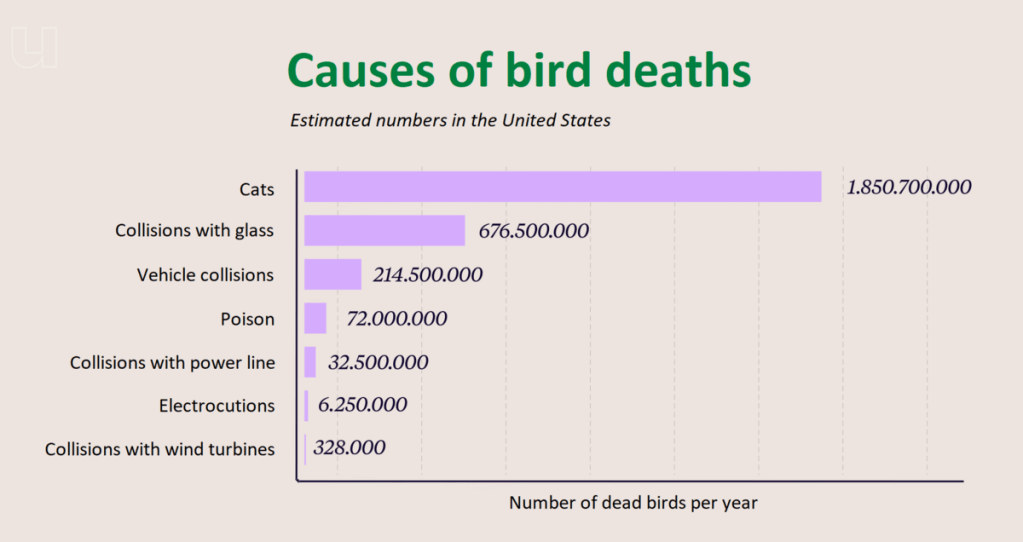
In addition, the biggest bird killer is not fossil fuels but cats. Cats kill 5,600 times more birds than wind power stations and 77 times more birds than fossil fuels. See the graph from Wikipedia below. The problem with wind power plants killing birds should be addressed (and has been addressed) but let’s be honest about the scale of the problem.

The graph shows that Wind Turbines kill 328,000 birds per year in the US, Electrocutions kill 6,250,000 birds, Collisions with powerlines kill 32,500,000 birds, Poison kills 72,000,000 birds, Vehicle collisions kill 214,500,000 birds, Collisions with glass kill 676,500,000 birds, and cats kill 1,850,700,000 birds per year in the US.
From Wikipedia: Universiteit van Nederland, CC BY 3.0 <https://creativecommons.org/licenses/by/3.0&gt;, via Wikimedia Commons

False claim : Wind power is only a marginal energy source

Wind power currently accounts for around 7.8%  of the world’s electricity up from 3.5% in 2015 and 1.63% in 2010. Wind power accounts for 10% of US electricity and 57.7% of Denmark’s electricity. It may also some as a surprise to some that in the fossil fuel capital of the world, the great state of Texas, where I live, wind represented 28.6 percent of the energy generation in 2023, second only to natural gas (41.8 percent). That is not a marginal energy source.

I can add that Texans are in general not favorable towards wind, and the local politicians are hostile towards wind. Fossil fuel is after all our bread and butter. Why wind power is so prominent in Texas is because of the Texas ERCOT system in which energy sources compete on price and the cheapest always goes first. In practice that means wind goes first.

Wind turbines, sunset in the background.
Photo by Pixabay on Pexels.com

False claim : Wind power is extremely expensive

Wind power used to be expensive. It has been and still is subsidized by the government, but that is basically true for all energy sources, not just wind. Below is the average unsubsidized levelized cost of energy according to Lazard (from Wikipedia). Notice that the light blue line indicates that wind power is pretty cheap.

The image shows 8 graphs representing the price of Nuclear, Gas (peaker), Thermal Solar, Coal, Geothermal, Natural Gas, Solar Panels, and Wind. Today Wind is the cheapest.
Mir-445511, CC BY-SA 4.0 <https://creativecommons.org/licenses/by-sa/4.0&gt;, via Wikimedia Commons.

To see the Super Facts click here