Review of Glacial by Chelsea Henderson

I recently read a very interesting book on the history of climate change politics; Glacial: The Inside Story of Climate Politics by Chelsea Henderson. Chelsea Henderson is a leader in the EcoRight movement, basically Republicans who care about the environment and climate change. She is a former senior advisor to Senator John Warner (Republican) and have held other positions in the US Congress. Her book is non-partisan. However, naturally she is accepting the reality of human caused global warming.

I should mention that the second last sentence of the seventh paragraph of my rather long review says this “As of very recently, a few days ago, those Tax Credits have been reversed.” Those few days ago have not yet happened. I thought Amazon would take longer to publish my review and I was predicting that the vote today/tomorrow on the Senate version of the Budget Reconciliation Bill (the Big Beautiful Bill) would allow it to pass. So those few days ago have not yet happened because Amazon was faster than I thought. Basically, the Budget Reconciliation Bill will roll back or phase out the clean energy tax credits enacted in 2022. For those who don’t know what a Budget Reconciliation Bill is, it is a bill that allows you to bypass the filibuster, and it is therefore typically a highly partisan bill.

Glacial The Book Formats

Glacial: The Inside Story of Climate Politics by Chelsea Henderson comes in four formats. I bought the hardback format.

  • Hardcover –  Publisher : Turner (August 6, 2024), ISBN-10 : 1684429579, ISBN-13 : 978-1684429578, 432 pages, item weight : 1.45 pounds, dimensions : ‎ 6.25 x 1.25 x 9.25 inches, it costs $ 23.11 on US Amazon. Click here to order it from Amazon.com.
  • Paperback –  Publisher : Turner (August 6, 2024), ISBN-10 : 1684429587, ISBN-13 : 978-1684429585, 432 pages, item weight : 1.34 pounds, dimensions : ‎ 6 x 0.96 x 9 inches, it costs $13.10 on US Amazon. Click here to order it from Amazon.com.
  • Kindle –  Publisher : Turner (August 6, 2024), ASIN : B0CBQKTM46, ISBN-13 : 978-1684429592, 460 pages, it costs $12.44 on US Amazon. Click here to order it from Amazon.com.
  • Audio–  Publisher : Tantor Audio (August 13, 2024), Listening Length : 9 hours and 50 minutes, ASIN : B0DCCWRMJS, it costs $0.00 with membership on US Amazon. Click here to order it from Amazon.com.
Front cover of hardback format of the book Glacial: The Inside Story of Climate Politics by Chelsea Henderson | Review of Glacial
Front cover of hardback format of the book Glacial: The Inside Story of Climate Politics by Chelsea Henderson. Click on the image to go to the Amazon page for the hardcover version of the book.

Amazon’s Description of Glacial

It took nearly sixty years for a meaningful climate change bill to run the political gauntlet from Capitol Hill to the Oval Office. Why?

From mavericks to party standard-bearers, U.S. Senators, members of the House of Representatives, and presidential candidates have campaigned for four decades espousing their intentions to address the impacts of climate change.

Glacial: The Inside Story of Climate Politics is the first Inside-the-Beltway account to lay bare the machinations of what went wrong in Washington—how and why our leaders failed to act on climate change as mounting scientific evidence underscored the urgency to do so. Glacial tells a story of behind-the-scenes infighting and power struggles that blocked or derailed federal legislative progress on climate change, even in times of bipartisanship and with polls showing most Americans favored action.

The good news today is that public opinion is at its highest level of support for climate action, from corporate boardrooms embracing sustainability for business reasons to movements led by passionate younger generations who can’t afford to stand mute because it is they who will inherit the worst environmental catastrophes. If the missed opportunities in Washington are instructive, the path to doing so is clear. Our elected officials must use their offices not solely for the power and prestige it bestows upon them personally, but for the public good—and they must do so while there is still time.

My five-star review for Glacial

The Glacial Pace of Climate Policy

This book recounts the history of the politics around climate change starting with the LBJ administration and ending with the Biden administration. LBJ was the first commander in chief to warn his fellow Americans of a steady increase in carbon dioxide from the burning of fossil fuels.

The author, Chelsea Henderson is a leader in the Eco-Right movement, basically Republicans for the Environment. Some well-known names in this movement are former secretary of state James Baker (under H.W. Bush), and the former secretary of state under Ronald Reagan, the late George Shultz, Bob Ingliss former Republican Congressman from South Carolina, the founders of RepublicEN, the Republican congressman Carlos Curbelo who founded the Climate Solutions Caucus in Congress together with Ted Deutch, Republican Utah Senator John Curtis, and George Mankiw a notable conservative economist.

It may come as a surprise to some that once upon a time the environment was not a divisive left versus right issue. Nixon signed into law the Clean Air Act, the Clean Water Act of 1972, the Endangered Species Act, and founded the Environmental Protection Agency. Ronald Reagan and Margaret Thatcher led the ratification of the Montreal Protocol in 1987 – 1989 to phase out the global use of CFCs due to their detrimental effect on the ozone layer. As a result, emissions of ozone-depleting gases have fallen by 99 percent, and it saves an estimated 2 million lives from skin cancer every year. This was one of Ronald Reagans greatest successes and yet it has been mocked by some subsequent Republican Presidents.

The book also talks about the history of acid rain and our fight against that. Margaret Thatcher, a chemist, was very concerned about the greenhouse effect, or global warming, and so was George H.W. Bush and Reagan to some degree. Unfortunately, the words climate change has grown to be deeply polarizing due to decades long disinformation campaigns funded by fossil fuel companies and far right think tanks and talk show hosts.

Another factoid that might surprise readers is that in 1957, scientists working for Humble Oil, later known as ExxonMobil, sounded the alarm on the greenhouse effect / global warming caused by burning fossil fuels. However, the executive leadership decided to deride the type of work its own scientists had done. The same thing happened on later occasions and Exxon funneled a lot of money into anti-climate change think tanks.

As the evidence that carbon dioxide was causing the greenhouse effect (or global warming or climate change) became increasingly indisputable in the 1990’s the fossil fuel industry and far right think tanks, and conservative talk show hosts, started to push back on the science very hard, by spreading misinformation, insulting and attacking scientists, environmentalists, and politicians taking a stand they did not like. Koch industries, the American Petroleum Institute and the Global Climate Coalition (GCC), which contrary to what the name seems to imply, opposed climate action, teamed up to fight climate action.

However, it was not only people on the right doing this. Democrat politicians from coal districts also opposed measures on global warming. Clinton and Gore tried make progress on the issue, but it became politically unworkable. The book explains what happened during the Contract with America episode, the Kyoto protocol, etc.

However, the issue of climate change was not purely a right versus left. Some Republican leaders such as Senator John McCain and Mitt Romney championed climate action (perhaps on and off and on again) and the George W. Bush administration contained both pro-fossil advocates such as Dick Cheney and those favoring action on climate change such as Treasury Secretary Paul O’Neill, Condoleezza Rice, Christine Todd Whitman, and Colin Powell.

Later during the Obama administration there was a climate change bill that was very close to passing, the Waxman-Markey bill. The bill passed the house but when it was going to be voted on in the Senate, Barbara Boxer (democrat) used her role as a committee chairman to change it and take it so far left that it became unpassable. She wasn’t against climate action, on the contrary, but she thought it would work.

I can add that the Tea Party, which had started out to oppose the national debt, but later focused on the culture war and opposed climate action made climate action more difficult. Well, it did not help that the oil and gas industry spent 175 million dollars lobbying against the bill in less than a year whilst environmental advocates spent only 22.4 million dollars lobbying for it, despite that being a record effort for environmental advocates.

The end of the book focuses on the Biden administration and the Clean Energy Tax Credits in the Inflation Reduction Act. This part of the book reads like a thriller because it was held up by one man, Joe Manchin, the Democrat Senator from West Virginia, who was pressured from all sides and kept changing his mind, until he finally decided to support it. As of very recently, a few days ago, those Tax Credits have been reversed. The history of action on climate change marches on.

By reading this book you will learn about a lot of people and their stories, politicians and scientists, who became embroiled in the climate change issue, for or against, George E. Brown, Dr. Roger Revelle, Dr. James Hansen, Katherine Hayhoe, Al Gore, Joe Lieberman, Rafe Pomerance, Speth, Shimberg, Senator John Chafee, John McCain, Mathew Stembridge, Rick Boucher, John Warner, Alex Bozmoski, Bob Ingliss, Lindsey Graham, John Sununu, Rahm Emmanuel, Congressman Joe Barton, Dick Cheney, Tom DeLay, Scott Pruitt, Lee Iacocca, Senator Inhofe, Rush Limbaugh, Harry Reid, Mitch McConnell, Myron Ebell, and many others. You will also learn about terms that relates to the American form of Democracy, the filibuster, budget reconciliation, appropriation, the parliamentarian, the various senate and house committees and caucuses, how bills are created and passed, an Omnibus bill, etc.

If you are interested in political history, the history of climate change politics, and the stories of the people involved, then this book is for you. The author explains all the terms used and it is not a complicated book. The book reads like a journey through political history, and you will learn thousands of facts and anecdotes. If you are a somewhat older reader, like me, you will be reminded of the events from the past and you will recognize people, and what they said, and the chaos, and the complexities, and all the hoopla, and you will think to yourself, what a crazy world politics is.

I also think that the book gives you a perspective of where the politics have been and where it might be going. Despite the many setbacks in the past, this book will give you reason for optimism. The younger generation both on the left and the right are more willing to accept the science and are more willing to embrace action on climate. Well, I guess it is their future. The world is moving forward, and it is decarbonizing, no matter what we do. Overall, I think the book is entertaining and fascinating and I highly recommend it.

Advance Praise for Glacial: The Inside Story of Climate Politics by Chelsea Henderson on a blue and red background. The praise for the book is by former South Carolina Congressman Bob Ingliss and environmentalist and author C.K. Westbrook.
Back cover of hardback format of the book Glacial: The Inside Story of Climate Politics by Chelsea Henderson. Click on the image to go to the Amazon page for the paperback version of the book.

Other Posts Related to Climate Change, Environment or Clean Energy


An update : The Senate version of the Budget Reconciliation Bill passed today (7/1 – 2025). The phase out of the clean energy tax credits stayed, as I predicted, but the excise tax on renewables that the Senate previously added to the bill was removed in the last minute, which is good news for those who care about the environment.


To see the Super Facts click here

The two main classes of beer are Ales and Lagers

Super fact 50 : There are hundreds of types of beer but in general they fall into two main categories, ales and lagers, and these two categories are not differentiated based on color. The ales are not necessarily dark and lagers light. There are light colored ales and dark, even black ales. There are light colored lagers and dark and almost black lagers (Schwarzbier). The difference between ales and lagers is the type of yeast used and the fermentation temperature. Ales are typically made with top-fermenting yeast at warmer temperatures. This result is a wider range of flavors and aromas, often with fruity or spicy notes. Lagers, on the other hand, are made with bottom-fermenting yeast at cooler temperatures making them crisper and more subtle. Ales have been around for 6,000 years. The lager is a more recent invention.

I consider this a super fact, first, because even though beer is a well-known drink that a lot of us drink almost every day, a lot of people don’t know what the two basic kinds of beer are. They don’t know what an ale is or what a lager is. Even beer fans and many people who drink beer every day are often clueless about this, the most basic fact about beer. A lot of people say that they like light/blond beer or they like dark beer. In my native country Sweden, which I admit is not a true beer country, I often hear people say that they prefer “ljus öl” (light/blond beer) rather than “mörk öl” (dark beer), or the other way around, which is like saying that you like blond / light colored food rather than dark colored food. It doesn’t make sense.

On the left, glass with black beer. It has a mocha-colored head. On the right is the bottle. The label says Das Schwarze.
This is a so called Schwarzbier that I drank some time ago. Das Schwarze a German Schwarzbier from Dinkelacker-Schwabenbräu, ABV 4.9%. Some roasted notes, sweet caramel, light flavor, a bit fizzy, somewhat thin but good enough. This is a Lager but notice a how dark it is, basically black. I did not put black dye in it. It is how they really look despite being Lagers.

I am in the process of learning Franch, and I’ve discovered that this confusion is even baked into the French language. Well as you might guess France is not a true beer country. If you use Google Translate and you type in “Lager” in the English edit box the answer you get in French is “Bière blonde”, even though French and Belgian beer that are labeled Blonde frequently are Ales not Lagers. I’ve read a lot of French language sites mentioning beer, and unless the author has some beer expertise, they make the same mistake as Google Translate. Blonde / light beer is not Lager, and dark beer is not necessarily Ale.

I had a discussion about this with one of my French teachers and despite me having talked a lot about beer in class and having previously shown him that I knew something about the topic, he had a very hard time accepting the truth. After a Google search he finally accepted the truth, but he was very surprised, perhaps even shocked.

The confusion is immense, it is worldwide, and the truth is surprising to some people. I should mention that Americans for the most part get this right. In general Americans know that Lager isn’t necessarily blonde and vice versa. They know that IPAs, which are not Lagers but Ales, typically are light colored. Perhaps because of the prominent craft beer industry in the US. I should also mention that there are also hybrid beer styles and beer styles that are hard to classify as lager or ale. More about that later.

A tall glass with black beer on the left. A can with the label Ba Ba Black Beer on the right. Behind the beer glass you can see Sushi | The two main classes of beer are Ales and Lagers
This is Ba Ba Black Lager, an American Schwarzbier. I had sushi with this Schwarzbier.

Secondly, lagers, especially pale bland mass-produced lagers have become so common that when people taste an ale, especially if it is a little bit different, like fruity, tart, have chocolate or coffee flavors, etc., they don’t even consider it a real beer. In their minds real beer is a bland tasting lager. Never mind that we have had Ales for 6,000 years, and that Ales dominated beer drinking up to relatively modern times. Nowadays 90% of beer consumption worldwide is lagers (87% in the US), but throughout most of human history nearly 100% of beer consumption worldwide was ales.

On the left is an IPA glass filled with a golden colored clear IPA with a snow-white head. In the middle is the Cold War can and on the right is a garden gnome holding a mug. There is a sign next to the gnome, which says “Welcome to my beer garden.”
This is an IPA called Cold War. IPAs are NOT Lagers. However, notice how light the color is. IPAs are popular in the US, which I think is one reason Americans are better educated on the difference between lagers and ales to countries that are not part of the European beer countries (Germany, Britain, Ireland, Belgium, the Czech Republic, etc.)

What is an Ale?

As mentioned, an Ale is a style of beer, brewed using a warm fermentation method. Ales are typically made with top-fermenting yeast at warmer temperatures. This result is a wider range of flavors and aromas, often with fruity or spicy notes. The word ale is an English word which in medieval England meant a drink brewed without hops (it is not what it means today). Some popular ales include IPA, Pale Ale, Stouts, Porter, Scotch Ale, and Barley Wine.  Below is a more complete list of Ales. The list is from the beer advocate. Despite the 120 styles listed the list is not complete. It should be noted that I’ve added a few that were missing.

  • India Pale Ales : American IPA, Belgian IPA, Black IPA, Brut IPA, Cold IPA, English IPA, Imperial IPA, Milkshake IPA, New England IPA.
  • Pale Ales : American Amber / Red Ale, American Blonde Ale, American Pale Ale, Belgian Blonde Ale, Belgian Pale Ale, Bière de Garde, English Bitter, English Pale Ale, English, Pale Mild Ale, Extra Special / Strong Bitter (ESB), Grisette, Irish Red Ale, Kölsch, Saison.
  • Wild/Sour Beers : Berliner Weisse, Brett Beer, Faro, Flanders Oud Bruin, Flanders Red Ale, Fruit Lambic, Fruited Kettle Sour, Gose, Gueuze, Lambic, Wild Ale.
  • Wheat beers : American Dark Wheat Beer, American Pale Wheat Beer, Dunkelweizen, Grodziskie, Hefeweizen, Kristallweizen, Witbier.
  • Stouts : American Imperial Stout, American Stout, English Stout, Foreign / Export Stout, Irish Dry Stout, Oatmeal Stout, Russian Imperial Stout, Sweet / Milk Stout.
  • Porters : American Porter, Baltic Porter, English Porter, Imperial Porter, Robust Porter, Smoked Porter.
  • Dark Ales : Dubbel, Roggenbier, Scottish Ale, Winter Warmer.
  • Brown Ales : Altbier, American Brown Ale, Belgian Dark Ale, English Brown Ale, English Dark Mild Ale.
  • Strong Ales : American Barleywine, American Strong Ale, Belgian Dark Strong Ale, Belgian Pale Strong Ale, English Barleywine, English Strong Ale, Imperial Red Ale, Old Ale, Quadrupel (Quad), Scotch Ale / Wee Heavy, Tripel, Wheatwine.
  • Specialty Beers: Ancient Herbed Ale, Sahti.
On the left a Westvleteren glass filled with dark brown Westvleteren. On the right the Trappist Westvleteren bottle | The two main classes of beer are Ales and Lagers
Trappist Westvleteren from Brouwerij Westvleteren (Sint-Sixtusabdij van Westvleteren) a Belgian Quadruple might be the most renowned beer in the world. I’ve had it many times and it is heavenly. However, it is very difficult  to get in the US. A Quadruple is a type of Ale.
On the left a glass filled with the dark brown to black porter Plutonium-239. On the right the can with the label Plutonium-239.
Plutonium-239 from the Manhattan Project Brewing Company in Dallas, Texas. It is a strong-tasting Porter with coconut flavors. (chocolate, coconut and coffee). There is no clear definition on the difference between porter and stout, other than porters are in general milder and not as strong as stouts. From that perspective Plutonium-239 is really a stout.

Wild Ales and Sour Beers often have fruity flavors. This can be achieved by adding fruits or berries to them but often fruit flavors emerge naturally from the fermentation process, which, at least if you use wild yeast, produce esters (fruit flavors). Wheat beers often have banana or pear notes and just as for Wild Ales these flavors emerge naturally from the fermentation process (esters again). Some of the IPAs also have distinct fruit flavors, especially the New England style IPAs, but in this case the fruit flavors come from the hops.

On the right is a glass filled with dark red beer with a thick pink head. On the left is the Atrial Rubicite bottle | The two main classes of beer are Ales and Lagers
Jester King in Texas brews a Wild Ale called Atrial Rubicite. It is a Wild Ale infused with raspberries. The fermentation process uses “wild yeast” to create a tart and fruity base but raspberries are added to enhance the fruit flavor resulting in a thick full raspberry flavor which most people describe as heavenly.

What is a Lager?

As mentioned, lagers are made with bottom-fermenting yeast at cooler temperatures making them crisper and more subtle. The word lager (German) means to storage or storeroom and used to refer to beers stored at cold temperatures. Sometime in the 15th century cold fermentation yeast emerged, and people started using it to do fermentation at cold temperatures. As time went by this form of fermentation became more popular. It was brought to the US in 1840 and between 1860 and 1870 it became the most popular fermentation process in Bohemia. As mentioned, today 90% of beer consumption worldwide is lagers.

Below is a more complete list of Lagers. The list is from the beer advocate.

  • Pale Lagers: American Adjunct Lager, American Lager, Czech / Bohemian Pilsner, Czech Pale Lager, European / Dortmunder Export Lager, European Pale Lager, European Strong Lager, Festbier / Wiesnbier, German Pilsner, Helles, Imperial Pilsner, India Pale Lager (IPL), Kellerbier / Zwickelbier, Light Lager, Malt Liquor.
  • Dark Lagers : American Amber / Red Lager, Czech Amber Lager, Czech Dark Lager, European Dark Lager, Märzen, Munich Dunkel, Rauchbier, Schwarzbier, Vienna Lager.
  • Specialty Lagers : Japanese Rice Lager, Chile Beer
The picture shows two large blue Paulaner cans and my big one-liter Disneyland cup filled beer with a thick white head.
Paulaner is a so called Festbier (or Octoberfest), which is type of Lager made especially for Octoberfest in Germany.

Finally, there are also specialty beers that are hybrids, or neither or that can be both.

  • Hybrid (Ale/Lager): Bière de Champagne / Bière Brut, Braggot, California Common / Steam Beer, Cream Ale.
  • Neither lager or ale, or can be both : Fruit and Field Beer, Low-Alcohol Beer, Rye Beer, Smoked Beer, Herb and Spice Beer, Kvass, Gruit, Happoshu, Pumpkin Beer.

That’s 120 styles of beer. I’ve had 110 beer styles. How many have you had?

To see the other Super Facts click here

Alien Civilizations and the Fermi Paradox

This is a submission for Kevin’s No Theme Thursday

The AI generated image shows magical rotating things in the sky and an alien civilization below | Alien Civilizations and the Fermi Paradox
Image by Kevin from The Beginning at Last

Kevin’s artistic picture above makes me think of Alien Civilizations. Do they exist? Do they exist in our Galaxy? To quote Enrico Fermi, if they do exist “Where is Everybody?”. That is the famous Fermi Paradox.

A telescope and a background showing the milky way
Did we find an advanced civilization in our Galaxy, which has hundreds of billions of stars?

We have found thousands of exoplanets,  and it is estimated that there are 11 billion potentially habitable Earth-sized planets orbiting stars roughly the same size as the sun in the Milky Way. It is estimated that there are an additional 40 billion potentially habitable Earth-sized planets orbiting red dwarf stars in the Milky Way. Earth is an estimated 4.5 billion years old whilst our Milky Way Galaxy is an estimated to be 13.6 billion years old. Add that there are at least hundreds of billions of Galaxies like the Milky Way in the observable Universe. Yet, human astronomers have not detected any signs of alien civilizations, and there is no evidence Earth has been visited by aliens in the past.

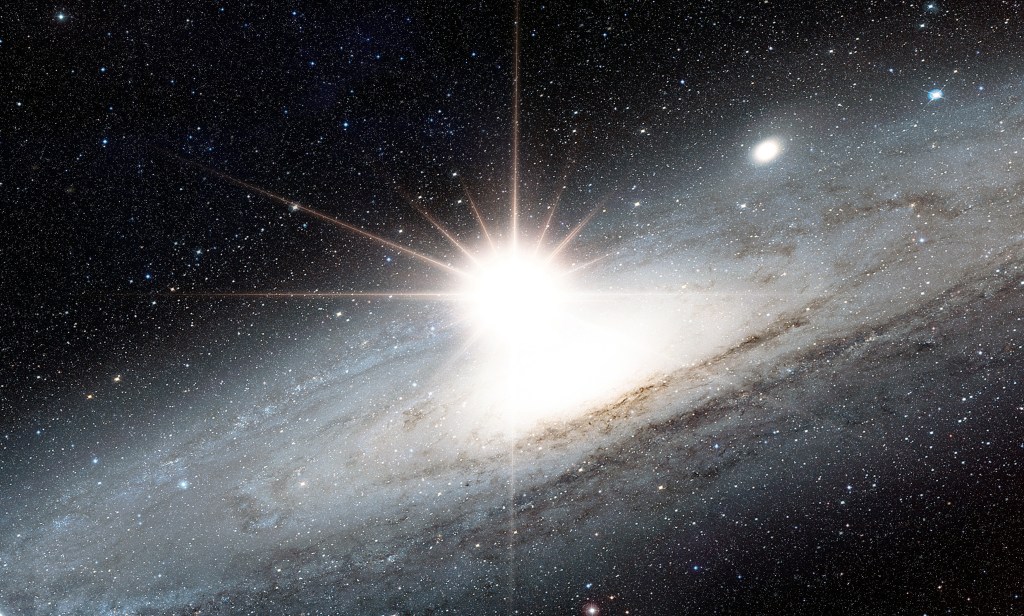
A picture of the Andromeda Galaxy with a bright white light near its center. The bright light is almost outshining the entire galaxy | Alien Civilizations and the Fermi Paradox
It should be noted that even though our Galaxy is 13.6 billion years old, its beginnings were very violent with a lot of supernova explosions, which were necessary for higher elements to come into existence and making life possible. So, we need to count out the first couple of billions of years. This is a supernova explosion in the center of the Andromeda galaxy “Elements of this image furnished by NASA” It is essentially an enhanced photo of a supernova explosion in a neighboring galaxy. Stock Photo ID: 2495486227 by muratart.
Blue and brown Earth like planet with rings.
Exoplanets, we found thousands but there are likely many billion habitable exoplanets in our Galaxy. This is an imagined Earth like exoplanet. Stock Illustration ID: 1440413666 by Dotted Yeti.
A planet surrounded by rings that are hundreds of times wider than the planet | Alien Civilizations and the Fermi Paradox
This is an illustration of a real exoplanet that we’ve found. J1407b is an exoplanet 20 times more massive than Saturn. It has enormous rings and is often referred to as Super Saturn. It may not harbor life. Stock Illustration ID: 2329821675 by Love Employee.

In this context, I would like to mention the Drake equation. The Drake equation is a probabilistic equation used to estimate the number of communicative extraterrestrial civilizations in the Milky Way Galaxy. It was created in 1961 by American astrophysicist and astrobiologist Frank Drake. This is the equation N = R * Fp * Ne * Fl * Fi * Fc * L. where N is the number of civilizations in the Milky Way galaxy with which communication might be possible.

  • R = the average rate of star formation in our galaxy.
  • Fp = the fraction of those stars that have planets.
  • Ne = the average number of planets that can potentially support life per star that has planets.
  • Fl = the fraction of planets that could support life that actually develop life at some point.
  • Fi = the fraction of planets with life that go on to develop intelligent life (civilizations).
  • Fc = the fraction of civilizations that develop a technology that releases detectable signs of their existence into space.
  • L = the length of time for which such civilizations release detectable signals into space.

We have a pretty good idea of what R * Fp * Ne is but the remaining factors are unknown.

An astronaut is standing on the surface of an alien planet. He is surrounded by giant mushrooms and in the sky, there is a large moon or a planet.
Exoplanet with life Stock Illustration ID: 1524001694 by Dotted Yeti

This is not really a super fact but more of a mystery. The goal of this blog is to create a list of what I call super facts. Important facts that we to be true, and yet they are disputed by many non-experts, or just highly surprising to the general public. However, I also post interesting facts and book reviews in this blog.

Is there Scientific Evidence for Alien Civilizations?

UFO sightings are not proof of alien spacecraft. The term “UFO” or “Unidentified Flying Object”, simply describes something in the sky that a person can’t recognize. Studies by NASA, Pentagon’s All-domain Anomaly Resolution Office show that the vast majority of these observations can be attributed to mundane phenomenon. Also, ask yourself, why would an alien civilization fly across interstellar space and only reveal themselves to random people with bad cameras and not to humanity as a whole. Why would they be flying around in little saucers? The typical flying saucer stories are not credible. Some UFO reports are also hoaxes or based on misidentified objects or misinterpretations of natural phenomena.

Grey alien with big black eyes showing peace sign, 3d render | Alien Civilizations and the Fermi Paradox
Alien showing peace sign. Shutter stock asset id: 2245224525 by adike

When I was in the Swedish army I was stationed near the Finnish Swedish border up north, which was close to Murmansk, a big Russian city which had the world’s largest navy base at the time. One night when I looked up in the sky I saw a shiny green elliptical shape in the night sky. It was quite big. I did not know what it was, but a lot of people called in to report it as a UFO. Were we being visited by space aliens as many believed. Some were even certain of it. No, it turned out to be Natrium cloud left behind by an intercontinental missile test launched from the Murmansk naval base.

A black hole with an orange accretion disk is approached by futuristic starship.
Was it a spaceship like this that we saw in the sky? No it was just a boring Natrium cloud left by a Russian missile. This spaceship approaching a black hole was generated by an Artificial Intelligence (AI) system. Stock AI-generated image ID: 2448481683 AI-generated image Contributor Shutterstock AI Generator.

Stories about past visitations are often guesses and conjecture mixed up with misrepresentation and fabrications. These stories are not taken seriously by scientists.  SETI (Search for Extraterrestrial Intelligence) has not found any definitive evidence of alien life. SETI have not detected any signals that convincingly can be attributed to an alien intelligence. In summary, there is no scientific evidence for aliens in the declassified UFO videos, in purported alien bodies, mutilated cows or in anything else.

But why have we not found any traces of alien intelligence? Where is Everybody? That’s the Fermi Paradox.

Solutions to the Fermi Paradox

Interstellar travel and interstellar communication are incredibly difficult. Maybe we should take the fact that nothing can travel faster than the speed of light seriously. You can always speculate about warping space and wormholes but that does not mean such travel is at all physically possible. The distances in the universe are enormous and require thousands or millions of years of travel even at speeds close to the speed of light. Likewise, those distances make communication difficult. Perhaps interstellar travel and communication is too difficult to be worth it.

The so called “Great Filters” hypothesis suggests that advanced civilizations don’t last that long. Maybe they self-destruct in nuclear wars or germ warfare. Perhaps they burn fossil fuels causing severe global warming ending civilization. Maybe AI destroyed their civilization. There could also be a great filter before intelligent life occurs. What if life itself is extremely unlikely to happen.

The “Dark Forest” hypothesis suggests that advanced civilizations are hiding to avoid detection from hostile advanced civilizations. A related idea is that there is a very advanced civilization in our galaxy, which destroys all other civilizations when they become too advanced and a potential threat. If that is true, maybe we shouldn’t advertise our existence using projects like SETI.

Another suggestion is that advanced civilizations are extremely rare because they can only arise under extremely rare conditions. Not only does a planet need to be habitable, but plate tectonics, climate, the shape of continents and oceans all to be just right for intelligent life and advanced civilizations to evolve. Also, consider the fact that intelligent human life existed for hundreds of thousands of years before the rise of civilization. Perhaps we are the only civilization in our Galaxy. Perhaps we are the first civilization in our Galaxy.

Yet another suggestion is that beings that are part of advanced civilizations eventually will escape into a virtual reality world or escape into other alternative worlds.

Here is a video giving an overview of the Fermi Paradox


I would like to end with a famous quote by the famous science fiction writer Arthur C. Clark “There are two possibilities: either we are alone in the Universe, or we are not. Both are equally terrifying,”

So, what do you think? Where is Everybody?

To see the Super Facts click here

There is a lot of Uranium in your Backyard

Super fact 49 : The top one-meter (3.3 feet) of a typical 10 meters (33 feet) by 40 meters (131 feet) garden contains 2 kilograms (4.4 pounds) of Uranium. For comparison, the Hiroshima bomb contained 64 kilograms (121 pounds) of Uranium. Certain rocks such as Granite and Shale contain much more Uranium than soil. Uranium also exists in the atmosphere and there is 4.5 billion tons of Uranium in the ocean.

The numbers above come from the IAEA (International Atomic Energy Agency) and Stanford University . I should mention that the numbers vary depending on Geography, type of soil, etc. For example, there is much less Uranium in the soil in Florida compared to the soil in the Midwest.

This may come as a surprise to many people. Isn’t Uranium radioactive? How come we are still alive? That’s why I call this a super fact. The answer is that even though Uranium is used in nuclear bombs and nuclear reactors, it is by itself not very radioactive. You can hold natural uranium in your hand without much risk. The radioactivity from, for example, nuclear explosions come mainly from the fission process and the radioactivity from nuclear reactor waste is mainly from other isotopes created by the fission process in the reactor rather than the uranium itself.

An enormous nuclear bomb explosion in the dessert featuring a huge mushroom cloud | There is a lot of Uranium in your Backyard
If Uranium is not very radioactive, how come a nuclear bomb spread so much radioactivity. The answer is that the radioactivity comes from the fission process and the resulting new isotopes, not the uranium.

What Are Isotopes?

Before I explain some facts about the radioactivity and decay rate of Uranium, I should explain what an isotope is. Atoms consist of a nucleus and electrons surrounding the nucleus. In the nucleus there are protons and neutrons (and some other stuff). Neutral atoms have an equal amount of electrons and protons, which determines what kind of element it is. Hydrogen has one electron and one proton. Helium has two electrons and two protons. Oxygen has eight electrons and eight protons, etc. The number of protons/electrons is called the atomic number of the element.

The number of protons plus the number of neutrons is called the mass number. Atoms of the same element but different number of neutrons are called isotopes. Uranium-235 or U-235 has 92 protons and 235 – 92 = 143 neutrons. The number if protons/electrons determine the chemical properties of the element. The number of neutrons determines nuclear properties such as the stability of the nucleus, radioactivity, etc., as well as the weight. Therefore U-238 and U-235 are identical chemically and look and feel the same, but U-235 is more radioactive, and you can use U-235 for fission but not U-238.

Bohr model representation of the uranium atom, number 92 and symbol U. Conceptual vector illustration of uranium-238 isotope atom, mass number 238 and electron configuration 2, 8, 18, 32, 21, 9, 2
This is a simplified Bohr model of the Uranium atom. There are 92 little blue balls circling a nucleus in the middle of the atom. Those are electrons. In the nucleus there are 92 protons. Those are the red balls with plus signs. In addition, there is a yellowish smudge around the protons in the nucleus. Those are the neutrons. Depending on the isotope, there are 143 neutrons for U-235, 146 neutrons for U-238 and 142 neutrons for U-234. Shutterstock asset id: 1999370450 by Patricia F. Carvalho

The decay rate of Uranium

There are three main Uranium isotopes. Uranium-234, Uranium-235, and Uranium-238. Uranium-238 is the most common. 99.28% of natural Uranium is Uranium-238, 0.72% is Uranium-235 and 0.0057% is Uranium-234. Uranium-235 is the isotope we use for nuclear weapons.

The different isotopes have different decay rates and different levels of radioactivity. The half life of a radioactive isotope is the time it takes for an isotope to decay so that only half of it is left. The half-life of Uranium-238 is four and half billion years. That means that it will be around for a very long time, but since its decay rate is so slow, it is not very radioactive. The half-life of Uranium-235 is 710 million years, again it will be around for a very long time, but again, since its decay rate is so slow, it is not very radioactive. The half-life Uranium-234 is 247,000 years, a little bit faster but it still has a pretty slow decay rate.

This should be compared to Cesium-137, which has a half-life of roughly 30 years. In other words, it decays 150 million times faster than Uranium-238 and 23.7 million times faster than Uranium-235. Since Cesium-137 decays so much faster than the Uranium isotopes it means that each atom of Cesium-137 will send out radioactive particles much more often than a Uranium atom will, making it much more radioactive.

If you want to read about when I was walking around a whole day with a Cesium-137 sample in the back pocket of my jeans, click here. Radon-222, an extremely radioactive isotope of radon, which seeps into our basements from the inside of earth. It has a half-life of 3.82 days giving it a decay rate that is 430 billion times faster than Uranium-238 and 68 billion times faster than Uranium-235.

What makes it possible to make a nuclear bomb from Uranium-235 is not because it is very radioactive. It is not. It is because it has properties that make it perfect for bomb making. Each nucleus emits more than one neutron, in fact more than two on average, and the neutrons colliding with other Uranium-235 nucleuses can be made to travel at the correct speed to cause fission. In other words, it is fissile. It is a goldilocks situation. It is just right. Below is an illustration showing a chain reaction. Observe, the picture indicates that Uranium has 95 protons. This is wrong. Uranium has 92 protons. When I have the time, I will fix this picture.

Illustration of nuclear chain reaction. Uranium-235 fission | There is a lot of Uranium in your Backyard
This is an illustration of a chain reaction with fission of a Uranium-235 isotope. Notice the atomic number (number of protons) is incorrectly stated as 95 in the picture. It is 92.  When I have time, I will fix that. Shutterstock Asset id: 73714504 by Mpanchenko.

Other Nuclear Related Posts


To see the other Super Facts click here

Review of Atomic Awakening

I recently read a very interesting book on the history of nuclear power and its possible future, Atomic Awakening: A New Look at the History and Future of Nuclear Power by James Mahaffey. Something like 90% of the book was history, the history of physics, nuclear physics, the Manhattan project, the nuclear bombs, the nuclear tests, nuclear reactors, etc.

About 10% of the book examined the viability of nuclear power and discussed the public’s fear of it. His approach to that is something like; well, no wonder people are afraid of nuclear power, look at the history. However, that fear is still irrational. The awesome power of nuclear power can give us safe and clean energy, replace fossil fuels and fight global warming, and also take us to the stars. He points out that nuclear reactions are millions of times more powerful than chemical reactions.

What Are Isotopes?

I should explain what an isotope is. Atoms consist of a nucleus and electrons surrounding the nucleus. In the nucleus there are protons and neutrons (and some other stuff). Neutral atoms have an equal amount of electrons and protons, which determines what kind of element it is. Hydrogen has one electron and one proton. Helium has two electrons and two protons. Oxygen has eight electrons and eight protons, etc. The number of protons/electrons is called the atomic number of the element.

The number of protons plus the number of neutrons is called the mass number. Atoms of the same element but different number of neutrons are called isotopes. Uranium-235 or U-235 has 92 protons and 235 – 92 = 143 neutrons. The number if protons/electrons determine the chemical properties of the element. The number of neutrons determines nuclear properties such as the stability of the nucleus, radioactivity, etc., as well as the weight. Therefore U-238 and U-235 are identical chemically and look and feel the same, but U-235 is more radioactive, and you can use U-235 for fission but not U-238.

Illustration of nuclear chain reaction. Uranium-235 fission.
This is an illustration of a chain reaction with fission of a Uranium-235 isotope. Notice the atomic number (number of protons) is incorrectly stated as 95 in the picture. It is 92.  When I have time, I will fix that. Shutterstock Asset id: 73714504 by Mpanchenko.

Cesium-137 in my Pocket

Before I continue with my review of the book I am going to tell a story about my crazy adventure with a Cesium-137, a very radioactive and dangerous isotope. In fact, Atomic Awakening claims that Cesium-137 and Strontium-90 are the two isotopes of the greatest concern with regards to nuclear waste.

Once when I was a young student of engineering physics, I was around 20 years old, we were doing experiments with radioactivity. We were using Cesium-137. There were signs on the walls warning about radioactivity and the Cesium-137 sample was enclosed in a little house built from lead bricks. We were supposed to quickly remove the lead bricks, take out the sample, do the experiment quickly, put the sample back and enclose it with the lead bricks. However, I got distracted by something and put the Cesium-137 sample in the back pocket of my jeans.

I walked around school with the Cesium-137 sample in my back pocket the whole day and after school I went shopping at the grocery store still having it in my back pocket. I discovered it once I got back to my room. I put in a drawer and stayed as far away from it as I could. The next day I woke up early, put the sample in my bag, went to the lab at school and when no one was looking I put the sample back in the lead brick house.

No, I don’t have any extra heads growing out of my buttocks, and I did not turn into the Hulk, but so much for nuclear safety.

Atomic Awakening Formats

Atomic Awakening: A New Look at the History and Future of Nuclear Power by James Mahaffey comes in four formats. I bought the hardback format.

  • Hardcover –  Publisher : Pegasus Books (June 23, 2009), ASIN : 1605980404, ISBN-13 : 978-1605980409, 352 pages, item weight : 1.42 pounds, dimensions : ‎ 6.4 x 1.2 x 9.3 inches, it costs $49.29 on US Amazon. Click here to order it from Amazon.com.
  • Paperback –  Publisher – Pegasus Books (October 15, 2010), ISBN-10 : 1605981273, ISBN-13 : 978-1605981277, 368 pages, item weight : 12.8 ounces, dimensions : ‎ 6 x 0.92 x 9 inches, it costs $15.63 on US Amazon. Click here to order it from Amazon.com.
  • Kindle –  Publisher : Pegasus Books (October 15, 2010), ASIN : B004GUS68I, ISBN-13 : 978-1605982038, Item 369 pages, it costs $13.99 on US Amazon. Click here to order it from Amazon.com.
  • Audio–  Publisher : Audible Studios (September 24, 2013), Listening Length : 11 hours and 44 minutes, ASIN : B00FBPGS78, it costs $21.83 on US Amazon. Click here to order it from Amazon.com.
Front cover of hardback format of the book Atomic Awakening: A New Look at the History and Future of Nuclear Power By James Mahaffey
Front cover of hardback format of the book Atomic Awakening: A New Look at the History and Future of Nuclear Power. Click on the image to go to the Amazon page for the hardcover version of the book.

Amazon’s Description of Atomic Awakening

Nuclear power is a paradox of danger and salvation―how is it that the renewable energy source our society so desperately needs is the one we are most afraid to use?

The American public’s introduction to nuclear technology was manifested in destruction and death. With Hiroshima and the Cold War still ringing in our ears, our perception of all things nuclear is seen through the lens of weapons development. Nuclear power is full of mind-bending theories, deep secrets, and the misdirection of public consciousness, some deliberate, some accidental. The result of this fixation on bombs and fallout is that the development of a non-polluting, renewable energy source stands frozen in time.

It has been said that if gasoline were first used to make napalm bombs, we would all be driving electric cars. Our skewed perception of nuclear power is what makes James Mahaffey’s new look at the extraordinary paradox of nuclear power so compelling. From medieval alchemy to Marie Curie, Albert Einstein, and the Manhattan Project, atomic science is far from the spawn of a wicked weapons program. The discovery that the atom can be split brought forth the ultimate puzzle of the modern age: Now that the energy of the universe is available to us, how do we use it? For death and destruction? Or as a fuel for our society that has a minimal impact on the environment and future generations?

Outlining nuclear energy’s discovery and applications throughout history, Mahaffey’s brilliant and accessible book is essential to understanding the astounding phenomenon of nuclear power in an age where renewable energy and climate change have become the defining concerns of the twenty-first century.

My five-star review for Atomic Awakening

The Amazing History of Everything Nuclear

The book is divided into three parts with five chapters each. The first third of the book (titled the Fantasy) recounts the history of physics, electromagnetics, light, the Michelson-Morley experiment, relativity, the nonexistence of simultaneous events, Einstein’s miraculous year, atoms, spectrometry, atomic models, isotopes, the photoelectric effect, radioactivity, quantum physics, nuclear physics, nuclear decay, fission, fusion, and why nuclear reactions are millions of times more energetic than chemical reactions. I already knew a lot of this history having a degree in physics, but I did not know all of it and the way it was written made it very interesting.

The second third of the book (titled the Puzzle) describes the discovery of fission and fusion and it is explained why the isotopes Uranium-235 and Plutonium-239 (among 3000+ isotopes) were perfect for fission. The author provides an account of the Manhattan Project’s history, and he explains in a general sense how a nuclear reactor and a nuclear bomb work. This section reminded me of the movie Oppenheimer. He describes a bit about the various nuclear reactor designs and how the first nuclear submarine came into existence.

This part of the book is filled with interesting and surprising anecdotes about the various scientists. The first part of the book also contained many interesting anecdotes, but this part of the book really has some very interesting and crazy stories to tell. The author points out that because of Hitler there were many Jewish top scientist and other top scientists who had to flee Europe to the US, thus turning the United States into the scientific superpower it wasn’t before. He explains why the Germans did not have a chance creating a nuclear bomb. I found it interesting that the Soviets deduced that the US was working on a nuclear bomb from the fact that so many US. physicist stopped publishing in physics journals. Apparently, the Germans and the Japanese did not figure this out. However, silence is suspicious, very suspicious.

The third part of the book (titled the Paradox) is about what came after the Second World War. The author describes the development of better and safer nuclear reactors (BWR, PWR, CANDU, etc.) as well as giving us an overview of many nuclear accidents, one of them being the terrible Chernobyl accident, which largely happened because of the extremely dangerous and bad reactor design, a so called RBMK reactor. RBMK reactors are monsters that cannot be built in the West. He recounts the development of new nuclear bomb technology, such as thermonuclear bombs, more popularly called hydrogen bombs.

He also tells us about the large number of nuclear tests performed including the detonation of Tsar Bomba, the Soviet 50 Megaton bomb. It was 3,300 times more powerful than the Hiroshima bomb. He makes it clear that there were thousands of nuclear bomb tests, but he did not specify an exact number, but I looked it up. There’s been more than 2,000 nuclear tests corresponding to a yield of 42,000 Hiroshima bombs. Many of the tests were not military. For example, project plowshare was about making a bigger and deeper Panama Canal by blowing a series of deep holes through Panama using hydrogen bombs. There were 35 nuclear bombs tests to determine the feasibility of creating giant holes with hydrogen bombs. He also explains how a nuclear bomb driven spaceship works and how we could have used it for interstellar space travel (Project Orion).

Towards the end of the book, he successfully makes the case that modern Nuclear Power (not the RBMK of course) is safe and clean. We avoid pollution, and it can be used to fight global warming. The same is true for solar and wind. However, he argues that the base power source must be constantly running, high-output nuclear stations. He argues that the public got a very bad impression of anything nuclear because of how it all started with nuclear bombs, nuclear tests, bad reactor designs and accidents, and how misinformation and miscalculations added to the bad impression. We often ignore the many tens of millions of victims of fossil fuels, and the hundreds of thousands of deaths from hydro, while exaggerating the dangers of nuclear power.

However, in nuclear power we have an immense power source that we are eventually bound to start using. That’s the Atomic Awakening. One of the shocking statements in this part of the book is that “all the medical and industrial radioisotopes, used daily in impressive quantities in the United States, are made in one reactor in Canada”. He blamed this on irrational fear of nuclear power. I checked whether this scary situation still existed today. Luckily, it is not as bad. Medical and industrial radioisotopes are still all imported but they also come from Europe and Australia. It is not just one reactor in Canada. He states that “the Paradox of Nuclear Power is that far more people die each year of radiation-induced disease from standing out in the sun than have ever died from the application of nuclear power” (page 223).

There were a few things that I did not like about the book. The first is that the author often describes complex experimental setups, designs, or tools that really could be better understood with an illustration, or a picture, but there were none. I found a typo on page 308, where he refers to fission as fusion in the third sentence. I think he spent too little space on the feasibility of Nuclear Power in the modern world and maybe too much on the history of physics. Nuclear Power seems to be what the book should be about and yet this topic was concentrated to the last 10% of the book and I don’t think he made his case as well as he could have. The end of the book seems rushed. On the other hand, it was a fascinating journey before we got there. Overall, I think this book is extremely interesting, it was a fun to read, and it was fact filled and a great learning experience. I loved reading this book, so even though I have a few misgivings I still think it is a five-star book. I highly recommend it.

Back cover of hardback format of the book Atomic Awakening: A New Look at the History and Future of Nuclear Power By James Mahaffey
Back cover of hardback format of the book Atomic Awakening: A New Look at the History and Future of Nuclear Power. Click on the image to go to the Amazon page for the paperback version of the book.

Other Nuclear Related Posts


To see the Super Facts click here