Science Books for Babies

I think that one of the most interesting series science books for beginners that I’ve come across is the Baby University series. I bought it for our soon to be born first grandchild Jack, but I couldn’t help but go through them myself. It is a great series for those who hope to put their one-year-old toddlers in a PhD program. But seriously, these books explain science concepts as simply as it is possible to do. The books may still be a little bit tough for babies, but I think 2–3-year-olds might get something out of them. The point of the books is not to make young children understand complex scientific concepts but to introduce the vocabulary and build curiosity.

Below I am presenting five books in the series, General Relativity for Babies, Electromagnetism for Babies, Artificial Intelligence for Babies, Quantum Physics for Babies, and Organic Chemistry for Babies. I am providing my review for the book and a link to my review as well as the book and a photo of the front cover.

General Relativity for Babies
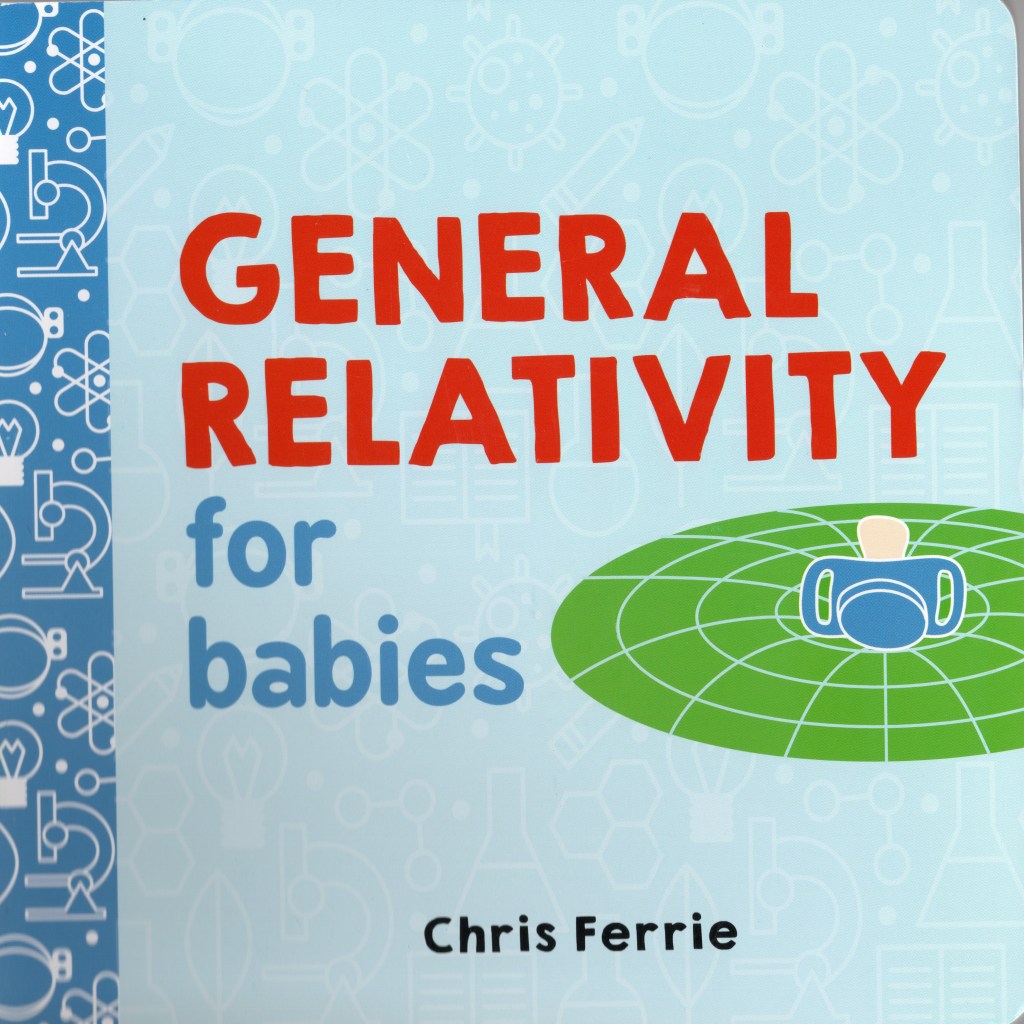
The front cover of General Relativity for Babies is light blue and features the title, author (Chris Ferrie) and a green illustration of warped space | Science Books for Babies
Front cover of General relativity for Babies.

This is the Amazon link for General Relativity for Babies.

My Review for General Relativity for Babies

General Relativity as Simplified as Possible

We bought this board book for our not yet born grandson. This book simplifies the General Theory of Relativity as far as you possibly can. It uses simple language and colorful illustrations to give the reader an idea of what is going on. Different sized masses are different sized balls, space-time curvature is illustrated using a distorted grid, and objects orbiting larger masses, such as a star, are shown as small balls having their paths curved by a warped grid. There are simple explanations for what a black hole is and what gravity waves are.

A baby would not understand this book but maybe someone who is 3-4 years old would. But your expectations need to be realistic. It should also be noted that even if you understand the book, the explanations are too simplistic for you to really understand General Relativity, but the explanations are not so simple that they are wrong. The book will just give you an idea of what is going on. However, I was impressed by the fact that the author and illustrator were able to present such an abstract theory in a way that makes it possible for a child to at least have a clue. I think that the most important aspect of the book is not whether the child understands General Relativity but the interest in science that it may evoke.

Electromagnetism for Babies

The front cover of Electromagnetism for Babies is light green and features the title, author (Chris Ferrie) and a light blue illustration of a binky surrounded by a field.
Front cover of Electromagnetism for Babies.

This is the Amazon link for Electromagnetism for Babies.

My Review for Electromagnetism for Babies

Electromagnetism Simplified for Young Children

We bought this short and colorfully illustrated board book for our not yet born grandson. I don’t think a baby will understand it but maybe when he is 2-3 years old. The book explains in simple terms and with colorful simple illustrations the basic concepts of charges, and attraction between negative and positive charges, and repulsion between two positive balls/charges and two negative balls. It explains about electrical and magnetic fields, and the fact that charges rotate around magnets. I believe this book can spur a child’s interest in science and engineering.

Artificial Intelligence for babies
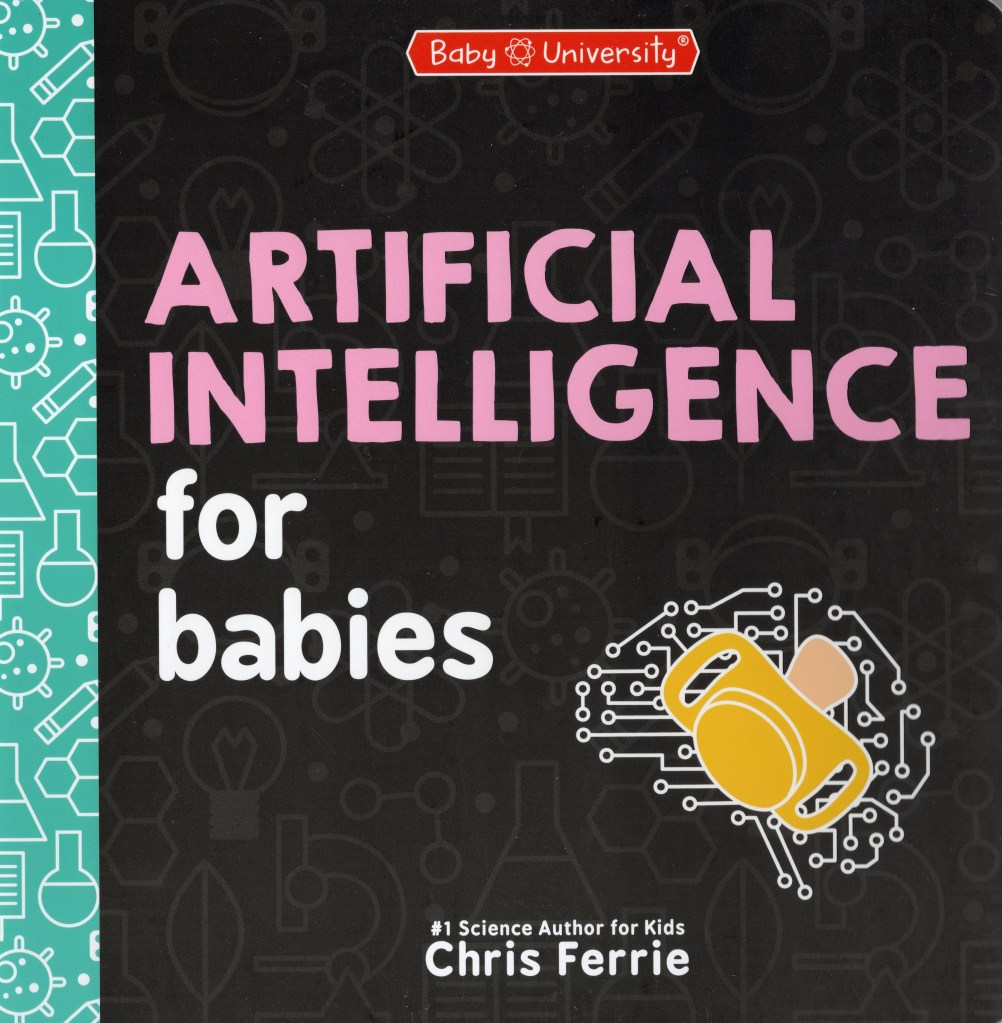
The front cover of Artificial Intelligence for babies is black and features the title, author (Chris Ferrie) and an illustration of a binky surrounded by an electronic network | Science Books for Babies
Front cover of Artificial Intelligence for babies.

This is the Amazon link for Artificial Intelligence for babies.

My Review for Artificial Intelligence for babies

Artificial Intelligence for Small Children

We bought this board book for our not yet born grandson. He will not be able to understand it until he is at least one years old, but that is OK. The book explains the difference between a dog, a live thing, and a computer. It does this in very simple terms that I believe a young child could understand. According to the book, a computer can do some things that are impressive, such as complex calculations, and you can teach it certain skills, but it is not adaptable like a dog. I think that is about what you can make a very young child understand. Naturally, there are no neural networks or AI algorithms in the book. However, I think it sells artificial intelligence short, since artificial intelligence is becoming increasingly adaptable.

Quantum Physics for babies

The front cover of Quantum Physics for babies is yellow and features the title, author (Chris Ferrie) and an illustration of a simplified Bohr Model of the Atom with a binky as a nucleus.
Front cover of Quantum Physics for babies.

This is the Amazon link for Quantum Physics for babies.

My Review for Quantum Physics for babies

Quantum Physics for Young Children and Adults who Detested Physics Class

We bought this board book for our not yet born grandson. We may need to wait until he is 2-3 years old before it makes sense to read it to him. In the meantime, it is also a good book for adults without a solid science education. The book talks about colorful balls with energy and presents a simplified version of the Bohr model of the atom. There are blue balls called electrons and red balls called protons in the middle (the nucleus). The electrons travel in circular orbits around the middle. Light can change the energy of electrons causing them to jump between the orbits.

My daughter made the comment that a baby is only going to understand that an electron is a blue ball and a proton is a red ball, which isn’t a correct description of electrons and protons. Protons and electrons don’t have specific colors, not to mention that a simplified Bohr model for the atom is quite different from the more realistic Schrödinger’s model of the atom with quantum waves and probabilistic electron clouds. However, I am still very impressed by how simple the author and the illustrator succeeded in making this abstract topic. It is a good start for budding physicists.

Organic Chemistry for babies

The front cover of Organic Chemistry for babies is red and features the title, author (Chris Ferrie and Cara Florance) and an illustration of a benzene ring made from binkies | Science Books for Babies
Front cover of Organic Chemistry for babies.

This is the Amazon link for Organic Chemistry for babies.

My Review for Organic Chemistry for babies

Your First Book on Organic Chemistry

We bought this board book for our not yet born grandson. We will read it to him when he is 1-3 years old. Right now, we can read it. This book simplifies Organic as far as you possibly can. It uses simple language and colorful illustrations to give the reader an idea of what organic chemistry is. Basically, atoms are balls of different kinds. Atoms make up everything. Atoms can stick to each other, and they can make different shapes. The balls we call carbon (in black) can stick to small white balls called hydrogen and other balls called oxygen. We call those organic molecules, and they make up plants, food, and medicines. I think this is simple enough for a 1–3-year-old to understand, but not a baby. In my opinion, a better name for this series would have been “for Big Boys or Girls” rather than babies, because young children don’t like being called babies.


To watch a woman read Quantum Physics for Babies. Click on the YouTube video below.


To see the Super Facts click here

Threats To Coral Reefs What Can Be Done

I am not a super fact hunter today. This post is about an interesting book that I recently finished reading, “Life on the Rocks: Building a Future for Coral Reefs by Juli Berwald”, a prominent marine biologist based in Austin, Texas. Coral Reefs are underappreciated. They are extremely important to the ocean’s ecosystems. A fourth of all marine species depend on the reef at some point in their life. Coral reefs are also very important to us humans for a variety of reasons.

Unfortunately, today’s coral reefs are assaulted by a host of environmental stresses. The largest is climate change, or if you call it global warming, which is warming marine ecosystems even faster than those on land. 75% of the reef building corals in the world have already been damaged by high seawater temperatures. This book is about corals, what they are, how they live and evolve, their DNA, and what is being done to save the coral reefs. The book is heavy on the science at the same time as it is not tough reading. She is a great author as well as scientist.

Life on the Rocks Book Formats

Life on the Rocks: Building a Future for Coral Reefs by Juli Berwald comes in four formats. I bought the hardback format.

  • Hardcover –  Riverhead Books (April 5, 2022), ISBN-10 : 0593087305, ISBN-13 : 978-0593087305, 352 pages, item weight : 1.25 pounds, dimensions : ‎ 6.31 x 1.11 x 9.26 inches, it costs $ 3.98 on US Amazon. Click here to order it from Amazon.com.
  • Paperback –  Publisher : Riverhead Books (April 4, 2023), ISBN-10 : 0593087313, ISBN-13 : 978-0593087312, 352 pages, item weight : 9.2 ounces, dimensions : ‎ 5.19 x 0.91 x 7.93 inches, it costs $ 15.44 on US Amazon. Click here to order it from Amazon.com.
  • Kindle –  Publisher : Riverhead Books (April 5, 2022), ASIN : B098PWTYLL, ISBN-13 : 978-0593087329, 348 pages, it costs $9.99 on US Amazon. Click here to order it from Amazon.com.
  • Audio–  Publisher : Penguin Audio (April 05, 2022), Listening Length : 10 hours and 52 minutes, ASIN : B09B83BHH1, it costs $ 15.75 on US Amazon. Click here to order it from Amazon.com.
Front cover of hardback format of the book Life on the Rocks: Building a Future for Coral Reefs by Juli Berwald | Threats To Coral Reefs What Can Be Done
Front cover of hardback format of the book Life on the Rocks: Building a Future for Coral Reefs by Juli Berwald. Click on the image to go to the Amazon page for the hardcover version of the book.

Amazon’s Description of Life on the Rocks

FINALIST FOR THE L.A. TIMES BOOK PRIZE

NAMED A BEST BOOK OF THE YEAR BY THE NEW YORKER AND BOOKLIST

The story of the urgent fight to save coral reefs, and why it matters to us all

Coral reefs are a microcosm of our planet: extraordinarily diverse, deeply interconnected, and full of wonders. When they’re thriving, these fairy gardens hidden beneath the ocean’s surface burst with color and life. They sustain bountiful ecosystems and protect vulnerable coasts. Corals themselves are evolutionary marvels that build elaborate limestone formations from their collective skeletons, broker symbiotic relationships with algae, and manufacture their own fluorescent sunblock. But corals across the planet are in the middle of an unprecedented die-off, beset by warming oceans, pollution, damage by humans, and a devastating pandemic.

Juli Berwald fell in love with coral reefs as a marine biology student, entranced by their beauty and complexity. Alarmed by their peril, she traveled the world to discover how to prevent their loss. She met scientists and activists operating in emergency mode, doing everything they can think of to prevent coral reefs from disappearing forever. She was so amazed by the ingenuity of these last-ditch efforts that she joined in rescue missions, unexpected partnerships, and risky experiments, and helped rebuild reefs with rebar and zip ties.

Life on the Rocks is an inspiring, lucid, meditative ode to the reefs and the undaunted scientists working to save them against almost impossible odds. As she also attempts to help her daughter in her struggle with mental illness, Berwald explores what it means to keep fighting a battle whose outcome is uncertain. She contemplates the inevitable grief of climate change and the beauty of small victories.

My five-star review for Life on the Rocks

Interesting Science an Important Message and the Beauty of Corals

Coral reefs are incredibly important to the ocean and its ecosystems. A fourth of all marine species depend on the reef at some point in their life. Coral reefs are also very important to us humans for a variety of reasons. However, today’s coral reefs are assaulted by a host of environmental stresses. The largest is climate change, or if you call it global warming, which is warming marine ecosystems even faster than those on land. 75% of the reef building corals in the world have already been damaged by high seawater temperatures.

Our burning of fossil fuels also causes ocean acidification. The effects of ocean acidification have not yet damaged corals but will in the future. Add to that, hurricanes (getting worse due to climate change), diseases (SCTLD), pollution, fertilizer and sewage runoff, wild harvesting of corals for export, loss of urchins, illegal fishing, such as using explosives to catch fish (blast fishing), and cyanide. In 2009 70% of all fish in fish markets had telltale scars from explosions and in 2016 more than half the fish in aquarium shops tested positive for cyanide poisoning. The explosives and the cyanide destroy coral reefs. We know what’s causing the loss of coral reefs, but we also know how to solve these things: stop burning fossil fuels, manage fishing, prioritize sanitation, and control pollution.

This book will teach you about corals, that they are marine animal related to jellyfish and sea anemones, consisting of hundreds to thousands of tiny individual polyps that form colonies. That they are in a symbiotic relationship with photosynthetic algae called zooxanthellae. That the algae power the coral by making sugar and the coral provides the supplies the alga needs to make that power. They are 160 million years old.

You will learn about the history of the oceans pH level (acidity). different species, coral bleaching, hybridization and reticulated evolution. You will learn about the threats to corals and the efforts to save the coral reefs. The author is a distinguished scientist who does a lot of research and scuba diving. She takes you on an underwater (and above water) journey around the world, Florida, Sulawesi, Bali, Dominican Republic, and Australia, like Jacques Costeau used to do.

The efforts to save the corals include coral restoration, which is very difficult and expensive, coral farming, marine protected areas, aquarium hobbyists growing corals, cryobiology/ cryogenics, which is a futuristic technology involving freezing and later restoring corals in a better future. It should be noted that as warming events and coral bleaching events kill corals the ones that survive are better equipped to survive future warming. This is not so much adaptation as evolution by natural selection. Even though this can give you hope, one should remember that the current warming is very fast and even if evolution might save some corals, it changes the composition of coral species.

However, scientists have sequenced coral DNA and are trying to identify the genes that help some corals to survive warming events better than other corals. This could lead to assisted evolution. The author also addresses geoengineering techniques to slow down climate change such as marine cloud brightening, and she discusses the tragedy of the commons.

This book is full of facts and interesting science. However, it is not a difficult read. In addition, she makes it more colorful and personal by discussing her personal opinions on issues, her daughter’s mental illness caused by a lingering strep throat infection, her experiences with covid-19, and as mentioned, this book is organized as a journey around the world. I should mention that I felt that some of her personal opinions and personal stories may have been distractions, especially when I could not agree with what she said. But I thought that was a minor issue. She is a great author who knows how to keep an audience captivated despite all the science. She lists 292 references. It is a very well-written and interesting science book about corals. I learned a lot from reading this book. I highly recommend this book.

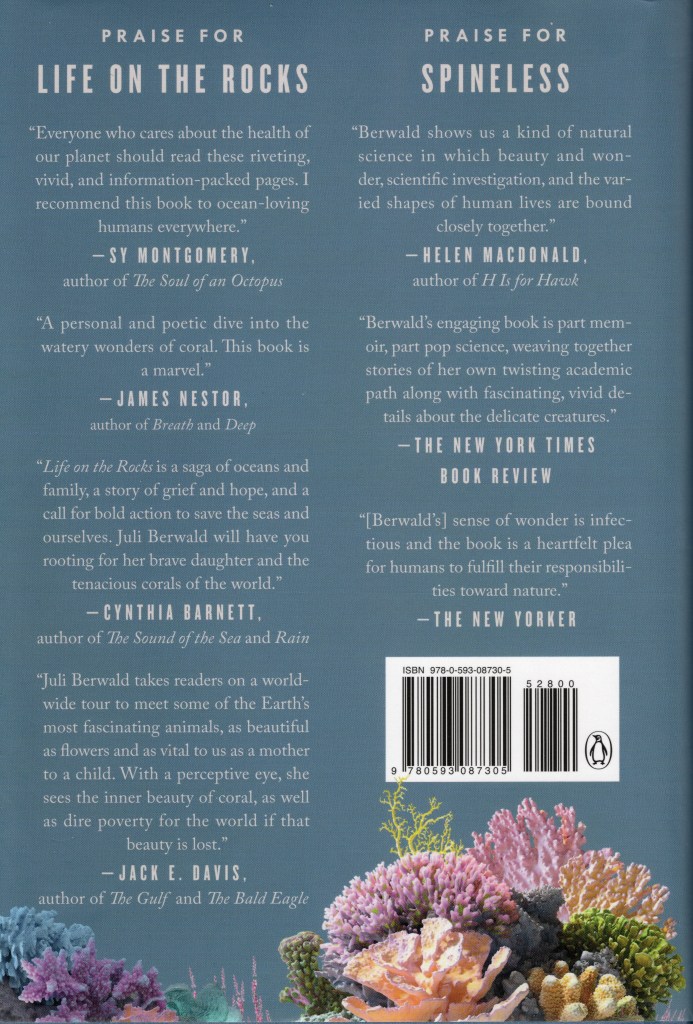
Advance Praise for Life on the Rocks and another book by the author called Spine Less, plus more colorful corals | Back cover of hardback format of the book Life on the Rocks: Building a Future for Coral Reefs by Juli Berwald.
Back cover of hardback format of the book Life on the Rocks: Building a Future for Coral Reefs by Juli Berwald. Click on the image to go to the Amazon page for the paperback version of the book.

Posts Related to Climate Change

Note: I have updated my previous super fact post Time is a fourth dimension. Now it is much clearer.


To see the Super Facts click here

Time is a Fourth Dimension

Super fact 58 : In relativity, time is considered the fourth dimension, inseparable from the three spatial dimensions to form a four-dimensional continuum called spacetime. Adding time as a fourth dimension, not (x, y, z), but (x, y, z, t), results in spacetime measurements called spacetime intervals that all observers can agree on.

Before relativity the distance between two points was the same for all observers. The distance between points is calculated using the Pythagorean theorem: (d^{2}=x^{2}+y^{2}+z^{2}). You calculate the distance between two end points in a coordinate system using Pythagoras theorem because the points make right angled triangles along the x-axis, y-axis and z-axis. See the picture below.

The image shows the formula for Pythagoras theorem in two and three dimensions and Pythagoras theorem applied to the distance between two points.
Pythagoras theorem in two and three dimensions which also apply to the distance between two points. The points are indicated in red.

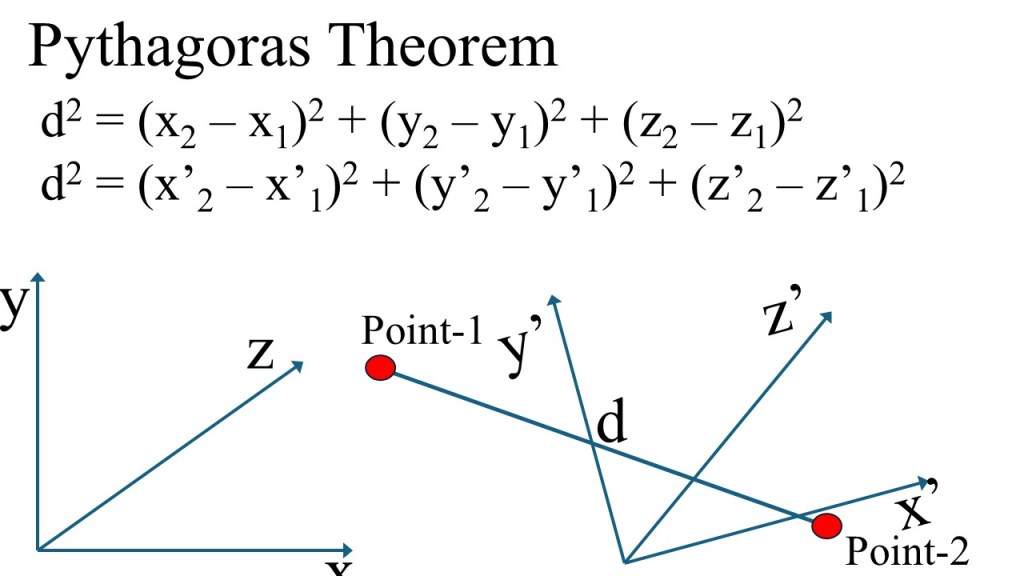
Let say you add another coordinate system (x’, y’, z’). The new coordinate system could be translated and rotated compared to the first one. The values of (x, y, z) and (x’, y’, z’) would be different and yet the distance between point-1 and point-2 would be the same. Well as long as you don’t change units, like using meters in one coordinate system and feet in the other. The distance between the points would be a so-called invariant. Now imagine that you forgot to include one coordinate in Pythagoras theorem, for example, y and y’ or x and x’, then your calculation for the distance would be different for the two coordinate systems. We need all coordinates, or all dimensions. See the picture below.

The picture shows two different coordinate systems. One is rotated and translated compared to the other. There are also two points and the distance between them is indicated. The formula for Pythagoras theorem is shown for both coordinate systems.
Pythagoras theorem is used to calculate the distance between two points from two different coordinate systems, with different coordinate values for the points. You still have the same distance for both coordinate systems. The points are indicated in red.

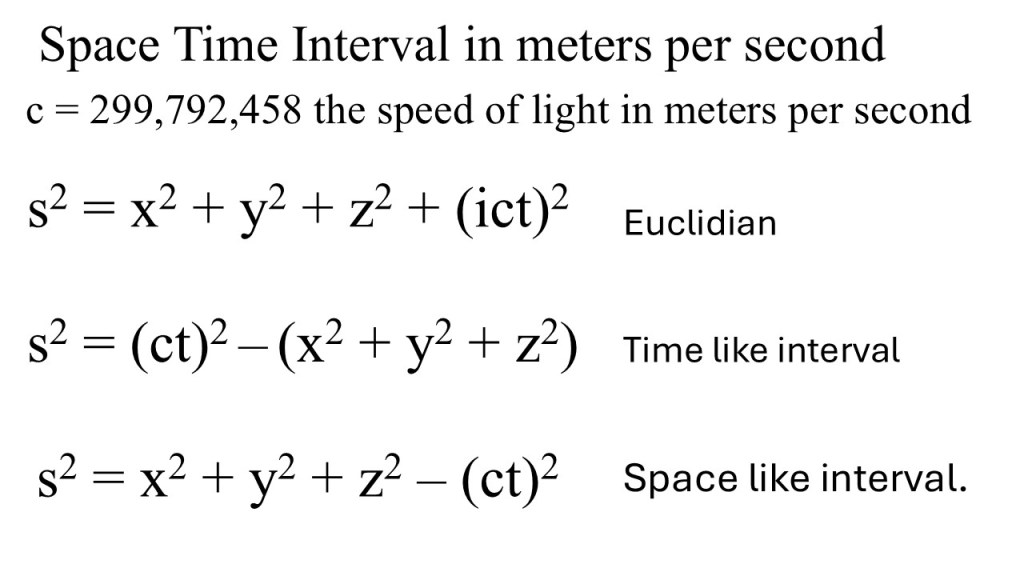
 In relativity the length of objects, as well as the time between events is relative and varies from observer to observer. In other words, distance and time varies from coordinate system to coordinate system. However, if you add time to the three space dimensions and calculate the distance between events using the Pythagorean theorem for intervals (between two events): or  (s^{2}= x^{2}+y^{2}+z^{2} – t^{2}) or (where the ‘t’ represents time in appropriate units), then the difference between different observers vanish. The interval is the same for all observers. It is a so-called invariant. The formula for the spacetime interval comes in a few different forms. One for distance like intervals (space distance bigger than time) (s^{2}= x^{2}+y^{2}+z^{2} – t^{2}), and one for time like intervals (time is bigger than the space distance) (s^{2}= t^{2} – (x^{2}+y^{2}+z^{2})). There is also one that includes the imaginary number (s^{2}= x^{2}+y^{2}+z^{2} + (it)^{2}). See below.

The image shows three formulas for the spacetime interval Euclidian: “(s^{2}=x^{2}+y^{2}+z^{2}+(it)^{2}”.  For Time like intervals, the standard form: “(s^{2} = t^{2} – (x^{2}+y^{2}+z^{2}))”. For distance like intervals: “(s^{2} = ((x^{2}+y^{2}+z^{2}) – t^{2}))”.
The three formulas for the spacetime interval above all assume that the unit used for time is the time it takes light in vacuum to travel the distance unit used. If that is meters, it would be the time it takes light to travel one meter. The top formula is the Euclidian form of spacetime. It contains only the ‘+’ operator at the expense of adding the imaginary number (square root of -1) in front of the time coordinate. The second form is typically used with time like intervals and considered the standard form. The third form is used when the distance between two events is larger than the time distance, or distance like intervals.

The interval concept was developed, not by Einstein, but by Hermann Minkowski (a few years after special relativity) and is often referred to as Minkowski space. Time is like a space coordinate but the opposite signs in the equation make it different. Based on articles I found it appears that the opposite signs (minus vs. plus) means that you cannot move “backwards” in time as you can in a space dimension.

I admit that this is a very abstract super fact, but it basically means that if you add time as an extra coordinate to the three space coordinates x, y, z you get something, the spacetime interval, that everyone regardless of speed, orientation, etc., agrees on, despite relativistic length contraction and despite time dilation and non-simultaneity.

Time Expressed in Appropriate Units

I would also like to explain what I mean by (where the ‘t’ represents time in appropriate units), as I stated in the above. For physical formulas to work they need to be expressed in consistent units. For example, you can’t use kilometers for the coordinate x, and miles for coordinate y, not without adding a constant to adjust for it. For the formula (s^{2}=x^{2}+y^{2}+z^{2}-t^{2}) to work you need to express time in a unit that corresponds the time light travels in one meter if x, y and z are expressed in meters. If you express x, y, and z in meters and express time in seconds you must adjust the formula with the constant c = 299,792,458, the speed of light in meters per second, so you get (s^{2}=x^{2}+y^{2}+z^{2}-(ct)^{2}). See the picture below.

The image shows the formulas for the spacetime interval with the constant representing the speed of light in vacuum “(s^{2}=x^{2}+y^{2}+z^{2}+(ict)^{2}”,  “s^{2}= (ct)^{2} – (x^{2}+y^{2}+z^{2})” and “(s^{2}=x^{2}+y^{2}+z^{2}-(ct)^{2}”.
If you measure the space coordinates in meters and the time in seconds you must adjust the units to match by inserting the speed of light in vacuum c = 299,792,458. The three forms of the space interval now have the constant c attached to the time coordinate.

Time Like Space Intervals

The formula for time like intervals is typically used for the situation where the time component is larger than the space component, which also means that it is possible to physically travel between the two events forming the space interval. As you can guess, that is a pretty normal situation. Let’s say you are watching TV and having a pizza. Your sofa is your coordinate system. You turn on the TV and 100 seconds later you move 2 meters to get a slice of pizza. Let’s calculate the spacetime distance between those two events.

The space component is easy, that’s 2 meters. However, if we express time in the time it takes light (in vacuum) to travel one meter we get 100 times 299,792,458. If you express time in seconds, you adjust it using the constant c = 299,792,458, and again you multiply 100 with 299,792,458, which is 29,979,245,800. So, the distance in time is almost 15 billion times larger. You really did not move far in space, but you moved very far in time. Now ask yourself. Are you spending your time well?

The Minus in Front of the Time Coordinate

There is one obvious difference between time and the space coordinates. In a coordinate system you can walk forward, along let’s say, the x-axis and then walk back the same way. You can walk back and forth as many times as you want, no problem, but you cannot do that with time. Time may be a space-time coordinate, but it is different from the other three coordinates in that way, and that’s where the opposite signs in the formula for the space-time interval comes in. This is beyond the scope of this super fact blog post, but you can read more about this here and here.

Other Relativity Related Superfacts


To see the other Super Facts click here

Half the World’s Population Live within a 2 Percent Circle

Super fact 57 : Half the World’s Population live within a circle that covers 2% of the world’s surface, or 10% of earth’s land area. This circle is often referred to as the “Valeriepieris Circle” or Yuxi Circle, and it is centered on southeast Asia.

This circle, has a radius of a bit more than 2,000 miles, and encompasses densely populated areas of East and South Asia, including major population centers like China, India, and Indonesia. The original Valeriepieris Circle was created by a teacher named Ken Myers in 2013 and was larger (radius 2,500 miles) than the more optimized circle created in 2015. In 2015, Singaporean professor Danny Quah—with the aid of an intern named Ken Teoh created a significantly smaller circle (radius 2,050 miles) that included half the world’s population. 4.2 billion people live in the Valeriepieris Circle, which is 5.6 times as many people as in Europe and 12.4 times as many people as in the Unites States.

I consider this a super fact because it is true, it is an important fact, and it is a surprising fact to those of us who have not come across this information before. It is an important fact because it impacts how we view our world. The circle is located far away from Europe and North America, in a part of the world that is rising quickly economically. The people in this highly populated circle have different cultures, music, literature and religions from the US and Europe. They speak different languages, and they play different sports, well soccer (the real football) is international but not as common in the Valeriepieris Circle as in Europe or South America.

Those among us who live outside of this circle, for example, in the United States or Europe, probably need to pay more attention to this half of world. Especially, if you live in the United States, it is easy to believe that the world is about us. The existence of this circle demonstrates that this view is not a realistic view.

This is a world map showing all the continents with the colors of the Valeriepieris Circle inverted. It should be noted that the circle is quite small compared to the whole world | Half the World’s Population Live within a 2 Percent Circle | The original 2013 map by Ken Myers, with the interior of the circle.
The original 2013 map by Ken Myers, with the interior of the circle. Half as many people live inside the circle as outside the circle. However, it is larger and less optimized compared to the circle from 2015 below. This circle is NASA, Public domain, via Wikimedia Commons
This is a special geometric projection of planet earth showing the Valeriepieris Circle at the center. The proportion of the circle (yellow circle) and the whole earth is proportional, and the circle is obviously much smaller | Half the World’s Population Live within a 2 Percent Circle | Danny Quah's 2015 circle, on a Lambert azimuthal equal-area projection.
Danny Quah’s 2015 circle, on a Lambert azimuthal equal-area projection. It should be noted that the fraction of the area of the circle to that of the globe is equal to its equivalent on Earth. Again, half as many people live inside the circle as outside the circle. From Wikipedia cmglee, jimht at shaw dot ca, CC BY-SA 4.0 <https://creativecommons.org/licenses/by-sa/4.0&gt;, via Wikimedia Commons.

Population of Southeast Asia

The countries that are part of the Valeriepieris Circle are, for example,

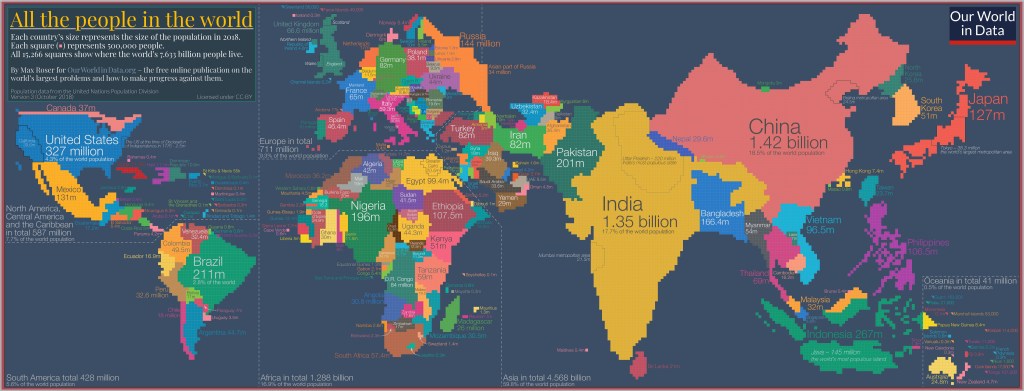
The map shows the countries in Southeast Asia as relatively large, especially, China and India. Almost the entire right-hand side of the map is filled with Southeast Asian countries making it easy to understand how just around 20 Southeast Asian countries can correspond to half the world’s population.
Each country’s size represents the size of the population in 2018. Each little square represents 500,000 people. All 15,266 squares show where the world’s 7,633 billion peopls lived in 2018 (now the world population is 8,244 billion people). Image from our World in Data. By Max Roser for OurWorldinData.org – the free online publication on the world’s largest problems and how to make progress against them.

Population Statistics

Most people know that in recent centuries the world population has grown almost exponentially but is now projected to level off sometime around the middle of this century. Europe is an interesting example. A thousand years ago Europe’s share of the world population was around 14.5%. Then came the scientific revolution and the industrial revolution and by 1900 it was 25%. As other countries around the world became industrialized Europe’s share of the world population shrunk, even though the population of Europe kept increasing, just slower. Now Europe’s share of the world population is 9%.

As countries become wealthier their population growth tends to slow down, not just in Europe, but around the world. The world’s population growth is illustrated by the image from Our World in Data below (starting 5,000 years ago, ending the year 2000) and the six minute YouTube video below from the American Museum of Natural History (starting 100,000 years ago and ending the year 2100). The YouTube video also shows the projected population decline beyond the year 2050.

Twelve maps depicting earth’s population distribution  (population per square kilometer) at different twelve different times in history. The times are 3000BC, 2000BC, 1000BC, 1AD, 500AD, 1000AD, 1500AD, 1600AD, 1700AD, 1800AD, and 2000AD | Half the World’s Population Live within a 2 Percent Circle
Population per square kilometer. Source of the original visualization Klein Goldewijk, Beusen and Janssen (2010). Long term dynamic modeling of global population and built-up area in a spatially explicit way: HYDE 3.1. In the Holocene 20(4) 565-573. The original visualization was adapted by OurWorldinData.org


A somewhat related super fact is – Poverty and child mortality has been sharply reduced worldwide.

Next Super fact coming up is : Time is the fourth dimension


To see the other Super Facts click here

Quicksand

A lot of people have died on the silver screen from being trapped in quicksand. In the 1960s, almost 3% of films featured someone sinking in clay, mud or sand. However, this is extremely rare, if it has ever happened, and it is very difficult to find any documented cases of people drowning in quicksand even when they struggle. The reason is that you can never completely become submerged in quicksand because quicksand is much denser than water so you’ll easily float. If you relax you will float and sink no more than up your waist or lower chest. In addition, quicksand pits are rarely more than a few feet deep. Another misconception spread by the silver screen is that quicksand appear in the desert. However, quicksand usually appears near water.

Quicksand is thick and heavy, and it is extremely difficult to get out once you are stuck. The best way to get out of quicksand on your own is to slowly lean back so that the weight of your body is distributed over a wider area and then do back and forth movements as if you are swimming. It will take a long time though, so expect to take it very slowly and gently.

That does not mean that getting stuck in quicksand is not dangerous. There are documented cases where people have gotten stuck in quicksand and there was no one around to help them and they couldn’t get out on their own and eventually died from thirst, exposure, or attacking animals. Another dangerous situation is when the quicksand is located on a beach near the shore. There are cases where a person was stuck in quicksand, and the tide came in resulting in a drowning.

There are situations in which the dangers associated with being submerged in quicksand are real, and that is what is called “grain entrapment” or “grain engulfment”. Several people are killed each year when they become submerged in grain and cannot escape. This happens in grain elevators and silos. So don’t jump into grain silos.

I should say that I do not consider this a super fact because it is not very important information, sort of trivia, and I also don’t think there is enough reliable information out there about this. However, I think it is interesting information that relates to me a little bit (see next section). To remind you, this is what I consider a super fact.

A super fact is:

  • An important fact that can be simply stated.
  • It is very surprising, shocking, widely disputed, misunderstood, or mind-blowing.
  • Yet it is true with a very high degree of certainty.
Outdoor photo of a cute young woman wearing a safari outfit sinking deep into the ground as like it was jungle quicksand, the ground turned into sandy milkshake mud, with a quicksand sign at the edge.
Woman sinking in quicksand Shutterstock Asset id: 2576940253 by Shutterstock AI

My Quicksand Experience

When I was about 6-7 years old, I had my own experience with quicksand or at least a mudpuddle that acted very much like quicksand. I should say that back then neighbors were friends, and your lawn was everyone’s lawn, and the kids in the neighborhood played with each other. The kids roamed the neighborhood and the forest. We threw stones at imaginary witches, screamed at moose, broke into barns to jump in the hay, ate dirt and cheerfully watched the schoolhouse burn down. There were no cellphones, doomscrolling, political keyboard warriors, online predators or overprotective parents. Kids were happy back then, but life was less safe.

I was with a group of kids, including a couple of kids a bit older than I was. We came upon a funny-looking mudpuddle, about two feet wide, and I decided to step in to check it out. I don’t remember why. Maybe I wanted to impress. Maybe I was curious. It only took a few seconds for me to sink in to right above my knees and then it was impossible to get out. The mud/quicksand held my legs in an iron grip. The fact that I stopped sinking around my knees might have been because my feet had hit solid ground. My friends tried to pull me up but could not get me up.

The older kids told me not to struggle and one of them ran to get my parents. They came running as fast as they could. My dad gripped me around the waist and slowly, bit by bit, he was able to pull me up. The rubber boots I was wearing stayed in the mud/quicksand. They might still be there like a fossil to be found by future inhabitants of our planet. Was it some sort of strange mud, or quicksand? I don’t know, but I remember being afraid. It taught me one lesson. Don’t step in funny looking mud puddles. In fact, maybe you shouldn’t step in mud at all unless you have to.


To see a list of the Super Facts click here