


So I am trying out the Daily writing prompt for the first time, answering the question “What alternative career paths have you considered or are interested in?”.
I’ve always been interested in astronomy and astrophysics, and I studied engineering physics, later electrical engineering. I did not think astronomer or astrophysicist was an easily attainable career and perhaps not very well paid either, but I think it would have been a fun job to have.

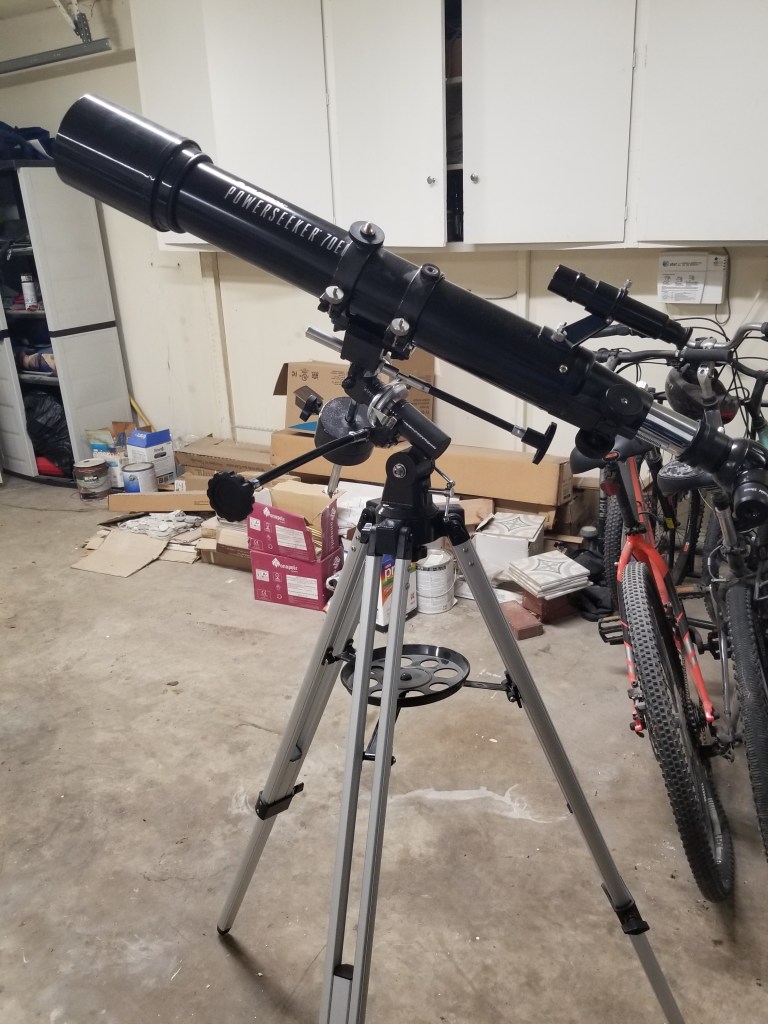
Celestron Powerseeker 70EQ
I am a bit of an amateur astronomer, and I own a basic telescope for amateurs, a Celestron Powerseeker 70EQ. It is not a great telescope, but it is good enough for observing objects such as Saturn and its rings, Jupiter and its four Galilean moons, Mars, Venus (the crescent), the moon and its craters. Those objects you can see from inside a big city like Dallas. Naturally you can do much better if you leave the city and especially if you visit a dark spot. I am a member of TAS, Texas Astronomical Society and they own a dark spot in Oklahoma. Below is a photo of my Celestron Powerseeker 70EQ standing in my garage.
What Does an Astronomer Do?
Astronomers study the universe, including galaxies, stars, planets, and other celestial objects, using telescopes and other instruments to observe and analyze them. They observe and analyze celestial objects. Depending on their specific area, astronomers have different duties.
- They observe celestial objects using telescopes.
- They conduct research, analyze data and test hypothesis.
- They use and develop models including complex mathematical models and computer simulations to understand complex astrophysical phenomena.
- They collaborate with peers, they teach, and they do mentoring and public outreach.
Types of Astronomers
- Observational Astronomers use telescopes and other observational instruments to collect data from celestial objects.
- Theoretical Astrophysicists use mathematical models and computer simulations to understand the physical processes in the universe. They may study stellar evolution, galaxy formation, cosmology, and black holes.
- Planetary Scientists study planets, moons, and other objects within our solar system. They use data collected by space missions, telescopes, and remote sensing techniques.
- Stellar Astronomers study stars, their properties, and their life cycles. They may study variable stars, binary star systems, massive stars, stellar remnants such as white dwarfs, neutron stars, or black holes.
- Galaxies and Cosmology researchers study galaxies and the large-scale structures in the universe.
- Radio Astronomers study celestial objects using radio waves instead of visible light. They may study radio galaxies, cosmic microwave background radiation, and the structure of the Milky Way.
- Exoplanet Astronomers study and discover planets orbiting stars outside our solar system. They use techniques such as transit photometry and radial velocity measurements to detect and characterize exoplanets.
Famous Astronomers
- Nicolaus Copernicus 1473–1543, discovered the heliocentric model putting the sun at the center of our solar system.
- Johannes Kepler 1571–1630, revolutionized our understanding of how planets orbit the Sun. He used the Copernicus heliocentric model and very careful measurements to show that the planets moved in elliptical orbits around the sun and he came with additional laws to describe the speed of the planets in their orbits.
- Galileo Galilei, 1564–1642, or Galileo di Vincenzo Bonaiuti de’ Galilei, was an Italian astronomer, physicist and engineer who greatly improved the optical telescope and discovered the four primary moons of Jupiter and the rings of Jupiter. He proved that all falling bodies fall at the same rate, regardless of mass, and developed the first pendulum clock. He got in trouble for defending Nikolai Copernicus idea.
- Edmund Halley, 1656–1742, investigated and discovered many things including the nature of comets’ orbits.
- Edwin Powell Hubble, United States, 1889–1953. Hubble proved that many objects previously thought to be clouds of dust and gas and classified as “nebulae” were galaxies beyond the Milky Way. He showed that these galaxies were moving away from us and each other leading to the conclusion that the universe was expanding.
- Vera Rubin, 1928–2016, studied the rotation of galaxies and uncovered the discrepancy between the predicted and observed angular motion. This led to the discovery of dark matter.
What about you? What alternative career paths have you considered or are interested in?

 Super Facts