
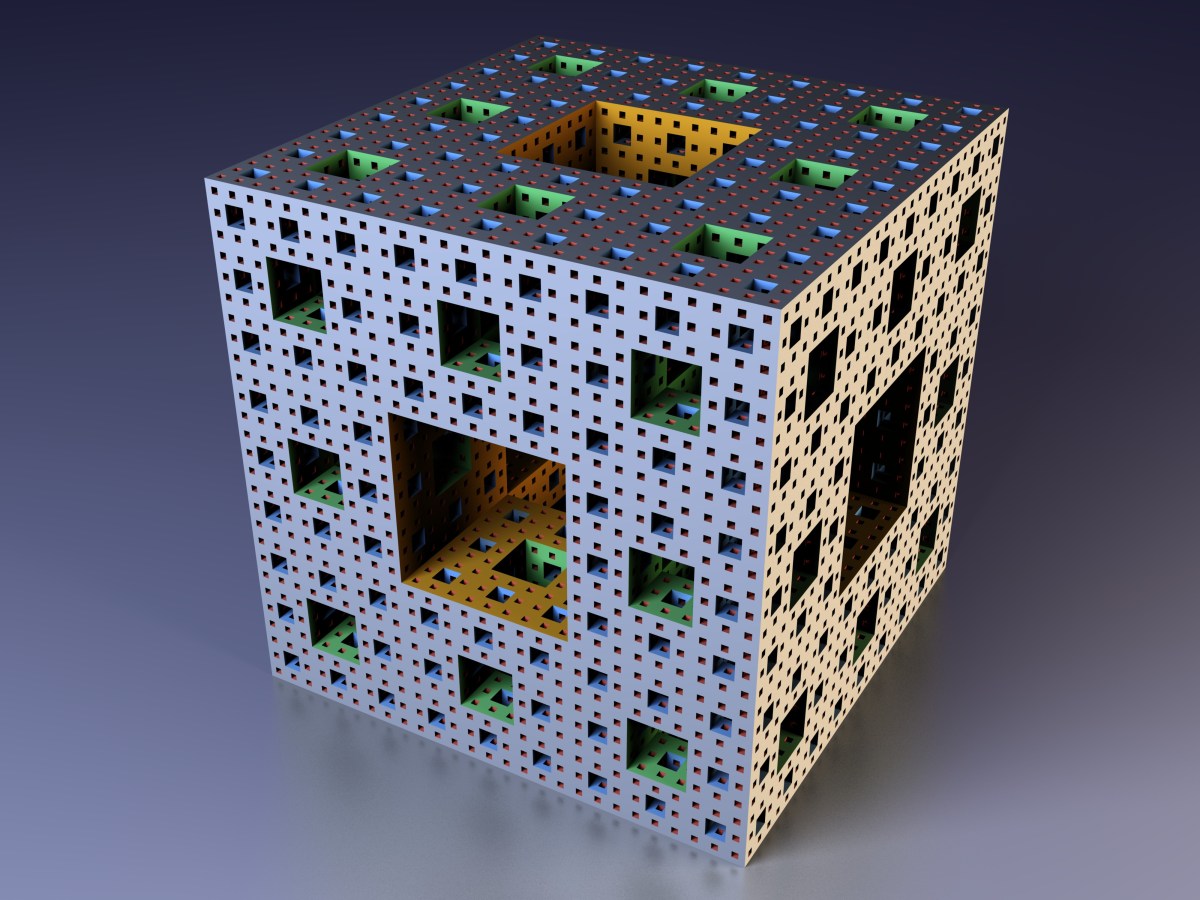
Super fact 113 : There are shapes that have a limited volume but an infinite surface area. Two examples are Gabriel’s Horn and the Menger Sponge.

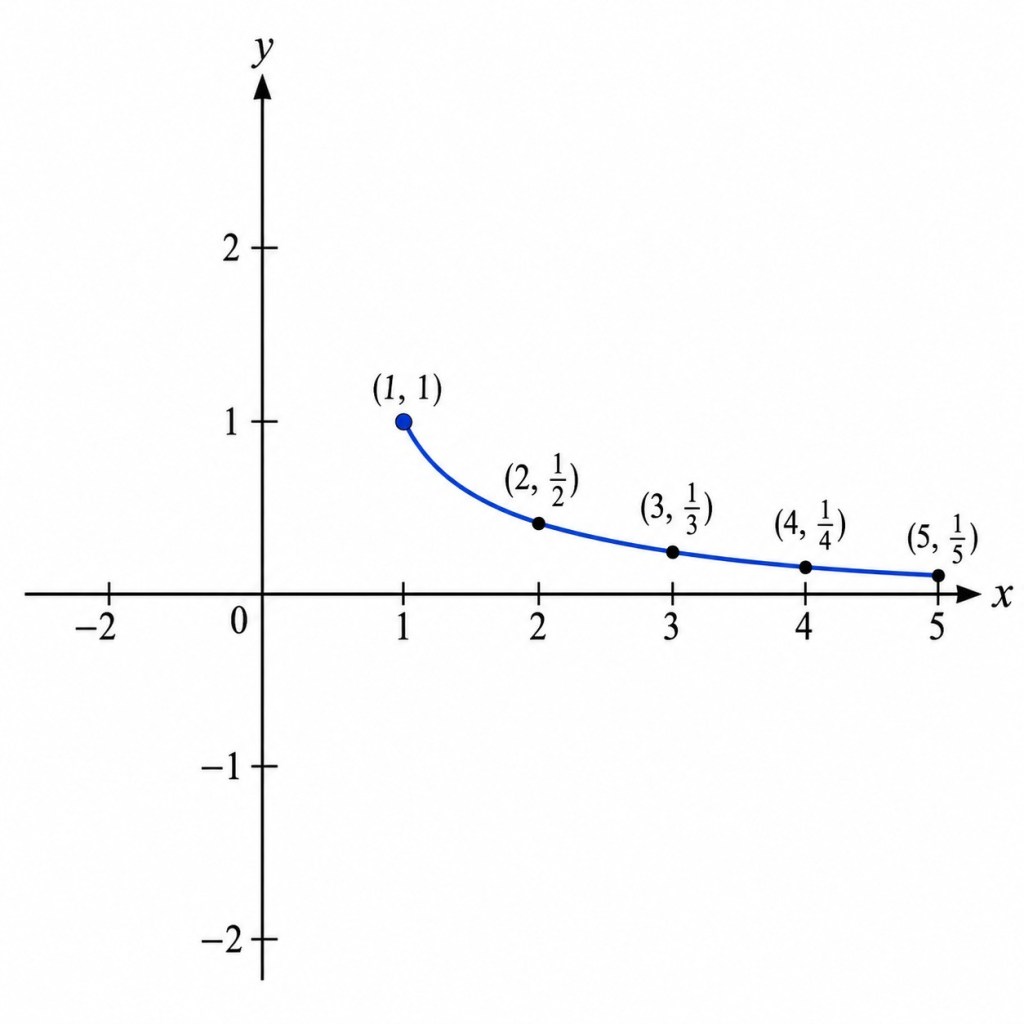
You get Gabriel’s horn by rotating the curve y = 1/x around the x-axis in a coordinate system with the horn starting at x = 1, and y = 1, as in the picture below. Well, you can choose other start values too. A Gabriel’s horn with a beginning radius 1, or widest radius 1, (as in this example) will have a volume equal to pi. Pi is a popular constant. However, it will have an infinite surface area.
This seems like a paradox. The amount of paint you need to fill up Gabriel’s Horn (with widest radius = 1) is pi. However, the surface area of the outside and inside is infinite. So, wouldn’t you need an infinite amount of paint to paint the inside of Gabriel’s Horn? The amount of paint you need to fill up the horn should be more than if you just paint the inside, shouldn’t it? What’s going on? The solution to the paradox is to realize that the radius of Gabriel’s Horn will become increasingly small as it stretches out to the right, and for a coat of paint to take up volume it must have thickness. This is explained well here.
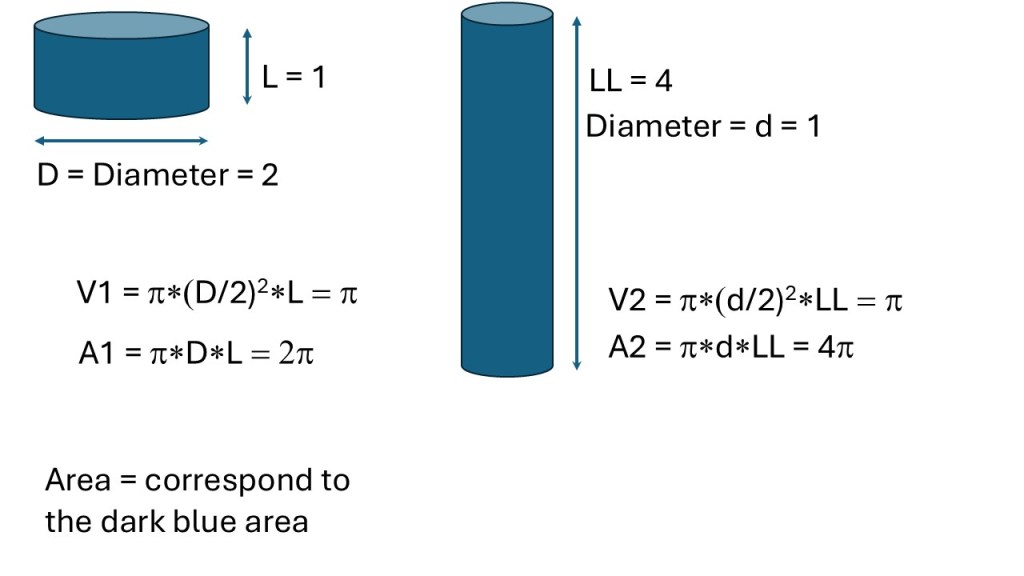
To understand why it is possible for the surface area of Gabriel’s Horn to become infinite you can imagine two cylinders of equal volume, one short (and thick), and one long (and thin). The longer and thinner cylinder will have a larger surface area as shown in the picture below. As Gabriel’s Horn is stretched out and getting thinner and thinner you get an infinite surface area, as you go towards infinity, while the volume does not become infinite. This is analogous to the infinite series in my previous post where adding an infinite number of subsequently smaller addends results in a finite number (corresponding to the volume being finite in this case).
The Menger Sponge
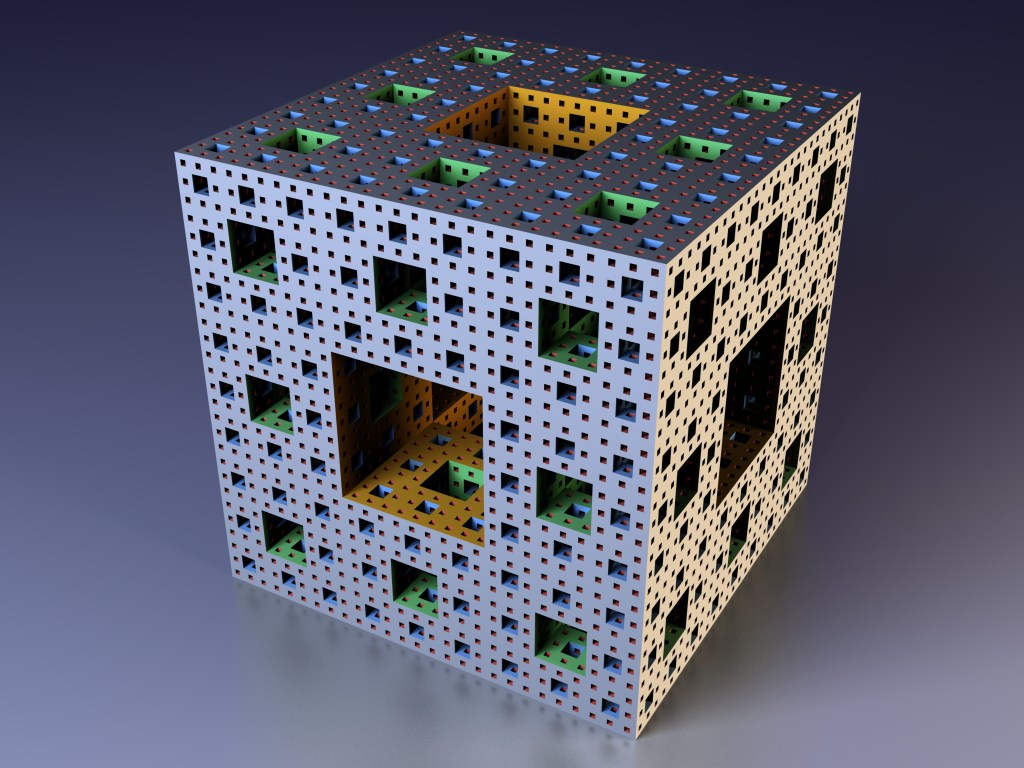
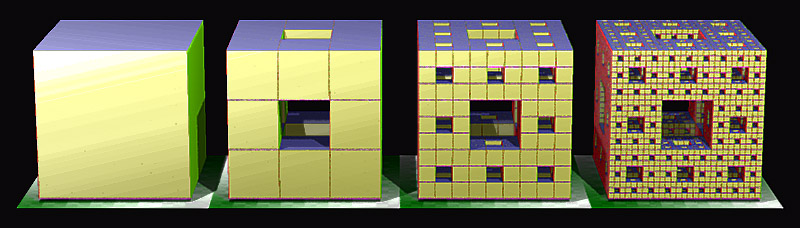
- The way you construct a Menger sponge or a Menger cube is by starting with a cube.
- Then divide every face of the cube into nine squares in a similar manner to a Rubik’s Cube, dividing the cube into 27 smaller cubes.
- Then remove the smaller cube in the middle of each face and remove the smaller cube in the center of the larger cube, leaving 20 smaller cubes. This is a level 1 Menger sponge.
- Repeat steps two and three for each of the remaining smaller cubes and continue to iterate infinitely many times.
As you are repeating this process over and over the volume of the Menger sponge will decrease a little bit in every step whilst the area will grow towards infinity.
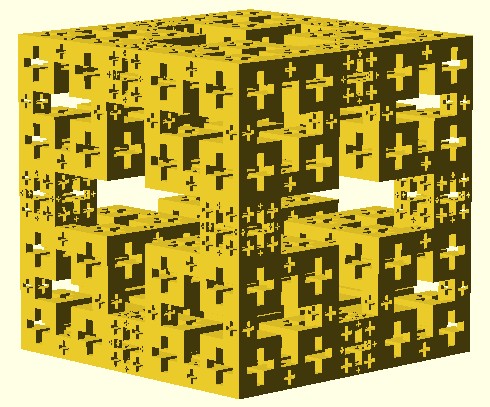
The Jerusalem Cube is like the Menger sponge/cube but instead of removing cubes you remove cross or plus looking 3D shapes from the larger cubes.
There are many other shapes with a finite volume and infinite surface area. However, there are no geometric shapes with an infinite volume and limited surface area.
Other Mathematics Superfacts
- Every Symmetry is Associated with a Conservation Law
- The Euler Number Math Magic
- Eulers Polyhedra Math Magic
- Infinities Come in Different Sizes
- Conic Sections are the Shapes that Shape Our World
- Russel’s Paradox
- Infinite Series Magic
To see the other Super Facts click here

 Super Facts
Trying to imagine infinity drives me crazy.
LikeLiked by 1 person
I agree, it is not easy
LikeLiked by 1 person
interesting read. Never really considered it but once you explain with the horn made sense. The picture of the cube was very cool.
LikeLiked by 1 person
Thank you so much Kevin. I thought the picture was pretty cool myself. It is great that Wikipedia lets you use them.
LikeLike
How cool! I’ve never heard of Gabriel’s Horn before!
LikeLiked by 1 person
Thank you Ada, it is a very interesting shape. I should say that it is also called Torricelli’s Trumpet (after its discoverer). Gabriel is referring to the angel.
LikeLiked by 1 person
As Spock would say, “Fascinating.”
LikeLiked by 1 person
Thank you Grant.
LikeLiked by 1 person
Never heard of these. They’re fascinating.
LikeLiked by 1 person
I agree, fascinating shapes. Thank you Jacqui.
LikeLiked by 1 person
Lulu: “Hmm, no wonder blowing Gabriel’s Horn is such a significant event …”
Java Bean: “Ayyy, but what about the TARDIS? It never seems to run out of volume, yet it only has the surface area of a police box!”
LikeLiked by 1 person
You are right Lulu blowing Gabriel’s Horn is a very significant event. Java Bean, I was just thinking, what if you build a shape around a worm hole. Worm holes just look like spheres, except they take to another place in the Universe or another Universe, and Universes could potentially be infinite so in that sense you could build something with a limited surface but infinite space inside. But maybe that doesn’t count.
LikeLike
Hi Thomas, I have never thought about the column versus surface area of a Gabriel’s horn. What you have explained makes perfect sense to me.
LikeLiked by 1 person
Thank you so much Robbie and Greg could probably explain it much better.
LikeLike
I don’t think so. Your explanation was fine.
LikeLiked by 1 person
Hmmm…. I’m going to have to think about this. But cool.
LikeLiked by 1 person
Yes it is something to think about. Thank you very much Denise.
LikeLiked by 1 person
Thomas 🤓 A riddle for your Super Fact:
What shape can be filled but never fully touched, holds only a little yet stretches without end, and has a cousin cube that shrinks in body while its skin grows forever thin?
Some infinities hide in plain sight 😉 quiet paradoxes pretending to be geometry (which I was never good at = LOL) Brilliant and so cool-mind-bending post per usual ~ 🔢🧮📐𝞹🧠📚
LikeLiked by 1 person
Wow that is an excellent riddle. Very clever and insightful. Thank you so much SiriusSea.
LikeLike
Oh heck, what? My little head doesn’t get that I’m afraid. I’ll just stick to Lego!
LikeLiked by 1 person
he he! You’re not alone! 🤣
LikeLiked by 2 people
It is kind of abstract. I loved lego as a kid.
LikeLiked by 1 person
wow! your mind goes some places!
LikeLiked by 1 person
I love math but I realize not everyone does. My next super fact will be something else.
LikeLiked by 1 person
he he – you do you – that’s the main thing!
LikeLiked by 1 person
Yes I guess you are right
LikeLiked by 1 person
That is one horn and my brain is trying to soak in this sponge, Thomas~! 💕😜
LikeLiked by 1 person
Ha ha, same here, that is a great and poetic way to put it. Thank you Cindy.
LikeLiked by 1 person
😹😝😂
Glad you loved the poetic punch, Thomas!!! You’re so very welcome! Hugs 🤗
LikeLiked by 1 person
I really appreciate it Cindy
LikeLiked by 1 person
🙏❤️🙌🏽
LikeLiked by 1 person