
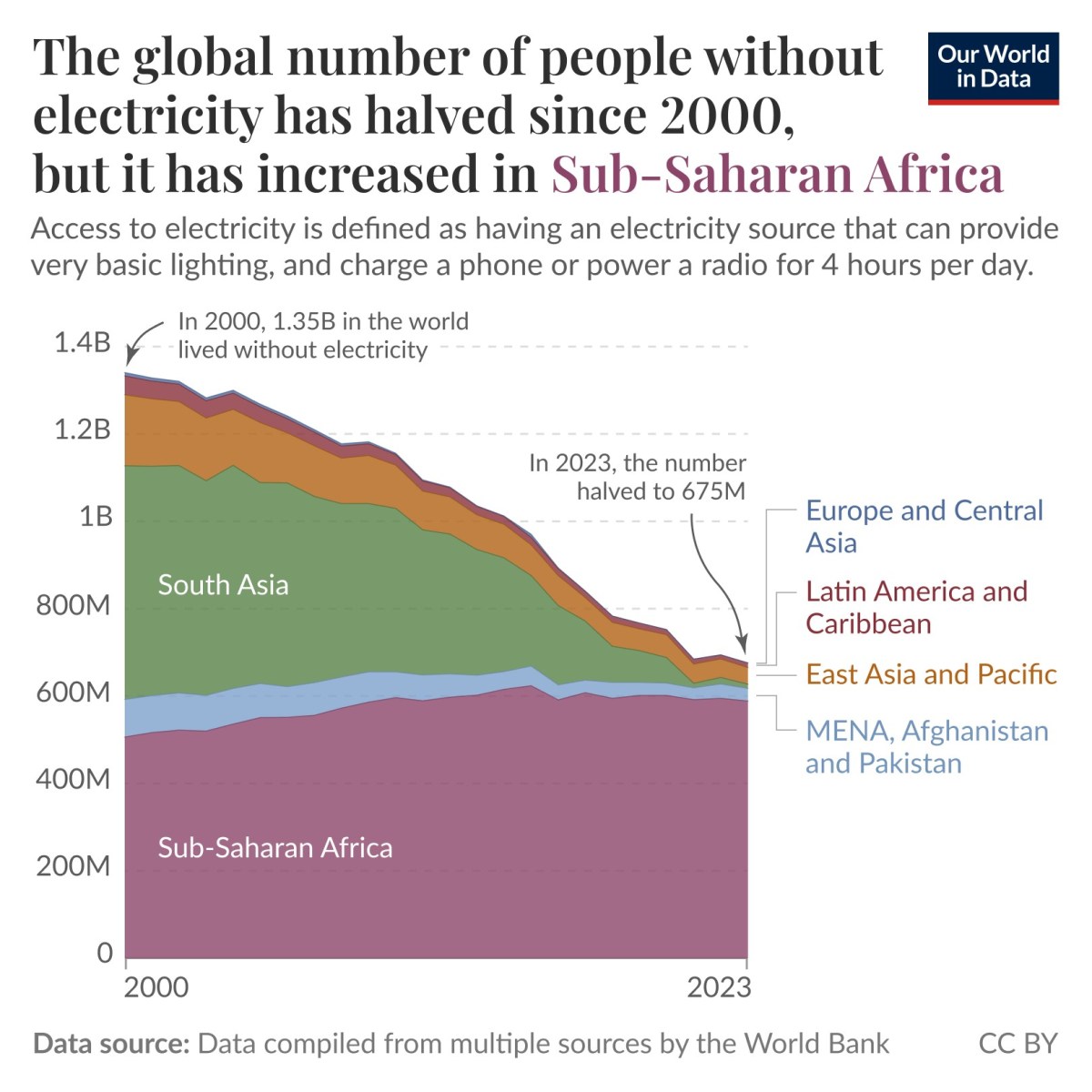
Super fact 109 : The global number of people without electricity has halved since 2000, but it has increased in Sub-Saharan Africa. In the year 2000 1.35 billion people in the world was without electricity and in the year 2023 it was 675 million people according to Our World in Data. The dark aspect of the statistics is that the number of people without electricity in Sub-Saharan Africa has increased from 500 million people to more than 600 million people.
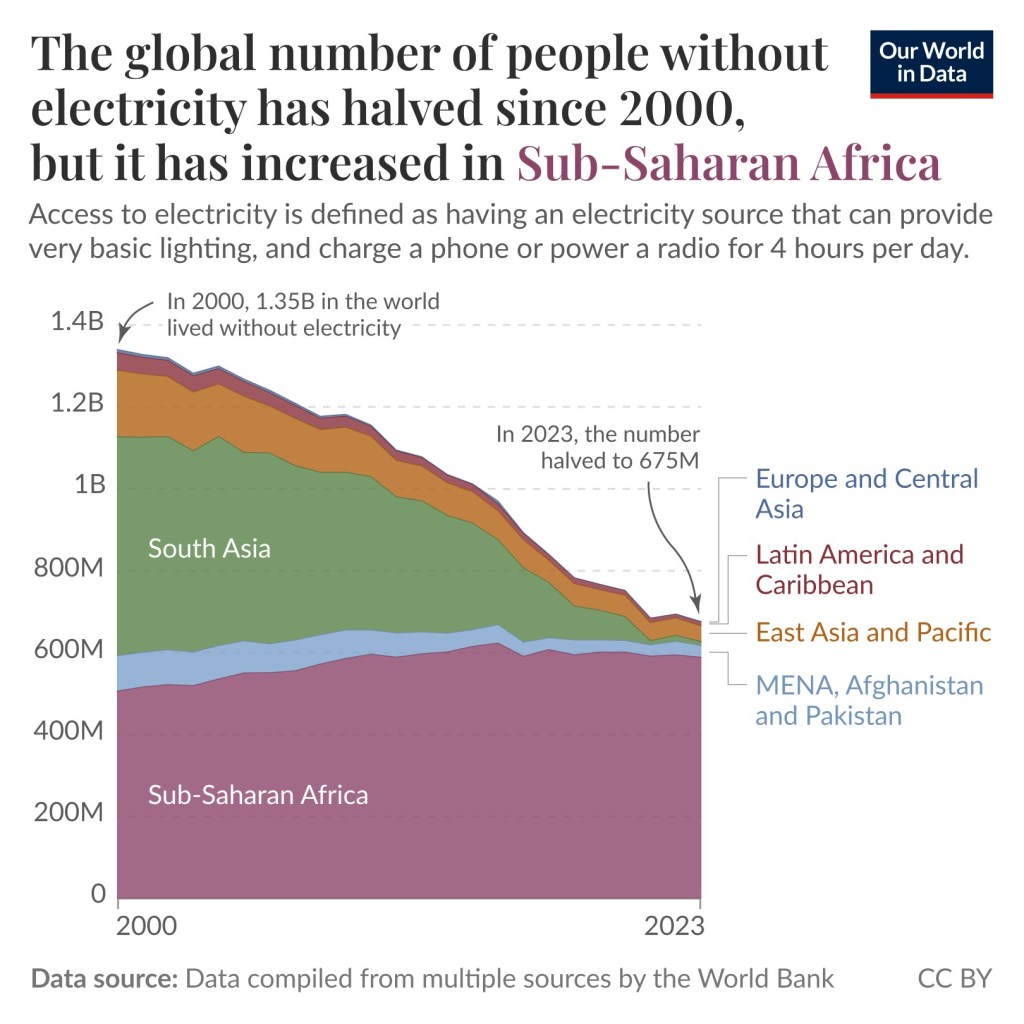
This also means that the share of people without electricity living in Sub-Saharan Africa increased from 37% in the year 2000 to 80% now. However, it is also true that the share of people in Sub-Saharan Africa with electricity has doubled, rising from 26% to 53%. What is going on is that population growth has outpaced this expansion, meaning the number of people without electricity has still risen.
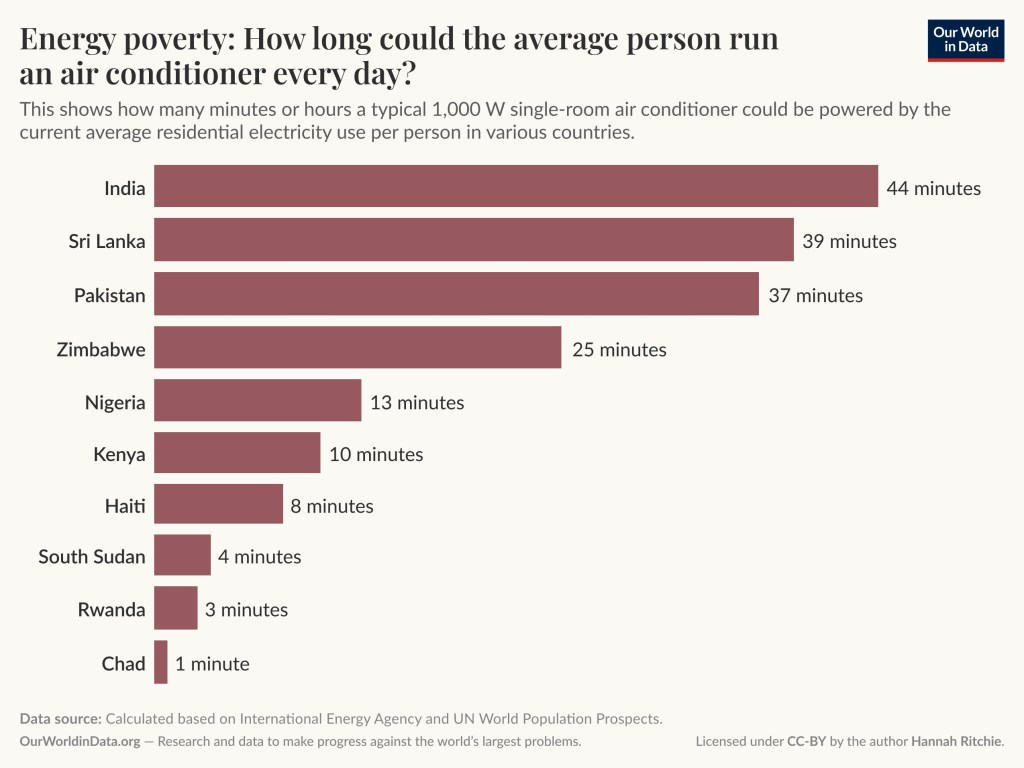
For the rest of the world, it is unequivocally good news. For example, in South Asia more than 500 million people lacked electricity in the year 2000, 414 million lacked electricity in 2010, and only 27 million people lacked electricity in 2023. Another way to look at the access to energy gap is by considering how long it is possible to run an air conditioner in different countries. Click here for data and analysis. In summary, the news for Sub-Saharan Africa is complicated but for the rest of the World, it is very good news. To read more about this topic click here.
I consider this a super fact because I believe it is an important but surprising fact in two parts. First the great news for the world and secondly the mixed news for Sub-Saharan Africa.
No Relief for the Heat Down in Africa
As mentioned, four of the five regions of the world, Europe and Central Asia, Latin America and the Caribbean, East Asia and the Pacific, MENA, Afghanistan, and Pakistan have made substantial progress. However, Sub-Saharan Africa is a complicated case. Note that MENA stand for Middle East and North Africa.
An alternative way of looking at access to electricity is to consider how much electricity is being used in each country and how that translates into the number of hours or minutes that an air conditioner could be running. Note it doesn’t mean that an air conditioner will be shut off after, let say 25 minutes, just that is much electricity one person use. What should be noted from the graph below is how dire the situation still looks like in Sub-Saharan countries. Sub-Saharan Africa is still very behind in this regard, and the fact that global warming is likely to hit Africa very hard that is not good news.
To see the other Super Facts click here


Wow, that was fast!
LikeLiked by 2 people
Yes we are making progress but maybe not Sub-Saharan Africa
LikeLike
It is so sad to read, especially since sub-Sahara Africa includes wealthy countries like South Africa, so it is even a worse scenario for populations in poorer nations. Maggie
LikeLiked by 2 people
Yes that is a good observation and I agree it is sad. Thank you Maggie.
LikeLike
it is hard to believe so many people still live without electricity.
LikeLiked by 1 person
Yes I agree Kevin. But we are making progress, but maybe not so much Sub-Saharan Africa.
LikeLike
Had no idea there was such an energy gap between rest of the world and Sub-Saharan Africa! Just shows not to take things for granted, like charging your phone (something I’ll pass on to my teenagers when they get back from school!).
LikeLiked by 2 people
Yes the entire rest of the world has made great progress but Sub-Saharan Africa still has enormous electricity poverty.
LikeLiked by 1 person
I wonder how many people have brown outs and blackouts as they try to access their access to electricity. It’s our normal day here in California.
LikeLiked by 2 people
That is an interesting issue to look into. I did not realize it was that bad in California. Black outs happen in Texas too but not often and it is typically weather related or problems with the grid (old and aging).
LikeLiked by 1 person
Very interesting Thomas and we take our power so much for granted… automatically switching on the kettle, oven and the television at the same time without a thought for the millions who don’t have even access to a lightbulb.. good news for many but definitely a long way to go for Sub-saharan Africa. xx
LikeLiked by 1 person
Thank you so much Sally. Yes we take this for granted but luckily most of the world has made progress except maybe Sub-Saharan Africa.
LikeLiked by 1 person
I was wondering how much the graph information might be skewed by areas where there is little or no population control. Could that be a factor?
LikeLiked by 1 person
Yes it is definitely a factor. The population in Sub-Saharan Africa has grown a lot, whilst access to electricity has grown (maybe relatively slow), it has not kept up with the population growth leaving more people without electricity.
LikeLiked by 1 person
This is definitely true with regards to sub Saharan Africa. South Africa used to supply electricity to other southern African countries but now it has its own power crisis due to corruption and mismanagement. I would like to see how this increase in electricity usage correlates with global warming stats.
LikeLiked by 1 person
Thank you Robbie, that is sad. Corruption and mismanagement ruin societies and people suffer. I would also like to see how this increase in electricity usage correlates with global warming stats. It is an interesting question. Unfortunately, Sub-Saharan Africa will suffer a lot from global warming while not having enough electricity.
LikeLike
It is a catch 22 as electricity consumption increases global warming.
LikeLiked by 1 person
Yes you are right. But if the electricity is produced by solar and wind or geothermal it is at least 40 times less emissions, and it seems like we are turning the corner on that.
LikeLike
Yes, I thought you would respond like this – smile!
LikeLiked by 1 person
if you remove the RSA from the data I guess the situation in sub-Saharan Africa is actually much worse!
Add to this the demographics with high birth rates and large family size and economic impoverishment, sub-Saharan Africa has major issues.
LikeLiked by 1 person
Yes you are right Pete, Sub-Saharan Africa has major issues. A commentor right above you, Robbie, from South Africa added that South Africa is not providing electricity to other countries as before due to corruption, making the situation worse.
LikeLike
How interesting and how sad. Within the United States, there are still places, such as remote areas of some reservations, that lack electricity and running water. There are programs that supply solar panels, for example. A former coworker talked about visiting family in Vietnam, where power was rationed. The way they got around that was running extension cords to another relative’s house. It’s a complicated picture, but as you say, progressing.
Sad to think things are getting worse—unnecessarily—in sub-Saharan Africa. A lot of people live there.
LikeLiked by 1 person
Thank you so much Denise. Yes things have gotten much better in this regard everywhere except Sub-Saharan Africa. It is mixed news. About solar panels, I was recently reading about Pakistan and Karachi. Despite improving and extending the grid and providing more electricity capacitiy the demand fell by 10%, and at first they couldn’t figure out why. As it turns out people were installing lots of cheap solar panels and had stopped using the grid electricity, and people without electricity even said no to grid connections because they had already bought solar panels and batteries. I do not know if these kind of situations are factored into these graphs.
LikeLiked by 1 person
Very interesting Thomas. But I worry about electricity being over consumed by AI and reverting all the progress. 🙁
LikeLike
Java Bean: “Ayyy, this is mostly good news! Here on the coast it’s warmer than it used to be and we run the air more than we used to, but at least we have solar panels now to help.”
Lulu: “That’s pretty shocking about the increase in the percentage of people in sub-Saharan Africa without electricity though. Besides population growth, I’m sure that all the wars going on there don’t help, destroying infrastructure and such. I hope things improve in the coming years.”
LikeLiked by 1 person
Java Bean it is great that you have solar panels. You are so right Lulu. Population growth and wars make it difficult to have a good reliable grid and build energy sources. You and Java Bean are lucky you don’t live there. Dogs need the air conditioning when it is hot.
LikeLike
I hope conditions improve in sub-Saharan. So that more people in sub-Saharan Africa have electricity, automobiles, etc. And paved roads are built in sub-Saharan Africa. I hope sub-Saharan Africa gets less poor, including Congo, Niger, Kenya, etc.
Should the U.S. and Canada export cars to sub-Saharan Africa for free? Should the U.S. and Canada help Congo, Niger, Kenya, etc. build their infrastructure?
Anything else I should mention besides cars, electricity? Ah yes, modern houses.
I hope modern houses are built in sub-Saharan Africa.
One reason for developed countries to help Africa build infrastructure for free is so that it would allow for improved production.
LikeLiked by 1 person
Yes that is a beautiful wishlist. People’s lives in sub-saharan Africa really needs to improve. Unfortunately, the opposite is happening. USAID, that’s mostly healthcare in sub-saharan Africa, was almost entirely eliminated, resulting in 600,000 to 700,000 deaths so far, maybe as many as 14 to 23 million deaths by 2030.
LikeLike
But why?
LikeLiked by 1 person
It was part of saving money. To eliminate government waste. It did not save much money though. Relatively little. Overall DOGE has saved very little and the results are very far from what was promised. True government waste, fraud and administrative overhead was / is mostly a myth, typicallly below 1%. To save money you have to cut real benefits, so that’s what happened.
LikeLike