
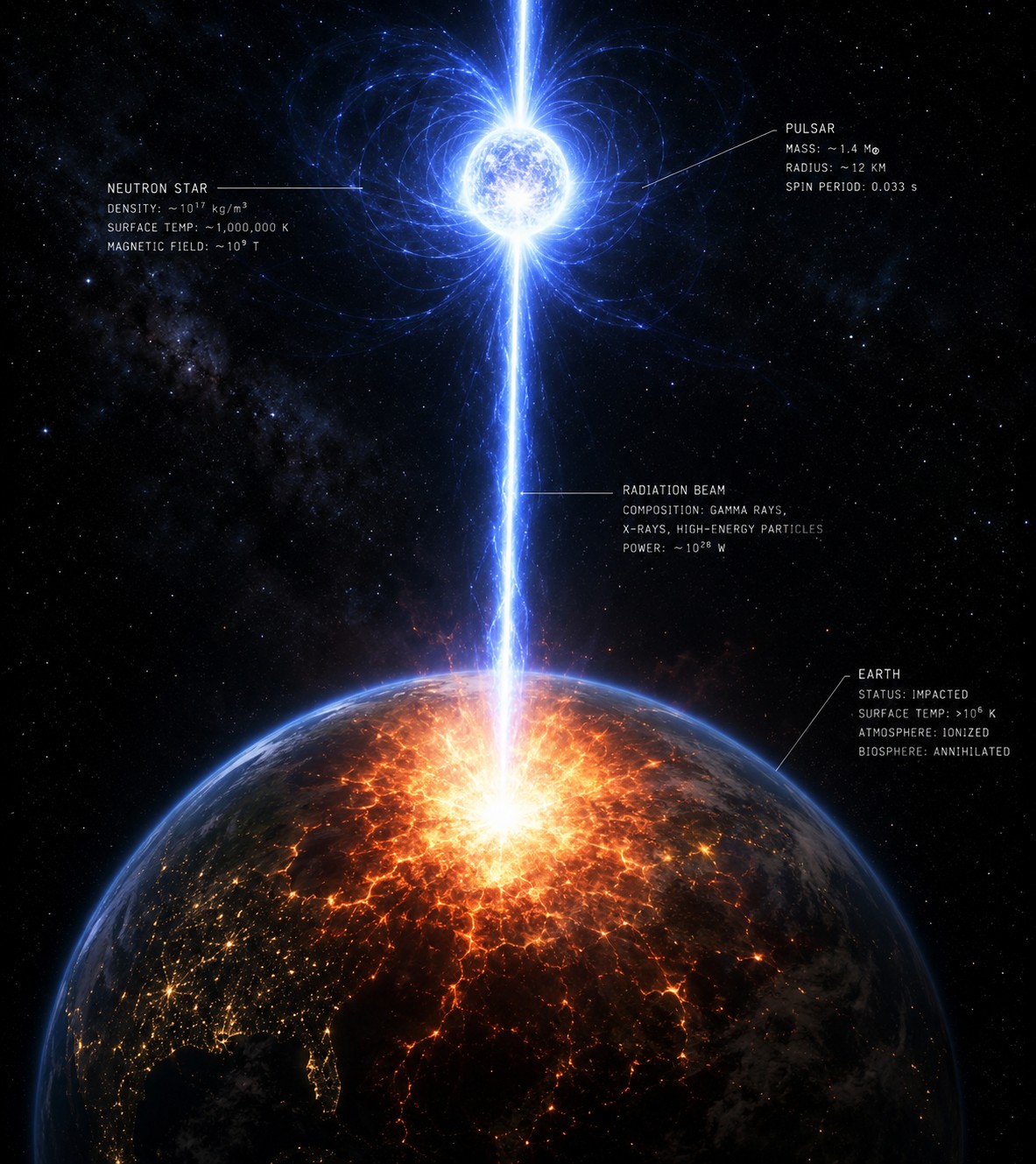
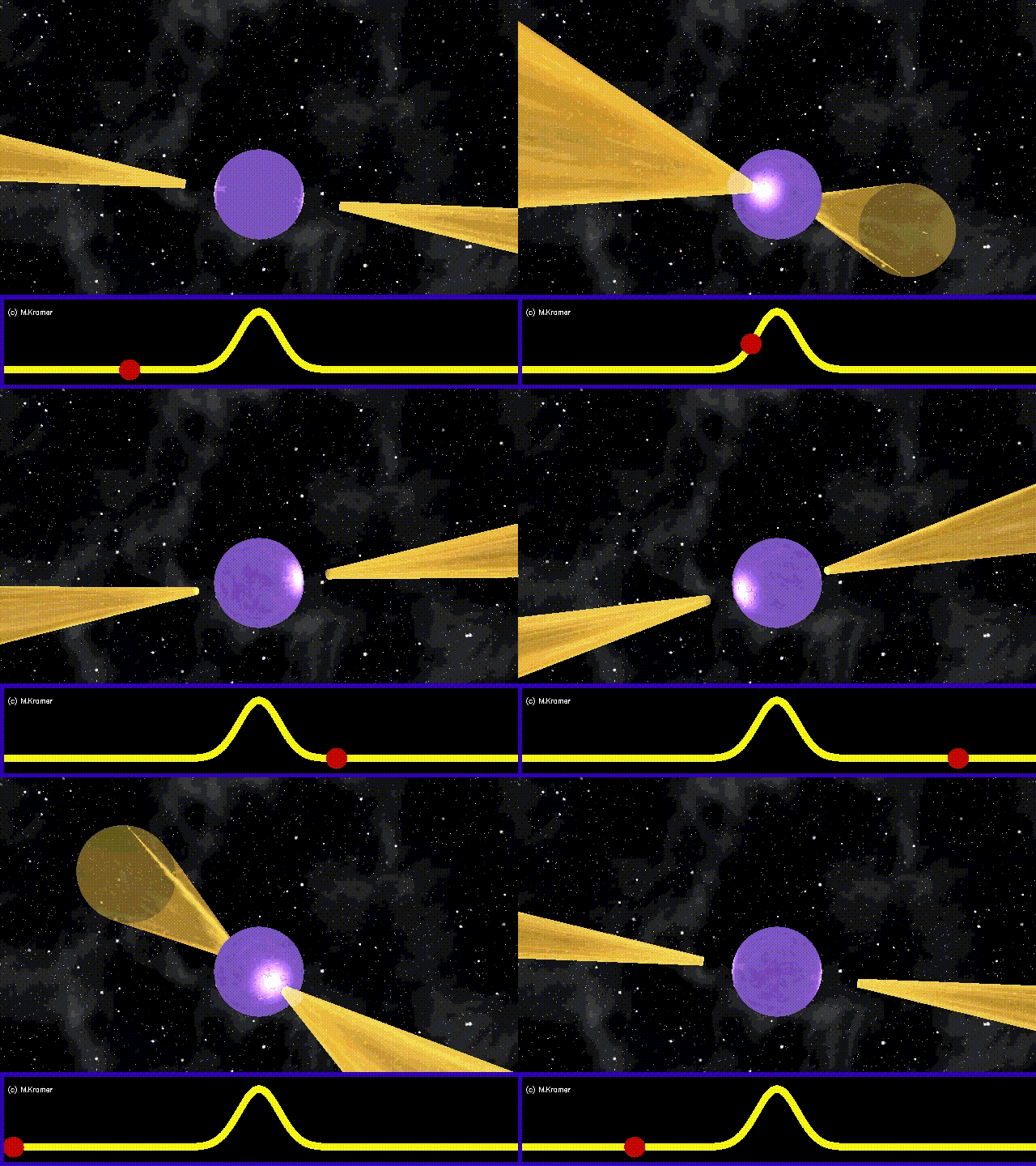
Super fact 108 : A Pulsar is a rapidly rotating neutron star that emits beams of electromagnetic radiation from its magnetic poles. The radioactive beam from a pulsar that is located where the sun is located would heat earth’s surface to tens of thousands of degrees. The pulsar may rotate hundreds of times per second, and we only detect the beam when it crosses our line of sight. A neutron star, or a pulsar, is vastly denser than the Sun, typically hundreds of trillions of times denser.
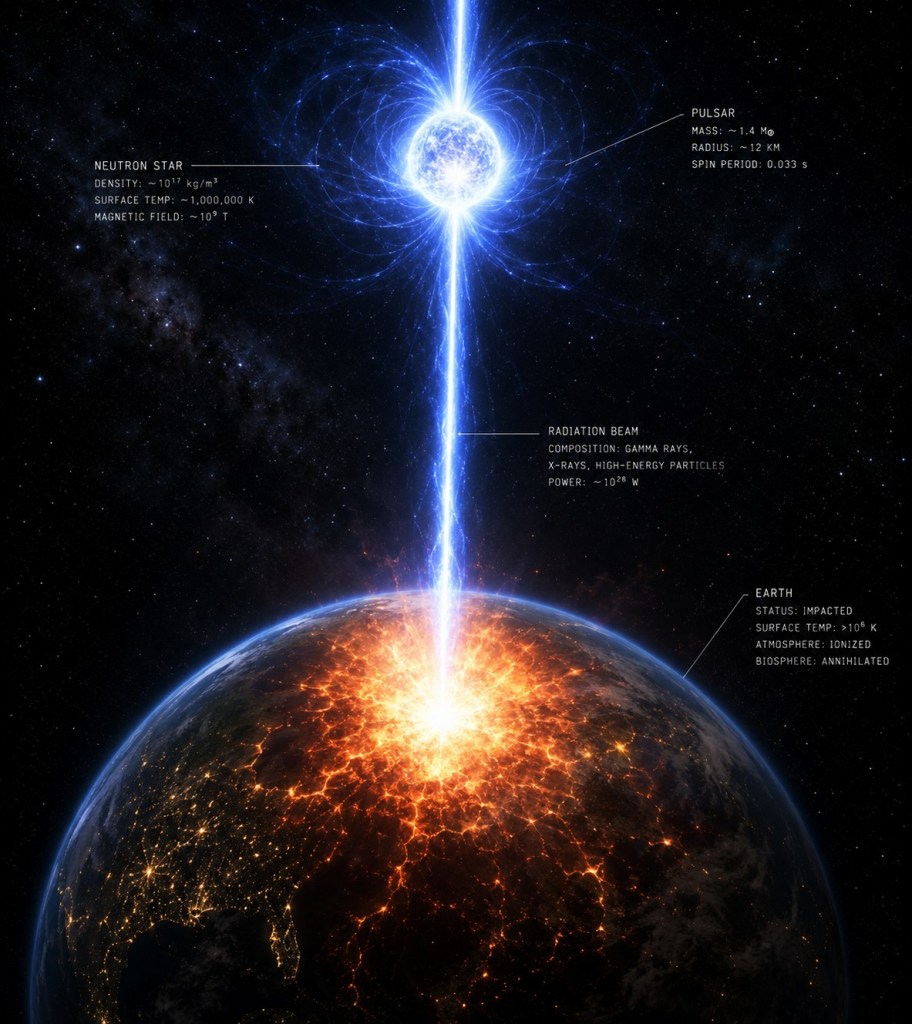
As mentioned, a pulsar is a rapidly rotating neutron star that emits beams of radiation from its magnetic poles. A neutron star is an ultra-dense remnant left behind when a massive supergiant star runs out of fuel and collapses. You can read more about neutron stars in my post here and you can read about neutron stars that act like super magnets called magnetars here. This web page feature a calculation of what the intensity of a pulsar beam would be if it hit Earth and the pulsar is located where the sun is.
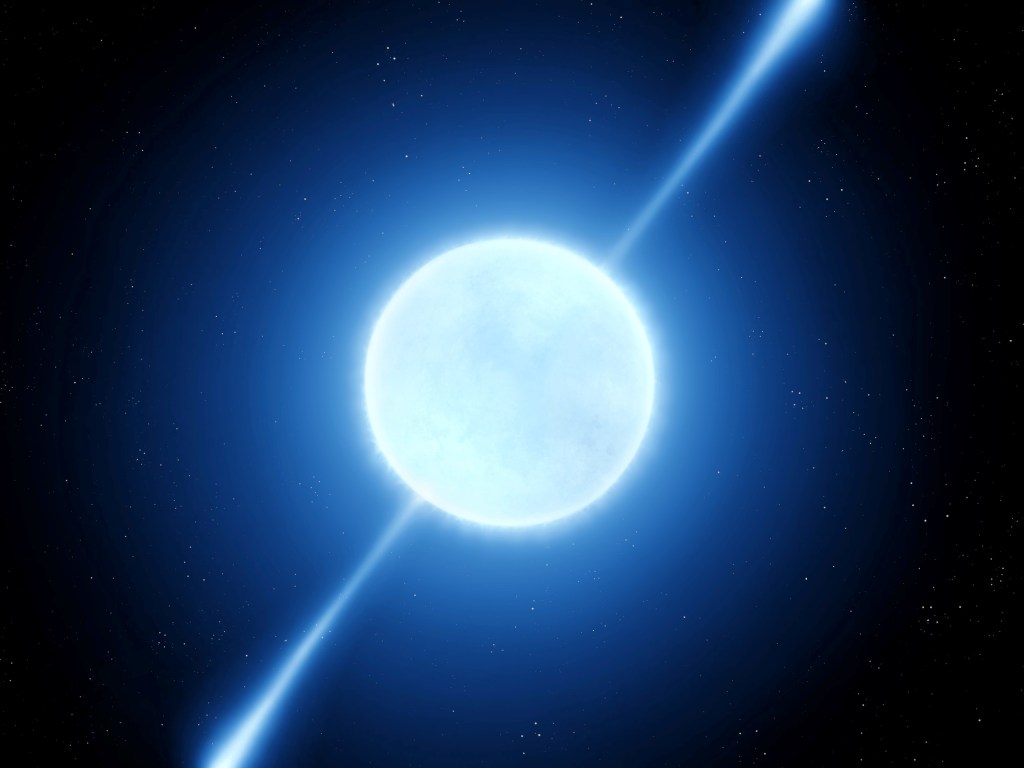
I consider this a super fact because pulsars are a very extreme type of star, which existence I believe comes as a surprise to many people.
Below is a one and a half minute NASA video explaining what a pulsar is. It is taken from this website.
Different Types of Neutron Stars and Different types of Pulsars
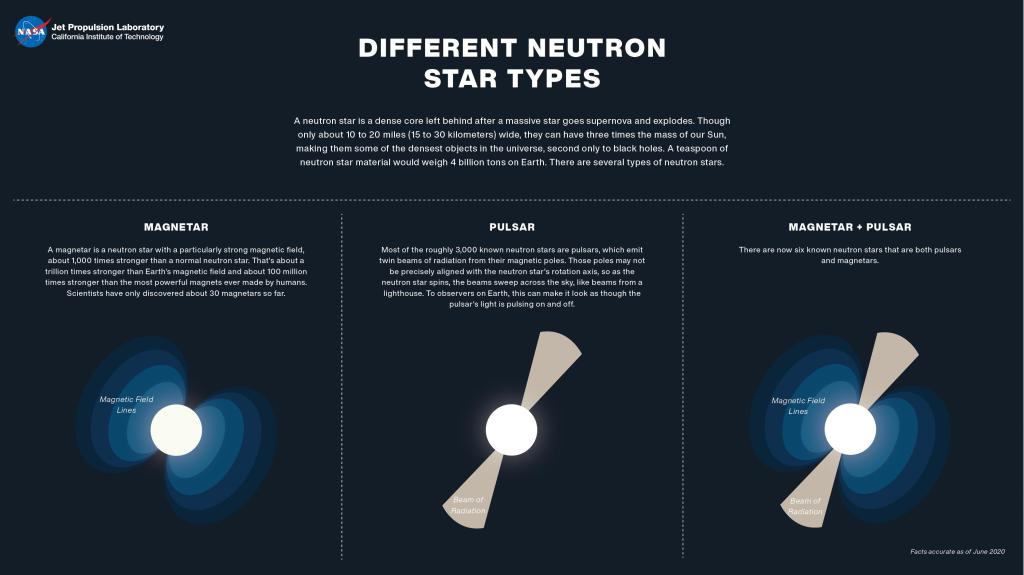
Neutron stars are extreme stars. They are small super dense stars with extreme gravitational fields. They are in a sense like a gigantic atomic nucleus. Perhaps it is not surprising that they are extreme in other ways as well. There are pulsars, neutron stars which emit twin beams of radiation from their magnetic poles. Those poles may not be precisely aligned with the neutron star’s rotation axis, so as the neutron star spins, the beams sweep across the sky, like beams from a lighthouse. To observers on Earth, this can make it look as though the pulsar’s light is pulsing on and off.
There are different types of pulsars. Some spin extremely fast. They rotate hundreds of times per second, even 700 times per second. They are called Millisecond Pulsars. There are pulsars that emit beams of radio waves and pulsars that emit only gamma rays. A black widow pulsar a star system consisting of a rapidly spinning pulsar and a companion star that is being consumed by the pulsar like a black widow spider eats its mate. This link feature animation videos from NASA showing a star being consumed by a black widow pulsar.
Finally, there are magnetars, neutron stars with extremely powerful magnetic fields trillions and quadrillion times stronger than Earth’s magnetic field at the surface. You can read about them here.
Other extreme Celestial objects
- We are Star Dust
- The Strange Worlds of Exoplanets
- The Bizarre Reality of Black Holes
- The Enormous Kuiper belt
- Quasar TON 618
- Magnetars Super Magnets in the Sky
- Neutron Stars Trillions of Times Denser than the Sun
To see the other Super Facts click here


Fascinating. I’ve heard about these before, but never really took the time to understand what they are. Great descriptions. Maggie
LikeLiked by 1 person
Yes they are fascinating and extreme stellar objects. Thank you so much Maggie.
LikeLike
Great overview. It’s amazing how energetic these things are! A typical pulsar releases about 10^{26} to 10^{28} watts (equivalent to 100,000 to 10 million Suns).
The other interesting historical point is that a Nobel prize was awarded to the supervisors involved in the study but the student that made the discovery, Jocelyn Bell was overlooked. 🤷♂️
LikeLiked by 1 person
Yow.
I’m glad the Sun is not a pulsar. Otherwise, it would be a real-life death star!
Great post, Thomas.
LikeLiked by 2 people
Thank you Alex, that is a great analogy. There are pulsars and neutron stars with planets and they are of course in a very extreme environment.
LikeLiked by 1 person
Thank you Pete, that is very interesting information. I tend to just write about the basics and you go deeper in a more detailed and academic fashion. It would be very interesting to see an article from you on this topic.
LikeLike
For the simple guy, how does a massive star collapse when it runs out of fuel but leaves these pulsars with all that energy? did I misunderstand that?
LikeLiked by 1 person
That is a very good question, which I don’t know a lot about. Perhaps someone else does. However, I know that the collapse itself provide a lot of gravitational energy that turns into superfast spin and magnetic fields that provide energy as the neutron star / pulsar slow down the spin. In addition, the pulsar phase is temporary, only 10 to 100 million years. It will stop as the energy from slowing down the spin runs out.
LikeLike
I like your summary at the beginning. It is a good preparer for the information that comes afterwards. I didn’t know about Pulsars.
LikeLiked by 1 person
Thank you so much Robbie. That is why I am doing that initial summery / abstract in bold. I follow with explanations and other related information but that can get complicated, so I write the stuff in bold in the beginning so that people can read just that if they wish.
LikeLike
I find it helps to understand the detail because you already have your mind around the summary. If that makes sense.
LikeLiked by 1 person
Yes that makes sense. Thank you very much Robbie.
LikeLike
Thanks to YOU!
LikeLiked by 1 person
Thomas, this is a beautiful presentation and well illustrated.
I have not heard of pulsars; however, their existence makes total sense. The heavens are hosts of moving galaxies… aspects of which churn at varied rates. It is not only the Earth that moves.
LikeLiked by 1 person
Thank you so much for your kind words Suzette. There are a lot fascinating objects out in space. Pulsars, Neutron stars, Magnetars, super compact white dwarfs, black holes, super massive black holes at the center of most large galaxies, quasars, galaxy clusters, giant voids, exo planets of various kinds, and so on. Very fascinating.
LikeLiked by 1 person
Oh wow! I agree that it is fascinating.. “The heavens declare the glory of God.”
LikeLiked by 1 person
The universe is certainly amazing and fascinating. Thank you Suzette.
LikeLiked by 1 person
You are most welcome, Thomas.
LikeLiked by 1 person
They sound kind of scary.
LikeLiked by 1 person
Yes I agree Anneli. Luckily, our star, the sun, will never turn into a pulsar. It will explode and turn into a white dwarf star though, but that major disaster will not happen until 5 billion years from now.
LikeLiked by 1 person
I might not be around then….
LikeLike
I wasn’t familar with Pulsars and appreciate the education! Astronomy is a fascinating subject, and I’m learning a lot from your posts, Thomas. They’re well-explained and beautifully illustrated.
LikeLiked by 2 people
Thank you so much for your very kind words Debbie. There are so many strange and extreme objects in our universe.
LikeLiked by 1 person
Another fantastic post, Thomas. I seem to recall that when the pulsars were first discovered (in the late 60s?), both the US and the USSR briefly thought there was an intelligence behind them. The US team labeled them LGM (“Little Green Men”). We and the Soviets were quickly disabused of the notion. 🙂
LikeLiked by 1 person
Thank you so much for your very kind words Denise. You are right. I remember reading about this too. I did not add this interesting information because I thought it might become too long, but maybe I’l add it. It is interesting information.
LikeLiked by 1 person
Wow… and fascinating!
LikeLiked by 1 person
Thank you Chris
LikeLiked by 1 person
Charlee: “Wow, that’s a strong magnetic field! Good thing they fall off quickly, otherwise all of our disk drives might get erased!”Lulu: “Disk drives? That’s what you’re worried about?”Charlee: “Well that’s where Dada keeps all his cat pictures you know.”
LikeLiked by 1 person
Ha ha Charlee, you are right. Magnetars are even more magnetic than average pulsars and will erase disk drives, lift cars, and other things, if they get too close. Lulu, Charlee is very worried about the photos for good reason.
LikeLike