
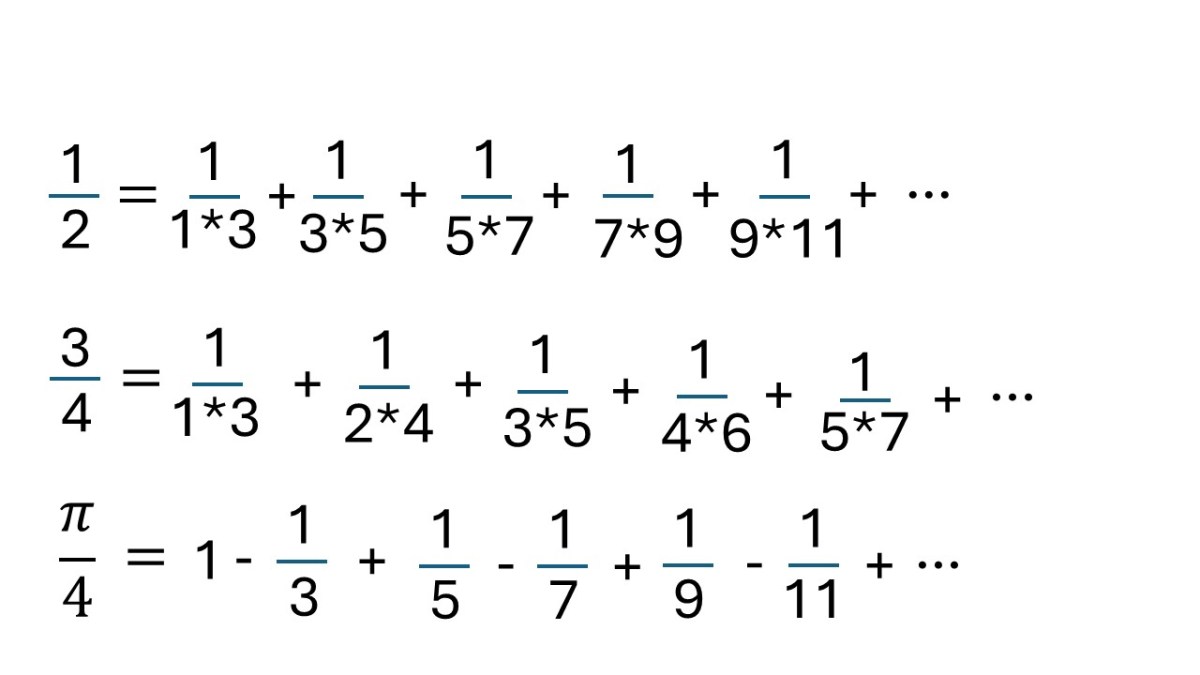
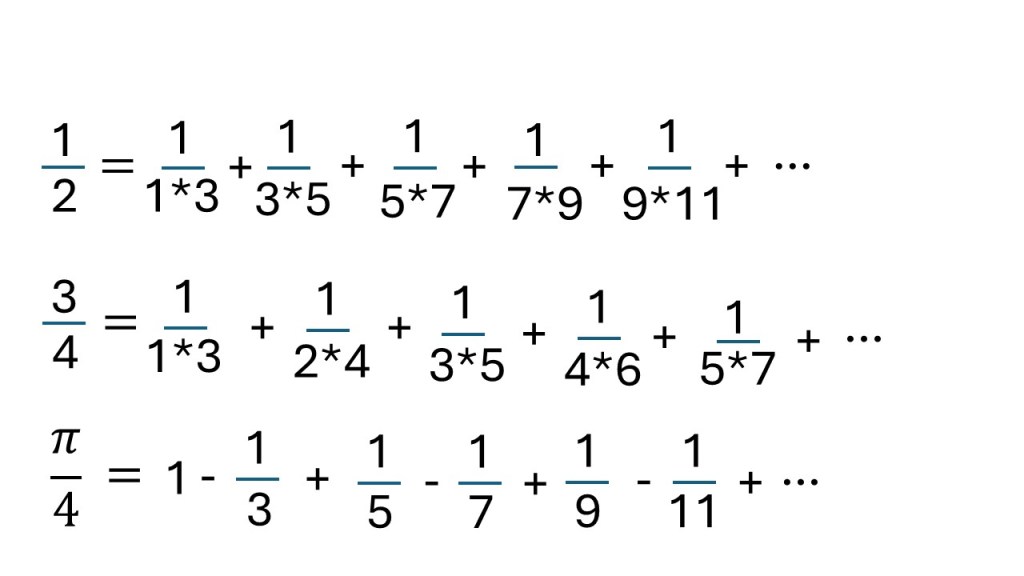
Super fact 112 : Adding infinitely many numbers may result in a finite number. In addition, adding infinitely many numbers may result in an irrational important constant such as Pi. The same holds true for infinitely nested radicals (square roots).
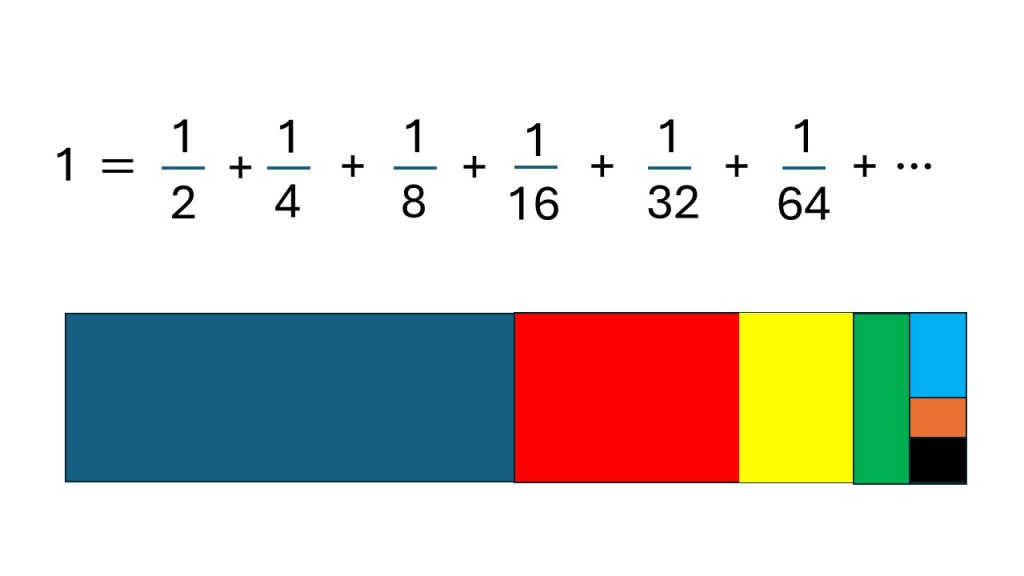
That you can add infinitely many numbers and get a finite number as the result is possible to understand if you imagine cutting a rectangle into smaller and smaller pieces and then adding them to get the rectangle back. If you start with half the rectangle and then you add the half of the remaining half and then the half of that remaining half, etc., you can keep doing that forever without exceeding the size of the rectangle. This is illustrated in the picture above. Note all these pictures are drawn by me.
If you’ve never seen an infinite series before this may come as a surprise. However, what is even more surprising is that you can add an infinite number of addends that are constructed from simple patterns and get all kinds of surprising results including irrational numbers with special meaning such as pi. You can easily find thousands of examples in mathematical handbooks and online. This reality is important in mathematics and our understanding of the world, as well as surprising, and therefore a super fact in my opinion.
Infinitely Nested Radicals
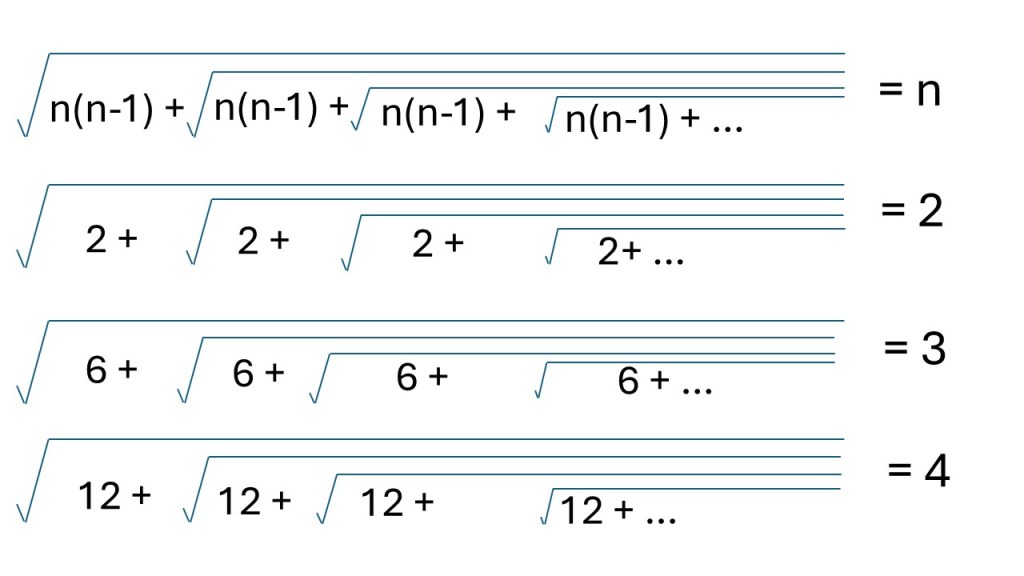
In addition, to adding an infinite number of addends you multiply an infinite number of factors and end up with a non-infinite (finite) result. You can even have an infinite number of nested radicals. To explain what a radical is. A square is a number multiplied by itself. For example, the square of 5 is five times five, which is twenty five. A cube is a number multiplied by itself three times. The cube of five is five times five times five, which is one hundred and twenty five. The square is denoted by adding a superscript of 2 (5 with a superscript 2). The cube is denoted by adding a superscript of 3 (5 with a superscript 3).
The square root is the opposite of the square. The square root of twenty five is five. The cube root is the opposite of the cube. The cube root of one hundred and twenty five is five. The square root and the cube root are examples of radicals. Radicals are indicated by using a little house on top of the number as shown in the pictures below. For radicals that are not square roots you add a number indicating what type of radical you have. The cube root has the number three above the house. All the examples below are square roots and in those cases the number two is left out.
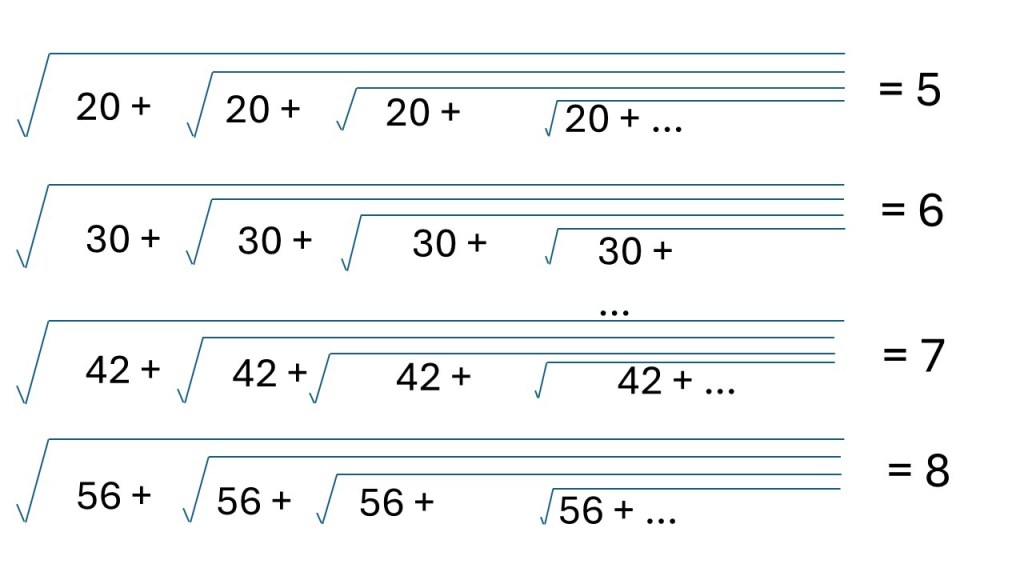
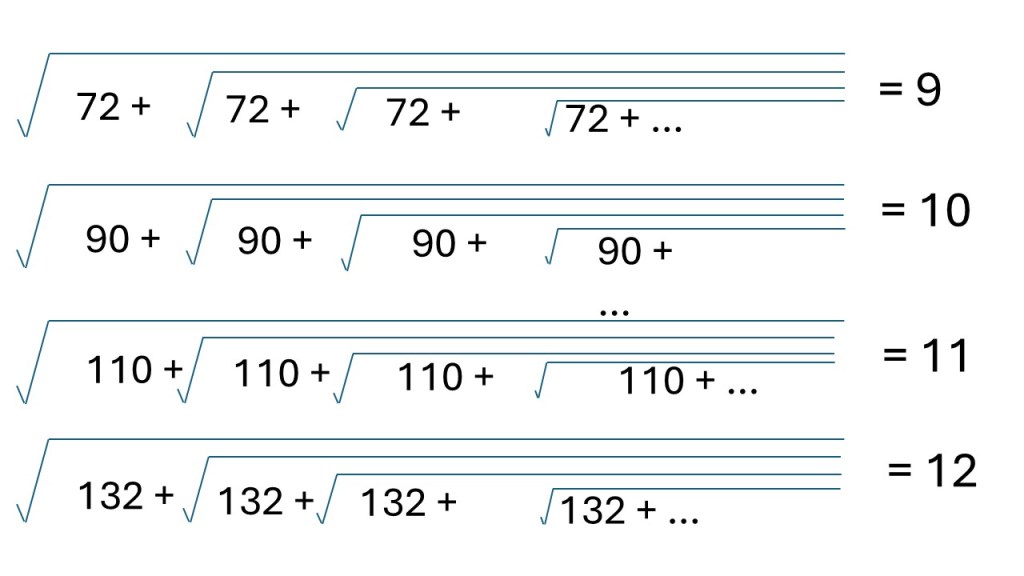
The three pictures below show one example of infinitely nested radicals (square root) using numbers n(n-1) repeatedly in the square roots. When n = 2 then n(n-1) is 2*1 = 2. When n = 3 then n(n-1) is 3*2 = 6, etc.
Infinite Series and Pi
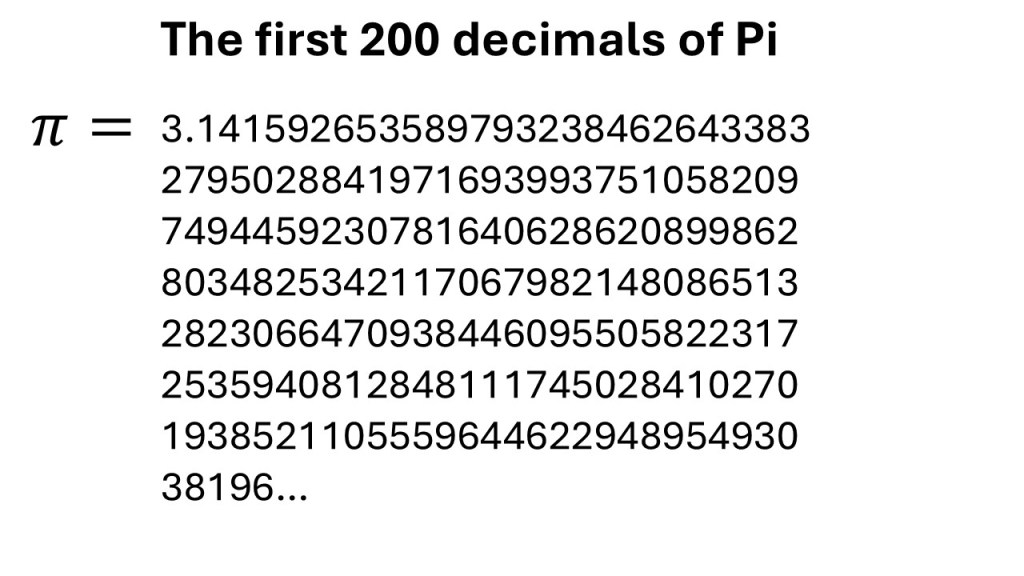
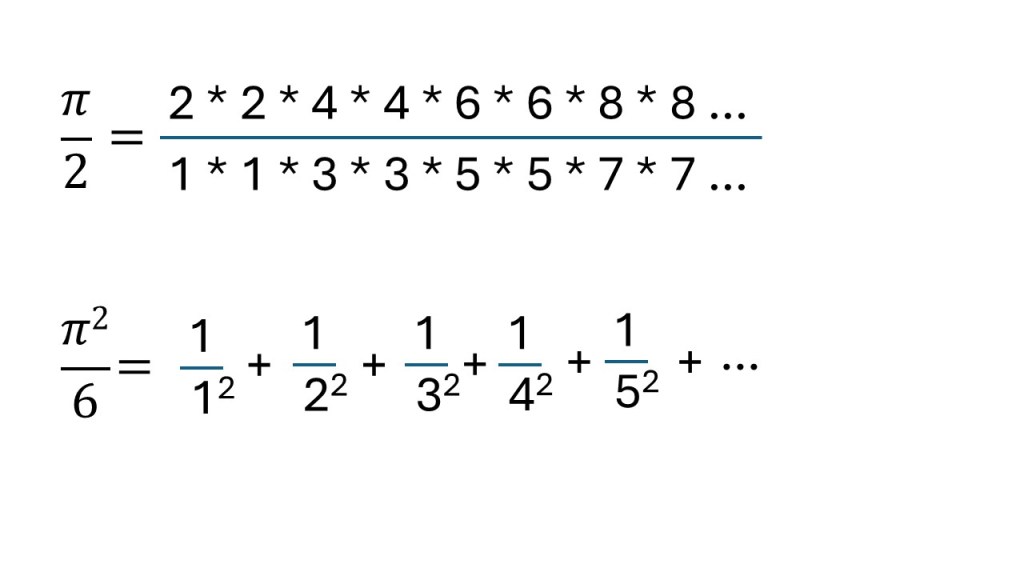
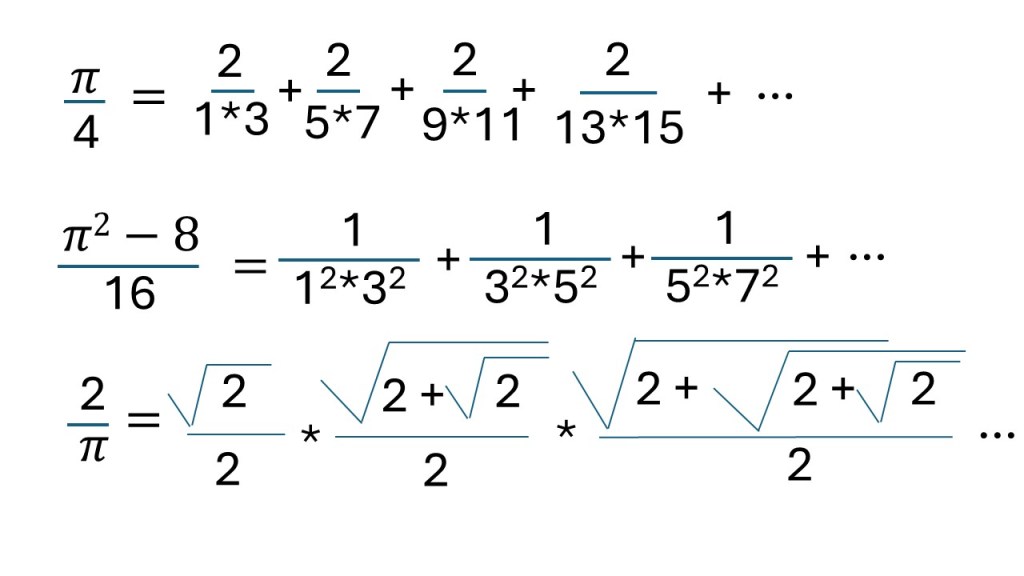
The constant pi is a special mathematical number that tells you exactly how the distance around the edge of any circle compares to the distance straight across the middle (diameter). Pi is an irrational number, meaning it cannot be expressed as a fraction and when written as a decimal it has an infinite number of decimals that have no repeating patterns. Despite pi being irrational, it shows up as the result of a very large number of infinite series that follow surprisingly simple patterns.
Other Mathematics Superfacts
- Every Symmetry is Associated with a Conservation Law
- The Euler Number Math Magic
- Eulers Polyhedra Math Magic
- Infinities Come in Different Sizes
- Conic Sections are the Shapes that Shape Our World
- Russel’s Paradox
To see the other Super Facts click here

 Super Facts
Oh, this is great, Thomas! My son was trying to talk to be about this (he’s probably not familiar with an infinite series) and I didn’t know how to talk to him, but this post will definitely capture his attention and give us much to discuss!
LikeLiked by 2 people
Thank you so much Ada. It is so great that your son is so curious. He will learn a lot.
LikeLiked by 1 person
Oh dear, maths is not my strong suit!
LikeLiked by 2 people
Sorry Chris. I have one more math post and then there will be other things coming up.
LikeLiked by 1 person
Not to worry, I will read!
LikeLiked by 1 person
Ha ha thank you Chris
LikeLiked by 1 person
This is very mathsy but I get the logic 👍🏻
LikeLiked by 1 person
Yes it is pretty mathsy. Thank you Robbie.
LikeLike
🩵
LikeLiked by 1 person
How does an infinite number of rectangles fit into a larger rectangle? Wouldn’t you get to the point where their sizes dwindle to nothing? 🤔 Probably a silly question, but math was never my strong suit.
LikeLiked by 1 person
No that is a great question. The rectangles get smaller and smaller but never zero, and despite not being zero an infinite number of them is still not infinite. That seems paradoxical. I certainly agree.
However, the trick is that you can keep adding half of what is left indefinitely. You have a rectangle left, which you have not yet added. You add half of it as the next addend, and leave the remaining half to be divided in half, and then you use the first half of that divison as the next addend, and you keep the remaining half for future addends, and you go on doing that for ever.
In the example the last addend in the series or the orange rectangle is 1/64 of the entire rectangle, but you still have 1/64 left, the black rectangle, which you have not added yet. But you only add 1/128, which leaves you 1/128, and then you add half of that, 1/256, but you still have 1/256, so you take half of that 1/512, and you go on and on the same way, until you only have 1/1,267,650,600,228,229,401,496,703,205,376 left, but then you do the same thing again, for ever and ever. You always leave half of what is left. Despite having an infinite number of rectangles which are not zero, you never fill up the rectangle.
I agree it is paradoxical but that is one reason it is a super fact. The other reason is that pi keeps popping up everywhere in these series.
LikeLike
Great piece.
There is an underlying point of interest. Why does pi appear in so many different places that have nothing to do with circles? It’s often in the infinite series. It appears in probability, in statistics, in the theory of heat, in the mathematics of sound and light, in quantum physics, in the equations governing gravity, and even in the deep study of prime numbers. It turns up in places where no circles are visible at all.
I find this intriguing! I think this is the underlying idea….
It is the measure of turning.
The measure of return.
The measure of symmetry without edges.
That is why π is everywhere.
Not because mathematicians love circles. But because the world, and the mathematics that describes it, is full of smooth, repeating, symmetric structure.
LikeLiked by 1 person
That is a very intriguing thought and I believe you are right. I should say that the first infinite series with pi (top picture bottom row) comes from the Taylor series of arctan(1), and being a trigonometric function it brings in the circle indirectly. However, that is not true for other infinite series and certainly not all the examples you give, so I agree it is not only about circle. I actually tried to google why pi is popping up in so many places, but I realized it is too complex and abstract for me to have time for it.
LikeLike
That’s pretty cool.
LikeLiked by 1 person
Thank you Jacqui
LikeLike
As always, a very interesting article, even if some aspects were a bit difficult.
LikeLiked by 1 person
Thank you Luisa. I agree it is abstract, but I just wanted to pointed to point that adding an infinite number of non-zero addends does not have to result in infinity, even though that seems paradoxial and that pi have a tendency to pop up all over the place in such series.
LikeLiked by 1 person
Thanks a lot for this kind and interesting reply
LikeLiked by 1 person
Thank you so much Luisa
LikeLiked by 1 person
Java Bean: “Ayyy, and here I thought this was going to be about a series that never seems to end like Doctor Who or maybe all the endless iterations of Law & Order …”
LikeLiked by 1 person
Ha ha, you are right Java Bean. Some series never end even on TV.
LikeLike
This is great stuff to do on those nights when I can’t sleep.
LikeLiked by 1 person
Ha ha you are right. Think about infinite series instead of an endless stream of sheep jumping fences. I did not mention this, but there was an Indian mathematician by the name Ramanujan who invented thousands of astonishing infinite series and number equations, and they came to him at night in his dreams.
LikeLiked by 2 people
Not sure he’d be a lot of fun….
LikeLiked by 1 person
Maybe not at parties, but he was an amazing genius who could do extremely complex calculations in seconds. When he was 15 years old he received a book containing 5,000 mathematical theorems that were not proven and he proved them all very quickly. He was a human super computer. They made a movie about him.
LikeLiked by 1 person
A rare kind of genius.
LikeLiked by 1 person
Yes and the movie I am thinking of is “The man who knew infinity”. Dev Patel plays Ramanujan and there are several famous actors such as Jeremy Irons, Toby Jones and Stephen Fry. It was a mind blowing movie.
LikeLiked by 1 person
I’ll have to watch for it.
LikeLike
Another fascinating subject I remember covering in my university days, but haven’t really thought about for a long time. Thanks for another fun look “under the hood” of mathematics!
LikeLiked by 1 person
Thank you so much David. Same here, but I was just thinking that infinite series are kind fascinating and surprising the first time you come across them.
LikeLiked by 1 person
I just looked him up and saw that he only lived to be 32 years old. What a waste. Poor guy.
LikeLiked by 1 person
Oh yes that was a short life. It is also in the movie I just mentioned.
LikeLiked by 1 person
Ok this one kind of went over my head 🙂
LikeLiked by 1 person
Sorry, I guess it got complicated
LikeLiked by 1 person
it makes me at least read it and try to understand it
LikeLiked by 1 person
Thank you so much for doing that Kevin
LikeLiked by 1 person
Okay… broke my brain.
LikeLiked by 1 person
Sorry, I guess it got complicated
LikeLiked by 1 person
🙂 No apology necessary. Thanks. I’ll just have to do a little research in a book. You know, like a caveman.
LikeLiked by 1 person
Ha ha thank you Denise
LikeLiked by 1 person
Thomas 😀 … After studying your infinite-series magic, I’ve derived my own simplified equation:
Math = 1/2 + 1/4 + 1/8 + a pinch of panic
Which converges neatly to: 1 + Deep Admiration (LOL)
Proof complete. Infinity still wins = Excellent & Brilliant Post
LikeLiked by 1 person
SiriusSea that is very creative and clever, and thank you so much for your very kind post.
LikeLike