How Our Planet Came to Life

I recently read a very interesting book on the history of our Planet Earth, Becoming Earth: How Our Planet Came to Life by Ferris Jabr. Life of various forms, microbes, fungi, plants, animals, etc., has had a large impact on climate, earth’s crust, the composition of the atmosphere, the oceans, and still do. This fact filled book is about this four and half billion history. Below is my review of the but first something about the book formats.

Becoming Earth Book Formats

Becoming Earth: How Our Planet Came to Life by Ferris Jabr comes in four formats. I bought the hardback format.

  • Hardcover –  Publisher : Random House (June 25, 2024), ISBN-10 : 0593133978, ISBN-13 : 978-0593133972, 304 pages, item weight : 2.31 pounds: ‎ 6.3 x 1.1 x 9.55 inches, it costs $16.68 on US Amazon. Click here to order it from Amazon.com.
  • Paperback –  Publisher : Random House Trade Paperbacks (April 1, 2025), ISBN-10 : 0593133994, ISBN-13 : 978-0593133996, 320 pages, item weight : 4.8 ounces, dimensions : ‎ 5.15 x 0.75 x 7.97 inches, it costs $ 13.57 on US Amazon. Click here to order it from Amazon.com.
  • Kindle –  Publisher : Random House (June 25, 2024), ASIN : B0CJTLBCDX, ISBN-13 : 978-0593133989, 423 pages, it costs $5.99 on US Amazon. Click here to order it from Amazon.com.
  • Audio–  Publisher : Random House Audio (June 25, 2024), Listening Length : 9 hours and 27 minutes, ASIN : B0CKM3P33F, it costs $0.99 on US Amazon with membership. Click here to order it from Amazon.com.
Front cover of Becoming Earth: How Our Planet Came to Life by Ferris Jabr.
Front cover of Becoming Earth: How Our Planet Came to Life by Ferris Jabr. Click on the image to go to the Amazon page for the hardcover version of the book.

Amazon’s Description of Becoming Earth

NEW YORK TIMES BESTSELLER • A vivid account of a major shift in how we understand Earth, from an exceptionally talented new voice. Earth is not simply an inanimate planet on which life evolved, but rather a planet that came to life.

“Glorious . . . full of achingly beautiful passages, mind-bending conceptual twists, and wonderful characters. Jabr reveals how Earth has been profoundly, miraculously shaped by life.”—Ed Yong, Pulitzer Prize winner and bestselling author of An Immense World

FINALIST FOR THE LOS ANGELES TIMES BOOK PRIZE • FINALIST FOR THE OREGON BOOK AWARD • AN AMERICAN LIBRARY ASSOCIATION NOTABLE BOOK OF THE YEAR

A BEST BOOK OF THE YEAR: Smithsonian, Chicago Public Library, Booklist, Scientific American, Nature

A BEST BOOK OF THE SUMMER: The Atlantic and NPR’s Science Friday

One of humanity’s oldest beliefs is that our world is alive. Though once ridiculed by some scientists, the idea of Earth as a vast interconnected living system has gained acceptance in recent decades. We, and all living things, are more than inhabitants of Earth—we are Earth, an outgrowth of its structure and an engine of its evolution. Life and its environment have coevolved for billions of years, transforming a lump of orbiting rock into a cosmic oasis—a planet that breathes, metabolizes, and regulates its climate.

Acclaimed science writer Ferris Jabr reveals a radical new vision of Earth where lush forests spew water, pollen, and bacteria to summon rain; giant animals engineer the very landscapes they roam; microbes chew rock to shape continents; and microscopic plankton, some as glittering as carved jewels, remake the air and sea.

Humans are one of the most extreme examples of life transforming Earth. Through fossil fuel consumption, agriculture, and pollution, we have altered more layers of the planet in less time than any other species, pushing Earth into a crisis. But we are also uniquely able to understand and protect the planet’s wondrous ecology and self-stabilizing processes. Jabr introduces us to a diverse cast of fascinating people who have devoted themselves to this vital work.

Becoming Earth is an exhilarating journey through the hidden workings of our planetary symphony—its players, its instruments, and the music of life that emerges—and an invitation to reexamine our place in it. How well we play our part will determine what kind of Earth our descendants inherit for millennia to come.

My five-star review for Becoming Earth

A Page Turner for People with a Curious Mind

This book gives us a brief overview of the natural history of Earth, emphasizing that not only is life impacted by geological forces, but life is influencing and even creating the composition of the atmosphere, impacting climate and even affecting geological forces. The author explains how microbes, plants, and animals transformed the planet. He is explaining how humans are transforming planet Earth and its climate through fossil fuel consumption, agriculture, and pollution. He is noting that we have altered more layers of the planet in less time than any other species, pushing Earth into a crisis. The author promotes the idea that Earth itself is a living organism (Gaia hypothesis). I am not sure if I entirely buy that idea, but he makes a good case for it.

The book covers a lot of history. Earth is four and half billion years old and a lot has happened. As a result, there are no deep dives into topics. However, the book is filled with hundreds of interesting facts and information, which makes the book a page turner to anyone with a curious mind. One major example of this is that about three billion years ago Cyanobacteria evolved a new type of photosynthesis that used sunlight, water, and carbon dioxide to create energy, while releasing oxygen as a waste product. This transformed the atmosphere and enabled complex life by allowing aerobic respiration to evolve. This invention turned the sky blue, gave us the protective ozone layer, but also caused climate change (snowball Earth) resulting in massive extinctions.

However, there is much more. Another example is that microbes helped transform Earth’s crust. During the first half billion years of Earth’s history, Earth was a water world save for volcanic islands. Trees communicate and assist each other via fungi (Mycorrhizas). Phytoplankton produces 50% of all oxygen, the invention of the Haber-Bosch process more than doubled the world’s crop harvest, there once was 30-60 million Bison roaming the plains, humans now emit 60 to 120 times more carbon dioxide each year than all the world’s volcanoes.

As I mentioned there are hundreds more interesting facts. He also presents a lot of facts and information regarding the destruction of the environment, which may not sit well with everyone. However, I think it is important information. The book includes a large number of references for further reading.

The book is well written and well organized and included fun personal anecdotes. It was easy and entertaining reading and like I said, it is a page turner to people with a curious mind. I loved this book and I highly recommend it.
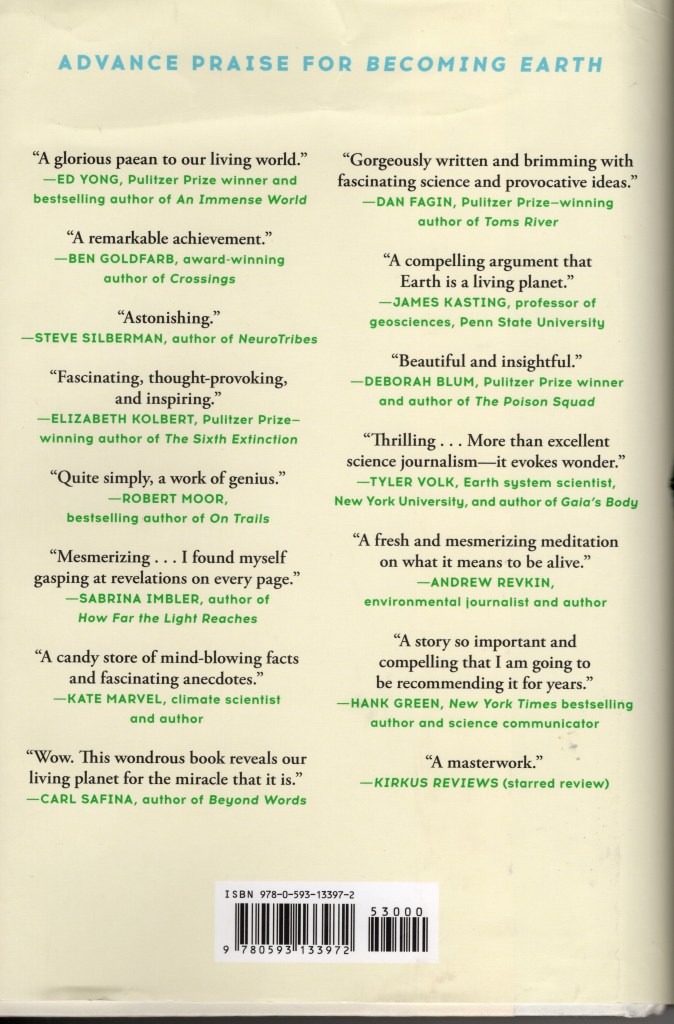
Back cover of Becoming Earth: How Our Planet Came to Life by Ferris Jabr.
Back cover of Becoming Earth: How Our Planet Came to Life by Ferris Jabr. Click on the image to go to the Amazon page for the paperback version of the book.


To see the Super Facts click here

Destroying Ourselves with High Conflict

I haven’t posted or read blog posts for almost a week because I was busy with something else. I am a member of a non-partisan volunteer organization called the Citizens Climate Lobby which seeks to create political will for a livable future. As the name suggests we do a lot of lobbying. It is not the kind of paid lobbying that is done by professionals and that is often associated with money. We are average constituents, average voters, with no money, who are visiting our legislators to give them information and opinions on legislation we support or don’t support.

Since we are non-partisan, we visit both Democrats and Republican offices. We just had a CCL conference in Washington DC on Sunday, Monday and Tuesday. We were 800+ volunteers who visited 400+ Congressional offices in Washington DC on Tuesday July 22nd.

I visited four Texas Congressmen, including Senator Ted Cruz (R), Congresswoman Beth Van Duyne (R), and Congressman Marc Veasey (D). We also had a zoom call with Congressman John Carter’s (R) office. I am the CCL liaison for Senator Cruz’ office and I was the one who organized our visit, from our side, with Senator Cruz and a couple of his staff. Ted Cruz does not always agree with us, or perhaps more correctly, he seldom agrees with us, but we had a friendly and interesting meeting, and he and his staff were very appreciative of us being there.

12 people from CCL plus Senator Ted Cruz in a blue suit | Destroying Ourselves with High Conflict
Senator Cruz hosts a Texas Tuesday Coffee for Constituents in Washington, DC on July 22, 2025. (Official U.S. Senate photo by Rebecca Hammel)
Ted Cruz is standing in the back between the flags. I am in the front row, second from the right wearing a blue suit. We are twelve people.

Right after our meeting with Senator Cruz I posted the following on Facebook “I am in Washington DC meeting with congressmen. We had an in person meeting with Ted Cruz and we took pictures with him.” along with a photo of the capitol building (not the group photo). Most people left interesting or nice comments but then a far-left Facebook friend of mine left a very hostile comment. He started out saying “so you are finally revealing your true colors Thomas…” and that was followed by an angry outburst in two separate comments filled with F-bombs and how he was ending his friendship with me. I deleted his comments and blocked him. Basically, a centrist on-line friend visiting with a Republican politician for a friendly exchange of opinions enraged him. Naturally I have seen a lot of this on both sides.

Division has become so severe in this country that we are losing our ability to talk to each other. Families are divided against each other, and the rhetoric is overheated. This is dangerous and it is what Amanda Ripley, the keynote speaker at our CCL conference in Washington DC calls High Conflict. High Conflict is a natural psychological phenomenon that sucks us deep into conflict that eventually gets out of hand. She compares it to the La Brea Tar Pits in Los Angeles. We form kinships and tribes, echo chambers, and dislikes for those with different opinions, we belittle and insult each other, which grows resentment, and we create an us-versus them scenario, which evolves into a good (us) versus evil (them).

Amanda Ripley is the author of the book High Conflict: Why We Get Trapped and How We Get Out. I think her message and her book are very important, and I have a lot of good things to say about the book. However, the book featured one false and defamatory statement and generalization about environmentalists, which prevents me from giving the book five stars. That claim pretty much ruined it for me , so I am giving the book three stars. I still recommend the book, and perhaps whether I like this book or not is not as important as the topic.

High Conflict the Book Formats

High Conflict: Why We Get Trapped and How We Get Out by Amanda Ripley. I bought the hardback format.

  • Hardcover –  Publisher : Simon & Schuster (April 6, 2021), ISBN-10 : 1982128569, ISBN-13 : 978-1982128562, 368 pages, item weight : 1.26 pounds, dimensions : ‎ 6 x 1.2 x 9 inches, it costs $24.98 on US Amazon. Click here to order it from Amazon.com.
  • Paperback –  Publisher : Simon & Schuster (April 5, 2022), ISBN-10 : 1982128577, ISBN-13 : 978-1982128579, 368 pages, item weight : 2.31 pounds, dimensions : ‎ 5.5 x 0.92 x 8.38 inches, it costs $13.95 on US Amazon. Click here to order it from Amazon.com.
  • Kindle –  Publisher : Simon & Schuster (April 6, 2021), ASIN : B08LDW7M7J, ISBN-13 : 978-1982128586, 363 pages, it costs $ 15.99 on US Amazon. Click here to order it from Amazon.com.
  • Audio–  Publisher : Simon & Schuster Audio (April 6, 2021), Listening Length : 9 hours and 50 minutes, ASIN : B0DCCWRMJS, it costs $0.00 with membership on US Amazon. Click here to order it from Amazon.com.
Front cover of the hardback format of the book High Conflict: Why We Get Trapped and How We Get Out by Amanda Ripley.
Front cover of the hardback format of the book High Conflict: Why We Get Trapped and How We Get Out by Amanda Ripley. Click on the image to go to the Amazon page for the hardcover version of the book.

Amazon’s Description of High Conflict

When we are baffled by the insanity of the “other side”—in our politics, at work, or at home—it’s because we aren’t seeing how the conflict itself has taken over.

That’s what “high conflict” does. It’s the invisible hand of our time. And it’s different from the useful friction of healthy conflict. That’s good conflict, and it’s a necessary force that pushes us to be better people.

High conflict is what happens when discord distills into a good-versus-evil kind of feud, the kind with an us and a them. In this state, the brain behaves differently. We feel increasingly certain of our own superiority, and everything we do to try to end the conflict, usually makes it worse. Eventually, we can start to mimic the behavior of our adversaries, harming what we hold most dear.

In this “compulsively readable” (Evan Osnos, National Book Award-winning author) book, New York Times bestselling author and award-winning journalist Amanda Ripley investigates how good people get captured by high conflict—and how they break free.

Our journey begins in California, where a world-renowned conflict expert struggles to extract himself from a political feud. Then we meet a Chicago gang leader who dedicates his life to a vendetta—only to realize, years later, that the story he’d told himself about the conflict was not quite true. Next, we travel to Colombia, to find out whether thousands of people can be nudged out of high conflict at scale. Finally, we return to America to see what happens when a group of liberal Manhattan Jews and conservative Michigan corrections officers choose to stay in each other’s homes in order to understand one another better, even as they continue to disagree.

All these people, in dramatically different situations, were drawn into high conflict by similar forces, including conflict entrepreneurs, humiliation, and false binaries. But ultimately, all of them found ways to transform high conflict into good conflict, the kind that made them better people. They rehumanized and recatego­rized their opponents, and they revived curiosity and wonder, even as they continued to fight for what they knew was right.

People do escape high conflict. Individuals—even entire communities—can short-circuit the feedback loops of outrage and blame, if they want to. This is an “insightful and enthralling” (The New York Times Book Review) book—and a mind-opening new way to think about conflict that will transform how we move through the world.

My three-star review of High Conflict

Interesting discussion on conflict but with a lot of interpretation and opinion

“Good conflict” is healthy conflict in which questions get asked, in which there is curiosity and movement in opinions. “High conflict” on the other hand is what happens when conflict devolves into a good versus evil kind of feud. The conflict takes on its own life and draws us in like a tar pit.

The book gives many examples of high conflict and explains how they came to be; the Hatfield’s and the McCoy, John Adams and Thomas Jefferson, our current political division, couples getting divorced, gang warfare, guerilla warfare, civil war, etc. The book focuses much attention on Gary, a friendly lawyer who rather solves conflict than benefit from it, as is typically a lawyer’s job. Gary runs for a local office and wins but because he is thinking a little bit too highly about himself and his abilities, he by mistake excludes some really knowledgeable, willing and helpful people from what he refers to as “the old guard”, which leads to a high conflict that he himself created. However, in the end he becomes part of the solution. It is a good story.

The author makes a lot of interesting observations such as; we have group belongings, we form factions, we need belonging, giving people two choices is dangerous, a proportional representation system might be better than the current American system, people have biases that inflame conflict such as confirmation bias, and there’s a conflict industrial complex. There are fire starters, group identities, conflict entrepreneurs, and humiliation. Media and social networking can function as conflict entrepreneurs. The areas in Rwanda where the radio reception was better there were more killings.

To escape high conflict, we need to recognize the conflict entrepreneurs around us, avoid excluding and humiliating people, and recognize that people want to be heard. Getting out of high conflict includes recognizing a saturation point where people had enough, building new broader identities, reframing the situation, and clearing the path for combatants. Welcome former combatants home rather than shaming them. Avoiding conflict involves complicating the narrative from the beginning. Simplifications do damage. I felt all that was pretty good advice.

Then on page 183 a strange claim is made, implying that very few people concerned about climate change would want a “carbon fairy” to solve climate change (that carbon fairy could be nuclear power) because they want to use “climate change” as vehicle for something else. I am volunteering in a climate change organization, and I have never met anyone who isn’t part of it primarily to solve carbon emissions. Half are pro nuclear power the other half skeptical about it being a “climate fairy” (I am pro nuclear). Some are pro-capitalists, others more left leaning, a substantial minority are Republicans, and world views are all over the spectrum. So obviously page 183 makes a false claim probably for sensationalistic reasons.

That’s just one dubious claim, but it alerted me to read the book more critically and I realized that the author is far from objective. She definitely wants to promote her ideas and make her book look more interesting. She is doing that by carefully selecting examples and stories, interpreting those cherry-picked situations, and there’s a lot of opinions, and who knows what she may get wrong or misreporting? It seems at first to be an authoritative work, but it is not a scientific book. That doesn’t mean that it’s wrong. I believe a lot of what the book claims to be true, but I do not know. It is a journalist’s opinion and interpretation of conflict, and it is therefore less than I expected.

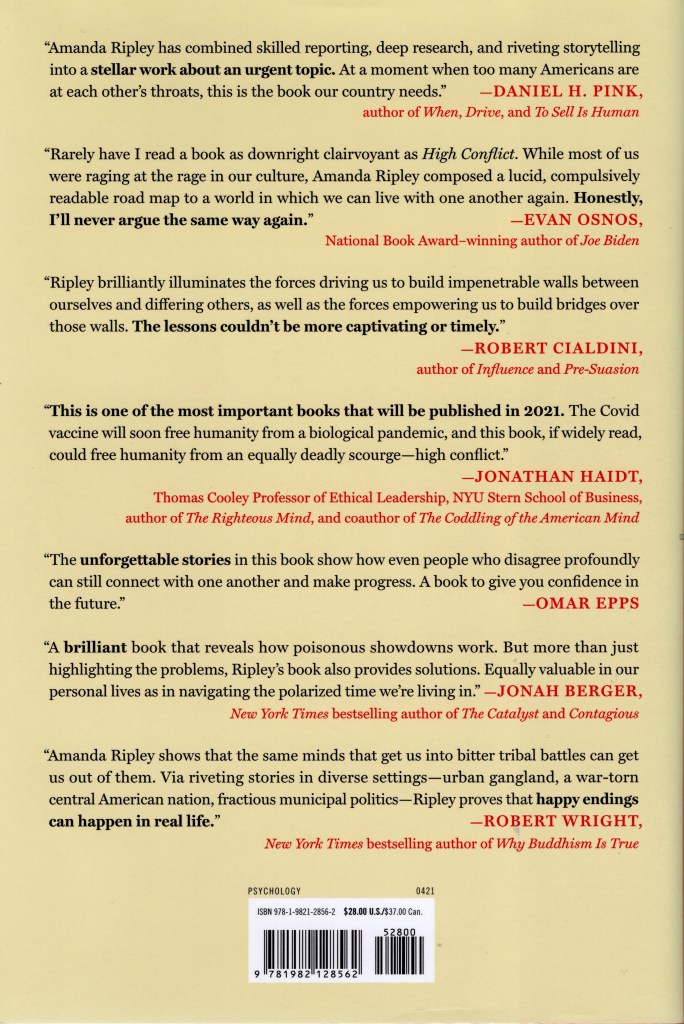
Advance Praise for High Conflict: Why We Get Trapped and How We Get Out by Amanda Ripley. The text is black and red on a beige background. Back cover of hardback format of the book High Conflict: Why We Get Trapped and How We Get Out by Amanda Ripley.
Back cover of hardback format of the book High Conflict: Why We Get Trapped and How We Get Out by Amanda Ripley. Click on the image to go to the Amazon page for the paperback version of the book.

To see the Super Facts click here

Review of Glacial by Chelsea Henderson

I recently read a very interesting book on the history of climate change politics; Glacial: The Inside Story of Climate Politics by Chelsea Henderson. Chelsea Henderson is a leader in the EcoRight movement, basically Republicans who care about the environment and climate change. She is a former senior advisor to Senator John Warner (Republican) and have held other positions in the US Congress. Her book is non-partisan. However, naturally she is accepting the reality of human caused global warming.

I should mention that the second last sentence of the seventh paragraph of my rather long review says this “As of very recently, a few days ago, those Tax Credits have been reversed.” Those few days ago have not yet happened. I thought Amazon would take longer to publish my review and I was predicting that the vote today/tomorrow on the Senate version of the Budget Reconciliation Bill (the Big Beautiful Bill) would allow it to pass. So those few days ago have not yet happened because Amazon was faster than I thought. Basically, the Budget Reconciliation Bill will roll back or phase out the clean energy tax credits enacted in 2022. For those who don’t know what a Budget Reconciliation Bill is, it is a bill that allows you to bypass the filibuster, and it is therefore typically a highly partisan bill.

Glacial The Book Formats

Glacial: The Inside Story of Climate Politics by Chelsea Henderson comes in four formats. I bought the hardback format.

  • Hardcover –  Publisher : Turner (August 6, 2024), ISBN-10 : 1684429579, ISBN-13 : 978-1684429578, 432 pages, item weight : 1.45 pounds, dimensions : ‎ 6.25 x 1.25 x 9.25 inches, it costs $ 23.11 on US Amazon. Click here to order it from Amazon.com.
  • Paperback –  Publisher : Turner (August 6, 2024), ISBN-10 : 1684429587, ISBN-13 : 978-1684429585, 432 pages, item weight : 1.34 pounds, dimensions : ‎ 6 x 0.96 x 9 inches, it costs $13.10 on US Amazon. Click here to order it from Amazon.com.
  • Kindle –  Publisher : Turner (August 6, 2024), ASIN : B0CBQKTM46, ISBN-13 : 978-1684429592, 460 pages, it costs $12.44 on US Amazon. Click here to order it from Amazon.com.
  • Audio–  Publisher : Tantor Audio (August 13, 2024), Listening Length : 9 hours and 50 minutes, ASIN : B0DCCWRMJS, it costs $0.00 with membership on US Amazon. Click here to order it from Amazon.com.
Front cover of hardback format of the book Glacial: The Inside Story of Climate Politics by Chelsea Henderson | Review of Glacial
Front cover of hardback format of the book Glacial: The Inside Story of Climate Politics by Chelsea Henderson. Click on the image to go to the Amazon page for the hardcover version of the book.

Amazon’s Description of Glacial

It took nearly sixty years for a meaningful climate change bill to run the political gauntlet from Capitol Hill to the Oval Office. Why?

From mavericks to party standard-bearers, U.S. Senators, members of the House of Representatives, and presidential candidates have campaigned for four decades espousing their intentions to address the impacts of climate change.

Glacial: The Inside Story of Climate Politics is the first Inside-the-Beltway account to lay bare the machinations of what went wrong in Washington—how and why our leaders failed to act on climate change as mounting scientific evidence underscored the urgency to do so. Glacial tells a story of behind-the-scenes infighting and power struggles that blocked or derailed federal legislative progress on climate change, even in times of bipartisanship and with polls showing most Americans favored action.

The good news today is that public opinion is at its highest level of support for climate action, from corporate boardrooms embracing sustainability for business reasons to movements led by passionate younger generations who can’t afford to stand mute because it is they who will inherit the worst environmental catastrophes. If the missed opportunities in Washington are instructive, the path to doing so is clear. Our elected officials must use their offices not solely for the power and prestige it bestows upon them personally, but for the public good—and they must do so while there is still time.

My five-star review for Glacial

The Glacial Pace of Climate Policy

This book recounts the history of the politics around climate change starting with the LBJ administration and ending with the Biden administration. LBJ was the first commander in chief to warn his fellow Americans of a steady increase in carbon dioxide from the burning of fossil fuels.

The author, Chelsea Henderson is a leader in the Eco-Right movement, basically Republicans for the Environment. Some well-known names in this movement are former secretary of state James Baker (under H.W. Bush), and the former secretary of state under Ronald Reagan, the late George Shultz, Bob Ingliss former Republican Congressman from South Carolina, the founders of RepublicEN, the Republican congressman Carlos Curbelo who founded the Climate Solutions Caucus in Congress together with Ted Deutch, Republican Utah Senator John Curtis, and George Mankiw a notable conservative economist.

It may come as a surprise to some that once upon a time the environment was not a divisive left versus right issue. Nixon signed into law the Clean Air Act, the Clean Water Act of 1972, the Endangered Species Act, and founded the Environmental Protection Agency. Ronald Reagan and Margaret Thatcher led the ratification of the Montreal Protocol in 1987 – 1989 to phase out the global use of CFCs due to their detrimental effect on the ozone layer. As a result, emissions of ozone-depleting gases have fallen by 99 percent, and it saves an estimated 2 million lives from skin cancer every year. This was one of Ronald Reagans greatest successes and yet it has been mocked by some subsequent Republican Presidents.

The book also talks about the history of acid rain and our fight against that. Margaret Thatcher, a chemist, was very concerned about the greenhouse effect, or global warming, and so was George H.W. Bush and Reagan to some degree. Unfortunately, the words climate change has grown to be deeply polarizing due to decades long disinformation campaigns funded by fossil fuel companies and far right think tanks and talk show hosts.

Another factoid that might surprise readers is that in 1957, scientists working for Humble Oil, later known as ExxonMobil, sounded the alarm on the greenhouse effect / global warming caused by burning fossil fuels. However, the executive leadership decided to deride the type of work its own scientists had done. The same thing happened on later occasions and Exxon funneled a lot of money into anti-climate change think tanks.

As the evidence that carbon dioxide was causing the greenhouse effect (or global warming or climate change) became increasingly indisputable in the 1990’s the fossil fuel industry and far right think tanks, and conservative talk show hosts, started to push back on the science very hard, by spreading misinformation, insulting and attacking scientists, environmentalists, and politicians taking a stand they did not like. Koch industries, the American Petroleum Institute and the Global Climate Coalition (GCC), which contrary to what the name seems to imply, opposed climate action, teamed up to fight climate action.

However, it was not only people on the right doing this. Democrat politicians from coal districts also opposed measures on global warming. Clinton and Gore tried make progress on the issue, but it became politically unworkable. The book explains what happened during the Contract with America episode, the Kyoto protocol, etc.

However, the issue of climate change was not purely a right versus left. Some Republican leaders such as Senator John McCain and Mitt Romney championed climate action (perhaps on and off and on again) and the George W. Bush administration contained both pro-fossil advocates such as Dick Cheney and those favoring action on climate change such as Treasury Secretary Paul O’Neill, Condoleezza Rice, Christine Todd Whitman, and Colin Powell.

Later during the Obama administration there was a climate change bill that was very close to passing, the Waxman-Markey bill. The bill passed the house but when it was going to be voted on in the Senate, Barbara Boxer (democrat) used her role as a committee chairman to change it and take it so far left that it became unpassable. She wasn’t against climate action, on the contrary, but she thought it would work.

I can add that the Tea Party, which had started out to oppose the national debt, but later focused on the culture war and opposed climate action made climate action more difficult. Well, it did not help that the oil and gas industry spent 175 million dollars lobbying against the bill in less than a year whilst environmental advocates spent only 22.4 million dollars lobbying for it, despite that being a record effort for environmental advocates.

The end of the book focuses on the Biden administration and the Clean Energy Tax Credits in the Inflation Reduction Act. This part of the book reads like a thriller because it was held up by one man, Joe Manchin, the Democrat Senator from West Virginia, who was pressured from all sides and kept changing his mind, until he finally decided to support it. As of very recently, a few days ago, those Tax Credits have been reversed. The history of action on climate change marches on.

By reading this book you will learn about a lot of people and their stories, politicians and scientists, who became embroiled in the climate change issue, for or against, George E. Brown, Dr. Roger Revelle, Dr. James Hansen, Katherine Hayhoe, Al Gore, Joe Lieberman, Rafe Pomerance, Speth, Shimberg, Senator John Chafee, John McCain, Mathew Stembridge, Rick Boucher, John Warner, Alex Bozmoski, Bob Ingliss, Lindsey Graham, John Sununu, Rahm Emmanuel, Congressman Joe Barton, Dick Cheney, Tom DeLay, Scott Pruitt, Lee Iacocca, Senator Inhofe, Rush Limbaugh, Harry Reid, Mitch McConnell, Myron Ebell, and many others. You will also learn about terms that relates to the American form of Democracy, the filibuster, budget reconciliation, appropriation, the parliamentarian, the various senate and house committees and caucuses, how bills are created and passed, an Omnibus bill, etc.

If you are interested in political history, the history of climate change politics, and the stories of the people involved, then this book is for you. The author explains all the terms used and it is not a complicated book. The book reads like a journey through political history, and you will learn thousands of facts and anecdotes. If you are a somewhat older reader, like me, you will be reminded of the events from the past and you will recognize people, and what they said, and the chaos, and the complexities, and all the hoopla, and you will think to yourself, what a crazy world politics is.

I also think that the book gives you a perspective of where the politics have been and where it might be going. Despite the many setbacks in the past, this book will give you reason for optimism. The younger generation both on the left and the right are more willing to accept the science and are more willing to embrace action on climate. Well, I guess it is their future. The world is moving forward, and it is decarbonizing, no matter what we do. Overall, I think the book is entertaining and fascinating and I highly recommend it.

Advance Praise for Glacial: The Inside Story of Climate Politics by Chelsea Henderson on a blue and red background. The praise for the book is by former South Carolina Congressman Bob Ingliss and environmentalist and author C.K. Westbrook.
Back cover of hardback format of the book Glacial: The Inside Story of Climate Politics by Chelsea Henderson. Click on the image to go to the Amazon page for the paperback version of the book.

Other Posts Related to Climate Change, Environment or Clean Energy


An update : The Senate version of the Budget Reconciliation Bill passed today (7/1 – 2025). The phase out of the clean energy tax credits stayed, as I predicted, but the excise tax on renewables that the Senate previously added to the bill was removed in the last minute, which is good news for those who care about the environment.


To see the Super Facts click here

What is Time

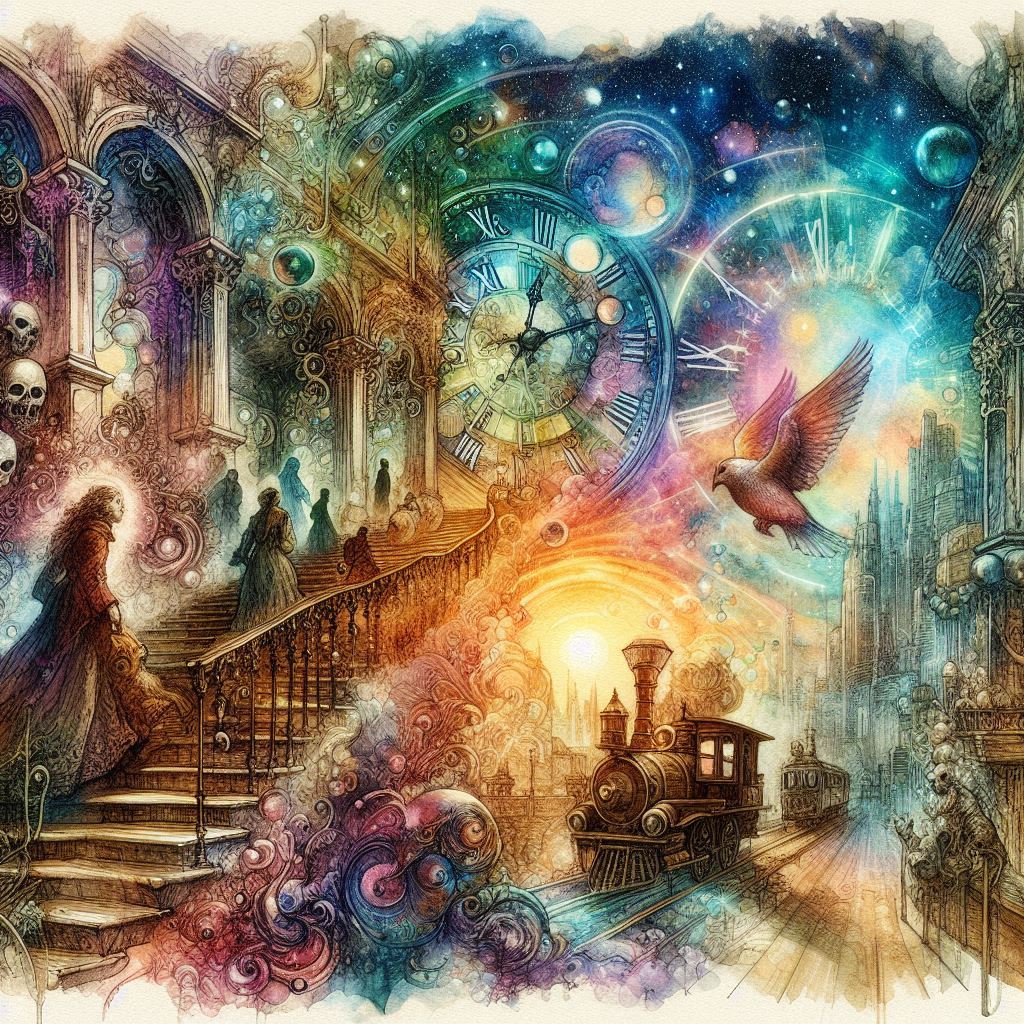
Image above by Kevin from The Beginning at Last

Many and strange are the universes that drift like bubbles in the foam upon the River of Time—first sentence of Wall of Darkness by Arthur C. Clarke, 1949.

What is Time? What is the arrow of time? Does entropy define an arrow of time? Is there a past and a future? Has time always existed as, for example, in the eternal inflation cosmological model in which universes continuously pop into existence via Big Bangs like the bubbles on the River of Time in the Arthur C. Clarke quote above. Does time have a beginning as a recent Big Bang model by Stephen Hawking imply. If time came into existence with the universe itself then there is no place for creation, just as in an infinitely existing universe. There cannot be anything north of the north pole, and there cannot be anything before time itself.

In the theories of relativity time is relative. The speed of clocks as well as the order of events differ from observer to observer. The presence of energy or mass will bend time. There is no universal flow of time. There is no universal time.

The goal of this blog is to create a list of what I call super facts. Important facts that we know to be true and yet they are surprising, shocking or disputed among non-experts. It is a type of myth busting. However, I also create posts that are not super facts but that feature other interesting information, such as this book review and book recommendation.

In the picture there are objects from the past as well as futuristic elements and several clocks | What is Time
This picture reminded me of the mysteries of time. This is a submission for Kevin’s No Theme Thursday

About Time: Einstein’s Unfinished Revolution by Paul Davies

The book I am about to present focuses a lot on relativity. This is not strange since the theories of relativity shed a lot of light on time. Yes, pun intended. I’ve come across a lot of people who make various claims about time, and even consider themselves philosophers of time, and yet they do not even understand the special theory of relativity.

Because of this they say a lot of profound sounding things about time that ultimately are nonsensical. There is no way around it. If you want to say profound things about time and expand human knowledge on this topic you need to first have some understanding of relativity as well as other related physics such as thermodynamics and entropy. This book will provide that.

I should say that the book is somewhat outdated, being written in 1995 and 1996. However, most of it is still relevant and I know of no other book that approaches the topic in such an honest and rigorous way. The book comes in two formats hardcover and paperback. I bought the paperback version.

  • Hardcover –  Publisher – Simon & Schuster; First Edition (March 13, 1995), ISBN-10 : 0671799649, ISBN-13 : 978-0671799649, 316 pages, item weight : 1.3 pounds, dimensions : ‎ 6.25 x 1.25 x 9.5 inches, it costs $18.09 on US Amazon. Click here to order it from Amazon.com.
  • Paperback –  Publisher – Simon & Schuster; First Edition (April 9, 1996), ISBN-10 : 0684818221, ISBN-13 : 978-0684818221, 316 pages, item weight : 0.704 ounces according to Amazon but I think that should be 0.704 pounds, dimensions : ‎ 9.21 x 6.14 x 0.8 inches, it costs $12.28 on US Amazon. Click here to order it from Amazon.com.
Front cover of hardback version of the book About Time: Einstein's Unfinished Revolution by Paul Davies
Front cover of hardback version of the book About Time: Einstein’s Unfinished Revolution by Paul Davies. Click on the image to go to the Amazon page for the hardcover version of the book.

Amazon’s Description of About Time: Einstein’s Unfinished Revolution

An elegant, witty, and engaging exploration of the riddle of time, which examines the consequences of Einstein’s theory of relativity and offers startling suggestions about what recent research may reveal.

The eternal questions of science and religion were profoundly recast by Einstein’s theory of relativity and its implications that time can be warped by motion and gravitation, and that it cannot be meaningfully divided into past, present, and future.

In About Time, Paul Davies discusses the big bang theory, chaos theory, and the recent discovery that the universe appears to be younger than some of the objects in it, concluding that Einstein’s theory provides only an incomplete understanding of the nature of time. Davies explores unanswered questions such as:

* Does the universe have a beginning and an end?

* Is the passage of time merely an illusion?

* Is it possible to travel backward — or forward — in time?

About Time weaves physics and metaphysics in a provocative contemplation of time and the universe.

My four-star review for About Time: Einstein’s Unfinished Revolution

The link above will take you to my original review for About Time: Einstein’s Unfinished Revolution. Below is a slightly modified version of the review.

Our Evolving Concept of Time

Science, particularly physics, has revealed to us some profound insights about time, and yet it remains a mysterious topic. In the first chapter of the book “A Very Brief History of Time” the author describes how the concept of time has evolved throughout human history. The ancient philosophers had a very fuzzy notion of time, and they often dismissed both motion and time as illusions. The author tells us about “cyclic time”, and the “linear time” concept from Judeo-Christian thinking, and how it was incorporated into science as a “time variable”. This made it possible to solve the paradoxes created by such Greek thinkers as Zeno, who based on apparent paradoxes concluded that motion and time cannot really exist. Those “false” paradoxes were solved with the concept of linear physical time.

Physical time also made Calculus and Physics possible, and it became clear that there was a difference between physical time, which is a measurable entity used to sequence events, and experienced time, which is the subjective human feeling of a past, present, and a future.

Most of the rest of the book is focused on the Special Theory of Relativity and the General Theory of Relativity. The theories of relativity revolutionized how we view time, and they enabled a much deeper understanding of time. Special relativity refuted the concept of universal absolute time. Not only do clocks in different systems run at different speeds, but there is no universal “Now”.

However, the theories of relativity are not all there is to know about time, and we are not even done drawing conclusions about time based on the theories of relativity. This is why the book is called “About Time Einstein’s Unfinished Revolution”. The book also discusses quantum time, the arrow of time, worm holes, neuroscience and modern psychological experiments.

The book contains a lot of information and yet it scratches only on the surface. Time is a quite complex concept when you start digging into it. Take, for example, the discussion on the arrow of time. The conclusion of the books seems to be that there really is an arrow of time. Time has direction. The author is presenting both “sides” of the issue and to really get a grasp of the issue you need to clarify and look at the physics. Time certainly seems to have a direction if you look at the concept of entropy. The Cosmos is filled with irreversible processes. Our memory, which is essential for our experience of a self, is another example.

However, time has a direction even on the most fundamental level in subatomic particles. Kaon, a type of meson, decays in a way that is not time symmetric. The same may be true for the neutron. These particles “know” the difference between the past and the future. One could easily imagine how this chapter could be turned into a several thousand pages long book by just digging deeper into the related physics.

“About Time Einstein’s Unfinished Revolution” covers a lot of interesting topics related to time and it is often quite informative. The book is also well written, well organized, it has a good pace, and it is very interesting. It strikes a good balance between depth and breadth, and it does not overwhelm its readers. However, I do have some critique of the book, which prompted me to give the book four stars instead of five stars.

To understand some of the discussions in the book you should have a decent understanding of the theories of relativity, in my opinion. The author is explaining the theories of relativity to some degree, but the explanations did not seem to be that good. I did not have a problem with understanding these explanations since I already studied these topics, but I don’t think I would have understood what I needed to understand had I encountered the theories of relativity for the first time while reading this book.

Another criticism I have of the book is that he introduces ugh Everett’s many-worlds interpretation of quantum mechanics and in my opinion promotes it. This interpretation is in my opinion both strange and implausible and is not necessary for the discussions in the book.

In short, it proposes that every quantum measurement creates new universes, each corresponding to a different possible outcome of that measurement. In essence, our Universe is just one of many, and each quantum event splits the universe into multiple versions, where each version experiences a different outcome.

The problem with this interpretation is not so much that you get multiverses, but that you an infinite number of new fully evolved universes every nanosecond, which in turn create an infinite number of universes, which in turn create an infinite number of universes, and so on infinitely, and there is no way to empirically verify their existence. It is a so-called solution to a problem that is fictitious in my opinion and is derived from an old naïve interpretation of quantum waves. It is “hip” and “cool” interpretation, but I don’t see how it is useful. I should add that I have no problem with, for example, the multiverse idea stemming from string theory.

Anyway, except for my two complaints I think this is a pretty good book that I can recommend.

Front cover of paperback version of the book About Time: Einstein's Unfinished Revolution by Paul Davies.
Front cover of paperback version of the book About Time: Einstein’s Unfinished Revolution by Paul Davies. Click on the image to go to the Amazon page for the paperback version of the book.

About Paul Davis

Paul Davies is an internationally acclaimed physicist, cosmologist, and astrobiologist at Arizona State University, where he runs the pioneering Beyond Center for Fundamental Concepts in Science. He also chairs the Search for Extraterrestrial Intelligence Post-Detection Taskgroup, so that if SETI succeeds in finding intelligent life, he will be among the first to know.

The asteroid 1992OG was officially renamed Paul Davies in his honor. In addition to his many scientific awards, Davies is the recipient of the 1995 Templeton Prize–the world’s largest annual prize–for his work on science and religion. He is the author of more than twenty books, including The Mind of God, About Time, How to Build a Time Machine, and The Goldilocks Enigma. He lives in Tempe, Arizona.

Other Relativity Related Posts

To see the Super Facts click here

Quick Easy Introduction to Astrophysics

The goal of this blog is to create a list of what I call super facts. Important facts that are known to be true and yet they are surprising, shocking or disputed among non-experts. In a sense it is myth busting. However, it is not the only type of posts I do. This is a review for a popular book on Astrophysics called “Astrophysics for People in a Hurry” by Neil De Grasse Tyson. It is a New York Times best seller and the #1 best seller in Astronomy & Astrophysics on Amazon. It has almost 37,000 ratings/reviews on Amazon and more 194,000 reviews/ratings on Goodreads.

Below is a list of the four formats in which it comes on Amazon.

  • Hardcover –  Publisher : W. W. Norton & Company; First Edition (May 2, 2017), ASIN : 0393609391, ISBN-10 : 9780393609394, ISBN-13 : 978-0393609394, 224 pages, item weight : 2.31 pounds, dimensions : ‎ 7.3 x 4.8 x 0.9 inches, it costs $6.21 – $13.26 on US Amazon. Click here to order it from Amazon.com.
  • Kindle –  Publisher – W. W. Norton & Company (May 2, 2017), ASIN : B01MAWT2MO, 222 pages, it costs $9.00 on US Amazon. Click here to order it from Amazon.com.
  • Audiobook –  Publisher : Blackstone Audio Inc (May 2, 2017), ASIN : B06XB2PX7G, it costs $10.20 on US Amazon. Click here to order it from Amazon.com.
  • Audio CD –  Publisher : Blackstone Publishing; Unabridged edition (May 2, 2017), ISBN-10 : 1538408015, ISBN-13 : 978-1538408018, it costs $24.95 on US Amazon. Click here to order it from Amazon.com.
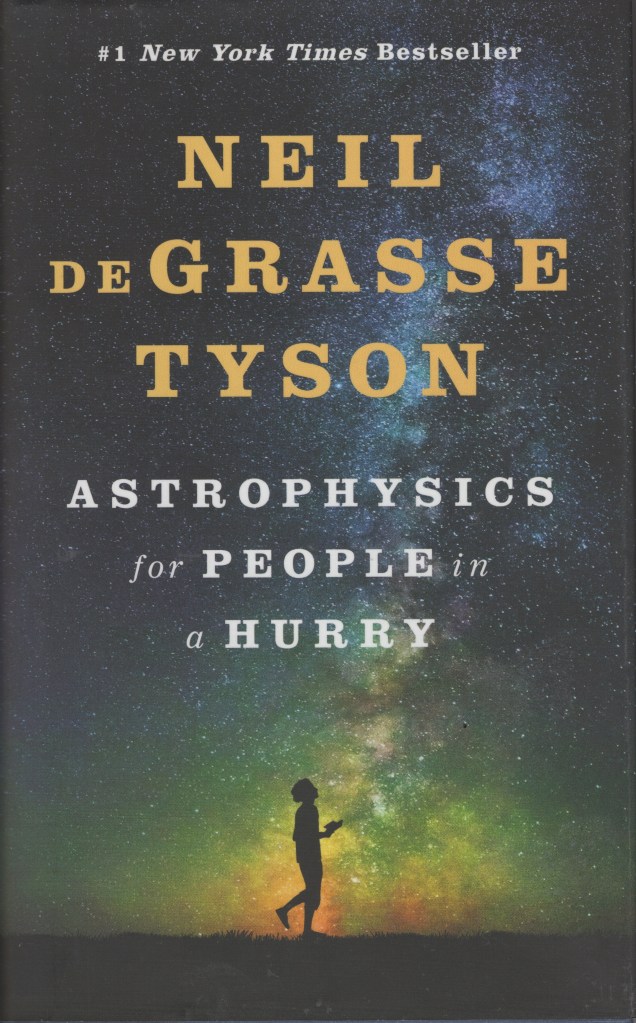
“Astrophysics for People in a Hurry” by Neil De Grasse Tyson front cover | Quick Easy Introduction to Astrophysics
Front cover of the book Astrophysics for People in a Hurry. Click on the image to go to the Amazon page for the hardcover version of the book.

Amazon’s Description of Astrophysics for People in a Hurry

Over a year on the New York Times bestseller list and more than a million copies sold.

The essential universe, from our most celebrated and beloved astrophysicist.

What is the nature of space and time? How do we fit within the universe? How does the universe fit within us? There’s no better guide through these mind-expanding questions than acclaimed astrophysicist and best-selling author Neil deGrasse Tyson.

But today, few of us have time to contemplate the cosmos. So Tyson brings the universe down to Earth succinctly and clearly, with sparkling wit, in tasty chapters consumable anytime and anywhere in your busy day.

While you wait for your morning coffee to brew, for the bus, the train, or a plane to arrive, Astrophysics for People in a Hurry will reveal just what you need to be fluent and ready for the next cosmic headlines: from the Big Bang to black holes, from quarks to quantum mechanics, and from the search for planets to the search for life in the universe.

This is my four-star review for Astrophysics for People in a Hurry

The reason I gave the book four stars instead of five is because I felt that if you have an interest in the topic, you will have heard it all before. However, in retrospect that might not be a good reason to deduct a star. After all, the book seems to be targeting people who do not know much about the subject and thus will not have heard it all before.

Quick and Entertaining Overview of Astrophysics

I’ve read a number of Neil DeGrasse Tyson’s books and I love them. This book is a compressed version of what he has been explaining in other books. If you’ve already read a number of Neil De Grasse books, or perhaps other popular science Astrophysics books such as those by Stephen Hawking, you will not find much new in this book. However, I think it is a brief but good summary of Astrophysics written for a layman. It is 208 pages, each page having about half as much text per page as a typical popular science book. It is an easy and fairly quick read.

He briefly explains the Big Bang, physical laws, spectra, nebulae, the speed of light, very briefly relativity and quantum physics, the cosmic background radiation, galaxies, gravitational lensing, dark matter, dark energy, neutron stars, the composition of the solar system and exoplanets. He covers a lot of ground quickly and he makes it easy to understand without simplifying so much that it becomes misleading. This book is exactly what the title says. However, as I mentioned, if you’ve read a lot on the topic already, especially if it is Neil DeGrasse Tyson’s books, you’ve seen it before. I still think it was very enjoyable though and I still learned something new. He is a very entertaining author.

“Astrophysics for People in a Hurry” by Neil De Grasse Tyson back cover
Front cover of the book Astrophysics for People in a Hurry. Click on the image to go to the Amazon page for the hardcover version of the book.
To see the Super Facts click here